TP003 Tatau_text_front-section.indd 2
28/05/18 5:23 PM
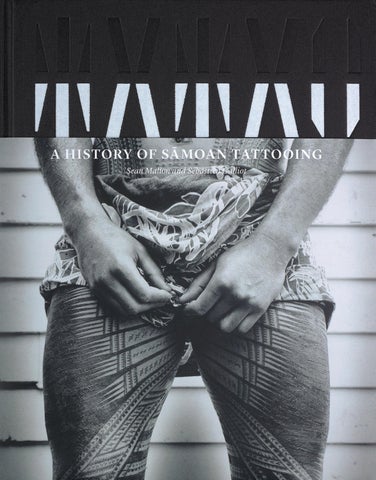
A History of Sāmoan Tattooing Sean Mallon and Sébastien Galliot
with contributions from Tusiata Avia Ron Brownson Adrienne Kaeppler Takahiro Kitamura Tupe Lualua Tavita Maliko Selina Tusitala Marsh Le‘ausālilō Lupematasila Fata ‘Au‘afa Sadat Muaiava Leali‘ifano Albert L Refiti Benoît Robitaille Nicholas Thomas Nina Tonga Maria Carolina Vesce Maualaivao Albert Wendt Sonya Withers Rachel Yates
TP003 Tatau_text_front-section.indd 3
28/05/18 5:23 PM
Fig. 1 Autā (tattooing tools) from the collection of the Museum für Völkerkunde, Berlin.
TP003 Tatau_text_front-section.indd 6
28/05/18 5:23 PM
TP003 Tatau_text_front-section.indd 7
28/05/18 5:23 PM
E sui faiga ae tumau fa‘avae The form changes, but the underlying principles remain — Sāmoan proverb
TP003 Tatau_text_front-section.indd 8
28/05/18 5:23 PM
CONTENTS
T A T A U
Foreword: Sean Mallon. . . . . . . . . . . . . . . . . . . . . . . . . . . . . . . . . . . . . . . . . . . . . . . . . . . . . . . . . . . . . . . . . . . . . . . . . . . . . . . . . . . . . 10 Foreword: Sébastien Galliot . . . . . . . . . . . . . . . . . . . . . . . . . . . . . . . . . . . . . . . . . . . . . . . . . . . . . . . . . . . . . . . . . . . . . . . . . . . . . . . 12 Introduction. . . . . . . . . . . . . . . . . . . . . . . . . . . . . . . . . . . . . . . . . . . . . . . . . . . . . . . . . . . . . . . . . . . . . . . . . . . . . . . . . . . . . . . . . . . . . . . . . . . . 14
Chapter 1:
TATAU: ANCIENT TRACES . . . . . . . . . . . . . . . . . . . . . . . . . . . . . . . . . . . . . . . . . . . . . . . . . . . . . . . . . . . . . . . . . . . . . . . . . . . . 19
Chapter 2:
TATAU: EUROPEAN ENCOUNTERS & OBSERVATIONS, 1722–1900. . . . . . . . . . . . . . . . . 33 MARK ADAMS PORTFOLIO . . . . . . . . . . . . . . . . . . . . . . . . . . . . . . . . . . . . . . . . . . . . . . . . . . . . . . . . . . . . . . . . . . . . . . . . . . . 81
Chapter 3:
TATAU: PERSISTENCE AND CHANGE, 1900–2000. . . . . . . . . . . . . . . . . . . . . . . . . . . . . . . . . . . . . . . . . 97 GREG SEMU PORTFOLIO . . . . . . . . . . . . . . . . . . . . . . . . . . . . . . . . . . . . . . . . . . . . . . . . . . . . . . . . . . . . . . . . . . . . . . . . . . . . . 177
Chapter 4:
TATAU AS A RITUAL INSTITUTION, 2000–2010. . . . . . . . . . . . . . . . . . . . . . . . . . . . . . . . . . . . . . . . . . . . 178 JOHN AGCAOILI PORTFOLIO. . . . . . . . . . . . . . . . . . . . . . . . . . . . . . . . . . . . . . . . . . . . . . . . . . . . . . . . . . . . . . . . . . . . . . 225
Chapter 5:
TATAU AND ITS GLOBALISATION, 2000–2017. . . . . . . . . . . . . . . . . . . . . . . . . . . . . . . . . . . . . . . . . . . . . . 241
Postscript . . . . . . . . . . . . . . . . . . . . . . . . . . . . . . . . . . . . . . . . . . . . . . . . . . . . . . . . . . . . . . . . . . . . . . . . . . . . . . . . . . . . . . . . . . . . . . . . . . . . . 298 Acknowledgements. . . . . . . . . . . . . . . . . . . . . . . . . . . . . . . . . . . . . . . . . . . . . . . . . . . . . . . . . . . . . . . . . . . . . . . . . . . . . . . . . . . . . . . . 302 Glossary . . . . . . . . . . . . . . . . . . . . . . . . . . . . . . . . . . . . . . . . . . . . . . . . . . . . . . . . . . . . . . . . . . . . . . . . . . . . . . . . . . . . . . . . . . . . . . . . . . . . . . . 304 Bibliography. . . . . . . . . . . . . . . . . . . . . . . . . . . . . . . . . . . . . . . . . . . . . . . . . . . . . . . . . . . . . . . . . . . . . . . . . . . . . . . . . . . . . . . . . . . . . . . . . .308 Image credits . . . . . . . . . . . . . . . . . . . . . . . . . . . . . . . . . . . . . . . . . . . . . . . . . . . . . . . . . . . . . . . . . . . . . . . . . . . . . . . . . . . . . . . . . . . . . . . . . 319 About the contributors. . . . . . . . . . . . . . . . . . . . . . . . . . . . . . . . . . . . . . . . . . . . . . . . . . . . . . . . . . . . . . . . . . . . . . . . . . . . . . . . . . . . 320 Index . . . . . . . . . . . . . . . . . . . . . . . . . . . . . . . . . . . . . . . . . . . . . . . . . . . . . . . . . . . . . . . . . . . . . . . . . . . . . . . . . . . . . . . . . . . . . . . . . . . . . . . . . . . . 322
TP003 Tatau_text_front-section.indd 9
28/05/18 5:23 PM
TP003 Tatau_text_C1.indd 18
28/05/18 5:26 PM
TATAU: ANCIENT TRACES T A T A U
Fig. 3 Did the knowledge and tools for Sāmoan tattooing originate in Fiji? A tattooed female figure from Fiji (1800s).
TP003 Tatau_text_C1.indd 19
28/05/18 5:26 PM
T A T A U
Fig. 9 Sāmoan male tatau as observed during the United States Exploring Expedition between 1839 and 1841, drawn by Alfred Thomas Agate.
TP003 Tatau_text_C2.indd 34
28/05/18 5:27 PM
02 —— Tatau: European Encounters & Observations 1722–1900
Despite the continuous visibility of tattooing in Sāmoa from 1722 onwards and its importance for the population – most European explorers agree that all adult men were tattooed – it was not described in detail until the end of the nineteenth century, more than 150 years after the European discovery of the archipelago. In fact, during this period – and with the exception of the Reverends John Williams and John Stair, who were present in Sāmoa during the 1830s and 1840s – tattooing was observed ‘from a distance’, at times with repugnance, at others with fascination, and seldom with precision. T A T A U
The first European residents in Sāmoa, those who could have described tattooing in detail as an institution, preferred to deal with the subjects of oral tradition and chiefdom organisation. There is nothing exceptional in this. Up until the end of the nineteenth century, the accounts of most European explorers of Oceania mention the islanders’ physical appearance (skin colour, build, presence of body markings and decorations) in passing, without making the connection with other local customs. Oral traditions collected in the nineteenth century and, in particular, the different versions of the origin myth of tattooing1 make it possible to follow the tracks of the two deities, Taemā and Tilafaigā, in various places across the archipelago. They also make it possible to track the distribution of the ‘atoau (the basket containing the tattooing tools) to certain chiefs. Despite numerous details on their doings and routes, however, the origin myth contains no information about the designs, the ways they were applied to the body, or the social function of tattooing. By reviewing the testimonies of explorers and occasional visitors before and during the establishment of the missionaries, this chapter aims at a historical reconstitution of the social implications of tattooing as a rite of passage before the European presence began to have a noticeable impact.
1. The story of Taemā and Tilafaigā, the deities who introduced tattooing, represents a short episode in the Sāmoan tale entitled Māvaega i le Tai.
This necessarily fragmentary and ethnocentric data leads us to build a hypothetical ‘classic period’ during which the relatively limited influence of Europeans is thought not to have disturbed the exact reproduction of a practice that is thought to have been a thousand years old. Though social changes in Sāmoan society and external influences may have had an impact on the institution of tattooing before the missionaries’ arrival, the available sources do not allow us to make any conjecture; we must be content with the impressions left by short-term visitors.
35
TP003 Tatau_text_C2.indd 35
28/05/18 5:27 PM
TP003 Tatau_text_C3 .indd 96
28/05/18 5:24 PM
TATAU: PERSISTENCE AND CHANGE
1900 — 2000
T A T A U
Fig. 30 Tattooing scene photographed c. 1960s by Jutta Merensky (later Gethen).
TP003 Tatau_text_C3 .indd 97
28/05/18 5:24 PM
T A T A U
Fig. 38 Au (tattooing tools) collected by Te Rangi Hīroa in Sale‘aula, Savai‘i in 1928.
53. See other nineteenth-century tattoos on page 72.
54. This according to Noel McGrevy’s documentation of the lineages of tattooists of the sā Su‘a and sā Tulou‘ena. 55. Hiroa, Samoan Material Culture, 657.
This practice of getting a ‘tryout tattoo’ disrupts the time-honoured process of getting a tatau as described in the historical literature. It allows individuals and their families to skirt around the very formal procedure of approaching a tufuga, commissioning the tatau and enduring the lengthy, painful process of receiving it. It also suggests that getting tattooed is a choice – a so-called rite of passage in order to ‘be deemed a man’, but one that is optional if you don’t feel up to it. A means of testing out the process of tattooing was not a practice that only began in the 1920s and 1930s, and not restricted to getting the punialo.53 Failing to complete a tatau solicited scorn and ridicule and brought shame to the individual and his family. With the punialo a family could avoid the embarrassment of an unfinished tattoo – although it seems good deeds and good character could also overcome the stigma of a pe‘amutu (incomplete tatau). The most valuable aspects of Te Rangi Hīroa’s account are the drawings and descriptions of the tatau and the names of various motifs. Through analysis of the tattoo motifs he reveals the contested nature of tattooing in Sāmoa, alerting us to the fact that even within the family lines of tufuga tā tatau there were different schools of thought. It is clear that tattooing was a creative process and subject to change. Te Rangi Hīroa highlights how tufuga tā tatau were active agents for innovation in their craft, who could accommodate new and novel ideas and disregard well-established ones. One of his informants was a young tufuga tā tatau named Faioso from the ‘āiga sā Su‘a, who supplied him with detailed drawings of tatau that were published in his account;54 another Sāmoan, Edmund Stehlin Jr from Savai‘i, who was an interpreter and guide for Te Rangi Hīroa, supplied him with drawings of the malu.55 Faioso was part of a younger school of tufuga who were moving towards breaking up the dark areas of the men’s tatau by introducing more ornamentation. As Te Rangi Hīroa explains, this took the form of fa‘aila – small window-like design elements
112
TP003 Tatau_text_C3 .indd 112
28/05/18 5:26 PM
03 —— Tatau: Persistence and Change 1900–2000
Fig. 39 A young tufuga tā tatau named Faioso from the ‘āiga sā Su‘a supplied several detailed drawings of the tatau to anthropologist Te Rangi Hīroa Peter Buck in 1930.
T A T A U
TP003 Tatau_text_C3 .indd 113
28/05/18 5:26 PM
TP003 Tatau_text_P2_GRAG SEMU.indd 172
28/05/18 5:24 PM
Fig. 79 The Last Cannibal Supper, because tomorrow we become Christians, revisited 2017.
TP003 Tatau_text_P2_GRAG SEMU.indd 173
28/05/18 5:24 PM
TP003 Tatau_text_C4.indd 176
28/05/18 5:24 PM
TATAU AS A RITUAL INSTITUTION
2000 — 2010
T A T A U
Fig. 81 A tattooing session in Point Chevalier, Auckland, New Zealand, in 2007. Tufuga tā tatau: Tuifa‘asisina Peni.
TP003 Tatau_text_C4.indd 177
28/05/18 5:24 PM
T A T A U TP003 Tatau_text_C4.indd 178
28/05/18 5:24 PM
04 —— Tatau as a Ritual Institution 2000–2010
Membership of a body of tufuga tā tatau involves a number of ceremonial prerogatives that acknowledge their high ceremonial status. All categories of tufuga – tattooists, housebuilders and canoebuilders – must be addressed according to a shared vocabulary of respect. As experts they are ceremonially addressed as agaiotupu (sovereign‘s attendant), mātaisau (craftsman, carpenter), matua o faiva (senior of the craft) and lātū o le faiva (in charge of the craft). They also share a corpus of honorary terms for some of their belongings and for family members which, although they differ from the polite term used for ali‘i and tulāfale (orator), still stand as a clear oratory marker 1 of high status (see page 181).
Accounts of Sāmoans bearing tattoos go back as early as the first encounters with Europeans during the discovery voyage of Roggeveen in 1722, but the first accounts of the organisation of the craft and descriptive drawings were not made until the following century.2 Reverend JB Stair, stationed on the island of Savai‘i in the 1840s, described tufuga as forming a ‘fraternity’. Other observers such as Augustin Krämer and Marist fathers of the Catholic Church described the profession as a ‘guild’, analogous to the professional brotherhoods of medieval Europe. To the extent that the transmission of a specific trade is either by inheritance and embodiment – when, for example, apprentices are the relatives of the master – or through companionship, and given that the apprenticeship includes toolmaking and tool use, body techniques and ritual prescriptions and ordinances, reference to a guild or fraternity is appropriate.
Fig. 82 Su‘a Sulu‘ape Peter improvising on a full leg at the 5th International Samoa Tatau Festival 2012.
T A T A U
Tufuga tā tatau are certainly the most renowned and dynamic class of tufuga or expert craftsmen in Sāmoa, where membership is based primarily on a genealogical link with a founding ancestor. In the case of ritual tattooing, the two main lineages of tufuga tā tatau – Su‘a and Tulou‘ena – were established during encounters between the female guardian deities Taemā and Tilafaigā and the chiefs Tapu and Auva‘a. Although there are some uncertainties about the existence of a strict continuum in these genealogies, Sāmoan practitioners refer nonetheless to one of these two clans to define their professional identity. And we will see in due course that new lineages have recently been created.
1. See GB Milner, Samoan Dictionary (Auckland: Pasifika Press, 2001), 8, 137, 98.
2. See C Wilkes, Narrative of the United States Exploring Expedition During the Years 1838, 1839, 1840, 1841, 1842, Vol. II (Philadelphia: Lee & Blanchard, 1845), 141; JB Stair, Old Samoa; or Flotsam and Jetsam from the Pacific Ocean (London: Religious Tract Society, 1897), 158–64; RPA Monfat, Les Premiers Missionnaires des Samoa (Lyon: E. Vitte, 1922), 71–72.
179
TP003 Tatau_text_C4.indd 179
28/05/18 5:24 PM
The tatau (pe‘a) Fig. 100 The application of the male tatau starts from the back at waist level and goes down to the knees. The vāega (zones, or groups of motifs) are as below. Tatau modelled by Faimasulu Larni Fiti. Tufuga tā tatau: Su‘a Sulu‘ape Paulo III.
pute navel talipute tali means response and pute means navel motif fa‘aulutao like the points of a spearhead
T A T A U
‘asofa‘aifo curved lines
punialo puni means closure (and alo is the respectful word for male offspring or son) fusi a belt, strap or band ‘asotali‘itu tali is to hold up and itu means side tapulu tele the outer area of the thigh lausae the outer area of the thigh
fusi a belt, strap or band ulumanu literally the head of an animal
220
TP003 Tatau_text_C4_BOX.indd 220
28/05/18 5:26 PM
04 —— Tatau as a Ritual Institution 2000–2010
‘asolaiti another set of small lines pula tele the larger part below the small black triangle pula tama also known as the tama‘i pe‘a ‘asoe tasi the rafter / line that stands alone va‘a canoe tafani tapulu dark borderline T A T A U
tafani teu decorated borderline saemutu thin tattooed lines that run across the buttocks fusi a belt, strap or band ‘asotali‘itu tali is to hold up and itu means side
fa‘amuliali‘ao the pointed ends of the conch shell atigivae the section behind the knee. (This part of the tattoo was not ornamented in drawings from the nineteenth century) fa‘apefu the area between the buttocks
221
TP003 Tatau_text_C4_BOX.indd 221
28/05/18 5:26 PM
Fig. 117 Fifita’s (left) tattooing shop in Savalalo markets, Apia, Sāmoa, 2002.
States, highlighted some contradictions that I thought were worth investigating further. Within contemporary Sāmoan society tattooing is well established as emblematic of Sāmoan culture – it is an indigenous practice with a long history. There are distinct male and female forms of tatau that are widely and positively upheld in Sāmoan society as symbols of Sāmoan culture. Yet in spite of this reification of tatau in Sāmoa, my experiences in Apia’s tattoo shops suggested that tattoos originating from other countries are somehow relevant to Sāmoan society. It reinforced the idea – argued throughout this book – that tattooing in Sāmoa is not just about Sāmoan tatau, and that Sāmoan tattooing might not be the stable, culturally homogeneous practice that is objectified and upheld as emblematic of Sāmoan culture. The two family lines of sā Su‘a and sā Tulou‘ena are still widely acknowledged in Sāmoan society today as the custodians of tatau. However, while they are perceived by Sāmoan society as agents for the control and persistence of tatau, they are also among the most active agents for its transformation. Tattooing in Sāmoa has always been subject to local (Sāmoan) and translocal influences, but these processes have been at their most intense since the 1990s. The ease of communication between different groups of people today makes it easy to recognise how cultural symbols like tatau and associated ideas and information move on global cultural flows. Understanding the
244
TP003 Tatau_text_C5.indd 244
28/05/18 5:24 PM
05 —— Tatau and its Globalisation 2000–2017
circulation of tatau and the juxtaposition of its various contexts gives us a greater appreciation of the transnational and international systems of which it is a part.
From at least the 1980s tufuga tā tatau have been taking tatau to the world in an unprecedented way – working in Sāmoa and beyond its borders, and also beyond the Pacific Islands. They have travelled to non-Sāmoan communities in the United States and Europe and demonstrated tā tatau at tattooing conventions and exhibitions. They have toured to Sāmoan communities in New Zealand, Australia and the United States. After Su‘a Sulu‘ape Paulo’s death in 1999, his brother Su‘a Sulu‘ape Alaiva‘a Petelo became the most active family member tattooing Sāmoans and non-Sāmoans overseas. His schedule in 2002 included visits to Hawai‘i in July and August, where he completed nine pe‘a in six weeks; he then returned to Hawai‘i to complete three more pe‘a. In a throwback to the practices of his ancient border-crossing ancestors, Alaiva‘a and his team worked on Tongans Ata‘ata Fineanganofo of San Francisco and later Hawai‘i-based Tongan tattooist ‘Aisea Toetu‘u, reproducing on them a Tongan version of a pe‘a based on a rare drawing made by Louis Auguste de Sainson during the voyage of Dumont d’Urville between 1826 and 1828.4 They were then booked to fly to the United States for a week, to Sweden for a few days, then to Germany for a convention, then on to another in Malmö and back to Sāmoa – all in under five weeks.
2. GE Marcus, ‘Ethnography in/ of the World System: The Emergence of Multi-sited Ethnography’, Annual Review of Anthropology vol. 24, no. 1 (1995): 95–117. 3. See April Henderson, ‘Gifted Glows: Netting the Imagery of Hip Hop Across the Samoan Diaspora’, Master’s thesis, University of Hawai‘i, 1999; April Henderson, ‘Dancing Between Islands: Hip Hop and Samoan Diaspora’ in Dipannita Base and Sidney J Lemelle (eds), The Vinyl Ain’t Final: Hip Hop and the Globalization of Black Popular Culture (London: Pluto Press, 2006), 180–199; KM Teaiwa, Consuming Ocean Island: Stories of People and Phosphate from Banaba (Bloomington, Indiana: Indiana University Press, 2014).
T A T A U
The increasingly global practice of Sāmoan tā tatau means that tatau is open to a wider range of interpretations from many different groups of people – Sāmoan and others; and even those who are Sāmoan don’t all think similarly. There are many ways in which tatau acquires significance in our societies and cultures, and many perspectives on its value and meaning. One useful approach to understanding the globalisation of tatau involves what some researchers call ‘following the thing’: anthropologists, for example, have used this strategy to study cultural phenomena across multiple sites;2 other Pacific-based researchers have employed it to trace the movement of hip hop music, or the use of phosphate rock for fertiliser.3 In the case of Sāmoan tatau, ‘following the thing’ involves following the circulation and appropriation of tatau through different contexts, examining how, why and where people use it and the many ways they give it meaning. It is a process of mapping the connections, associations and various relationships that tatau mediates in order to understand how they are articulated.
4. See discussion on page 31.
These overseas engagements helped to create an awareness of Sāmoan tatau globally and provided new opportunities for the tufuga tā tatau to meet and share their work with other tattooing enthusiasts. In the new millennium there have been more frequent overseas tours, and further invitations to participate in tattooing conventions – resulting in a diversification of the places where tatau was being made, who was making it and who was wearing it. The international interest in tatau among Sāmoans and non-Sāmoans was the catalyst for major transformations in the work and lives of the tufuga. Financially, the tours had a big impact at home, with benefits for the tufuga, their families and, in some cases, their villages. Culturally, the tufuga were travelling and seeing the world; socially, they were enhancing their status as tattooists, as artists and as cosmopolitans.
245
TP003 Tatau_text_C5.indd 245
28/05/18 5:24 PM
Tatau: The cultural continuum Sean Mallon 17 August 2017
Tyla Vaeau Ta‘ufo‘ou is a tufuga tā masini based in Auckland, New Zealand. She is one of a few Sāmoan women, if not the only one, actively working with tatau motifs. She talks about her journey and learning her trade.
T A T A U
SM: What is your family connection to Sāmoa? TT: I have Sāmoan heritage through my father’s side. My grandfather migrated to New Zealand from Sāmoa in the 1950s. His mother was from Sale‘a‘aumua, Aleipata and his father was from Safune, Savai‘i. SM: How long have you been tattooing? TT: I have been tattooing since 2009. Growing up, tattoos were a visible part of my everyday life as my dad is heavily tattooed. I’ve been drawing for as long as I can remember and tattooing felt like a natural progression, a development from my art practice and research. While I was at college I became really interested in the pe‘a, malu and taulima, their history and significance, and I began designing tattoos for family and friends. After college I went on to complete a BFA at Elam School of Fine Arts and a BA in art history. Tatau remained a constant theme throughout my studies. I designed a piece for my uncle in Wellington which he took to the late Roger Ingerton to tattoo. I was able to sit in on these sessions, photograph the process and chat with Roger about tattooing. In 2008 my husband had another of my designs tattooed by Roger; during this session he allowed me to do some of the shading. Roger was really encouraging and I’m really grateful for the time I had with him. My dad was also supportive and helped me get the equipment I needed to start and was my first guinea pig! I’m largely self-taught, which is not an easy road to take, but I’ve received a lot of support, encouragement and guidance from my family and a number of tattoo artists I‘ve met along the way.
In 2011 I met Su‘a Sulu‘ape Alaiva‘a Petelo while he tattooed my friend Falaniko Tominiko and his brother. Su‘a knew I was a tattoo artist and I would sit in on the sessions often. Although we had spoken it took me two weeks to build up my courage to ask him if he would consider teaching me the ‘au. I was overwhelmed and honoured when he agreed. Later I watched him tā a malu and it was during this session that he gifted me one of his ‘au. It was an empowering moment and set me on a path towards learning our sacred tatau method. The journey to learn the ‘au is ongoing. In 2017 I went to Samoa and received my malu from his son Su‘a Sulu‘ape Paul Junior which was an important step for me as a practitioner, apprentice and tamaita‘i Samoa. I’m working towards the day I'm able to serve our people, particularly our women, with this treasured art form. SM: How would you describe your style? What inspires your work? TT: I would describe my style as contemporary, however it is very much inspired by the malu and pe‘a. I reconfigure ancient patterns into contemporary designs using modern techniques to tell the wearer’s story. I also reference designs from siapo mamanu (freehand painted barkcloth) and occasionally include naturalistic renderings of flowers, ‘ava bowls and other symbols of significance to the recipient. I’m inspired by our heritage artforms and the innovation and creativity found throughout the Pacific and the diaspora. More recently I have been inspired by the old Western-style ‘sailor tattoo’ and the archetypal hula girl. I’ve been redrawing the ‘hula girl’ as more culturally specific Pasifika women wearing adornments from their island groups. I’ve
done some of these women as tattoos and I’ve been thinking about how this style can be used to tell our own stories. SM: What have been some of the challenges? TT: It can be challenging to see our designs misappropriated or reproduced by non-Sāmoans without any understanding of the historical and cultural context they come from. This is an ongoing issue not only for Sāmoan tatau but also for indigenous tattoo practices globally. Thanks to Google our markings are only a click away, and quite often they are mislabelled or mashed together with other designs from across the Pacific. Because of this, education is an important part of my practice. I strive to be a culturally responsible artist and to treat our designs with respect. People just assume that my husband is the tattooist when we’re at conventions. However, tufuga tā tatau and other male tatau artists I’ve met have been open and accepting, which is really heartening. SM: What have been some of the rewards? TT: It’s incredibly rewarding to be able to connect or reconnect people with their cultural heritage. I enjoy collaborating with people, hearing their backgrounds – which so often are shared experiences – and translating them into patterns worn in the skin. To be able to play a part in the cultural continuum of Sāmoan tatau is an honour and a privilege I don’t take for granted. Fig. 134 Tyla Vaeau Ta‘ufo‘ou in 2017. Photographed by Pati Solomona Tyrell.
290
TP003 Tatau_text_C5_BOX.indd 290
28/05/18 5:24 PM
05 —— Tatau and its Globalisation 2000–2017
T A T A U
TP003 Tatau_text_C5_BOX.indd 291
28/05/18 5:24 PM
punialo �����������������������������������������������triangular tattoo
design applied to lower abdomen and pubis
pute �������������������������������������������������������navel sā �������������������������������������������������������������indicates extended kinship of a group or family
sama �����������������������������������������������������mixture of ground
turmeric and coconut oil
samāga pe‘a �������������������������������anointing ceremony
for the tattooed person
saofa‘i �������������������������������������������������title bestowal sausau �����������������������������������������������striker, mallet siapo �����������������������������������������������������barkcloth siapo mamanu �������������������������freehand decorated barkcloth
T A T A U
sigano �������������������������������������������������male flower of the pandanus plant
and coconut
taule‘ale‘a / taulele‘a ���������untitled man / untitled men
taulima ���������������������������������������������armband or wristband tattoo
taumafa ‘ava �������������������������������kava ceremony tauvae �����������������������������������������������anklet tattoo tāupou �����������������������������������������������daughter of village high chief
tautua �������������������������������������������������service to matai toso �������������������������������������������������������skin stretcher
(assistant to tattooer)
to‘oto‘o ����������������������������������������������ceremonial staff used by tulāfale
tufuga fau fale �������������������������master carpenter tufuga tā tatau �����������������������master tattooist Tui Tonga ���������������������������������������(Tongan term)
paramount chief or king
siva ���������������������������������������������������������dance sogā‘imiti ���������������������������������������tattooed man solo �������������������������������������������������������wiping cloths, person
tulāfale ���������������������������������������������orator chief tulāfono �������������������������������������������distinctive oral
sua ���������������������������������������������������������special presentation
tunuma ���������������������������������������������cylindrical wooden
suafa matai ���������������������������������chiefly title suafa tā pe‘a �������������������������������tattooing titles suli ���������������������������������������������������������successor su‘isu‘i �������������������������������������������������to be sewn or stitched Tafa‘ifa �����������������������������������������������sovereign, king tāga �������������������������������������������������������tattooing operation ta‘inamu �������������������������������������������mosquito net talalaupaongo �������������������������thorned edge of the
u‘a �����������������������������������������������������������the paper mulberry
who wipes the tattooing wound of food to chiefs
pandanus leaf
talie �������������������������������������������������������tropical almond tree
(Terminalia catappa)
traditions and customs, prescriptive rules, laws container
tree, or unfinished barkcloth
ulutao �������������������������������������������������spearhead motif umu �������������������������������������������������������earth oven umusāga �����������������������������������������final ceremony after
tattooing is complete
u‘u �����������������������������������������������������������oil prepared from coconut kernals
va‘a ���������������������������������������������������������canoe or boat vae‘ali �������������������������������������������������tattooing motif
representing legstands of a bamboo headrest
tapa �������������������������������������������������������barkcloth tāpafua ���������������������������������������������to be without a ‘ava
vāega ���������������������������������������������������zones, areas of the
tāpua‘iga �����������������������������������������act of worship, church
vaetulī �����������������������������������������������tattooing motif
title
service
taualuga �������������������������������������������special final dance
performed by a taupou
taufalemau �����������������������������������master of ceremonies (during the tattooing)
taufolo �����������������������������������������������a special dish made
from breadfruit paste
tattoo
representing the feet of tulī (seabirds)
vaisalo �����������������������������������������������a special coconut dish vatu‘e ���������������������������������������������������a sea-urchin whose spines are used to sharpen the tattooing tool’s needles
306
TP003 Tatau_text_back-section.indd 306
28/05/18 5:27 PM
TATAU —— Glossary
Fig. 138 Autā (tattooing tools) made by Su‘a Sulu‘ape Alaiva‘a Petelo.
T A T A U
307
TP003 Tatau_text_back-section.indd 307
28/05/18 5:27 PM