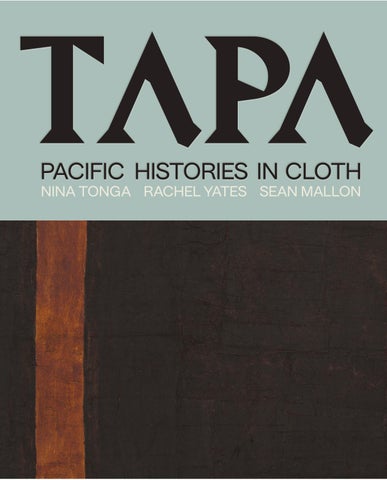
NINA TONGA RACHEL YATES SEAN MALLON
CONTENTS 6
01
02
03
20
INTRODUCTION: MAKING TAPA HISTORIES MAKING HISTORIES: KOKA‘ANGA IN AOTEAROA NEW ZEALAND
NINA TONGA RACHEL YATES SEAN MALLON NINA TONGA
26
PAWNSHOP TAPA
PING-ANN ADDO
32
AT THE PAPA KOKA‘ANGA
EBONIE FIFITALAUFILITOGA MAKA
37
AKOMAI HERITAGE
KAUFO’OU TAULATA ANAISE SMALL
46
CLOTHED IN STORY: FASHIONING IDENTITY THROUGH TAPA
RACHEL YATES
56
A TĪPUTA FOR NUMANGĀTINI
KATE NGATOKORUA
58
JO TORR: ‘TUPAIA’S PAINTBOX’
CLAIRE REGNAULT
74
SIAPO NIU SILA
SONYA WITHERS
76
JEWELLERY GENEALOGIES
LEONE SAMU TUI
78
MADE TO CROSS THE RACIAL DIVIDE
NIRMALA BALRAM
82
TAPA AS CONTEMPORARY ART
NINA TONGA HANAHIVA ROSE
105
JOHN PULE: EPISODE AA 94 0035; TUKULAGI HAAKU PAPERSKIN DIALOGUE
110
ÖMIE KINSHIP
KIRSTEN MCGAVIN
112
LAUTOKA COLLABORATIONS
ROBIN WHITE LEBA TOKI
117
TAPA MOANA NUI: A REGIONAL PRACTICE
MATARIKI WILLIAMS
118
NGATU TĀ‘ULI IN THE ART GALLERY
ANE TONGA
123
HELIAKI MOE NGATU TĀ‘ULI
STONE MAKA
126
MAILE ANDRADE: A LIFE PLAITED WITH ALOHA
KAMALU DU PREEZ
99
SEAN MALLON NINA TONGA
04
05
130
TAPA DOESN’T COME HERE TO DIE: COLLECTING AND CURATING TAPA CLOTH
SEAN MALLON
132
‘AHU: NGĀ WAIRUA O HINA
SEAN MALLON
141
MARY J PRITCHARD: SIAPO ARTIST
REGGIE MEREDITH FITIAO
148
THE PRACTICE OF FA’APITO LESĀTELE
RACHEL YATES
155
POLYTRICKS OF THE TRAVELLING SIAPO
GRACE IWASHITA-TAYLOR
157
MASI: AN EXPLORATION OF IDENTITY
NINA NAWALOWALO
160
COLLECTION CARE AND DISPLAY OF TAPA
161
CONSERVATION OF TAPA
NIRMALA BALRAM
165
CARING FOR TAPA COLLECTIONS
GRACE HUTTON
168
DISPLAY OF TAPA
ANNE PERANTEAU
172
THE IMAGING OF TAPA AND NGATU
MICHAEL O’NEILL
175
USING PLANT DNA TO IDENTIFY BARKCLOTH
LARA SHEPHERD
178
THE TAPA
185 189 215 229 235 241 253 261 267
TAIWAN PAPUA NEW GUINEA SOLOMON ISLANDS NEW CALEDONIA VANUATU NORFOLK AND PITCAIRN ISLANDS AOTEAROA NEW ZEALAND ROTUMA FIJI
307 319 359 391 407 423 443 453 461
‘UVEA (WALLIS) AND FUTUNA TONGA SĀMOA NIUE COOK ISLANDS HAWAI‘I SOCIETY ISLANDS MARQUESAS ISLANDS RAPANUI
FURTHER READING 468 ABOUT THE AUTHORS AND CONTRIBUTORS 476 ACKNOWLEDGEMENTS 478 INDEX 466
01
MAKING HISTORIES: KOKA‘ANGA IN AOTEAROA NEW ZEALAND NINA TONGA
Ngatu (decorated Tongan barkcloth) has become a familiar part of the cultural landscape of Aotearoa, finding new forms of expression from urban street clothing to utility boxes. The prominence of ngatu is reflected in the breadth of Te Papa’s collections, which represent multiple histories forged in a constant flow and exchange of people and textiles. For example, one of the three ngatu tā‘uli (blackened tapa) in Te Papa’s collection was originally a gift from ‘Ana Tonu Palu to her brother Naua Toki when she visited Aotearoa from Tonga in 1990.
AKOMAI HERITAGE
KAUFO‘OU KATOA-TAULATA AND ANAISE SMALL WITH RACHEL YATES
→ Akomai Heritage at Wana Ake – Celebrating Makers, Te Papa, 2021. Photograph by Nathaniel Cashell.
Members of Akomai Heritage embrace the philosophy of ako mai, ako atu – teach me, teach you – which reflects their commitment to cultural knowledge and its transmission. Their mission is to ensure that no matter where one may live, the connections to Tongan heritage remain strong. Their story highlights the ways Tongan knowledge, practice and creativity continue to thrive within diaspora communities, sustained through collective effort, shared teaching and cultural pride. Founded by Kaufo‘ou Katoa-Taulata and Anaise Small through the women’s fellowship of
St John’s Avalon Uniting Parish, Te Whanganuia-Tara Wellington, the effort grew from a shared concern about the erosion of Tongan language and traditions among younger New Zealand-born generations. To address this, they identified koloa making as a way to pass on cultural knowledge within their community. More than a craft, koloa making has long been central to fulfilling kavenga, the roles and responsibilities that shape signifi cant life events such as birthdays, weddings and other communal exchanges. Ngatu holds an especially esteemed place as koloa, as Kaufo‘ou explains: ‘Ngatu is everything. We are wrapped
02
A TĪPUTA FOR NUMANGĀTINI
56
KATE NGATOKORUA In August 2020, the island of Mangaia in the Cook Islands held its investiture for its new ariki, the paramount chief to hold the Numangātini title. In preparation, the Aronga Mana (the titular ruling group of Mangaia, comprising ariki and kavana, leaders of each district) met to discuss the customs and protocols for the moment. They determined that they would like their new leader to be dressed in regalia made from traditional materials and wanted each of the six puna (districts) to be tasked with various elements of its creation. The investiture came at a time when the art of tapa making was being revitalised by the va’ine tini, a women’s collective under the guidance of Mama Inangaro Papatua in the puna of Keiā, who were experimenting with the preparing and making of tapa crafts and performance costumes. The Aronga Mana enlisted the creative services of this va’ine tini and their leader Tangimama Harry to lead them in planning and creating a unique design for Numangātini. The need for a bespoke creation for the ariki was important, with instructions for the garment to be different from all others the group had made to date. The group chose the tīputa, an ancient poncho-like garment, for their inspiration.1 Their contemporary design fused elements of a suit jacket, featuring buttons made from ironwood, with loops crafted from ka‘a (woven coconut sennit) sourced from specific ka‘a coconut trees. The tapa itself was made from the aova (banyan tree) and beaten until it was soft to make it as comfortable as possible. A cotton lining was sewn in, as it was made to be worn more than once. It was given the name ‘E Tīputa rangi ua to‘ou e Numangātini’, which literally translates to ‘a poncho in the sky for Numangātini’. This parapore (ancient proverb) influenced the length of the tīputa created. Although Numangātini is the ariki and leader of Mangaia, their garment should not touch the ground, as the land remains under the guardianship of the Aronga Mana.
Decisions are made not solely by Numangātini but by the six pava (chiefs) of Mangaia. The tīputa was intentionally made to fall below the knee, but the attached cloak, also made of tapa, was longer. Around the neck, strands of tapa were woven like a mat to represent the culture of the island. Six black volcanic stones, chosen from the valleys in Keiā, were placed around the shoulders to symbolise the six kavana of the island. The mat and stones signify that the kavana hold onto their culture, and by resting on Numangatini’s shoulders, they imply he will carry the people of Mangaia. The traditional maroitiki motif was drawn on the borders of the cloak to represent people coming together in unity.2 The parapore ‘Te metua moa i te akako’uko’uanga i tā’ana anau, tā’ana unuunu i raro i tona kēkē’, meaning ‘like a mother hen keeping its young warm’, symbolises Numangātini keeping the people of Mangaia safe. It took Puna Keiā six weeks to make the tīputa and the cloak, from collecting the aova to preparing and beating the bark, and finally making and decorating the garment. It was a collective effort, with many hands needed, especially to beat the bark. Youth and senior classes from Mangaia School joined in for the experience, with the younger students coming to watch and be a part of this significant moment on the island. To complete Numangātini’s regalia, Puna Veitātei made his tokotoko (staff), Puna Tamarua made his pare (headpiece), Puna Tava‘enga made his tamaka kiri’au (hibiscusfibre shoes), Puna ‘Ivirua made his tā‘iri‘iri (fan) and Puna Karanga made his kiri (belt). This creation was a collective effort by many hands in Mangaia, all united in their support for their Numangātini Ariki.
1 See Tiputa (poncho), 1900s, Mangaia. Museum of New Zealand Te Papa Tongarewa, FE002267, collections.tepapa.govt.nz/ object/170097, accessed 18 February 2026.
Teuanuku tied their maro together so they were joined at the back while defending themselves from attackers.
2 The maroitiki motif looks like a mirrored letter K, and symbolises unity. The word comes from maro (loincloth) and itiki (to tie). It means ‘I have your back’, because the brothers Raumea and
KATE NGATOKORUA was born and raised on Mangaia and has worked in cultural heritage roles in both the Cook Islands and Aotearoa. She is grateful to Numangātini Ariki Tangi Tereapii, Tangimama Harry, Tuaine Papatua and Peter Ngatokorua for their kind assistance.
57
CLOTHED IN STORY: FASHIONING IDENTITY THROUGH TAPA
↑ Numangātini Ariki Tangi Tereapii during his investiture on 20 August 2020 in Mangaia. Photograph by Tuaine Papatua.
03
TAPA AS CONTEMPORARY ART NINA TONGA
Tapa, more than any other Pacific art form, has maintained a constant presence in the cultural landscape of Aotearoa New Zealand. Like many other Pacific art forms, tapa has been contextualised in numerous and enduring ways, as artefacts, collectibles, curiosities, décor and specimens – and as fine art. As an art form, tapa exists within and outside Pacific communities, where it is continually made and exchanged as a treasured form of material wealth. Outside of this context, tapa has been employed in novel trends and cultural movements that reflect its potency as a marker of place and identity.
TAPA: PACIFIC HISTORIES IN CLOTH
↑ Luseane Koloi (right), giving a demonstration of tapa making at Auckland City Art Gallery, Tāmaki Makaurau Auckland, 1984.
86
↓ Tapa Cloth exhibition at Auckland City Art Gallery, 1984–85. Photographs courtesy of Auckland Art Gallery Toi o Tāmaki.
141
MARY J PRITCHARD: SIAPO ARTIST
REGGIE MEREDITH FITIAO
↓ Mary Pritchard, 1984. Photograph reproduced from Siapo: Bark cloth art of Samoa, by Mary Pritchard.
Mary Jewett Pritchard of Tutuila, American Sāmoa, referred to by many as Aunty Mary, was an artist whose choice of creative medium was barkcloth from the paper mulberry tree, painted with natural dyes to make siapo. Her knowledge of the ancestral art form came to her under the tutelage of the Leone village women, namely Kolone Fai‘ivae Leoso. The knowledge Aunty Mary acquired, fused with the siapo she created and her desire to share it with others, had a lasting impact on many siapo makers today. Some consider siapo simply a handicraft-style art form, however, Aunty Mary took siapo making to another level, transforming it into contemporary works of art imbued with ancestral energy. Her skill at making siapo tāsina (using the rubbing method) or siapo mamanu (freehand method) was undeniably distinguished. Aunty Mary’s aptitude with mamanu (motifs) was exceptional. Her ability to paint the fa‘agogo birds in flight, or repetitions of fa‘atulī birds juxtaposed with fa‘asigago (male pandanus blooms), meticulously arranged next to fa’alau’ulu (breadfruit leaves), made the siapo come to life, filled with intricately laid-out patterning and colour. Whether it was on a large or small scale, Aunty Mary’s devotion to every siapo piece she created evoked a rich love for siapo, for her family, her people, and the Sāmoan culture. Aunty Mary’s relationship to siapo was more than the making of siapo; she thought deeply about her relationship with nature as a siapo maker. She commented, ‘When you go into the forest to collect your materials – the bark of the u‘a (the paper mulberry), the dyes and what else you need, a profound communion with Nature takes place. If you remain still the even greater stillness around you works itself into you. No one who makes siapo and who has experienced that silent communion ever feels that they are making mere handicraft. Some thing deeply felt, like a prayer, gets into your being, your limbs, and through them into the siapo itself.’1 REGGIE MEREDITH FITIAO is an artist, teacher and niece of Mary Pritchard.
1 Mary Pritchard, quoted in Frederick Koehler Sutter, The Samoans: A global family, University of Hawai‘i Press, Honolulu, 1989, p. 210.
ACKNOWLEDGEMENTS This book has emerged through the efforts of many people committed to continuing the life of tapa and bringing forward its stories. Mālō ‘aupito, fa‘afetai tele lava. We are deeply grateful to our guest authors: Ping-Ann Addo, Akomai Heritage, Sana Balai, Nirmala Balram, Yihao Cheng, Ngarino Ellis, Ebonie Chal FifitaLaufilitoga Maka, Reggie Meredith Fitiao, Tepaeru-Ariki Lulu French, Enerike Ngaara Te Manu Carrasco Hotu, Grace Hutton, Katrina Talei Igglesden, Grace IwashitaTaylor, Emmanuel Kasarhérou, Rébecca Kulimoetoke, Fa‘apito Lesātele, Lekal FC Lin, Stone Maka, Kirsten McGavin, ‘Uhila Mo E Langi Nai, Nina Nawalowalo, Kate Ngatokorua, Michael O’Neill, Anne Peranteau, Kamalu Du Preez, Claire Regnault, Pauline Reynolds, Doron RikiSemu, Hanahiva Rose, Leone Samu Tui, Lara Shepherd, Mere Taito, Rihi Teikitutoua, Jasmine Togo-Brisby, Leba Toki, Ane Tonga, Inangaro Vakaafi, Robin White, Matariki Williams, Sonya Withers and Jocelyn Zeke, whose voices bring richness and depth to the tapa in the collections. We thank Michael Upchurch, publisher at Te Papa Press, for his steady support and belief in the project and are most grateful to senior project editor Jo Elliott for her dedication in bringing it to completion. We also acknowledge Nicola Legat, whose early vision helped spark the publication, Olivia Nikkel who contri buted to its initial development, and Ruby Leonard who assisted with the many copyright requests. Thank you to the wider publishing team, including Alan Deare and Dave McDonald at Area Design, copy editor Caren Wilton, indexer Brian O’Flaherty and proofreaders Mike Wagg and Emily Goldthorpe, for shaping this book with clarity and expertise.
Special thanks to Safua Akeli of Übersee-Museum Bremen and Wonu Veys of Wereldmuseum Amsterdam for their peer reviews. We extend our gratitude to the imaging team at Te Papa, who worked closely with conservators and collection managers to prepare the tapa for photography. Their efforts allow readers to encounter these works with a strong sense of their material presence. Special thanks to: Michael O’Neill, Maarten Holl, Yoan Jolly, Briarna Martelletti, Dionne Ward and Kate Blair. We also thank the copyright holders who have enabled the sharing of these images. We acknowledge Te Papa’s Pacific Cultures and Histories curators, conservators and collection managers, past and present, whose work has sustained and enriched Te Papa’s tapa collections: Grace Hutton, Nirmala Balram, Anne Peranteau, Rangi Te Kanawa, Valerie Carson, Caitlin Hartmann, Safua Akeli, Kolokesa Māhina-Tuai, Jacki LeotaMua, Maile Drake, Tarisi Vunidilo, Andrea Hearfield, Boyd Chester-Freeman, Janet Davidson, Roger Neich, Betty McFadgen, Fulimalo Pereira, Ross O’Rourke, Emelihter Kihleng and Hanahiva Rose. Many thanks to the archivists, curators and librarians from public institutions across Aotearoa and Australia who supported our research, in particular Martin Lewis of Te Aka Matua Research Library at Te Papa. Special thanks are also due to everyone who supported the translations, thank you for helping realise this book’s multilingual approach. And finally, to the artists, makers, collectors and donors of the tapa included here – named and unnamed – we acknowledge you as the foundation of this publication. Your work sits within wider Indigenous Pacific knowledge systems and creative practices that continue to grow and evolve; we offer this book with gratitude to the communities who hold, make, and live these traditions.
477
NINA TONGA Mālō ‘aupito to all the artists and practitioners for en trusting us with your knowledge and practice. I extend my gratitude to your families, some of whom I have been privileged to meet through this book. I am grateful to everyone who generously shared their thoughts, knowledge and tapa stories with me along the way, including Lita Foliaki, Frank Koloi, Fine Koloamatangi, Hainoame Fulivai, Judge Ida Malosi and Tony Solomona, Dr Linitā Manuatu, ‘Ana Līsala ‘Ofa, and Eseta Tupouniua. I am deeply indebted to my sister Ane for journeying with me through every stage of this book from the research wins to final edits. Special thanks to my dear colleagues Associate Professor Caroline Vercoe and Dr Melenaite Taumoefolau for your guidance and careful reading in the final stages. Mālō ‘aupito to my parents Taniela and ‘Elisiva Kinahoi, my siblings Mapa, Cliff and Ane, and my nieces and nephews for your love and support. To my beloved husband Joseph Siulangapo, thank you for wrapping around me and the many cups of tea served at my desk as I wrote into the night. Finally, to my grandmothers Mele Manu and Luseane Kinahoi, the first ngatu practitioners I ever knew; my contributions to this book are a tribute to both of you.
RACHEL YATES E muamua ona si‘i le vi‘iga ma le fa‘afetai i lo tatou Tamā ‘o i le lagi mo lona alofa tunoa ‘ua mafai ai ona fa‘ataunu‘uina ma le manuia lenei galuega. E momoli fo‘i le fa‘afetai i mātua fa‘aleagaga, le susuga i le fa‘afeagaiga Upuia ma le faletua ia Tu‘ugatiti Leota, mo talosaga ma fa‘amanuiaga i aso ta‘itasi, fa‘apea le tatou ‘āiga lotu i Kilbirnie AOG Church of Samoa mo tapua‘iga.
Thank you to my parents, siblings, and your families, I appreciate you all. Special thanks to my family in Sāmoa, especially Niuava Keleni Hopati, Maiava Faleoo and Seleisa Iosefa, who hosted me during a research trip for this book. I also acknowledge everyone who has taught me about tapa over the years. It has been a true privilege to learn from you and to share your stories here. I am es pecially grateful to Leitūmālo Parsons, Jope Vakacegu, Nitika Erueti-Satish and Teti Nair for generously giving their time to review my writing. To Maikolo, Ailini, Michael and Alapati – you are my constant. Mālō ‘aupito to Ane Nanasi Kinikinilau Pahulu for wrapping our lives in tapa and love; we appreciate everything you do for our family.
SEAN MALLON I would like to acknowledge the many artists, knowledge holders and visitors (in person and online) to Te Papa who have shaped my understanding of tapa in the Pacific. My tapa related projects over the years have been supported by siapo maker Fa‘amuli Salu, Peter Mesenhöller, Oliver Lueb, Nicholas Thomas, Maud Page and Imelda Miller and most recently the artists of the ‘Ahu: Nga wairua o Hina project 2023. In relation to my contributions to this book, I am grateful to Hele Ikimotu, Yuka Keino, David Meech, Kamalu Du Preez, Michael Powles, Fukumoto Shigeki, Marine Vallee, Futuru CL Tsai, Shih-Han Tien, Lekal FC Lin, Yihao Cheng, Mele Feoko and Waninoke Jiu. Fa‘afetai tele lava to my friends and family for their constant support and encouragement, but especially to Teresia, Manoa and Vaitoa.
TAPA: PACIFIC HISTORIES IN CLOTH NINA TONGA, RACHEL YATES AND SEAN MALLON RRP: $95 ISBN: 978-0-9951384-8-3 PUBLISHED: November 2026 PAGE EXTENT: 484 pages FORMAT: Hardback with jacket SIZE: 268 x 216 mm
FOR MORE INFORMATION OR TO ORDER https://www.tepapa.govt.nz/about/te-papa-press/tapa-pacific-histories-in-cloth