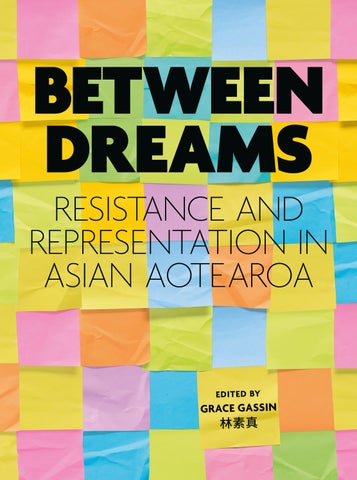
BETWEEN DREAMS
RESISTANCE AND REPRESENTATION IN ASIAN AOTEAROA
EDITED BY Grace Gassin 林素真

Grace Gassin
Grace Gassin
Grace Gassin Deep
Grace Gassin
Grace Gassin
Sun-Min Elle

Sidney
Grace
Umi
Grace
Preface
Dreaming is an active state. It is a time when we engage with our past and play with the ingredients of our potential futures. To dream is to be brave –when protesters took to the streets of Hong Kong during the anti-Extradition Law Amendment Bill protests of 2019–20, they referred to their demonstrations as ‘dreaming’. Fittingly, the Cantonese verb for dreaming is 發夢 faat3mung6, which implies that a dream ‘spreads, radiates, proliferates’.1 In 2020, following speeches on labour law and rights for gay, lesbian and transgender people at a prodemocracy rally in Thailand, human rights lawyer Arnon Nampa took to the stage to declare defiantly that ‘we will continue dreaming’.2
The dreams of many people between Asia and Aotearoa are the inspiration for this book. One such vision began in 2014 as fourteen-year-old Leah Bell and her class at Ōtorohanga College listened to a kaumātua at Rangiaowhia describe the massacre of Māori there in 1864.3 Shocked that many students were never taught these histories, Bell and sixteen-year-old Waimarama Anderson presented a petition to the government the following year calling for a commemoration day for the New Zealand Wars, and for New Zealand history to be taught in secondary schools.4 Together, they dreamed of a generation of New Zealand students knowledgeable of the country’s complex, often traumatic colonial history.
Their actions influenced the Ardern Labour government’s decision, several years later, to make New Zealand history a compulsory part of the social sciences curriculum for years 1–10. This curriculum explicitly designated Māori history as ‘the foundational history of Aotearoa’ for the first time.5
It was in the period after the release of this draft curriculum for public feedback that the seeds of this book were first sown. The majority of articles and opinion pieces commenting on the newly released draft were positive, applauding the new emphasis on Māori history. Predictably, negative responses expressing concern about the ‘exaggeration’ of colonisation’s pervasiveness in the history of Aotearoa, or calling for ‘balance’, were also apparent, though with less visibility, in the public submission process and on right-wing platforms such as Hobson’s Pledge.6
Others, although pleased about the greater emphasis on Māori history, felt that the document was lacking in some other areas. The omission of Asian Aotearoa histories in the public draft, for instance, was quickly called out by individuals of Asian backgrounds across Aotearoa, including Chinese New Zealand author Helene Wong and Emeritus Professor Manying Ip.7
As one of the few Asian New Zealanders working in New Zealand history professionally, I watched these debates with great interest, but I couldn’t help feeling that something was missing. The notable absence of Asian (and Pacific and other minority) histories in the curriculum draft needed to be addressed, yes – but simply adding a few mentions of us all into a revised document, although likely the simplest way to quell public discord, did not feel sufficient either. This was a once-in-a-generation opportunity, and I was desperate for more room to explore how Asian Aotearoa histories – as imagined and interpreted by established and emerging critical voices from within our own communities – might more deeply intersect with and complement the goals of Leah, Waimarama, and all the others who have longed for a greater reckoning with our colonial past.
So, in May 2021, I arranged a special Asian Aotearoa histories kōrero with several of my smartest friends and colleagues to do just that. Over the course of a day on the University of Auckland campus, and in the presence of Emeritus Professor Graeme Aitken, we gave ourselves permission to radically imagine how we wanted to tell our stories and how our histories connected with those of others who have shaped Aotearoa. We distilled these ideas into a joint submission, which called for a greater emphasis on non-Pākehā communities’ ‘historical and cultural connections with each other and with tangata whenua’, and for Asian communities’ histories to be ‘explored within the context of global histories of interconnected forms of imperialism, colonialism, capitalism and forms of racial supremacy, which also enables a fuller understanding of Aotearoa’s history’.8
Around this time, the activist collective Asians Supporting Tino Rangatiratanga (ASTR) was also preparing their own separate submission, and mutual connections resulted in valuable exchanges of ideas that, ultimately, strengthened both submissions.9
Two years later, when Te Papa Press approached me about potentially working
Stuck in the middle with you
Tze Ming Mok 莫志明
During the ‘Inv-Asian’ migration wave of the early 1990s, you could see the Asians at school clustering together in class and lunch break. We didn’t know if we liked each other yet, because we didn’t speak the same languages or dialects. There was just an unspoken agreement that we wouldn’t try to hurt each other.
This is how you make friends, I think.
Scholar and literary theorist Gayatri Chakravorty Spivak’s strategic essentialism is one way of Being Asian, but it also requires thinking through what your strategy is in aid of.1 To not get bullied, yes. What about the rest? Can we imagine something better? To make a real life for ourselves, with agency, humanity and validation of our specificity?
What even is an ‘Asian’ and why are we bundled together, at lunch, in statistics, in books, in a blur of ill-fitting stereotypes? On the streets of Aotearoa, ‘Asian’ is a racialised term specific to East Asians or ‘yellow’ Asians. Meanwhile, Stats NZ defines ‘Asian’ through a far vaster sweep of continental geography that takes in 60 percent of the world’s population – from Samarkand to Chennai, from Pyongyang to Bali. What about West Asia? You’ll have to ask the Iranians.
At a grassroots organisational level, pan-‘Asian’ community activism in the diaspora is often based on strategic alliances within state-determined funding of diversity, policy and community initiatives – the confines and definitions of which can be grating. But activism and community work inside these confines can also be generative, collaborative, and specifically dependent on articulating difference within our tenuous alliance. We grind away for recognition of the term ‘Asian’ as not simply inherently absurd, but – in the way we need to use it – as inherently diverse. We do so in order to deploy it meaningfully in public policy, in political analysis, in collective struggles and in our histories of ourselves.
‘Asians’ do not always have a shared ethnic history, language, religion, tradition or migration cohort. Oft-times, our homelands have been or are still at war with each other, even as others cannot tell us apart in the suburbs of Auckland. But more often, we do have a common history or experience of migration, arrival, settlement and daily life that has been governed by a racial and colonial logic marking us out for a clear purpose, which I will state bluntly: To return an advantage to colonial capital through replacing more expensive and betterorganised labour.


Bishop Jūji Nakata (also sometimes spelt Nakada), who later travelled to Aotearoa in 1927 to open the Rātana temple. In recent years, some have suggested that Bishop Nakada may have been of Ainu ancestry.15
Akemi’s gifts were formally welcomed into the museum during a special pōwhiri, after which Akemi, her small travelling party and invited guests shared kai. Akemi and the other Ainu artists whose work featured in Ramat Kor Kur also performed Ainu songs and dances for the gathering. Akemi’s collection, donated just a year before her death in 2025, is the first direct gift from Ainu to be accepted by the museum – a rare taonga materialising the ongoing and continually evolving histories of engagement between Māori and Indigenous Asian peoples such as the Ainu. It seems fitting that the formal Deed of Gift for this donation bears both Ngaroma’s and Akemi’s signatures as witness and donor respectively, recording their friendship for posterity.16
For Ngaroma and Akemi, their love for each other was always their most precious taonga. ‘We’re supporting each other as fellow human beings, as Indigenous sisters,’ says Ngaroma, who fights back tears as she expresses her deep gratitude to Akemi: ‘She always wrapped her korowai around me . . . she always did it out of aroha, and she gave me so much.’17

Ngaroma Riley and Akemi Shimada at the opening of Ramat Kor Kur at Te Auaha, Wellington, in January 2024.


Akemi Shimada’s legacy at Te Papa
THESE TEXTILES WERE CREATED by the late Ainu artist and cultural advocate Akemi Shimada and exhibited in Aotearoa as part of the Ainu exhibition Ramat Kor Kur in Wellington in 2024. Following the closure of the exhibition, Akemi formally donated these items to Te Papa as part of a wider collection. The gift paid tribute to her friendships with Māori across Japan and Aotearoa and their impact on her life.
This attus garment was made by Akemi in 2011. To make it, strips of inner bark flesh from trees such as the lobed elm, typically collected by women in spring and summer, were soaked in water and then bleached in the sun. The fibrous strands were subsequently split and joined together in a thread that was woven into cloth on a loom. The cloth was then sewn into an attus and decorated with embroidered navy and black appliqué. Historically, attus were distinctive and highly prized robes as well as important trading items for Ainu during the Edo period (1603–1867) due to their durability and resistance to water. Following the formal colonisation of Ainu Mosir (the Ainu homeland) during the Meiji period (1868–1912), however, practices such as making and wearing Ainu garments were criminalised. Though some Ainu continued to defy these oppressive measures, it became difficult for communities to pass their practices down to
Chelsea sugar works and indentured labour
IN THE 1830S, BRITAIN and France turned to indentured workers to fill the demand for cheap labour created by the abolition of the Atlantic slave trade. Fiji was the last British colony to receive indentured labourers for its plantations under this system. Over the period 1879–1916, over 61,000 labourers arrived in Fiji from India to work on plantations owned by the Australian Colonial Sugar Refinery (CSR), a company with close ties to New Zealand.
A substantial proportion of the CSR’s profits were repatriated to New Zealand, and New Zealanders travelled between the various countries to work for the CSR in different capacities, including as plantation overseers in Fiji. In the 1884, the CSR led a consortium to establish the Chelsea Sugar Refinery and Estate in Auckland (pictured opposite in the 1880s). Chelsea Sugar remains a household name in New Zealand and the country’s main source of sugar.
AS AN ALTERNATIVE FORM of cheap labour, the indentured labour system supposedly differed from slavery as workers signed an agreement or ‘girmit’ to work for their employer in one of the colonies for a fiveyear period. Many who chose to leave India had their own reasons for doing so, such as debt and poverty; however, the contracts that those who became indentured labourers or ‘girmitya’ signed were often highly misleading, and there were many instances in which people were deceived or coerced into these arrangements. The conditions the labourers encountered upon arrival were often far from what they had been told to
expect. This is reflected in the name they gave to the plantations – narak (hell). 1
Girmitya were paid very poorly and worked long hours, and those who were unable to work, or refused, were fined or jailed. Abuse and exploitation were rife, and those who tried to leave before their contracts finished could end up in jail.
In his pamphlet Indentured Labour: Is it slavery?, published in 1920, New Zealand MP Harry Holland drew on a range of contemporary sources to highlight the


suffering of indentured labourers working in British colonies such as South Africa, New Guinea and Fiji. On the plight of Girmitya in Fiji, he quoted Reverend Dr Burton’s condemnation of the girmit system as ‘slavery in everything but name’ and Reverend Charles Freer Andrews’ description of it as containing ‘the worst features of the old slave system’.2
At the time Holland wrote his pamphlet, New Zealand had just been granted a League of Nations mandate to govern the formerly German colony of Sāmoa subject to various conditions, including the prohibition of slavery. Although these conditions were agreed to, Prime Minister William Massey later acknowledged in a parliamentary debate
that the government would continue the indentured labour system set up by Germany. In response to the Opposition, he insisted that, although indentured labour might be slavery under a foreign power, it could not be under British rule.3
Holland, who was passionately opposed to this action, urged his readers to question Massey’s stated view. In his description of conditions in Fiji, Holland reminded his readers: ‘Fiji is under the British flag. And what is the lesson it teaches? British subjects – natives of India – were transplanted to Fiji as indentured employees of the sugar companies, especially the Colonial Sugar Refining Company. With what results?’4
Bev Moon, Fortune
THIS ARTWORK, FORTUNE (A Knitted Yum Cha for my Mother’s 90th Birthday), was conceived and created in 2021–22 by artist Bev Moon, who is descended from Taishanese men who first arrived in Aotearoa
New Zealand in the 1880s. It is a loving tribute to her mother, Yip Sue Yen, and grandmother Lee Choy Kee, two of only 500 Chinese women and children to be granted refuge in Aotearoa following the Japanese invasion of China in 1937.
For this work, Bev painstakingly hand-
knitted replicas of yum cha delicacies her mother and grandmother used to prepare. Through this labour-intensive process, she renders visible the significant amount of work that both women performed in their daily lives. Moon’s mother and grandmother before her were also talented knitters, and Moon’s skill in creating the many complex elements of this work can also be read as a homage to the intergenerational knowledge they passed down to her.


One pandemic, three responses
IN DECEMBER 2019, THE FIRST confirmed case of COVID-19 was reported in Wuhan, China. Within a matter of months, the virus had spread across the globe, leaving devastating health and economic impacts in its wake.
Anxieties fuelled by the pandemic also triggered waves of racism and xenophobia targeting people of Chinese and other East Asian backgrounds.1 The T-shirts shown here represent two very different responses from individuals of Chinese ancestry to this spike in anti-Asian racism.
IN FEBRUARY 2020, MOST of the virus’s victims were still based in mainland China. Cat Xiao, who was born and raised in Wuhan, did her best to stay in touch with family and friends back home while she checked for updates from her home in Christchurch. Scrolling on her
phone and computer, Cat was shocked by the lack of empathy she saw online for Wuhanese victims and their families.
‘After COVID-19 was discovered in Wuhan, the news, political conspiracies, race wars and region discrimination articles flooded my social media. When I went online to check how was my hometown Wuhan, these articles popped out.
‘One of my friends lost her mother and couldn’t get to see her for a proper goodbye, couldn’t even have her relics, everything was burnt in an incinerator. But at that stage when the world was not alerted, their tragedies were just another story for the internet residents to consume.’
In protest, Cat painted powerful messages onto the front and back of a plain white T-shirt (below) emphasising her


connection to Wuhan, the humanity of her hometown’s victims, and her grief over the city’s climbing death toll. She then posted images of the shirt on Instagram under the hashtag #iamnotavirus. In a statement provided to Te Papa, Cat explained her motivation in simple terms:
‘I made this T-shirt to tell others that behind the masks there are lives being lost, families being torn apart and cities losing their backbones.’2
FOR HELENE WONG, a th ird-generation Chinese New Zealander and the author of the memoir Being Chinese: A New Zealander’s Story , 3 the racial targeting of Asians during the pandemic triggered painful memories. In her past writing and interviews, Helene has described the difficult period of the 1990s when the passage of the Immigration Act 1987 provoked hostile reactions towards the arrival of new Asian migrants – the so-
I said: ‘No, thanks, I want to be a trade union official. That’s my pathway.’ But they came back a few times and pretty much said to me: ‘You’ve got us into changing our ways and not fighting. Why don’t you help us more? Put your money where your mouth is.’16
In the decades since, Harry has cut a unique figure on the public stage, moving between government bureaucrats, the media and the Mob. He has spoken publicly on such issues as the connection between (un)employment and gang membership. In an interview for E-Tangata in July 2021, he observed:
The people coming into the gangs are pretty much third-generation . . . I think there’s a direct correlation with the growth in disparities . . . really, those communities are not unemployed. They’re jobless. They’ve stopped actively looking for work, because they’re actually unskilled . . . [a]nd these people have been brought up with intergenerational dysfunction. You only have to have a look at what’s coming out of the Royal Commission of Inquiry . . . so people are disconnected from their culture. They’re disconnected from their whakapapa and all those things. And then they see
Harry Tam, pictured in ‘Harry and the Mob’, NZ Listener , 5 March 1990, pp. 4–5.

a group that lives in what they perceive as a family, and the closeness, and people that don’t judge them. It becomes an attractive alternative.17
Most recently, in the wake of the Luxon government’s crackdown on gangs, Harry has urged those in power to take heed of history’s lessons on the counterproductivity of such harsh measures. ‘We should have learnt our lesson about moral panics . . . we have seen the failures of hardline policing to tackle gangs and witnessed the discriminant and disproportionate impacts that political rhetoric and media sensationalism has on particular communities. Yet, here we are again.’18
William ‘Burma Bill’ Maung
Harry Tam’s mentor and former teacher, William ‘Burma Bill’ Maung (1919–2011), was a political refugee from Burma’s 1962 military coup. He had been part of the post-independence government’s administrative elite, including as Secretary for Labour and for National Minorities, and as an International Labour Organization governor. Part of the armed struggle for independence in his youth, Bill was interned, along with his mother, by the Japanese when they occupied Burma during the Second World War. During this time, Colonel Bernard Fergusson was in Burma leading a brigade of Chindits, a special elite force for the Allies. Fergusson later returned to Burma in the 1950s as a senior regional governor, where he was hosted by Bill. The pair maintained a close friendship in the following years, and Fergusson later helped arrange for Bill’s family to migrate to New Zealand in 1967. By this time, he was known as Sir Bernard Fergusson, Governor General of New Zealand, which meant that Bill’s first home in New Zealand was Government House – his work with urban Māori, in fact, started at Fergusson’s request.
In a sharp shift away from these patrician beginnings, Maung later joined the Jerusalem commune,19 with James K Baxter as fascinated by Bill’s political Buddhism as he was by Sofi Pua’s radical Pasifika Catholicism (see pages 60–68). Bill worked for a time as a schoolteacher, meeting a young Harry Tam while teaching at Wellington’s Rongotai College. Soon, however, Bill started building community-based education, outreach and cooperative businesses in Wellington with displaced urban Māori youth who were joining gangs, including running crash-pads with activist group Ngā Tamatoa, and setting up a community school. The school attracted his former student Harry Tam, who had by then dropped out of college.
Through this grassroots work, Bill eventually became the senior economic and political mentor to Black Power in the Wellington region. With his weighty international background and connections, Bill had a fearlessness about going straight to the top in New Zealand, becoming known for knocking directly on the
Queer Asians: Beyond closets
Sidney Gig-Jan Wong 黃吉贊
What comes to mind when you think of a closet? A ubiquitous feature of a house, normally composed of three walls, a ceiling, a floor and a door? Sometimes closets conceal people, too. Those who do not neatly fit within our societal norms or roles are often forced to conceal themselves.
Sociologist Michael Brown defined the ‘closet’ as ‘a term used to describe the denial, concealment, erasure, or ignorance of lesbians and gay men [etc.]. It describes their absence – and alludes to their ironic presence nonetheless – in a society that, in countless interlocking ways, subtly and blatantly dictates that heterosexuality is the only way to be.’1 Perhaps this is why those of us who are considered different resonate deeply with this spatial metaphor.2
However, the closet is more than just a metaphor; it symbolises the continued discrimination, erasure and invisibility experienced by different communities in contemporary Aotearoa. As people who intersect multiple marginalisations in society, Queer Asians are no strangers to the closet. Trans activist Wai Ho aptly used the phrase ‘minority within a minority’ to describe the Queer Asian experience. At the Equality and Diversity Conference hosted by the Human Rights Commission in 2014, Wai Ho chaired a session titled Too Gay to be Asian? Too Asian to be Gay?3
During the session, Wai Ho explained that, within ethnic and migrant communities, ‘often it’s assumed being gay or lesbian is seen as a real white thing’.4
Some ethnic and migrant families in Aotearoa continue to associate Queer identities with Westernism and mental illness,5 unfoundedly, however, because cultures across Asia have long developed their own Indigenous views of gender. As one example, phuying-kham-phet (also known as khon kham-phet), who often simply refer to themselves as phuying (woman), is a way to describe people who embody two or more souls in Thai society.6 Bugis people in South Sulawesi recognise multiple genders: oroané, makkunrai, calabai, calalai and bissu, associated with specific roles within Bugis society.7 More specifically, bissu embody aspects of all genders and are perceived as spiritual leaders in the community. Across South Asia, literary accounts of diverse genders, sexualities and sex characteristics can be traced to Sanskrit and Pali texts from the eighth century BCE.8 Some gender and sexually diverse people known as hijra and khawajasara held esteemed positions in the royal court of the Delhi Sultanate and the Mughal Empire.9
Wai Ho was critical of the small number of Asian members of Parliament for
projects, and I had so much fun. [translated from Tagalog]3
Prior to moving to Aotearoa in 2007, Dennis had already spent years running his own lucrative fashion label in Quezon province, Philippines. He was known for his skill in designing and constructing ornate tailored gowns, which were frequently debuted in pageants and major cultural festivals such as the Flores de Mayo (Flowers of May).4
In 2025, Dennis again collaborated with Marc Conaco, as well as musician Magenta and moving image artist Mariadelle Gamit, to create the immersive fashion installation
Ang Sininang Bulawan (The Golden Dress), which was exhibited at Studio One Toi Tū in Tāmaki Makaurau in early 2025. Dennis’s dress was inspired by the fabulous regalia created by queer folk for religious status inside churches and conceived as an outfit that ‘could be worn by both the Virgin Mary and a drag performer’. 5


candlelight vigil. It is modelled after a blackand-white People’s Republic of China (PRC) flag that was flown at a separate overseas protest, which appeared to have been inspired by the ‘Black Bauhinia’ Hong Kong flag first used during Hong Kong’s anti-Extradition Law Amendment Bill (ELAB) protests (the ‘Black Bauhinia’ flag is a black-and-white version of the red-and-white Hong Kong flag).
Like Hong Kong’s ‘Black Bauhinia’, the reimagined PRC flag is a statement of not only mourning but also political defiance. The white of the stars conveys mourning in traditional Chinese culture, while the black background is an explicit rejection of the colour of the Chinese Communist Party – symbolically resisting the Party’s power to define the Chinese nation and its identity, and even challenging its ownership of communism and socialism.
According to the participant who brought the flag to the Aotea Square vigil,
it remained furled during most of the day’s events to respect the safety concerns of the organisers. However, once the day’s formalities were over, and immediately after a Uyghur attendee spoke in support of Uyghurs facing persecution in China and abroad, the flag suddenly unfurled itself in a gust of wind.


Tiananmen Square
ANNA*, THE FORMER OWNER of this T-shirt was just a high-school student when she left New Zealand to visit Hong Kong during her school holidays in May 1989. While there, she joined the large movement then capturing the attention of the world by participating in a major demonstration. Only two weeks later, on 4 June, a crowd of protesters was fired upon by the People’s Liberation Army at Tiananmen Square in Beijing. Death toll estimates range from a few hundred to a few thousand.1
Anna bought this shirt while still in Hong Kong for the first commemoration of what is now known as the Tiananmen Square massacre. It features an image of Chai Ling, one of the key student leaders in the Tiananmen Square protests, alongside a

message which translates to: ‘The Republic, you must remember these children who struggled for you!’
For decades, Hong Kong was the only place in China where the victims of the Tiananmen Square massacre could be publicly mourned. Commemorative shirts such as this one were produced by leading Hong Kong pro-democracy figures including media mogul and businessman Jimmy Lai. In 2020, Lai was arrested on unlawful assembly charges in connection with the Hong Kong anti-ELAB protests of 2019–20. Since that year, the annual Tiananmen Square vigil held in Hong Kong’s Victoria Park has been banned.2
Two Chinese poets in exile, Yang Lian and Gu Cheng, were in Auckland when the tragedy took place in China. They organised protests, wrote poems condemning the Chinese Communist Party, and were instrumental in arranging for a Tiananmen Square memorial boulder dedicated to the victims of the massacre.3
The stone memorial (see page 244), which represents the geographical shape of China, was unveiled just months after the massacre, on 17 September 1989, opening the China: The Survivors memorial festival, which had been organised by the poets and their New Zealand supporters. It was established on the Alten Road frontage of St Andrews Presbyterian Church after an initial attempt to place it at the University of Auckland’s city campus was rejected by university officials.4
The Chinese inscription on the stone was
Further reading
1. Old Stories, New Perspectives
Ng, James, ‘The sojourner experience: The Cantonese goldseekers in New Zealand, 1865–1901’, in Manying Ip (ed.), Unfolding History, Evolving Identity: The Chinese in New Zealand, Auckland University Press, Auckland, 2003, pp. 5–30.
Wong, Helene, Being Chinese: A New Zealander’s story, Bridget Williams Books, Wellington, 2016.
2. New Zealand’s Asian Pacific Inheritances
Mok, Tze Ming, ‘After a long silence: A letter to a lost friend in Xinjiang’, in Janet McAllister (ed.), Life on Volcanoes: Contemporary essays, Beatnik Press, Auckland, 2019, pp. 16–43.
———, ‘Black Asian, white Asian: Racial histories and East Asian choices in the white settler state’, in Arcia Tecun, Lana Lopesi and Anisha Sankar (eds), Towards a Grammar of Race in Aotearoa New Zealand, Bridget Williams Books, Wellington, 2022, pp. 81–90.
———, ‘Postscript: “Race you there” two decades later’, Satellites, no. 1, 2024, www.satellites.co.nz/magazine/issue-1
3. War, Memory and Identity
Im, Chan-Sang, dir., The President’s Barber (film), Showbox, 2004.
Jo, Jeong-Rae, The Taebaek Mountain Range, Haenaem, Korea, 1989.
‘North Korea-South Korea >> South-North Joint Declaration’, 2000, United States Institute of Peace, www.usip. org/files/file/resources/collections/
peace_agreements/n_skorea06152000.pdf
Park, Chan-Wook, dir., Joint Security Area (film), Myung Films, 2000.
4. Whose Histories Are We Telling?
Ambedkar, BR, Annihilation of Caste: The annotated critical edition, Navayana Publishing, New Delhi, 2014.
Khilnani, Sunil, The Idea of India, Penguin Books India, New Delhi, 2004.
Prashad, Vijay, The Karma of Brown Folk, University of Minnesota Press, Minneapolis, 2000.
Shingade, Balamohan, ‘A letter from Bombay, or Mumbai: On the troubles of renaming as a decolonial act’, Pantograph Punch, 2018, pantograph-punch.com/posts/ bombay-or-mumbai
———, ‘Singing with practical intent’, in Balamohan Shingade and Erana Shingade (eds), Past the Tower, Under the Tree: Twelve stories of learning in community, GLORIA Books, Auckland, 2023.
———, ‘Led Astray from a Cultural Inheritance’, Satellites, no. 3, 2024, www.satellites.co.nz/ magazine/issue-3/led-astray
5. Asians and Workers’ Rights in Aotearoa
Bennett, James, ‘Rats and Revolutionaries’: The Labour movement in Australia and New Zealand 1890–1940, Otago University Press, Dunedin, 2004.
Ip, Manying, ‘Nancy Wai-lan Kwok-Goddard: A Pioneer Humanist-Socialist’, New Zealand Journal of Asian Studies, vol. 16, no. 2, 2014, pp. 141–158.
Kaloti, Anu, ‘Commentary – Migrant Lives
Matter – A Call to End Precarity and Exploitation’, in Jessica Terruhn and Shemana Cassim (eds.), Transforming the Politics of Mobility and Migration in Aotearoa New Zealand, Anthem Press, Melbourne, 2023, pp. 151–154.
Landry, Donna and Gerald MacLean (eds), The Spivak Reader: Selected works of Gayatri Chakravorty Spivak, Routledge, New York, 1996.
Miller, Edward, and Dennis Maga, ‘Disaster Capitalism and Migrant Worker Organising in Aotearoa/New Zealand’, in Aziz Choudry and Mondli Hlatshwayo (eds.), Just Work? Migrant Workers Struggles Today, Pluto Press, London, 2015, pp.188–208.
Said, Edward, Orientalism, Pantheon Books, New York, 1978.
Segalen, Victor, Essay on Exoticism: An aesthetics of diversity, Duke University Press, Durham, 2002.
Warburton, Graham, ‘The Attitudes and Policies of the New Zealand Labour Movement Towards Non-European Immigration 1878–1928,’ MA thesis, University of Canterbury, 1982.
6. At the Intersections
Bal, Vinod, Our Histories Are Queer: A resource of queer and trans South Asian histories, Adhikaar Aotearoa, Hamilton, 2024, www.adhikaaraotearoa.co.nz/ourhistories-are-queer
Piepzna-Samarasinha, Leah Lakshmi, Care Work: Dreaming disability justice, Arsenal Pulp Press, Vancouver, 2021.
Tse, Chris, and Emma Barnes (eds), Out Here:
An anthology of takatāpui and LGBTQIA+ writers from Aotearoa, Auckland University Press, Auckland, 2021.
Wake, Naoko, ‘Asian American disability: A history and its archives’, Journal of American Ethnic History, vol. 43, no. 3, 2024, pp. 5–33.
Wong, Sidney Gig-Jan, Queer Asian Identities in Contemporary Aotearoa New Zealand: One foot out of the closet, Lived Places Publishing, Long Island, New York, 2023.
7. Asian New Zealanders in Global Movements
Karat, Brinda, ‘Towards Intensified Struggles for Adivasi Rights’, The Marxist, XXVI 3, 2010 pp. 19-38. mronline.org/wp-content/ uploads/2020/12/201003-advisasis20Brinda.pdf
Khalid, Iram, ‘New Forms of Anti-Hindutva Resistance: Critical Feminist Struggle and Diaspora Activism against Hindutva in India and Abroad’, Annals of Human and Social Sciences, vol. 5, no. 4, 2024, pp. 618-629.
Lim, Louisa, Indelible City: Dispossession and defiance in Hong Kong, Riverhead Books, New York, 2022.
Solnit, Rebecca, A Paradise Built in Hell: The extraordinary communities that arise in disaster, Penguin, New York, 2010.
Teltumbde, Anand, ‘Onslaught of Fascist Hindutva on Dalits: Impact and resistance’, a paper presented at the All India League for Revolutionary Culture Seminar on the Onslaught of Fascist Hindutva, Mumbai, 22 December, 2002, www.ambedkar.org/vivek/ ailc_speech.pdf.
About the authors
Umi Asaka is a proud second-generation disabled person and Tangata Tiriti. She works as a disabled researcher and education coordinator at the Donald Beasley Institute (DBI), a national independent institute for disability rights research and education based in Dunedin. She is also a member and organiser of Migrants Against the Acceptable Standards of Health Aotearoa (MAASHA) and Asians Supporting Tino Rangatiratanga ki Ōtepoti. Originally from Japan, Umi moved to Aotearoa New Zealand at the age of fifteen. She has been a wheelchair user her entire life. She is passionate about social justice, especially for disabled migrant communities.
Mohan Dutta is Dean’s Chair Professor of Communication at Massey University. He is the Director of the Center for Culture-Centered Approach to Research and Evaluation (CARE), developing culturally centred, community-based projects of social change, advocacy and activism that articulate health as a human right.
Christopher Fung teaches Anthropology, Native American and Indigenous Studies, at the Honors College and is core faculty in the Critical Ethnic and Community Studies Masters programme at the University of Massachusetts Boston. A fifthgeneration Chinese New Zealander, his topical focus includes race, gender, Indigenous, national and community identities, diaspora cultures, archaeology, socio-cultural anthropology, museums, and material and expressive culture. His latest research project examines notions of identity and belonging in Chinese New Zealand communities and the impacts of engagement with te ao Māori on immigrant identity.
Chris has taught previously at Harvard University, the University of Auckland, the University of Hawai‘i at Manoa, and Tufts University. Immediately prior to taking up his role at UMass, he was Associate Professor of Anthropology and Chair for the Anthropology programme at Hawai‘i Pacific University in Honolulu.
Dr Grace Gassin 林素真 is Curator Asian New Zealand Histories at Te Papa. Raised in her mother’s Malaysian Chinese family, Grace proudly identifies as a secondgeneration Chinese (Hokkien) New Zealander of mixed heritage. She is also a passionate delegate for E tū union. Through her doctoral research (University of Melbourne, 2016) and her various commitments within and beyond Te Papa, Grace has had the privilege of collaborating with a range of amazing humans over the years to highlight the diverse experiences of Asian diaspora communities across Aotearoa and Australia.
Rebekah Jaung 정레베카 (she/her) is Korean and works as a doctor and health researcher in Tāmaki Makaurau. Her areas of research interest include racism and anti-racism in health, health equity, and developing spaces for Māori–migrant solidarity within health in Aotearoa. She is involved in community organising with the group Korean New Zealanders for a Better Future.
Tze Ming Mok 莫志明 is a writer, social scientist, former international human rights worker, and a veteran commentator and occasional activist on racism, colonialism and rights issues affecting Asian communities. Their now foundational Landfall essay ‘Race you there’ urged Aotearoa Asians to live by the terms of Te Tiriti o Waitangi, and their recent work continues to explore the past, present and future of Aotearoa Asian political positionality. Tze Ming was born in Mount Roskill, and is Baoshan Yunnanese by way of Burma and Singapore, and Szewui Cantonese via Vietnam, Thailand and Malaysia.
Keith Ng is a Hongkong New Zealander based in Pōneke. He has been a freelance writer, journalist and data-visualisation specialist for most of his career, and a data journalist for the NZ Herald until 2022. His work has ranged from reporting on politics, public finances and cybersecurity to investigations of companies and hidden assets. He currently works as a data scientist in the public sector, and occasionally as a freelance digital investigator. He was in Hong Kong during the summer of 2019, and he still misses the city’s Museum of History.
Sun-Min Elle Park 박선민, 朴宣玟 has an art history research background with interests in how Western interpretations of contemporary Asian art subjects are often shaped by Orientalist assumptions. These assumptions include the misappropriation of culture and history, mystification of Zen and the exclusion of Asian voices. Her thinking is influenced by post-colonial theories of racial studies, such as Spivak’s subaltern theories, Said’s Orientalism, and Segalen’s exoticism. Proudly neurodivergent with ADHD and autism, Sun is a union organiser at Workers First Union. She strives to live in the way of 투쟁 (fighting despite struggles), navigating a world that is inherently fucked for neurodivergent and working-class people.
Dr Sapna Samant डाॅ. सपना सामंत. is a writer, filmmaker, radio producer, activist, GP and single mum. A migrant herself, Sapna tells migrant and refugee stories through her company Holy Cow Media. She has made award-winning content for
Between Dreams: Resistance and Representation in Asian Aotearoa
RRP: $50
ISBN: 978-1-99-116558-9
PUBLISHED: May 2026
PAGE EXTENT: 288 pages
FORMAT: Flexibind with jacket SIZE: 230 x 170 mm
FOR MORE INFORMATION OR TO ORDER https://www.tepapa.govt.nz/about/te-papa-press/between-dreamsresistance-and-representation-in-asian-aotearoa