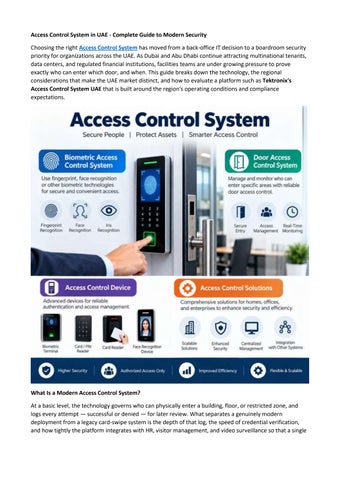
Access Control System in UAE - Complete Guide to Modern Security Choosing the right Access Control System has moved from a back-office IT decision to a boardroom security priority for organizations across the UAE. As Dubai and Abu Dhabi continue attracting multinational tenants, data centers, and regulated financial institutions, facilities teams are under growing pressure to prove exactly who can enter which door, and when. This guide breaks down the technology, the regional considerations that make the UAE market distinct, and how to evaluate a platform such as Tektronix's Access Control System UAE that is built around the region's operating conditions and compliance expectations.
What Is a Modern Access Control System? At a basic level, the technology governs who can physically enter a building, floor, or restricted zone, and logs every attempt — successful or denied — for later review. What separates a genuinely modern deployment from a legacy card-swipe system is the depth of that log, the speed of credential verification, and how tightly the platform integrates with HR, visitor management, and video surveillance so that a single
access event triggers a coordinated response across multiple systems rather than sitting in an isolated log file. For UAE facilities operating alongside critical infrastructure, financial services, or sensitive government tenants, this level of integration is quickly becoming the baseline expectation rather than a premium feature. Why Access Control Solutions Matter for UAE Businesses Today The Emirates' rapid infrastructure growth — from DIFC's financial towers to the industrial and logistics zones ringing Abu Dhabi — has created dense, multi-tenant environments where a single unmanaged door can expose an entire building. Landlords, free-zone authorities, and insurers increasingly expect tenants to demonstrate a documented, auditable approach to physical security. Robust Access Control Solutions give facilities managers exactly that: a centralized, reportable record of every entry, rather than a set of mechanical keys that can be copied, lost, or never returned when an employee leaves. This shift also intersects with the UAE's Personal Data Protection Law (PDPL), which pushes organizations toward systems that can demonstrate precisely how biometric and credential data is captured, stored, and retained — an expectation that legacy key-and-lock systems were never designed to meet. Core Technologies Powering an Advanced Access Control System An Advanced Access Control System is rarely a single product — it is a stack of complementary technologies working together. Understanding each layer helps facilities teams evaluate vendors on technical substance rather than brochure claims. Biometric Access Control in Dubai: Fingerprint and Facial Recognition Deployments across Dubai's commercial towers increasingly favour fingerprint and facial-recognition readers over traditional cards, since biometric credentials cannot be lent, lost, or duplicated. Biometric Access Control Dubai installations are especially common in data centers, trading floors, and server rooms where the cost of an unauthorized entry is measured in reputational and regulatory terms, not just petty theft. Door Hardware and Controllers A Door Access Control System lives or dies on its hardware layer — electric strikes, magnetic locks, requestto-exit sensors, and door controllers that communicate reliably with the central management software. Poor-quality hardware is the single most common cause of nuisance alarms and stuck doors, and it is often the first thing to fail in the UAE's heat and humidity if not rated for the environment. Mobile Credentials and Cloud-Based Management Many newer UAE deployments now issue credentials directly to an employee's smartphone, removing the cost and administrative overhead of physical card issuance entirely. Cloud-based management consoles let a security team administer permissions across multiple buildings — even across emirates — from a single dashboard, rather than maintaining separate local servers at every site. Access Control Device Hardware: Readers, Panels, and Sensors Every credential type ultimately depends on the Access Control Device installed at the door — the card reader, biometric scanner, or keypad that captures the credential and passes it to the controller. Choosing devices rated for outdoor exposure, dust, and continuous operation is essential for UAE sites, where equipment not built for the climate fails far faster than manufacturer specifications from temperate markets would suggest. Security Access Control System Features Every UAE Facility Should Have
Beyond basic door locking, a genuinely capable Security Access Control System should include the following as standard, not as costly add-ons: •
Role-based permission tiers: Different access levels for staff, contractors, and visitors, enforced automatically rather than manually.
•
Real-time alerts: Instant notification of forced doors, held-open doors, or repeated failed credential attempts.
•
Anti-passback logic: Prevents a single credential from being used to let multiple people through the same door.
•
Audit-ready reporting: One-click export of entry logs for a specific door, zone, or time window during an investigation or compliance review.
•
Integration with HR systems: Automatic credential deactivation the moment an employee's status changes, closing the offboarding gap that manual processes routinely miss.
•
Video-surveillance correlation: Linking a door event directly to the corresponding camera footage for faster incident review.
Access Control System Dubai vs. Access Control System Abu Dhabi: Regional Considerations While the underlying technology is largely the same, deployment priorities differ noticeably between the emirates. An Access Control System Dubai installation is often driven by dense, high-rise, multi-tenant buildings — think DIFC towers and Business Bay commercial floors — where the priority is managing shared lobbies, elevators, and floor-specific tenant zones within a single structure. An Access Control System Abu Dhabi deployment, by contrast, more frequently spans large, low-rise government, energy, and institutional campuses where perimeter control, vehicle gates, and multi-building coordination take priority over vertical, floor-by-floor management. Vendors familiar with both patterns — rather than a one-size-fits-all template — deliver noticeably better outcomes across either emirate. A Practical Example: Retrofitting a Multi-Tenant Dubai Tower Consider a commercial tower in Business Bay where facilities management inherited a mix of mechanical keys and an aging, unsupported card system across twenty floors. Tenants reported lost keys weekly, and there was no way to confirm who had entered a vacated suite after a company moved out. A phased retrofit began with the shared lobby and elevator banks, replacing card readers with a cloud-managed platform that could later be extended floor by floor as individual tenant leases came up for renewal. Within the first quarter, the building's facilities team reported a measurable drop in lock-related maintenance calls, and property management could finally produce an accurate access report during a tenant dispute — something the previous mechanical system had never been able to deliver. The rollout illustrates a pattern common across Dubai's commercial stock: incremental, floor-by-floor modernization tends to outperform an attempt to replace an entire building's security infrastructure in one disruptive weekend. Integration Depth: Why Standalone Door Locks Are No Longer Enough A door reader that only talks to its own local panel creates a security blind spot the moment an incident spans more than one system. Leading UAE deployments increasingly connect access control to a wider security and operations stack, including: •
Visitor management platforms: So, a pre-registered guest's badge only opens the specific zones their visit was approved for.
•
Fire and life-safety systems: Automatically unlocking egress doors during an alarm event without requiring manual override.
•
Elevator destination control: Restricting which floors a credential can call in a shared multi-tenant tower.
•
Time and attendance systems: Using the same badge event for payroll and workforce reporting, removing duplicate data entry.
•
Building management systems (BMS): Adjusting lighting and HVAC in a zone automatically based on occupancy detected through access events.
Facilities teams evaluating a new platform should ask vendors for concrete examples of these integrations working in live UAE buildings, not just a features list in a datasheet. Industries Relying on Access Control Across the UAE •
Financial services and DIFC-based institutions — where regulatory expectations demand a fully auditable entry trail for trading floors and server rooms.
•
Data centers and technology campuses — environments modelled on the security posture of hyperscale operators such as G42, where every door event must be logged and justified.
•
Healthcare facilities — hospitals restricting pharmacy, ward, and records-room access to authorized staff only.
•
Government and semi-government entities — public buildings where identity verification is a compliance requirement rather than a convenience.
•
Transport and infrastructure operators — facilities aligned with standards set by RTA Dubai for operational and back-of-house area access.
•
Industrial and logistics parks — multi-gate sites requiring vehicle and pedestrian access control across large footprints.
How to Choose the Right Access Control System UAE Vendor Selecting an Access Control System UAE provider is as much about regional fit as it is about product specifications. The following criteria consistently separate a strong long-term partner from a vendor selling a generic global product: •
Climate-rated hardware: Readers and controllers tested for Gulf heat, humidity, and dust exposure.
•
PDPL-aligned data handling: Clear policies on how biometric templates and access logs are stored and for how long.
•
Local support presence: A regionally based engineering team that can respond on-site within hours, not days.
•
Integration track record: Proven interoperability with visitor management, HR, and videosurveillance platforms already in use.
•
Scalable licensing: A model that grows sensibly from a single building to a multi-emirate portfolio without a full platform replacement.
This is the standard Tektronix's access control platform was built to meet, combining Gulf-rated hardware with a support model designed around how UAE facilities teams actually operate day to day. Common Deployment Mistakes to Avoid
•
Choosing hardware on price alone: Budget readers rated for temperate climates frequently fail within a year in Gulf conditions.
•
Leaving default credentials active: Unchanged manufacturer defaults remain one of the most common entry points for unauthorized access.
•
Skipping the HR integration step: Manual offboarding is the single largest source of stale, still-active credentials in audits.
•
Underestimating door hardware maintenance: Electric strikes and magnetic locks need scheduled servicing, not just a one-time installation.
•
Ignoring visitor and contractor flows: A system that only manages employee badges leaves a significant population of building occupants unmanaged.
Card, Biometric, or Mobile: Comparing Credential Types Facilities teams frequently ask which credential type is right for their building. Each option carries genuine trade-offs, and most mature UAE deployments end up using a combination rather than a single method across every door. •
Proximity cards: Low cost and familiar to occupants, but can be lost, shared, or cloned without proper encryption.
•
PIN codes: No hardware to issue or replace, but codes are easily shared and offer weak accountability on their own.
•
Biometric readers: Cannot be lent or duplicated, ideal for high-security zones, though enrollment and hygiene considerations need planning.
•
Mobile credentials: Convenient and easy to revoke instantly, but dependent on smartphone battery life and app compliance from occupants.
A common pattern across UAE commercial towers pairs mobile or card credentials for general staff circulation with biometric verification reserved for server rooms, cash-handling areas, and other high-value zones — balancing convenience against the highest level of assurance where it matters most. Measuring the Return on a Security Investment Facilities leaders often ask how an access control upgrade justifies its cost beyond the obvious security benefit. In practice, the return shows up in several measurable places: eliminated re-keying costs whenever a physical key is lost, reduced facilities-staff time spent manually adding or removing permissions, faster incident investigations when a documented log replaces guesswork, and lower insurance premiums in some cases where insurers recognize a documented, auditable access history as a risk-reduction measure. For multi-building portfolios, the compounding value is even greater: a single management console covering every site replaces a patchwork of local systems and mechanical keys, giving portfolio managers one consistent, comparable view of physical security posture across Dubai, Abu Dhabi, and any satellite locations. Why Tektronix's Access Control Platform Stands Out Tektronix has deployed access control infrastructure across UAE financial towers, industrial parks, and campuses supporting the kind of institutions clustered around DIFC and Abu Dhabi's business districts, along with facilities aligned with EXPO 2020's legacy security standards. That field experience shapes every recommendation in this guide — from the specific hardware ratings that survive Gulf summers to the HRintegration patterns that actually close the offboarding gap in practice, not just on paper.
The platform is built around ISO 27001-aligned data-handling practices and a locally based support and installation team, with integration experience spanning the visitor-management and video-surveillance systems already deployed across Dubai and Abu Dhabi facilities. Teams evaluating a new deployment are encouraged to request references from comparable UAE sites before committing. Implementation Roadmap •
Audit existing doors and credentials: Map every controlled entry point and the current method used to secure it.
•
Pilot on a single zone: Validate hardware, integrations, and staff workflow before a full-building rollout.
•
Integrate with HR and visitor systems: Close the offboarding gap and unify visitor and employee credential management.
•
Train security and facilities staff: Ensure the team can manage exceptions and hardware faults without vendor support for routine issues.
•
Review access logs quarterly: Use reporting data to catch dormant credentials and refine zone permissions over time.
What's Next: The Future of Access Control in the UAE As the UAE continues investing in smart-city infrastructure, access control is moving toward deeper integration with national identity credentials, AI-assisted anomaly detection that flags unusual entry patterns automatically, and touchless verification methods that reduce physical contact at high-traffic doors. Expect tighter alignment between access platforms and mobile-wallet-based digital credentials, broader adoption of cloud-native management consoles, and closer integration with building-wide sustainability systems that adjust energy use based on real-time occupancy. Organizations that select a flexible, well-integrated platform today are better positioned to adopt these capabilities as they mature, rather than facing a costly rip-and-replace a few years down the line. Conclusion A well-planned Access Control System is now central to how UAE organizations protect people, assets, and data. From Biometric Access Control Dubai readers to a hardened Door Access Control System and reliable Access Control Device hardware, every layer needs to be chosen for Gulf conditions, not imported unchanged from another market. Businesses comparing Access Control Solutions across Access Control System Dubai and Access Control System Abu Dhabi deployments should prioritize regional fit, and Tektronix's Access Control System UAE delivers exactly that combination of climate-rated hardware and local expertise. FAQs 1. What is the difference between a basic and an advanced system? A basic setup simply locks and unlocks a door with a card or code. A more advanced deployment adds biometric verification, real-time alerts, HR integration, and audit-ready reporting across every controlled entry point. 2. Is biometric access control legal and compliant in the UAE? Yes, provided biometric data is collected, stored, and retained in line with the UAE's Personal Data Protection Law, with clear policies on how templates are secured and for how long they are kept. 3. Can it integrate with existing visitor management and CCTV systems?
A well-built platform connects to visitor-management software and video-surveillance systems so that a single door event can trigger a coordinated alert and footage review rather than sitting in an isolated log. 4. How long does a typical installation take? A single-zone pilot can usually go live within one to two weeks, including hardware installation and staff training, with a full-building or multi-site rollout phased over the following months. 5. What should a UAE business prioritize when comparing vendors? Prioritize climate-rated hardware, PDPL-aligned data handling, a locally based support team, and proven integration experience with the visitor-management and HR systems already in place.