


Academic Authors: Muskan Panjwani, Anna Danchenko
Creative Directors: Alena Sizintseva
Book Production: Natalia Karabanova, Anastasia Voitovich
All products and brand names used in this book are trademarks, registered trademarks or trade names of their respective owners.
© Uolo EdTech Private Limited First edition 2026
This book is sold subject to the condition that it shall not by way of trade or otherwise, be lent, resold, hired out, or otherwise circulated without the publisher’s prior written consent in any form of binding or cover other than that in which it is published and without a similar condition including this condition being imposed on the subsequent purchaser and without limiting the rights under copyright reserved above, no part of this publication may be reproduced, stored in or introduced into a retrieval system, or transmitted in any form or by any means, electronic, mechanical, photocopying, recording or otherwise, without the prior written permission of both the copyright owner and the abovementioned publisher of this book.
Book Title: DinoLab Math Smartbook 5
ISBN: 978-93-89789-91-1
Published by: Uolo EdTech Private Limited
Corporate Office Address: 91Springboard, 3rd Floor 145, Sector 44, Gurugram, Haryana 122003
CIN: U74999DL2020PTC360472
Printed by: Printpro Solutions
All suggested use of the internet should be under adult supervision.
Get access to animated interactive courses, Marathons, Olympiads and much more — all in the Uolo Learn app!
1. Download the "Uolo Learn" app from Google Play (Android) or App Store (iPhone).
2. In the app, click scanner to scan the QR code below.
Class: Name: School:
3. Follow the instructions in the app to access the content.
DinoLab is an AI-powered self-learning platform that helps children learn Mathematics and other subjects step by step, at their own pace. Students can practise and revise every topic digitally and through printed Smartbook.
The DinoLab Mathematics Smartbook is a companion to the digital course. Each exercise has a QR code linking to the Uolo Learn app for continued practice.
Using AI, DinoLab creates a personalised learning path: it explains the concept, gives guided practice and adapts if mistakes occur — helping students gain clear understanding.
Digital content is presented as interactive flashcards with 50,000+ gamified exercises and animations, making learning engaging and enjoyable.
DinoLab works in Uolo apps and on multiple devices
To use DinoLab on the web, Smartboards, and in computer labs, your school will receive special access for each student and teacher.
Once the Uolo Learn app is installed and you are logged in, you can access DinoLab. Our Mathematics course is designed with interactive exercises that help children cover the school syllabus step by step, at their own pace.
1 2 3
Compete and win in Marathons!
• Solve problems and earn points
• Check the leaderboards of your class, school and all of India
• Get achievement certificates
2 1 3 In this Smartbook, you will find QR codes placed next to the exercises. Simply use the QR scanner inside the app to access the interactive content. QR codes in the smartbook
Open the Uolo Learn app.
1. Write the expanded form.
a) 827 = 800 + 20 + 7
b) 3712 =
c) 23,817 =
d) 45,001=
e) 44,44,000 =
f) 9,82,930 =
g) 1,00,23,345 = a) 4261365 d) 629506
2. Write the place values of the underlined digits in the following numbers.
8367489
a) The place value of 1 is 1000. b) c)
86189
47227
419164
3. Connect each set of digits in the following number to their period names as per Indian Number System.
4,18,91,549 ones period
4. Write the numbers in figures.
Four thousand five hundred seventy-six
Twenty lakh fifteen thousand three hundred forty-eight
Ninety lakh ten thousand one hundred
One lakh sixty-seven thousand one
Eight crore thirty-four lakh seventy-two thousand eight hundred eleven 4576 lakhs periodcrores period thousands period
5. Write the number name and expanded form of the following numbers using Indian Number System.
a) 1093827
Number name
Expanded form
b) 54354
Number name
Expanded form
c) 380008
Number name
Expanded form
6. Connect each set of digits in the following number to their period names as per International Number System.
60 879 344 154 millions
7. Write the numbers in figures.
Thirty one thousand fifty-five
Four hundred nineteen thousand five hundred twenty-six
One million two hundred thousand
Seven hundred million forty-four thousand one hundred ninety-three
Fifteen million twenty-four
31,055
8. Identify the position of each digit in the following number. Connect each place to its name.
9. Write the number name and expanded form of the following numbers using International Number System.
a) 4562817
Number name
Expanded form
b) 41002
Number name
Expanded form
10. Write the given numbers in standard forms using Indian and International number systems.
a) 47297452
a) 4,72,97,452 47,297,452
c) 19364067
b) 75629000
b)
d) 67265901
COMPARING, ORDERING AND ROUNDING-OFF LARGE NUMBERS
11. Arrange numbers in descending order.
a) 4,85,922; 56,78,354; 8234; 34,563
b) 23,34,245; 8,28,135; 17,74,732; 9183
c) 34,462; 99,99,999; 5,35,452; 4,65,13,450
12. Compare the numbers using <, >, = .
a) 32,933 32,943
c) 7183 7283
e) 2,52,56,235 3,44,714
g) 68,26,005 68,26,105
13. Round the numbers
a) to tens
b) 3,45,891 39,999
d) 50,19,341 50,19,342
f) 93,37,348 93,07,348
h) 10,00,00,001 10,00,00,002
b) to hundreds
c) to thousands
14. Tick the example that shows the correct rounding of a number to the nearest hundreds. Cross out the wrong ones.
a)
15. The lady wants to buy some cheese. Connect the correct piece of cheese to her cart.
I need about two hundred grams of cheese.
b)
I need about four hundred grams of cheese.
I need about three hundred grams of cheese.
City
16. Round off the population of the cities to the correct values.
Guwahati
Chandigarh
Moradabad
Bhiwandi
Noida
Asansol
Kurnool
Dhule
Purnia
PopulationTo hundredsTo thousands
9,63,429
9,60,787
8,89,810
7,11,329
6,42,381
5,64,491
4,30,214
3,76,093
2,80,547
9,63,4009,63,000
ADDITION AND SUBTRACTION OF NUMBERS UP TO 6 DIGITS
1. Calculate the expressions.
471 + 10 =
492 + 10 = 981 + 10 = 711 + 30 =
+ 20 =
+ 30 =
– 40 =
– 10 =
2. A farmer collected 11 kg of apples from the first tree. He collected 5 kg more apples from the second tree than the first. How many kilograms of apples did the farmer collect in total from the two trees?
4. On the first day Amrit walked 4,300 m. On the second day, he walked 700 m less. How many metres did he walk in two days?
5. Fill in the missing digits.
6. Connect the expressions with their answers.
7. There are three units in the fruits section of a cold storage facility. The first unit can store 150 kilograms of fruit. The second unit can store 34 kilograms more than the first. The third unit can store 98 kilograms less than the combined capacity of the first two units. What is the total storage capacity of the fruits section?
8. Four friends compared the candies they collected at a Halloween party. Sahil collected 7 fewer candies than Dinesh. Dinesh collected 10 more than Amit.
Keshav collected as many as Amit and Sahil together. Amit collected 5 candies. How many candies did each of them collect?
52,381 + 7014 =
38,927 + 1839 =
29,401 + 6354 =
18,910 + 2709 =
8,00,762 + 471 =
63,337 + 1371 =
44,191 + 5372 =
21,372 + 17,277 =
28,817 – 7299 =
43,222 – 9001 =
4,21,576 – 887 =
54,383 – 1346 =
82,521 – 3817 =
63,167 – 9091 = 48,381 – 6188 = 74,221 – 3661 =
11. Fill in the missing digits.
12. Solve.
a) 73 × 1000 = d) 4377 × 10 = c) 918 × 10 = f) 40 × 1000 = b) 371 × 100 = e) 205 × 100 =
14. Solve. a) 3,63,000 ÷ 100 = c) 67,30,100 ÷ 10 = e) 73,00,000 ÷ 1000 = b) 57,800 ÷ 10 =
4,06,50,000 ÷ 10000 =
8,08,00,000 ÷ 100000 =
15. A boutique had 69 metres of fabric in stock. The tailor made 5 dresses and used 3 metres of fabric for each dress. How many metres of fabric were left in the boutique?
16. A heavy duty truck carries 17 tonnes of goods in one trip. How many tonnes of goods will it carry in 9 trips?
17. A basket has some fruits. There are 36 apples in it, and the number of pears is one-third of the number of apples. How many more apples than pears are there in the basket?
272 × 51 =
428 × 18 =
725 ÷ 29 =
591 × 19 =
516 × 29 =
688 ÷ 43 =
572 × 26 =
404 × 35 =
2277 ÷ 9 =
608 × 96 =
277 × 9 =
429 ÷ 11 =
56 × 634 =
450 ÷ 30 =
630 ÷ 35 =
833 × 63 =
7902 ÷ 18 =
494 ÷ 19 =
709 × 27 =
8048 ÷ 16 =
729 ÷ 27 =
123 × 71 =
672 ÷ 12 =
1820 ÷ 20 =
20. Divide each of 14, 15, 16, and 17 by 4. Write the quotient and remainder. Then match each number to the correct statement that shows: Dividend = Divisor × Quotient + Remainder.
= (Remainder = (Remainder = (Remainder = ) ) ) )
21. Make all statements correct. Connect each blank to the correct option.
22. Mark the operators in the correct order of operations. Write 1 above the first operation to be done, 2 above the next, and so on.
24 + 2 × 5 – 12 ÷ 4 4 × 4 – 12 + 3 × 8
24 – 25 ÷ 5 + 10 × 3 72 – 7 × 6 – 54 ÷ 9
56 – 7 × 6 ÷ 2 + 14 43 + 12 – 12 ÷ 4 × 3
23. Complete the following rule to perform operations. Fill the correct words in the blanks.
First perform and then from left to right, from left to right. and and multiplicationdivision additionsubtraction
24. A yacht can carry 32 people in one trip across the river. There are 300 people waiting in the queue to cross. How many trips will the yacht need to take everyone across? How many people will be on the last trip?
25. Fill in the correct signs to make the statements true.
1. Find two factors of the numbers given below.
a) 12: ; b) 21: ;
c) 17: ; d) 54: ;
e) 65: ; f) 72: ;
2. How many factors do prime numbers have? Circle the right answer.
3. Check whether each of the following numbers is prime or composite.
a) 19 b) 24 c) 41 d) 51
a) 19 = 1 × 19 — prime number
4. Match each number to the correct order of its prime factors.
5. Split the number into its prime factors.
6. Circle all the numbers that are divisible by 10.
7. Read each statement carefully and circle True or False.
1) If a number ends with a digit of 0 then it is always divisible by 8.
2) If a number ends with a digit of 0 then it is divisible by 10.
3) If a number ends with a digit of 3 then it is not divisible by 10.
8. Circle all the numbers divisible by 5.
9. Read each statement carefully and circle True or False.
1) If a number ends with a digit of 0 then it is divisible by 5.
2) If a number ends with a digit of 5 then it is always divisible by 3.
3) If a number ends with a digit of 3 then it is not divisible by 5.
10. Circle all the numbers divisible by 2.
11. Read each statement carefully and circle True or False.
1) If a number ends with an odd digit then it is not divisible by 2.
2) If a number ends with an even digit then it is divisible by 8.
3) If a number ends with 5 then it is not divisible by 2.
12. Choose the right answer.
1) To see if the number is divisible by 10, you need to check if the is 0.
last digit sum of its digits
2) To see if the number is divisible by 3, you need to check if the is divisible by 3.
last digit sum of its digits
3) To see if the number is divisible by 2, you need to check if the is divisible by 2.
last digit sum of its digits
4) To see if the number is divisible by 9, you need to check if the is divisible by 9.
last digit sum of its digits
5) To see if the number is divisible by 5, you need to check if the is divisible by 5.
last digit sum of its digits
13. Use some of the given digits to form numbers that are divisible by 3 as well as by 5.
14. Use some of the given digits to form numbers that are divisible by 3 but not by 9.
15. Use some of the given digits to form numbers that are divisible by 3 but not by 9.
16. Write the missing factors of 12 and 8.
Circle the pairs of common factors.
The highest common factor of 12 and 8 is .
17. Write the missing factors of 6 and 10.
Circle the pairs of common factors.
The highest common factor of 6 and 10 is .
18. Write the missing factors of 15 and 16 .
Circle the pairs of common factors.
The highest common factor of 15 and 16 is .
19. Circle what HCF stands for.
HCF: .
Highest Common Function
Highest Common Factor
Highest Common Figure
20. Calculate the Highest Common Factor (HCF).
a) HCF (7; 9) = 1
a) 7 = 7 × 1 9 = 1 × 3 × 3
c) HCF (6; 18) =
e) HCF (5; 15) =
g) HCF (14; 35) =
b) HCF (10; 12) =
d) HCF (6; 14) =
f ) HCF (9; 15) =
h) HCF (10; 30) =
1. Father Kangaroo jumps 4 steps at a time. Baby Kangaroo also jumps 2 steps at a time. Mark all the points where both Kangaroos land together.
; ; are common multiples of 4 and 2. So, is the lowest common multiple of 4 and 2.
2. Write two multiples for each of the numbers given below.
3. Write the missing multiples of 4 and 6.
Circle the pairs of common multiples.
The lowest common multiple of 4 and 6 is .
4. Write the missing multiples of 3 and 2.
Circle the pairs of common multiples.
The lowest common multiple of 3 and 2 is .
5. Write the missing multiples of 5 and 3.
Circle the pairs of common multiples.
The lowest common multiple of 5 and 3 is .
6. Circle what LCM stands for.
LCM: .
Lowest Common Metre Lowest Common Multiple
Largest Common Multiple Longest Common Multiple
7. Calculate the Lowest Common Multiple (LCM).
a) LCM (6; 4) = 12
b) LCM (4; 12) =
a) 6 = 2 × 3 4 = 2 × 2 LCM (6, 4) = 2 × 3 × 2
c) LCM (15; 3) =
e) LCM (7; 5) =
g) LCM (11; 9) =
d) LCM (5; 4) =
f ) LCM (6; 8) =
h) LCM (15; 4) =
1. Shade 2 whole circles and 1 6 of the third circle.
2. Shade 1 whole circle and 6 8 of the second circle.
3. Shade 2 whole circles and 4 5 of the third circle.
4. A mixed fraction is shown below. Write the names of its highlighted parts. Write the correct names in the spaces provided. mixed fraction a) b)
12 4 8 12 4 8 12 4 8 12 4 8
4 3 4 12 4 8 12 4 8
5. Write the correct labels. One Two Three Four Five
6. Write the missing mixed fraction on the number line.
7. Sort the fractions. Connect each fraction to the right box.
8. You want to convert the given mixed fraction to an improper fraction. Show which numbers will you put in the given boxes.
Now make a rule to convert any mixed fraction to an improper fraction. Fill the blanks with the correct parts of the mixed fraction.
9. Change the mixed fractions to improper fractions.
10. The following are the steps to convert an improper fraction into a mixed fraction.
Arrange them in the correct order.
Jumbled Steps:
A. Write the remainder as the numerator of the fractional part.
B. Keep the denominator the same as in the original fraction.
C. Divide the numerator by the denominator.
D. Write the quotient as the whole number part.
correct order:
11. Change the improper fractions into mixed fractions.
12. The shaded parts in the following circles show a fraction. Write this fraction in two different ways by filling the blanks.
= Mixed fraction Simple fraction = Mixed fraction Simple fraction = Mixed fraction Simple fraction
13. Write the fractions for each of the two shaded parts. Then compare them.
14. Arrange the fractions from the smallest to the largest. Then look at the pattern and underline the correct word to complete the rule.
These fractions have the same denominators.
Rule: Among the fractions with the same denominators, the larger the numerator the larger / smaller the fraction.
15. Arrange the fractions from the smallest to the largest. Then look at the pattern and underline the correct word to complete the rule.
These fractions have the same numerators.
Rule: Among the fractions with the same numerators, the larger the denominator the larger / smaller the fraction.
16. Compare the fractions using <,> or =.
17. Look at the fractions on the number line. Use these to compare the following fractions.
18. Look at the fractions on the number line. Use these to compare the following fractions.
19. Compare the fractions.
20. Find the closest whole numbers to the following fractions.
21. Connect the circles with the same shaded area.
22. Fill in the blanks.
23. Fill in the gaps.
24. Fill in the gaps.
25. Write the following fractions as equal fractions that have the given numerators or denominators. Cross out the given numerators or denominators if such a conversion is not possible.
26. Write all the fractions in a simplified form.
27. Did Gagan simplify the fractions correctly? Circle the correct answer.
28. Simplify the fractions.
1. Find the amount of lemonade in litres.
2. Complete the following rules to add and subtract two fractions. Connect each box to its correct place.
Make the denominators same.
Check the denominators.
Add the fractions.
Make the denominators same. Are the denominators the same? Are the denominators the same?
Subtract the fractions.
Check the denominators.
Separate the whole and fractional parts. Then add them to find the sum.
Place here sum of whole numbers.
Place here whole numbers.
Place here fractional parts.
Place here sum of fractions.
Place here sum of whole numbers.
Place here whole numbers.
Place here fractional parts.
Place here sum of fractions.
6. The formula for multiplying two fractions is shown on the left. Complete it. Then use it to find the product of the given fractions.
7. Did Ira simplify the fractions correctly? Circle the right answer.
8. The formula for dividing two fractions is shown on the left. Complete it. Then use it to divide the given fractions.
9. Solve.
1. Look at the thermometer. What is Eva’s body temperature? Circle the correct answer.
I have a body temperature of thirty six point seven degrees.
degrees
degrees point 7 mm
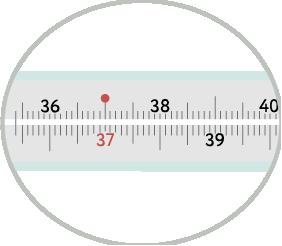
degrees43 degrees
2. Write the temperature that each of these thermometers show.
3. Write the length of the pencil in centimetres and the remaining part in millimetres.
4. Look at the decimal numbers. Write what place each digit is in.
5. Complete the table.
3 tenths
3 hundredths
3 thousandths
3 ten thousandths
3 hundred thousandths
1,00,000
6. Write the decimals for the given number names.
Five and seven hundred seventy-four thousandths
Two hundred thirty-four and nineteen hundredths
Eighty-four and sixty-five thousandths
Eleven hundredths
Twelve and twelve thousandths
7. Match the equal numbers.
8. Complete the table.
Look at the shaded part. Write the fractions with the given denominators for it. Also, write the decimal number that shows the shaded part.
Shaded region:
Colour the boxes that show the correct statements.
10. The numbers that have the same number of digits after the decimal point are called like decimals. Convert each pair of numbers to like decimals.
11. Compare the numbers using <,> or =.
12. Write a number that lies between the given decimal numbers. Fill each blank with the correct digit.
13. Convert the given decimal numbers to fractions. Then compare them with the fractions given in the last column.
14. Mona wants to buy the fruits and vegetables that have the weights closest to what she is thinking of. Connect the correct ones to her cart.
I want a watermelon that weighs eleven kilograms.
I want a melon that weighs four kilograms.
I want a pumpkin that weighs nine kilograms.
15. Meena wrote the nearest whole numbers for the given decimal numbers. Tick the correct answers and cross out the wrong ones.
16. The decimal numbers on the left are rounded to a certain place value. Connect each number to its rounded value. Also match it to the place it was rounded to.
17. Round the numbers in the first column to the given places.
OnesTenthsHundredths
18. Round numbers as per the given conditions.
a) To make pancakes you need 2.4 L of milk. How many 1-litre packs of milk do you need to buy?
b) To make jam you need 3.6 kg of sugar. How many 1-kg packets of sugar do you need to buy?
1. Fill in the blanks.
a)
2. Has John done the correct calculations? Circle the correct answer. Yes Yes No No b) 6.375 2.068 + 8.443 11
2.543 5.329 + 7.862
3. Has John done the correct calculations? Circle the correct answer. Yes Yes No No
4. Match each subtraction to its correct answer.
49.266 + 14.42 =
6.6226 + 55.14 =
23.51 + 562.57 =
771.31 – 456.2 =
64.11 – 23.741 =
512.1 – 24.541 =
344.15 + 13.24 = 51.42 – 24.718 =
6. Gagan multiplied two decimal numbers as shown. Did he put the decimal point in the right place? Circle the correct answer.
7. Multiply. Fill each blue box with the correct digit and place the decimal point in the correct circle.
8. Multiply.
9. Solve.
10. Tick the options that make the given statements correct.
a) If 9 tenths are divided by 3 then you will get
b) If 5 hundredths are divided by 5 then you will get
c) If 3 thousandths are divided by 3 then you will get . . .
11. Divide.
12. Tick the option that makes the given statement correct.
In a division statement the dividend and divisor are multiplied by the same number then the quotient will . increasenot changedecrease
13. In each question, first convert the divisor to a whole number. Then find the quotient.
a) 0.35 ÷ 0.5 = =
c) 0.42 ÷ 0.7 = = 0.35 ÷ 5
b) 5.6 ÷ 0.08 = =
14. To solve the following, you need to make its denominator a whole number.
The easiest way to do this is
0.144 ÷ 0.12
a) multiply both the numbers by 5.
b) multiply both the numbers by 10.
c) multiply both the numbers by 25.
d) multiply both the numbers by 100.
645 × 6.4 =
0.0998 × 9.4 =
9 ÷ 0.12 = 900 ÷ 12 = 315 ÷ 7.2 =
0.25 × 756 =
153 ÷ 2.4 =
0.034 × 48 =
0.6912 ÷ 0.432 =
1. Write the correct word.
This is a line.
This is a line. curved straight point
This is a . In this image all the lines are (straight/curved) lines. The shortest path between the ship and the island is a (curved/straight) line.
2. Choose the correct answer.
Lines and Angles
Answer
3. Choose the correct word.
This is a . It has a starting point but has no end point.
This is a . It has two end points.
Answer line segment ray
4. How many line segments are shown here? Write your answer in the box.
5. How many rays are shown here? Write your answer in the box.
6. The name of a line is usually written using a small English letter. A line segment is named using two capital letters that show its endpoints. What is the name of the line segment shown below? Tick the correct option.
A line is denoted by one small English letter. Also, a line segment can be called by two points that lie on it.
7. Circle all the points that lie on the line d.
8. Draw a straight line that passes through the point A. How many such lines can you draw?
Many straight lines
Only one straight line
can be drawn through a given point. can be drawn through two given points.
No straight line
9. Draw a straight line that passes through the points A and B. How many such lines can you draw?
Many straight lines
Only one straight line
No straight line
Lines and Angles
10. Circle the right answer.
How many different straight lines can be drawn through one point?
How many different curves can be drawn through one point?
How many different curves can be drawn through two points?
How many different straight lines can be drawn through two points?
11. Connect the dots to make a line segment.
12. A ray is denoted by two letters: the first letter shows the starting point of the ray, and the second shows any other point on it. What is the name of the ray shown below? Tick the correct answer.
13. Circle the rays AB and BC.
14. Draw two rays that start from the given point. The shape that you get is an angle.
An angle is a figure formed by rays meeting at a common . two three straight point
15. An angle is denoted by three letters. The letter for the vertex (corner) is written in the middle, and the other two letters show points on the arms of the angle.
Now, tick the correct image of angle whose name is given in each part.
16. Name the parts of the angle shown. Fill in the blanks.
17. Look at the following image and then complete the sentence. Fill in the blanks.
Two rays emerge from point B are: and , so is an angle.
18. Identify the straight angles and the right angles in the following image. Write their names in the spaces provided.
Straight angles:
Right angles:
Lines and Angles
19. Tick the figure that has 4 vertices and 3 sides.
20. Tick the figure that has 5 vertices and 5 sides.
21. Tick the figure that has 3 vertices and 3 sides.
22. Count the number of vertices and sides. Write your answer in the blanks.
23. Colour all the polygons in the picture. vertices sides vertices sides vertices sides
24. Draw an open polygonal chain on the left and a closed polygonal chain on the right. Mark all vertices with red dots and all line segments with blue lines.
25. Tick the name of each of the following shapes.
Triangle Pentagon
Quadrilateral Heptagon
Triangle Pentagon
Quadrilateral Hexagon
Triangle Pentagon
Quadrilateral Hexagon
Lines and Angles
26. Complete the following definitions. Choose correct words to fill the blanks.
1) If of the angles of a triangle is , it is called a right-angled triangle.
2) If of the angles of a triangle is , it is called an obtuse-angled triangle.
3) If of the angles of a triangle are , it is called an acute-angled triangle.
4) If sides of a triangle are , it is called an isosceles triangle.
5) If sides of a triangle are , it is called an equilateral triangle.
Tick all isosceles triangles.
28. Read the two statements given by Kamal and Alex. Which one of them is correct? Tick the right answer.
This is an equilateral triangle, since all sides are equal. It is an isosceles triangle, as it has two equal sides.
Kamal is correct. Alex is correct.
Both are correct.
29. Identify the sides and bases of the following isosceles triangles.
30. The names of four triangles are given below. Look at the image and tick the ones that are obtuse-angled.
31. The names of four triangles are given below. Look at the image and tick the ones that are right-angled.
32. In the figure, equal sides are marked with equal numbers of dashes. The names of four pairs of sides are given below. Tick the pairs in which both sides are equal.
33. Read the two statements given by Ruhi and Rohan about the given shape. Which one of them is correct? Tick the right answer.
This is a rectangle since all angles are right-angled.
This is a square because it has all sides equal and all angles are right angles.
Ruhi is correct.
Both are correct.
Rohan is correct.
34. Tick all rectangles.
35. Colour the shapes in the following images as per these instructions:
Triangles Squares Circles
36. Colour the shapes in the following images as per these instructions:
Triangles Hexagons
37. Colour the shapes in the following images as per these instructions:
Triangles
Rectangles Circles
38. Colour the shapes in the following images as per these instructions:
Triangles Squares Hexagons
1. Write the missing numbers.
a) b) c) a) b)
2. Colour the shapes to continue the pattern.
3. Draw the next shape in each of the following patterns. a) Patterns and
4. Find the pattern and write the missing numbers.
2, 8, 32, 128, 14, 28, 56, 112, 5, 15, 45, 135, 5, 20, 80, 3, 9, 27, 81,
4, 12, 36, 108, 2, 4, 12, 48, 1, 5, 10, 16, 23,
1, 4, 9, 16, 25,
5. Complete the table.
2, 3, 5, 8, 13,
6. Look at the shapes and write whether each one is symmetrical or non-symmetrical.
7. Draw the line or lines of symmetry for each shape. Write how many lines of symmetry each shape has.
a) Lines of symmetry =
b) Lines of symmetry =
c) Lines of symmetry =
d) Lines of symmetry =
8. A mirror is placed along the dotted line. Tick all the pictures that show the correct reflection of the image on the left.
9. Draw the reflection of each figure when it is reflected about the mirror line (dotted line).
1. What is the length of the pencil shown below? Write your answer in the space provided.
2. What is the length of the bottle shown below? Write your answer in the space provided.
3. What is the length of the line segment shown below? Write your answer in the space provided.
4. Tick the line segment that is 7 cm long.
5. What is the length of the pen shown below? Write your answer in centimetres and in decimetres.
6. Convert the following units of lengths. Write correct number in each box. 1 cm cm = dm
a) 3 dm = cm b) 15 dm = cm
c) 40 cm = dm d) 90 cm = dm
7. What is the length of the brush shown below? Write your answer in decimetres (dm) and centimetres (cm).
8. Solve.
The lizard is 2 decimetres long. The snake is 70 centimetres longer than the lizard. How long is the snake? Write your answer in decimetres.
9. Perform the given operations. Write your answers in the spaces provided.
10. Fill in the blanks.
11. Use < , > , = to compare the numbers.
a) 28 mm 3 cm
12. Find the sum.
a) 3 cm 2 mm + 1 cm 4 mm = cm mm
b) 6 cm 7 mm + 2 cm 4 mm = cm mm
13. How long is the table? Write the answer in decimetres (dm) as well metres (m).
14. Find the difference.
a) 4 cm 7 mm – 2 cm 4 mm = cm mm
b) 8 cm 7 mm – 5 cm 9 mm = cm mm
15. Which units of length will fill the given blanks? Tick the correct option.
a) Length of the matchstick is 5 .
millimetres
centimetres
decimetres
b) Height of the tree is 3 .
millimetres
centimetres
decimetres
c) Thickness of the notebook is 7 .
millimetres
decimetres
centimetres metres metres metres Length
16. How long is the street shown below? Write your answer in metres and in kilometres.
17. Look at the following image. How far is the house on the left from the tree? Write your answer in the box.
18. A ladybug moved from the pink flower to the yellow flower. How far did it travel? Write your answer in the box provided.
19. Some units of length are shown below. How many times larger is each unit compared to the next one?

20. A tailor needs 3 m 5 dm of fabric to make a gown. A frock needs 1 m 30 cm less fabric than the gown. How many decimetres of fabric are needed for the frock? Length
21. Some kittens are playing with balls of yarn. The lengths of yarn in the balls are shown below.
a) Sort them from largest to smallest and write the correct lengths in the blanks provided.
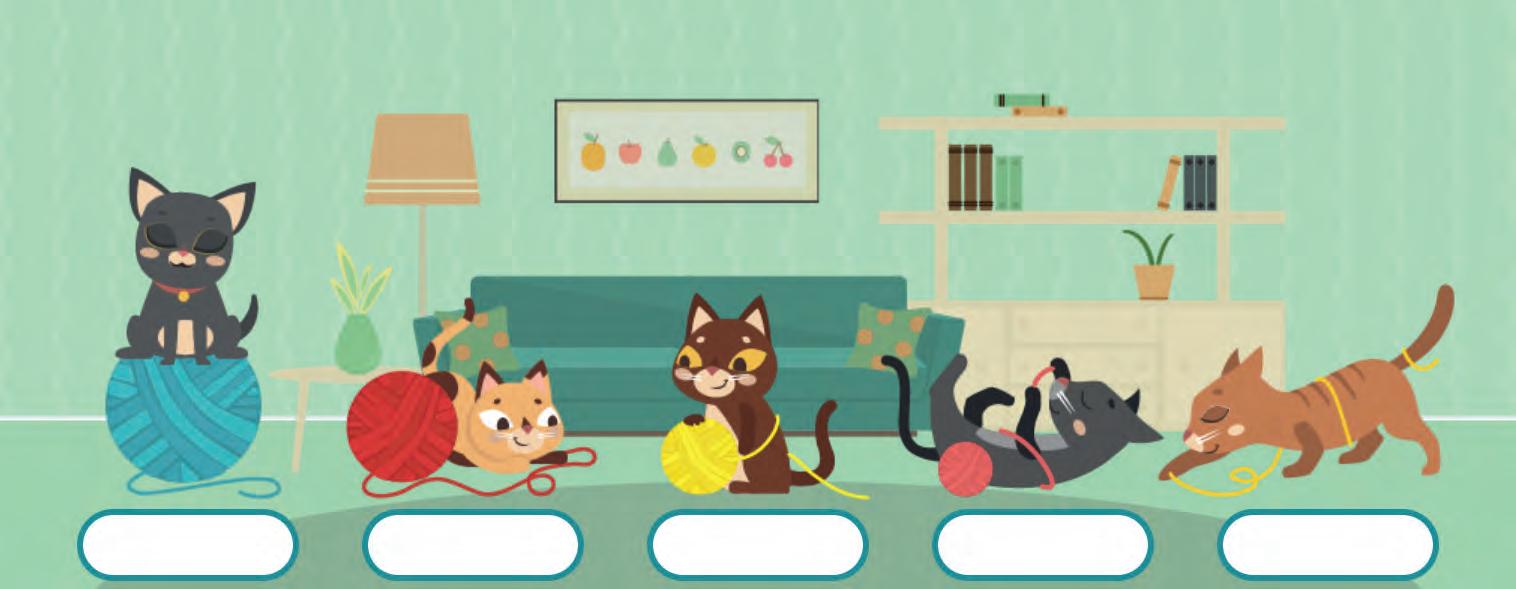
60 mm60 dm700 cm60 cm60 m
b) Sort them from smallest to largest and write the correct lengths in the blanks provided.
50 dm505 cm50 mm50 m50 cm
Length and Weight
a) Three athletes, Alex, John, and Max, took part in a jumping competition. Alex jumped 13 dm. John jumped 8 cm more than Alex. Max jumped 1 dm 3 cm more than John. How far did Max jump?
Write the answer in metres and cm in the given boxes.
Answer: m cm
b) Three gnomes Dori, Nori, and Ori were spinning wool into yarn. Dori made 5 m 6 dm, Nori made 2 m 3 dm, and Ori made 40 dm of yarn. How much yarn did they make altogether?
Write the answer in metres and cm in the given boxes.
Answer: m cm
Length and Weight
23. Look at the weighing scales. What is the weight of each ostrich egg? Write your answers in the given boxes.
24. Convert the given weights into the units shown. Write your answers in the boxes. a) b) c) 5,800 g = kg g
3 kg 750 g = g 16,000 g = kg 6 kg 800 g = g 3,650 g = kg g
16 kg 700 g = g Length and Weight
25. Look at the objects shown. Complete the sentences about their weights by ticking the correct units.
a) The weight of a loaf of bread is about 450 .
c) An ear of corn weighs about 300 . kilograms grams kilograms grams kilograms grams
b) Asian elephant weighs about 2700 .
Length and Weight
PERIMETER
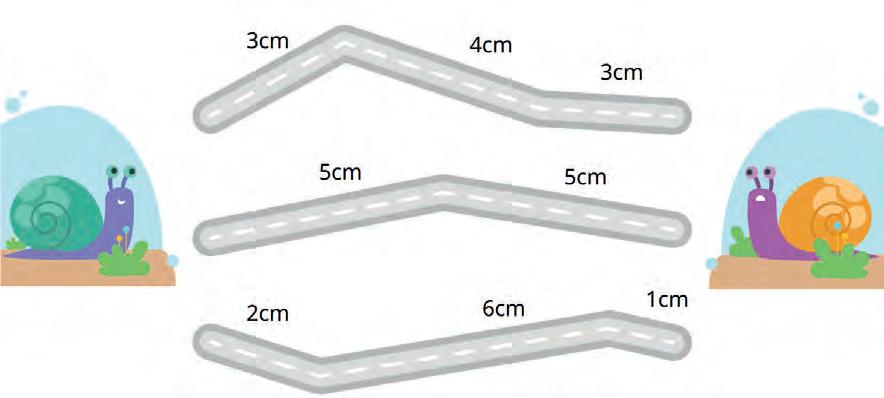
1. The two snails shown below want to meet. Tick the shortest path they should take.
2. Draw a shape made up of three line segments such that:
The first line segment is 3 cm long, the second line segment is 4 cm long and the third line segment is 2 cm long.
Perimeter and Area
3. Which of the three twisted wires, when straightened, will be equal in length of the straight wire shown above them? Tick the correct answer.
4. Look at the figure given below. Then complete the sentence by filling in the missing number. The perimeter of the figure is m. 5 m 10 m
5. Look at the three figures given below. Then complete the sentences by filling in the missing numbers.
a) The perimeter of the triangle is
b) The perimeter of the quadrilateral is
с) The perimeter of the pentagon is
6. Find the perimeter of the shape shown below.
7. Look at the figures given below. Then complete the sentences by filling in the missing numbers.
a) The perimeter of the square is
The area of the square is
b) The perimeter of the rectangle is
The area of the rectangle is
8. Complete the formulas for finding the perimeter and area of a rectangle. Next, use these formulas to find the perimeter and area of the rectangle shown below. Write your answer in the boxes.
1) Perimeter = AB +
2) Area = AB × + = ++ + × + = = cm2 = cm Perimeter and Area
9. The following rectangle and the square have the same perimeter. Use this information to complete the sentences given below.
1) The perimeter of the square is
2) Hence, the perimeter of the rectangle is
3) The unknown side of the rectangle measures cm.
4) The area of the square is
5) The area of the rectangle is
10. Find the perimeter and the area of the following figure. Write your answers in the given boxes.
a) a glass
1. Tick the vessel that has more water.


2. Tick the amount of water that each of the following vessels can hold.
b) a vase c) a pool
3. There were 7 litres of juice in the jar. The juice was poured into two glasses shown. How much juice was left in the jar?
There was L of juice left in the jar.
4. Look at the image below. How many litres of juice are needed to fill the smaller vessel? After filling the smaller vessel, how much juice will be left in the larger vessel? Write your answers in the given boxes.
The amount of juice needed to fill the smaller vessel = L
The amount of juice left in the larger vessel = L
5. Look at the image below. The juice from the larger vessel is poured into the smaller one to fill it. How much juice will be left in the larger vessel?
Amount of juice left in the larger vessel = L.
6. Look at the formula used to calculate the volume of cuboids. Use it to find the volume of the given cubes. Write your answer in the given boxes.
V = l × b × h
7. Count the number of unit cubes in each of the following figures. Write the volume of each figure in the given box.
a) V = unit cubes.
b) V = unit cubes.
c) V = unit cubes.
d) V = unit cubes.
1. How many faces, edges, and vertices do the following shapes have? Write the correct numbers in the table given below.
Square pyramid Triangular prism Cylinder
Cone Name
2. Draw a cube on the following square grid.
3. Which of the following nets will fold into a cube? Tick the correct ones.
4. Draw the net of a cylinder in the grid given below.
5. Draw the net of a square pyramid in the grid given below.
6. If you look at the figure on the left from the top, which view will you see? Tick the correct answer.
7. In the images given below, connect each blank space to the correct name of the direction.
8. Look at the following map of a locality. Use it to complete the given sentences.
The museum is to the of the school.
The market is to the of the school.
The circus is to the of the school.
The hospital is to the of the market.
The tyre centre is to the of the school.
1. Solve the problem.
TIME
Kiran spent 25 minutes on Math homework, 20 minutes on Science homework, and 15 minutes on English homework. How many hours did Kiran spend on homework in total?
Write your answer in the given box.
Total time spent on homework = hours
2. Complete the following sentences by choosing the appropriate units of time.
a) The summer break at the school usually lasts for 5 .
b) Travelling by train from Guwahati to New Delhi takes about 32 .
c) The world record for the 100 m race is about 10 .
Time and Temperature
3. What time does each of the following clocks show? Tick the correct answer.
19 : 21
3 h 53 min quarter past twelve 9 : 21 10 h 15 min quarter to one 4 : 47 10 h 30 min noon
4. It takes 1 hour 40 minutes to prepare a recipe and 1 hour 5 minutes to cook it. If you want the dish to be ready at 1:55 p.m., what time should you start preparing it?
Answer: I need to start preparing at
5. A shuttle bus leaves from the starting point at 15:40. It takes 2 hours 20 minutes to reach its destination. After stopping there for 30 minutes, it returns to the starting point in 1 hour 50 minutes. What time does the bus arrive back at the starting point?
6. Compare the given durations of time. Write <, = or > in the given boxes.
a) 1 day 2 h 25 h
b) 190 sec 3 min 20 sec
c) 4 h 45 min 275 min
d) 3 min 5 sec 180 sec
Time and Temperature
7. Look at the thermometer. What is Sara’s body temperature? Tick the correct answer.
I have a body temperature of thirty seven point two degrees.
8. Connect each of the following things to its possible range of temperatures.
–25 °C to –18 °C
1. Complete the table by converting the given amounts of money. Write each amount in rupees or paise as required.
Amount in Rupees
₹ 4.57
₹ 10.20
Amount in Paise 457 p 599 p 702 p
2. Solve using the Unitary Method.
a) The cost of 4 books is ₹1,600. Find the cost of 7 such books.
b) The cost of 7 kg of apples is ₹490. Find the cost of 3 kg of apples.
3. It costs a factory ₹15 to make a pen. The factory produces 1,000 pens in a day. If each pen is sold for ₹20, find the profit the factory earns in one day.
4. Raj wants to buy a TV priced at ₹21,000. On the store’s 15th anniversary, a discount of ₹1,500 is offered on all the TVs. How much will Raj pay if he buys the TV on that day?
5. Gita wants to buy some ice-creams. She has ₹120. If each ice-cream costs ₹23, how many ice-creams can she buy?
6. Vivan lent his friend ₹600. For each day the friend delays returning the money, the amount increases by ₹5. How much should the friend return if he is late by two weeks?
7. Look at the following rate list at a store.
Price
₹ 50 per kg
₹ 54 per litre
₹ 55 per kg
₹ 45 per kg
You bought 3 kg of apples, 2 litres of milk, and 5 kg of potatoes. How much money will you pay?
a) The chart shows the lifespans of different animals. Use it to find how many years a wolf lives for. Tick the correct answer.
b) The chart shows how many candies different children collected on Halloween. Which child collected 44 candies? Tick the correct answer.
a) The chart shows the amount of rainfall (in mm) in Mumbai for each month of the year. How much rainfall was there in May? Tick the correct answer.
b) The chart shows how many hours a day different animals sleep. Which animal sleeps the least? Tick the correct answer.
3. The following chart shows the scores of four teams in a quiz competition. Look at this chart and fill the correct rank of each team in the box provided next to it.
— Team 1 place
— Team 2 place
— Team 3 place
— Team 4 place
4. This chart shows the life expectancy of different animals.
Life expectancy
Indian elephant
Dog
Cockatoo
Python
Cat
Which animal will be in the 4th place when they are arranged from the longest to the shortest life expectancy? Write your answer in the box provided.
Answer:
5. Look at the graphs and answer the questions.
a) The graph shows how the price of the raincoat changed over several months.
How much did the raincoat cost in September?
Write your answer in the given box.
b) The graph shows how the population of red wolves in the zoo increased over the years.
How many wolves lived in the zoo in 2013?
Write your answer in the given box.
6. Look at the graphs and answer the questions.
a) The graph shows how the Earth's population changed during the second half of the 20th century.
How many millions of people lived on the Earth in 1970?
Tick the correct answer.
b) The graph shows the number of countries that took part in the Winter Olympics in different years.
In which year did 82 countries participate?
Tick the correct answer.
7. Look at the graphs and answer the questions.
a) The graph shows how the area of the Aral Sea changed due to the negative impact of human activities.
What is the smallest area of the Aral Sea? Tick the correct answer.
b) The graph shows how the temperature changes in the Sahara Desert during various times of a day.
At what time is the air temperature the lowest? Tick the correct answer.
c) The graph shows how the altitude of a helicopter changed during its flight.
How many minutes after take-off did the helicopter reach its highest altitude? Tick the correct answer.
(minutes after take-off)
1. NUMBERS UP TO 8 DIGITS 1–9
1. b) 3000+ 700 + 10 + 2
c) 20,000 + 3000 + 800 + 10 + 7
d) 40,000 + 5000 + 1
e) 40,00,000 + 4,00,000 + 40,000 + 4000
f) 9,00,000 + 80,000 + 2000 + 900 + 30
g) 1,00,00,000 + 20,000 + 3000 + 300 + 40 + 5
2. b) 9 c) 40,000 d) 0 e) 100 f) 4,00,000
3. 4 — crores period, 18 — lakhs period, 91 — thousands period, 549 — ones period
4. 20,15,348 │ 90,10,100 │ 1,67,001 8,34,72,811
5. a) Ten lakh ninety-three thousand eight hundred twenty-seven. 10,00,000 + 0 + 90,000 + 3,000 + 800 + 20 + 7
b) Fifty-four thousand three hundred fifty-four. 50,000 + 4,000 + 300 + 50 + 4
c) 3,80,008 Three lakh eighty thousand eight. 3,00,000 + 80,000 + 0 + 0 + 0 + 8
6. 60 — billion period, 879 — millions period, 344 — thousands period, 154 — ones period
7. 419,526 │ 1,200,000 │ 700,044,193 15,000,024
8.
9. 4,562,817 — Four million five hundred sixty-two thousand eight hundred seventeen. 4,000,000 + 500,000 + 60,000 + 2,000 + 800 + 10 + + 7
41,002 — Forty-one thousand two. 40,000 + 1,000 + 0 + 0 + 2
10. b) 7,56,29,000 │ 75,629,000
c) 1,93,64,067 │ 19,364,067
d) 6,72,65,901 │ 67,265,901
11. a) 56,78,354 > 4,85,922 > 34,563 > > 8,234
b) 23,34,245 > 17,74,732 > 8,28,135 > > 9,183
c) 4,65,13,450 > 99,99,999 > 5,35,452> > 34,462 3 7 7 5 9 6 hundredthousands hundreds tenthousands tens thousands ones
12. a) 32,933 < 32,943
b) 3,45,891 > 39,999
c) 7183 < 7283
d) 50,19,341 < 50,19,342
e) 2,52,56,235 > 3,44,714
f) 93,37,348 > 93,07,348
h) 68,26,005 < 68,26,105
i) 10,00,00,001 < 10,00,00,002
13. 2157 ≈ 2160 │ 2159 ≈ 2160 2154 ≈ 2160 │ 4534 ≈ 4500 4592 ≈ 4600 │ 4504 ≈ 4500 4247 ≈ 4000 │ 4671 ≈ 5000 4737 ≈ 5000
14. 1246 ≈ 1200 │ 8256 ≈ 830 5482 ≈ 5500 │ 3078 ≈ 3080
15. a) 193 g b) 368 g c) 285 g
16. City
Guwahati
Chandigarh
Moradabad
Bhiwandi
Noida
Asansol
Kurnool
Dhule
Population To hundreds To thousands
Purnia 9,63,429 9,60,787
2. OPERATIONS ON LARGE NUMBERS 10–23
1. 1st column: 481 │ 502 │ 991
741 │ 443 │ 214
2nd column: 521 │ 519
686 │ 509 │ 410 │ 379
2. 27 kg 4. 7900 m
3. a) 3771 b) 42,507 c) 75,243
d) 9,73,127 e) 13,24,797 f) 44,345
g) 1,01,922 h) 4,35,242
5. a) 2356 + 241 = 2597
b) 5124 – 4563 = 561
c) 4829 + 381 = 5210
d) 7834 – 2656 = 5178
e) 9,45,340 + 10,029 = 9,55,369
f) 1,48,548 – 64,231 = 84,317
g) 3,64,734 + 5,38,841 = 9,03,575
h) 2,89,022 – 1,80,926 = 1,08,096
6. 3452 + 4882 → 8334
54,345 – 8817 → 45,528
7509 + 8010 → 15,519
8162 – 482 → 7680
7. 570 kg
8. Amit — 5 , Dinesh — 15, Sahil — 8, Keshav — 13
9. 1st column: 59,395 │ 35,755
8,01,233 │ 49,563 2nd column: 40,766 │ 21,619 │ 64,708 │ 38,649
10. 1st column: 21,518 │ 34,221
4,20,689 │ 54,076 2nd column: 42,193 │ 70,560 │ 53,037 │ 78,704
11.
12. a) 73,000 b) 37,100 c) 9180 d) 43,770 e) 20,500 f) 40,000
14. a) 3630 b) 5780 c) 6,73,010
d) 4065 e) 7300 f) 808
15. 54 m
16. 153 tonnes 17. 24
18. 1st column: 13,872 │ 11,229
14,872 │ 58,368 2nd column: 7704
14,964 │ 14,140 │ 2493 3rd column: 25 │ 16 │ 253 │ 39
19. 1st column: 35,504 │ 52,479
19,143 │ 8733 2nd column: 15 │ 439
503 │ 56 3rd column: 18 │ 26 │ 27 │ 91
20.
2 4 1 d) 72 – 7 × 6 – 54 ÷ 9 4 2 1 3 e) 56 – 7 × 6 ÷ 2 + 14 3 4 1 2 f) 43 + 12 – 12 ÷ 4 × 3
23. First perform division and multiplication from left to right, and then addition and subtraction from left to right.
24. 10 trip, 12 people
25. a) 25 ÷5 + 7 = 12 b) 3 × 6 + 5 = 23 c) 7 + 4 × 3 = 19
(Remainder = 3)
(Remainder = 0)
(Remainder = 1)
21. 14 cannot be divided by 4
22.
(Remainder = 2) a) 24 + 2 × 5 – 12 ÷
15 cannot be divided by 4
16 can be divided by 4
17 cannot be divided by 4
3
4 × 4 – 12 + 3 × 8
1 3
c) 24 – 25 ÷ 5 + 10 × 3
3. FACTORS AND HIGHEST COMMON FACTOR 24–32
1. Possible answers:
│ 4, 18 │ 6, 12 │ 8, 9 2. 2
3. b) composite c) prime d) composite
4. 42: 3 × 7 × 2 │ 3 × 2 × 7 │ 7 x 3 x 2 99: 3 × 3 × 11 │ 3 × 11 × 3 │ 11 × 3 × 3
5. 459 153 3 3 3 51 17
Possible answer.
17. Missing factors of 6: 2, 3
Missing factors of 10: 5
Common factors: 1, 2
HCF = 2
18. Missing factors of 15: 3
Missing factors of 16: 4, 16
Common factors: 1
So, 459: 1, 3, 9, 17, 27, 51, 153, 459
6. 10, 20, 30, 40, 50
7. a) False b) True c) True
8. 5, 10, 15, 20, 25, 30, 35, 40, 45, 50
9. a)True b) False c) True
10. 22, 24, 26, 28, 30, 32, 34, 36, 38, 40, 42, 44, 46, 48, 50
11. a) True b) False c) True
12. 1) last digit 2) sum of digits 3) last digit 4) sum of digits 5) last digit
13. Possible answer. 240 │ 420 │ 480 │ 840
14. Possible answer. 12 │ 21 │ 102 │ 120 │ 201 │ 210
15. Possible answer. 24 │ 42 │ 54 │ 552
16. Missing factor of 12: 3, 12
Missing factor of 8: 2
Common factors: 1, 2, 4
HCF = 4
HCF = 1
19. Highest Common Factor
20. b) 2 c) 6 d) 2 e) 5 f) 3 g) 7 h) 10
4. MULTIPLES AND LEAST COMMON MULTIPLES 33–35
1. 2, 4, 6, 8, 10, 12, 14
4, 8, 12. ( 4 )
2. Possible answer. a) 12 │ 24
b) 23 │ 46 c) 49 │ 98 d) 50 │ 100
e) 64 │ 128 f) 75 │ 100 g) 99 │ 198 h) 150 │ 200
3. Missing multiples of 4: 12, 20, 28, 32, ...
Missing multiples of 6: 12, 24, 42, 48, ... Common multiples: 12, 24, 36, ...
LCM = 12
4. Missing multiples of 3: 6, 9 21, 24, ... Missing multiples of 2: 4, 12, 14, 16, ... Common multiples: 6, 12 18, ...
LCM = 6
5. Missing multiples of 5: 5, 20, 35, 40, ... Missing multiples of 3: 6, 9, 21, 24, ... Common multiples: 15, 30, 45, ...
LCM = 15
6. Lowest Common Multiple
7. b) 12 c) 15 d) 20 e) 35 f) 24 g) 99 h) 60
4. a) whole part b) numerator
c) denominator d) fraction part
e) fraction bar f) mixed fraction
5. Four wholes three fourths
5. FRACTIONS 36–50 6.
7. Proper
Improper
10. Possible answer: C D A B 9.
24. a) 25. a)
27. a) Yes b) No
22. 23. a) 1. a)
a) Yes b) No
Five and seven hundred seventy-four thousandths
Two hundred thirty-four and nineteen hundredths
Eighty-four and sixty-five thousandths
Eleven hundredths
and twelve thousandths
12. 1) 0.726 < 0.734 < 0.738
2) 9.21 > 9.14 > 9.11
3) 83.39 < 83.40 < 83.41
4) 57.2 < 57.3 < 57.4
5) 82.406 < 82.506 < 82.606
18. a) 3 b) 4
8. OPERATIONS ON DECIMALS 66–74
14. a) 10.724 kg b) 4.05 kg c) 8.691 kg
4.678 ≈ 4.68 → to hundredths
7.264 ≈ 7.3 → to tenths
3.231 ≈ 3 → to ones
0.40773 ≈ 0.408 → to thousandths 0.75 =
2. a) No b) Yes
3. a) No b) Yes
4. 6.749 – 3.425 → 3.324
5.154 – 4.732 → 0.422
9.648 – 8.324 → 1.324
7.106 – 4.683 → 2.423
5. 1st column:
63.686 │ 61.7626 │ 586.08 │ 357.39
2nd column: 26.702 │ 315.11
40.369 │ 487.559
6. a) Yes b) No c) No
8. 1st line: 8.08 │ 9.99 │ 4.2
2nd line: 8.24 │ 6.82 │ 4.14
9. LINES AND ANGLES 75–92 4 9 5 h) 6. .4 1. 2 8 4 1 24 –
7. a) 1.4 2.3 22 3 42 28 × + . b) 3.5 2 8.7 20445 16 45 1808 × + .
9. 1st column: 3137.1 │ 52510
4243 2nd column 921.52 │ 0.004781 2.385
10. a) 3 tenths b) 1 hundredth c) 1 thousandth
11. 1st line: 1.11 │ 3.12 │ 2.14 2nd line: 2.07 │ 1.32 │ 22.1
12. not change
13. a) 0.35 ÷ 0.5 = 3.5 ÷ 5 = 0.7
b) 5.6 ÷ 0.08 = 560 ÷ 8 = 70 c) 0.42 ÷ 0.7 = 4.2 ÷ 7 = 0.6
14. d) multiply both the numbers by 100
15. 1st column: 4128 │ 0.93812 │ 189 │ 1.632 2nd column: 75 │ 43.75 │ 63.75 │ 1.6
1. point │ curved │ straight
2. Curved │ Straight
3. ray │ line segment 4. 6 5. 4
6. a; CD 7. D; K; E
8. Many straight lines
9. Only one straight line
10. Many │ Many │ Many │ One
12. АС 13.
14. two; point
15. a)
16. BA is an arm. BC is an arm. B is a vertex.
17. BA; BC; ABC
18. Straight angles: ABC or CBA; NBM or MBN; Right angles: NBC or CBN; MBC or CBM; ABM or MBA; ABN or NBA.
19.
20.
21.
22. 1st figure: 3; 3
2nd figure: 4; 4
3rd figure: 5; 5
23.
24.
Sample answers.
25. Pentagon; Hexagon; Quadrilateral
26. 1) one, right-angle
2) one, greater than a right-angle
3) all, smaller than a right-angle
4) two, equal 5) all, equal
27.
28. Both are right
29. a) AB, BC: side AC: base
b) FD, DE: side FE: base
30. ACD; COD 31. ESK; CBO
32. CO and CD; AB and AE
33. Both are correct.
10. PATTERNS AND SYMMETRY 93–98
1. a) 100 │ 250 b) 15 │ 20 │ 35 c) 500 │ 1500 │ 3000
2. a) b)
36.
4. 1st column: 512 │ 405 │ 243 240 │ 36 2nd column: 224 │ 320 324 │ 31 │ 21
5. 1st column: 16 │ 256 │ 1024 2nd column: 25 │ 125 │ 625 3rd column: 100 │ 1000 │ 1,00,000
6. a) symmetrical b) nonsymmetrical c) symmetrical d) non-symmetrical
7. a) 2 b) 1 c) 0 d) Many lines of symmetry
10. The stool is shorter than the table by 30 cm.
11. a) 28 mm < 3 cm
b) 13 mm > 1 cm
c) 30 mm < 3 dm
d) 45 cm > 4 dm
8. a, c, d
11. LENGTH AND WEIGHT 99–111
1. 7 cm 2. 4 cm 3. 6 cm 4.
e) 900 mm = 9 dm
f) 57 mm < 7 cm
12. a) 4 cm 6 mm b) 9 cm 1 mm
13. 10 dm = 1 m
14. a) 2 cm 3 mm b) 2 cm 8 mm
15. a) centimetres
b) metres c) millimetres
16. 1000 m = 1 km 17. 25 m
18. 11 dm
5. 10 cm = 1 dm
6. a) 3 dm = 30 cm c) 40 cm = 4 dm
b) 15 dm = 150 cm d) 90 cm = 9 dm
7. 1 dm 2 cm 8. 9 dm
9. 20 cm – 10 cm = 1 dm
50 cm + 3 dm = 8 dm
5 dm + 4 dm = 90 cm
6 dm – 10 cm = 50 cm
20. 22 dm
21. a) 60 m; 700 cm; 60 dm; 60 cm; 60 mm
b) 50 m; 505 cm; 50 dm; 50 cm; 50 mm
22. a) 1 m 51 cm b) 11 m 90 cm
23. a) 2 kg b) 1 kg
24. a) 5800 g = 5 kg 800 g
6 kg 800 g = 6800 g
b) 3 kg 750 g = 3750 g
3650 g = 3 kg 650 g
c) 16000 g = 16 kg
16 kg 700 g = 16700 g
25. a) grams b) kilograms c) grams
12. PERIMETER AND AREA 112–116
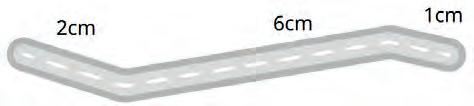
2. Possible answer:
3. a)
6. 30 m
5. a) 16 cm b) 19 cm c) 23 cm
6. 24 cm
7. a) 16 cm; 16 cm² b) 20 cm; 24 cm²
8. 1) Perimeter = AB + BC + CD + DA = = 8 + 11 + 8 + 11 = 38 cm 2) Area = AB × BC = 8 × 11 = 88 cm²
9. 1) 24 cm 2) 24 cm 5) 35 cm² 3) 7 cm 4) 36 cm²
10. Perimeter = 62 m Area = 165.5 m² 1. Right;
13. CAPACITY AND VOLUME 117–120

2. a) 200 ml b) 5 l c) 13 kl
3. 3 L 4. 2 L, 2 L 5. 3 L
6. 1st figure: V = 4 × 3 × 5 = 60 m³ 2nd figure: V = 10 × 2 × 3 = 60 m³
7. a) 10 b) 11 c) 19 d) 27
14. 3-D SHAPES ON FLAT SURFACES 121–126
2. Possible answer:
3. a; b; c; e; f; h
4. 6. b
7. 5. Possible answer:
4. 11:10 a.m. 5. or 8:20 p.m.
6. a) 1 day 2 h > 25 h
b) 190 sec < 3 min 20 sec
c) 4 h 45 min > 275 min
d) 3 min 5 sec > 180 sec
7. 37.2 degrees
8. Ice Less than 0℃
Freezer –25 °C to –18 °C
Weather –20 ℃ to 50℃
Water 0 ℃ to 100℃
Oven 150 ℃ to 250℃
8. north northeast northwest northwest southeast
15. TIME AND TEMPERATURE 127–130
1. 1 hour
2. a) weeks b) hours c) seconds
3. a) 9:21 b) 10 h 15 min c) quarter past twelve
16. MONEY 131–133
1. ₹ 4.57 → 457 p; ₹ 5.99 → 599 p; ₹ 10.2 → 1020 p; ₹ 7.02 → 702 p
2. а) ₹ 280 b) ₹ 210 3. ₹ 5000
4. ₹ 19,500 5. 5 6. ₹ 670 7. ₹ 483
17. DATA HANDLING 134–140
1. a) 17 b) Alex 2. a) 54 b) 6
3. Team 1 — 3rd place; Team 2 — 2nd place; Team 3 — 4th place; Team 4 — 1st place
4. cat 5. a) 400 b) 12
6. a) 3600 b) 2010
7. a) 8000 km² b) 6 o’clock c) 50 min