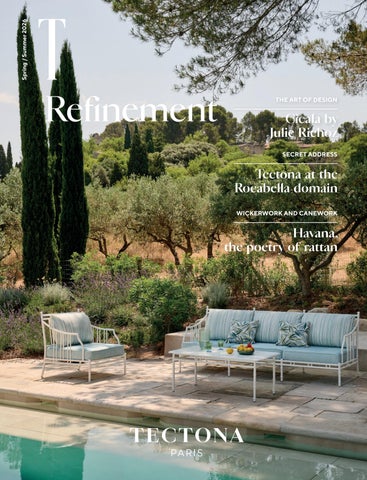
Magazine T - Spring / Summer 2026

Page 1


Refinement

WICKERWORK AND CANEWORK

Richoz

Refinement

On the cover of T Magazine, the new Bamboo collection heralds an edition where design is the common thread linking our featured furniture. The white aluminium structure exudes nonchalance and lightness of spirit, ideal for spending sunny days outdoors indulging in farniente.

We encounter Julie Richoz and a new lounge, the latest instalment of her Cicala collection. Her signature style, precise and poetic lines, sparkles. The ethereal grace of the polished stainless steel structure complements the discreet sturdiness of the teak slats. Generous proportions allow for generous cushions, for optimal comfort.

New destination! After Japan, the Osaka 25 chair, designed by Jean-Baptiste Fastrez and fabricated by Tectona in partnership with Mobilier National, has a new home at Villa Hegra, in AIUIa, Saudi Arabia. The collection consists of stackable chairs and bistro tables, in aluminium and ash wood, and is available in garnet, ivory and green – three colours that reflect the mineral decor of this archaeological jewel featuring hundreds of monumental tombs with ochrered facades sculpted in sandstone. Villa Hegra opened in 2025 and, like Villa Medici in Italy and Villa Kujoyama in Japan, hosts artists. It joins the international network of French residences.

We return to France for a discreet and enchanting visit to the Rocabella domain, six hectares situated on a cliff overlooking the Mediterranean. The initiated are not inclined to oversharing the address of this extraordinary site, a witness to the Belle Époque, divided into La Folie, Temple and a cottage… Its restoration called on some of Tectona’s iconic pieces and its core materials: teak, aluminium and woven resin.

The Glenwood bench saga continues, now highlighting the French-style gardens of Château de Chambord. The gardens were restored in 2017, and have reached their full splendour today with in particular around 618 trees and 840 shrubs. Dispersed along the paths, Glenwood benches offer visitors a wide deep seat, a high comfortable backrest and gently curved armrests for optimal comfort. Glenwood benches are fabricated using the best woodworking practices and they are made from teak so they will withstand the elements and the passage of time, marked only by a graceful mild silvery patina. Prestigious sites have made the benches their own: in the garden of Musée Rodin in Paris, the benches have been providing rest for visitors since the 1980s.

Woven plant fibres and craftsmanship make an entrance in Tectona. We wanted to showcase rattan, prized for its flexibility and lightness. We created the Havana dining set, a tribute to the rattan creations of Perret & Vibert that were in vogue around the 1890s. The collection is intended for winter lounges, conservatories and patios; in the summertime it can be used outdoors (but keep it away from rain!). A flower basket, in woven wicker with gently curved lines, is perfect for those who want to create their own bouquets.

We end this edition with a new selection of products for spring/summer 2026.

Contemporary refinement Cicala, a new installment

The young French-Swiss designer Julie Richoz expands the Cicala collection with a comfortable and welcoming lounge tailor-made for long summer days, a veritable invitation to live in the present moment. The collection subtly blends materials and volumes.

MATERIALS AND LIGHT

Cicala, “cicada” in Italian, is an allusion to the summer, to idling time away outdoors under the sun. Via the precise contours of her design, Julie Richoz evokes a lifestyle that is both elegant and relaxed.

Julie Richoz founded her design studio in Paris around ten years ago to explore and experience every facet of her discipline, everything from unique pieces to industrial products, from objects to textiles. She is known for her mastery of materials, which she handles with precision, and her highly developed sense of detail – these qualities underpin her signature style, a blend of rigour and poetry that remains resolutely contemporary. She shares: “Tectona were one of the first brands to commission me. For Cicala, the idea was to create a bridge between Tectona’s more classic collections and a modern language”. By combining the sturdiness of wood with the aerial tension of stainless steel, she managed to imbue teak with an unprecedented lightness. The subtle balancing act lends a timeless refinement to the design.

AN INVITATION TO SLOW DOWN

The new lounge consists of a sofa and stackable low armchairs with generous and welcoming proportions, an intentional design goal that was achieved without sacrificing the sensation of lightness in space. The overall effect is to draw you in, to invite you to take a break and, in the designer’s words, “to sink into your seat”. Another of her goals was to imbue the lounge with the carefree essence of summer days – mission accomplished we say! Who would not want to luxuriate in the Cicala lounge?

The warmth of the teak balances the modernity of the polished stainless steel, a new Tectona finish with a subtle lustre. The fine, contoured lines of the pieces effortlessly blend in with the environment. “The defining feature of the lounge is a structure that is both legible and light, thanks to the interplay of the teak slats and the polished stainless steel”, explains the designer. This airy material confers a beautiful contemporary look to this collection. The other pieces in the collection – a table for two and stackable armchairs, also in polished stainless steel – are a further reason, if one was needed, to extend your time outdoors.

With its discreet elegance and inspired choice of materials, the Cicala collection by Julie Richoz is guaranteed to bring joy, year after year. She adds, with a sparkle in her eye, “The stainless steel and the teak slowly form a patina, giving rise to more colour combinations over time”. The effortless and timeless nature of the Cicala collection perfectly encapsulate the desire, so dear to Tectona, to offer furniture that stands the test of time.

STACKABLE ARMCHAIR

CICALA COLLECTION

58,5 × 52 cm

ROUND TABLE

CICALA COLLECTION

⌀ø 80 cm

Villa Hegra

Osaka-AlUla,

a one-way ticket to culture.

Photographs by

The bistro chair Osaka 25 by Jean-Baptiste Fastrez, designed for the France Pavilion at the Osaka 2025 World Expo, can be seen in the café of Villa Hegra, a new French-Saudi artist’s residence in AlUla.

VILLA HEGRA, A FRENCH RESIDENCE AT THE HEART OF ALULA

When it opened its doors in October 2025, Villa Hegra, in northwest Saudi Arabia, officially joined the international network of French residences abroad. For sure, the institution is less well-known than its older mythical stablemates, Villa Medici in Rome and Villa Kujoyama in Kyoto. But it has already become an integral part of this booming destination. Villa Hegra is far more than an artist’s enclave; it is a multidisciplinary cultural hub in the urban heart of AlUla where inhabitants and visitors alike can take the pulse of the local creative scene.

Two renovated buildings, connected by a botanical courtyard, host five modular workshops, exhibition rooms, performing art studios, a covered cinema and a café that is fast becoming the place to be and be seen.

OSAKA 25, A NOMADIC COLLECTION

This location has become the backdrop of the Osaka 25 collection by JeanBaptiste Fastrez: bistro chairs with matching tables, compact and stackable. Why Osaka? Tectona, in partnership with Mobilier National and Villa Noailles, created the collection specifically for the France Pavilion at the 2025 World Expo in Osaka, Japan.

The principle is intentionally elementary: a structure made from metallic tubes and a seat in solid wood. The unfussy design is intended to adapt to every use and context, outdoors and indoors. “It’s a universal chair,” sums up the designer. And it’s precisely this simplicity that allows the chair to travel so easily.

Though originally designed to symbolise the ties between the Japanese and French cultures of excellence, the collection is also a natural fit in the mineral decor of AlUla, located among ochre sandstone mountains that resemble citadels breaking up the vastness of the desert. At sunset, their burnt-copper silhouettes appear behind the patios of the Villa, while the chairs, arranged as a counterpoint, seem to extend the rocky verticality.

In combination, the aluminium tubes and ash wood achieve the perfect equilibrium between robustness and lightness, sensuality and fantasy. As for the silhouette, which is both figurative and abstract, it lends itself to a multitude of interpretations according to one’s cultural background: for some, the slender lines of the backrest resemble a leaping frog; for others, the alternating lines are a rhythm evoking calligraphy or a stave.

SHADE, COLOUR, A MEETING PLACE

The palette of the collection is in consonance with the surrounding desert hues: in addition to the original black, there is a deep garnet, a warm ivory and a muted palm green – the last a nod to a land of oases, where pilgrims stopped on the way to Medina or Mecca. Visitors today will find a warm welcome and respite from the heat but also a hotbed for the cross-fertilisation of ideas and creativity. Until its relocation to the future building imagined by Lacaton & Vassal a few hundred metres away, it remains possible to watch artists as they work, to participate in family workshops or simply to sit down and sip a freshly squeezed fruit juice.

STACKABLE ARMCHAIR

OSAKA 25 COLLECTION 53 × 53 cm STACKABLE CHAIR OSAKA 25 COLLECTION 46 × 53 cm

STACKABLE TABLE

25 COLLECTION 72 × 76,5 cm

Summertime at Rocabella

For Rocabella, the architect Mathilde Grouvel imagined spaces in harmony with the site’s refined charm, a term that also aptly describes Tectona furniture. To amplify the Mediterranean lifestyle, synonymous with enjoying life outdoors, the founder of M | A | G Designs opted to combine the three materials favoured by Tectona: teak, aluminium and woven resin. A winning combination sublimated by the architect.

A BELLE ÉPOQUE BACKDROP

The sky, the sun and the Mediterranean come together at Rocabella. On the upper terrace, Roma parasols welcome you. Everything here is about refinement and intimacy. The address of the exclusive domain is shared with parsimony, like a family secret. A discretion appreciated by the initiated. People living in the surrounding area, in Le Pradet, between Pointe Sainte-Marguerite and Cap de Carqueiranne, very often are unaware of the existence of the vast historic residence dating from 1897. Hans-Georg Tersling – a Danish architect and leading proponent of the Riviera style who was noted by Empress Eugenie and who knew how to skilfully combine, with romanticism, the orientalist, neoclassic and floral expressions so cherished in the Belle Epoque – built this village for the industrialist Jules Hippolyte Petin and his family. The main building, aptly named La Folie, is surrounded by gardens on balconies and terraces offering spectacular views of the Bay of Garonne, and also the Saint-Mandrier and Giens peninsulas. Can you imagine a more exquisite retreat? The region was not spared by history, but the property and surrounding nature have been preserved across generations and uses.

BETWEEN HERITAGE AND MODERNITY

At the turn of the millennium, the domain underwent a renovation that modernised all of the various constructions, notably the grand villa, the gardens and La Folie. From 2020, Rocabella underwent further work under the impetus of Jean-Baptiste Rudelle. The entrepreneur transformed the domain, instilling a new dynamic to allow it to express its full potential, including an artist’s residence and reception spaces. The refined setting has also opened up to the seventh art. Cinephiles will surely recognise the site: more than 15 feature films have been shot here, including “Downton Abbey: A new era”. Rocabella is a model of equilibrium, perfectly balancing the diverse sites making up the domain: a 6-hectare park, reception spaces for marriages in the elegant Hameau de la Corniche or professional seminars.

To amplify the already plentiful charm, Rocabella called on Mathilde Grouvel, an interior architect in phase with her era. For her, every project is a dialogue between aesthetics, use and identity – here she favoured a personalised approach. To highlight the use of each of the varied spaces, she selected the most appropriate models from among the various Tectona collections of outdoor furniture. She relied on the characteristics of each piece, the dimensions and proportions of each collection, and the three core materials of the brand.

OUTDOOR ELEGANCE

So you will encounter stackable Horizon sun loungers arranged around the swimming pool shaded by Roma parasols fabricated by artisans in Italy using craftsmanship handed down over four generations. Elsewhere, folding deckchairs of the Copacabana collection, with three sunbathing positions, in teak and Navy Blue Batyline fabric, with comfortable and generous seat. On the convivial terraces, where seminars and banquets are held, Mathilde Grouvel placed stackable chairs in woven resin around the iconic square teak table Arlington, a model that has been loved by fans of the Tectona style for over 40 years. The joie de vivre under the Mediterranean sun is synonymous with freedom. SQUARE PARASOL ROMA COLLECTION 3 × 3 m

STACKABLE SUN LOUNGER

HORIZON COLLECTION

200 × 75,5 cm

SQUARE TABLE ARLINGTON COLLECTION

90 × 90 cm

Chambord and Glenwood, the perfect couple

Dispersed along the paths of the French-style park of Château de Chambord are elegant, solid and timeless pieces with a distinctly regal bearing: Glenwood benches, an iconic Tectona piece. At sunrise, the mist floating above the estate is captivating, instantly transporting visitors to the times of the Kings of France and their royal hunts. Close your eyes and it’s easy to imagine the horseriders disappearing amid oaks and Scots pines in the forest and marshlands. If you’re lucky, you’ll catch sight of the wild boar, deer or black storks that still roam the park. At 5440 hectares, the National Estate of Chambord is the largest royal park in Europe.

ROYAL SPLENDOUR

The renaissance-period château is a model of its kind, with its double-helix staircase wanted by François I, recently returned from the Battle of Marignano and an admirer of Leonardo da Vinci and the artistic currents present in 16th century Italy. The French-style park – featuring geometric perspectives and flowerbeds, a symbol of man’s mastery over nature – was imagined a century later by Louis XIV and fully completed during the reign of Louis XV.

A BEST-PRACTICE RESTORATION

The French garden gradually fell into disuse until all that was left of them were a few grassy squares. In 2017, a restoration was begun under the patronage of Stephen A. Schwarzman, President of Blackstone and American philanthropist committed to the preservation of cultural heritage. Sixteen years of studies, documentary and archaeological research, geophysical prospection and five months of work were required to complete the largest garden restoration project in France for over two decades. An astounding feat! The number of replanted species is dizzying: 618 trees, 840 shrubs, 10 928 flowering perennials, 15 640 miscellaneous plants lining the borders, a lawn of 18 874 m², 176 rose bushes, including one “baptised” Catherine Deneuve, an allusion to a film she starred in, Peau d’Âne by Jacques Demy, that was partly shot at Chambord in 1970.

AN ESTATE OF ITS TIME

Perhaps the only difference with regard to the original garden is the fact that some species, such as horse chestnut trees and box trees have, due to climate change, given away to other ones that look similar but are more resistant to disease. Wild cherry trees, Japanese spindles, small-leaved lime trees or Tilia cordata, thyme edges… resilient plants with low water requirements in keeping with the eco-responsible stance of the National Estate of Chambord.

AN OBVIOUS CHOICE

To spruce up the garden and convert it into a place of contemplation and serenity for the 1.2 mn annual visitors, the teak Glenwood bench by Tectona was the obvious choice. The bench is characterised by a classic design inspired by English parks, premium-quality wood, mortise-and-tenon joints guaranteeing sturdiness and durability and finally a golden-brown patina that develops over time. Since its founding in 1977, Tectona, a maker of outdoor furniture also active in the cultural world, has installed the Glenwood bench at several iconic sites such as Musée Rodin and the gardens of the Château de Vaux-le-Vicomte. Exceptional gardens for an exceptional company.

BENCH 180 CM
GLENWOOD COLLECTION
180 × 64 cm

Canework and wickerwork

Ode to natural fibres

Whether we’re talking about rattan, derived from rotang, a plant of the liana family of palms, or wicker, a type of willow with flexible branches, plant fibres are prized for their flexibility and resistance. The history of working with these materials – the crafts of canework and wickerwork – dates back centuries yet they retain their modernity. With the new Havana dining set and the the flower basket, Tectona once again place artisanal craftsmanship at the service of durable creations.

RATTAN, A MATERIAL AS ECOLOGICAL AS INSPIRING, WITH A LONG HISTORY

The oldest evidence of humans working with rattan is found in Asia. As a woody plant, rattan is highly resistant yet flexible, qualities that have allowed the material to flourish under human ingenuity. During the Second Empire period in France (1852–70), aristocrats enthusiastically adopted this material to furnish their winter lounges — areas for enjoying daylight while sheltered. Around the same time, woven chairs started appearing in Parisian cafes, helping to forge the popular and now classic image of the French art de vivre.

Subsequently rattan made its entry inside properties, particularly second homes, with rattan representing a notion of escape. Throughout the 20th century, many leading designers explored its possibilities and some of their creations would become iconic: Louis Sognot, Mathieu Matégot, Joseph-André Motte – and notably Janine Abraham and Dirk Jan Rol, who were awarded a Gold Medal at the Brussel’s World Fair in 1958 for their Soleil armchair. With such an illustrious creative heritage and at a time when sustainable development is a key part of caring for the environment, rattan remains very relevant.

CANEWORK: THE ART OF WEAVING RATTAN

A key part of canework’s appeal is its “return to nature” aesthetic, representing a quest for authenticity and simplicity. Nevertheless the material requires painstaking craftsmanship and this has been handed down over generations. Canework, visible as the openwork surfaces on the backrest and seat of armchairs, consists of weaving motifs from a “ribbon” derived from rattan canes. Weaving is done thread by thread according to a precise method: the vertical threads are stretched over the structure, then the horizontal threads, followed by diagonal intertwining that generally forms the classic star motif, although other geometric forms such as diamonds and chevrons are possible too. When weaving is completed, a wooden fishplate is placed on top to cover the holes and maintain the ensemble in place. The result is a surface that is light, resistant and comfortable – qualities that explain why canework has been used in traditional furniture for centuries. In Europe, canework has been used since since the 17th century; it became established in France in the 18th century under the Regency and Louis XV. Over the centuries canework became a decorative element in its own right, notably appearing on the backrests of armchairs where it visually lightens solid teak furniture. Beyond its aesthetic appeal, canework continues to symbolise mastery of an ancestral craft, combining utility and beauty.

TECTONA’S TRIBUTE TO RATTAN

Tectona were drawn to rattan as it provided many possibilities for reinterpreting a traditional material. The fruit of their endeavours is the new Havana dining set, inspired by 1890s rattan furniture by the renowned company Perret & Vibert. Their winter lounge pieces in particular became spectacular examples of ingenuity and style: the canework liberates the surfaces while lines take on a new lightness encouraged by the Belle Epoque style. Havana furniture is a judicious blend of the traditional and the modern, with a touch of end-ofcentury exoticism.

The Havana armchair gives off an impression of lightness, while also providing optimal comfort. The table also showcases the natural material: a tabletop, with a woven surface and gently undulating sides, rests on sober leg assembly. While the set is easy to carry outdoors when the weather permits, it has been designed for interior use to protect the delicate material, which is sensitive to humidity and direct heat. Havana evokes the ambiance of winter lounges in the Second Empire while in the popular imagination it is bound up with impressionist art and cinematic images, above all the famous armchair of the film Emmanuelle

ARMCHAIR

WICKERWORK: BUILD YOUR OWN BOUQUET

Tectona also celebrates another technique using woven fibre: wickerwork, which is defined as the art of weaving or intertwining flexible natural materials to make useful or decorative objects. The object here is a flower basket, used since time immemorial, in woven wicker and available in two colours (black or natural). Use the basket to gather flowers in your garden or along country paths without damaging them. When the bouquet is placed in a vase, the basket remains a refined, decorative object.

FLOWER BASKET
59 × 37 cm
BLACK FLOWER BASKET 59 × 37 cm

Our Spring/Summerselection !

Bamboo collection

This collection is inspired by the distinct design of bamboo “thatches” using hollow knotstudded poles. This year, a new color — white — has been introduced to enrich the collection. The Bamboo lounge epitomises absolute comfort by the generosity of its seats, wide and deep.

LOW ARMCHAIR

×

TWO-SEATER SOFA 152,5 × 82 cm

THREE-SEATER SOFA

RECTANGULAR COFFEE TABLE Marble tabletop 116 × 63 cm

Daybed

1800 collection

Designed for two people, the daybed is a true ode to wellbeing. Its generous dimensions (2 × 1.70 m) are ideal for a siesta, reading, conversation, or simply daydreaming. Its two independently reclining backrests let each person settle into their perfect position.

DAYBED 203 × 73 cm

Available in : Blue-grey Matt black

Bar set

1800 collection

Designed for terraces, restaurants, and exceptional outdoor spaces, this armchair pairs perfectly with the 1800 high bar table, creating a set that exudes revisited classic elegance. Easy to move, it features a slightly reclined backrest and openwork armrests to rest elbows or forearms. Both are equipped with adjustable glides for perfect stability.

BAR ARMCHAIR

57,5 x 55,5 cm

Available in : Blue-grey Matt black

BAR TABLE ⌀ø 80 × 113 cm

Available in : Blue-grey Matt black

Southampton collection

The comfort of the sunlounger is assured by the reclinable backrest (four positions) and use of Batyline fabric, which adapts to the natural contours of the human form. Practicality is present: rear legs are fitted with nearly-hidden castors so the loungers are easy to move around. Nearby, the nesting tables adapt to the mood of the moment — perfect for setting down a drink or a book.

STACKABLE SUN LOUNGER

200 × 72 cm

NESTING TABLES SET OF 3

ROUND ROMA PARASOL ø 3 m

SQUARE STEEL BASE 35 KG

60 × 60 cm

Serena collection by Christophe Delcourt

This collection by Christophe Delcourt attests to the designer’s creative freedom, which owes itself to his perfect knowledge of wood, teak in particular. Here the wood seems emancipated from its standard sturdy image, with the lines and the slanted widely set legs generating an aerodynamic, almost weightless, look. The gaps in the backrests and in the armrests contribute to the aerial grace of this piece, making it suitable for indoor use, a garden or a patio.

Horizon collection by AC/AL

Combining the lightness of aluminum with the beauty of teak, the Batyline fabric adds flexibility and comfort. Stackable and easy to move thanks to its wheels, the sun lounger blends practicality with lightness. The new folding deck chair is perfect for relaxing outdoors. Two side tables complete the set, ideal for keeping a drink or a book within easy reach.

STACKABLE SUN LOUNGER 200 × 75 cm

DECKCHAIR

× 72,5 cm

RECTANGULAR

SIDE TABLE

× 32 cm

ROUND

SIDE TABLE

Tectona ! Find

France

Stores

Paris

36 rue du Bac 75007 Paris +33 1 47 03 38 05 paris@tectona.fr

Saint-Rémy de Provence 7 avenue Albin Gilles 13210 Saint-Rémy de Provence +33 4 32 62 05 05 saintremy@tectona.fr

Switzerland

Store

Nyon Avenue Viollier 4 1260 Nyon +41 22 700 10 10 suisse@tectona.ch

Spain

Italy

Store

Madrid Calle de Claudio Coello 22 28001 Madrid +34 91 781 18 45 madrid@tectona.es

Store

Milan Via della Moscova 47/A 20121 Milan +39 02 65 34 23 milano@tectona.it

Vallauris 3015 chemin Saint-Bernard 06225 Vallauris +33 4 92 96 92 29 vallauris@tectona.fr

Order

www.tectona.fr info@tectona.fr +33 1 47 03 05 05 36 rue du Bac, 75007 Paris

Order

www.tectona.ch suisse@tectona.ch +41 22 700 10 10

Contract

Marion Guéroult mg@tectona.fr +33 7 86 34 21 99

Mireille Vosgien PACA region

m.vosgien@tectona.fr +33 6 84 95 99 42

Magali Durbesson Région Rhônes-Alpes m.durbesson@tectona.fr +33 6 31 86 82 31

Contract

Roberto Bolzoni rb@tectona.ch +41 79 322 84 31

Order

www.tectona.es madrid@tectona.es +34 91 781 18 45

Contract

Mar Izquierdo mizquierdo@tectona.es +34 627 57 93 12

Order

www.tectona.it milano@tectona.it +39 02 65 34 23

Contract

Massimo Bufi m.bufi@tectona.it +39 351 39 69 798

Portugal

United States

Order

www.tectona.pt portugal@tectona.pt +35 19 22 27 92 60

Order

www.tectona.fr usa@tectona.fr +33 1 47 03 05 05

Contract

Mariana Abreu Lima ml@tectona.pt +351 922 279 260

Contract

Mariana Abreu Lima ml@tectona.pt +351 922 279 260

Florida Allison Vaughn a.vaughn@tectona.fr 001 772 882 5749

All countries

Online

www.tectona.fr info@tectona.fr

Order Phone +33 1 47 03 05 05

Turn static files into dynamic content formats.

Create a flipbook