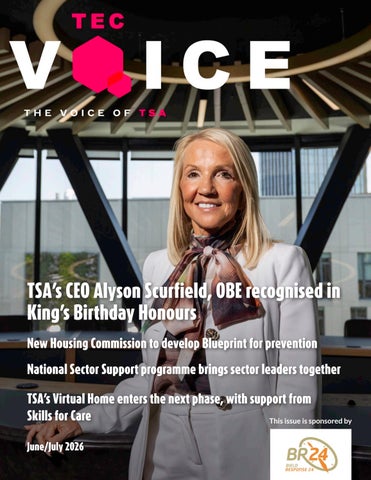
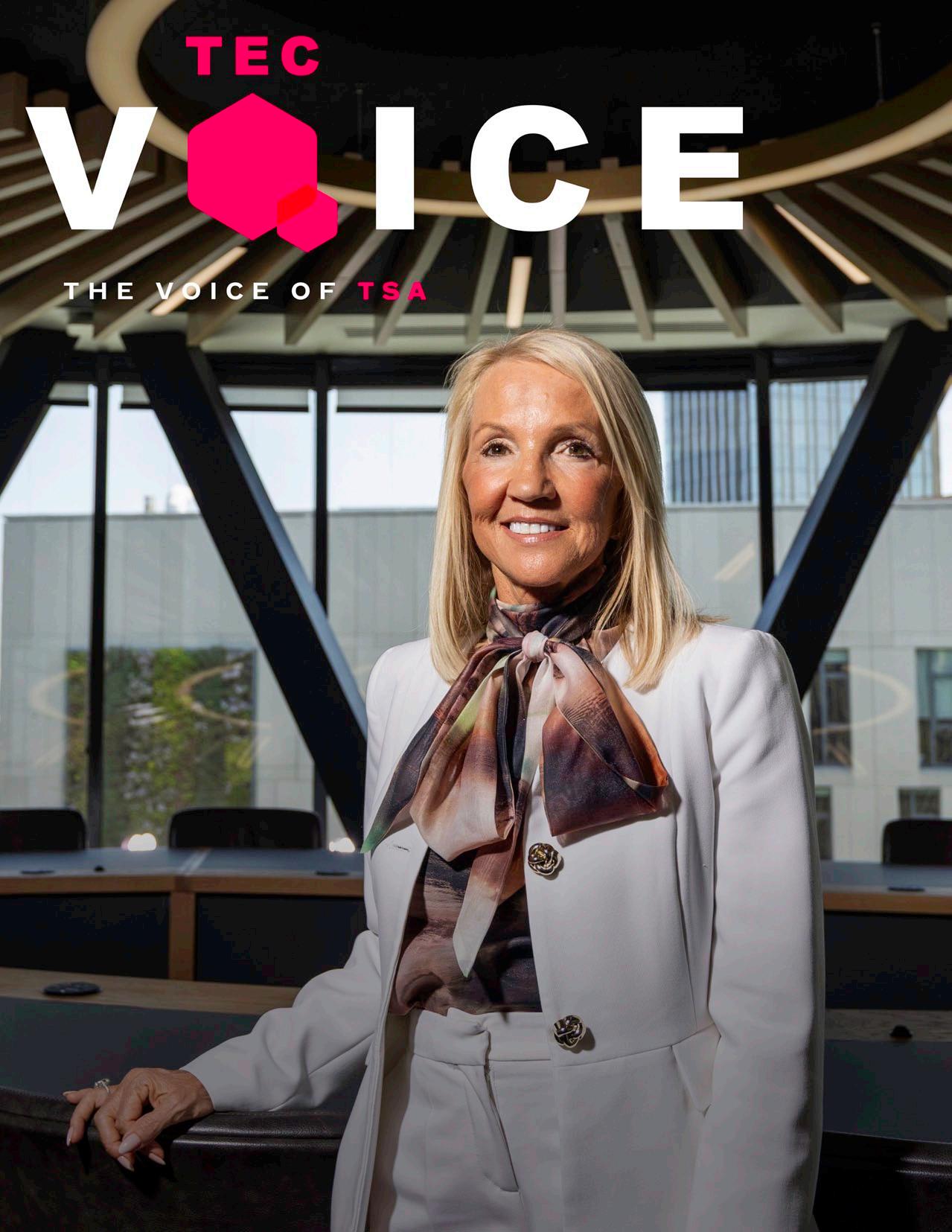
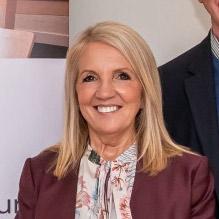
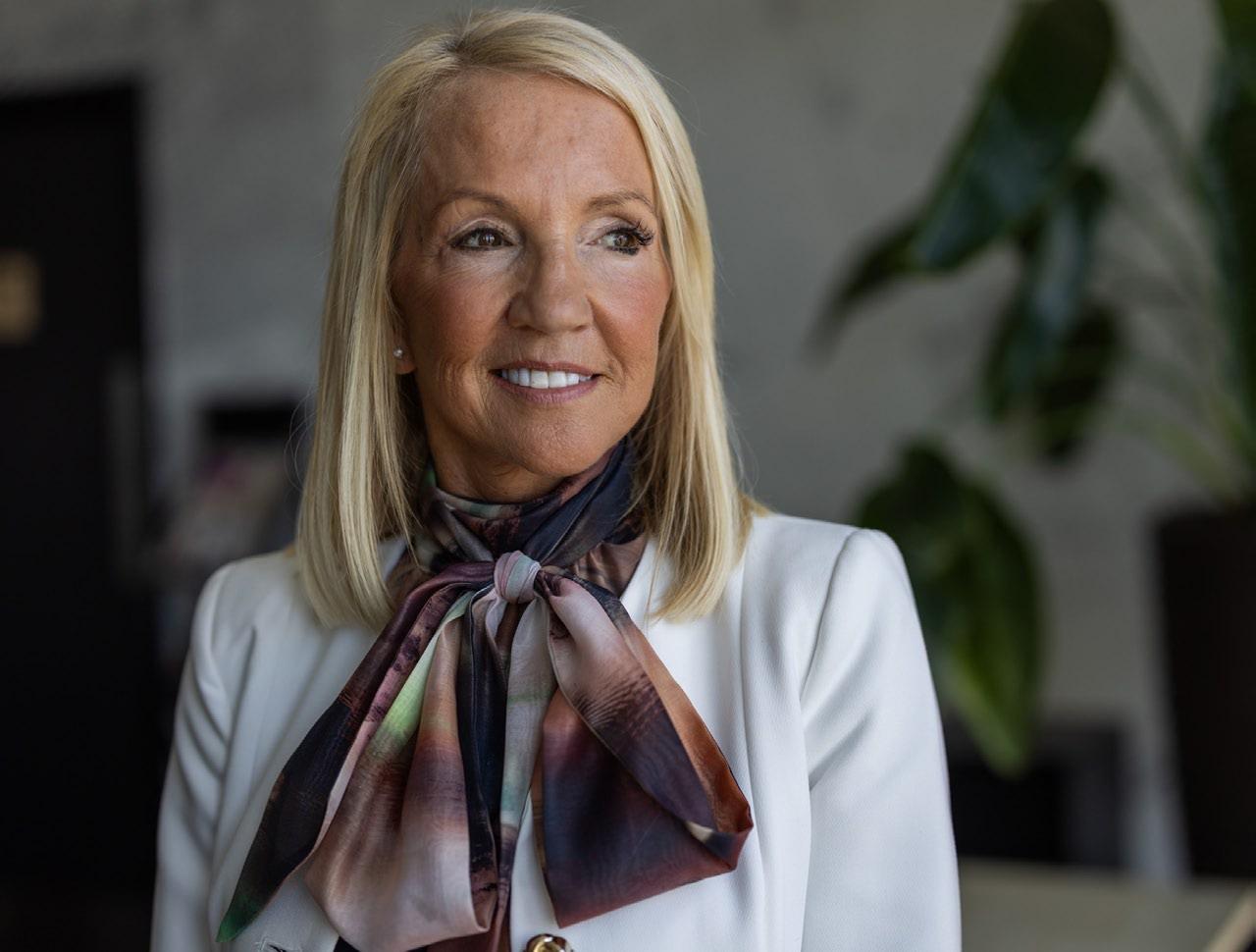
TSA’s CEO Alyson Scurfield, OBE recognised in King’s Birthday Honours
National Sector Support programme brings sector leaders together New Housing Commission to develop Blueprint for prevention
TSA’s Virtual Home enters the next phase, with support from Skills for Care
This issue is sponsored by
June/July 2026
The voice of Technology Enabled Care
Alyson Scurfield, OBE TSA Chief Executive
I want to start this issue with something very special. Last week I received an OBE in the King’s Birthday Honours List for services to Technology Enabled Care. This is an extraordinary personal moment, but far more importantly, this recognition is for you, our wonderful TEC sector.
It’s for the brilliant, often unsung work that TEC organisations deliver every single day for over two million people across the UK.
It shines a light on a sector that has too often been the Cinderella service - vital, life-enhancing, preventative, but not always visible. Your innovation, your compassion, your determination to help people live safely and independently at home: that is what this OBE celebrates – it belongs to the whole TEC community.
And this issue of TEC Voice shows exactly why our sector deserves that recognition.
On page 3 you’ll read about the launch of our new Housing Commission, chaired by Warren Heppolette - who began his career in front line housing and now leads England’s first Prevention Demonstrator. The Commission will develop a practical Blueprint to help housing providers move from digital switchover compliance to true prevention - using TEC, data and proactive support to improve safety, independence and outcomes for residents. It’s a hugely important piece of work, and I’m excited for the sector-wide conversations it will spark.
We’re also welcoming some fantastic new talent into TSA. Joe McLoughlin has joined our consultancy team, bringing more than thirty
years of housing and TEC expertise with him. And Professor Huw Thomas has joined our Board as finance lead. Huw’s experience across NHS Wales, digital transformation and system leadership will be invaluable as we strengthen the financial case for TEC nationally. Read more about Joe and Huw starting on page 13.
Turn to page 4 for an update on our Sector Support programme, which is all about building the evidence, economic argument and visibility of TEC and is now gathering pace.
And don’t miss our feature on the next phase of the Virtual Home, supported by the Skills for Care Impact Fund. This work will develop the Virtual Home into an AI-enabled decision support tool, helping frontline staff to harness TEC with greater confidence in their day-to-day work.
We also have a refreshed Sector Risk and Innovation Group (SRIG) work programme kicking off this summer - a reminder of the vital role SRIG plays in responding to risks and opportunities in our sector, shaping standards and guidance in response.
Thank you, as always, for everything you do. This honour belongs to all of us.
New Housing Commission to help housing providers use TEC, data and prevention to improve outcomes for residents
TSA is setting up a Housing Commission which will publish a practical Blueprint to help housing providers plan, implement and scale digital preventative services.
A step-by-step resource will be developed to guide housing organisations on how to move beyond a narrow compliance response to the digital switchover and treat technology enabled care, data and digital infrastructure as core health, safety and servicequality issues. It will also explore how homes can be made more accessible, connected and ready for future care technologies, while remaining practical and usable for residents.
Chaired by Warren Heppolette, who started his career as a neighbourhood housing officer and now leads England’s first Prevention Demonstrator in Greater Manchester (an initiative announced in the Government’s 10-Year Health Plan), the Housing Commission builds on the TSA ADASS Blueprint launched in April 2025, which has been downloaded more than 700 times and is helping councils expand preventative digital services across the UK.
Alyson Scurfield, OBE, CEO of TSA, said:
Members of the commission will include residents with lived experience, leaders from housing associations, local authorities and integrated care boards across England, Scotland, Wales and Northern Ireland; along with bodies such as the Department of Health & Social Care, Chartered Institute of Housing, Northern Housing Consortium and the Association of Directors of Adult Social Services. Tunstall will sponsor the Blueprint.
Several key themes will be addressed, including housing’s response to the digital switchover, the sector’s role within neighbourhood health and care systems, the use of data to identify risk earlier, and how housing can contribute to a shift from sickness to prevention. Data, interoperability and innovation will be at the heart of all discussions.
“Warm, safe housing is a foundation of good health, and when you pair high quality homes with high quality technology enabled care, you unlock something even more powerful. TEC can support key Government priorities such as the shift from sickness to prevention and from hospital to community, helping people live in the homes they love for longer, but that will only happen if TEC services are designed around residents, embedded into housing practice, and supported by the right data, infrastructure and operating models. This Commission will create a Blueprint for how housing providers can plan, implement and scale preventative digital care across their organisations.”
The Commission will gather evidence through the summer, engagement and analysis will take place in the autumn, and publication of the final Housing Blueprint is planned for early 2027; a pivotal point for the housing sector as the digital switchover enters its critical phase.
For more about the housing commission and how you can contribute, email: Joe.McLoughlin@tsa-voice.org.uk
TSA brings sector leaders together to grow investment in TEC
TSA has brought together leading organisations from across technology enabled care to support a new programme of sector development. Acting as an independent convenor, TSA will work with sponsors, commissioners, policy makers and sector partners to strengthen the evidence, messaging and practical guidance needed to increase confidence and investment in TEC.
The TEC National Sector Support Group (NSSG) is being supported by Alcove, Access Group, Careium, Chiptech, Legrand Care, Taking Care and Tunstall Healthcare, with each organisation committing to a multi-year investment in the programme.
The group has been formed around a clear aim: to help more decision makers understand the value of TEC, invest in it with confidence and recognise its role in delivering better outcomes for people who draw on care.
Despite strong examples of impact across the UK, investment in TEC remains inconsistent.
Local authorities face competing pressures, limited capacity, varying levels of evidence and a lack of common measures to support decision making.
The NSSG has been established to help address these barriers through collective action across the sector.
Year one of the programme has four connected workstreams:
Stronger messaging:
• developing clearer, evidence based messages around the value of TEC for central government, local government, commissioners and finance leaders. The work will focus on communicating the contribution TEC makes to prevention, demand management, productivity and service sustainability using language and measures that resonate with decision makers.
A stronger evidence base:
• bringing together existing published evidence, public sector data and a minimum dataset from sponsors, so the sector can make a more credible case for investment. This work also recognises where the evidence base needs to improve, including common definitions, shared measures and stronger financial modelling. The programme will also explore the development of common measures, shared definitions and approaches to impact assessment that allow outcomes to be understood more consistently across the sector.
Expanding on last year’s practical • blueprint:
Following on from the TSA / ADASS coproduced blueprint ‘Unlocking the Power of Proactive and Preventative Care Services’ released last year, Blueprint 2 draws on benchmarking, rapid assessments and implementation programmes and will include stronger guidance on service design, evaluation, financial modelling, common metrics and practical approaches to scaling successful services.
Blueprint 2 is expected to be launched in October 2026.
A TEC commissioning guide: • creating a sister document to support local authorities to commission TEC supporting current service pressures while creating the foundations for preventative, community based and neighbourhood health models of care. This will be released at ITEC 2027.
Prevention, productivity and sustainability
A major output from the first phase of the programme will be a sector briefing intended to inform discussions taking place through the Casey Commission review and the wider adult social care reform agenda. Baroness Casey’s review is looking at prevention, productivity and sustainability in adult social care, which are three areas where TEC has an important contribution to make.
The briefing will bring together the current evidence position, the data gap, the scale of the sector and a value case for TEC. It will give TSA a sector backed document to use in engagement with policy makers at a point when the future direction of adult social care policy is being shaped. For sponsors, this is a clear example of collective investment creating something that no single organisation could produce alone.
The programme will also begin laying the foundations for a clearer understanding of the scale, impact and contribution of the TEC sector, helping to inform future policy, commissioning and investment decisions.
While funded by industry sponsors, the outputs of the programme are intended to benefit the wider TEC sector and the organisations responsible for delivering health, housing and social care services. We will keep you informed through TSA’s channels of progress and opportunities.
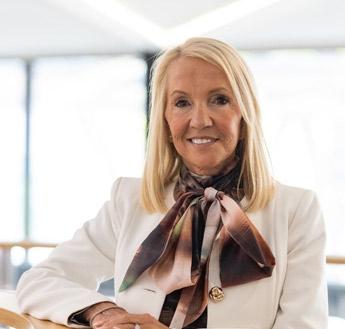
Our CEO Alyson Scurfield awarded OBE in King’s Birthday Honours
We are incredibly proud to share that Alyson Scurfield, CEO of TSA, has been awarded an OBE in the King’s Birthday Honours List for services to Technology Enabled Care.
For everyone at TSA, Alyson’s honour is a moment of real pride. Across the wider technology enabled care sector, it reflects years of work to bring TEC into conversations where it was too often missing.
Since joining TSA as Chief Executive in 2013, Alyson has worked with energy, determination and deep personal commitment to help technology enabled
care become part of serious national conversations across health, housing and social care.
This is a very personal honour for Alyson, and one we know she will receive with great humility. It is also recognition for the wider TEC sector, for TSA’s members, partners, staff team and the many organisations across the UK working every day to help people live safely, independently and well in the place they call home.
This honour is recognition of the brilliant TSA team who have supported me so much, and crucially, it’s acknowledgement of our talented, highly innovative TEC sector. Their dedication to improving people’s lives never ceases to amaze me.
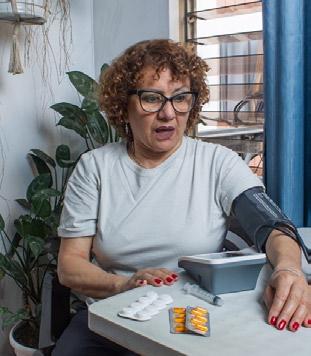
Alyson’s commitment to technology enabled care is also deeply personal. She has spoken openly in the past about caring for her dad, who had Parkinson’s and mixed vascular dementia before he passed away in 2021. With family support, carers and the right technology around him, he was able to live at home for seven happy years. That experience gave Alyson a very personal understanding of what TEC can mean for someone and their family, from medication reminders and favourite songs on a tablet, to blood pressure monitoring, falls detection and support from TEC responders as needs changed.
It also shaped her belief that TEC should reach people earlier, before a crisis point, and that more people should be able to access the right support in the place they call home. Alyson has often reflected that when her dad first began showing signs of dementia, TEC was not mentioned at his GP appointment, even though simple technology could have helped at that early stage. That experience continues to sit behind her work to build stronger links between TEC, social care, primary care, community services, housing and the wider health system.
Under Alyson’s leadership, TSA has grown from a traditional membership association into a national advisory body for technology enabled care, representing more than 350 organisations across
local government, housing, care, the NHS and technology supply. She has helped shape a more collaborative sector, with a stronger focus on people’s lives and a better understanding of where TEC can make a practical difference.
Her work has also helped to strengthen safety, quality and assurance across the sector.
In 2017, Alyson established the UKAS accredited Quality Standards Framework, created to address the absence of formal regulation or legislation around TEC safety. Today, 87% of people using TEC are supported by QSF certified providers, with the framework auditing TEC providers against 200 standards.
Alyson has also played a leading role in national work around the digital phone switchover. Following the deaths of two TEC users after their landlines were switched to digital, she helped build stronger partnerships between telecoms and TEC organisations to support safe digital migration. That work has helped inform the Government’s Telecare National Action Plan and continues to shape how the sector protects people through one of the most significant infrastructure changes affecting TEC services.
Alongside this, Alyson has championed the role of TEC in prevention, community based care and workforce development. She led the launch of the Virtual Home, a lifelike digital learning environment designed to improve understanding and confidence around TEC. More than 9,000 care staff have now used the Virtual Home, with 95% saying they feel more confident prescribing TEC as a result.
She has also strengthened TEC commissioning across health and care, including TSA’s work with the Association of Directors of Adult Social Services on a free blueprint to help councils scale digital preventative services. That blueprint has now been downloaded by more than 700 council staff.
Speaking about the honour, Alyson said:
“I am overwhelmed to receive this honour for services to TEC. I love this sector and believe passionately in the impact it has. Every single day TEC organisations cut pressure on the NHS, they strengthen community based care and ensure millions of people live well in their own homes.
“This honour is recognition of the brilliant TSA team who have supported me so much, and crucially, it’s acknowledgement of our talented, highly innovative TEC sector. Their dedication to improving people’s lives never ceases to amaze me.
“I will use this OBE to continue banging the drum for technology enabled care and the vital role it can and must play in the future of health and care, supporting the government’s 10 Year Health Plan and its three strategic shifts.”
Professor Martin Green OBE, Chair of TSA and CEO of Care England, said:
“I am delighted that Alyson has been honoured by the King with the award of an OBE. This is recognition for the outstanding leadership that Alyson has offered to TSA and the technology enabled care sector, and it is also an indicator of the importance of her work at a time of significant health and social care reform.”
Dr Clenton Farquharson, CBE, Associate Director of Think Local Act Personal, also paid tribute to Alyson’s leadership and her commitment to keeping people at the heart of technology enabled care:
“I am absolutely delighted that Alyson Scurfield has been awarded an OBE. She has always understood that TEC is about people. It is about enabling people to live the lives they choose, with dignity, independence, connection, meaning and purpose.
“Her work has helped shift the conversation from devices and systems to real lives and real outcomes. She has consistently championed the idea that technology must sit alongside care, relationships and humanity, helping people to stay connected, safe, included and in control.
“This honour recognises Alyson’s personal contribution and the importance of putting people and their lives at the very heart of technology enabled care.”
Dawn McNally, Chief Executive of Age UK North Tyneside, said:
“We are absolutely delighted that Alyson has been recognised with an OBE. This honour is a fitting tribute to her exceptional leadership, unwavering commitment, and longstanding dedication to improving the lives of others.
“As Chair of Age UK North Tyneside for the past two years, Alyson has provided outstanding guidance and support, helping to strengthen our organisation and keep us innovative. Her passion, integrity, and tireless advocacy have made a lasting impact not only on our charity, but on the wider community we serve.”
Alongside her role at TSA, Alyson chairs Age UK North Tyneside. Before joining TSA, she spent 11 years working in TEC at housing association Your Homes Newcastle, following an earlier role at Newcastle City Council.
Everyone at TSA sends Alyson our warmest congratulations. This is a proud moment for Alyson, for the TSA team, and for a sector that has worked hard over many years to prove its value, build trust, improve safety and show the difference technology enabled care can make to people, families, carers and communities across the UK.
Skills for Care Impact Fund supports next phase of TSA’s
Virtual Home programme
TSA has secured support through the Skills for Care Impact Fund to further develop and expand the Virtual Home programme, strengthening workforce confidence, improving consistency in Technology Enabled Care decisions, and supporting better outcomes for people drawing on care and support.
The Skills for Care Impact Fund supports practical work that helps adult social care build capability, improve learning and strengthen practice. For TSA, it provides the opportunity to build on the foundations already created through the Virtual Home, which has helped thousands of learners explore how TEC can support people in realistic home settings.
The Virtual Home is now moving into a broader role, and the next phase will develop the platform from a learning and development resource into an AI enabled decision support tool, helping frontline
Virtual Home 2.0
Through the next phase of the Virtual Home, TSA will develop a practical aid for the person on the frontline, helping staff think through which technologies may be appropriate, how those technologies could support a person’s outcomes, and when a referral or recommendation may be needed.
Across health, housing and social care, TEC decisions are made by people working in different roles, with different levels of experience and confidence. Virtual Home 2.0 will give staff a clearer way to explore options, apply learning to real situations and support more consistent decisions.
The programme will also support suppliers and commissioners by creating a stronger link between people’s needs, best practice and appropriate TEC solutions. By bringing together realistic scenarios, learning content, decision support and a QSF
staff understand, assess and apply TEC with greater confidence in everyday practice.
The platform has already been adopted by 26 organisations and has engaged more than 9,000 learners nationally. Evaluation to date has shown improved workforce confidence, alongside betterquality TEC referrals and decision making.
aligned supplier directory, the Virtual Home will help suppliers understand where their tools can add most value.
Planned developments include an enhanced immersive Virtual Home environment, CPD accredited learning modules, role specific pathways, an AI enabled “What TEC?” support tool, workforce and impact analytics, expanded preventative care scenarios and a QSF aligned supplier directory.
Closing the TEC confidence gap
Adult social care continues to face sustained pressure, with services managing rising demand, greater complexity of need and ongoing workforce challenges. National policy is also placing greater emphasis on prevention, early intervention, community- based care and the better use of digital and technology enabled approaches.
For TEC to have a meaningful impact, staff need to understand what is available, how different technologies can support independence and wellbeing, and when a particular solution may be appropriate.
Shaped with the sector
The next phase of development is being shaped in collaboration with care providers, local authorities, integrated care systems, workforce leads, suppliers and people with lived experience.
This work was developed further at TSA’s Virtual Home 2.0 launch event, held at The Catalyst in Newcastle on 23 June 2026. The event brought together partners and stakeholders from across adult social care, health, local government, workforce development, provider organisations and the supplier community.
Across the sector, this confidence and understanding remains uneven. Technology can still be seen as specialist, technical or separate from everyday care practice, which can make it harder for staff to identify earlier opportunities for support.
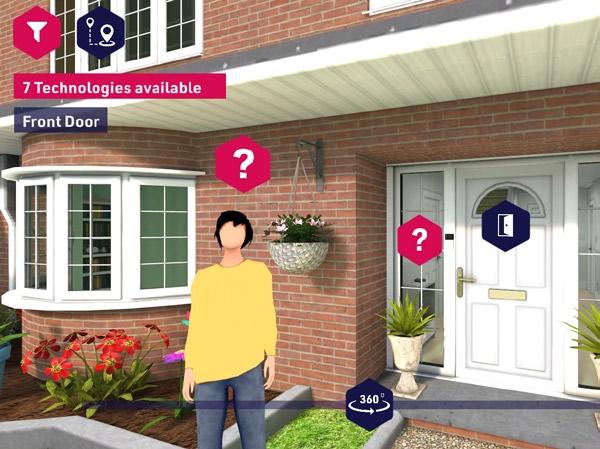
The Virtual Home responds to this challenge by giving staff a practical way to explore TEC in familiar home environments. Users can move through different rooms and scenarios, considering how technology might support someone with falls prevention, medication, environmental monitoring, safer living, communication, daily routines or support for unpaid carers.
As the programme develops, the AI enabled “What TEC?” tool will help staff consider appropriate TEC solutions based on different needs, settings and scenarios. The intention is to strengthen professional judgement, confidence and consistency, while giving staff a practical resource they can return to when they need support in day-to- day decision making.
Attendees helped shape future priorities, test emerging thinking and identify the practical workforce challenges the Virtual Home needs to support. Their input will help refine the platform, strengthen learning journeys, develop realistic scenarios and make sure the programme reflects the realities of frontline delivery.
“The Virtual Home has already shown the value of practical, accessible learning in helping the workforce build confidence around Technology Enabled Care. This next phase gives us an important opportunity to support staff to understand TEC and make more consistent, confident and personcentred decisions about how it is used in practice.
“The Skills for Care Impact Fund gives us the opportunity to develop this work with the sector, for the sector, creating impact on a national level, and I am delighted with the progress we have made so far.”
ADVERTISING
Join Us in TEC Voice
Align your brand with TEC Voice, the only dedicated publication in TEC, and engage a dedicated, receptive audience that can transform your business. Secure your space today and connect with leaders shaping the future of Technology Enabled Care.
Contact Us
marketing@tsa-voice.org.uk
With an engaged readership and limited, highvalue advertising opportunities, your message will reach those making impactful decisions.
Don’t miss this exclusive chance to be part of TEC’s only dedicated magazine!
Keeping you in the loop...
Stay up to date with what’s happening in the TEC sector with all the latest news from our valued members, including all of the latest developments and views from Access, Chiptech, Aico, Alcove and the Virtual Care Agency, Careium, Taking Care and many more.
Visit our Member News page here for mor e, and remember to bookmark the page!
Professor Huw Thomas joins TSA Board as finance lead
TSA has appointed Huw Thomas to its Board, strengthening the organisation’s financial leadership at a pivotal moment for the technology enabled care sector.
Huw, currently director of finance at Hywel Dda University Health Board, brings more than two decades of senior public service experience across NHS Wales, audit practice and national system leadership.
A Chartered Accountant, Honorary Professor at Aberystwyth University and fluent Welsh speaker, Huw has been responsible for the digital transformation agenda at Hywel Dda University Health Board, introducing modernisation programmes around data, interoperability and digital foundations to support safe, efficient care.
His work across governance, reporting and assurance was recognised by Audit Wales and used across NHS Wales, and he has significant experience working with Welsh Government, local authority partners and regulators.
As TSA’s new finance lead, Huw will help the sector sharpen its financial case to national and local government, commissioners and health systems. He is clear about the opportunity ahead:
“I wanted to join the TSA Board to bring a finance director’s view to TEC. Care is increasingly delivered as a continuum, where historic boundaries between NHS and social care are blurred. TEC works in between - keeping people independent and at home
safely for as long as the technology and the support around it allow. Yet adoption remains piecemeal. I want to help the TSA and the wider sector build the financing and commissioning model that moves TEC from pilot to core infrastructure, so that the people we serve can live their best lives.”
“I am delighted that Professor Huw Thomas will be joining the TSA Board. Huw brings a wealth of experience in both finance and non-executive roles, and his skills, experience and networks will be a valuable addition to TSA as we embark on our ambitious plans for the future.”
Huw’s appointment marks the next step in TSA’s refreshed Board under Professor Green’s leadership, as the organisation brings in powerful new voices to drive TEC adoption across health, housing and care.
Find out more about TSA’s Board members here
TSA Chair Professor Martin Green welcomed the appointment, saying:
Joe McLoughlin joins TSA’s consultancy team - bringing decades of housing and TEC expertise
Joe McLoughlin has spent more than thirty years shaping how housing, technology enabled care and customer focused services work for the people who rely on them.
His career began on the frontline, supporting London’s Irish community with welfare rights and housing advice - an early grounding in empowerment, co-production and listening to residents’ voices.
From there, Joe worked across almost every corner of housing, including supported housing, innercity estate management, development, allocations and major digital transformation projects. That experience came together at Camden Council, where Joe helped create, spin out and grow a new company into a national software house.
Housing has remained the constant thread through Joe’s senior leadership roles, board positions and national technology-enabled care programmes.
As managing director of two major TEC organisations: Astraline – a subsidiary of Johnnie Johnson Housing Trust, and Careium - one of the UK’s largest telecare organisations - he led largescale 24/7 monitoring and support services, strengthened governance, secured funding for innovation and delivered award-winning culture and workforce development programmes.
Joe has also been at the forefront of digital switchover preparedness, cyber resilience and
future ready TEC. He chaired TSA’s Proactive and Preventive Services Special Interest Group, developing national commissioning guidance, and has advised housing providers, care organisations and global TEC suppliers on strategy, compliance and digital transformation.
His board role at Pickering and Ferens Homes - a community-based housing association in Hull with top ratings for governance, viability and consumer standards - brings direct insight into regulated housing expectations, residentled scrutiny and what good looks like for residents.
Joe’s commitment to genuinely understanding residents’ needs runs through everything - from previous research and development collaborations with universities around assistive technology
and co-production, to understanding how different communities experience technology. He’s particularly driven by the urgency of the analogue to digital transition and its implications for safety, equity and inclusion.
Now, as part of TSA’s consultancy teamleading our offer to housing providers - Joe brings wide-ranging housing expertise, deep TEC knowledge and a commitment to helping providers plan, implement and scale digital preventative services.
Crucially, Joe’s commitment to putting people at the heart of TEC will shape every project he supports. This will all be invaluable to organisations needing support to navigate the next era of housing, health and care.
We’re also looking for more brilliant people like Joe. If you’ve got TEC experience and want to help shape the future of care, join TSA’s Associate Network.