�� Attention Arbitrage
Monetizing Media Consumption Channels ��
Understanding the hidden value of digital attention systems
�� Introduction: Attention as a Digital Financial
Layer
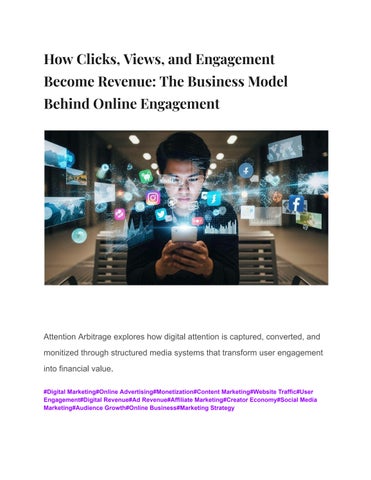
Modern digital ecosystems are built on a hidden economic structure where human attention functions as a continuously traded asset
Every interaction scrolls, clicks, pauses, and engagements contributes to a global monetization system operating beneath the surface of platforms.
�� Core Insight: Attention is not consumed it is extracted, measured, and monetized in real time
1. Attention as an Economic Asset
Attention behaves like a structured financial resource with measurable and transferable properties.
● ⏱ Finite cognitive bandwidth
● �� Fully trackable interactions
● �� Divisible into micro-engagement units
● �� Monetizable through digital systems
This transforms attention into a core input of the digital economy.
�� 2. Attention Arbitrage Mechanism
Attention arbitrage operates by capturing low-cost attention and converting it into high-value monetization streams.
�� Step 1: Attention Capture
● Algorithmic recommendations
● Viral content distribution
● Feed-based exposure systems
⚙ Step 2: Engagement Conversion
● Watch time optimization
● Interaction loops
● Behavioral reinforcement
�� Step 3: Monetization Layer
● Ad revenue systems
● Affiliate conversions
● Subscription monetization
● Data-driven targeting ��
3. Platforms as Attention Markets
Modern platforms function as real-time attention exchange systems
● �� Social media ecosystems (Instagram, TikTok, YouTube)
● �� Algorithmic recommendation engines
● �� Creator monetization infrastructures
�� Platforms do not distribute content they distribute attention flow.
��
4. Attention Monetization Pipeline
● �� Capture (visibility systems)
● �� Retention (engagement loops)
● �� Conversion (ads & actions)
● �� Revenue distribution (platform + creators)
This pipeline ensures continuous transformation of attention into economic output
�� 5. Behavioral Engineering Systems
Attention systems are optimized through psychological reinforcement structures
�� Dopamine Loops
● Short-form content cycles
● Infinite scrolling behavior
● Instant gratification triggers
�� Engagement Signals
● Likes
● Shares
● Comments
● Watch duration
�� Platforms predict attention they do not wait for it.
6. Efficiency vs Content Value
Digital systems prioritize engagement efficiency over content depth.
● ⚡ Retention rate > content quality
● �� Engagement speed > information value
● �� Interaction density > production effort
7. Attention Arbitrage Models
● �� Creator economy systems
● �� Advertising exchange networks
● �� Affiliate marketing systems
● �� Data monetization pipelines
8. Structural Risks
● �� Platform dependency
● �� Algorithm volatility
● �� Market saturation
9. Future of Attention Arbitrage
● �� AI-generated engagement systems
● �� Real-time attention pricing models
● �� Cross-platform attention liquidity
● �� Predictive behavioral engineering
�� Conclusion: Attention as Financial Infrastructure
Attention arbitrage transforms human behavior into a structured economic input system that powers the digital economy.
�� Final Insight: The real asset is not content it is the ability to control and convert attention flow at scale