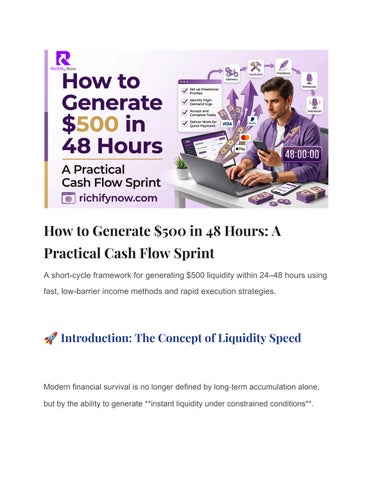
How to Generate $500 in 48 Hours: A Practical Cash Flow Sprint
A short-cycle framework for generating $500 liquidity within 24–48 hours using fast, low-barrier income methods and rapid execution strategies.
�� Introduction: The Concept of Liquidity Speed
Modern financial survival is no longer defined by long-term accumulation alone, but by the ability to generate **instant liquidity under constrained conditions**.
The Liquidity Sprint is a structured methodology designed to create a **$500 working capital floor within 24–48 hours** using high-intent, low-barrier execution systems.
⚡ Core Principle: Liquidity is not built over time — it is activated through rapid execution cycles
��
1. Understanding the Liquidity Sprint Model
The Liquidity Sprint is based on a short-cycle capital activation framework designed for immediate cash flow creation
�� Traditional Approach
● Long-term income planning
● Delayed revenue realization
● High dependency on stability
⚡ Sprint Model
● 24–48 hour execution window
● High-frequency micro revenue actions
● Immediate settlement focus
⚙ 2. Core Framework of Rapid Capitalization
The sprint model operates through three structured layers:
�� Input Layer: Resource Activation
● Existing skills
● Available tools
● Immediate-access platforms
⚙ Execution Layer: Fast Monetization
● Service delivery
● Task-based revenue
● Micro transactions
�� Output Layer: Liquidity Capture
● Instant payments
● Daily settlements
● Rapid reinvestment potential
3. High-Intent Revenue Channels
The liquidity sprint focuses on channels with **immediate demand and low entry friction**.
● ⚡ Freelance micro-services
● �� Digital task completion
● �� Resale arbitrage opportunities
● �� Local service fulfillment
● �� Direct client outreach systems
��
4. Execution Psychology
The success of a liquidity sprint is determined by execution speed, not strategy complexity
● ❌ Overthinking reduces output
● ⚡ Speed increases conversion probability
● �� Iteration replaces perfection
�� The objective is not optimization it is activation.
⚖ 5. Risk Management in Short-Term Capital Cycles
● �� Avoid high-lock capital systems
● �� Maintain immediate liquidity access
● �� Focus on repeatable low-risk cycles
● �� Diversify micro income attempts
6. Cycle Acceleration Strategy
Instead of relying on a single income event, the sprint model focuses on multiple rapid cycles.
⚡ More attempts → higher probability of reaching $500 liquidity threshold
�� 7. Structural Blueprint for $500 Liquidity Floor
● �� Define immediate income targets
● ⚙ Select 2–3 fast conversion methods
● �� Execute in parallel cycles
● �� Capture and consolidate earnings
8. Operational Constraints & Realities
Liquidity sprint models operate under real-world constraints that must be acknowledged.
● ⏱ Time sensitivity (24–48 hours)
● �� Market availability limits
● �� Skill-dependent execution speed
9. Evolution of Micro-Liquidity Systems
Future financial systems will increasingly support real-time income generation structures.
● �� AI-assisted micro work systems
● �� Instant payout platforms
● �� Decentralized gig economies
● ⚡ Real-time labor marketplaces
��
Conclusion: Liquidity as an Activation Problem
The Liquidity Sprint reframes financial survival and growth as a function of execution speed rather than long-term planning.
⚡ Final Insight: Liquidity is not created — it is unlocked through rapid, structured action cycles