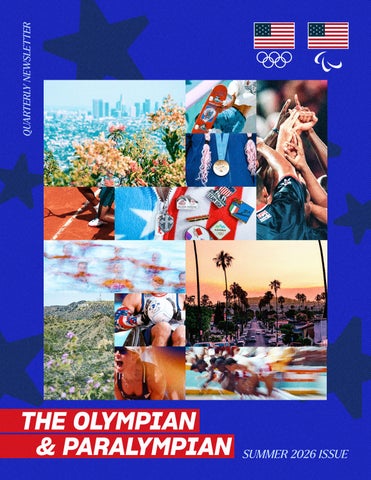

A LETTER FROM USOPA PRESIDENT
Greetings Olympians and Paralympians,
The excitement is building as we officially stand just two years away from the historic LA 2028 Olympic and Paralympic Games The anticipation surrounding these Games is unlike anything we have experienced in decades. For many of us, Los Angeles represents more than a host city—it represents a return home for the Olympic and Paralympic Movement in the United States. As former athletes, we understand the dedication, sacrifice, and perseverance required to reach the world’s greatest stage. LA 2028 will showcase the next generation of athletes while also celebrating the legacy and contributions of Olympians and Paralympians who paved the way. We encourage all members of our community to embrace the journey toward 2028 and find meaningful ways to support, mentor, and inspire future Team USA athletes. Before we arrive at LA 2028, we have another extraordinary milestone to celebrate—the 2027 Olympians and Paralympians Reunion Under the leadership of reunion chair Willie Banks, preparations are already underway for what promises to be one of the most memorable gatherings in USOPA history. The reunion will be hosted in the beautiful city of Los Angeles and will provide an incredible opportunity to reconnect with teammates, competitors, friends, and fellow members of the Olympic and Paralympic family. Whether you competed decades ago or recently represented Team USA, this reunion celebrates our shared experiences, achievements, and lifelong commitment to excellence. The reunion will feature a variety of engaging activities, special recognition events, networking opportunities, educational sessions, and memorable social gatherings. It will serve as a bridge between our proud history and the exciting future of the Olympic and Paralympic Movement. Most importantly, it will provide an opportunity for us to

strengthen relationships, share stories, inspire younger generations, and reaffirm the values that unite us as Olympians and Paralympians. We encourage everyone to mark their calendars and begin making plans to attend. This is truly a reunion you will not want to miss.
The USOPA Executive Committee election process will begin as four Executive Committee positions become vacant at the end of the year. This will provide members an opportunity to learn about the responsibilities of Executive Committee services. Olympians and Paralympians interested in USOPA leadership roles will be encouraged to participate, ask questions, and consider how they can contribute to USOPA’s future direction and growth. The election process is an important component of the organization’s governance, ensuring continued member representation, fresh perspectives, and strong leadership for the years ahead.
It is my hope that all sports and all years engage in the festive activities, ceremonies, and leadership opportunities mentioned above.
Best,

Jackie Washington

FROM PRESIDENT


ALUMNI RELATIONS UPDATE
Dear USOPA members,
Just two years away from LA28, wild! It is our truest hope that those still training for an Olympic or Paralympic dream on home soil are having great luck, momentum, understanding of themselves and their place in sport, and support from loved ones and teams. To those of us beyond our competitive days, I wanted to share some ways you can be involved in the Movement as we rocket toward these Games!
As Jackie mentioned in her letter, get excited for an All Games, All Sports Reunion in LA in 2027! You’ll be getting save-the-dates soon.
If you are interested in being involved with LA28 directly, whether in a volunteer capacity, with questions about event tickets, or simply to chat with them about what you have available to you as an athlete surrounding the Games, this is the first time in history that there has been an Athlete Relations team within the OCOG (Organizing Committee of the Olympic and Paralympic Games). Get ahold of them by emailing athleteconnect@la28.org.
With LA28 on the near horizon, many organizations in your local areas are catching Olympic and Paralympic fever. The best way to build positive home soil sentiment around the Games is to get involved with those eager to learn about your experience! Join your local USOPA Chapter at the events that they’re planning, and even consider being involved in leadership of that Chapter. Don’t have a Chapter near you? Take advantage of our new Legacy Lattes program (email Robbie for details), and meet your local peers! You can also form a Chapter if you like, just let us know. Have other ideas? Show up at
USOPA Office Hours, hosted the second Friday of each month from 1-2pm MST on Zoom, and tell us what’s been floating around in your brain! We will also reimburse you for gas mileage to any Movement-furthering local event you’re invited to, so let us know who you’re reaching in your communities and how we can help.
There are many ways that you can be involved with your National Governing Body in this time as well. Stay tuned for connections we’re making in this area, and crossover between our team and the sports that built you!
Get involved now, so that the Americans around you have that much more insight into what it takes to show up and perform on the world’s biggest stage when they take the pool, runway, field, arena, mat, and more in Los Angeles in two short years.
In Olympic and Paralympic Spirit,

Kara Winger USOPC Alumni Relations Director


GAMES SPOTLIGHT

Last call to register for special access to LA28 Olympic Games tickets!
LA28 is two short years away! For those of you who attended the LA28 Collective Summit put on by the LA28 Athlete Relations team at the Los Angeles Memorial Coliseum in January, you know that there is an Olympic ticket purchase opportunity available to Olympians and Paralympians specifically, IF you register with LA28 directly as an Olympian or Paralympian. That purchase opportunity for Olympic tickets is scheduled to happen August 3-5. You must have registered with LA28 directly by July 10, and you must register with the LA28 Ticket Draw before July 22 to take advantage.
REGISTER WITH LA28 NOW if you don’t want to miss future opportunities. We at the USOPC cannot help with the LA28 ticketing process, but support LA28’s efforts fully to get you access. Please communicate directly with them.
All information will come directly from LA28, and know that Paralympic ticket access will follow a similar process, and be available in 2027. LA28 Athlete Relations is considering putting another Collective Summit on next year to keep you informed, so stay tuned!
PATTY SOLIMENE VISITS NLC IN D.C.
USOPA HAPPENINGS CHAPTER EVENTS NCOPA MILANOCORTINA WATCH PARTY
Patty Solimene visited the National League of Cities’ headquarters on May 6 to share with eight cities in attendance of the NLC’s Learning Lab: Opportunity for All: How to Increase Employment for People with Disabilities. This effort is part of a multi-year collaboration between the NLC, the State Exchange on Employment and Disability (SEED), and the US Department of Labor’s Office of Disability Employment (ODEP). Patty represented her DMV Chapter and all of USOPA, of course, very well. Tashfia Hasan of the NLC said, “You (Patty) did such a nice job of weaving together many of the important themes of not just why it matters to create an inclusive workforce but also how cities can take concrete and meaningful steps to support people with disabilities.”

We’re so sorry: We missed publishing a big Opening Ceremony watch party in the last edition of The Olympian & Paralympian! The Northern California Chapter of USOPA gathered: Twenty four athletes were present (ranging from 1960-2024 Games alumni) with family and friends, as well as 60+ members of the public, and NBC Bay Area at the LOT. Everyone had a great evening reminiscing, cheering on the athletes, and making new friends.
SCOPA VISITS THE AQUARIUM OF THE PACIFIC
Southern California Chapter President John Moffet and a few fellow members, most specifically 2x Water Polo silver medalist Jody Campbell, literally dove into fun at the Aquarium of the Pacific in May! Lara Teixeira, Brazilian 3x Olympian in Artistic Swimming and now Chief of Sport at USA Artistic Swimming, shared about the experience on her Instagram, and John looks forward to planning more Chapter events at the beautiful facility.

HAPPENINGS
COLORADO CHAPTER SUPPORTS U.S. FIGURE SKATING
For the first time since Milano-Cortina, that entire U.S. Figure Skating Olympic team got back together in May at Colorado Springs’ ENT Center for the Arts for a Toast to Milan live-taped show that you can now watch on Peacock! Part of U.S. Figure Skating’s Impact Summit, Chapter President Michelle Dusserre Farrell helped coordinate Carl Schueler (4x OLY, Track & Field), Mike Tagliapietra (2016 PLY, Shooting), Jennifer GutierrezHughes (2000 OLY, Triathlon), and Kara Winger (4x OLY, Track & Field) to be there in support and grab some Mexican food afterward.


OLYMPIC AND PARALYMPIC DAY CELEBRATIONS
The first Chapter to kick off Olympic and Paralympic Day celebrations this year was Georgia, in collaboration with BlazaSports America, at the Peachtree Paragames on June 12 and 13!
Video: YouTube Shorts


About ten more Chapters have Olympic and Paralympic Day festivities planned this year, an exciting jump from 2025, and we shared in July 2’s Scoop about all of them! If you got up to something as a USOPA member to celebrate the holiday, we’d love to hear about it. Please email us photos, or fill out this survey with your fun content!
Two USOPA Chapters in particular are taking mutual advantage of USOPA’s connection to the Affiliate Organizations Council within the USOPC: Oregon (whose relationship with the YMCA is long-standing) and Georgia (a Chapter which wouldn’t be in existence without the awesome BlazeSports America!). Florida, recently connected to the National Senior Games, looks to work together in the future! Utilizing these internal-tothe-USOPC connection points is a great way to get your Chapter (or you as an individual seeking to be involved) engaged with your community, as these organizations share in the mission to positively impact your local residents. Let us know how we can help, or even just that you want to get started! We’ll help you brainstorm.
service to others. It serves as a celebration of impact in all its forms, showcasing how the lessons of sport continue to shape leaders long after competition ends. Bringing together the full slate of USOPA honors that have existed for years but whose recipients have never been this visible, the page recognizes and reflects excellence at every stage of the USOPA journey. Featured awards include the USOPA Award of Excellence, The Dorothy Franey Langkop Ambassador Award, and The Louis Zamperini Lifetime Achievement Award, each honoring a unique kind of impact from lifelong achievement to community connection and leadership within the USOPA network.
AOC CONNECTION ALUMNI LISTENING SPORTS COMMISSIONS AND USOPA
Another avenue for reaching community as USOPA members, whether in Chapter formation or as individuals around the country, is to reach out to local Sports Commissions: These organizations host events regularly in your local area, and would likely jump at the chance to have you as a local Olympian or Paralympian at those events! USOPA’s Houston Chapter has a great relationship with the Harris County – Houston Sports Authority, for example, and has enjoyed many mutuallybeneficial events over the last many years (including their fabulous annual Olympic and Paralympic Day event). We’ve built a list of Sports Commissions around the country we’d be happy to connect you to, an initiative close to President Jackie Washington’s heart. Get ahold of us to get started today!
USOPA AWARDS CELEBRATED ON WEBSITE
New to the Team USA Alumni Awards page is a meaningful look into the impact of USOPA honors. Rooted in the values that define the Olympic and Paralympic movement, this space highlights how USOPA members continue to lead with purpose across their lives, whether in their professions, within their communities, or through
We recently concluded two different listening projects – one with USOPA Chapter Presidents in focus group format, and the other a digital survey sent to all Team USA Alumni (inclusive of World Championships and Pan/ ParaPan American Games team members, to name a few qualifying events) – and are excited about the learnings there. There isn’t much you hadn’t already told us, which feels good (thanks for your straightforwardness faceto-face!), but we’re looking forward to streamlining the way that USOPA Chapters operate across the country, offering more robust and newly-formatted resources to USOPA leaders, and building out long-term plans for potential Team USA Alumni inclusion in the USOPA system. Thank you for your honest participation in building your own USOPA!
CELEBRATE INTERNATIONAL DAY OF FRIENDSHIP
Are you a member of the USOPA Facebook group? What about Team USA Athlete and Alumni Connect on LinkedIn? Request to join! Come hang out! And take part in significant holidays by sharing your reflections in those peer-driven channels.
The UN’s International Day of Friendship is July 30! We’ve heard some extremely cool stories of friendships forged at the Olympic and Paralympic Games that span country borders. Check out a special story on Peter Bos on page 18 of the Spring 2025 edition! On July 30, share your stories of friendships made via the athlete journey on Facebook and LinkedIn, and reinforce the message that sport is about way more than sport.
Gold medalists of Team United States pose for a photo after the medal ceremony for the Team Event on day two of the Milano Cortina 2026 Winter Olympic games at Milano Ice Skating Arena on February 08, 2026 in Milan, Italy.

Step up to The Podium and share your life updates, career milestones, and more with our USOPA community. Submissions will be featured on the Team USA alumni website and in the USOPA quarterly magazine.


Welcome to The Podium, a quarterly spotlight of life updates, career or personal milestones, and more from USOPA members across the country. This is an opportunity to stay connected with fellow alumni who choose to take the podium and give us an inside look into their lives!
Judi Brown Clarke, OLY & Rory Cooper, PLY
Track and Field | 1984 / Para Track & Field | 1988
At the United Nations Headquarters in New York City, leaders and innovators gathered to explore the intersection of intellectual property and sport during World Intellectual Property Day, where Judi Brown Clarke, OLY and Dr. Rory Cooper, PLY represented Team USA’s voice in advancing inclusion through innovation. As Dr. Cooper reflected, “Olympian Judi Brown Clarke and I had the fortunate opportunity to speak at the United Nations for World Intellectual Property Day. This year’s theme was intellectual property and sport,” setting the stage for a timely and impactful discussion. The conversation underscored how emerging technologies are reshaping the landscape of sport, particularly through adaptive and accessible design. Judi Brown Clarke noted, “It was fascinating to hear about and see some of the innovative work happening around the world,” Clarke added. “I left feeling inspired and optimistic about what can be accomplished when innovation and inclusion go hand in hand.” Together, their perspectives painted a powerful picture of how thoughtful innovation can not only elevate performance but also ensure that sport remains a space where all athletes can thrive.
Read Here: Ready, Set, Innovate

Lara Dallman-Weiss and Stu McNay of Team United States compete in the Mixed Dinghy 470 class on day eleven of the Olympic Games Paris 2024 at Marseille Marina on August 06, 2024 in Marseille, France. (Photo by Clive Mason/Getty Images)
Rory Cooper, PLY
Para Track & Field | 1988
Dr. Rory Cooper closed out March at The Burj Awards in Washington, D.C., where he was honored for Global Innovation. In early June, Cooper continued his momentum at McGill University, where he delivered the commencement address and received an honorary Doctor of Science degree.
Read Here: McGill LinkedIn Post

Lara Dallman-Weiss, OLY
Sailing | 2020, ’24
At Eckerd Colleges’ 63rd Commencement Ceremony, two-time Olympic sailor, Lara Dallman-Weiss shared stories from both her athletic career and life beyond sport during her keynote address. She spoke about experiences that shaped her, from learning to drive a stick-shift truck to haul a boat across Europe, to navigating challenging waters in the Canary Islands, and the life lessons gained through those moments and her education at Eckerd. She used her own journey as an example of commitment, perseverance, and chasing a dream. She is currently preparing a campaign to earn a spot on the 2028 U.S. Olympic Sailing Team in the mixed 470 event.
Read More: HERE

Patty Solimene, PLY
Para Triathlon | 2016
Patricia “Patty” A. Solimene, the 27th Director of the Bureau of Engraving and Printing, spoke at the Expanding Workforce Opportunities for All Learning Lab hosted by National League of Cities in partnership with the U.S. Department of Labor, a day-and-a-half convening that introduced research-based strategies to help city leaders develop actionable approaches to better support workers with disabilities within city hall and across their communities.
Read More: NLC Learning Lab

Ed Burke, OLY
Track and Field | 1964, ‘68, ‘84
Ed Burke, our Team USA 1984 Olympic Opening Ceremony flag bearer, recently traveled to Greece on what he called a bucket list trip. He described a wonderful reception by the Hellenic Olympic Committee’s leadership and the International Olympic Academy in his multiple stops, appreciating the impact that the Ancient Greeks had on our culture, and marinating in the shared Olympic affinity he felt with those he encountered. “These iconic leaders have shared their love of Olympism with me. The principles that guided my life,” said Ed, “This international relations effort is what the spirit of Olympism is about.”
Read More: Ed’s Story | The IOA

Pictured: IOA Professor Dionyssis Gangas, Kristin Bush 1960, Ed Burke, and Antonia Borbotsialou (Hellenic coordinator)
Podcaster Melissa Forziat will feature
USOPA Members in The Journey to LA Series
Melissa Forziat’s Take the Doughnut message is centered around a simple but meaningful idea: don’t hold back from opportunities, go after what you want. Through conversations, stories, and insights, she focuses on personal growth, confidence, leadership, and making bold life and career decisions. Melissa, a former gymnast, recently launched The Journey to LA series which features multiple Olympians and Paralympians sharing their stories and advice to young athletes chasing some of the same goals.

Courtney Ryan, PLY
Wheelchair Basketball | 2020, ‘24
In the Journey to LA podcast, Courtney Ryan discusses her path from being a collegiate soccer player to becoming a Paralympic wheelchair basketball athlete after a life-changing injury left her paralyzed from the waist down. She reflects on the emotional challenge of losing her original athletic identity, finding new purpose through adaptive sport, and the determination it took to rebuild her career from the ground up. Through her story, Ryan emphasizes resilience, the importance of support systems, and the mindset needed to overcome setbacks—sharing a powerful message that while adversity may alter your journey, it can lead to new opportunities and success at the highest level.
Watch here.

Maddie Zimmer, OLY
Field Hockey | 2024
In her episode of Journey to LA podcast, field hockey standout Maddie Zimmer reflects on her development as an athlete and the drive required to perform at an elite level. She shares how her early connection to the sport laid the foundation for her competitive edge, while also speaking to the discipline and focus needed to continue advancing. Looking toward Los Angeles 2028, Zimmer highlights the importance of steady progress, self-belief, and embracing the
process, offering a perspective centered on growth, accountability, and long-term ambition.
Watch here.
Justin Best, OLY
Rowing | 2020, ‘24
Olympic rower Justin Best offers an inside look at the discipline and teamwork required to compete at the highest level of his sport. He discusses how rowing demands not only physical endurance but also complete trust and synchronization among teammates, along with the mental focus needed to perform under pressure. As he looks ahead to Los Angeles 2028, Best emphasizes the value of consistency, preparation, and a shared commitment to collective goals, highlighting how success in rowing is built through unity, resilience, and relentless daily effort.
Watch here.
Zach Hammer, OLY
Sport Climbing | 2024


Zach Hammer offers an inside look at the fast-paced world of speed climbing, breaking down the discipline’s unique combination of precision, power, and strategy. He reflects on how he first discovered sport climbing and traces his journey from a newcomer to an elite competitor with sights set on the Los Angeles Games. Along the way, Hammer shares meaningful advice for young athletes, emphasizing resilience, consistency, and the importance of enjoying the process. He also takes time to recognize the mentors, teammates, and supporters who have shaped his path.
Watch here.


STAY CONNECTED
Update your contact information and stay in the know of all things USOPA. We want to connect you to active Chapter leadership across the country! Help us help you network with your Olympic and Paralympic peers!

Zach Hammer of Team United States and Jinbao Long of Team People’s Republic of China compete during the Men’s Speed, Qualification Elimination Heats on day eleven of the Olympic Games Paris 2024 at Le Bourget Sport Climbing Venue on August 06, 2024 in Paris, France.


Q2 USOPA MEMBER SPOTLIGHT
REPOST

MEMBER REPOST
On the USOPC Alumni Relations team, it is our sincere mission to get to know, one by one, as many of you as possible. In that spirit, Robbie (Manager of Alumni Relations) and Kara (Director) write a column in the biweekly Scoop newsletter that shines light on one person at a time whose continued living example of the Spirit of the Games has moved us. Enjoy this recap of our features on your stories in our magazines moving forward!
Aug 1996: United States men’s basketball team at the Summer Olympics in the Georgia Dome in Atlanta, Georgia.

DANA JASTER
Originally published 4/24/26, by Kara Winger
“What a DELIGHT.” - a Teams message I sent to Robbie (Manager of USOPC Alumni Relations, the guy I share the privilege of writing these columns with) after chatting with Dana Jaster for the first time.
The moment I saw Dana’s face and felt his welcoming, fun spirit on the other end of our Zoom call, I was beaming, laughing, sharing in the joy that this lifelong track and field enthusiast and coach emanates. Within a half hour, I shared something big that I’m going through with Dana, and it seems like that’s commonplace for him. He helps people open up, be comfortable, exist well in their own skin. He’s infectious and positive and a DELIGHT. He’s exactly the kind of person you want introducing your kids to sport, and he’s been doing so his whole life, fostering relationships between fellow athletes and himself, and athletes and themselves, in the context of the sport he loves.
This Paralympian grew up in the Sierras: He first fell in love with high jump in middle school, when he watched Dick Fosbury flop to victory during coverage of the 1968 Olympic Games. Then, he really got into it during the 1972 Games, going so far as to have his mom embroider “USATF” on clothing. He was totally hooked. And stayed hooked even after graduating and beginning his coaching career at Summerville High School in Tuolumne City, CA, on the edge of Stanislaus National Forest. He went from there to the San Jose Striders to coach, and from what I can tell (and continuing to this day), was always ready to lend a helping hand in his local community, with meets, friendship, encouragement, whatever. “I chitty chat a lot. I don’t have to have known you for very long, to know you,” he says, and I believe that, knowing that his relentless energy is the kind that spurs an event, relationship, or goal forward, not pausing it for the sake of the chitty chat. When the Los Angeles 1984 Olympics rolled around, he and fellow coaches went and soaked in the glory of the Games he had always loved.
Dana had also, at that time, married his saint of a wife (his endearing description), their four total kids yet to come, was working in electrical manufacturing, and participated in other adaptive sports and sports in general: He came in second in a slalom race in Jackson Hole in 1984 to Cathy Gentile, who would go on to race and place second in the Calgary Olympic exhibition Giant Slalom event in the LW2 classification in 1988. He dabbled in distance running, but also did the life thing where he worked, gained some weight, had some little kids. Then, he got a letter in 1988 about an amputee national championships for track and field. He asked for the results of meets like it, and used those do-able numbers for motivation in his training, the real draw being that the letter-senders were building a team for the Paralympic Games in Barcelona. While amputee and visual impairment classifications were introduced at the Paralympics 50 years ago (in 1976), the ‘90s really saw the evolution of the classification system start, and high jump at the Games became a real possibility for this jolly man. He ran a half marathon to drop the weight, then got to the technical and strength work.
Not only did Dana, two decades after first falling in love with the high jump, earn bronze in his favorite event, but qualified for long jump and the javelin, too, and medaled with teammates in the 4x100m. Teammates whose names he mentions in other stories, often. He says though, about his Paralympic experience,
“I could have broken my leg, not jumped, not done anything, and it still would have been worth it.”
He had always loved the Games. Experiencing walking into the stadium in Barcelona, 65,000 spectators cheering, for the Opening Ceremony, is still a memory
that brings emotion forth from Coach Jaster. He always loved it, always saw the value in sharing track ovals with fellow athletes and future athletes just learning their way, then got the chance to live a dream he didn’t see coming, and loved it all the more.
There are so many more stories that would prove to you that Dana is the epitome of joy in the small moments, each journey around him noticed and given credence. He calls to mind descriptions of seeing friends after years in unexpected places, and sharing heartfelt recognition both ways. Some of the athletes he has coached have moved from high school into college ranks, and he doesn’t share with their future coaches what their split times or favorite drills are, but how goofy their personalities can be, how much fun they’ll have working together as genuinely enjoyable humans. He contributed gladly to the team scoring system as a 46-year-old collegiate crosscountry runner when he joined the team while earning a degree at Edgewood College in the mid-2000’s: He never got last in a race, and he’s still buddies with his muchyounger teammates to this day. He truly sees people, and how he can help. Then, he does.
The Californian has maybe gotten used to 50-below in Madison, WI after many years in residence, but I don’t think the local community has a chance at getting used to his joyful contributions. The essential thing, which he embodies, is to take part.
Thank you for your joy, Dana. Proud to be your peer.

Dick Fosbury (USA), inventor of the “Fosbury Flop” style of highjumping, leaps over the bar on his way to a gold medal at the 1968 Olympics in Mexico. Mandatory Credit: Tony Duffy/ALLSPORT

Originally published 5/8/22, by Kara Winger

TERESA EDWARDS
Teresa Edwards is an expert hooper. Emphasis on is, not was. She closes important arcs: Finishes games strong, harkens back to impactful moments and remembers meaningful details, sees how her experience can loop back around and help a kid find their intrinsic motivation. She makes circles full, with her presence, assuredness, groundedness. It was immediately so easy to chat with a legend who shrugged off each compliment I attempted to bestow. She’s just her.
One of the reasons her career spanned so many successful years, I believe, is this ability to keep circling back. The way we live our lives in cyclical quads in Olympic and Paralympic sport can be draining, but once Teresa was bit by the international basketball bug, the complete set of five Olympic rings she earned (accompanied by five gorgeously round, shiny medals) each seemed to energize her anew.
The Olympic stage is where she learned to respect her opponents the most. She craves competition, says she would have rather been on the bench than in the game if it were a blowout: Wants to test herself against competitors when they’re at their best and so is she. She showed the respect that she built for women from around the world who also had their countries’ expectations on their shoulders by preparing well, walking in knowing that they would have done the same. She could feel, tangibly, the pressure of an entire nation behind each bench, and went to war on the court as an extremely reliable player, accordingly.
That first Olympic year in Los Angeles, Teresa became the youngest basketball player in U.S. history to medal at the Olympic Games (her first of four golds). When she won her fourth gold (and fifth medal) in 2000, she became the oldest at the time to have accomplished

that feat (a title that Tamika Catchings took over in Rio, that Sue Bird earned in Tokyo, and which Diana Taurasi now holds, but Teresa set the stage for such longevity decades before).
A rudimentary circle was a big part of it at the beginning: Teresa and her brother secured a bicycle rim to a pine tree at her grandma’s house growing up in Cairo, Georgia, perhaps a lack of backboard contributing to the prolific shooter she would become. The experience of loving something that much (to make it happen no matter what) is the kind of personal motivation she loves to foster in the middle and high school kids she coaches today, and that love (she says that she was a “kid in a candy store” for many years) carried her for so long that she got to choose to walk off the court eventually, looking at the rest of life as a candy store too, rather than feeling forced out by pain or heartbreak.
That earliest hoop on the tree alludes to a reality that Teresa faced: She was the first person from her family to go to college, and might not have gotten there if not for some tough love from a high school English teacher. She reminisced on that teacher’s continued encouragement via an active text thread in her journey as an author. The collegiate step she took to Athens, Georgia meant that she wore a metaphorical spiked Bulldogs collar while she collected her first Olympic gold in age-record-breaking fashion, and while she never grabbed an NCAA ring, the arcs that began in those times and with meaningful nudges forward continue to be sacred memories, nonsport and sport trajectories intertwined always. She mentions friends and teammates more than any stat when recalling the big moments. Three-time Olympian David Robinson petitioned for her to be the athlete chosen to recite the Olympic Oath during the Atlanta Opening Ceremony in 1996, and her respect for Edwin
Moses as a fellow athlete meant she knew the weight of that responsibility (he had done it during her first Games in 1984). Her closest teammates helped her recite the oath repeatedly the day of the ceremony, which also happened to be her birthday (one of her many “presents” on the day was meeting Venus and Serena for the first time). Her nerves were off the charts, until she saw both Muhammed Ali and the Cuban team that her team was scheduled to play, then she locked in and executed the task at hand, with all the honor that comes with it. Acknowledgement of history, greatness, and the gravity of what was around her collided with her grounded ability to be spectacular when required, and she closed a loop with gratitude for the role that she played in that sphere of a big Olympic moment.
These days, after countless more impactful experiences within the Movement (her Chef de Mission role in London 2012, the first time she really got to see the Games rather than the inside of a gym, for one, many Hall of Fame inductions, and very cool other personal projects), Teresa coaches the kids. She can see a world in which a player might come back later and express what we’ve all felt, that a high school coach influenced our lives for the very better, but that’s not why she’s there. She takes each moment along each arc, with each individual kid whose motivation might differ from another’s, just as seriously as connecting the dots at the end. The journey makes the loop worth closing, honoring in its conclusion and then continued meaningful course around other bends that make life rich.
As the legend said, “These full circles are so meaningful. I guess we should keep reaching back out to them, huh.” I couldn’t agree more.
Thank you for your thoughtfulness, Teresa. Proud to be your peer.
American basketball players Yolanda Griffith (13), Kara Wolters (11 - partially obscured behind Lisa Leslie), Lisa Leslie (an American flag wrapped around her head), DeLisha Milton (8), and Teresa Edwards (4) celebrate victory after the gold-medal game of the women’s basketball event, between Australia and the USA, at the 2000 Summer Olympics, at the Sydney SuperDome in Sydney, New South Wales, 30th September 2000. The United States won the match 76-54.

usskiandsnowboard.org
JOHN CALDWELL
Note from Kara:
5/22/26,
When the legendary cross-country figure and Olympian that was John Caldwell crossed life’s finish line earlier this year (notably, just five days after the Milano-Cortina Winter Olympic Games concluded: I like to imagine that he watched them with as much zest as he always had for his sport), the first person we heard from about it was Ed Williams, the author of this piece. A fellow Olympian, Ed wanted to be sure we were in touch with Tim, one of John’s sons, for the aftermath of his passing and in order that his role in the Movement be honored. As we always do, a flag was sent to the Caldwell family, and it has been moving to see the volume of articles covering Ed’s friend’s life.
I chatted with Ed last week and had planned to
incorporate his piece in my own, but after more reflection, this first-person praise of a peer and friend must stand alone. I was struck in talking with Ed by how we are all capable of building things that didn’t exist before, be they structures for cross-country ski development, or relationships, or our own companies, or advocacy channels, or all of the above. John set that example for us in his life. As a woman myself, John and Hep’s partnership and prioritization of women in the sport and at their camps moved me greatly. And finally, the story of the father of cross-country skiing shows us that prolific athletes can come from everywhere. The Caldwells built a place that athletes could go to train hard and learn, sure, but one of the things that Ed reflects on most is that camps at the Putney School were friendly, relatable, personal: I think we all have fond memories of training camps where our physical work might have been more effective simply because of the awesome humans we were around. We look back on those things and realize, maybe for the hundredth time, that the journey was the destination. And John building a universe that fostered such connection and personal growth, outside of the pressure cooker of official camps or training systems, may have introduced athletes to the Games when other avenues wouldn’t have been best-suited for them.
An advocate, coach, athlete in his own right, outdoorsman, and clearly beloved family man, enjoy the story of John Caldwell through his friend Ed Williams’ eyes.
John H. Caldwell, Oly ’52 (Nordic Combined and CrossCountry Skiing)
Written by Edward G. Williams, Oly ’68 (Biathlon), on May 8, 2026
John H. Caldwell, a 1952 Olympian (Oslo) in Nordic Combined, and widely regarded as “The Father of CrossCountry Skiing” in the United States, died on February 27, 2026, in Hanover, NH. He was 97 years old at the time of his death; one of the oldest US Olympians.
Caldwell was born in Detroit, MI, but moved with his family at an early age to Putney, VT where, faced with long winters, he learned how to ski. The Putney School, cross-country skiing, his wife Hester (“Hep”) and family thereafter became the center of his life. He was a teacher of mathematics, ski coach, insightful contributor to the growth and development of Nordic Skiing in the United States, and author. One should quickly add steadfast civic leader in the town of Putney, and maker of homemade bread and maple syrup to this list.
Armed with his early skiing background, keen intellect and straightforward approach to problem solving,
Originally published
by Kara Winger
Caldwell attended Dartmouth College, located just north of Putney. There, he excelled both academically and as a member of the varsity ski team. He competed as a fourevent skier - in cross-country, jumping, downhill and slalom - at a time when versatility defined the sport. Following graduation from Dartmouth in 1950, and after returning to Putney to teach math and coach skiing and soccer at The Putney School, Caldwell was invited to compete in the Oslo Olympics in the Nordic Combined. In a recorded interview several years before his death, Caldwell described the “selection process” and the support he received from the Olympic Committee: He was simply advised that if he wanted to compete in the Oslo Olympics, he should show up at the designated airport in NYC with his equipment and there he would be provided an airline ticket to Oslo. Uniforms would be provided upon arrival in Norway. That was it.
Caldwell’s participation in the Olympics was memorable, not because he did well (he did not); but rather because he fast learned how outclassed he and the other US Nordic skiers were by athletes from the well-established Scandinavian and European programs. Caldwell recognized the significant gap that existed between the ski programs in the United States and our international counterparts in training, equipment, technique, and supporting infrastructure and returned to Vermont determined to make a difference.
He did so. In Putney, Caldwell, with the unwavering support of his wife Hep, built - from scratch and together every step - what would become one of the most important centers of cross-county skiing in the country. Putney became the mecca of a steady stream of aspiring and accomplished cross-country skiers from throughout the United States, drawn by the opportunity to train under the tutelage of Caldwell and learn from each other. In collaboration with the Putney School, John and Hep hosted many X-C ski races and training camps, and were some of the first to advocate for and train women in the sport, notably helping Martha Rockwell onto the first ever women’s team in 1972.
Caldwell founded the New England Nordic Ski Association (“NENSA”) to bolster competitive cross -country skiing when he felt that the national program was not doing enough. He also had the foresight to encourage and provide opportunities for women to learn cross-country skiing and race, many of whom achieved at the international level. The name Martha Rockwell, a product of the Putney School, readily comes to mind. He was a frequent commentator on the state of affairs and development of Nordic Skiing in the United States in letters to the Ski Association (not always welcome) and author of innumerable thoughtful articles and letters to the editor published in ski magazines.
Many future Olympians, as well as collegiate and national champions can trace their journeys to success from the doorstep of the Caldwell’s century-old home in Putney, with its inviting pond and wood-fired sauna to be enjoyed after a hard workout. But Caldwell’s impact on cross country went far beyond the Town of Putney. He served as coach of the U.S. X-C ski team for multiple Olympic Games. One of his most celebrated skiers, also a product of The Putney School, was Bill Koch, who won the silver medal in the 30Km event at the 1976 Winter Olympic in Innsbruck, Austria.
Caldwell is perhaps best known by the public as the author of the book, entitled simply “The Cross Country Ski Book ” first published in 1964. This straight-forward and easy read (with photos) was instrumental in popularizing cross-country skiing in the United States. It went through 8 editions, each one building upon the last, and sold over 500,000 copies. He was known to say, “This book kept me out of the poor house.”
John Caldwell leaves a long and deep legacy in the world of cross-county skiing, including Olympians, national and collegiate champions (among them members of his family: His son, Tim, a four-time Olympian, his grandson, Patrick and granddaughter Sophie). Others who trained and raced under Caldwell have themselves become wellknown and talented ski coaches, one of the best known perhaps being his son Sverre, who over the course of coaching at the Stratton Mountain School for 40 years, coached over 15 students who later became members of the US Olympic Ski Team (including Jessie Diggins, who with teammate Kikkan Randall became the first ever gold medalists for the U.S. in the sport with their 2018 victory, and were also the first medalists for Team USA since Bill Koch’s silver). But Caldwell will perhaps best be remembered for introducing thousands of people to the special joy derived from cross-country skiing via his groundbreaking book and relatable delivery of the sport he loved.
A memorial gathering to celebrate the life of John Caldwell will be held August 8, 2026, starting at 1:30pm at the Putney School, in Putney, VT.
If you are planning to attend John’s celebration of life, please let us know.

WESLEY WILLIAMS
Originally published 6/18/26, by Kara Winger
When I think Wesley Williams, I think “ultimate teammate.”
I moved to Chula Vista just after college with my thenboyfriend (now husband), to train at the former training center, now training site. It was 2009, two years after Wes got there. A magical place to me (I went to camp there starting in 2002, and saw Olympians and Paralympians training all around me, a dream started 8 years earlier getting a little clearer), I was pumped to be there and free of academic obligation: Moving on from school with the person I loved, a great training partner, gorgeous weather, proximity to USOPC coaches and sports med, and more. There were all these big new things that were going to make our lives better. What I didn’t see coming, and what I miss to this day, are the little interactions, lunches, weight room rest periods, chats on training room tables, and high fives down outdoor corridors that fill my memories of that place.
Many of those are with Wes. And while he played an important, joyful, but small part in my development as an athlete, it was a privilege to watch him be a main character in others’ journeys.
Recently, Rory Cooper, PhD and PLY, a member of the USOPA Executive Committee, created a document about the various on-field assistant roles in Paralympic
sport. Wes, a 4x Paralympian in Track and Field, did something at those Games and every day in between that Rory describes as “in active service to disability:” He’s a guide. Specifically, he has guided superstar Lex Gillette to 4 straight Paralympic silver medals in the long jump, from 2008 to 2020(ne). Guide runners get medals alongside the visually-impaired athletes they steer around the track or down the straightaway, but guides in field events do not. The pandemic and oddness of Tokyo, though, meant that Wes, typically relegated to the sidelines during the medal ceremony, got to place Lex’s latest silver around his neck, their own bubble of brotherhood intact.
In Rory’s powerful words: “The through-line across all of these roles is a profound interdependence — one that challenges the individual achievement narrative of elite sport and replaces it with something arguably more interesting: partnership, trust, and shared excellence.” Guides, aides, tappers, whichever role they play, bring to mind that one quote we’re all often reminded of: The important thing is to take part. The selflessness of all of that training, phenomenal partnership, and time spent, is one of my favorite things to ponder in the Movement. Witnessing Wes and Lex take their morning jog in the grass around the track, laugh it up, heckle fellow teammates, and keep it light as we all pursued greatness, together, was precisely the way I’ve watched Wes navigate his last year in Colorado Springs as an athlete fellow. He has a way of bringing levity to situations that need it, relieving pressure when a room gets too serious, but without distracting from the main goal. One of his many strengths is his consistency, and his perfect claps for Lex to run straight down the runway toward the sand pit have transformed into the steady rhythm with which he approaches work and creates a reliable, great atmosphere within it.
Wes will tell you when he sees your effort, and in a way that shows you he means it. In a world that often moves way too quickly, he takes the time to notice the small things and encourage others on their paths. He’ll back you up on a little memory that he also noted, and react so genuinely to something you share in excitement about your own life. Solidarity. Teammate stuff. It’s who he’s always been.
Wes is, simply, a great dude, and it’s been wonderful to have our greeting-of-old from Chula Vista back periodically in my life. There really is nothing like old teammates, especially those who truly choose to be there.
Thank you for being a true teammate, Wes. Proud to be your peer.

SHAQUILLE O’NEAL
Originally published 6/5/26, by Robbie Fulton II
Shaq, Diesel, Superman, The Big Aristotle—whatever nickname you choose for arguably the most dominant big man in the game of basketball, Shaquille O’Neal has been just as dominant when it comes to education and mentorship.
Shaq was a member of the 1996 Team USA men’s basketball team that brought home gold at the Atlanta Games. Following the gold medal game, Shaq, an everfierce competitor, was frustrated with his lack of playing time in the final game, and his passion led to an action he says he doesn’t regret. That moment was clearly a reflection of his competitive fire and high personal standards. Shaq built one of the most decorated careers in college basketball and the NBA, yet his greatness extends far beyond the court. It is seen, heard, and felt daily through countless acts of kindness—taking time for photos with kids, joining pickup games or playful
moments with fans, pulling pranks, or quietly covering the cost of someone’s purchase while shopping. To this day, Shaq remains a passionate supporter of Olympians and Paralympians, most recently showing that support in person at the Milano Cortina Olympic Games 2026, continuing to celebrate the athletes and the movement they represent.
Shaq has been outspoken about the importance of education, a value instilled in him by his mother at a young age and reinforced as his profile grew within the game of basketball. In May, O’Neal earned his second master’s degree from LSU, adding to an academic portfolio that now includes a bachelor’s degree, two master’s degrees, and a doctorate. His doctoral thesis, “An Interdisciplinary Approach to Mentorship Through the Lens of the Epic Poem ‘The Odyssey,’” aligns perfectly with his recent announcement that he plans to teach a mentorship course at LSU.
The timing couldn’t be more fitting. As Shaq’s career continues to evolve without losing momentum, his focus on mentorship aligns with the USOPC’s Athlete Development and Engagement announcement of the new Team USA Career Platform, which features a mentorship component. This platform allows Team USA alumni to do exactly what Shaq emphasizes in his studies and will undoubtedly teach in his course: Guide young athletes not only through their competitive careers, but also as they begin to envision what life and purpose look like after sport.
Mentorship, as Shaq demonstrates through both action and education, is about service, legacy, and responsibility to those who come next. It recognizes that success is measured not only by personal achievement, but by the impact left on others, and that the true power of sport lies in its ability to shape leaders, strengthen communities, and inspire lifelong growth long after the final competition ends.
To Shaq, from the USOPC Alumni Relations Team, simply, thank you. Thank you for being you, for your undeniable energy, and for always thinking about how to reach back and lift others up. Everything we hear from our Team USA community points to a real hunger for mentorship, and your leadership continues to set the example. Thank you for leading the way and showing what it truly means to grow while giving back.
or
(email or
if you’d like to chat.
ADE SPOTLIGHT
Written by: Rebecca Ingraham, Athlete Partnerships & Development Specialist
The New Game Plan - The Launch of Team USA Career Platform
Supporting athletes on and off the field of play is the USOPC’s most important role. In April, a new resource became available to all 10-year eligible Team USA Athletes. The Team USA Career Platform is a digital platform created to support athletes as they prepare for life beyond sport. Designed with the Team USA athlete experience in mind, the platform brings together career opportunities and professional networking in one place, making it easier for athletes to explore what comes next while still navigating the demands of competition and training.
Explaining why the platform was created, Ethan Lievense, USOPC Manager of Athlete Partnerships and Development, said, “The USOPC launched this platform because we recognize that an athlete’s journey extends far beyond competition. Team USA athletes develop exceptional skills—leadership, resilience, teamwork, and performance under pressure—but often face challenges translating those experiences into career opportunities. By bringing together meaningful job opportunities from trusted employers and mentorship from Team USA alumni who have successfully navigated their own career transitions, we’re creating a community that helps athletes prepare for what’s next. Our goal is to ensure every Team USA athlete has access to the connections, guidance, and opportunities needed to thrive during and after their athletic career.”
Built to meet athletes wherever they are on their journey, the platform serves as both a job marketplace and a networking hub. It recognizes that career development for athletes is rarely one-size-fits-all and provides ways to connect with employers, alumni, and job opportunities that align with an athlete’s goals, schedule, and stage of transition.
For employers, the platform offers a meaningful way to engage with Team USA athletes and showcase opportunities within their organizations. Employers can build profiles, post open roles, and choose how they want to receive applications, whether directly on the platform, through email, or via their own recruitment pages. Beyond job postings, organizations can also host informational webinars, introduce company talent development programs, schedule conversations with athletes, and highlight the specific ways they are investing in athlete career development.
Athletes can use the platform to gain access to opportunities from vetted employers who understand the unique experiences and transferable skills that come from competing in sport at the highest level. Through the platform, they can browse and apply for internships or fellowships, part-time roles, and full-time positions while also building relationships with Team USA alumni who can provide mentorship, career guidance, and introductions across industries. Manager of Alumni Relations, Robbie Fulton added “We’re excited to share that numerous Team USA alumni are already active on the platform, representing a wide range of professional backgrounds including education, government, finance, business, and more. These alumni bring valuable real world experience and a shared understanding of what it means to compete at the highest level, making them uniquely positioned to support athletes as they explore career paths and professional growth.”
The opportunities available through the Team USA Athlete Career Platform come from a growing network of trusted organizations, including Team USA corporate partners, the United States Olympic & Paralympic Committee, and National Governing Bodies. As the platform continues to expand, additional employers will be added, increasing the range of career pathways available to athletes and strengthening the long-term support system around them.
Lievense said he hopes the platform will have a

SPOTLIGHT

lasting impact on athletes as they navigate both their current competitive careers and future professional goals: “We hope to see Team USA athletes gain greater confidence, clarity, and opportunity as they prepare for life during and after sport. Success for us means athletes are actively exploring career pathways, building professional networks, securing meaningful employment opportunities, and learning from mentors who have walked a similar path. We also hope to strengthen connections between athletes, alumni, and employers, creating a sustainable ecosystem where the skills developed through sport are recognized and valued in the workforce. Ultimately, the outcome we’re striving for is that every Team USA athlete feels supported in building a successful future beyond competition.”
Looking ahead, Lievense emphasized that the platform will continue to grow alongside the needs of the athlete community. “The launch of the platform is just the beginning. Moving forward, our focus is on growing the community of athletes, alumni, and employers who participate in the platform and ensuring they have meaningful ways to connect. We’ll continue expanding job opportunities, increasing mentorship offerings, and introducing new resources that help athletes explore careers, develop professional skills, and build their networks.” Lievense adds. “As engagement grows, we’ll also use feedback from athletes and partners to evolve the platform so it remains responsive to their needs. Our vision is for this to become a long-term destination where Team USA athletes can access career support throughout every stage of their journey.”
If you’re interested in learning more about becoming a Mentor in the Team USA Career Platform, please reach out to Robbie Fulton II at Robbie.Fulton@ usopc.org.
PARIS, FRANCE - JULY 30: Taylor Averill #19 of Team United States celebrates with teammates Micah Christenson #11 and Matthew Anderson #1 during the Men’s Preliminary Round - Pool C match between Team United States and Team Germany on day four of the Olympic Games Paris 2024 at Paris Arena on July 30, 2024 in Paris, France.
CRAWFORD FAMILY ARCHIVES SPOTLIGHT
THE WORLD OLYMPIC COLLECTORS COMES TO COLORADO SPRINGS!

Colorado Springs was selected as the host city for the 27th World Olympic Collectors’ Fair, which was held from May 22nd to May 24th, 2026. Jim Goddard, vice president of the Olympin Collectors’ Club, and Mark Maestrone, President of Sports Philatelists International, served as co-presidents for the event, supported by a group of Colorado Springs locals, and others active in the world of Olympic Collectors. The Antlers hotel served as a home base for the fair, and activities included VIP tours of the Olympic & Paralympic Training Center, a visit to the Crawford Family U.S. Olympic & Paralympic Archives, and an evening at the U.S. Olympic & Paralympic Museum.
The Fair itself boasted 55 tables and over 70 collectors in attendance, taking over the ballrooms inside The Antlers. USOPC Alumni Relations director and four-time Olympian Kara Winger addressed the group on Friday

morning on behalf of the USOPC during the brief opening ceremony celebration and attended the fair herself as a collector. After the event, this is what Kara had to say about the experience:

“The WOCF in Colorado Springs was an awesome opportunity for me, personally, to be reminded firsthand of the enthusiasm that diehard Games fans bring to the Olympic and Paralympic experience. Having not been to a Games that saw spectators since Rio 2016, it was really uplifting to interact with the people who live Olympic and Paralympic spirit in their hobby of choice.
Professionally, getting to help spread word to the USOPA population about the event and then meet new-to-me athletes who chose to bring their eraspecific spoils to share just reinforced everything I love about my job: The nuance of each generation of
Gala dinner at the U.S. Olympic & Paralympic Museum.
WOCF Opening Ceremony presenters Doug Price (VisitCOS), Kara Winger (USOPC), Marisa Wigglesworth (USOPM), Jim Goddard (Olympin), Davis Tutt (Colorado Springs Sports Corp), and Mark Maestrone (Sports Philatelists International).
by Amanda McGrory, PLY, USOPC Archivist & Collections Curator
FAMILY SPOTLIGHT


Olympians and Paralympians is neat to see, and the overarching pride in the role they’ve gotten to play in the Movement is the consistent thread that ties those generations together. Seeing that in physical artifacts was a special experience.
Thanks to Sports Philatelists International (SPI) and Olympin, in coordination with the Association Internationale des Collectionneurs Olympiques (AICO) for bringing your passion to Olympic City, USA and for your warm welcome to all USOPA members!”
As Archivist & Collections Curator for the Crawford Family Archives, I had the pleasure of serving as tour guide for three of the five groups who came through the Archives for guided tours on Friday evening. I’m always impressed by the level of knowledge and passion collectors have for the Movement. I had a fantastic time speaking with old friends and making new connections, talking about everything from badges to photos to autographs to pins.
After the tours on Friday, attendees returned to the Antlers for an opening dinner and silent auction, where many collectors had donated pieces from their personal collections to help support the event. Saturday was the first official day of the fair, with five Olympians attending to swap, share, and sell their personal memorabilia. In addition to Kara, athletes in attendance included Jack Elder, Michael Theimer, Jeanne Golay, and Michelle Dusserre-Farrell. That night, all attendees were invited to peruse the US Olympic & Paralympic Museum, before a seated gala dinner in the Museum’s impressive threestory atrium.
All in all, the event was a huge success, and a labor of love by the organizing committee. A location has not yet been announced for the 30th World Olympic Collectors’ Fair, but keep an eye out as the date gets closer for more information!

Jim Goddard and a young collector
Amanda McGrory with Christian Kunz (left) of Germany and Rufin Shullian (right) of Italy and AICO.


America’s Athletes. Your Museum.
As Olympic and Paralympic alumni, you are the reason this Museum exists—a living tribute to the legacy you’ve created through dedication, perseverance, and excellence.
Your stories are the heartbeat of the Museum. Every exhibit, every artifact, and every visitor’s experience reflects the values you embody and the inspiration you continue to provide. You are the foundation of this extraordinary place, and it’s your legacy that makes the Museum vibrant, meaningful, and timeless.
Thank you for being the driving force behind it all. It’s our honor to celebrate your achievements and share your stories with the world.
As Olympic and Paralympic alumni, you receive complimentary admission! Explore the incredible legacy of Team USA through guided tours, live artifact demonstrations, and engaging events designed to bring history to life. Have questions or want to connect? Reach out to us at athletes@usopm.org for more information.
USOPM Legacies
Unscripted
Hosted by the U.S. Olympic & Paralympic Museum, Olympic bronze medalist and host Adam Rippon brings together Olympic champion Nathan Chen and Olympic bronze medalist Ashley Wagner for an honest conversation about the moments that defined their careers, the realities of performing under sport’s brightest lights, and what life looks like on the other side of competition.
Watch the first episode now and experience the conversation firsthand.


Our curators were on the ground in Milan at Winter House
celebrating athletes in the moment, distributing medal care kits, and collecting authentic artifacts straight from the Milano Cortina 2026 Winter Games that will come to life in our brand-new exhibit, “It’s Your Vibe” on April 4, 2026.
Interested in a medal care kit for your Olympic or Paralympic medal?
Reach out to our team at curator@usopm.org.
Want a peek into what the Museum was up to during Milano Cortina 2026?
Follow us on social at @usopmuseum.

The U.S. Olympians & Paralympians Relief Fund (OPRF) provides support to U.S. Olympians and Paralympians who are recovering from natural disasters and other hardships.
Our PURPOSE remains steadfast
To offer financial assistance and solidarity to U.S. Olympians and Paralympians facing difficulties or hardships (such as personal loss, injury, accident, illness, or natural disaster) in the past twelve months.
Our MISSION continues unwavering
To raise funds, guide USOPA members through the application process, and provide OPRF Financial Assistance Grants to eligible members meeting the qualifying guidelines.
For information on how to apply for a grant, visit OPR.fund.
Please contribute if you can. Here are ways to give:
- Visit OPR.fund
- Click the DONATE button and give through PayPal
- Write a check and mail it to the address on our website.
- Arrange for a disbursement from your donor-advised fund (DAF) or family foundation.
- Make a distribution from your IRA or another retirement account.


FOUNDATION SPOTLIGHT
Carly Margulies, OLY, (2022 Freeski (halfpipe)) recently graduated from the USOPC’s Athlete Fellowship program with a hire on at the organization. This 28-year-old USOPA member now gets to share her story with prospective donors to the Foundation and typically interacts with those of her own generation: Aiding the NextGen Council of the USOPF is a big part of her new role, and a piece she wrote recently for them is quite moving. We wanted to share it below.
My name is Carly Margulies, and I recently joined the U.S. Olympic & Paralympic Committee as the Manager of Donor Engagement and Councils. I realized something recently that honestly stopped me in my tracks: Every major chapter of my life exists because someone chose to invest in a possibility in me that they couldn’t yet see.
Long before I became an Olympian, before I ever wore a Team USA jacket, before I even knew what freeskiing was, I was just a little girl growing up in Mammoth Lakes, California. Through the support of the Mammoth Mountain Community Foundation I was able to join a program called Ski P.E., which allowed me to ski twice a week during elementary school. At the time, we weren’t old enough to ski in the terrain park where all the jumps and rails were. But every time we rode the chairlift over the park, I couldn’t stop staring at it. For some reason, I just knew I wanted to be down there.
So, I found a loophole.
I would intentionally drop my ski pole off the chairlift. That way, I had a perfectly good excuse to ski into the terrain park to go retrieve it. And while I was down there, I’d sneak in a few hits on the rails and jumps before rejoining my group.
Looking back, I realize that’s where everything started. That ski program introduced me to a sport that would ultimately shape the rest of my life. A few years later, I joined the Mammoth Mountain Freeski Team which was supported by the MMCF. For the first time, I was officially allowed to ski the rails and jumps I had spent
Carly Margulies of Team United States performs a trick during the Women’s Freestyle Skiing Freeski Halfpipe Qualification on Day 13 of the Beijing 2022 Winter Olympics at Genting Snow Park on February 17, 2022 in Zhangjiakou, China.
FOUNDATION SPOTLIGHT
years trying to sneak into.
Then in high school, I attended yet another MMCFsupported independent learning program that allowed me to complete school online while training every day. The only requirement was showing up once a week to take proctored tests. Without that freedom to hone my skills I may not have had the opportunity to being showing up on the competition circuit.
Then I made the U.S. Ski Team. That same year, I moved to Salt Lake City to attend college. Most athletes don’t have a traditional college experience. Between training, travel, competitions, and injuries (I had lots of surgeries in my career, which I’ll get to), earning a degree can feel almost impossible. But because educational resources existed within the USOPC to support athletes pursuing both sport and academics, my tuition was fully covered.
Ironically, all those injuries gave me plenty of time to study! Five years later, I graduated debt-free with a college degree in Psychology while chasing an Olympic dream.
And that’s where community support became even more personal. Throughout my career, I went through seven knee surgeries before making the Olympic team. Seven.
There were moments when I wanted to quit, when I was exhausted from starting over, when I was tired of surgery, tired of rehab, and tired of watching everyone else move forward while I sat on the sidelines. But every time I got knocked down, there was a community behind me helping me get back up.
Because of the investment people made into my career, I had access to world-class surgeons, physical therapists, athletic trainers, sports psychologists, and the Center of Excellence in Park City.
My surgeries, rehab, physical therapy, and mental health support were covered. The support wasn’t just financial, it was hope, and the belief that my story wasn’t over yet.
Without that support, I honestly don’t know if I would have made it past the first surgery, let alone the seventh.
In fact, the greatest example of that came just two months before the Olympics.
On December 6, 2021, during the first Olympic qualifier of the season, I partially tore my meniscus. I remember sitting with a doctor that same day after my MRI. He looked at the images and told me my Olympic dreams were over. Just like that. After everything I had fought through, after years of setbacks and surgeries and sacrifices, I was being told that the dream I’d spent my entire life chasing was gone.
I’ve experienced heartbreak before, but I’ve never felt heartbreak like that. The next day, my surgeon— the same doctor who had helped me through all my previous surgeries—called me. He said, “There might be another option.”
The challenge was that he wouldn’t know until he got inside my knee.
If the meniscus needed a full repair, I was looking at six months of recovery. The Olympics would be over before I could even think about getting back on skis. If he could trim the tear instead, I might be able to recover in four to six weeks. There was still hope.
Before surgery, he told me something I’ll never forget: “When you wake up, if your knee brace is on your leg, it’s the six-month recovery. If it’s sitting beside you, it’s the shorter recovery.” So when I woke up from anesthesia, still groggy and barely able to open my eyes, the first thing I did was look down.
And there it was.
My knee brace was sitting beside me.
Then I looked up and saw my mom smiling through tears.
In that moment, I knew there was still a chance. Not a guarantee. Just a chance.
I still had to rehab faster than I ever had before. I still had to sit on the sidelines and watch four of the five Olympic
Carly Margulies of Team United States performs a trick during the Women’s Freestyle Skiing Freeski Halfpipe Qualification on Day 13 of the Beijing 2022 Winter Olympics at Genting Snow Park on February 17, 2022 in Zhangjiakou, China.

qualifiers go by. I still had to hope that the points I had earned from a fourth-place finish the season before would be enough to keep me in Olympic contention. By January 9th, I was back on snow. By January 13th, I was back in the halfpipe.
And on January 18th, while driving eight hours to a training camp in Mammoth, my car broke down in the middle of nowhere.
As I sat in a repair shop waiting for my car to be fixed, my phone rang. It was my coaches. They asked if I was in a good place to talk. I said, “Good as ever.”
And then they told me I had officially qualified for the 2022 Olympic Games.
I started crying. I started screaming. The mechanics in the shop were looking at me like I had completely lost my mind. Little did they know.
A few weeks later, I was on a plane to Beijing. And when I look back on that moment now, I don’t just see perseverance, I see the people who made perseverance possible: The surgeons, physical therapists, trainers, sports psychologists. The facilities, the resources. The community that stood behind me every step of the way.
I wasn’t standing alone in that Olympic halfpipe, I was standing on the shoulders of an entire village that believed in me long before I got there.
And donor support didn’t stop after sport. When I retired, I faced a challenge I never expected. For most of my life, I knew exactly who I was: An athlete. Then suddenly, I wasn’t.
I didn’t know what came next. I didn’t know what my purpose was outside of competition. Once again, donor-funded programs showed up at exactly the right time. Through the USOPC’s athlete support
resources, I attended the Pivot Program, which sparked conversations about athlete transition and helped me begin imagining a future beyond sport. That experience ultimately led me to apply for the Athlete Fellowship Program – another opportunity made possible by the investment of people who believe in athletes beyond their competitive careers – which gave me hands-on experience inside the Olympic and Paralympic Movement and helped me discover a new purpose and career path.
And now, somehow, life has come full circle. Today I work for the USOPC, an organization dedicated to serving athletes at every stage of their journey. And I have the privilege of serving as the Manager of Donor Engagement.
When I look back on my life, I can draw a straight line through every major chapter—from Ski P.E., to the Freeski Team, to the U.S. Ski Team, to college, to athlete transition, to the Athlete Fellowship, and now to this role.
At every stage, someone I had never met chose to invest in the future of someone they believed in. Me.
I am the product of people who believed in something bigger than themselves, people who chose to invest in possibility and the next generation.
And now, I get to help build that bridge for the athletes who come next.
Carly gets to share her story with potential USOPF donors regularly in her new role, but every USOPA member can, too. Your tales of donor funding aiding your career matter in continuing to pursue greatness as one Team USA. Email Kara today if you’d like to share!


Philip Reavis Track and Field 1956
Russell Hodge Track and Field 1964
Stephen Clark Swimming 1964
J. Paul Robinson Wrestling 1972
William “Ernie” Cunliffe Track and Field 1960
Gary Piantedosi Rowing 1976
Tim Mountford Cycling, 1964, ’68
Louise Holcombe-Morris Canoe/Kayak, 1972


“ONCE
Kelsey Plum #5 of Team United States celebrates while wearing the American flag after her team’s victory against Team France during the Women’s Gold Medal game between Team France and Team United States on day sixteen of the Olympic Games Paris 2024 at Bercy Arena on August 11, 2024 in Paris, France.