
A LETTER FROM USOPA PRESIDENT
Greetings Olympians and Paralympians,
As we reflect on the extraordinary moments of the recent Winter Games in Milan and Cortina d’Ampezzo, we are reminded that the Olympic and Paralympic spirit is defined not only by medals and podium finishes, but by perseverance and courage. The world watched as athletes from across the globe demonstrated what it means to pursue excellence at the highest level. From breathtaking performances on the snow and ice to inspiring stories of determination, the Games once again reminded us that sport has the power to unite, uplift, and inspire.
Throughout the Olympic and Paralympic Winter Games, we witnessed unforgettable moments that will live on in the history of our movement. Athletes rose to the occasion with remarkable performances— some capturing long-awaited victories, others setting new records, and many achieving personal bests on the world’s greatest stage. Yet equally powerful were the moments that reminded us that the Olympic journey is not defined solely by victory, but by the resilience to rise again after defeat. In both triumph and disappointment, our athletes showed the world what true strength looks like.
As Olympians and Paralympians, we understand better than anyone that the road to the Games is paved with sacrifice, discipline, and countless unseen hours of preparation. Every competitor who stepped onto the field of play carried with them years of dedication and the support of communities who believed in their dreams. Whether standing at the top of the podium or finishing just shy of it, every athlete represented the very best of the Olympic and Paralympic ideals— demonstrating integrity, respect, and the pursuit of excellence.

At the United States Olympians & Paralympians Association, we take immense pride in the legacy that each Olympian and Paralympian continues to build. Our community represents generations of athletes who have carried forward the values of sport long after the closing ceremonies. The Winter Games reminded us that our influence extends far beyond competition; it lives on in the communities we serve, the young athletes we mentor, and the example we set for the next generation. As we look ahead to the future of our movement, let us continue to embrace both the victories and the lessons that come with every challenge. The true measure of an Olympian or Paralympian is found not simply in medals, but in character, resilience, and the commitment to keep moving forward.
Together, we will continue to honor the legacy of those who came before us while inspiring those who will one day follow in our footsteps.
Best,


FROM PRESIDENT

Cover: Erin Jackson of Team United States skates to victory to win the gold medal during the Women’s 500m on day nine of the Beijing 2022 Winter Olympic Games at National Speed Skating Oval on February 13, 2022 in Beijing, China.
(Photo by Richard Heathcote/Getty Images)

Mikaela Shiffrin of Team United States competes during the Women’s Slalom Run one on day twelve of the Milano Cortina 2026 Winter Olympics at Tofane Alpine Skiing Centre on February 18, 2026 in Cortina d’Ampezzo, Italy. “Layers of the Games” shows, through the combination of multiple images from a fixed camera, the quickfire drama that unfolds in a game or a day of competition during the Milano Cortina 2026 Winter Olympics Games.
ALUMNI RELATIONS UPDATE
Dear USOPA members,
To those of you receiving The Olympian and Paralympian magazine in your inboxes for the first time, a heartfelt welcome! You are a member of the United States Olympians and Paralympians Association for life, and the USOPC Alumni Relations team looks forward to serving you.
To those of you who watched this team record history from the stands or at home in awe and reflection, I see you! This wasn’t my first Olympic and Paralympic Games without a spot on the roster, and I had similar emotions watching Paris on TV as I did Milano-Cortina: At the forefront, immense pride a) to have given my own athletic career my all, and b) in my friends and teammates. It occurred to me while cheering and chatting with some of you, though, that we might be able to support each other even better as peers, and to support you from the USOPC side. I felt this continued, wavering, unknowable shift in me, and some of you were vulnerable enough to express a similar feeling: My relationship to my own Olympic performances continues to evolve as I move away from them. Mostly in positive, self-affirming ways, but sometimes in ways that make me think, “What if?” I realize that that question has no answer! But I wonder if we might be able to explore the phenomenon of our evolving perceptions of our experiences at the Games, together.
As a result of that thinking and your willingness to share, the USOPC Research team is embarking on a longitudinal study! So, stay tuned for something meaningful that
you’re more than welcome to be involved in: Your thoughts and changing feelings about your performance and place within Team USA over time will inform how we as the USOPC seek to support you moving forward, in ways that include alumni like they never have before. This Alumni Relations team will be honored to meet you where you are.
Oh, and now that Milano-Cortina is over? LA28 here we come!
Hitting the ground running,


Kara Winger USOPC Alumni Relations Director


GAMES SPOTLIGHT
Elana Meyers Taylor of Team United States participates during Women’s Monobob Heat 1 on day nine of the Milano Cortina 2026 Winter Olympic Games at Cortina Sliding Centre on February 15, 2026 in Cortina d’Ampezzo, Italy.

The Milano-Cortina Olympic and Paralympic Games were truly historic for Team USA in many ways. Medal counts are the focus of Olympic and Paralympic recaps from the USOPC, but we’ll let you peruse those articles for yourself, and focus instead on the lovely diversity of these USOPA members, in sport and life experience, origin, age, and more.
To start, of 232 Olympians and 72 Paralympians on these rosters, 134 new Olympians and 28 new Paralympians join the ranks of the U.S. Olympians & Paralympians Association, having received their athlete credentials and navigated their first Games. At the Paralympics, 7 of those brand new Paralympians medaled, all of whom struck gold: The four rookie sled hockey players who helped that team complete the USA sweep of all available Milano-Cortina hockey medals, Jake Adicoff’s two guides, Peter Wolter and Reid Goble (2 golds each to equal Jake’s four-gold sweep), and Kate Delson, whose gold in banked slalom was later joined by her silver in snowboard cross. On the Olympic side, 45 first-time Olympians earned medals in their Games debuts, from a broad range of sports (hockey, figure skating, bobsled, curling, and snowboarding).
Of multi-time ‘Lympians, 13 Olympians medaled for the first time at either their second (12 of them) or third Games (one: Jackie Wiles in the team combined). Patrick Halgren is the sole returning Paralympian to have earned his first medal at these Games, a moving silver in the men’s standing super-G.
There were 26 Olympic and 14 Paralympic parents on Team USA this year, 14 mothers and 26 fathers. Some of them publicly decided to hang up their competitive hats after these Games to spend more time with their families (among other pursuits), and of the stories I read, those who said so are Dads, very cool. Women like Elana Meyers Taylor, who celebrated her first Olympic gold in five Games and the most Olympic medals of any black Winter U.S. Olympian with both of her kids in tow, and Brenna Huckaby, who became the most decorated U.S. women’s Paralympic snowboarder with her fifth career medal and has been outspoken about being a role model
for her two daughters, also shone light on issues that move them, as they always do. Elana and her husband’s sign language to their two deaf sons in victory and Brenna’s continued participation in classifications with less significant lower limb impairment than her after a battle to be able to compete (and subsequent medal) in 2022 are powerful reminders of the strength Olympians and Paralympians possess beyond the physical.
The youngest members of Team USA were 15-yearold Abby Winterberger (Olympic freeskier whose nomination to the Games usurped typical qualification pathways, showcasing her promise) and 16-year-old Meg Gustafson (Paralympic alpine skier whose 18-yearold brother Spenser guided her down the mountain, the pair achieving top 10 finishes in all five of their events).
The oldest members of Team USA were Rich Ruohonen (curler who became the oldest U.S. Winter Olympian in history when he threw a stone for Team Danny Casper) and Steve Emt (3x Paralympian who recorded a historic 4th place finish with first-time Paralympic partner Laura Dwyer in Wheelchair Curling’s mixed doubles debut).
In doing research on these rosters, preparing for our Alumni Relations team to build a whole-USOPA database through which the world can always see how amazing each team really is through more than athletic results on this stage, there is just astounding accomplishment in the rest of life in every line you read. There are multiple lawyers, nurses, scientists doing groundbreaking research, and, of course, advocates for fellow humans. Reading the why behind many athletes’ relentless pursuits of excellence is always motivating, and the broadcast of these Games left many in awe of athletes’ abilities to simply seek their best, to define what that meant for themselves long before stepping onto the field of play. What a privilege to be part of this incredible group.
Heartfelt congratulations to every member of the Milano-Cortina U.S. Olympic and Paralympic Team, and welcome, new USOPA members!
USOPA HAPPENINGS
CHAPTER EVENTS

OREGON CHAPTER CELEBRATES OLYMPIC AND PARALYMPIC OPENING CEREMONIES
OREGON CHAPTER CELEBRATES THE OPENING OF THE OLYMPIC GAMES
Hosted by Sport Oregon (statewide organization promising and recruiting sporting event to Oregon), Oregon Sports Action (a non-profit that supports Oly/Para sports and encourages participation by youth and adults), and the Oregon Chapter of USOPA.

More than 40 people attended the event held in downtown Portland. Sport Oregon Board members, representing a broad swath of business people, along with several non-profit sport organizations, and community groups attended. Olympians and Paralympians joined folks in conversation, stories and networking. Great conversations about the role of sport, the future in Oregon, cooperative efforts and promotional ideas especially with LA28 on the horizon. This event provided the opportunity for business and non-profit leaders to gather, visit, and hear ideas from Olympians and Paralympians that move all efforts forward. This was a connection for the USOPA community to the business community.


Left to right: Jack Elder Luge ‘72; Cindy Jensen T&F ‘76; Sean O’Neill Table Tennis ‘88, ‘92; Jen Armbruster Goalball 92-21; John McArdle T&F ‘80
HAPPENINGS

OREGON CHAPTER CELEBRATES THE OPENING OF THE PARALYMPIC GAMES

Athletes, alumni, sponsors, family, and friends, enjoyed gathering at the People Court in Portland for the opening ceremonies of the Paralympic Games. Food, drink, conversation, and games along with Team USA goodies, and raffle prizes highlighted the event. Sponsored by Oregon Sports Action, Adaptive Sports NW, Sport Oregon, and the Oregon Chapter of the Olympic and Paralympic Association, this gathering provided an opportunity for stories to be told, discussion of upcoming competitive events, friendships to be renewed and new friends to be made.


USOPA HAPPENINGS | CHAPTER EVENTS
MINNESOTA
Chapter President Katrina Radke and 2000 Olympic swimming coach Ross Gerry visited a few different elementary schools during the Games, drawing smiles from the kids and teachers alike with their stories, Team USA tidbits, and autograph cards.
Katrina looks forward to facilitating similar opportunities with the rest of her Chapter members this year!


ALABAMA
Members of the USOPA Alabama Chapter visited WVTM 13 (the local NBC affiliate) in Birmingham during the Games! Many of those USOPA members in attendance compete in sports for which the local Lakeshore Foundation serves as a valuable training site and in an important infrastructure role – Wheelchair Rugby, Boccia, and Para Powerlifting. It’s always fun to see currently-competing athletes and those who have moved on to other things in life mingling at Chapter events. Chapter President Jennifer Chandler and USOPA Executive Committee member and Alabama resident Michelle Finn-Burrell have plans in the works for Olympic and Paralympic Day, so tune in if you’re in the area!


Katrina and Ross with teacher
COLORADO
Colorado Springs and your U.S. Olympic and Paralympic Museum served as the backdrop for an Olympic Opening Ceremony watch party featuring five Olympic members of the Colorado Chapter, organized by President Michelle Dusserre Farrell (1984, Gymnastics). Others pictured are Diane McCormick French (1980, Volleyball), Carly Margulies (2002, Freestyle Ski and current USOPC Athlete Fellow), Cameron Wood (2024, BMX), and Christopher Penny (1984, Rowing). See more on getting involved with the Museum in our Archives and Museum Spotlights later in the magazine!


NY/NJ/CT
Approximately 30 Olympians and Paralympians of the New York/New Jersey/Connecticut Chapter spent four hours mingling at Beatbox NYC on February 10, watching the women’s combined alpine event, the historic mixed doubles curling gold medal match featuring Team USA, the 20km men’s biathlon, and much more! Chapter member Kristin Luckenbill’s 2004 Soccer gold medal (in attendance that night) got to witness Ashley Farquharson’s bronze in singles luge, the Lake Placid resident becoming only the second woman to medal in that event for Team USA in history. Thanks to Chapter President Dominick Minicucci for organizing a great event!

Interested in getting more involved with your Chapter? Let us know!

NEW CHAPTER ADDED
Florida is the most recent USOPA Chapter to be formed! President Jarrod Shoemaker (Triathlon, 2008) and Vice President Matt LaPorta (Baseball, 2008) reside in Central Florida, and seek help in other areas of the state in being hubs for USOPA members to connect. If you are in Florida and did not receive Jarrod’s email in midMarch, please let us know so that we can connect you! They’re planning their first Chapter events for mid-April and beyond. Welcome back, Florida Chapter!
ALUMNI LISTENING
The USOPC Alumni Relations team has contracted with two separate companies to listen to two distinct groups of Team USA Alumni: USOPA Chapter Presidents via a qualitative interview process, and Team USA Athletes who are 6, 7, 8, 9, or 10 or more years removed from their last Team USA delegation event with a more traditional, multiple-choice survey. The former is to inform structure, guidance, funding models, and more for our USOPA Chapters – both existing and to come in the future – and the latter is in order to help us shape what the future of Team USA Alumni (inclusive of World Championships, Pan American and Parapan American Games team members, and USOPA) looks like!
In case you missed it, we welcomed the first Class of Team USA Alumni, as defined by the USOPC’s Team USA Eligibility model, this year! Peruse them all here This Class includes 53 USOPA members, who of course were members of USOPA immediately upon conclusion of their first Games and will be for life. There are 38 Olympians and 15 Paralympians in the overall group of 415 athletes, spanning Games years from 1992 (Paul Nitz, 5x Track and Field Paralympian and James Butler, 2x Table Tennis Olympian) to 2022 (Jazmine Fenlator’s third and final Bobsled Olympics for Jamaica, after earning her USOPA membership with her Team USA Olympic debut in 2014).
We’ve had requests from multiple USOPA members in the last year to update their Team USA Profiles, so we’re working on a searchable, filterable database just like the one for Team USA Alumni Class of 2025, but for all of USOPA! Stay tuned for that later this year, and let us know what you will want on your updated profile.
AOC CONNECTION
Opportunities continue to become available via our relationship with the Affiliate Organizations Council of the USOPC. Check out recent Scoop newsletters for opportunities with Special Olympics USA (the Minnesota USOPA Chapter might go to the 2026 Special Olympics USA Games in June!) and let us know what connections you have to local organizations who might want to feature Olympians and Paralympians in your area! Whether associated with a Chapter or not, we can assist with outreach to get your stories told and inspire the next generations of Olympians and Paralympians via the impactful missions that unfold in your neighborhoods every day.

COMCAST NBCUNIVERSAL PHILADELPHIA EVENT
Philadelphia-area USOPA members attended a celebration of the Olympic Winter Games at Comcast’s headquarters on February 18! Whenever opportunities pop up that seek to celebrate local Olympians and Paralympians, we do our best to connect you, even if you’re not part of a USOPA Chapter. Know an organization that wants to invite athletes to attend? Send them to this part of our website so they can fill out an event request form with us. We can help!


Welcome to The Podium, a quarterly spotlight of life updates, career or personal milestones, and more from USOPA members across the country. This is an opportunity to stay connected with fellow alumni who choose to take the podium and give us an inside look into their lives!

Chaunte’ Lowe, OLY
Track and Field | 2004, ’08, ’12, ‘16
A four-time Olympian, and decorated Georgia Tech athlete, Chanté Lowe was inducted to the Georgia Sports Hall of Fame this past February. Chaunté also received the USOPA Award of Excellence from Georgia Chapter President, Al Mead, PLY (Para Track and Field 1988, ‘92). Lowe now tells her story of resilience and triumph in speaking form with her show The Lowe Point and requested events.
Read Here: The Lowe Point / GA HOF

Tim Willis, PLY
Para Track and Field | 1992, ’96, ‘00
Three-time Paralympian and the first blind runner to compete in NCAA Division I cross country, Willis was inducted into the Georgia Sports Hall of Fame in February. Tim also received the USOPA Award of Excellence for his leadership, service, and continued commitment to advancing opportunities for individuals with disabilities.
Read More: GA HOF
Tim Willis of the USA races in the Men’s 5000m T11 Final, finshing fourth during the Sydney 2000 Paralympic Games on October 25, 2000 at Olympic Stadium in Sydney, Australia.

Nina Cutro-Kelly, OLY
Judo | 2020
In 2025, Nina led the U.S. Deaf Judo Team to Tokyo to compete in the 2025 Deaflympics as Assistant Coach & Team Captain. She also took home her second Deaflympics Gold medal in +78kg Judo, to follow up on her 2022 Gold from Brazil.
Read More: Fighting For More Than Gold

Jeff Pagels, PLY
Nordic Skiing | 1992, ‘94
Jeff Pagels is the author of Always Climb Higher, a motivational work centered on perseverance, faith, and
personal growth. In the book, he shares powerful life experiences and lessons that encourage readers to push beyond obstacles, stay committed to their goals, and continually strive for something greater. His message inspires individuals to keep moving forward, reminding them that challenges are opportunities to rise and always climb higher.
Read More: Always Climb Higher

Kelly Cheng, OLY
Beach Volleyball | 2020, ‘24
Kelly Cheng has her sights set on the LA Olympics and has partnered with a young rising star, Meg Kraft, who won four national championships at USC and has earned numerous international medals since graduating in 2024. Kraft, a unique 6-foot defender, brings intensity and fire to every swing!
The pair recently competed in their first Elite event together in João Pessoa, Brazil, where they earned a bronze medal. They believe their potential is high, and fans can expect to see genuine joy every time they step onto the court together.
USOPA Members and fans can follow their journey on Instagram (@kellycheng and @megan_kraft) and watch their matches on the VBTV app.
Read More: HERE


Podcaster Melissa Forziat will feature USOPA Members in The Journey to LA Series
Melissa Forziat’s Take the Doughnut message is centered around a simple but meaningful idea: don’t hold back from opportunities, go after what you want. Through conversations, stories, and insights, she focuses on personal growth, confidence, leadership, and making bold life and career decisions. Melissa, a former gymnast, recently launched The Journey to LA series which features multiple Olympians and Paralympians sharing their stories and advice to young athletes chasing some of the same goals.
See More:
Nick Itkin, OLY (Fencing)
Grace Norman, PLY (Paratriathlon)
Lara Dallman-Weiss, OLY (Sailing)
Payton Jacobson, OLY (Wrestling)
Mindy Cook, PLY (Goalball)
Clara Brown, PLY (Para-Cycling)
Step up to The Podium and share your life updates, career milestones, and more with our USOPA community. Submissions will be featured on the Team USA alumni website and in the USOPA quarterly magazine.


Cory Thiesse, Taylor Anderson-Heide and Tabitha Peterson of Team United States compete during the Women’s Bronze Medal match between Team Canada and Team United States on day fifteen of the Milano Cortina 2026 Winter Olympic Games at Cortina Curling Olympic Stadium on February 21, 2026 in Cortina d’Ampezzo, Italy.

STAY CONNECTED
Update your contact information and stay in the know of all things USOPA. We want to connect you to active Chapter leadership across the country! Help us help you network with your Olympic and Paralympic peers!


Q1 USOPA MEMBER SPOTLIGHT REPOST
Liu of Team United States competes during the

MEMBER REPOST
On the USOPC Alumni Relations team, it is our sincere mission to get to know, one by one, as many of you as possible. In that spirit, Robbie (Manager of Alumni Relations) and Kara (Director) write a column in the biweekly Scoop newsletter that shines light on one person at a time whose continued living example of the Spirit of the Games has moved us. Enjoy this recap of our features on your stories in our magazines moving forward!
Alysa
Women’s Single Skating - Short Program on day eleven of the Milano Cortina 2026 Winter Olympic Games at Milano Ice Skating Arena on February 17, 2026 in Milan, Italy.

ED BURKE
by Kara Winger, 1/16/26
One of the most magical, powerful things about the Olympic and Paralympic Games is the comeback stories. All athlete stories drive me, to be sure. But that extra layer of somebody believing in themselves again; having the support of those around them to just try, see what happens, sets my soul on fire. One of the best ones I’ve heard lately is about a man who carried a flag into a stadium before I was born.
Ed Burke is clearly driven by relationships. He cares deeply about others and holds himself accountable in ways that are relatable to any niche sport, individual athlete. You vs. you on the field of play is you vs. them, but it can take years to understand the truth of that. Really trusting your own instincts, preparation, training, and heart to lead the way in performance takes practice, time, wisdom, and often, encouragement from the most important people in your life.
When I chatted with Ed a few weeks ago, he listed many names of friends on the other side of the world he remained close to long after his career, and recalls with perfect clarity the individuals who were essential in his first days throwing the hammer, those who laid out how he could qualify for conference championships for San Jose State University and continue on from there. He mentioned being inspired by Hilmer Lodge himself, a name I know by its presence on the stadium at Mt. San Antonio College (I got to throw there in the Mt. SAC Relays’ return to its home in 2022 after extensive renovation) rather than by the legendary man himself. Ed has coached many young hammer throwers to
collegiate scholarships, and continues to compete in masters’ track and field, celebrating the movement ingrained in him at every level of its mastery and making impacts on those around him at every turn, maintaining those relationships across international boundaries and phases of his protegee’s lives. But the relationship that has shone brightest in Ed’s life was that with his late wife, Shirley.
Ed spoke with joy about the woman he spent so many decades with when we talked, despite losing her so recently. If you’d like to get a glimpse of the sharp wit she carried, read this New York Times feature from 1984 that brought me quickly to tears. Before Ed even made his first Olympic team (Tokyo 1964), Shirley had to convince him to throw the hammer again. Shirley survived a hammer to the head in 1962 after one he threw smashed through their very own car window: She’d been watching from the presumed safety of the vehicle, and the scare of that random impact would be enough to make me put down an implement, too!! But Shirley talked Ed back into the ring, and Ed made sure he kept her close from that point on: She coached him for the rest of his career.
1968 wasn’t the dream it should have been for Ed. After setting a world best and American Record that stood for 14 years in 1967, an officiating error dashed his podium dreams in Mexico City, and he once again hung his hammer in the shed, not to be touched for more than a decade. He started a family and multiple businesses, and eventually dabbled in endurance training, for which he spent time at tracks again, exposed to the sport he loved.
In the throwing world, technique and its application across body types is ever-evolving. It’s true that my long levers helped me throw the javelin far, but I like to joke that my shorter competitors (which most of them were) had less time to make mistakes with their shorter levers, therefore their consistency beat mine most of the time! It’s also not odd in the throws for a big guy like Q1 USOPA MEMBER SPOTLIGHT REPOST
Ed to actually be on the small side in the spectrum of enormous human beings who decide to throw stuff for fun. Shirley kept her finger on the pulse of international hammer throwing, and when she saw body types shift toward what her beloved husband sported, she talked him back into it in 1979.
In 1984, at 44 years old, Ed made his third Olympic team. He, the oldest member of the team and clearly a phenomenal teammate, having valued relationships with those around him through his many stints in the sport on U.S. and foreign soil, was chosen to carry the U.S. Flag into the Opening Ceremony in his home state at the Los Angeles 1984 Olympic Games. He expressed shock to me that he would be chosen, with all of the teammates he saw around him who deserved the honor more in his eyes. He listed them for me. But, they saw in him what he saw in them. It was twenty years after his debut at the Games in Tokyo.
True to his humor, inclusivity, and application of extra meaning to special moments in life, Ed told me a story about getting ready to carry the flag into the Memorial Coliseum: He’d said he’d carry it all the way down the straightaway with one hand, but when they gave him the flag, the pole it was attached to was slicker than anything. The officials with him got rings and keys out of their pockets to scratch up the surface of the metal so his sweaty, big guy hands had something to grip, in the milliseconds before he stepped onto the track in front of the world. True to his word and perhaps as a thank you to the teammates and officials who chose him for this immense honor, he held the flag aloft with one arm, doing every power athlete proud in the strength endurance of it.
One of my favorite things about people who get honored by their communities is the way that they simply create community wherever they go. Ed’s story of connecting in such a genuine way with those officials is something I can imagine in every interaction he ever had with teammate and fellow coach Mac Wilkins, training partners and inspirations Parry O’Brien and Harold Connelly, every young athlete he ever passed wisdom to, and, to be sure, his family, Shirley especially.
There’s been a lot more to Ed’s life than that one, unexpected, extremely special moment carrying the flag, but the extrapolation of his gratitude around the honor, humor in the moment, and appreciation for every person, teammate, and family member who made his election and final Olympic team possible are what I know are the common denominators across the years that have passed since. Communities are relationships, after all, and Ed is prolific at them.
Thank you for your genuineness, Ed. Proud to be your peer.

olympics.com

by Kara Winger, 2/13/26

“Juries are twelve people. I played on a team of 12 people. Juries have to make a unanimous decision; we couldn’t decide on lunch!”
That wisdom and good-natured team-deprecation from Sarah Castle, four-time Paralympian (medalist in both Swimming in her 2000 debut and Wheelchair Basketball (when the team won in 2008 and she made each team on either side of that as well)) and now Division 1 Judge in the 16th Circuit Court of Jackson County, Missouri. She was appointed to the bench in 2020.
Sarah says that her life wouldn’t have taken her to that bench without basketball. She looked for colleges with great able-bodied swim programs – a DIII one that had a solid team but told her she could be the manager and go to a nearby pool to get her workouts in, a “welcome” that her Dad advised her to turn her back on, and through that experience she learned to be where she was wanted, not force herself into places that she wasn’t.
But she keeps finding herself in situations in which she might shift the perspectives of others to consider all of the human experience. To advocate for teammates when ridiculous rules aren’t considered by those who aren’t affected by them. She finally felt, through basketball, like she wore a wheelchair well, and therefore noticed how others might need the nuances of their lives to be seen and understood by those in positions of power. Often, and not necessarily on purpose, she was that person in a position to help.
After her 100m breaststroke (SB6 classification) silver in Sydney and a subsequent swimming world championships medal, a shoulder injury meant Sarah looked to the basketball court rather than the pool. I often, as an individual sport athlete, wonder how that

solo to team transition would feel! Sarah thrived, and her entire world changed course.
As a swimmer (at University of Illinois, where she was wanted), Sarah started to study genetic science and what it might mean to correct genetic disability. Through the profound power of sport and her transition into basketball, she eventually landed on a legal career. Like her parents, but not quite, driven to the career by entirely different and unforeseen experiences.
She says she learned confidence on the court, with her teammates, and that it was okay to exist in a world where people don’t agree on most things (like where to get lunch). Her American pride when competing in the Paralympic Games came from the potential that we have for equality, that she doesn’t take for granted that the United States has laws that guarantee her access to buildings in her chair. Global travel as an athlete, on her own as a swimmer or with the women on her team, taught her that people are just people, there’s beauty in every human experience, and that we all have an innate desire to be great at something, we just have to unlock what that could be, unique to each of us.
It seems to me that basketball enhanced what Sarah’s parents instilled: Belonging, strength, confidence, is up to each of us to expect for ourselves. That going where we’re wanted really means going where we can tell we’ll succeed, with the support we need at that time. Sarah, I think by nature, creates that for others.
She told me that, circa the first decade of this century, if a basketball player’s sports bra didn’t match the color of her uniform, it resulted in a technical foul. Athletic wear for women of the time was not what it is today (I remember my shock at the London 2012 team kit neon bra well), and this was a serious problem for her and her teammates - one that the male coaches simply didn’t
understand. Sarah took to the National Wheelchair Basketball Association’s board of directors, and she’s been serving on Boards ever since. Basketball not only brought her confidence, but an interest in civic experiences. Her election as Captain of the 2012 team (maybe we’ve worn our neon bras on the same day since!) is evidence of how well she represents her peers on the most important stages.
As an athlete, the goal in training is consistency. In any sort of studying, consistency of effort wins. To be a reliable teammate in high-pressure situations, be consistent. Everyone sees different things in the world, but if you’re consistent in your views, people know what to expect from you. Behind the bench, Sarah’s goal is the same: Consistency. She has traded a basketball court for a court she presides over and wears a billowing robe of a metaphorical referee uniform rather than a player’s: She must be consistent in her calls.
I wonder if many of us feel similarly about our life paths: Sarah’s took a turn when she found herself in advocacy roles, but maybe hadn’t put herself there. I’m sure many of you have heard the same statement that I have: Leadership isn’t necessarily a choice as an athlete, but an expectation. As we watch this current team thrive and be themselves in Italy, I think we can all see (and remember) the weight of the world on them, too. I’m truly inspired by the way that Sarah has transferred that pressure into balancing the weight of the important decisions she makes about peoples’ lives, every day.
Thank you for your consistency, Sarah. Proud to be your peer.

JOHN REGISTER
by Kara Winger, 2/24/26
You’ve read John Register’s name in these features multiple times, as his impact on the Olympic and Paralympic movement is genuinely focused on human connection. He has impacted MANY lives, and I love the casual nature with which an athlete will say to me, “then I met a guy named John Register, who told me about the Paralympics,” or, “John Register really taught me how to tell my story,” or, “I heard a funny story from a man named John Register.” All the while, it’s so fun for me to see that the throughline is him in so many instances. His guidance of fellow Paralympians is striking, but the lessons from his life that he openly, transparently, forever self-reflectively shares with the broader world apply to all of us. And his mentorship roles in many of our peers’ lives, including my own, help us all move forward in this unique landscape of elite performance and transition
out of it.
John likes to say, in his very successful speaking career, that he did not overcome losing his leg – you can’t grow a limb back as a human being – but he adapted to it. To quote his wife, he began a journey in his “new normal” after his elective amputation following a bad landing off a hurdle that dislocated his knee and severed an artery. He could have kept his leg and used a walker/wheelchair combo for the rest of his life, but he chose a new normal. The way John described rehabilitation after his injury to me was so personally relatable: As we rocket toward the start of the Milano-Cortina Winter Paralympics, this is a piece that I think we all (Olympians and Paralympians alike) understand. When you have physical challenges, the personal physical and mental journey you go on to heal from them, move beyond them, and succeed in the initial awful moments, in the muddy middle, and on the other side is what sport truly is. The richest parts of the journey are the profound moments of full range of motion after ACL reconstruction, or the first fitting of a prosthetic, or a successful transfer back home, by yourself, into the car to go to the grocery store. The most important victories, the ones that stack up to eventually put you on an Olympic or Paralympic team, and just maybe put you in a final or on a podium, happen in the dark, perhaps with one physical therapist as witness, rather than the whole world watching and cheering. John’s description of sport as rehabilitation, and the very self-led journey that he went on to get to his first Games, as holding up a mirror to himself, spoke to my soul.
Truly, no athlete does what we do alone. But there are many moments that the personal voice inside your head has to be the strongest one of belief. The others are out there bolstering you, but they’re sometimes not as loud as the doubt, and the trust you build in yourself to keep going in the depths of difficulty is so hard-earned, such a valuable commodity, and such a powerful foundation.
For John, he turned his personal foundation of strength and adaptability into action for others.
John’s an Army man. But unlike many fellow military service members who also become Paralympians, and as you read above, he wasn’t injured in the service. John came back from Desert Storm, in his words, “without a scratch.” But the way he got to the Gulf War was via the World Class Athlete Program before it was even WCAP: He helped pave roads for fellow athletes to be supported by military systems. Upon his return stateside, he competed in a second career Olympic Trials in his chosen best Track & Field discipline, the 400m hurdles. Then, the injury that he would learn to adapt to, succeed with, make part of himself and his compelling story.
One of the hallmarks of John’s speaking career and
the way he carries himself is the idea of “irreversible leadership.” It emanates from him, demonstrated by the path he took forward through his injury, but also clear in the way he carries others along. After the way sport as rehab led him to success (a Swimming Paralympic debut just two years after his amputation, followed by a silver medal in his original love, Track and Field (Long Jump) in Sydney), he helped create a system of healing for other military members: His Paralympic Military Sport Program became the Warrior Games. Having witnessed these Games last summer in person, I can tell you that they’re extremely impactful, not only on the individuals competing, but on their families’ perceptions of their abilities within disability, and potential in this new normal they’re faced with. John shared with me that his thinking in that process came largely from Ludwig Guttman, but how awesome for U.S. military members that his strategy stemmed from the personal empowerment he felt as an athlete and Army member, rather than originating from the medical field.
I cannot count the number of Paralympians who have told me personally that John Register played a role in their recruitment to the Movement. I also cannot count the number of Olympians and Paralympians who have seen the value in his guidance, mentorship, and simple enthusiasm for life – his own and theirs.
John has such a unique combination of leadership by example and with powerful words, that you cannot help but be drawn to, motivated by, and uplifted from his presence. To know him is to be spurred forward by him. He continues to tell his own story on some giant stages, and to re-evaluate the presentation of that story, even years later. He’s doing his own thing. But he’ll also bring you along, if you’d like to come: The irreversible way that he applies his hard-earned lessons and puts into action programs that will help other athletes also heal, succeed, speak better, and generally be empowered, is the type of behavior that is exactly what I started this series to highlight.
Thank you for your example, John. Proud to be your peer.


Q1 USOPA MEMBER SPOTLIGHT REPOST
JEFF PAGELS
by Robbie Fulton II, 3/27/26
Long before anyone reaches the summit, a mountain has already proven itself. It has stood through storms and the slow grinding of time. In many ways, Jeff Pagels carries that same kind of presence.
“It’s always better to climb higher,” an everyday quote from Jeff Pagels. A quote that means more than just physically climbing; it means doing more. And when you think you’ve hit the summit or reached the pinnacle, Jeff bets that you still have more to give.
The Two Rivers, Wisconsin native began his adult athletic career at UW-Stevens Point where he was a standout swimmer and was named team captain his junior and senior year. He earned Most Valuable Swimmer, conference championships in the 100 freestyle, 200 freestyle and 400 freestyle relay, while also setting conference records in the 200-freestyle and the 400-freestyle relay in 1968.
After graduating, Jeff was employed by the State of Wisconsin Department of Natural Resources as a Regional Government Outreach Team Leader and retired 30+ years on June 30, 2004. Jeff’s role involved administering and advocating for a variety of Federal, State and local grant programs associated with outdoor recreation, clean water, land use and sewage treatment.
In October of 1984, Pagels became a T-10 paraplegic as the result of a falling tree, but in Pagels’ fashion he didn’t allow an unfortunate circumstance to stop him from excelling. In fact, Jeff went on to reach a pinnacle in a new universe for himself. After working through his injuries, physical therapy, and adapting to his new way of life, Jeff set his sights on the Paralympics!
Pagels went on to represent Team USA in 1992 and 1994 at the Paralympic Games. He earned two gold medals (’92) and three silver medals (’94) all of which came competing in Nordic Skiing in the 5k and 10k.
But for Pagels, his story meant more than just sports; his story embodies the Paralympic movement - to drive inclusion for athletes with impairments, emphasizing determination, inspiration, courage, and equality. Throughout the ‘90’s and early 2000’s Pagels didn’t just compete against others, he competed against the odds… climbing higher! Jeff sought after the mountains, chasing will, the will of being able, the will of doing more, the will of never giving up.
To mention just some of his feats - in June of 2000 Jeff became the first wheelchair user to summit the highest mountain in Northern Europe, Mt. Galdhopiggen in Norway. In March of 2001, Jeff became the first wheelchair user to summit the highest mountain in the lower 48 states, California’s Mt. Whitney (14,497 ft.).
In 2014, Jeff completed his autobiography, titled “Always Climb Higher.” The autobiography is how he came back to be the fastest USA Nordic Disabled Skier in the world and then abandoned competition against others to just compete with himself by climbing mountains and other extreme outdoor pursuits.
Today, Jeff does peer counseling volunteer work at various hospitals and medical centers as well as one on one counsel with individuals with disabilities. Jeff has developed a park and recreation accessibility manual and served as a chief advisor in the preparation of a federal US Fish and Wildlife Service video on accessibility and has conducted numerous “sensitivity” sessions for groups involved in providing services to the public and the disabled. As we recognize Jeff Pagels in this Member Spotlight, we celebrate not only his achievements but also the example he sets for others to continue to “Always Climb Higher.”

IAN RICE
by Kara Winger, 3/13/26
“I was definitely in this miracle bubble when I was socialized to disability,” says Ian Rice, a movement, transfer, propellance, and more researcher at the University of Illinois and 2x Paralympian in Para Track & Field – primarily the T52 sprints, though he got up to 5K distance in his 2000 Sydney debut. He describes about his road racing career something that we know researchers also say about Usain Bolt: That sprinters can be great endurance athletes, but the other way around is tougher. Ian lived it.
He told me that his “run of the mill spinal cord injury” came as a collegiate gymnast, and that, already enrolled at a University that is a bit of a wheelchair sports mecca, his journey to the Paralympic Games followed a similar course to the one that has kept him in classrooms at that University and the ones at University of Pittsburgh, a research partner of Illinois. He healed from his injury in places that set examples of excellence in adaptive sport and in adaptive sport technology.
I trained primarily at U.S. Olympic and Paralympic Training Centers in my career, which meant I got to share spaces with, sometimes primarily, the Paralympic
and adaptive athletes who utilized those facilities. A prosthetic leg or five leaning against a storage box in Chula Vista, guide dogs on break behind the weight room desk in Colorado Springs, and chairs removed from the dining hall tables so that all wheelchair users can get to the grub are normal. But that actually isn’t the real world, as Ian also describes.
As we watch our incredible peers in Milano-Cortina until the Paralympics conclude on Sunday, Ian is tasked with zooming out. He’s researching wheelchair propulsion biomechanics, and his study is calibrated to all people with mobility issues; adaptive sport fits into that, but it’s general mobility research that he’s digging into, not only high performance. Safety, independence, empowerment, for ALL people with disabilities. He is intentionally attempting to serve the broader disability community via his research on the highest-level adaptive athletes. He puts it simply, and the bigger implication there for me is striking.
We are proxies, examples, as athletes. We’ve seen it in many, many ways in these Games, as Team USA has chosen to live out loud the complexity of what it can mean to be American, a medalist, a teammate, proud of your effort, and, even, sad. The variety of who each member of these teams is is so beautiful, and that is true of every team who competes at the Games. That variousness is essential for the diverse fans who see a glimpse of who they could be, the vulnerability essential so that fans see that little steps might get them there. One bite at a time until the whole elephant is eaten. Ian’s research is the same: The elite wheelchair athletes at Illinois are untouchable in skill for most of the population he’s serving, but starting at 1000 and working back to one uncovers endless paths one could take to the end goal. The zoom out reminds me of the transition out of sport as well: Are we not then looking to non-athletes, fans, as role models for what we could be in our professional lives once the limelight fades? People helping people, one population aiding the other and vice versa, has been making me smile since I talked to Ian. And he’ll keep on, in his words, “just intentionally attempting to serve the broader disability community.”
So simple, so real, so genuine. Thank you for your consistency, Ian. Proud to be your peer.
Please email or call Kara (719-606-9834) or Robbie (email or 719-235-7892) if you’d like to chat.
ADE SPOTLIGHT: ATHLETE RESOURCE CENTERS
Written by: Melanie Phillips, USOPC Associate Director of Athlete Learning & Development
A Home Away from Home: The Success of the ARC at Milano Cortina 2026
In the sprawling, high-stakes landscape of the Milano Cortina 2026 Games, where venues stretch across 22,000 square kilometers of Northern Italy, maintaining a sense of team unity and personal well-being is no small feat. Enter the Athlete Resource Center (ARC). Strategically nestled within the Team USA buildings in the athlete villages of Milan, Cortina, and Livigno, these spaces served as the heartbeat of the delegation, providing a vital sanctuary for athletes to recharge and decompress during the Games.
More than just a lounge, the ARC is a dedicated, athlete-only space designed to bridge the gap between the intensity of the Olympic and Paralympic stage and the comforts of home. This year, the ARCs were bustling hubs of activity where teammates from different sports—who might otherwise never cross paths—connected over puzzles, postcards, and Peacock streams of fellow Americans competing across Italy. Whether it was grabbing a quick snack or dropping in to ask a question, the ARC ensured that no athlete had to navigate their journey alone.

The true impact of the center is best summed up by one of the ARC Leads:
The value of the ARC comes in the form of meeting each Team USA athlete where they’re at as it pertains to how they prefer to prepare for and decompress from competition. While a Games can serve as a stressful time, the ARC provides a space where athletes can build community, lounge while watching their teammates compete, or maybe just grab some familiar nutrition that serves as a comfort for them back home.
As the curtain closes on Milano Cortina, the ARC stands out as a triumph of collaborative support. By integrating representatives from athlete development & engagement, the Team USA Athletes’ Commission, Team USA Athlete Ombuds, Psychological Services, and sports medicine, the USOPC created a low-key, welcoming environment that didn’t just support performance—it supported the whole athlete.
SPOTLIGHT: RESOURCE


CRAWFORD
ARCHIVES AND Q&A

With new U.S. Olympians and Paralympians in the mix, we thought we’d introduce you to a fantastic opportunity to share your own history, celebrate your unique contribution to Team USA’s diversity, and really think about the pieces of your career that tell your true story. The Crawford Family Archives at the USOPC and the USOPM can help you do just that.
What does it take to bring Team USA’s stories to life, and preserve them for generations to come? We caught up with Lindsay Flanagan Huban of the United States Olympic & Paralympic Museum and Amanda McGrory of the Crawford Family Archives at the United States Olympic & Paralympic Committee to talk about storytelling, history, and what it means to capture the legacy of Team USA. From museum exhibits to archival collections, they share how these stories are preserved, shaped, and shared every day.
Lindsay Flanagan Huban (LH) is Chief Content & Integration Officer at the United States Olympic & Paralympic Museum located at 200 S. Sierra Madre Street, Colorado Springs, CO (www.usopm.org).
Amanda McGrory (AM) is a four-time Paralympian and serves as Archivist and Collections Curator for the Crawford Family Archives at the United States Olympic & Paralympic Committee, located inside of the USOPC headquarters building in downtown Colorado Springs, CO. (www.usopc.org/archives).

Can you explain the primary mission of the U.S. Olympic & Paralympic Museum?
LH: The mission of the USOPM is to be the home to the U.S. Olympic and Paralympic legacy, igniting dreams through athlete stories and inspiring excellence in all whom we serve. Basically, we protect and preserve the stories of members of Team USA, and share those stories with the entire nation. We share the moments that moved our country, and the memories that inspire the next generation of athletes.
What is the role of the U.S. Olympic & Paralympic Archives, and how does it differ from the Museum?
LH: This feels like an Amanda question! My only note is that the Archives collects and preserves the physical pieces and records of Team USA, while the Museum shares the stories publicly through physical and digital exhibits, programs, and events.
AM: The Crawford Family U.S. Olympic & Paralympic
FAMILY AND USOPM

Archives is the official repository of the U.S. Olympic & Paralympic Committee, responsible for collecting, preserving, and sharing the history of Team USA and the Olympic and Paralympic Movements in the United States. Established in 2012, the Archives safeguards materials spanning from 1894 to the present day.
Like Lindsay mentioned, our role is focused on long-term preservation, research access, and documentation, ensuring that the full historical record is maintained. While partner organizations may present stories publicly, the Archives works mainly behind the scenes to care for the materials and ensure their long-term accessibility.

How do the Museum and Archives work together to preserve and share Team USA history?
LH: The Museum and Archives work together closely on collections and exhibits. The Archives collection
is significantly larger than the Museum’s and so the Museum regularly borrows artifacts from the Archives for exhibits. We are in touch throughout the exhibit process to ensure that the most compelling stories are included and supported with images and artifacts.
AM: The Archives serves as the steward of Team USA’s historical record, preserving and organizing materials that document more than a century of Olympic and Paralympic history. These materials support storytelling, exhibitions, and educational initiatives through partnerships with institutions ensuring that the preserved history can be shared widely while remaining protected for future generations. All materials in the Archives permanent collections have the potential to be displayed in exhibitions at the U.S. Olympic & Paralympic Museum (USOPM). We collaborate closely with the USOPM as well as other museums, libraries, and cultural heritage institutions across the United States to tell the story of Team USA.

What types of materials or stories is the Museum most interested in showcasing?
LH: This is a tough question! The Museum is most interested in showcasing all the stories of Team USA. We update our content regularly and are developing rotating exhibits to ensure that the stories from a wide variety of Team USA athletes, sports, Olympic and Paralympic Games, and individual events are included. We love being able to include Games-used equipment, uniforms, or lucky charms from athletes and teams. Our focus is on the American athletes at Olympic and Paralympic Games, rather than qualifying events or training, but other than that, we tell (and want to continue telling) many different stories.

What kinds of items or collections is the Archives actively seeking from Olympians and Paralympians?
AM: The Archives actively seeks materials that document the full scope of an athlete’s journey and the broader history of Team USA. This includes artifacts such as uniforms, medals, and equipment, as well as photographs, correspondence, training materials, and organizational records.
Because the Archives operates without an acquisition budget, it relies entirely on donations from athletes,

families, and the Olympic and Paralympic community. Each contribution helps expand a collection that already includes over 15,000 artifacts, 100,000 photographs, and 500,000 documents.

For athletes who may not have “traditional” memorabilia, what other contributions are valuable to the Archives or Museum?
AM: The Archives places strong value on personal stories and documentation of the athlete experience, with an emphasis on pieces that tell the unique and individual stories of Team USA. Contributions such as personal notes, correspondence, artwork, and other one-of-a-kind materials are incredibly important. These materials help tell the stories behind the competition and contribute to a richer, more inclusive historical record.

How does the Museum ensure that Paralympic athletes and stories are fully represented?
LH: The Paralympics and Paralympic athletes are included side by side with the Olympics throughout our exhibits. The USOPM is rare among sports museums in that we include both in the same galleries, rather than separating them out. It is right there in our name and
in our mission – we are home to the U.S. Olympic AND Paralympic legacy!
In what ways does the Archives support research, education, and storytelling about Team USA?
AM: The Archives functions as both a repository and research hub. It provides access to primary source materials for USOPC staff, National Governing Bodies, athletes, media, researchers, and academics.
Services include research appointments, guided tours for athletes and families, photographic and reference support, and digital access to materials. The Archives also supports storytelling by supplying content for exhibitions, publications, and media, ensuring that all narratives are grounded in accurate historical records.

What happens after an athlete donates an item to the Archives or Museum? Can you walk us through the process?
LH: When an athlete first approaches the Museum about donating an artifact, we refer them to the Archives first! If the Archives chooses not to accept the artifact, the Museum will consider it for our collection. Once a new artifact has been received, we do an examination and condition report that includes photographs, measurements, notes of condition/wear/damage, and any other significant information. If it is being included in an upcoming exhibit, Curatorial staff will write a label and prepare it for the exhibit. (This is very similar to our handling of any object that comes to us on loan as well!)
AM: The process is very similar on the Archives side. Staff review the proposed donation materials to determine their relevance to the collection. If accepted, a Deed of Gift is completed to formally transfer ownership.
The item is then cataloged and preserved using professional archival standards in a secure, climate-
controlled facility. Two-dimensional materials may be digitized to improve access and can be used for research, loans, or storytelling initiatives. While some artifacts may be featured in exhibitions, most are preserved to ensure long-term access and historical continuity.

Are there opportunities for Olympians and Paralympians to collaborate directly with the Museum on exhibits or programming?
LH: Yes, definitely! We offer a wide variety of virtual and in person programming, including discussion panels, a book club, sports demonstrations, meet-andgreets, and more. Our programs are always enriched when athletes are directly involved. Please reach out to athletes@usopm.org if you might be interested in participating!

How can athletes stay connected with the Museum and Archives after their competitive careers?
LH: Athletes can stay connected with the Museum in a variety of ways, including following along on social media (@USOPMuseum) and signing up for the Museum’s newsletters. These channels provide ongoing updates on exhibitions, programming, and opportunities to stay engaged with the Team USA legacy being shared every day.
What are some of the most unique or meaningful items currently held in the Museum or Archives?
LH: We have some fantastic items on display – including complete collections of Olympic torches and medals (many on loan from the Archives), and an almostcomplete collection of Paralympic medals. It is difficult to pick the most meaningful, because that changes for each individual. I asked a couple of our team members at the USOPM, and answers ranged from a ticket from the Athens 1896 Olympic Games to the scoreboard from the 1980 Miracle on Ice game to Noah Elliott’s prototype snowboard.
AM: The Archives holds a wide range of historically significant materials, including athlete-worn uniforms, game-used equipment, and a collection of handmade scrapbooks dating back to 1904, so it’s hard to pick a favorite.
As Lindsay mentioned, a standout for both of us is the Crawford Family Collection, which includes over 1,200 pieces including a complete set of Olympic prize medals and torches, with ongoing efforts to build a full Paralympic medal collection.

How do you decide which stories or artifacts are displayed in the Museum versus preserved in the Archives?
LH: Artifacts that are displayed in the Museum change over time. For the opening of our exhibit Beyond the Podium, we borrowed several additional artifacts from the Archives – including Eddie Eagan’s boxing gloves, and Pat Sapp’s sled hockey goalie glove. These items will be returned to the Archives when the exhibit closes, and new artifacts will be borrowed for the next exhibit.
AM: For the Archives, materials are evaluated based on their relevance to the mission of documenting Team USA history, their historical significance, and their ability to contribute to a comprehensive and inclusive record. Our collection policy prioritizes items that reflect diverse athlete experiences, document
underrepresented stories, and capture both milestone achievements and everyday moments within the Olympic and Paralympic movements.

What advice would you give to athletes who are considering preserving their legacy through donation or storytelling?
LH: Do it! We are honored to tell your stories every day. Whether you want to be involved in a program, loan an item for a single exhibit, or know that your objects are preserved and protected for the long-term by donating them, we are here to support you and share your story broadly. If you aren’t ready to loan or donate yet, we’re also happy to help you care for your artifacts. Generally speaking, keep anything delicate in a cool, dry location with consistent temperature and humidity levels, and out of direct sunlight.
AM: Athletes should think broadly about their legacy and consider preserving not only major achievements but also the personal materials that help tell their full story. Items such as training notes, correspondence, photos, and credentials can be just as valuable as medals.
Every contribution, no matter how small, helps ensure that future generations understand the depth, diversity, and impact of the Team USA experience.

How can members of the U.S. Olympians & Paralympians Association get in touch with the Museum or Archives?

LH: Email, call, or drop by the Museum! You can reach me at lhuban@usopm.org or 719.497.1234 x 12334.
AM: USOPA members can contact the Archives directly via email at archives@usopc.org to inquire about donations, research requests, or collaboration opportunities. The Archives also offers appointments for tours and research visits, as well as virtual reference services. And our website (www.usopc.org/archives) will continue to expand virtual access to collections and information in the future.
Are there upcoming initiatives, exhibitions, or projects that athletes should be aware of?

LH: We have a very full exhibit schedule this year, including a Milano Cortina exhibit, “The Genius of Sport” about Pierre de Coubertin, and an exhibit on decathlon. Ongoing programs are each quarter, with updated information always available on the Museum’s website and social channels.

Why is it important for Olympians and Paralympians to actively participate in preserving their own history?
LH: It all starts with the athlete. These are your stories and your legacy. Everything we do at the Museum gets better when athletes are involved – from artifacts and images to getting the details right and inspiring the next generation of Team USA. Your stories, your accomplishments, your victories, and your tenacity are unparalleled. By preserving your history, you can inspire and shape the future.
AM: Athletes are essential to preserving an accurate and complete historical record. The Archives relies entirely on donations, meaning that history is shaped by what athletes and their communities choose to share.
By contributing their materials and stories, athletes ensure that their experiences, and the full diversity of Team USA, are represented, preserved, and passed on. Their participation helps fulfill the Archives’ mission: to ensure that Team USA’s legacy lives on for generations to come.


America’s Athletes. Your Museum.
As Olympic and Paralympic alumni, you are the reason this Museum exists—a living tribute to the legacy you’ve created through dedication, perseverance, and excellence.
Your stories are the heartbeat of the Museum. Every exhibit, every artifact, and every visitor’s experience reflects the values you embody and the inspiration you continue to provide. You are the foundation of this extraordinary place, and it’s your legacy that makes the Museum vibrant, meaningful, and timeless.
Thank you for being the driving force behind it all. It’s our honor to celebrate your achievements and share your stories with the world.
As Olympic and Paralympic alumni, you receive complimentary admission! Explore the incredible legacy of Team USA through guided tours, live artifact demonstrations, and engaging events designed to bring history to life. Have questions or want to connect? Reach out to us at athletes@usopm.org for more information.
USOPM Legacies
Unscripted
Hosted by the U.S. Olympic & Paralympic Museum, Olympic bronze medalist and host Adam Rippon brings together Olympic champion Nathan Chen and Olympic bronze medalist Ashley Wagner for an honest conversation about the moments that defined their careers, the realities of performing under sport’s brightest lights, and what life looks like on the other side of competition.
Watch the first episode now and experience the conversation firsthand.
Our curators were on the ground in Milan at Winter House
celebrating athletes in the moment, distributing medal care kits, and collecting authentic artifacts straight from the Milano Cortina 2026 Winter Games that will come to life in our brand-new exhibit, “It’s Your Vibe” on April 4, 2026.
Interested in a medal care kit for your Olympic or Paralympic medal?
Reach out to our team at curator@usopm.org.
Want a peek into what the Museum was up to during Milano Cortina 2026?
Follow us on social at @usopmuseum.

The U.S. Olympians & Paralympians Relief Fund (OPRF) provides support to U.S. Olympians and Paralympians who are recovering from natural disasters and other hardships.
Our PURPOSE remains steadfast
To offer financial assistance and solidarity to U.S. Olympians and Paralympians facing difficulties or hardships (such as personal loss, injury, accident, illness, or natural disaster) in the past twelve months.
Our MISSION continues unwavering
To raise funds, guide USOPA members through the application process, and provide OPRF Financial Assistance Grants to eligible members meeting the qualifying guidelines.
For information on how to apply for a grant, visit OPR.fund.
Please contribute if you can. Here are ways to give:
- Visit OPR.fund
- Click the DONATE button and give through PayPal
- Write a check and mail it to the address on our website.
- Arrange for a disbursement from your donor-advised fund (DAF) or family foundation.
- Make a distribution from your IRA or another retirement account.

FOUNDATION SPOTLIGHT

Oyuna Uranchimeg of Team United States acknowledges the crowd following victory in the Mixed Team Round Robin Match between Team Sweden and Team United States on day three of the Milano Cortina 2026 Winter Paralympic Games at Cortina Curling Olympic Stadium on March 09, 2026 in Cortina d’Ampezzo, Italy.

Kristen Santos-Griswold of Team United States competes in the semi-final 1 of the Short Track Speed Skating Women’s 3000m Relay on day eight of the Milano Cortina 2026 Winter Olympic Games at Milano Ice Skating Arena on February 14, 2026 in Milan, Italy.
MILANO-CORTINA TEAM MEMBERS TO RECEIVE STEVENS FINANCIAL SECURITY AWARDS
In case you missed it, a historic $100 million gift to the U.S. Olympic and Paralympic Foundation was announced in March of last year, a year prior to now, when it will be applied to this Milano-Cortina team. Entrepreneur and philanthropist Ross Stevens’ gift promises financial support for both athletes and their families: It is structured for release to those athletes and their families half to live ($100,000 paid to athletes over four years, either 20 years after this Games or at age 45, whichever is later) and half to protect ($100,000 as a guaranteed benefit for an athlete’s chosen beneficiaries).
In a piece for teamusa.com by Lisa Costantini, Kristen Santos-Griswold (Olympic speedskater in Beijing and Milano-Cortina) and Oyuna Uranchimeg (2x Paralympic wheelchair curler) reflect on what the Stevens Financial Security Awards mean to them and how they heard the news:
“While I could have started working and earning a stable income, I’ve spent my time on the ice or in the gym, where income is never guaranteed. Our support is often result-based, so to receive support that honors the hard work we put in regardless of results means a lot.” – Kristen
“Everybody who is in it does it because they love it. They have their own drive and determination. . . . I got so excited. This means I can get a house. I can put a down payment, get a more wheelchair accessible house, or have something built. I got super excited thinking about that.” -Oyuna
Read the entire feature with more sentiment from Kristen and Oyuna here.
Every gift to the USOPF is transformative, and impacts the Team USA Athlete experience. See more on the Team USA Fund and how you can be involved in our Winter 2026 edition of The Olympian and Paralympian, on page 48.


Bobby Douglas Wrestling 1964, Coach 1968, ‘92
Benjamin Nighthorse Campbell Judo 1964
John Caldwell Ski and Snowboard 1952, Coach 1968, ‘72
James Hartung Gymnastics 1980, ‘84
Robert Gaudreau, Sr. Ice Hockey 1968
John (Jeff) Galloway Track and Field 1972
Lloyd Monsen Soccer 1952, ‘56
Philip Long Swimming 1968
Ronald Joseph Figure Skating 1964
Blake Eaton of Team United States competes during the

Slalom leg of the Para Alpine Skiing Men’s Alpine Combined Sitting on day four of the Milano Cortina 2026 Winter Paralympic Games at Tofane Alpine Skiing Centre on March 10, 2026 in Cortina d’Ampezzo, Italy.
“ONCE AN OLYMPIAN OR PARALYMPIAN, ALWAYS AN OLYMPIAN OR PARALYMPIAN. NEVER FORMER, NEVER PAST”


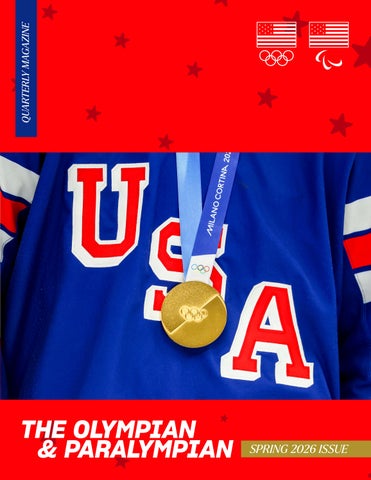
Megan Keller #5 of Team United States scores the game winning goal in overtime against Claire Thompson #42 and Ann-Renee Desbiens #35 of Team Canada to win the gold medal during the Women’s Gold Medal match between the United States and Canada on day 13 of the Milano Cortina 2026 Winter Olympic Games at Milano Santagiulia Ice Hockey Arena on February 19, 2026 in Milan, Italy.
The Olympian & Paralympian SPRING 2026 ISSUE
Design
McLain Broussard
Alumni Relations team
Christine Taylor
Robbie Fulton II
Kara Winger