
Tea Volume 28

Page 1


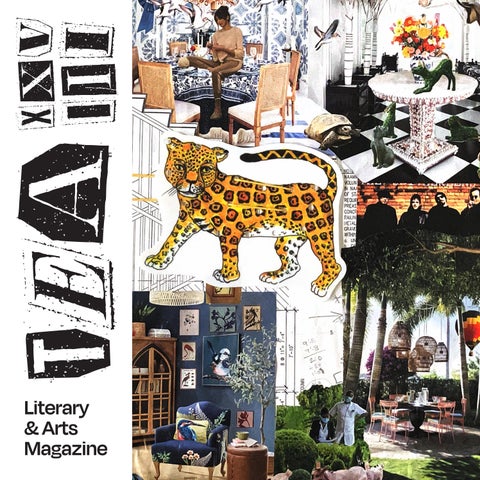
TEA XXV III

Literary & Arts Magazine

TEA

Literary & Arts Magazine

Cabinet & Staff

Editor in Chief:

Sarah Garfield

Presidents:

Ian Jackson

Fabiola Vindas Montero

Vice President:

Syd Hinton

Treasurer: Alex Fanaro

Webmaster: Mary Hanson

Media Director:

Viktoria Marcus

Events Staff:

Nithya Kunta

Art Editor:

Noie Prouty

Art Staff:

Angelique Aguado

Greta Reichenbach

Krisha Patel

Sari Homer

Yasmin Martins Amar

Photography Editor: Syd Hinton

Photography Staff:

Amrita Ketireddy

Arundhathi Arun

Jessiah Wassink

Logan Lumucso

Presley Lomel

Susan Williams

Poetry Editor: Noah Anderson

Poetry Staff:

Deborah Torrez

Laura Collins

Leah Braxton

Sofia Galvan

Sofia Toledo

Steph Seraphin

Design Editor: Turner Toliuszis

Design Staff: Anna Gibson

Giulana Leon-Velarde Meneses

Hiral Shukla

Leandro Bonilla

Sarah Gissendanner

Viktoria Marcus

Sarrinah Saif

Prose Editor:

Eluney Gonzalez

Prose Staff: Alex Fanaro

Elliana Boyarshinov

Gabriel Vazquez

Isabella Flores

Lely Truong

Maddy Durand

Nathan Mei

Nina Prouty

Sam Douglas

Samuel Bullard

Sophia Sonkin

Taylen Huang

Untitled 4
Sydney Launay

Letter from the Editor

Dear Reader,

It is with great pleasure and honor that I welcome you to Tea Literary & Arts Magazine’s 28th issue!

As a starry-eyed freshman who longed for a creative outlet between my STEM classes, Tea has been a home for me for the last four years. First serving as a design staffer, and then as the Co-Design Editor in my 2nd and 3rd years, I understand firsthand how much time and effort it takes to turn an initial concept into a tangible magazine. It would be an impossible undertaking without the incredible Tea staff and editors. Thank you all for everything you do! To my brilliant editors, Eluney, Noah, Noie, Sydney, and Turner, I am constantly in awe of your creative talent and artistry. Thank you for all of your hard work. To the graduating staffers, it has been amazing to know you, grow with you, and share your stories and passions. To the new members and those staying on, I am confident in your energy and dedication, and how your talents will extend beyond your roles in Tea. I am so hopeful for the future of this magazine and the community you will continue to foster.

The first edition of this magazine, back in 1996, was hand-stapled on a borrowed Xerox machine. Our founder, Matthew DeVille, envisioned Tea as a ‘refuse-to-take-yourself-seriously’ ideology built to create a place of security, positivity, and support for creatives. This is the environment that I hoped to maintain during my tenure as Editor-in-Chief. While no longer printed and hand-stapled on a borrowed Xerox machine, Tea remains a spectacularly collaged, bound body of work created by the shared will and passion of our community, and the stories and memories of our photographers, poets, artists, and writers. Tea feels like lying in the grass with your friends in Plaza. It feels like walking across the University after hours. It feels like a multi-hour design session in Library West. It feels like, and truly is, a labor of love.

As I cherish every memory I’ve made these past four years, I invite you to enjoy and celebrate Tea 28 with the beautiful community of Tea Literary & Arts Magazine.

Signing off,

Prize Winners

The Palmetto Prize for Short Fiction: "That One Time My Dad Drove His VW Bus All The Way to Costa Rica" by Savannah Sisk

In this emotionally intense story, an unnamed narrator tries to “construct the mythology” of the eccentric father who died when they were seven: a father who once drove a VW bus from Texas to Costa Rica and who refused to celebrate his own birthday. Legend and memory converge as the narrator, knowing better than to look for answers, tries to figure out which questions to ask. A beautiful piece of writing.

The Ghost Orchid Prize for Photography: “Detail of Modeled Speakesy”

At first glance, the image appears digitally manipulated; yet the title and other visual cues draw us into the content of the architectural model and its materiality. This oscillation between belief and disbelief, between construction and naturalization, invites viewers to linger on the mechanics of the photographic medium itself. The work draws attention not only to what is pictured, but to the process and labor of its making, reminding us that a photograph is made, not simply taken.

Also made—or constructed—by a hand that is not immediately apparent, and functioning as a kind of simulated reality, the architectural model itself further reinforces this idea. "Detail of a Modeled Speakeasy" asks a central question of photographic practice today: when we encounter a photograph, what is to be believed? The work actively engages this question, staging the instability of photography’s relationship to the world and, in turn, the stakes of what we perceive as real.

Prize Winners

The Blackbird Prize for Poetry: "That’s Us" by Amanda

Noyn

The poem “That’s Us” offers the reader an account of a bleak, violent relationship energized by a driving meter, loosely around seven feet per line, arranged into endstopped lines in couplets. Couplets are of course an ideal form for mimicking a pas de deux (or more like folie a deux). And yet, the fact that none of the lines enjambs succinctly conveys the feeling that the narrator is trapped. Tonally somewhat flat, the narrator doesn’t succumb to self-pity or hysteria, merely coolly noting “We ignore furniture that’s overturned, the empty glasses on the nightstand./The marks on my neck when I wake up are about the size of your hand.”

I admire the slant rhymes, the subtle escalation of each couplet until the finale, with its anticlimactic surrender to “morning, you love me again….” Morning ought to promise renewal, but we (and the narrator) know it’s just the start of another cycle that will break like a sudden storm. At every point, form drives the content: I was utterly convinced by the powerful engine of the meter that powerful emotions underlie the narrator’s matter-of-fact tone.

The Autumn Blossom Prize for Art: "Buncha Bull Sr" by Cherry Hybrid

The mixed media collage "Buncha Bull Sr." combines strong design elements with a surprisingly engaging narrative, highlighted by the mosaic-like construction of the bull that creates both structure and visual rhythm. Subtle variations in color add depth and cohesion. The handwritten details introduce a personal, expressive layer that contrasts with the geometric form, enriching the overall meaning of the piece.

Trinkets

Guileinah Dupiton

My aunt’s greatest loves begin in a leather purse holding lipstick, a light bill, and a diamond necklace; and end with a swift zip– concealing polaroids capturing young love, chump change, and the remnants of a dinner date.

Crinkled beige receipts tell tales of her past lovers, and their shared milkshakes– overflowing with whipped cream. CDs of curated instrumentals, from when she’s found herself in dark rooms with well-dressed men and a microphone. Dry, used brown wipes from nights she danced with someone special–face to chest, and too much powder on her nose.

My purse is lined with satin stitches and embroidery. The zippers store no gold bracelets, no slivers of silver, no crumpled twenties stained with crimson kisses. It is clean, too clean; like when mother’s expecting guests, so she discards piles of mail, covers the living room couch, and vigorously scrubs away at any flaw.

To my greatest loves, I offer no parts of myself–it’s dirty to be known, to have dug through a woman’s purse and love her anyway.

Self Portrait
Kali Gerrish Oil on canvas

You’ve Got Mail

A Taste of Childhood

Catalina Frias
Acrylic paint
Amelia McKay
Acrylic on canvas

Streetside

Reid Castillo

Puerto Rico, pero no es una vacación

Little me called Puerto Rico by its rightfully earned name: La Isla del Encanto. It was a place where banana trees swallowed the Earth, and coconuts from my Tia’s backyard provided drinking water. My bisabuelo fed chickens their daily corn; I’d pretend his corn grinders were potion makers. That was, until the funerals came tumbling, overflowing like ripe mangoes on trees, lost to the soil resting in front of abandoned homes. First, Abuelo died of cancer. Then his sister, Tía Any, died of a different kind of cancer. Bisabuelo joined his children a year and a half later. Around the same time Abuelo died, I was an angsty seventh grader. My one year of Catholic school made its mark on me: when you don’t know what else to do, pray.

When life is rocky and the light at the end of the tunnel ceases to exist, pray.

When life goes well and the light widens from a tunnel into your whole being, pray.

Pray because you’re here and because God blesses you even when you don’t see it. Pray for others, no matter who they are. Everyone needs prayer because we’re all on the rocks sometimes. So I prayed for Abuelo and Any and Bisabuelo. I prayed for the dead and those still alive on soil that bore fruit. If the unliving soil could

bring forth life, I prayed we wouldn’t let the dead stop us from living.

I wish life were rocky the way a seashore is. Then maybe I could pray more for Abuela. The wind blows, a storm blazes by, the salt makes my eyes bleed. Yet, there’s beauty in the beating waves, interminable and unceasing.

But in my Abuela’s brain, all that exists is the storm with moments of brilliance sprinkled in. Her life is a horde of tightly knit dark clouds circling her vision. They clear up slightly when she smiles at

a stuffed animal we see in the pharmacy, a little piñata donkey.

“Ay, mira que lindo! Te lo compro?” she asks, stopping to look at it as we pass by before training her eyes on what she came for: a gift for Mami. Mother’s Day is two days from now. She insists on buying Mami a gift despite calling her an uncountable number of names in a span of 48 hours—malcriada, desgraciada, testaruda.

“No, está bien.” I smile back at her acknowledgement of something beautiful, a rare thing these days.

“Pero mija, te lo compro.” Good or bad, she’s always been insistent.

“No no, ya yo tengo bastantes peluches.”

I thought about how different she acted on our first night back. Mami escaped to Tía’s house, to the coconuts that were once my source of happiness. She slept there, battling allergies to dust that Tía can’t get rid of until she clears the house of her hoarding addiction.

When Mami took off, I was in my room, which had been Abuelo’s room before he died. I heard my mom’s screams spreading beyond the living room, digging into my skin. I wonder if they dug into Abuela’s: her shrill, lone voice, on the verge of tears, asking her own mother to stop insulting her. Begging her to stop locking herself behind a gate and two doors in a small town where a robbery happens only once a year. Dios mío, así encerrada vuelves cualquiera loco! She’d say. Tired of seeing Abuela hide from the light of day, Mami chose to hide from the contagion of her isolation.

Abuela has bipolar depression, but don’t tell her that. She’ll insist she’s okay and that everyone has it out for her. In the course of three days, she insulted Mami, Papi, my late Abuelo, my Tía Dary, my cousins, and two of her sisters.

Mami is trying to find a lady who will pass by a couple of hours a day, lay out Abuela’s pills, and make sure she’s taking them. The last one quit. Hard things are the ones worth fighting for. The old adage makes sense until you’re picking up the pieces of a puzzle that doesn’t want to be solved. Abuela is just part of that puzzle. The other part? My late aunt and uncle, who are no longer

around to share the burden. My cousins, who hardly pass by Abuela’s house. They showed up to take a couple of cars in her driveway and pretend now that she’s unrelated to them.

“Sometimes, you just gotta know when to stop fighting, and let things be,” Mami said at the end of the trip.

The light in her eyes that she normally had at home, or even at the beginning of the trip, had dulled. I couldn’t blame her—we were ready to get back to our normal lives.

Yet, my mind keeps wandering, and so does Mami’s. I see it when she stares at Abuela’s knees as she walks. Or when she finds a bottle of pills and sighs loudly before throwing it away(again). What will happen when Abuela gets so old that her feet won’t take her to her car anymore? What will happen when she can’t close her fingers around a spoon and bring the food to her mouth?

If I voiced these thoughts out loud, Papi’s reply would be his tried and true phrase: We’ll get there when we get there.

La Puerta Nabil Naser Elliot
Little One
Kali Gerrish Graphite

Little Two

Kali Gerrish Graphite

Daze, Days (Excerpt)

That night he dreamed of the apartment, blurred and surreal in the way only dreams could make places seem, and in the morning, he mourned it.

They had gone there the day before to bid their goodbyes after the death of his grandmother. The apartment itself was garishly ugly; a perfect preservation of the moment his grandparents had married. Fifty odd years had gone by, and the patterned vinyl floors and plastic-covered furniture had long since passed out of fashion.

“Alessio, take these and start going through the kitchen,” his father said to him, handing him a roll of black garbage bags. He was about to ask how he should know what to keep and what to toss, but his father had already escaped down the flight of stairs that led to the garage.

“Great,” Alessio said, “just great.” The only company he had was the Madonna on the windowsill above the sink. The blue of her robe and the brown of her hair had faded in the sun, but her eyes remained as black as fresh ink, transfixed on the sights before her. Whether she was watching over him or watching him, it was difficult to say.

The task ahead of him was theoretically simple, but how was he to determine the sentimental value of items he himself attributed little to no value to? Maybe that was the point, he thought, and he began emptying out the cabinets.

All of it went into garbage bags: plates with horrid flower designs used at childhood dinners, pans that his grandmother had used to cook, glasses with superhero cartoon characters he had loved as kid, and obscure kitchen tools whose purposes weren’t immediately evident. The only item that was spared was the caffettiera—it retained a clear purpose, and several cups of coffee were going to be necessary before the end of the day.

He wandered throughout the apartment. Through his child’s eyes, it had once been enormous: the kitchen table was a fort, the terrace a concrete park, the whole apartment a city to explore. Now there were actual cities he would rather have been exploring on the weekend; he was too young to be reminiscing about a dusty house. If it had been up to him, they would have thrown everything away and started anew. His father had always been attached to his belongings; he imagined them as an extension of himself, representations of his life. And yet here they were, the two of them, throwing away most of his parents’ lives. The remainder of seventy-something years fit into a couple of trash bags. He made himself some coffee and noticed a large gluedtogether crack in the side of the Madonna. More than likely it had been broken and fixed by his grandfather.

The last cabinet held a collection of coffee

cups from Italy that some relative had given his father when he married his mother. Without the least bit of sentimentality, he threw them into the trash, save for two. He reached into the cupboard to check if anything was left, and felt an unevenness at the back. He pushed against it, and a small piece of the wall caved in. Out of that hollow space came a thick wad of fifty-dollar bills. The space in the wall shouldn’t have existed; and he examined it from different angles and couldn’t understand how it had been made. Typical of his grandfather, he thought to himself. He pocketed the money. All of a sudden, the cleanup had become a treasure hunt: who knew what else he could find here?

He heard his father’s heavy footsteps coming up the stairs and started making coffee. His father sat down at the table and they remained in silence as Alessio poured the rich dark brown liquid into a small cup.

His father drank it straight, without any sugar, in about two seconds. “L’hai fatto troppo lungo,” he said, “it’s practically an American coffee.”

“If you don’t like it then why don’t you make it yourself?” Alessio snapped, more than a little irritated. “What am I even supposed to do with all this stuff ?”

“Go through all of it,” his father replied indifferently.

“And how the hell do I know what you want to keep?”

“Figure it out. Jesus Christ, use your common sense.”

“Okay then, using my common sense,” Alessio started and picked up a set of ugly

embroidered red placemats, “I can throw these away since no one needs them?”

“My mom brought those from Italy. Keep them. Someone made them by hand. You don’t find that kind of quality anymore,” his father replied and took them, examining them in the light of the window.

Alessio sighed, “So then should I just keep all of the plates and cutlery and glasses, since she brought those from Italy, too?”

“Well,” his father hesitated, “I mean…no, just toss them. We don’t have the space for it. You know what, put all of it in bags and we’ll donate it.”

“Good, because I already did,” he said, and continued to toss things. He was mentally counting down the days until he would leave for college. Some things simply could not come fast enough.

His father stood at the door of the apartment, his gaze completely lost, as if he was trying to envision the lifetime that had passed there, the people who had lived, eaten, talked, cried, loved, and hated within these four walls. If it were up to him the apartment would have been left exactly as it was; a memorial to times passed.

“What about the Madonna?” Alessio could have sworn her eyes met his when he asked that question.

“We’ll bring it home.”

“And the rosary?” he asked of the one that was wrapped around the base.

“Leave that too, it was blessed by a pope. Or it was from a religious site. I don’t remember; it was a long time ago.”

Sorrow Glimpsed Through the Mesh

Flock
Syd Hinton

Between Blight and Budding

An old woman sells dewberries in Eldorado, Maryland out of emptied shortbread boxes. As she weighs out each bundle, the outline of Lorna Doone peeks through cardboard.

Once I bought a pound on the wayback to my spring semester of college, when I dreamed of sitting among paisley neckties too delicate to iron out.

She told me the dewberry’s a relic of the time when forests made way for pastures and pastures filled themselves with brambles so prickly even sparrows wouldn’t touch them.

An American sea captain tried cultivating them once, hoping for plumper fruits but quickly surrendered to the wild Gypsy of Northeastern fields.

When she handed me the dewberries, I felt skin, a gentle give losing its grip on the body, as my calluses, formed through wistful guitar lessons, scraped her palm.

I wish I had stayed there for another moment, letting the woman see the nectar dribble down my lips in a straight purple line and stain my vintage sweater.

Painted Elephant
Riya Murugappan
Graphite, watercolor, acrylic paint

Delta

No one on the ferryboat seemed to be breathing except one woman, her fig lips pursed in concentration on a catalogue of coups by children of friends from high school. Slack-jawed, drooling, the remaining gaped at the channel’s pendulum curvets and the rasping hull. The briny pulse nipped their nostrils, unacquainted to its rhythm. As the vein neared, their captain queried if the passage out to sea was written in that melody.

The Void of Time

Reanna Hossain Oil paint on canvas

Buncha Bull Sr.

Cherry Hybrid
Mixed media collage

Threshold

Charcoal, graphite, and ink

Protecting the Peace

Logan Lumucso

Looking in, Looking Out

33127

Descriptions of Little Haiti, Miami Florida:

1. There are plenty of chickens. I wrote my college essay about the chickens here and how their ironic disposition (have wings, can’t fly somewhere better) towards escape fueled my deeply intentional one. I miss it when I am away and can’t wait to be gone when I arrive.

2. When you Google it, tour guides and Reddit posts suggest you visit Upper Buena Vista (which is not Little Haiti) or the Cultural Complex (which is the block of my former hair lady and where Rihanna was when shooting the Wild Thoughts music video). People also search for Restaurants (see #3, #7), Little Haiti crime (yes), Things To Do (I wouldn’t know— the crime stopped my mom from letting me out much), and is it dangerous. I guess that depends on what you think the dangers are.

3. I’ve fallen deeply in love with its women. They are from everywhere and mean everything they say when talking about how their home country made them. Because of how it made their mom. Usually. An observation I’ve made: the women I’ve loved in Little Haiti have always

loved their moms. They’re always good in the kitchen. The women and their moms. They serve me baleadas and sopas on spontaneous visits. The women let me know when their moms are cooking for the family and when to come over. Sometimes the women love their moms but don’t know what to do with them; they convince me to not fear steak and that sometimes fires in the kitchen are good things. The women come from long lines of Little Haiti women and tell me about parts of themselves at night while laughing at my jokes and reading my poems.

4. Me and all my friends live down the same street Granted, everything is on this same street: it is Miami. Every street is the same street and has everything down it. All roads lead to wherever you’re trying to go (plus a few wrong turns because the highway signs move faster than you remember the exit being). My friend lives 14 blocks up from the Target and all the houses surrounding her grandma’s are turning into minimalist million-dollar homes. I heard

someone get shot at the park six blocks up from her, three down for me. At that pace, the place my parents rent will probably be snatched out from under them in four years to be bulldozed and turned into another Family Home in the Booming Area, Steps Away From Upper Buena Vista. I wonder how they’ll make sure the kids that’ll grow up in that house won’t hear someone get shot at the park.

5. The K-8 Center I went to is lifesaving. The seeds planted by teachers and the lessons learned from friendship kept me alive despite my wanting to end something that hardly even started. Now I’m older and I look back on the conversations I’d have with my school personnel, and wow, was that a lot to hear from an eleven-year-old. Yes, the teachers there do make a difference that matters. Yes, I do matter. My high school opened in 1955 and was the first school for black students in Miami in decades. The culture brewed within the walls. It was hard to fit in. But a way can be found. The friends I made in life have been plentiful in experience and wisdom. Through more adventures and exploration. Through creating spaces we remember needing.

6. Sound weaves through everything. From the sonical drive-bys to loud Haitian ladies on the

block (my mom on mine </3) there is enough noise to go by. It is important to soothe a baby through it. It prepares you to sleep through anything. Eventually, falling asleep gets lighter. You can sleep through anything.

7. Music videos are often shot here. Rihanna’s Wild Thoughts, Tribe by Bas and J. Cole, God’s Plan by Drake. When I asked my brother for more examples he said Stick Talk by Future, which is far too dystopian-seeming of my neighborhood for me to register it as my own. But those are the streets behind Piman Bouk. That is the green house my dad worked on: the one my brother pleads me to believe him in remembering. I do not like seeing it from these angles. I turn God’s Plan back on.

8. The dangers: historically black town, highways run through neighborhoods, underfunded public transit, traffic, air pollution; grocery chains, ghost kitchens, sysco: smoke shops, liquor stores, dispensaries; emotionally absent parents, alternative schools, unprevented preventables; isolation, individualism, egotistical thinking; climate gentrification, midtown, wynwood, magic city, brickell, design district; botanicas, roadside shrines, flower stands; empty apartments, hospital encampments, warehouses; news vans,

unmarked vehicles, body bags; the weight of downtown on the Earth, the amount of concrete in its pulse, the grid systems, the highways.

9. Piman Bouk and Chef Creole are the standard Haitian restaurants. I have never tried either of their food, but my mom makes lalo and legume and so many variations of dire ak pwa I am always impressed to discover a new thing a bean can do. There is a Haitian food spot my friends and I went to after my book signing in high school, which I only share through visiting together because the prices have risen and the portions have shrunk enough. I am unfamiliar with desserts. I am expanding my vegetable cooking methods. The food here is in abundance. Chains, local, Haitian, not.

10. In October, the Catholic-Church-by-nightpre-k-by-day hosts a seven-day prayer event based on the biblical story of Jericho. At least that’s what Google says. In all the years that we attended, what we were doing was never explained, or why. All I remember of it is that it is always around Keke’s birthday; every night they walked the church once, and on the last night they walked the church seven times; we would bring blankets and sit in the lawn entertaining ourselves however we could until

it wasn’t worth pretending to make something out of anymore. When it was time to walk, we got up and did it. Never explained, it was just done. Sometimes the pastors and churchgoers would get very passionate in their staging and had to be repeated. The lessons I’ve learned since then is when me or my siblings need cheering up, we call and respond “Jericho” “miray la kraze”, referencing a time before our own autonomy to turn thought into action. We laugh. At least we’re freer now. It is only where we’ve been.

Sydney Launay

The Rude Awakening

To The Hot Delivery Guy I Locked Eyes with on Zendaya’s Birthday

If you’re from the same place as me—a place rated America’s retirement home capital and sorority capital in the same year—you’ll know that we have two mountains in Florida. The first, a metaphorical one drawn in red marker depicting STD rates, highest in the nation (thank you old people, thank you young people). The second, a rotting mound surrounded by vultures that we affectionately call Garbage Mountain.

If you’re from Florida, you’ll think Primrose Hill sounds like a Bridgerton filming location. A tea brand. The green of a Carhartt jacket, an Aesop fragrance, a pair of Doc Martens. You’ll reduce it to one of those performative reading locations where Labrador retriever poetry guys cross their legs and bob their feet to Marxist literature. And maybe it is.

But most of all, if you come from a place entirely devoid of elevation, where you could take a picture of the sky any given Sunday at 2 pm and that would be the sky for the remaining 364 days of the year, then you too will cry the first time you visit Primrose Hill. Not because it is inherently magnificent, but because it will be your introduction to height. To perspective. To seeing the world as having dimension and surprises and hidden pockets of potential energy.

It will make you emotional for no reason and for every possible reason all at once.

My bank account cowers at 20 cents the night I first visit Primrose Hill. Sam, my very blonde, very

British friend, fishes a can of Pringles, strawberries, and chocolate from his backpack and sets them in the dying icy grass. He asks me how I plan to survive financially in London now that I’m not working.

“Sell feet pics,” I say.

I don’t know where all my money went. It seems like all I buy is matcha and tampons.

“That will do wonders for your mental health.” He scans the scene around us. “What do you think she’s thinking about? Person to our right. Three o’clock.” A young woman resembling the Lofi YouTube Girl rests her chin on her knees and places headphones over her ears.

“She can’t decide whether to break up with her boyfriend or not.”

“I was gonna say love stuff too.” He wipes Pringles dust on his jeans. “Whatever happened with that guy you DM’d? William or whatever.”

I de-crown a strawberry and shrug.

“Wally? He never responded to me.”

“Ass.”

“Ass,” I agree.

With every year that goes by, as I edge closer and closer to a fully developed prefrontal cortex, I learn something invaluable about the male species. I’m convinced this is part of the feminine experience: gaining intel on people who don’t have a womb from the collective knowledge of the people who do.

I imagine Wisdom herself as some feminine

powerhouse that takes me to cocktail bars when I need it most, sipping a shallow martini and teaching me about self-respect.

Veiny tree branches crackle up the skyline and puncture pink fluffs of clouds. To our left, magma orange melts behind the horizon of skyscrapers, the London Eye motionless.

Two men sitting in front of us pass a bottle of wine back and forth and rub their temples like people who pursued their parents’ dreams of finance careers—whatever that actually means— and now have to bear the conviction that their boundless knowledge of crypto tells them nothing about culture.

Pretty watches, pretty shoes, empty eyes.

A little farther down the hill, a group of British girls laugh into each other’s shoulders. One of them cackles breathlessly,

“Can we not talk about this when I’m LITerally intoxicated?”

They rotate a vape pen, and with each inhale, a little blue electric star brightens. With each exhale, pungent clouds of watermelon droplets diffuse into the air, melding with the hill’s existing aroma of earth and dirt and piss. A candlelit cupcake emerges, and the group starts singing a clumsy “Happy birthdayyy dear Zendayaaaaa.”

“Oh, here,” Sam says, removing a bottle of soju and two shot glasses from his backpack. I inspect the one that says Aruba on it, with a tiny Santa Claus wearing sunglasses and lounging under a palm tree.

My ass is cold, my thumbs so cold they don’t feel like thumbs anymore, and every cavity in my face leaks from the chill. A wind surges up the hill and sticks strands of hair across my face.

“When are you leaving?” Sam asks.

“Probably June,” I say. “Unless I marry someone here.”

“What about him?” He nods to a man wearing baggy trousers and wooden jewelry. He does a headstand, encircled by tiny incense statues.

“Our star signs don’t align,” I say.

“How do you know?

“I’m a Libra, he’s an Asparagus. By the looks of it.”

“Pity.”

When it’s time to leave, we gather up our things and veer around a couple making out.

“Damn, it’s cold,” Sam says into his gloves.

“Let’s do star jumps down the hill or something. To get blood pumping.”

I halt in my tracks and stare at him.

“Star jumps? Star jumps?” He demonstrates a Jumping Jack and I double over in laughter.

“Well what do you call them?”

“Jumping Jacks.”

“Jack? Who the hell is Jack?”

So there we are, doing star jumps down the hill when a food delivery biker stops at a red light. From the speaker in his cupholder blasts Landslide by Stevie Nicks. The green insulated box on his back trembles under the motorcycle’s purr, which is very loud on the empty street.

I want to ask him if biking around this city has changed his view of it somehow. If going through certain neighborhoods conjures specific feelings. Or if it’s all just a ride.

He winks at me before tearing down the road, leaving behind a trail of one lyric that gets quieter and quieter until he is no longer visible. Can I sail through the changing ocean tides?

The Leopard’s House Building Agenda

Marina Barnak, Helen P. Augustyn Collage

Detail of a Modeled Speakeasy

Brianna Breslaw

Architectural Composite

Physical model, bristol paper, and bassword linears

Roberto
Syd Hinton

Exposure

After The Three-Body Problem

The loose threads of the pseudoscientist and her silky lab coat are easily exposed by the stage magician’s own nylon-notorious sleight of hand. Whether in familiarity, revulsion, or an amalgamized, “I know you,” he unravels her.

Ghost
Catalina Sigmond
Tabbies of the 9th Ward
Cherry Hybrid
Mixed media collage

4

Sydney Launay

Driving Down for Thanksgiving

Hour three of a two hour drive. I watched the taillights of each highway-jammed car flicker to life, a bumper-to-bumper colony of fire ants amassing in dutiful marching form. A car up front right skips the center lane and goes to the far left, skipping the center lane—a man about my age stuck his head out the passenger-side window. He waved. I pointed at myself. Quirked an eyebrow, downturned for the vocal upturn of a question. He nodded. Thumped a closed fist to his flat palm, twice.

I had one hand on the steering wheel and the other tapping aimless patterns, seeing if I could still find the time in music. Key signature was a faraway memory, and I was frustrated at my inability to recall the circle of fifths. Keeping time wasn’t working out so I nodded at the guy, gave a small smile. My lack of tinted windows made me the lone transparent lens in an ocean of sunglasses. It worked out, I guess. Rock, paper—

A freight truck cut between the two of us, and his lane flowed forward while mine slogged unconvincingly. I was going to get off the highway, but then I changed my mind and the GPS rerouted me to the Ocala backroads for the fourth time. I got stuck in the right lane, never nudged off. That dreaded, disparaged right lane with its fearful drivers and its untrained truckers.

To my left, adjacent, someone else. I won round one. He won the second.

He turned to say something to the driver. Could be a brother—like mine, who was asleep in the passenger seat—or a father, or a roommate. Cousin, friend, neighbor. Men acted like best friends after just meeting someone new, despite knowing nothing about their lives. Their car was black amidst a wall of white. Mine was blue. It darkly sparkled in the light like a halfabandoned performance.

The guy in the front seat patted a guy in the back on the shoulder. Exchanged some words I didn’t really care to discover. I felt like they were discussing me. For a moment, I was blindingly real. I liked how I was nothing to him and that he was nothing to me. I liked that we had a lane of space between us and we didn’t try to talk over honking horns and wind that slipped between the cars. I liked being a smudge in their conversation, carried on namelessly.

Traffic shuffled; I changed lanes and squeezed slowly past it. I rolled down my window because the first Rock, Paper, Scissors Guy had done it, and so had the old woman in her white car behind him. And because everyone in the movies did it too. Mostly because I felt like I was missing out on every life experience already. I only learned about what I had missed out on after I could never experience it again. People were fond of telling me about fundamental and life-altering experiences by saying it was quite a shame that I

“missed out.” So I stuck my hand out the rolleddown window and let the car slowly pick up speed. I listened to Arctic Monkeys circa 2007, because they seemed like they had never missed out on important life experiences.

The sun set early by Thanksgiving. I-75 had no streetlights and dense vegetation that blocked signs of life outside the road. The world in front of me was a uniform, unending black cavity. It stretched on and on and would keep going even after I eventually took my exit. I ground the accelerator to the floor until I lost sight of the other cars in the rearview, lights shrinking to dust as I went deeper down the spine of the state, further into the hollowed-out ribcage of it all.

A Real Treat!

Forest Half-Remembered

Body Double (excerpt)

The girls, who look like they just strutted off a modeling catalogue, turn with uncanny coordination when Amina opens the door to her sister’s apartment. Her spare key lies unused in her hand. Amina thinks she can be excused from her slow realization because she hasn’t slept, her eyes are bloodshot and her mouth is dry, and she’s had a headache for hours. The models—all of them tall and skinny, with shiny hair and tastefully minimal outfits—look on in silence.

“God, they really do look alike,” one of them, a redhead, says softly. Amina wonders if she naturally has a fiery shade of hair or if she dyes it. For three years she was intensely jealous of how Parisa’s hair had morphed into a rich red-brown, another natural gift that skipped over her but blessed her sister with plenty. When Parisa had revealed it was salon dye, refreshed on a schedule, she stopped caring much for it. Beautiful things are only beautiful when they’re real, and Parisa’s hair, much like the rest of her, is a veil shielding something underwhelming.

The apartment, Amina realizes, is more colorful than usual. This irritates her. Parisa, who demands for everything to be in shades of white and beige, would never approve of the neon yellow tape or the red numbered cards crowding the already-busy apartment. Alongside the models, a crush of police officers flows in and out of the entryway. They carry small, clear bags. In one of them, she spies a red-soaked knife. Something is probably wrong. Come to

think of it, she hasn’t seen Parisa at all.

The entryway of the apartment funnels into the living room, which directs to a semi-closed off kitchen. The silhouette of the space is perfect for hiding in, and Amina has lost count of the number of times she’s crouched here, knees pressed up against her shoulders, waiting for her sister to come home. A tarp hanging in the entryway covers her line of sight, but bags from the farmer’s market lean against the outer wall. Eggs, cilantro, peppers. Basics that everyone should have and Parisa refuses. But Amina thinks the groceries are recent due to the slight condensation on their bags. It’s early in the morning and the sunlight trickles in, making everything shimmer like powdered gemstones. A few hours ago, in a lastditch effort to stave off insanity, she had texted her big sister, an old, familiar habit. Amina remembers the way she would curl into Parisa’s side while their parents screamed downstairs. She would rub the flat edge of her palm against her chest in a facsimile of soothing. Parisa had said she could come over, though. Said she could stay for breakfast and get out of the house before it would be her turn to throw away the shattered charger plates from the dining room. Something distinct from hunger—voracious, persistent, and allconsuming—begins to gnaw at Amina’s stomach. The world slows around her as she shuffles inside, head twisting like a camera on a swivel. One of the officers comes back inside, then slows to a stop in front of her. “Jesus,” he says.

“Amina,” she replies. It’s not that funny, but the redhead she saw at the doorway laughs.

“The sister,” another one of Parisa’s runway friends pipes up. She has curly hair that seems to bounce with every breath but stays pinned neatly away from her face. Her eyes are red. She looks, Amina thinks, as though she has been crying.

“Where’s Parisa?” she says, her voice suddenly small in the cramped room. There are too many people and now it is cavernous, uncontained. She is starving. The officer’s face softens into unfamiliar pity. She could get used to kindness like that.

“I think we should talk,” he says, and he puts a not-quite-comforting hand on her shoulder. He steers her further away from the kitchen. Red pools into a puddle on the gray floors. “Sit down, please.” He wraps a shock blanket around her shoulders when the sound, like a bullet, booms throughout the room.

“This is a crime scene,” someone shouts. “Get the hell out!”

Amina flinches—first at the sound, then at the yelling—but the officer pats her again. “It’s just reporters,” he says softly. “We’ll keep them at bay for a little while.”

This is a crime scene. Oh God, Parisa killed a man. And now the police are after her and the man’s blood is all over the kitchen floor and probably smeared over the farmer’s market veggies and Parisa is on the run and their parents will be so disappointed and again—again, there is a catastrophe at their door. Parisa had killed someone; not someone, likely a man. Amina doesn’t believe she would murder a woman unless she was exceptionally evil, but she doubts an

exceptionally evil woman would have confronted her confident, unyielding older sister in the kitchen of her tiny studio. Her sister is gone, and she thinks about lying to the police officer who tries to be comforting but cannot take one hand away from the gun holstered at his hip, and wonders if he would shoot her for lying. They shoot everyone these days, and lying, depending on who she lies to, is a crime.

Maybe she will say Parisa is out of town. Her sister has recently broken into the modeling industry, so Amina watches her plants while Parisa chases down the starlet opportunities of life. This seems reasonable enough, but like with most things, Amina does not get the chance to contribute.

The officer holding her hand says, “I know this is the last thing on your mind, but if you have any information on why your sister may have taken her own life, we need to know.”

“She didn’t kill herself.” Amina blinks. “She said she would make me an omelette.”

one of these is eternal

Lamb of God

St. Peter’s Catholic Church had stood in this spot for over a century, long enough for the air to have taken on a perpetual vault-like chill even in the brutal Florida summer. Isaiah’s blue button-down, far too heavy for late September, was somehow not enough to keep him comfortable as he knelt on the hard stone floor and felt the cold seeping into his knees. He bowed his head and felt the silver cross around his neck tap gently on his breastbone. The choir behind him began the Agnus Dei.

St. Peter’s had always sung their hymns in Latin. His mother, when she’d come to Mass with him that first Sunday, had rejoiced to hear it; she’d told him that was a sure sign that they did things the right way. You know how young people are today, she’d said. No one has any respect for tradition and faith anymore. She hadn’t wanted him to come to a state school and had instead pressed him to apply to the Catholic university just west of the state line, with the assumption that he was sure to receive scholarship funding. He’d been denied the money and had to come to the state school instead, several hours farther from home. He hadn’t told her that he’d submitted an incomplete scholarship application.

His pew was the very last one, and he could feel a draft creeping in behind him. Someone must have stepped outside, he thought. He tried in vain to keep his mind on the liturgy and not the visions that had been with him for the past day and a half; those of all things did not belong in a church.

Allen had set him on the edge of the mattress

and knelt down before him, hands on his thighs, looking up with genuine warmth in his dark brown eyes and a fond smile gracing his lips. His whole face had lit up when he’d smiled; it always had, but just then, he’d looked like an angel come down from heaven. Isaiah had smiled back, and Allen had pulled him down to kiss him once, twice, before starting to undo the buttons on Isaiah’s worn plaid shirt, one of the ones he’d purchased secondhand after his mother left him at school. Allen had pushed it off his shoulders like he’d done this for other boys a hundred times. If he had, Isaiah wouldn’t have minded. It had been more than enough for Allen to kneel there, grinning as he rested his soft, warm hands on Isaiah’s waist and made him blush.

Allen’s shirt had joined his on the carpet in short order, followed by the rest of their clothes, and after another moment Isaiah had unclasped the silver chain around his neck and laid the cross on the bedside table. The room had been thick with the comfortable late-September heat; Allen liked to keep his windows open at night for the air, he’d said, and a lullaby of cicadas and tree frogs had filtered through the screen and mingled with the quiet creaking of the fan overhead and the squeak of the mattress springs as Allen laid him down. Isaiah had been delighted to see that the rich tan he so admired, the consequence of eighteen sun-drenched summers in the Keys, continued up Allen’s shoulders and across his chest with only the faintest shadow of a farmer’s tan on

Reid Castillo

his biceps. Allen had spent the last few weeks of the summer lobster diving with his parents, he’d told Isaiah in bed afterwards, full days out on the boat, but it seemed he’d come away without even a trace of pink on his shoulders when Isaiah ran his hands over the smooth skin. The way Allen spoke about home made it seem like he’d sprung fully formed from the ocean, a sort of tropical Venus reclining unashamedly on his grey pinstriped sheets.

Isaiah hadn’t fought the temptation to stay the night. It was only the next day, after Allen had walked him to his dorm and left him at the door with a knowing smile and a promise to see him Monday, that a wave of guilt had hit him as he stood in front of the mirror to change out of yesterday’s clothes. He’d crawled between his sheets in an old youth group t-shirt, and when he laid his head on the pillow and began to weep, the cross around his neck slipped down to one side and weighed on him like a millstone.

He hadn’t had the courage to go to confession, and so here he was now, making his way to the altar with the faithful and fighting the way his stiffened knees threatened to buckle and send him crashing to the floor. He knelt in front of the priest. The deed nauseated him, and a cynical part of him wondered if he’d be punished more for the sex or for communicating in sin. He thought suddenly of Allen kneeling before him instead, and of the comfortable warmth of his smile. Isaiah crossed himself after the priest placed the

wafer onto his tongue, and as he stood, his mouth thickened with the taste of blood.

He slipped into his pew, hot tears spilling down his cheeks, and when he wiped at his eyes he saw the girl next to him looking on with something like surprise. She knew. She must know, he thought with horror. Everyone must know why he had worn his shirt buttoned to the collar and why he looked ill as he knelt back down and the choir sang the first phrase of the Salve. The girl frowned slightly after another moment, and Isaiah sank down onto his feet the way his mother had always scolded him for after Mass. He bowed his head and wept into his shirtsleeves, half expecting Hell to break open below him and swallow him whole as the girl sat and stared.

Bluebird
Syd Hinton
Watercolor, colored pencil and ink

That’s Us

China under carpet, broken hinges: babe, that’s us. We collect all of our grievances as we sip silently from cups.

I can tell that you’re unhappy, you can’t tell that I am hurt. We stare at the shattered screen of the television and pretend that it still works.

There are cracked stones on the countertops and then scuff marks on the floor. You speak and I’m scared of the way your voice sounds so familiarly hoarse.

We ignore furniture that’s overturned, the empty glasses on the nightstand. The marks on my neck when I wake up are about the size of your hand.

There are scratches running down your back and your hair’s always disheveled. Your smile has this peculiar habit, you know, of making me think of the devil.

Whenever you come home, I hold my breath and the atmosphere turns frail. I taste iron when you kiss me and you pick out the skin from under my nails.

We rearrange the dressers whenever there’s an added subtraction to the wall. You fuck me in the master bedroom—bruises, busted lip and all.

There’s a knife under the bathroom sink—you can’t know I went and bought it. There’s crimson on the curtain that wasn’t there when we originally got it.

I’ve hidden my favourite belongings, I’m packing bags while you’re asleep. In the morning, you love me again and I forget that I was meant to leave.

World’s Puppet

Zea

Alcohol markers, charcoal, and string

Moss
Enny Sun Digital

What I’d want the guy on the 7th floor who plays Indie-Pop on his guitar to know

The guy on the floor above me makes me privy to his dream of becoming a professional guitarist. An indie-pop artist. A soul singer. Today, he played “Golden” from K-pop Demon Hunters. Several Saturdays ago, his performance consisted of original music. He’d invited his friends to listen, and they clapped with fervor. My roof dripped with the energy of college students who were not yet submerged in the depths of midterm season. His voice cracks as he tries to go high, but he keeps playing. Like the almost-professional he wants to be, he keeps playing, because the show must go on.

I catch myself wondering what he’ll play next on the rare occasions that he goes past 11pm, his voice lulling me to sleep or keeping me awake. Enchanted, I want to befriend him. I wonder if he’s in one of those local bands, or if he performs in The Wooly or How Bazaar or any other venue around town. Will I ever get to see him play, face-to-face?

I yearn to be part of his world. A world where guitar strums dictate my movements. A world where soul is song, where bearing the soul is welcomed. Necessary, even. Even though I don’t know the Indie-pop music guy, I see him. He’s the star that shoots into my apartment and accompanies me in the dark. For now, the roof between the 6th and 7th floor separates our worlds. One day, I hope the barrier will shatter. In the contemplative darkness, his voice still reaches me.

The Wait

Sexuality
Amanda DeRosa
Physiology
Amanda DeRosa

Bloom

Coconut Dog

That One Time My Dad Drove His VW Bus

All The Way to Costa Rica

In the mid-seventies or early eighties, my dad attended college at the University of Texas at Austin. I am unsure of the specific year and so is my mother; those details are the first to fade after somebody has been dead a long time. But one thing is for certain: I know he had a VW bus. I remember the picture of him standing next to it, posing in that goofy, smiling-with-your-eyes-and-mouth-wide-open way people did before social media. His shirt is off. He’s really scrawny. “He was washing the car,” my aunt or somebody explains. He is also wearing a pair of those atrocious dolphin shorts so popular with men in the early eighties. So then it must have been the eighties. My dad takes his orange VW bus to college. Sometime in those next four years, he will have no money and donate plasma. His apartment will burn to the ground. These things I know for certain—I’ve heard the plasma story a hundred times, and my mom still has all his old burnt textbooks. “I don’t know what to do with them,” she sighs. “I guess I should just throw them away.” But she doesn’t, and I don’t blame her. His old things are like puzzle pieces. Like the cowboy boots tucked away in the back of her closet. Or the gun she found in the attic seven years after he died. After they found out he was sick he tried to tell my mom where he’d stashed it. Except by then the tumor had gotten too big, and he couldn’t remember where he’d put it anymore. He

couldn’t remember a lot of things, then. I was seven and afraid of him because he had all these big thick scars slashed across the top of his head. I thought he looked like Frankenstein.

I know my father in the way that most people know Marilyn Monroe. I’ve heard the legends and I have a general idea of him, yes, but I do not, and will never, know him personally. I have heard that he was kind of wild. “If I had known your dad in high school I would not have dated him,” my mother has assured me on numerous occasions. I have gathered that this may have had something to do with his childhood being bad. But what “bad” means no one will say. “Oh, I don’t want to talk about all that,” my aunt has said. I have heard her speak dismissively then fondly of her father. I have vague suspicions he may have been some kind of abusive alcoholic. “It was just so strange,” my mom has said. “He seemed so happy. But then there were all these things. Like, right when we started dating I found out that he didn’t celebrate his own birthday. Didn’t want to. Apparently it just wasn’t something he grew up doing. But, y’know.” She smiles shyly. “I fixed him.” She takes great pride in having done this. And why should she not? In trawling the annals of my memory I have been unable to locate a single still-image of My Parents, Unhappy. Upon meeting, they discovered that their licence plates were nearly

identical. When he proposed, the ring bore an uncanny resemblance to one she kept magazine clippings of as a child. Today that ring has been relegated to a safe-deposit box. Those two licence plates still hang in the garage above boxes of his things that she cannot bear to purge from her life. You’re supposed to get rid of things you don’t need. They got married after four months of dating. Had kids together. Would have grown old.

I know all the Jay stories. I know about that one time he picked up an armadillo and his stomach got all scratched up. I know about that one time his bare foot got stuck in the chain of a dirt bike. I know about that time he could’ve gone pro but messed up his shoulder. I know about the time his father up and moved the whole family to Costa Rica. One by one the kids grew up and left. Eventually the house was foreclosed upon, and when that happened, my dad drove his orange VW bus all the way to Costa Rica to bring his father back to Texas. My mom won’t tell me what the drive back was like. “I don’t know,” she frowns. “That’s one of those things I would have wanted to ask him about, first, if he were still alive. Y’know?”

I know.

From these fragments I construct the mythology of my father.

Dawn Emily Drake Acrylic
Whitebird Syd Hinton

bear one another’s burdens

love = door

Sarah Stander
Cross stitch and embroidery

What the Wind Remembers (Excerpt)

Soft light dapples the ground through pink leaves and arching branches, settling on the traveler’s face. It strokes the curve of his cheek as if trying to commit the lines of his skin to memory. As if light, too, forgets what it touches in this place. The sky burns gold, filtering in through the swaying trees, with the hush of leaves muttering secrets in languages lost to time.

The traveler lies among the fallen leaves— still, open-palmed, sand settling on his skin like a final blessing. The white powder catches the light, gilding him in sparkles. Above, the trees lean in to get a better look at him. Below, the earth sighs, cradling his body where it lies. At his feet, the water sings a wordless tune, lapping playfully at his boots.

The wind sighs as it rustles the pink leaves. It hums low, braided into the hush of the forest, threading through fern and thorn and bone. The forest before the traveler is peaceful, the lake behind is mirror-still.

Finally, the traveller inhales. His blood no longer weeps from his flesh. The wind around him rustles leaves that settle back onto his body. His fingers curl, stirring tree-litter, exposing the blackened soil beneath. It clings to the undersides of his fingernails. He breathes.

His eyes open slowly. He lifts his head from

the earth, surveying the forest. The pink foliage stirs a memory at the back of his mind. He has never been to this place, and yet he knows it. He does not question how he knows. The God of Death was laid to rest here, beneath the whispering trees. The forest was their domain in life—he does not let himself wonder what has become of it in their death. The traveler knows he must have washed up on its shore. He does not question how.

His boots kick up white sand as he lifts himself off the ground. It clings to his tarnished armor, to the tattered edges of his tunic. He stares deep into the dark, where the forest knots together and strangles the golden sky.

He turns, regarding the endless lake for a moment. It offers no answer in its stillness, stretched to the seam of the horizon. He cannot see where he came from—he finds he cannot remember. A yearning to return gnaws at him.

The wind caresses his cheek as it brushes past him, beckoning him to turn back toward the forest. As he does, the wind grows melodic, carrying more than the scent of flowers in blossom and decay. Damp earth, and sharp iron, and wet hair. The rush of a distant river. The call of a long lost voice. The tumble of an imagined waterfall. Then the air is still once again, and the visions fade.

The forest twines dark and ominous ahead of him. He feels dread pool in his stomach, feels like the forest stretches deeper the longer he stares. The wind still breathes against his ears, calling to him, tugging on his hair as if to draw him in.

He looks back again, gazing longingly across the lake, trying to ignore the dense blackness of the forest. The wind shifts, whipping across his face. Not just a breeze this time. A word. Come.

It is not quite speech, but something close, a murmur that finds the hollow spaces of his chest. It brushes against his ear as though she were standing just behind him, in the gap between breath and silence. He hears himself gasp, but the sound drowns in the melody of that word.

He knows the voice. He would know it in any silence, in any dream. He does not ask how. He does not dare. The impossible has already happened—she is here, speaking to him through the hush of the leaves.

Another breath of wind finds his ear, carrying her low tone. Find me.

His body moves before his thoughts can fully form. He knows her presence is impossible, but he cannot question it. He stumbles forward, into the pink cascade of leaves. She is here, she is calling. And he will find her. He will see her again. The forest parts for him, canopies bending into an arch overhead, as if it too obeys her call. Leaves flutter down around him in a ceaseless fall, brushing against his shoulders, his face, as though the forest itself seeks to claim him. The leaves whisper against each other as they fall, like the

swishing silk of her dress. The lake fades behind him, a still and distant world, swallowed by the forest closing in. He does not worry about finding his way back out of the forest, too entranced by the sound of her voice. He thinks for a moment that maybe it does not matter.

Everything around him feels vaguely familiar, as if he has walked these paths in another life or dreamed them into being. He cannot remember— he does not care. The wind hums again, weaving through the branches, carrying fragments of her voice. I am here. Do you remember? Will you follow? He follows. He always follows. And as he walks, the forest shifts—it grows quiet, intimate, folding around him, drawing him ever inward. The golden light above him fades until the forest is dark. The trees stand in neat, even rows, as though guarding the path the traveler carves. Pink vegetation flattens underfoot. When he looks over his shoulder, there is nothing left of where he came from. Only pink foliage sinking into dark soil. When he looks ahead again, a black, packed earth path opens where he steps.

He thinks only of her as he presses forward. She is here, in this dead god’s domain. If he could reach her, he could bring her back with him. She could be his again. The god would not be able to stop him. Her voice grows stronger on the wind as he presses deeper into the forest, as if confirming his thoughts.

I am waiting for you.

Read Into the Moment

Special Thanks

Brianna Bates

Jupiter Jones

Alejandro Aguirre

Gary Jackson

Charles Humes

Darien Octave

Matthew DeVille

Maia Anderson

Jasmine Siddick

Nithya Kunta

Garry Bouland

Charis Cochran

Alanis Gonzalez

Gregory Charlestin

Nicole Beaufrand

Brandon Mull

Alex Del Canal

Chloe Grant

Revengeivy

Mom & Pop

Lynx Books

The SL8 Gallery

Gender & Sexuality Protection

The Palmettos

Nighjar

Dr. Sarah Gamble

The School of Architecture

The UF College of the Arts

David Leavitt

Ange Mlinko

Tea 28 was designed, produced, and edited solely by the University of Florida undergraduate students. The opinions expressed are those of our contributors and do not necessarily represent those of Tea editors and staff or University of Florida staff, faculty, administrators, or trustees.

Copyright 2026 by the University of Florida Tea Literary & Arts Magazine. Tea, and by extension the University of Florida, has given permission from the contributing students to reproduce the content of this magazine for use in physical and digital publishing, social media, and any other reasonable academic uses. Submissions are welcome from all University of Florida undergraduate students.

More information can be found at tealitmag.com.

Turn static files into dynamic content formats.
Create a flipbook