Vol. LIII, No. 12
The Signal
Taking a ‘Look Back at It’: A Boogie Wit da Hoodie performs fall concert at TCNJ
By Alena Bitonti Arts & Entertainment Editor
After weeks of anticipation from students, the College Union Board brought rapper A Boogie Wit Da Hoodie to campus on Nov. 11 for a sold-out performance in the Recreation Center.
Born Artist Dubose in the Bronx, New York, A Boogie Wit da Hoodie rose to fame with his breakout track “Still Think About You,” featured on his 2016 debut mixtape, “ARTIST.” He is best known for hits such as “Drowning” and “Look Back At It.”
CUB revealed A Boogie as the headliner on Oct. 22 through an announcement on Instagram. Tickets for the event went on sale a week later and sold out within hours.
Admission was limited to students and one guest per student, with tickets priced at $5 per student and $10 for guests.
“I feel like this is a once-in-a-lifetime opportunity that it’ll only be $5 for students,” said junior speech pathology major Olivia Nowinski, who secured a spot at the front of the barricade. “As soon as I heard he was coming, I told all my friends.”
Students filled the Rec Center after doors opened at 7:30 p.m. According to
Sherrill elected

A
CUB, a total of 2,500 general admission tickets were sold, including both student and guest tickets.
The College’s own Toilet Theory, who earned the opening spot after winning CUB’s “Battle of the Bands” competition on Oct. 27, kicked off the show by performing songs including “Misery Business” by Paramore and “Locked Out
NJ’s first Democratic woman governor over Trump ally Ciattarelli
By Isabella Darcy Managing Editor
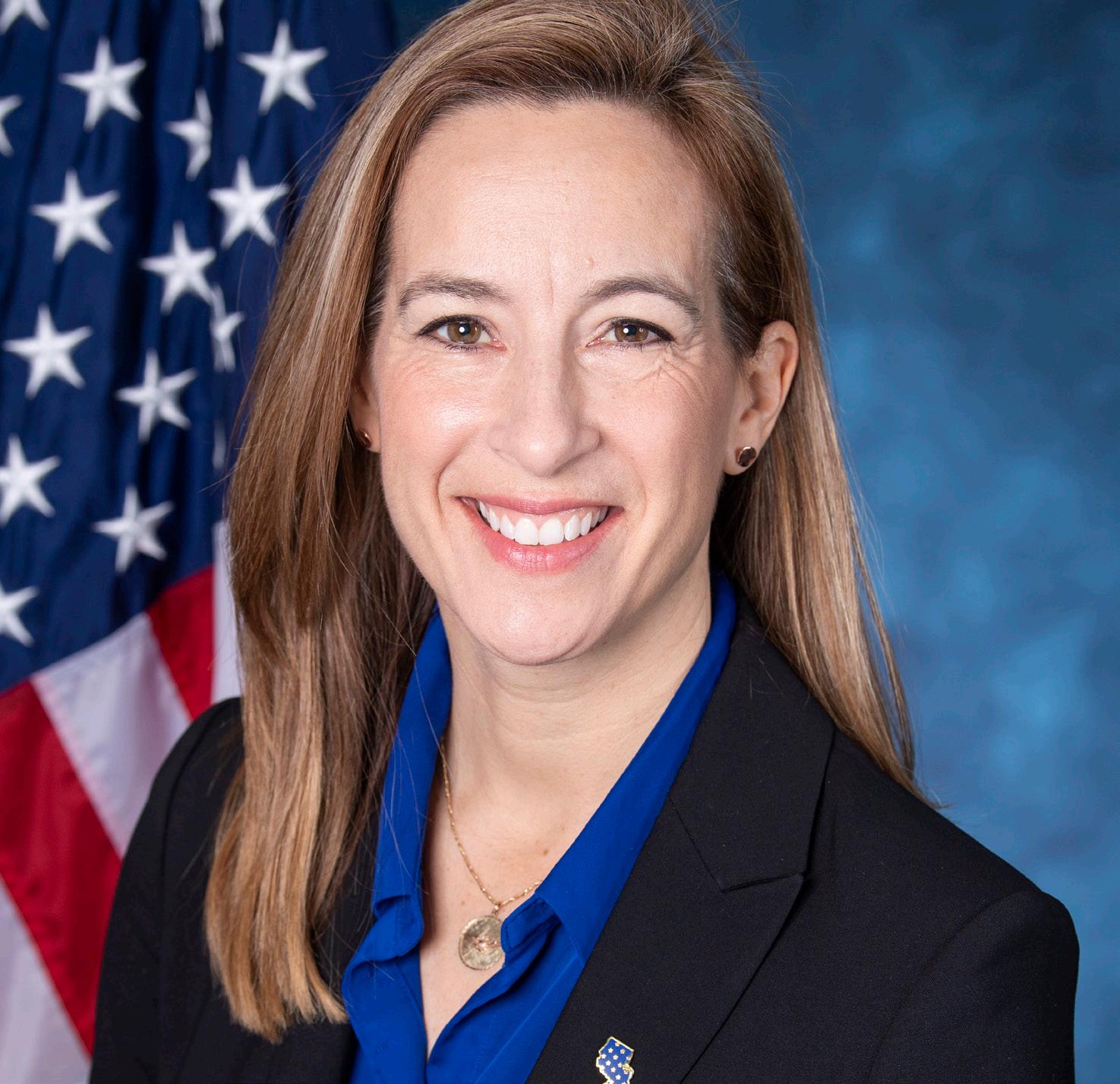
Democrat Mikie Sherrill was elected governor by a surprisingly wide margin over Republican Jack Ciattarelli on Tuesday to become the first woman from her party to lead the Garden State.
With almost 90% of ballots counted, Sherrill had 56% of the vote to Ciattarelli’s 44%, according to The Associated Press, which called the race for Sherrill less than 90 minutes after polls closed.
“Serving you is worth any tough fight I have to take on and I am incredibly honored to be your next governor,” Sherrill said during a victory speech at her watch party at the Hilton hotel in East Brunswick. “Governors have never mattered more, and in this state, I am determined to fulfill prosperity for all of our citizens.”
New Jersey has had only one female governor, Republican Christie Whitman, who took office in 1994. Sherrill and her lieutenant governor running mate, Centenary University President Dale Caldwell, will take office in January.
Sherrill, 53, a member of Congress and Navy veteran, and Ciattarelli, a 63-year-old former Assembly member and ally of President Donald Trump, faced off to succeed two-term Democrat Phil Murphy. New Jersey governors are constitutionally barred from seeking a third consecutive term.
Polls had showed the candidates far closer, and at one point in a dead heat.
“Our job doesn’t end,” Ciattarelli said during a concession speech at his watch

party at the Bridgewater Marriott hotel in Somerset County. “Yes, Republicans are the minority party, but that means also being the loyal opposition and continuing to ensure that our voice is heard.”
New Jersey voters also were choosing all 80 members of the General Assembly, which Democrats dominate 52-28. As of 11 p.m., many races were undecided, though Democrats were certain to remain in control.
Other races
In Virginia, the only other state with a gubernatorial election this year, Democrat Abigail Spanberger, a former member of Congress, defeated Republican Winsome Earle-Sears, the lieutenant governor. In New York City, Democrat Zohran Mamdani won the mayor’s race.
The three contests were being watched nationally to gauge voter sentiment about the president and the 2026 congressional midterms that will determine whether Republicans maintain control.
“Tens of thousands of New Jerseyans told Trump that we will never stand down to his attacks,” Caldwell told the crowd at the Sherrill gathering.
In Jersey City, New Jersey’s second-largest municipality by population, the race to replace three-term Mayor Steve Fulop was heading to a runoff. Councilman James Solomon will face another candidate, yet to be determined, on Dec. 2. Among the candidates was Jim McGreevey, the former New Jersey governor who resigned amid a sex scandal in 2004. Follow us!


stage, opening with his certified platinum hit “My Shit.”
Throughout the show, A Boogie performed fan favorites like “Swervin” and “Jungle,” even bringing out special guest Wolffacejoeyy. The crowd’s excitement made it clear that CUB had made the right choice.
At one point, A Boogie grabbed fans’ phones to film them, and himself, creating a memorable moment with the audience.
He closed the night with “Drowning,” as students sang along to every word.
The concert’s success was the result of preparation by CUB’s student crew, who managed everything from booking the artist to coordinating event logistics.
of Heaven” by Bruno Mars. Student DJ Will Peer, a senior secondary education and history major, followed with a set to warm up the crowd. His mix kept the energy high and the audience ready for the main performance. At 9:35 p.m., the lights dimmed and the Rec Center glowed with hundreds of phone flashlights. A Boogie took the
“Seeing it all in motion, seeing everyone in person, and realizing it’s not just numbers on a screen or tickets sold is so rewarding,” said CUB Live Event Coordinator Lindsey Ludwig, a sophomore elementary and special education major. “It’s rewarding to see that what we’ve been putting our hard work into is truly making an impact on campus.”
The performance marked the College’s fourth fall concert since the COVD-19 pandemic, following past shows featuring Yung Gravy, Swae Lee and Neon Trees.
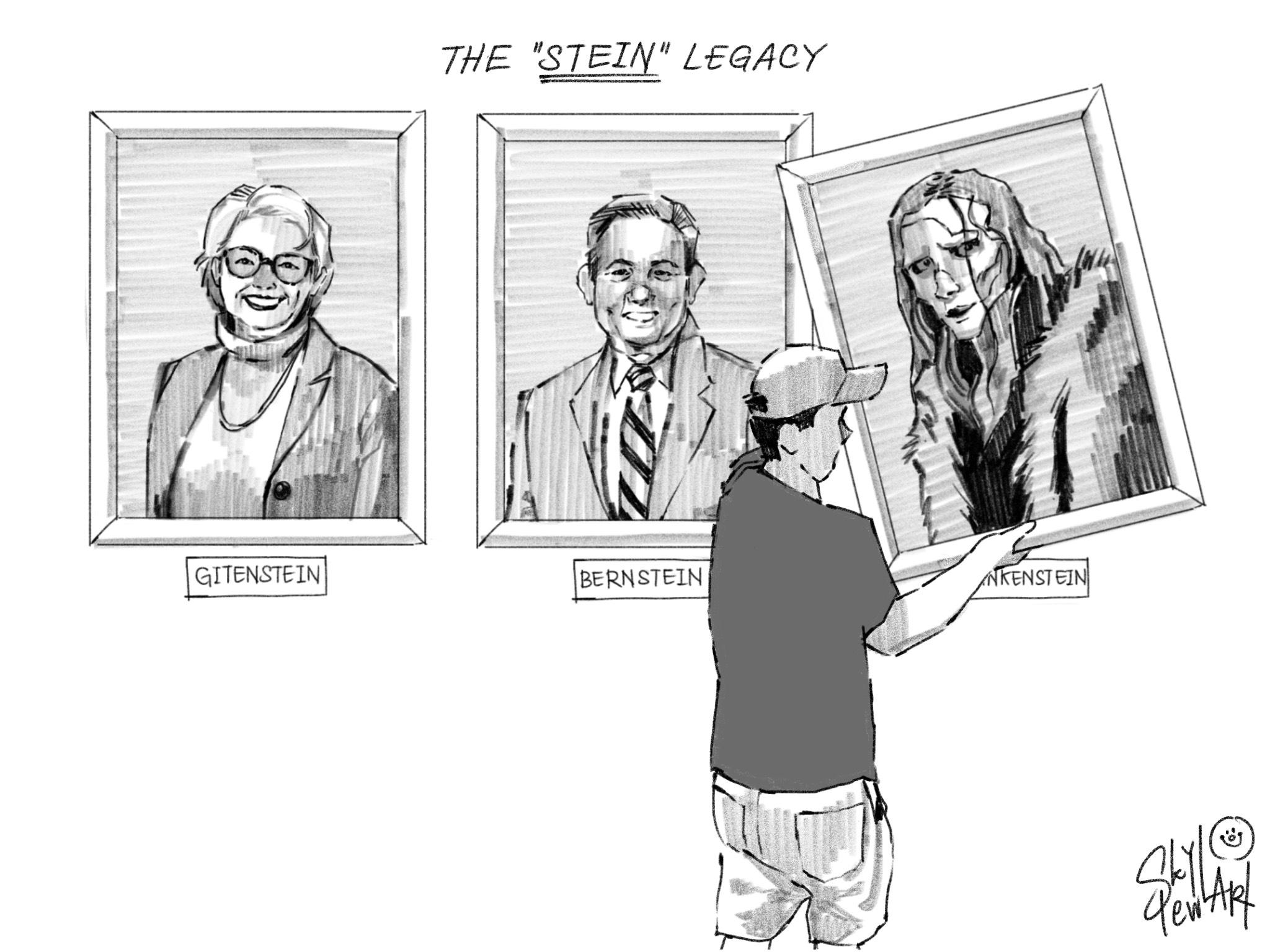
Former president Gitenstein visits TCNJ to speak on her experiences in academic administration
By Natalia Tomczak Opinions Editor
Former President Barbara R. Gitenstein, the 16th and first female president of The College, visited campus on Wednesday, Nov. 19, to speak about her second book and her experiences in academic administration.
Upon her arrival in 1999, Gitenstein enhanced academic rigor and transformed the undergraduate program. The College is ranked fifth in the nation among all public colleges and universities for having the highest fouryear graduation rate. Alumni donations nearly doubled during her time as president, and the College received its largest-ever single gift at $5 million.
Under her leadership, the College invested more than $380 million in its physical plan, including six academic buildings, housing for an additional 400 students and the acquisition of 103 acres of property to add to the campus of 289 acres. She also completed a contract for Campus Town, the College’s first public/private partnership with a developer.
She has recently written two memoirs on her leadership journey, the first being “Experience is the Angled Road: Memoir of an Academic,” for which the College hosted a book club in 2022. Her second book is “Portrait of a Presidency: Patterns in My Life as President of The College of New Jersey,” which she spoke about in greater detail during the event.
Writing the Book
She begins each chapter in her second book with an Emily Dickinson poem, someone she said she has always been inspired by. She wrote it, not as a chronological narrative, but with a
flow like memory, because those are the kinds of memoirs she enjoys.
Some of the chapters she began writing while the events were happening. Gitenstein said her typical writing process is that she simply starts writing, and then she goes back in to see what to remove.
She keeps many documents and bases a lot of her writing in her new book on news publications. She finds that for that reason, her second book is a lot more objective than her first, which was more personal.
Academics
As Gitenstein was president, she worked to change three credit courses to four credit courses. This meant a revision to every single course, major, minor and concentration. It wasn’t without pushback, but staff cooperation has allowed the College to elevate its courses.
Current President Michael Bernstein prompted a discussion about attacks on higher education, as people question the value of higher education in the current political climate. Gitenstein speaks to this, and how some academics have a sense of romance about academics, but “we haven’t listened to some of the legitimate questions asked of us. Why has tuition risen more than inflation? We need to own what we need to change.”
Leadership Through Grief
Gitenstein had to lead through various challenges, as she was president during 9/11. Leading through the grief was unique on a New Jersey campus because of its close proximity to New York City, she said. She speaks to this in greater detail in her memoir.
Read more on our website! see ELECTION RESULTS page 2
page 3
students’ art is open to the public.
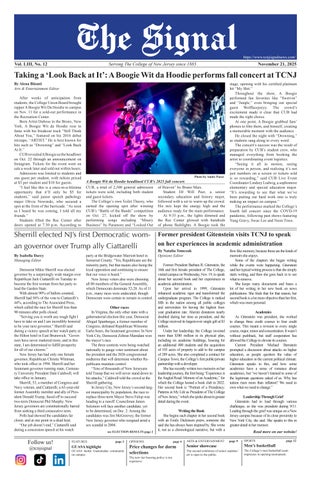
Boogie Wit da Hoodie headlined CUB’s 2025 fall concert.
Photo by Andre Paras
Cop Shop: Bathroom Bandits, Business Bullies and Blaze
Natalia Tomczak Opinions Editor
The Signal and Campus Police work together on a weekly basis to inform the campus community about crime on and around campus. All records given to The Signal are public records and do not contain personal information. Some information provided may be triggering for some students.
Nov. 5 & Nov. 17: Bandits
On Nov. 5, two Kendall Hall bathroom signs for the men’s and women’s first-floor bathrooms were reported by faculty to be damaged. The signs were pried off the wall. The missing sign says, “Please use the restroom that most closely aligns with your gender identity.”
On Nov. 17 at 3:24 p.m., there was a report of a stolen red utility trailer in the Facilities Building. A head grounds worker reported that it was stolen from
What’s
the Green Lane Compound over the weekend. The worker initially called other shops in facilities to inquire if they were using the trailer, but they all reported not having it. It was last seen at around 3 p.m. on Nov. 17.
Nov. 4 & Nov. 11: Busi ness School Bullies
On Nov. 4, bathroom graffiti was found on the firstfloor men’s bathroom of the Business Building. Writing in Sharpie said “#fucktcnj” in both stalls. It was photographed and removed. There is no indication of who
on voters’ minds

may have written it or when, but there have been previous instances of the same graffiti message in the same
On Nov. 11 at around noon, it was found that two employee the Business Building were pried open and the locking mechanism was damaged. Nothing has been stolen from the lockers, and facilities will repair them. The investigation is still
Nov. 1 & Nov. 10: Eickhoff Haze On Nov. 1 at 10:36 p.m., there
at
the
polls: high costs, honesty, Latino empowerment
By Isabella Darcy Managing Editor
Tuesday was Election Day in New Jersey, and voters headed to polls to cast ballots for their next governor and Assembly members. Residents in four towns shared what influenced their votes. Here’s what they said:
Michele Davis, a 71-year-old retired cashier from Egg Harbor Township, said Democrat Mikie Sherrill is her choice for governor because “she’s for the people.” The United States has “fallen way behind” since President Donald Trump first took office in 2017, she said.
The administration and Trump’s fellow Republicans in Congress are “not protecting us,” Davis said. “Every time I see him on TV, I want to throw something at my TV, but I can’t afford to replace that TV, because my taxes and everything are so high.”
Davis said she likes that Sherrill wants to lower utility costs.
“My bills went up. Water used to cost me $15 a month, then it went to $45 a month,” she said. On her heating bill, she said, natural gas is taking another hit. “Gas is expensive. All the charges that are added to these bills is ridiculous.”
For 33-year-old small-business owner Mike English, voting for change was top priority. Displeased with Democrat Governor Phil Murphy, the Egg Harbor Township resident said Sherrill would “be a continuation of exactly that” administration.
“We just can’t just keep going down. Democratic leadership in the states – you can’t have it,” English said. Of consumer costs, he said: “Everything is just so high.”
English said his utility costs are higher. Electricity bills in the state soared an average 20% in June as a result of an annual wholesale power auction.
“New Jersey would basically tax you to death with everything,” English said. His choice for governor was Sherrill’s opponent, Republican Jack Ciattarelli. “Jack talks about lower property taxes, and just taxes in general,” English said.
In Shamong Township, 42-year-old teacher Bob Colombo said he cast his ballot to practice his civic duty. He voted for a candidate whom he believes would “value public school teachers and make sure that they’re doing the right things to promote people going into education.”
Twenty-five-year-old salesman
Thomas Scarpello from Shamong Township said he thinks this is a “super-important election for New Jersey” with “two really good candidates.” He did not share which candidate he favored.
High taxes were the biggest issue influencing his vote.
“Being a young person wanting to try to buy a house, these taxes and things are so expensive,” Scarpello said.
Rising costs, especially for healthcare, were the biggest concern for Satish Patel, a 63-year-old pharmaceutical consultant who voted in Bordentown Township.
“We cannot afford to pay an enormous amount of like $1,800 per month for healthcare,” Patel said. “We don’t want free healthcare, but want healthcare at least affordable.”
Patel said he typically likes Democratic candidates because of their policies and approach to issues that citizens cite. Republicans, he said, tend to think in capitalistic terms, “which is not right.”
In Egg Harbor Township, 61-year-old hairstylist Karen Dixon also voted for Ciattarelli. She is “pro-Trump,” she said, and he has done “more than any president I remember.”
“I think he’s on the right path with a lot of things,” Dixon said. “Just getting rid of a lot of these illegals, securing the borders, now he’s going after the drugs on boats. Those kind of things I like.”
In May, as Ciattarelli was running for the Republican nomination, Trump called him a “terrific America First Candidate” on social media. Dixon said Ciattarelli’s alignment with Trump was the reason she voted for him for governor.
Trump is “destroying the Republican Party,” according to Emma Metz, an 82-year-old retired carrier for a doctor’s office and Egg Harbor Township resident. Metz said she was a Republican from 1961 until 2016, when Trump ran for president the first time.
“I changed parties because this man has broken all of the Ten Commandments,” Metz said. “He bullies people, he lies to people and if somebody says something to him he don’t like, he degrades them, gets rid of them. That is not the sign of a real president.”
About Sherrill, Metz said, “Republicans send their lies.” But the Democrat got her vote because, she said, “she seems to be honest.”
Read more on our website!
was an activated smoke detector inside a room in Eickhoff Hall. The door was knocked on, and there was no response. Upon entering, there were no signs of fire, but an odor of smoke. A full evacuation was ordered. The room was hazy and it smelled of cigars. On Nov. 10 at 5:34 p.m., there was a fire in The Atrium at Eickhoff Hall. At C-Street Grill, the cook was making hamburgers when the grease leaked into the grease trap, causing a fire. They quickly extinguished the fire, and the C-Street Grill was shut down. Firefighters arrived on the scene and the dining hall was cleared to stay open. There were 13 incidents of fire alarms from Oct. 27 to Nov. 19 in Phelps Hall, Decker Hall, Eickhoff Hall, Cromwell Hall, Wolfe Hall, Centennial Hall and Hausdoerffer Hall. Some causes include malfunction of a stove fan, aerosol anti-perspirant, popcorn, shower steam and cooking empanadas.
ELECTION RESULTS/ Sherrill Wins
Groceries and utility bills
New Jersey voters cited affordability, property taxes and utility costs as some of their top priorities.
Democrats and Republicans alike said they were aggravated by high prices for automobiles, appliances, groceries and other goods, and wanted a lower cost of living. Both candidates ran on promises to do just that.
Ciattarelli, in his third bid for governor, pledged to revamp how state aid is distributed to schools and said he would veto lawmakers’ pet projects, which add hundreds of millions of dollars to the state budget.
His campaign often invoked his grandparents, who had immigrated from Italy and became business owners.
“It is my hope that Mikie Sherrill has heard us in terms of what we need to do to make New Jersey that place where everyone once again feels they can achieve the American dream,” Ciattarelli told his supporters.
Sherrill said she supports consolidating school districts to drive down property taxes and wants to offer incentives to local grocers to spur competition and lower prices.
New Jerseyans also want a solution to rising energy prices. Electricity bills climbed an average 20% in June due to an annual wholesale power auction, and a spike is expected next year as well.
In an effort to freeze utility rates, Sherrill promised to declare a state of emergency on her first day as governor. Ciattarelli, who praised Trump’s ban on offshore wind farms, said he would rely more on natural gas and nuclear power as energy sources.
The Trump administration also was on voters’ minds. Forty percent of New Jerseyans approve of the way the president is doing his job, while 56% disapprove, according to a Quinnipiac University poll released on Oct. 30. The survey, of 1,166 likely voters contacted from Oct. 23-28, has a margin of error of plus or minus 3.8%.
The competitive race drew significant spending from both parties, especially by Democrats. Combined costs of both the primary and general elections make this race the most expensive in state history, according
to the New Jersey Election Law Enforcement Commission.
The general election itself was the second most expensive of its kind in state history, according to the commission. The two major candidates and independent political committees supporting them spent $82 million as of Oct. 30, records show. Sherrill and her backers spent $43 million, while Ciattarelli and his supporters spent $39.7 million.
Cash reserves five days before the election were $9 million for Sherrill and $7.2 million for Ciattarelli.
Before dawn on Tuesday, authorities reported bomb threats, though no related incidents, at polling places in seven counties: Bergen, Essex, Mercer, Middlesex, Monmouth, Ocean and Passaic, according to a statement from Attorney General Matt Platkin. By 8:20 a.m., some targeted locations were cleared for use and others had personnel to direct voters elsewhere, Platkin said. Local, state and federal law enforcement were investigating, he said.
Editor’s note: This story was produced in collaboration with the NJ State House News Service. It was written by NJ State House News Service intern Isabella Darcy. Reporting was contributed by fellow interns Isabella Burke, Adam Kendall, Rebecca Wechter and Brooke Holzhauer.

Photo courtesy of Wikimedia Commons Sherill was voted in as New Jersey’s new governor.
Features
GUASA builds Guatemalan community and pride at TCNJ

By Ashley Ragone Features Editor
When five sophomores of the College noticed a considerable lack of Guatemalan representation on campus, they passionately built the Guatemalan Student Association, or GUASA. Almost two years later, they have built connections with the Latin American organizations on campus, and are working on growing their presence within the wider Trenton community.
GUASA, which became a Recognized Student Organization in February 2024, has since been providing cultural tradition and education for Latin American students, as well as those just wanting to learn more about the culture.
“We want students to have fun through our events…GUASA’s founders also want to be the bridge for the College and the Trenton community, because of its close proximity to TCNJ and because of the heavy influence that Guatemalan culture has on Trenton,” said Elizabeth Menchu, a senior speechlanguage pathology and audiology major, as well as GUASA’s president.
The organization aims to grow connections, both externally and within the various cultural organizations at the College, promoting diversity and representation. GUASA most recently has worked with
the Latin American Student Alliance at the College for Hispanic Heritage Month, specifically in planning the Oct. 15 Calle 12 Parade.
The parade, which highlighted Latin American achievement from the 12 clubs within LASA, included dancing, food and various games. GUASA specifically contributed weaving boards and garnachas street food. The RSO also helped in planning the Dia de los Muertos celebration on Oct. 30.
“Apart from collaborating with other Latin organizations, we also collaborate with other cultural organizations to show the beautiful intersection of cultures across countries,” Menchu said.
The Dia de los Muertos event included face painting, live performance and frame decoration for an ofrenda.
However, GUASA is not exclusive to those of Guatemalan or Latin American descent. In fact, not all of the founders were Guatemalan themselves, but all shared a respect and love for the culture.
“Seeing the lack of representation in Guatemalan culture on campus impacted us when we were surrounded by it at home,” Menchu said. Founding the organization meant “[creating] another home on campus for students who identified as Guatemalan, and might’ve felt the same underrepresentation,
and for students who wanted to learn about the culture all together.”
Sophomore graphic design major Zahara Anglin, who serves on the executive board of GUASA, has enjoyed what she has been able to learn through the organization.
“I’m not of Latin or Hispanic descent at all…I’ve learned so much about the culture. As the graphic design chair, I came into my position hoping to not only sharpen my skills as a designer but to also involve myself in a culture I wouldn’t have the opportunity to otherwise,” Anglin said.
GUASA prides itself on its general body meetings as well, connecting the student body with various cultural traditions and holidays.
“With each meeting we usually include a craft and presentation connected to the theme,” Anglin said.
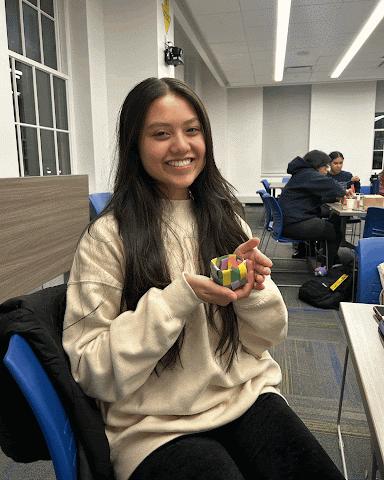
Most recently, GUASA explored Mercado de Chichicastenango, the name of a large market in Guatemala with vibrant products that attract tourists and provide a livelihood for indigenous artisans. The meeting included colorful textiles, various foods and basket weaving to immerse members into the craft further, according to Anglin.
GUASA members hope to connect students with Guatemalan culture, using both large-scale events and more intimate biweekly meetings as chances to educate.
“We also hope to clear the negative stereotypes that Trenton has, as we know that it holds artists and beautiful culture that also
represents Guatemala but also the general Latino community,” said Menchu.
GUASA’s future programming includes its next upcoming meetings, with “Buscando el Quetzal” and a Pumpkin Patch event on Nov. 6 and 11, respectively, as well as further collaborations with LASA. GUASA can be found through their Instagram @tcnjguasa. Menchu hopes to see GUASA provide a home to students and community members alike, no matter their background or status.
“Our goal is to create a supportive environment where students and those interested in the culture can connect, learn and grow together,” Menchu said.

Another brick in the path: The legacy behind TCNJ’s Alumni Grove

By Brooke Stollsteimer Correspondent
Sidewalk bricks on campus often get overlooked as busy college students rush by and walk over them daily.
This is the opposite for the College’s Alumni Grove. Filled with dedicated bricks from previous students, the Grove features names written out alongside their graduation year and organizations. Alumni Grove
is a special place for all current and former students.
Alumni of all ages and graduation years find the College’s Grove to be a spot on campus that they always remember.
“Ever since I committed in 2021, I intended on purchasing a brick,” said Alex Forton, ’25. “It was super cool to see names of alumni who graduated decades ago, and I knew I wanted to be a part of that.”
Located in the middle of campus, the Grove has become a spot for students to study, eat, meet with friends and soak in the school’s history. The area is used by the entire campus community, and over 2,300 personalized bricks have been purchased for placement.
The College encourages students to leave a “lasting and unchanging legacy of your own,” as stated on the brick website. Students can engrave their names, short sayings, memorial commemorations, Greek letters and the College’s logo. Those who purchase bricks also receive a free mini brick replica, so alumni can always have their brick with them.
“I had my name, class year and some notable student organizations that shaped my college experience engraved,” Forton said. “The College
has given so much to me, and I love to keep my brick replica on my desk every day to remind myself of the good times I had in college.”
Meaghan Dohan, ‘01, believes that it is extremely important to leave your mark on campus, whether through a brick at Alumni Grove or through your work during college.
“I saw the bricks the year prior when I came to TCNJ homecoming for [my daughter], and what inspired me was that I saw two bricks sideby-side, for a husband and a wife,” Dohan said. “It was so cute, and I looked at my husband and started thinking about it.”
Dohan was involved in Kappa Delta and Residential Education and Housing as a community advisor throughout her time at the College. She said she feels those organizations made her time at the College special. Dohan’s father attended the College before her, and she also met her husband at the College. Her daughter now attends the College as well.
“My father had joked about him starting a TCNJ dynasty, and it hit me around Father’s Day that it would be a great gift for him and my husband,” she said.
Current students often think about leaving a lasting mark in Alumni
Grove as well.
“I remember when I was visiting TCNJ in high school, I saw the Alumni Grove bricks and always loved the idea of them,” said Maura Gathercole, a junior art education major. “I think that purchasing a brick is a meaningful way to celebrate your time in college, and I definitely would love to buy a brick before graduating.”
The College’s Brick Campaign not only provides a lasting legacy for students. According to its website, purchasing a brick benefits programming for the College’s community. By adding their name to the distinguished list of Alumni who own bricks, students can also continue to support the College and its programming efforts post-graduation. On the College’s website, students can also locate bricks by name or graduation year. Through this locator, students can admire bricks bought by their friends who have graduated, or alumni can look at their bricks without visiting Alumni Grove in person.
“I encourage people to purchase a brick because you are able to be a part of TCNJ’s history,” Forton said. “For some, it’s a physical representation of one’s accomplishments.”
Photo by Zahara Anglin
GUASA celebrates Guatemalan heritage in the College and surrounding community.
Photo courtesy of Elizabeth Menchu
GUASA works alongside the 11 other Latin American student groups on campus.
Photo courtesy of Elizabeth Menchu Mercado de Chichicastenango brought basket weaving to GUASA.
Photo courtesy of Erin Reilly Alumni Grove celebrates past students and their contributions to the College.

TCNJ’s new tiered housing rates are too costly
By Tasnim Oyshi Staff Writer
If you live on campus and have yet to look at the recent emails from Residential Education and Housing, it is important that you do so. On Nov. 5, ResEd sent out an email to students with the subject, “Upcoming Housing Changes.” The email discussed three significant updates that we can expect to see next year in the College’s housing plans.
The first two modifications that are explained are generally good news for students. The first is that the College will begin to allow students across different class years to room together, starting next year. “Beginning Fall 2026, sophomores, juniors and seniors will select from the same housing options under the new ‘Rising Student Experience’ (RSE),” the email states.
In addition to the benefit this will provide to friends and family from different years who want to live together, this change will also give upperclassmen the ability to room in other RSE residential halls. This will be an improvement from before, when upperclassmen housing was limited to the apartment-style Haudoerffer and Phelps Hall and Townhouses South and West, according to TCNJ’s website.
The second update stated that the College intends to have air conditioning in Cromwell, Decker, Ely, Allen and Brewster halls by the fall of next year, “providing there are no additional supply chain complications.” As stated in the email, this will give all RSE buildings and half of the freshmen buildings air conditioning.
Up until this point in the email, the information provided speaks of upgrades that will better the quality of on-campus living. It is the third point regarding the new tiered housing system that does not seem to be much of an improvement to the current housing plan.
The email shows a table in which three tiers are listed. Each of the tiers has specific amenities. They range from communal bathrooms and no air conditioning in Tier 1 to private bathrooms and/or air conditioning in Tier 2 to private bathrooms, air conditioning and private living rooms in Tier 3.
The prices for single rooms, double rooms and triple rooms, as well as what buildings fall into which tier are also stated on the list. For single rooms in Tier 1 and double rooms in Tier 2, students would have to pay the base rate. The amount they have to pay for the other options are shown through an addition or subtraction of either $500 or $1,000 per semester.
This will be an expansion on the single/ double room prices that the College began in 2023, which has since added a $500 extra charge to single rooms in certain buildings. This is the College’s way of “ensuring affordability and transparency.” While this list does give a transparent price breakdown of the cost of living in specific buildings, the affordability part is questionable.
When the College increased the price of single rooms by $500, I remember students who either had planned to room in a single room or even had to have single rooms due to accommodations being quite distressed. This was of course justifiable, as the price students pay for tuition is already such a large number.
A love letter to the digital age

By Natalia Tomczak
Opinions Editor
Gone are the days of love letters, carrier pigeons and messages in bottles. Here are the days of targeted instagram notes, Hinge and direct messages. We’re maintaining more correspondences than ever, and we’re not worse off for it.
Romance in the digital age is not dead, it is evolving. With the liberty of choice and the freedom of the internet, love is abundant.
“This reminded me of you” is contemporary poetry, and it is everywhere in the digital age. How amazing is it that we get to send each other pictures and videos from our day, or that we get to send memes and news updates so easily?
Instagram is a great channel for low risk invitations. Liking and replying to Instagram stories are subtle ways to start low pressure conversation or express interest in what someone is up to. The most delusional of Instagram users use Instagram notes to drop specific messages through songs and hope that the receiver gets the message.
We’ve all become a bit like Gatsby, but instead of throwing parties hoping Daisy will notice, we share songs on Instagram notes, add to our close friends’ store and repost hyperspecific messages. Over-analysts and romantics are thriving.
Displays of yearning have changed. Courtship itself used to be considered more of a family matter, but greater freedom of choice and movements of liberation have
Now, the single rooms in the Townhouses, Phelps and Hausdoerffer will cost an additional $1000 per semester, instead of the $500 per semester.
It is not abnormal for colleges to increase the amount they charge students for tuition and housing every year, with inflation playing a big part. According to an article by BestColleges, tuition prices are also not regulated in the U.S. In addition, the decline in state funding for public colleges over the years have contributed heavily to the increase in prices that students have to pay.
However, going from a $500 to a $1000 upcharge to live alone is a bit absurd, especially when you consider that many of the people who apply for single rooms have to get them
due to specific accommodations. Asking students to also pay that money for an air conditioned building is also unreasonable when students don’t get to decide which buildings get air conditioning.
Ely, Allen, Brewster, Cromwell and Decker are only getting air conditioning now and if the College is planning on doing this for all residential halls eventually, all students will have to pay at least the extra $500 each semester. When housing applications begin on Nov. 21, there will ultimately be students who get the short end of the stick and have appointments set so late that they’re basically cornered into selecting a room that may be more expensive than the one they wanted. Ultimately, this new plan is too pricey.
There are too many biopics coming out
By Tasnim Oyshi Staff Writer
allowed people to pursue connections of their own. Marriage is not the goal anymore as much as love is.
Dating is reinvented by youth culture, not adult standards and the digital realm is a playground. It is so accessible to message anyone online, that people are way more hesitant before they shoot their shot. And, it is far more common to exchange social media than it is to pass someone a phone number. Besides, having lived through the pandemic, communicating online became the norm and rejection became more intimidating.
At the end of the day, authentic connection requires vulnerability and imperfection. It can often be easier to open up over text, and messages can be more thoughtful and coherent without the pressure and anxiety there can be in person.
There’s also the fun of exploring texting chemistry. Do they use emojis? Double text? How long does it take them to respond? What’s their tone? Who initiates conversation? All of these details are indicators of digital body language and ways we read compatibility.
Sharing music has always been a quintessential part of love, and online music platforms make it super easy. Sharing music through Spotify, or even sharing Letterboxd and Goodreads accounts, are cute ways people can get to know likes and dislikes on a deeper level thanks to these apps.
I am a big proponent of pursuing love for the sake of pursuing love, even if it might seem messy, unwise or scary. Recklessly, repeatedly, fall in love in the digital age.
The teaser trailer for “Michael” was posted on the YouTube channel for Lionsgate Movies on Nov. 6. As of midNovember, the little over a minute-long video has amassed about 14 million views. This biopic about Michael Jackson will feature his nephew, Jaafar Jackson, as the widely recognized “King of Pop” and it will be released in theaters on April 24, 2026.
The news of this film has already garnered a great deal of attention, with music and movie fans alike looking forward to watching it next year. The excitement surrounding the biopic is similar to the hype that “Elvis” had when it came out in 2022.
Just four years before that, “Bohemian Rhapsody” premiered in 2018 to an audience of enthusiastic fans and has since become one of the most recognized biopics. The release of “Oppenheimer” in the summer of 2023 was also an immense success, especially with the marketing boost that came from the “Barbenheimer” meme.
All of these films were hits in the box office, with “Elvis” reaching $289 million worldwide, “Bohemian Rhapsody” with its $904 million in revenue, and “Oppenheimer” gaining $976 million, according to Box Office Mojo. Looking at these numbers, it is clear that biopics have cemented themselves as a well-loved genre.
They have become so well-received by audiences, in fact, that there are even shows nowadays that replicate the style in a longer form. “Pam and Tommy” from 2022 about Pamela Anderson and Tommy Lee’s past relationship, 2016’s “The Crown” about the British royal family and Netflix’s “Monster” that focuses on a different serial killer each season are a few recently famous
ones.
There is nothing inherently wrong with biopics, of course, and there are plenty of excellent ones out there, such as “The Wolf of Wall Street,” “The Social Network” and “A Beautiful Mind.” In fact, biopics can be a great way to explore the life of a prominent person. However, one of their main problems is the frequency with which they have been made in the last couple of years.
It seems the number of biopics that are being released each year is growing consistently. Because they end up being so well-liked by audiences, this can be seen as a good thing. However, focusing so much on biopics can breed a lack of creativity. While making a movie is a long, complicated and strenuous task, the workload is much lighter when the plot has already taken place. Yes, the screenwriters still have to write the script. But the task is ultimately much easier to complete than to come up with an original idea and decide where to take the story.
Movie executives unfortunately seem aware of the success of this genre, however. They understand that they are marketable at the moment, and that prevents them from giving original ideas the space to come into existence.
The genre has also become so saturated in recent times that there are now films coming out about people who are still alive and have the potential to do more with their lives. The 2024 Bob Dylan biopic, “A Complete Unknown,” and the recent Bruce Springsteen film, “Springsteen: Deliver Me from Nowhere,” are just two examples that are both guilty of this. It feels odd to watch a film about someone when you could easily go to their concert instead. At the very least, the person the biopic is about should have passed before the biopic is made.
Read more on our website!
Photo by Andre Paras
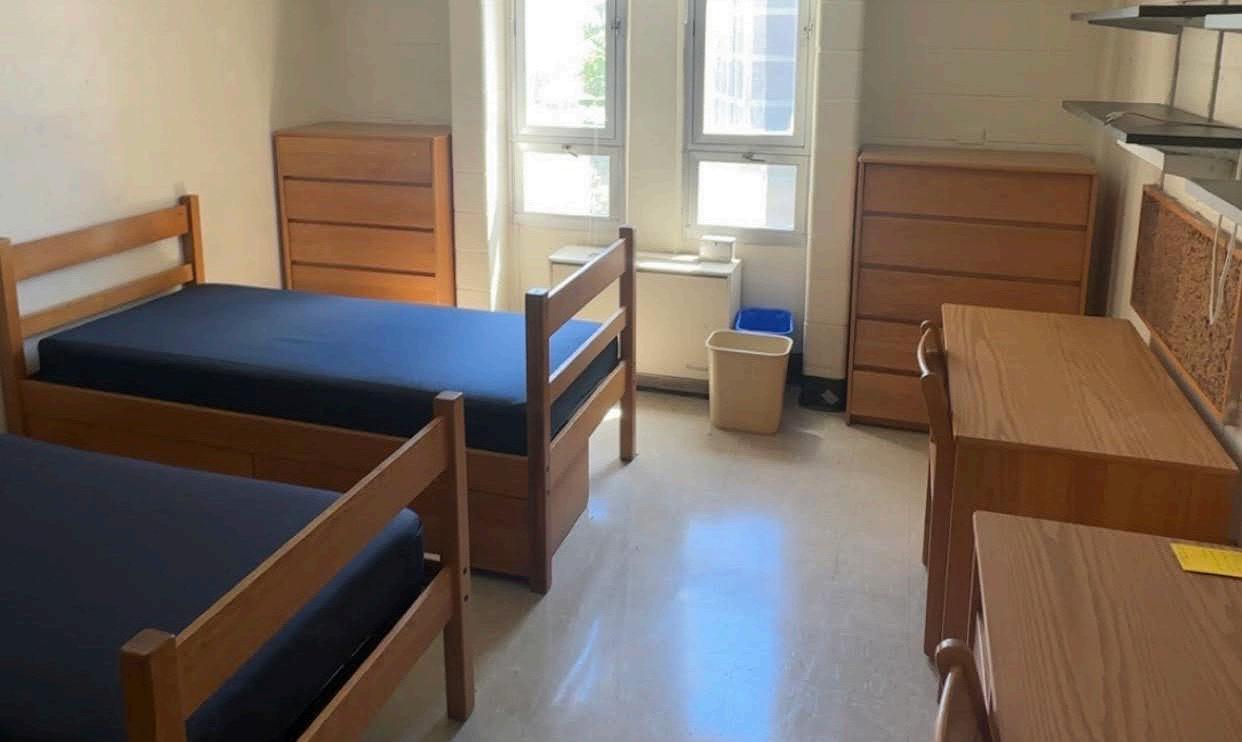
The College is introducing a new tiered housing plan.
Photo courtesy of Pexels
Romance is pursued digitally, and that isn’t a bad thing.
Editorials Common respect is dead in college classrooms
By The Signal Editorial Board
Common respect and decency is eroding in Generation Z, and it is particularly evident in underclassmen college students. Common courtesies have slowly turned into rarities, and students are more likely to have an avoidant attitude towards random socialization.
Many students on college campuses now seem to move and live in their own little “bubble.” Students seem to prefer to exist individually rather than spend time socializing and surrounding themselves with others. While walking to class, it is more common you will see students on their phones with their headphones on than with peers holding a conversation.
This shift in behavior is not entirely surprising. Many of today’s college students, particularly freshmen and sophomores, spent a large majority of their adolescence and formative years during the COVID-19 pandemic. Typical inperson conversations and social activities were then hosted virtually, cutting a huge portion of their social life.
According to a survey conducted by
PubMed Central, a majority of “teenage respondents (92%) reported not feeling connected to others during the pandemic.”
Remote learning replaced in-class conversations and relationships, resulting in more poor classroom manners. The relaxed environment of doing work from home and being able to easily tune out the Zoom classes while in the comfort of your own bed translated into weaker social norms once students returned to physical classrooms, and later on became a shock as they entered college.
In classrooms at the College, students who should know better are distracting themselves and others by being on their cellphones and laptops during lessons. Whether they are texting, scrolling on social media or playing video games, the inappropriate use of devices in an educational setting is disrespectful to professors and fellow students who are in class to learn uninterrupted by busy screens.
Side conversations also are not unheard of — literally — in these classrooms. Students are taught in elementary school that talking, laughing and shouting over
teachers is disrespectful. Yet, adults at the College seem to have forgotten this basic rule of classroom etiquette.
With the disrespect worsening over time, it becomes unclear what can be done to remedy the situation.
In high schools, it is a common practice for teachers to take technology away from students completely. However, after becoming so accustomed to using technology in academic settings, is it beneficial for students to now adapt to another new learning environment?
Because students have a clear reliance on technology, they may develop a resentment toward their professors for not allowing them to use technology.
With fully taking away technology not being an option, it is up to professors to identify what motivates their students. It is also their responsibility to adapt their pedagogy to each student or group of students, as the same teaching method may not always work for every class.
Professors could benefit from setting clear expectations and goals regarding technology with their students. This can be achieved by having a policy that involves using technology in moderation or by having a structured routine so that students know what to expect when they enter the classroom. This may decrease the anxieties or uncertainties faced by students that cause them to fall back on using their screens in class.
However, it should not be solely up to the professors to hold the attention of students in class. As adults, college students hold the responsibility of being attentive in class, being active in participation and respecting their professors.
The first step to being respectful in these settings is for students to be mindful of their own actions. Without students being aware of the responsibility they hold in college, they will not reach their full potential before entering the work force. \
The Signal
https://www.tcnjsignalnews.com/ Email: signal@tcnj.edu Business Email: thesignalbusiness@gmail.com
Editorial Staff
Ally Uhlendorf Editor-in-Chief
Isabella Darcy Eddie Young Managing Editors
Rae Raccagno News Editor
Alena Bitonti Arts & Entertainment Editor
Natalia Tomczak Opinions Editor
Ashley Ragone Features Editor
Joseph Caruso Sports Editor
Lake DiStefano Nation & World Editor
POLICIES
Join S The Signal
Administrative Staff
Sky Stewart Multimedia Coordinator/Editorial Cartoonist
Andre Paras Video Editor
Abigail Holliday Copy Editor
Amanda Incalcaterra Erin Reilly Social Media Managers
Cristina Collins Joshua Post Business Managers
Jenna Weldon Web Editor
Kathleen Webber Faculty Advisor
SThe Signal is published bi-weekly during the academic year. It is an independent publication. Any student may submit articles to The Signal. Publication of submitted articles is at the discretion of the editors. All materials submitted become the sole property of The Signal.
The Letters section is an open forum for opinions. Submissions that announce events or advertise in any way will not be printed.
The Signal willingly corrects mistakes. If you think we have made a mistake, contact us signal@tcnj.edu.
Photo courtesy of Shane Gillespie
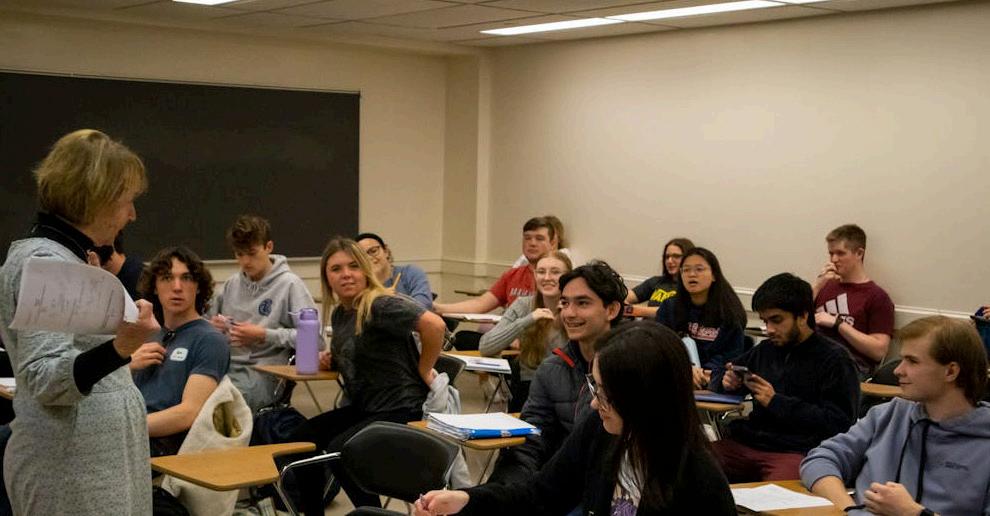
Respect in the classroom from students is a constant struggle that professors have faced.


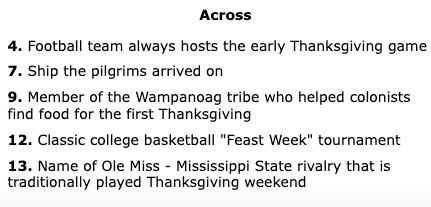
Thanksgiving Crossword



Longest U.S. government shutdown ends, leaving lingering questions

By Isabel Conforme Coello Correspondent
The longest government shutdown in United States history has come to a close after 43 days, following a long negotiation in Congress over the funding of healthcare subsidies.
down a funding bill that had been supported by the Republicans. The Democrats’ principal demand was an extension of the Affordable Care Act subsidies, which would allow millions of Americans to purchase health insurance, according to the BBC.
The Republican Party, which has majorities in both chambers of Congress, refused to act, declaring they would not include the Affordable Care Act subsidies in the continuing resolution, according to NPR. They offered to hold a vote about the subsidies in a later time frame, roughly in December.
The Democrats viewed the organized disruption as an occasion to negotiate, although prolonged, with robust negotiations bringing pressure and risk to the issue. Eventually, with several senators and six Democrats from the House of Representatives, the group voted to end the shutdown.
Program) due to delays in funding for over 42 million Americans. Funding is now scheduled to be restored for SNAP through Sept. 2026.
Early childhood programs such as Head Start, as well as national museums and monuments, could take some more weeks to reopen, according to the BBC.
Overall, the legislation funds most federal agencies until Jan. 30, 2026, but neglects to address the subsidies under the ACA differently.
Senate Majority Leader John Thune said he would call for a vote in mid-December, but Senate Democrats remain doubtful, according to NPR.
“A handshake deal with my Republican colleagues to reopen the government and no guarantee to actually lower costs is simply not good enough,” stated Senator Tammy Baldwin.
Analysts estimate that the shutdown cost the economy roughly $15 billion each week in lost economic growth, resulting in delayed loans, permits and contracts.
The shutdown started on Oct. 1, the date the Senate Democrats voted
According to The Guardian, on Nov. 12 President Donald Trump signed a funding bill into law after the House of Representatives voted, 222–209, to pass the bill. Two-hundred-sixteen Republicans, together with six Democrats, ensured that the bill passed.
Budget cuts lead to the end of pennies in the U.S

By Anna Miele Correspondent
The very last penny in the United States was finally produced on Nov. 12.
President Donald Trump issued an order to the Treasury Department to stop minting pennies due to recent budget cuts. Stores have reported running short on pennies and have had to round cash transactions up and down to the nearest five cents when customers don’t have exact change, according to USA Today.
This shortage has resulted in a shift to nickels, although they are much more costly to make, which can lead to other cuts in the federal budget. The U.S Mint’s annual reports show that a penny costs about 3.7 cents to produce, while nickels cost about 13.8 cents to make a very wide difference between the two costs.
The penny will remain a legal currency, however, economists predict that there will be a “rounding tax” for consumers who primarily pay with cash, according to Investopedia.
“For far too long the United States
has minted pennies which literally cost us more than 2 cents. This is so wasteful!” Trump wrote on Truth Social.
Canada, which ended their penny production back in 2012, adapted in their own way when the Canadian Government advised retailers and other cash businesses to round to the nearest five cents, according to TIME.
Seemingly, this is what America has been adapting to as well, although some businesses have resorted to stockpiling, saving every last cent of pennies they have, says TIME.
The topic of discontinuing pennies has been a years-long debate, and even former President Barack Obama supported the elimination back in 2013 during an interview, according to NPR.
In earlier years, Congress has attempted to suspend its production temporarily or eliminate its circulation to address its cost, the Congressional Research Service reported.
Americans for Common Cents, a group that represents the interests of zinc producers and other coin manufacturers, has spoken out, calling Trump’s penny plan “fundamentally flawed,” saying that it would increase the Mint’s losses by the requirement to produce more nickels, according to NPR.
Although pennies have been around for a very long time, ever since digital payments and card payments were created, about 86.9% of all transactions in the U.S were cashless in 2024, according to CapitalOne Shopping Research.
The shutdown had an extensive impact. About 1.4 million federal employees missed their paychecks, thousands were furloughed and many more were not paid for their work during the furlough. Under the new legislation, employees are guaranteed back pay, and all furloughs will be reversed, according to NPR.
Payments were delayed or reduced during the shutdown for SNAP (the Supplemental Nutrition Assistance
With government funding set to expire again in January, Congress faces another deadline. How quickly Republican and Democratic lawmakers can come to an agreement regarding the ACA subsidy will influence both policy outcomes and political messaging heading into 2026.
Epstein emails suggest Trump knew about his sexual misconducts
By Isabella McHugh Staff Writer
The Democratic House Oversight Committee recently released emails from the notorious sex offender Jeffrey Epstein in which he claimed Donald Trump “knew about the girls” he abused, according to AP News.
Three emails that pertained to Trump were released, according to CNBC, and the New York Times later published the contents of the three emails.
In the first from 2011, Epstein wrote the “victim spent hours at my house with him,” implying that Trump could have had an inappropriate interaction with her. This email was sent to Ghislaine Maxwell, Epstein’s co-conspirator.
Epstein further wrote that “He [Trump], has never once been mentioned.” In other words, suspicion of misconduct on Trump’s part has never been looked into by officials.
There is, however, no sufficient evidence to prove Trump’s involvement with Epstein’s victim.
Another email features author and journalist Michael Wolff along with Epstein strategizing Epstein’s appearance around Trump’s 2016 Presidential Campaign. Wolff told Epstein to let Trump “hang himself,” meaning if Trump said he never visited Epstein’s house or plane he could use that against Trump as leverage for his own standing.
On the other hand, if Trump did well in the election, Wolff told Epstein to protect him so Trump would owe him.
The third email was from 2019, when Epstein was once again facing criminal
charges. That same year he reportedly died by suicide while being held in federal custody, according to NPR.
In the message from Epstein to Wolff, he stated “of course he knew about the girls, as he asked Ghislaine to stop.”
This email again suggests that Trump knew more about Epstein’s schemes than he has previously stated publicly.
Once again, there isn’t evidence proving this to be true. However, the email contents can be potentially politically damaging for Donald Trump.
The Republicans responded to these emails by making what they said are 20,000 pages from the Epstein estate that were investigated during the case, according to NBC.
White House press secretary Karoline Leavitt told NBC that the Democratic party was “selectively” leaking these emails “to the liberal media to create a fake narrative to smear President Trump.”
She further stated, “These stories are nothing more than bad-faith efforts to distract from President Trump’s historic accomplishments, and any American with common sense sees right through this hoax and clear distraction from the government opening back up again.”
The email from 2011 that was released did not mention the victim’s name. Republicans on the Oversight committee afterward said it was Virginia Giuffre who died by suicide earlier this year. She accused Epstein of “arranging for her to have sexual encounters with a number of his rich and powerful friends,” wrote AP News.
Photo courtesy of Wikimedia Commons
President Trump signs the funding bill to end the 43-day government shutdown in the Oval Office.
Photo courtesy of Wikimedia Commons
Democrats win major elections nationwide ahead of midterms
By Anna Miele Correspondent
Democrats had a victorious election season, with the party winning major elections nation-wide on Nov. 4.
Democrats especially swept in three key races for Virginia governor, New Jersey governor and mayor of New York City, with the party’s voters drawing in huge numbers and leading to sinking approval rates of the Republican party.
The Supreme Court declines to revisit its 2015 same-sex marriage precedent
By Lake DiStefano Nation & World Editor
The Supreme Court has decided that it will not take on an appeal to overturn its 2015 landmark ruling Obergfell V. Hodges, which codified same-sex marriage into federal law.
According to AP News, the decision was made on Nov. 10, as the court briefly debated whether or not to take the case on Nov. 7. The appeal was thrown out without comment from the justices, and reaffirmed the legal precedent set by the court back in 2015.
The appeal was brought forth by Kim Davis, a former Kentucky court clerk who landed in legal hot-water when she refused to issue marriage licenses to same-sex couples even after the high court’s 2015 ruling in Obergefell v. Hodges.
Davis cited her religious objection to same-sex marriage as justification for her refusal to administer the licenses. A decision with which she was promptly sued for by multiple couples in the county. As a result of the 2015 ruling, a jury ordered her to pay $360,000 in damages and legal fees, according to CNN.
She was also thrown in jail for several days after a federal court found she had violated a court order to issue licenses, according to CNN.
Since then, Davis has been trying to get a higher court to overturn the lower-court order for her to pay $360,000 in damages and attorney’s fees.
This eventually led to the case reaching the Supreme Court, as the damages were requested on legal basis of the 2015 Obergfell V. Hodges precedent.
Mat Staver, the founder and chairman of Liberty Counsel, the legal group that represented Davis in this case, said that as a result of this ruling the former clerk will face “crippling monetary damages based on nothing more than purported hurt feelings,” according to CNN.
In New Jersey, Democratic candidate Mikie Sherril was elected for governor against Republican candidate Jack Citarelli. Sherill managed the win with a non-minimal lead of 13.1% points against Citarelli. New Jersey had the highest turnout rate in a governor election since 2009, according to the Associated Press.
In New York City, Democrat Zohran Mamdani won his race for mayor by 8.8% points, defeating former Governor Andrew Cuomo and fellow candidate Curtis Sliwa. Mamdani won about three quarters of voters under the age of 30, according to the AP voter poll.
Virginia also managed another Democrat sweep as Abigail Spanberger won by 14.6% of votes against Lieutenant Governor Winsome EarleSears. Spanberger’s victory was especially notable as the average margin of victory was 8.6 percentage points in the past 12 gubernatorial elections in the state, according to the Associated Press.
Ghazala Hashmi also managed to win Virgnia’s lieutenant governor race winning by 11.1% of the vote against Rep. John Reid. Hashmi has become the nation’s first Muslim woman elected to hold statewide office.
There was only one race on the ballot in California. However, the race was regarding major implications for control of the House in next year’s midterm elections. The state managed to overwhelmingly pass 64.6% in favor
Good
Despite the near-immediate dismissal of the appeal, it had received outsized attention partially due to the court’s 6-3 conservative majority, which three years ago overturned Roe v. Wade and the constitutional right to abortion that its previous 1973 decision established. The court also notably looks far different than the version of the itself which initially codified same-sex marriage into federal law.
Evidently, the court does not seem too concerned with revisiting other cases in the same way it did with Roe v. Wade.
According to AP News, Human Rights Campaign president Kelley Robinson praised the justices’ unwillingness to revisit the case, saying, “The Supreme Court made clear today that refusing to respect the constitutional rights of others does not come without consequences.”
While the swiftness of the rejection is notable within the back-and-forth for LGBTQ+ rights in this administration, the court’s recent taking on of Chiles v. Salazar — an ongoing case challenging a federal ban on conversion therapy — calls into question exactly how the justices feel free speech falls in relation to religious freedom and LGBTQ+ rights.
In the meantime, this marks a major loss for religious-freedom focused groups, such as Liberty Counsel, which according to the Liberty Counsel website, chose to represent Davis with the explicit purpose of overturning Obergefell v. Hodges.
“We are committed to overturning Obergefell. Like the abortion issue in Roe v. Wade, the Obergefell opinion has no basis in the U.S. Constitution. Marriage should have never been federalized,” Staver said.
Conversely, a decision for Chiles v. Salazar is expected by the summer, according to the SCOTUSblog, which will more fully color in this court’s view of religious freedom in relation to LGBTQ+ rights.
and 35.4% not for Proposition 50, which aims to temporarily substitute a democratic drawn congressional map.
Following this win, California will become the first state to have a new map which would add democratic seats in this current administration.
Democrats also managed to flip two seats on Georgia’s statewide Public Service Commission earning about 60% of the vote to have two new members to be a part of the five person public utility regulator. They are Peter Hubbard and Alicia Johnson. This is the first time Democrats have won a nonfederal statewide office in the area since 2006, according to NPR News.
Pennsylvania voters made the decision to keep three states Supreme Court judges as well as Democratic wins in special elections for a seat in Pennsylvania’s Superior Court, and a seat on its Commonwealth Court.
Mississippi Democrats had also managed to flip two seats in the State senate as well as in the State house, breaking the vast majority of seats which belong to the Republican party.
According to ABC News exit polls, voter’s top concerns are affordability, which likely ties into the overwhelmingly blue results this election season, with many democrats notably running campaigns focused heavily on advertising potential price reductions — such as Mamdani’s and Sherril’s.
News Lions: Sweden students gain access to free, healthy food; Finnish daycares boost immunity with nature; the Maldives bans smoking for younger generation

By Raeanne Raccagno News Editor
Good News Lions is the Nation & World section’s bi-weekly news segment, highlighting positive news in the country and around the world. The theme of this article is highlighting different governmental actions around the globe that have the youth’s best interest at heart.
Sweden launches pilot free food program to nourish students
Students at a handful of schools in Sweden can pick up healthy food donated by local food markets due to a new pilot program. The program helps decrease food waste and provides students with nourishing foods instead of leaving class to grab sweet treats from a vending machine, according to The Guardian.
Along with a revamped school menu, institutions are also adding social spaces for students to enjoy their nutritious snacks. Teachers at participating schools have noted an increase in students being more engaged and energized in the classrooms.
Sweden has been offering free lunches to their students since 1946, and in 2011, it became law for them to be nutritious. In 2018, the Swedish Food Agency said that schools were not providing enough nourishing food.
This led to Vinnova, the Swedish Agency for Innovative Systems, setting up joint food programs to progress towards more sustainable school food practices and to act as a domino effect to transform Sweden’s broader food system.
Finland daycares awarded money to ‘rewild’ facilities to boost children’s immunity
Forty-three daycares in Finland are receiving 1 million euros in grants to add more garden spaces in their schools to increase young children’s exposure to nature, according to Good News Network.
A 2020 study done at a Finnish daycare found that children who have a higher number of interactions with nature have a lower probability of developing illnesses that result from immune system disorders. The observational study found that immune-mediated diseases were more prevalent in areas that adopted modern urban culture as compared to areas with preindustrialized lifestyles. A leading hypothesis was that this was caused by the biodiversity loss that comes with urban spaces.
The Natural Resources Institute Finland, one of the organizations involved in the previous study, is now launching the Nationwide Research on the Rewilding of Kindergarten Yards, which is part of the Biodiversity Interventions for Wellbeing project. The initiative involves 43 daycares compared to the previous sample of 75 school children that was in the 2020 study.
The Maldives has banned smoking tobacco for the younger generation
The Maldives became the first country to implement a generational smoking ban for tobacco. It is now illegal for those born on or after Jan. 1, 2007, to use, buy or sell tobacco products, according to The BBC.
In the previous year, the Maldives made the import, selling, possession, usage or distribution of electronic cigarettes and other vaping products illegal. The new tobacco plan applies to all tobacco products, and retailers are required to verify a consumer’s age before the purchase is complete.
Photo courtesy of Wikimedia Commons
This is a series of major wins for the Democrat party.
Graphic by Sandra Abrantes
The theme of this week’s Good News Lions article is focused on government initiatives that are being implemented with the intent to benefit the younger generation.

TCNJ Musical Theatre presents its fall production, ‘Cabaret’

By Alena Bitonti Arts & Entertainment Editor
“Willkommen, bienvenue, welcome!”
TCNJ Musical Theatre welcomed friends, family and the campus community to a night at the Kit Kat Klub in Don Evans Black Box Theater. Based on the musical by Tony-winning composer John Kander, TMT performed the 1998 revised version of “Cabaret” for five-sold out audiences on Nov. 5, 6, 7 and 8.
Set in a Berlin nightclub in the early 1930s, the production explores the “dark, heady, and tumultuous life of Berlin’s natives and expatriates as Germany slowly yields to the emerging Third Reich,” as described in the show’s playbill.
The Master of Ceremonies, or Emcee, played by senior political science major
Ben Cupit, hosts the Kit Kat Klub and serves as a symbolic figure reflecting the political changes happening at the time.
The show follows Cliff, a young American writer who has just arrived in Berlin, portrayed by sophomore English and secondary education major Travis Martin. He quickly becomes infatuated with English singer Sally Bowles, portrayed by Bella Moitoso, a junior elementary and special education and history major.
At the same time, Fräulein Schneider, the owner of Cliff and Sally’s boarding house played by Megan Hurley, a junior elementary and special education and English major, begins a hesitant romance with Herr Schultz, a kind-hearted Jewish fruit seller portrayed by Eddie Mulvihill, a sophomore English and secondary education major.
Part two of the senior art solo shows opens to the public

By Sky Pinkett Staff Writer
The season of great art continues as the College’s student art galleries recently held the opening reception on Nov. 12 for four more talented seniors as part two in the Senior Solo Series.
This line up of seniors included Anna Cook, Dylan Manfre, Sky Stewart and Doris Yan, each of whom brought their own styles, techniques, materials and themes to the unique showcase.
There was truly something for every type of viewer in the exhibits. For our Christmas lovers, Dylan Manfre’s “Christmas in October” brings the holiday cheer early on campus. As viewers step into his exhibition, strings of overhead lights and snowflakes, snow sprayed windows, a large inflatable snowman and so much more transport the viewer into the North Pole itself.
“Christmas has always been my favorite holiday,” Manfre explained to The Signal. “I’m not really crazy about Halloween anymore. I stopped going trick or treating, I never went to any more Halloween parties
Before the show began, audience members shared their excitement about seeing “Cabaret” live.
“I’m half Jewish, and I know the premise of ‘Cabaret,’” said Julia Miller, a junior public health major. “I feel like it’s very important to go out and see live theatre, especially a show like this.”
Directors Brendan Branosky, a senior special education and history major, and Naomi Pirani, a senior history major, spoke to the audience about their commitment to telling the story of “Cabaret” in a thoughtful and historically accurate way. They had consulted with history professors and spent the year educating themselves on the historical and cultural context of 1930s Germany.
“We’re dealing with a very heavy topic because it has to do with the Holocaust,” Branosky told The Signal. “Of course that is emotionally draining for not only the cast, but the crew as well, and I’m so privileged to have a cast and crew that have such a dedicated perspective on the story.”
The production made full use of the intimate Black Box space, creating an immersive environment that kept the audience drawn into the story from start to finish. During “Entr’acte,” select audience members were even invited to dance with the cast.
Standout musical numbers such as “Willkommen,” “Cabaret,” “Don’t Tell Mama” and “Money” were performed with high energy, with the full ensemble helping to bring the Kit Kat Klub to life.
Beyond its lively musical numbers and visuals, “Cabaret” delivers a powerful social message that resonated deeply with
the cast. Sophomore nursing major Shain Stanley, who plays Kit Kat Klub girl Lulu, emphasized the broader impact of the show.
“I just hope people get [the message of] standing up for what you believe in, being there for others, and making sure you’re not a bystander to things you don’t support,” she said. “There’s heartbreak and there’s real issues, but they can live together and be in the same story — and I think that’s really beautiful.”
TMT is the College’s only student-run source for musical theatre entertainment. Stay up to date with their latest performances and behind-the-scenes moments on Instagram @tcnjmusicaltheatre.

TCNJ Jazz Ensemble presents ‘Synergy 1: Celebrating Togetherness’
and I’m not a horror person. So all of that just made me totally gear into Christmas super early.”
Interspersed among the Christmas decorations were photos depicting the chaotic holiday aisles to be found in stores such as Walmart, Lowe’s and TJ Maxx. Explaining these photos, Manfre said, “The whole show is called Christmas in October because I’m viewing how every retail store does Christmas in October. I go into every store and just check it out, anticipating all the decorations and the gifts I want.”
After spending time in Manfre’s Christmas wonderland, the viewer is treated to exploring the delicious Chinese dishes that Yan depicts in her vertical painting series “A Lingering Taste.” Fruits and food platters such as mangosteen, longan and dim sum are painted on long swaths of canvas paper, making the foods feel as though they’ve been recorded on scrolls.
“In my Capstones, I’ve been focusing on my culture and what it means to me,” Yan said. “For this semester, I wanted to focus on the foods that I have a lot of nostalgia for, either because the food I had when I was in China can’t be found here, or because they’re seasonal foods.”
Yan’s paintings go beyond depicting these foods as they look in real life. Using bright colors and animated layering, Yan captures her nostalgia for these foods by portraying them as fantastical and vibrant.
“I wanted to push myself, experiment and have fun with fruit… I wanted it to have this whimsical vibe because it is from how I felt eating them in my childhood.“ Yan continued.
Read more on our website!

By Devyn Briones Staff Writer
TCNJ Jazz Ensemble took their assigned seats on Kendall Hall stage as the lights slowly dimmed out. Their conductor, Doug Beavers, took the stage to introduce the first piece the ensemble would play.
“You know what would be great?” Beavers asked the audience. “A theme song. This was last weekend, and I had a couple days, so I was like, let’s write something.”
The first piece performed was called “Synergy 1: ‘A Call to Togetherness,’” which was followed by ‘Just Friends,’ a popular jazz piece created by John Klenner and Sam M. Lewis. The two compositions were blended together, with the start of the ensemble’s theme song giving the audience a happy, upbeat feel and ending with the second piece on a slower note.
Just before the intermission, the College’s Jazz Quintets performed, including Matthew Scuzzese, a sophomore music major, on
trumpet, Ariel Bravo, a senior early childhood education and psychology double major, on the piano, Justin Elias, a freshman chemistry major, on bass and Nickolas Alcaide, a freshman engineering major, on drums.
“They’re really designed to be of the professional level group,” Beavers said.
The audience were surprised as the four played together and each performed a solo, never guessing that they were improvising the whole time.
“In case you didn’t notice, the goal of the quartets is to play improvised music,” Beavers said. “And when they play, there’s no music, it will never happen again because it came from their brains improvising on the core changes of offer.”
The second to last piece performed by the Jazz Ensemble was “The Smell of the Sunshine” by Dr. José Beviá. Douglas and Dr. Beviá worked together to arrange the piece for TCNJ Jazz Ensemble.
Photo courtesy of Katie Gallagher
Emcee, played by Ben Cupit, hosts the Kit Kat Klub.
Photo courtesy of Devyn Briones
The College’s Jazz Ensemble takes a bow.
Photo courtesy of Naomi Pirani
The “Cabaret” cast under the Kit Kat Klub sign.
Photo courtesy of Dylan Manfre Manfre’s “Christmas in October” brings the holiday cheer early on campus.
TCNJ partners with German students in ‘Mirrors of Perception: Distorting Images of Reality’

Nov. 5 through Dec. 5
abroad teaching exchange at Goethe University’s Curatorial Program.
All of the art featured in this exhibit were created by students from Städelschule Frankfurt, HfG Offenbach, HSE Art and Design School and Moscow School of New Cinema.
The artists appearing in this exhibition are Simon Gilmer, Konstantia Lechler, Anton Andrienko, Nelly Habelt, Aerin Hong, Elsa Stanyer, Ilyada Dağlı, Lena Bills, Killa Schütze, Evelyn Roh, Dasha Likhaya, Angelika Sarkisyan and Sasha Kozma.
One artist, Ilyada Dağlı, captured her piece “be brave not to look away” in Venice.
and consciousness are altered. The work blurs the boundaries between reality and hallucination, presenting unpredictable sensations, distorted visuals, and chaotic narrative cues… Through this exploration, Martynov reflects on the fragility of human cognition and the uncertainty inherent in experience. It is not clear in the end who the main character in the film is, or what is even happening. Where is reality and does it exist at all?”
By Abigail Holliday Copy Editor
Tucked away in the College’s Art and Interactive Multimedia Building is a mirage of artwork, an exhibit called “Mirrors of Perception: Distorting Images of Reality.” Open until Dec. 5, AIMM 102 will be filled with prints, screens, images and sounds that all work together to draw you in and make you question reality.
“Mirrors of Perception” is curated by Egor Miroshnichenko, Leonie Cecco and Polina Arzhenovskova. This exhibition came to be through a partnership between the College’s Exhibition Design and Production course and the MA Curatorial Studies program at Goethe University Frankfurt in Germany.
The College’s own Professor Liselot van der Heijden initiated the collaboration during a semester
On the label, it reads, “In ‘be brave not to look away,’ Dağlı transforms everyday objects into sites of reflection and resonance. The series focuses on covered motors in the canals of Venice, which initially appear as mundane cityscape details. Upon closer consideration, these forms evoke associations with crisis and mortality, reflecting how media imagery shapes perception… The work meditates on perception as both a personal and social act, emphasizing how subtle encounters with the ordinary can reveal hidden layers of meaning and memory.”
Another interesting installation is “DELIRIUM” by Ilya Martynov, a just-over four minute video overloaded with videos, pictures, recorded lines and background sounds guaranteed to jumble your mind.
As written on the label, “DELIRIUM examines the disorienting state of delirium, where perception, thought,
When questioned on her inspiration for this exhibit, artist Ilya Martynov responded, “Lately, I have been inspired by different forms of the everyday and by the possibility of preserving a sense of ‘flânerie’ in the urban environment, as well as by the search for something new within constancy and repetition.
As for my work displayed at the exhibition, it is built on repetitions and sound loops which, when combined, create a layered soundscape. It seems to me that this, for the most part, generates an additional space for perceiving everyday reality. I am fascinated by discovering such shifts in real life and attempting to reproduce them through sound or imagery.”
Viewers of this exhibit are encouraged to use Post-Its to reflect and share their thoughts on the art. They were asked to share one word to describe the exhibit and their answers were, “intimate,” “unexplainable,” “mystical,” “reality” and “unsettling.”
Make sure to stop by this exhibit, open through Dec. 5 from 12 p.m. to 7 p.m. on Tuesdays through Thursdays and 1 p.m. to 3 p.m. on Sundays.
Tune In: TCNJ’s radio station gets a new remote studio launch
By Kayla Cox Correspondent
At the College, the student-run radio station, WTSR 91.3, is stepping up its game with a new control soundboard, creating the opportunity to open a remote studio in the Brower Student Center. These upgrades intend to expand student organization involvement opportunities and deepen hands-on media experience for the College community.
Commissioned by the College in 1966, the radio station has long been a hub for alternative and specialty music, public-service news programming and live college sports coverage. Now, nearly 60 years later, WTSR is making one of its most visible moves yet.
According to WTSR General Manager Kevin Potucek, the new space in the Stud will officially open for broadcasts starting in the Spring 2026 semester.
“The old box office is being set up as a remote studio. We’ll be broadcasting from the student center Monday through Friday during the day, ending at 4 p.m., while evenings and weekends will still be broadcast from our main studios in Kendall Hall,” he said.
This is all made possible by the new soundboard. A control soundboard is the central hub that manages all the audio signals in a studio or live broadcast setup, such as microphones, instruments, computers and remote feeds. When setting up a remote studio in a new building, the soundboard serves as the bridge between that location and the main station elsewhere on campus.
Situated in the old box office in the Stud, the new setup aims to bring campus radio directly to the students.
“Our hope is to engage directly

Decorations in Brower Student Center promote the new studio. a behind-the-scenes operation only located in Kendall Hall into a visible, interactive part of the College’s daytime energy. The studio’s glass-windowed setup will allow students to watch live shows unfold as they pass through the student center, offering an interactive glimpse into campus media in action.
with the people who spend time in the student center during the week,” Potucek explained. “This spring will be a trial period to see how well the student center studio is received. If the feedback is positive, we hope to stay in the student center for the foreseeable future.” The initiative reflects WTSR’s ongoing commitment to innovation while maintaining its trademark motto: “Open your mind.”
The move transforms the production of the student-run radio shows from
Senior art education major Vivian Drew-Perna says she’s hopeful for this upgrade, “We don’t get nearly as much attention as it deserves, but college radio is something we put so much
effort into, so I think people will be way more excited about it if they can see it live.”
Drew-Perna has been running a radio show through WTSR for the past three semesters with Christina Cinque, a senior communications major. The show is called “I Could’ve Written That” on air every Wednesday night from 7 to 8 p.m. Currently living together for their third year in a row, this duo credits their lasting friendship to the radio station. “We met in the studio the first week of freshman year,” Drew-Perna said.
Cinque, who is also specializing in digital filmmaking and the current president of Lions Television, said, “I’ve watched the studio go through many different executive boards and have many different updates and I think that the studio is at a place right now where it’s ready to take this next step. I’m very excited to see how it is handled by the executive board and the general body.”
The idea of the remote studio has been talked about for many years, but the main obstacle was location. “With the box office going completely online, the space opened up and can now be used by WTSR,” Potucek explained. He credits campus partners, such as Dave Connor, the executive director of student life, who helped make the project possible.
With its new control board and a more central campus presence, WTSR is tuning into the next era of college radio, one that’s not just heard, but now seen across the College. The upgraded infrastructure means you’ll be learning radio with tools and facilities that mirror professional standards. For students interested in radio, production or live media, this is an incredible opportunity.
Photo courtesy of Abigail Holliday
“Mirrors of Perception: Distorting Images of Reality” is open
in the AIMM building.
Photo courtesy of Kayla Cox
Football season ends after back-to-back losses

By Tyler Fennell Staff Writer
The College’s football team has been fairly dominant throughout the season. However, the past two weeks have been rough for the Lions. Last week, they lost to Montclair State, 30-27. Now, they dropped their Senior Night in a loss to Cristopher Newport in their season finale, 27-7.
The first game was evenly matched throughout, and after Montclair had a scoreless third quarter, it seemed as though the Lions could walk away with a win. After opening up the scoring in the fourth quarter,
the score was 27-19. With six minutes left in the game, Montclair scored a touchdown and had a successful two-point conversion to tie the game. After an unsuccessful drive by the Lions, Montclair gained possession and went on to score a field goal. With 53 seconds left on the clock for the Lions, it would take a miracle for them to win the game. No miracle came for the Lions as the clock ran down.
This game had a different style. This game marked the most passing yards the Lions have shown all season, with 130. It also marked a significant season low in rushing yards.
Senior Quarterback Dean Licari had a season high 79 passing yards, along with a season
Men’s soccer ends season in first finals since 2010
By Nick Kurti Staff Writer
In August, the men’s soccer team was named a Dark Horse in the preseason. Now, they have five players selected for All-New Jersey Athletic Conference, their first playoff win since 2016, a major upset against the top seed in the conference and their first NJAC championship appearance in fifteen years.
Sean Najdzinowicz is the first freshman at the College to be an NJAC Goalkeeper of the Year. With four shutouts and a save percentage of .838, the Tinton Falls native is first in saves in the conference and second in average goals against (.800). Junior Chris Meder was selected to the First Team after he topped the NJAC in assists (11), placed third in goals (13) and second in points (37). Matt Will, as a freshman, earned Second Team honors after he came ninth in points (21) in his first season as a Lion. On the other end of the field, sophomore Lawrence Mancino and freshman Matt Maceri earned Second Team and Honorable Mention, respectively, to begin a hopeful playoff run.
On Nov. 1, the fourth-seeded Lions hosted fifth-seeded Rutgers-Camden in the NJAC quarterfinals. Tensions were high for the Lions to play well, and they capitalized on it quickly. Just 16 seconds into the match, junior Matias Hornos ripped a shot from 25 yards out and sent it into the top right to take a very early 1-0 lead. In the 20th minute, freshman Aidan Grund took a corner, headed up by freshman Manny Thatcher and finished off by Will to go into the break 2-0.
The Scarlet Raptors got a goal in the 55th minute, but with just under four minutes passing, senior Massimo Rodio would drive a long shot to Will, who didn’t get a touch on the ball, but helped fake out the Raptors keeper and bring the score up 3-1. Substitutes freshman Aidan Ayar and junior Nathan Lipton each nabbed a goal in the final 25 minutes of play to comfortably win 5-1 and head into the semifinals. Rutgers Camden led in shots 31-12 and corners 9-2 but were unable to capitalize on it with Najdzinowicz’s seven save performance.
high longest pass for 69 yards. The College attempted to run the ball 43 times compared to just nine passing attempts. The rush was simply not as effective as it normally was, with a team average of 1.9 yards per carry. Montclair dominated in terms of total yards of offense with 338 yards compared to the Lions’ 212.
Now 3-3 in conference play, the College took on a tough Christopher Newport team in their Senior Night matchup, going in, Christopher Newport was undefeated on the season in both regular season games and conference games. The College came in as the clear underdog.
Senior night was not kind to the Lions. After the game was over, Christopher Newport ended their regular season with a perfect record. With the Lions at home, there was a possibility of an upset to end the season on a high note. However, home field advantage and fan presence wasn’t enough to swing the game in the Lions’ favor. The College lost by a score of 27-7.
With the soul-crushing loss, there are some positive takeaways from the game. The Lions’ defense held Christopher Newport to their lowest score all season. Before the game, Christopher Newport had not had a game with fewer than 38 points. The Lions brought their season low to 27.
Senior running back Joe Visaggio put up his third 100-yard game of the season, along with the sole only touchdown of the game. Last year, Visaggio only had 12 rush attempts for 39 yards and was primarily on special teams. This year, Visaggio ended the season with 685 rushing yards with 4.7 yards per carry and 12 touchdowns, leading the team in rushing yards and touchdowns.
Senior wide receiver Ryan Gill ended his season with a team-leading 260 receiving yards, averaging 21.67 yards per reception. Senior receiver Erik Garv also posted a more than 200 receiving yard season with 219 receiving yards.
Senior quarterback Licari ends his season with a 164.03 passer rating and 473 passing yards. Fellow senior quarterback Kyle Vellis ended his season with a 133.64 passer rating and 268 passing yards. Despite this Lions team prioritizing a heavy rushing offense, the quarterbacks maintained consistent play throughout the season with both player’s season passer rating being greater than the opponents average of 115.86 passer rating. On the defensive end of the ball, senior linebacker Jameson Sessa led the team in sacks with four. Senior linebacker Bill Westerby came in second with two sacks, as well as a D3football.com Team of the Week honor for his performance in the final game of the season with 12 tackles and two forced fumbles. Senior linebacker Dave Giulian led the Lions in total tackles for the second season in a row with 92.
Senior defensive back Justin Kurc ended his season with a team-leading six interceptions. Nobody else on the team had more than one.
This team, despite the record being the same as last year, had a very different identity. Last year the pass was the priority, this year was the exact opposite. However this playstyle highlighted a physical identity with a very strong rush and a very strong defense. The culture set this year by the new coaching staff, led by head coach Tyler Moody, as well as the senior athletes moving on, will be continued by the rest of the team in future seasons.
On Nov. 5, standing in the Lions’ path was No. 20 Montclair State, a team the College had lost to 2-1 earlier in the regular season. In the 13th minute, Mancino crossed a pass to Meder on the right wing, who struck a sharp shot into the bottom left side to get the lone goal of the first half. Coming into the second half, the Lions were ready to hold the lead.
In the 56th minute, senior J.J. Zaun would steal a Redhawks goal kick, allowing Hornos to break away and pass it to Meder in front of the keeper. The Montclair goalie deflected it, but it bounced off the inner goalpost and into the net for a controversial 2-0 lead. Meder would secure the hat trick ten minutes later off of the same situation as before, only now it was Ayar with the assist. The first seed in the NJAC were able to finally get a glimmer of hope with a goal in the 72nd minute, but Meder would score just one minute later to undo it. The Red Hawks outshot the Lions 27-14, but the Goalkeeper of the Year was proving his title with six saves on the night. This marked the College’s first time with an 11-win season since 2013, and the first NJAC championship since 2010.
The Lions traveled to Glassboro on Nov. 8 to face third-seeded Rowan, where the Profs had pulled off their own 1-0 upset against Stockton. Rowan let off nine shots in the first half hour as opposed to the Lion’s three before Evan Schlotterbeck put the lone goal of the game up in the 31st minute. The Profs’ Travis Holiday was a formidable opponent for Najdzinowicz, with Rowan getting four saves and the College nabbing six. The Lions were ultimately unable to come back despite turning up the pressure in the final quarter of play, losing out on being NJAC champions after 20 years.
As NJAC champions, Rowan are the sole team from the conference to qualify for the NCAA tournament, but it’s not to understate the performance the College’s men’s soccer team has put on. With a fresh set of coaching staff and young talent already proving themselves on the field as All-NJAC stars, Coach Steve DeMatteo has outpaced the expectations of any preseason predictions.

By Joseph Caruso Sports Editor
The College’s women’s soccer season came to an end after a gut-wrenching loss via penalty kicks in the New Jersey Athletic Conference semifinals against Rowan.
The College enjoyed a very successful regular season that saw them cruise to nine wins, including a five-game winning streak to conclude their conference play heading into the NJAC tournament.
In the quarterfinals, they faced off against Stockton University, whom they had lost to in their only regular season matchup this year, 3-2.
The College wouldn’t make the same mistake twice, as they came out ultra-aggressive against the Ospreys, scoring at the 4:01 mark when sophomore Maggie Murphy capitalized on a chance to put the Lions on the board, converting on an assist from Raquel Garces to put the College ahead 1-0 less than five minutes into the game.
Not much later, with 22 minutes gone by, Murphy found herself in the middle of the action again, assisting on the Lions’ second straight goal scored by sophomore Lexi Caruso. The College would continue to hold off Stockton into the end of the half, holding a 2-0 lead heading into the locker room.
Throughout the whole game, the College dominated in opportunities, similarly to they have all season, outshooting Stockton 15-3, allowing
Now in the second half, the College kept their foot on the gas, and eventually broke the game wide open with a goal from Murphy, her second of the game, to cap off a magnificent performance. The score would hold at 3-0, as the College would take home an impressive victory to advance to the next round of the NJAC Tournament, and would take on Rowan in Glassboro.
Rowan, ranked 11th, has had an excellent season of their own, finishing second in the NJAC, boasting a 7-0-2 conference record.
This was a much different game script for the College, getting dominated in the shots department, losing the battle 22-4, with the College just putting two shots on goal the entire game.
In a standout performance from sophomore goalkeeper Ellen Williams, the College did not allow a single goal throughout the entire game, with Williams making nine spectacular saves to keep their season alive.
On the other hand, Rowan also stymied the College’s offense, denying them of a goal through 90 minutes, as the game remained 0-0 through extra time, forcing penalty kicks.
Ultimately, Rowan prevailed 3-1 in penalties to end the Lions season in heartbreaking fashion. It was the 12th straight season the Lions advanced to the NJAC semifinals, and with a promising group of underclassmen, this team has lots to look forward to in the future.
Photo by Andre Paras
Lions season ends after loss to Christopher Newport.
Women’s soccer falls to Rowan in NJAC Semifinal
just one shot on goal from the Ospreys the entire game.
Photo courtesy of Elizabeth Gladstone
The Lions drop heartbreaker in penalty kicks.


No. 24 Men’s basketball sweeps Tip-Off Tournament with new coach
Seniors impress in Greg Grant Tournament
By Nick Kurti Staff Writer
The No. 24 Lions have lots to prove with such high pre-season hopes, and with a new head coach in Evan Elberg, they did not disappoint.
The tournament kicked off against the City College of New York on Nov. 14, and the Lions were off to a hot start with senior guard Nick Koch making a layup and earning the extra point just twenty seconds in. After back-to-back threes from senior Jonathan Okocha, the College was up 11-5 and showed no signs of slowing down. Okocha personally set a career-best performance
on the Beavers, with 28 points on the night. He shot 8-11 in threes and 9-12 in the field.
Koch also had a stellar performance, logging 15 points solely from inside the field, while Daniel Yarus put up the same points tally with 11 less minutes logged on the court. Freshmen Mason Mangione and Lucas Dipasupil both got their first ever court appearances at Packer Hall, with Mangione making a trio of threes and Dipasupil logging two layups and a free throw. After the first 12 minutes of the game, the Lions were up by a minimum of 13 points for the entire game, and ended the half on a senior Matt Solomon dunk 56-34.
The rest of the game saw the Lions refusing to let up, with the College striking by scoring on fast breaks 17-4, turnovers 20-13 and second chances 166. While the Lions had kept up a lead of about 20 points, around seven minutes into the second half, the team gained momentum until they were leading by 39. In the final five minutes, the Lions had subbed out the entire starting lineup to soften the blow on CCNY, but by the final buzzer the College had won by a commanding 106-74. The game was not only record-breaking in points, being the highest in one game since 2010, but the 26 assists were also the highest the College had seen since the 2022 season.
“People always talk about planting seeds that you never see grow,” Coach Elberg said after the game, “but I think it’s been really special for me to come back and see some of those trees fully blossomed six or seven years later.” Elberg was assistant coach under the former head coach, Matt Goldsmith, until 2019, but has returned to be head coach after Goldsmith left last season.
The next day, the Lions faced the tournament final against No. 13 Wesleyan, a formidable opponent that ended their previous season in the Final Four with a record of 30-2. Solomon got the Lions off to a good start with a three and a dunk, and in the first four minutes the College was up 18-4, the largest lead they would take all night. Solomon had a 21-point performance against the Cardinals, leading the team with eight assists and seven rebounds in his 38 minutes on the court.
While the Lions led by double digits for most of the first half, Wesleyan made some substitutions and began coming back on scoring; the Cardinals bench scored 18 points in the first half alone. At the break, the lead was still in the College’s hands but now at 3836. Just one minute into the second half, a Hauser Fritz layup would give Wesleyan the lead 40-39. The entire team had doubled their three-pointer accuracy to keep the game competitive until the very end, with a 28-point performance by Koch leading the way.
The Lions had the ball, down by three, with seven seconds left. Koch picked up the dribble and threw it over to Solomon alone on the wing. His buzzer-beater three swished and took the Cardinals’ regulation-winner hopes down, as the Lions would force overtime and win the tournament 9290.
“Honestly, it’s just the trust that my teammates and my coaches had in me,” explained Solomon after the game. “Coach Elberg was just telling us to remember those times when we’re struggling, or we’re about to pass out because those 6 a.m. lifts or 6 a.m. conditionings are so hard.”
Field Hockey loses NJAC championship in heartbreaking fashion
By Jhett Laurie Staff Writer
The Lions’ field hockey team’s season came to a heartbreaking end Saturday, Nov. 8, suffering a double-overtime loss to Rowan in the New Jersey Athletic Conference championship. The Lions advanced Wednesday, Nov. 5, after taking down Stockton in the semifinal matchup.
The Lions got up early following a barrage of shots from the Lions offense. Sophomore Julia Neff found the cage eight minutes in to give the Lions a 1-0 lead.
A defensive showdown ensued as the Lions didn’t allow a shot from Stockton for the remainder of the half. The Osprey also had a strong defensive showing, keeping the College from scoring on eight shots.
Stockton came into the second half with some momentum, attempting their first three shots. Sophomore Rachael Tetzlaff recorded her 16th career defensive save, tying her for the career record at the school.
The Lions had their first defensive mishap of the game late in the fourth
quarter, as Stockton was able to tie it with just seven minutes remaining. Tetzlaff’s 17th career defensive save kept the score tied with four minutes left on the clock, bringing her to first on the alltime defensive saves list for the school.
Tetzlaff is just a sophomore and will look to add to her record in the coming seasons.
Junior Isabel Maher was able to find the go-ahead goal with two minutes remaining, effectively sealing the game for the Lions. The defense kept their cool for the remainder of the game, carrying the Lions to their fourth straight conference championship appearance.
The Lions were set to take on No. 14 Rowan in a rematch of their loss earlier in the season. The Lions defense showed up in Glassboro, keeping the Lions alive for the majority of the game.
The Profs kept the pressure on the entire night, attempting 24 corners and 19 shots. The Lions defense stayed strong, with Senior goalie Brigette Racey tallying 10 saves. The College carried the game into extra time, clinging on defensively.
The Lions offense couldn’t make anything happen, and the Profs were able

to slip one by Racey to secure the NJAC title.
The Lions took home a plethora of awards this season, including Racey, who won Goalkeeper of the Year, and junior Jadyn Huff was named Offensive Player of the Year.
The College had a total of six players named to an All-NJAC Team, the most they have had since 2016.
The Lions’ season has likely come to an end, unless they can secure an NCAA tournament appearance off power points and rankings.
Photo by Nick Kurti
Nick Koch’s stellar performance thrusts the College to victory.
Photo courtesy of Elizabeth Gladstone
The College fought until double overtime against Rowan.