
NATIONS HERD: EQUESTRIAN ART FROM THE INDIGENOUS PLAINS, PLATEAU AND SOUTHWEST

NATIONS HERD: EQUESTRIAN ART FROM THE INDIGENOUS PLAINS, PLATEAU AND SOUTHWEST
EQUESTRIAN ART FROM THE INDIGENOUS PLAINS, PLATEAU AND SOUTHWEST
A curated sales exhibit presented by Thomas Cleary LLC
SCOTTSDALE ART WEEK
March 19th–22nd, 2026
WestWorld of Scottsdale, North Hall
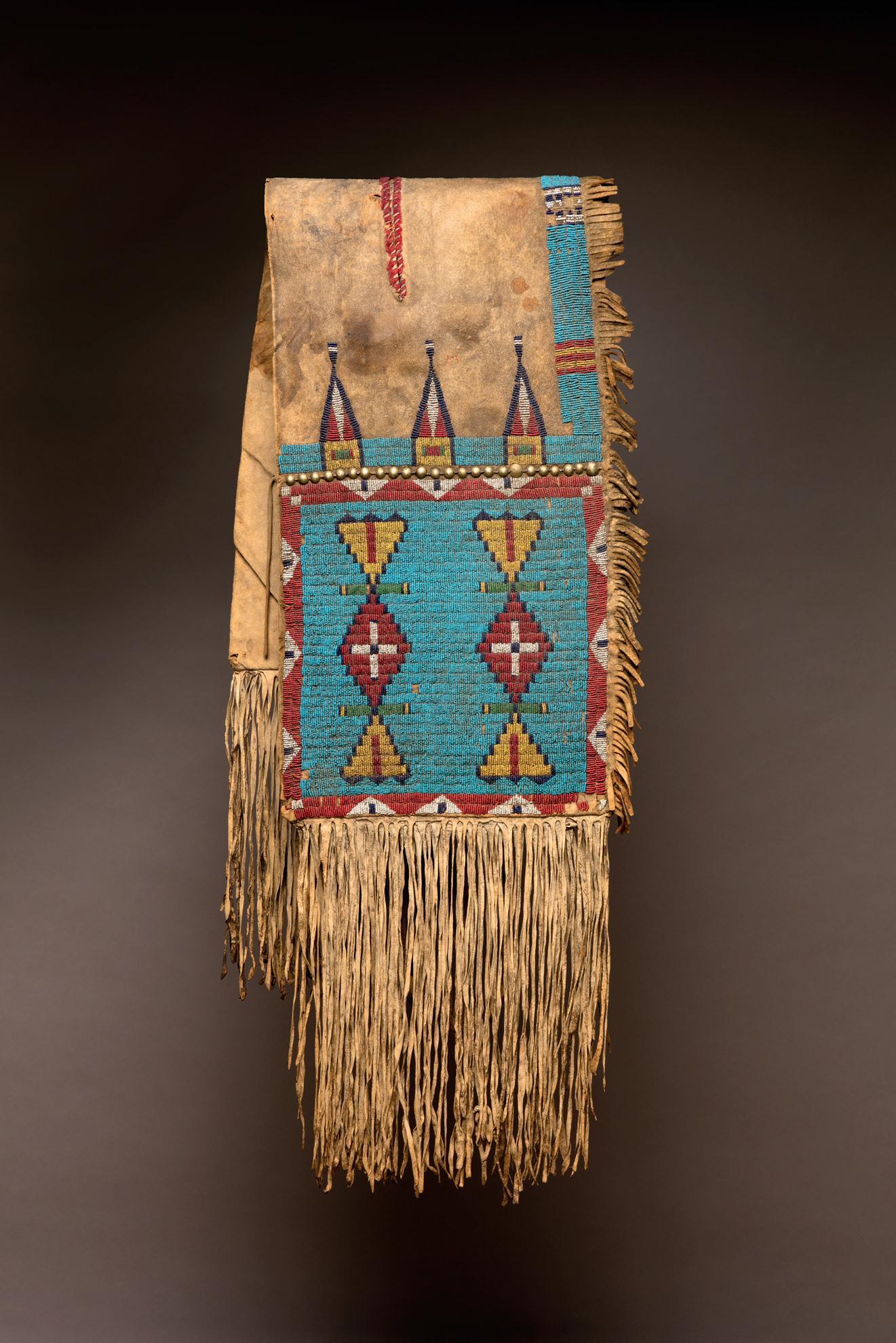
Unknown Artist Sioux, probably Lakota, circa 1870
North Dakota or South Dakota
Native tanned buffalo hide, Stroud, brass tacks, seed beads, sinew 38” long and 13.5” wide
Ex Robert Nooter, D.C.; Ex Helene Sage, VA.
#51152
In 1680, Indigenous Pueblo peoples in what is now New Mexico united in resistance against Spanish colonial rule in an event known as the Pueblo Revolt. Although Spanish forces eventually returned, the revolt permanently changed the cultural landscape of the region. One unexpected result was the spread of Spanish Mustangs into Indigenous lands across the Southwest and beyond. Some Spanish horse herds escaped or were captured during the upheaval and spread northward across the continent, reaching as far as the First Nations of Canada.
For many Indigenous nations, the horse brought profound change. Communities that had once traveled mainly on foot could now move farther and faster across vast landscapes. Mobility reshaped hunting, trade, diplomacy, and warfare. Over time, many nations became highly skilled horse breeders and riders. The Nez Perce people, for example, cultivated selective breeding practices along the Palouse River in present-day Washington State, contributing to the development of the distinctive spotted horse now known as the Appaloosa.
As horse culture grew, so did artistic expression connected to it. Indigenous artists adapted new materials arriving through global trade networks — glass beads from Italy, wool from England, Spanish bayeta, and metal horse equipment from Mexico. They combined these imported materials with locally sourced leather, plant fibers, and dyes to create objects both practical and beautiful. Men assumed the role of figural drawing and sculpture, while women thrived in mediums such as beadwork and quillwork. At times, depending on the object and culture, artistic gender roles were more fluid and collaborative.
These inspired artists fashioned utilitarian items such as saddlebags, bridles, and quirts (horse whips). Their objects not only helped riders care for and control their horses, but they also communicated identity, military skill, family history, and social standing. Horse-related objects initially made travel and military conquest more efficient. Yet, with the arrival of the Reservation Period (1880 –1920) and accordingly the end of nomadism in the American West, equestrian objects evolved into lavish statement pieces – primarily used at annual communal gatherings, like parades and rodeos.
Nations Herd celebrates this vibrant but brief artistic flourishing. The works in this sales exhibition reflect Native artists’ deep knowledge of their horses, materials, and surrounding environment. They also simultaneously reflect cultural pride, innovation, and individual artistic voice. Each object represents not only the bond between horse and rider, but also the enduring strength and creativity of Indigenous communities across generations. So inspired were these singular objects that surviving examples went on to inspire 20th century artists like Narciso Abeyta, T.C. Cannon, Jackson Pollock, Fritz Scholder, Jaune Quick-toSee Smith, and Andy Warhol.
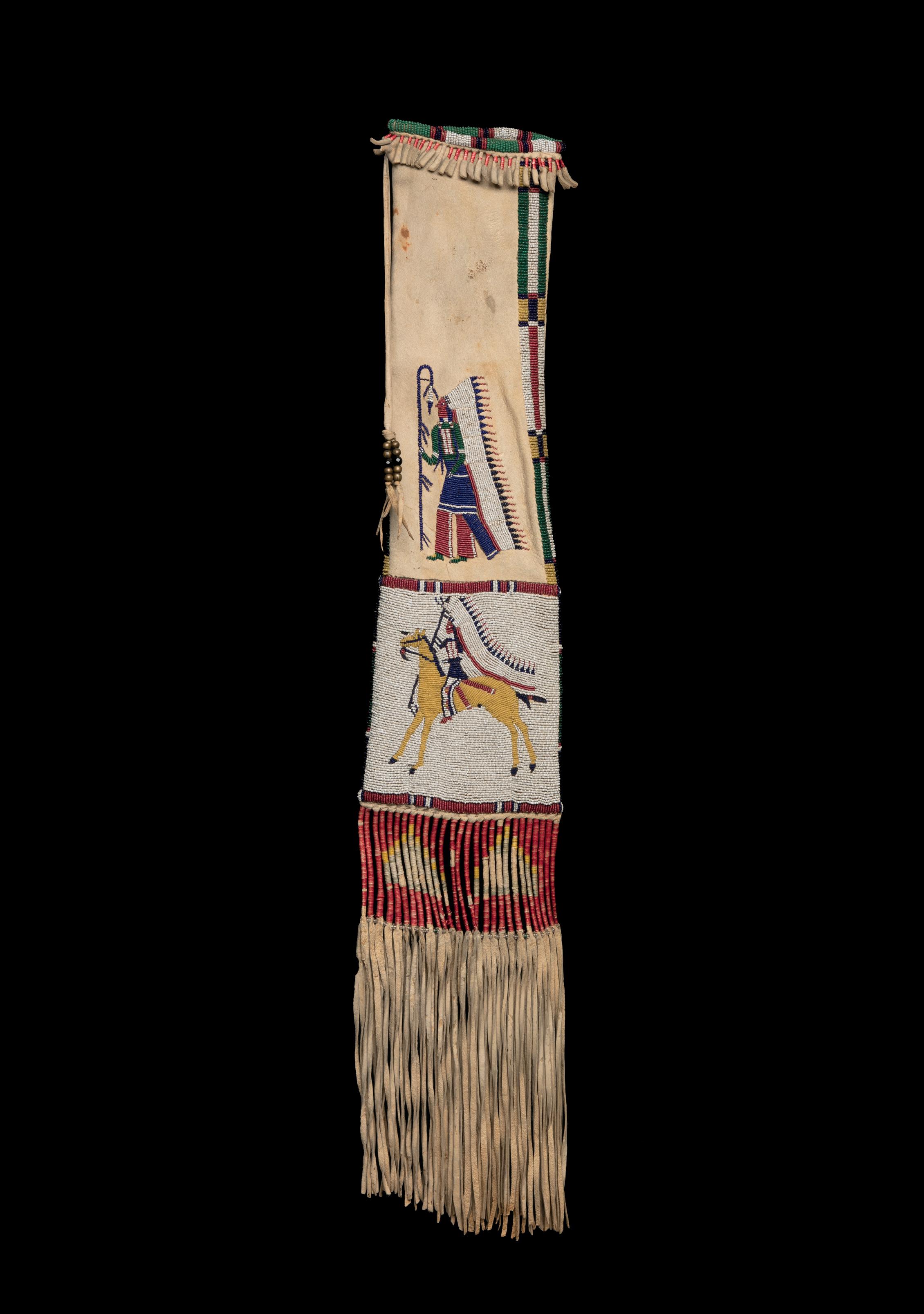
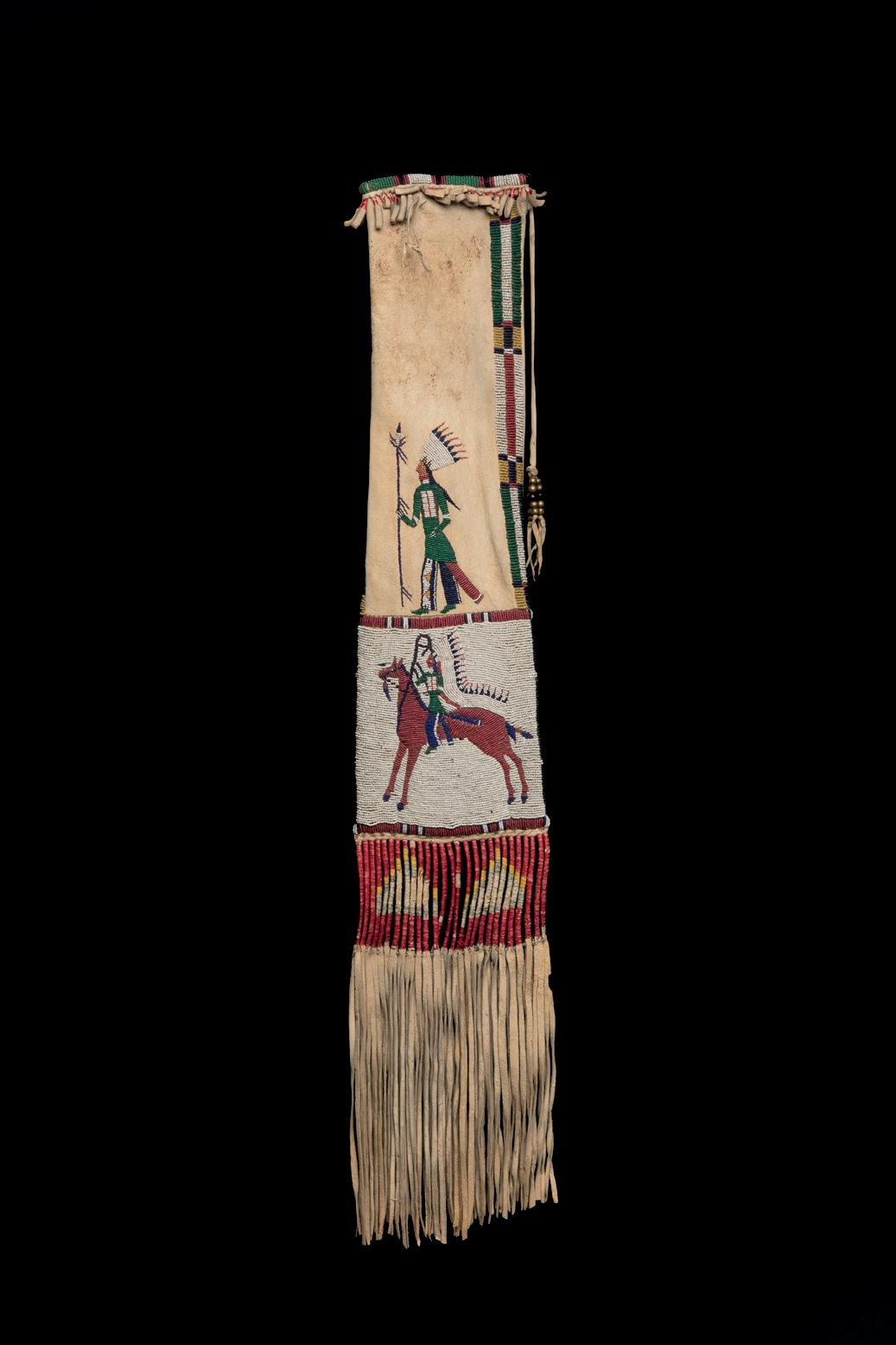
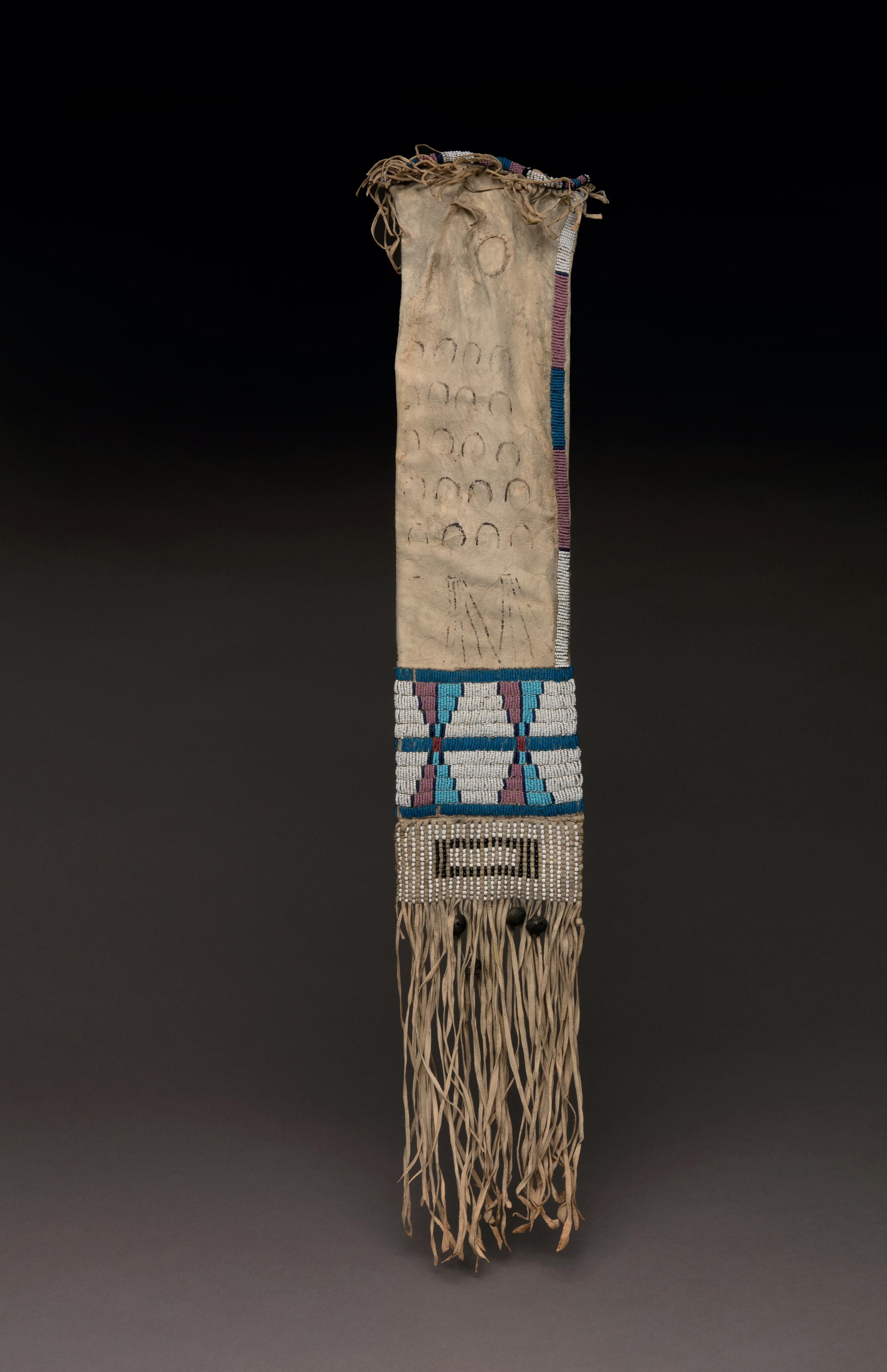
Unknown Artist Sioux, probably Oglala (Lakota), circa 1880
South Dakota
Native tanned hide, porcupine quills, dyes, seed beads, sinew 35” long and 6.5” wide
Ex Larry Williams, BVI; Ex Adolphus Andrews, CA.
Michael Kokin, ed. Larry Williams Collection of 19th Century Tobacco Bags exh. cat. (Sherwoods Spirit of American, 2004), cover.
#51160
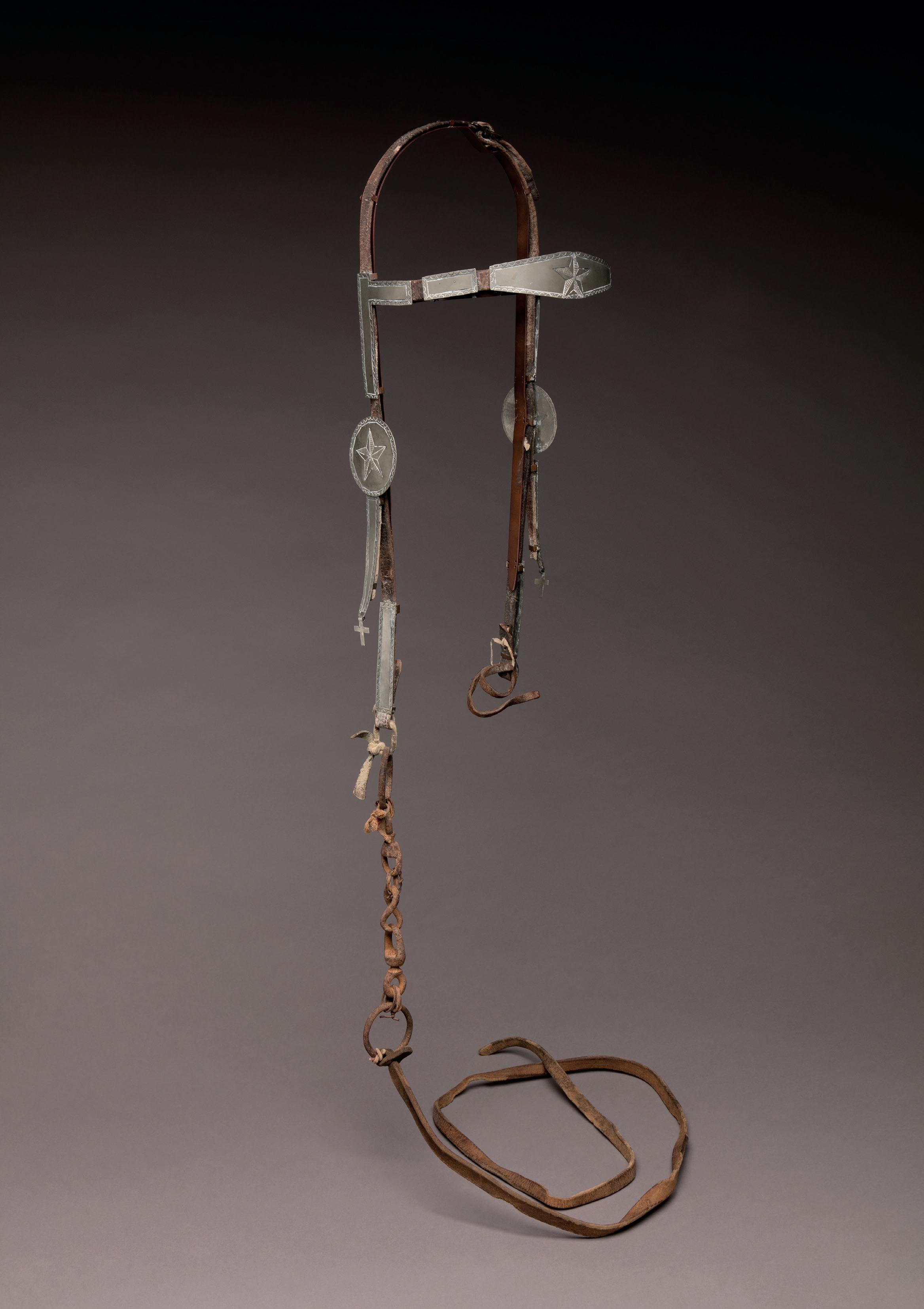
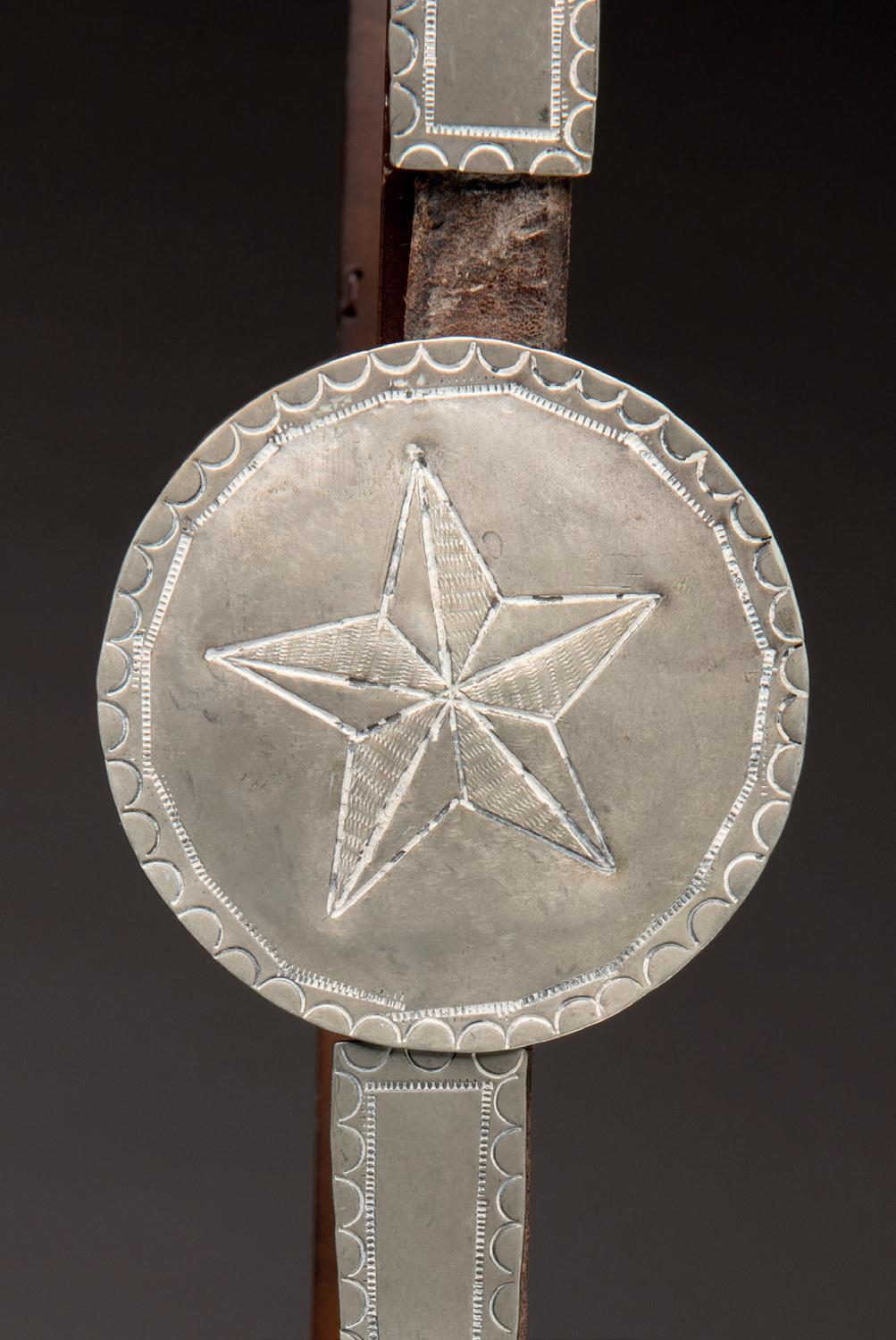
Unknown Artist
Comanche, early 20th century Oklahoma
German Silver, commercial leather, iron
41” long and 8” long
#51166
By Peter L. Bowles and Thomas Cleary (editor) Plains Indian Ledger Art Project (PILA), University of San Diego, California (UCSD) West Yorkshire, United Kingdom
During the mid-19th century, many changes occurred in a relatively short period of time on the Southern Plains: the cessation of Mexico’s northern territories to the United States; the clearing of the Oregon Trail, and the subsequent Mormon migration; the discovery of gold in Colorado and California, and the “rush” which followed; as well as the extermination of the wild buffalo herds on which the Indians subsisted. While the Civil War (1861–1865) provided a brief respite from Anglo encroachment, the hiatus was short-lived. The Reconstruction Era (1865–1877) ushered in a new generation of white settlers who were better armed and more determined to solve the “Indian Problem.” Within a decade, not long after the conclusion of the Red River Wars of 1874, the once nomadic Southern Cheyenne and Southern Arapaho were sequestered onto “Indian Territory” in present-day Oklahoma.
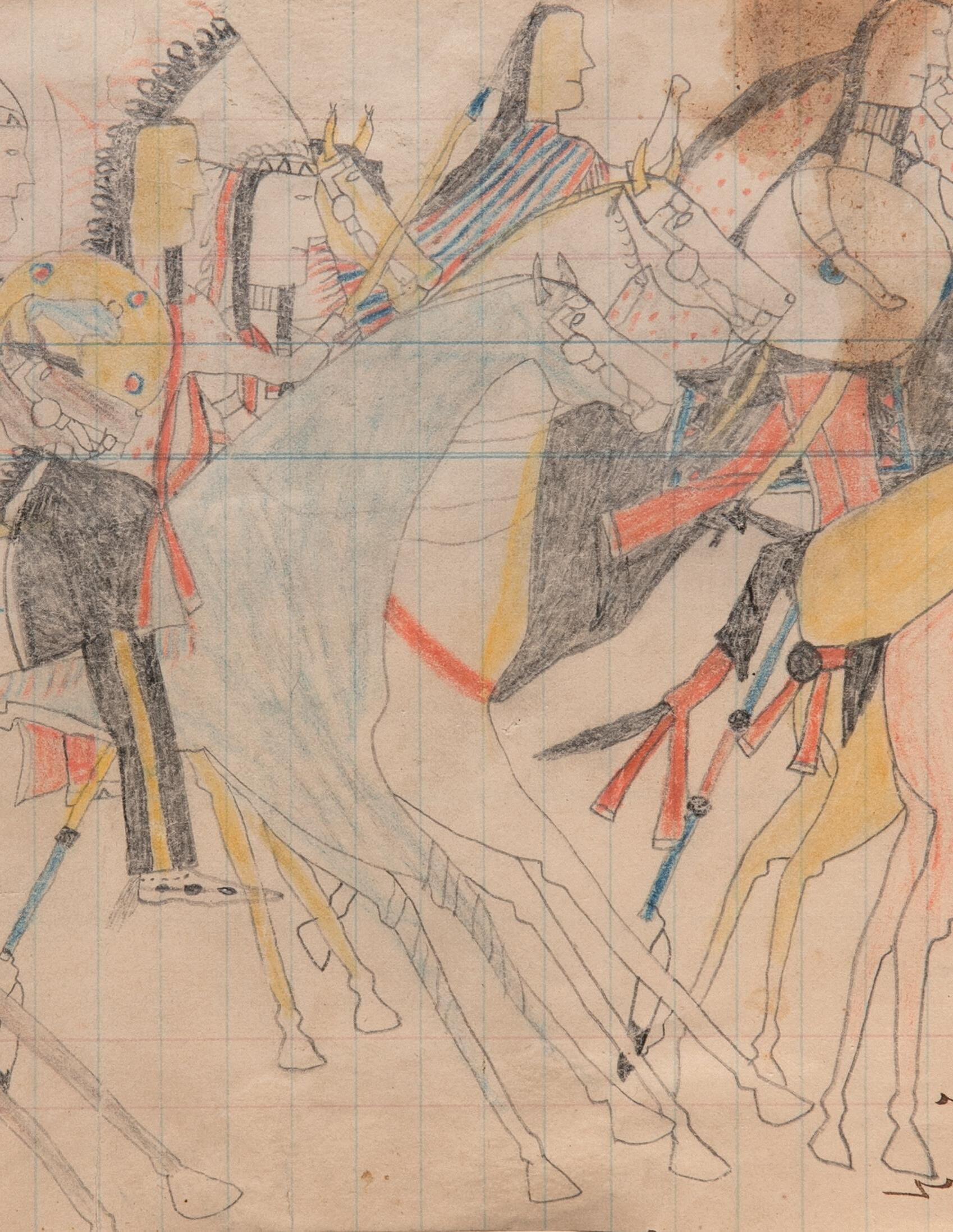
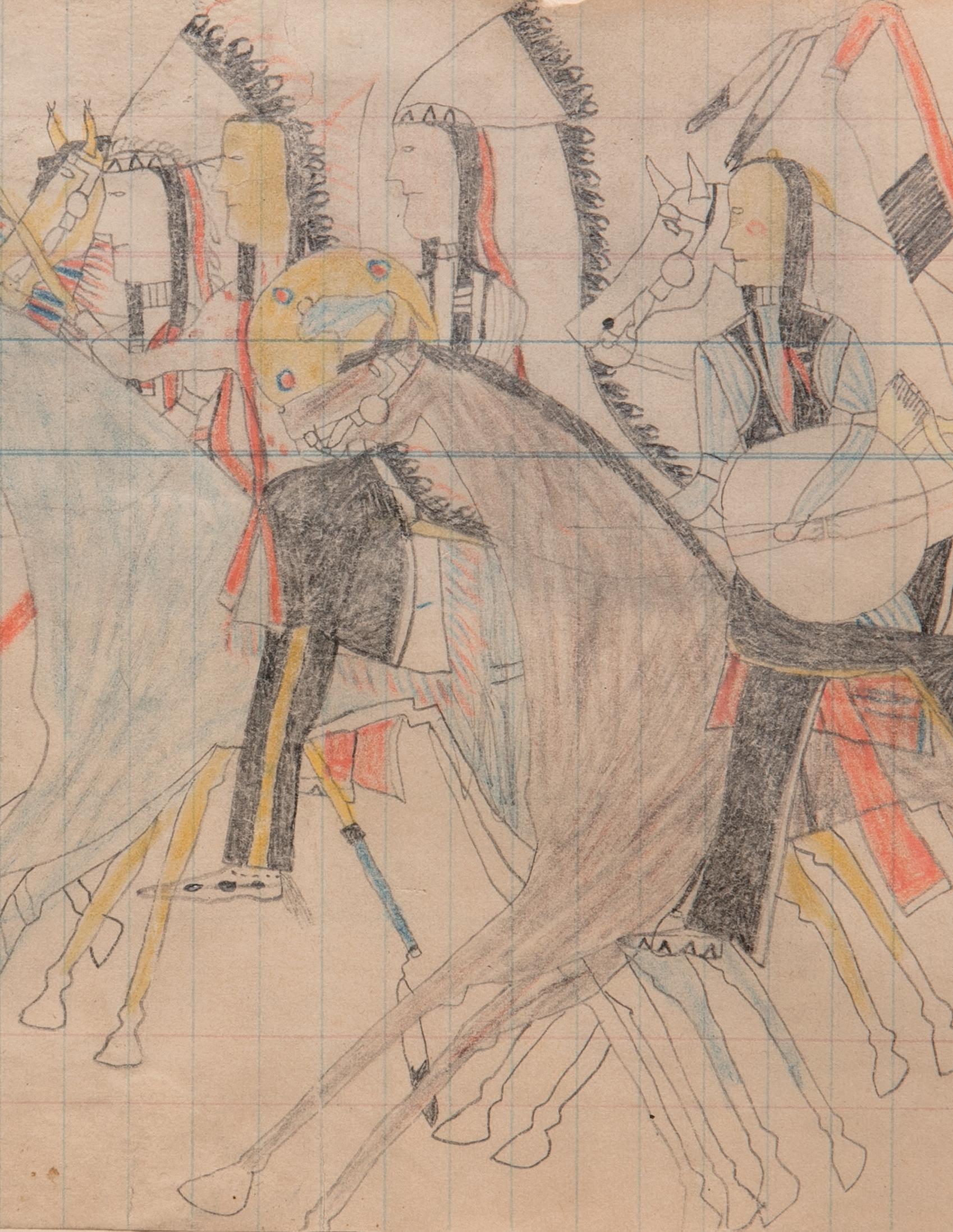
The warriors acutely observed and recorded these changes with fascination, nostalgia and fear. In documentation these changes, a powerfully poignant two-dimensional art form emerged. Southern Plains men had a long-standing tradition of illustrating their oral histories on rock surfaces, hide robes and shirts. With this new cross-cultural exposure, however, Southern Plains male warrior-artists began drawing and recording their observations on paper. They documented important exploits on lined paper found in repurposed ledger books. Such books, filled with sequentially numbered and lined pages, were initially used by the US Army to record military activities and financial transactions on the frontier.
The Mad Bull Ledger Book was created during this unique time, circa 1880. The autobiographical book recounts the exploits of several elite Southern Cheyenne and Southern Arapaho warriors. These skirmishes they recorded took place during the warriors’ last decade of freedom, likely in Oklahoma, Texas, Colorado, and Kansas. The drawings depict the warriors battling against the US Government as well as their traditional native foes. The scenes are masterfully rendered with graphite and colored pencil—also acquired through trade—in indigo, vermillion, green, and yellow Featured here is a selection from the Mad Bull Ledger Book consisting of eight drawings on seven pieces of lined ledger paper.
Due to the brutality of the Red River Wars, few Southern Plains ledger books survive; fewer still come to us with any documentation. Fortunately, the Mad Bull Ledger Book has inscriptions from its various custodians. These inscriptions enable us to reassemble its past, though imperfectly as the book was regrettably split up between 1950 and 1980. These inscriptions provide a wealth of knowledge about the book, including when it was collected and by whom. We also have insight into what the individual scenes depict. For example, an inscription found on the verso of one of these featured pages reads:
Indian Sketch Book / Cheyenne and S. Arapaho Agency / Ind. Territory / May 1883 / Lieut. Tilton / US Army / Painted and Sketched by Native Indians
continued on page 12...
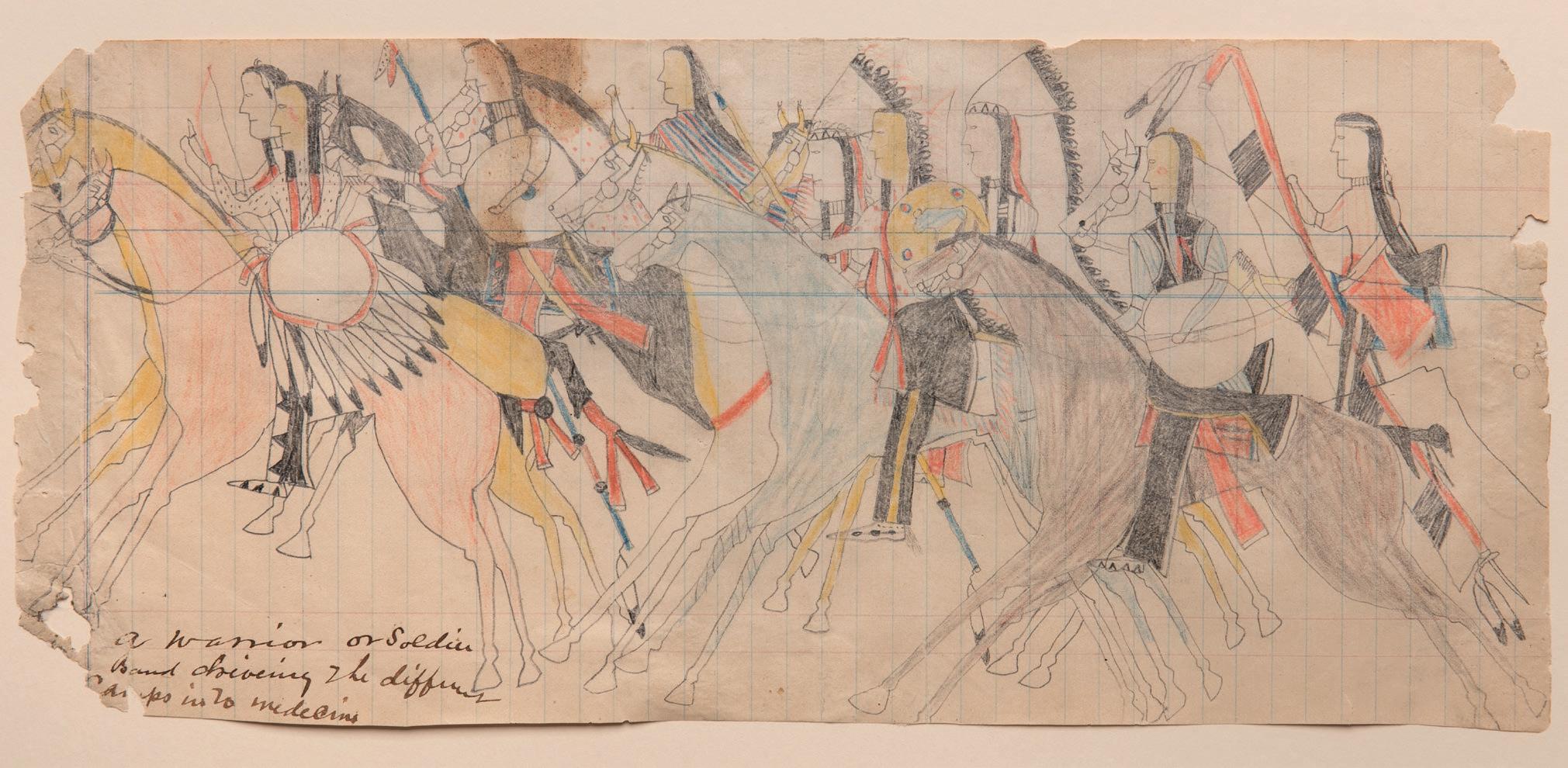
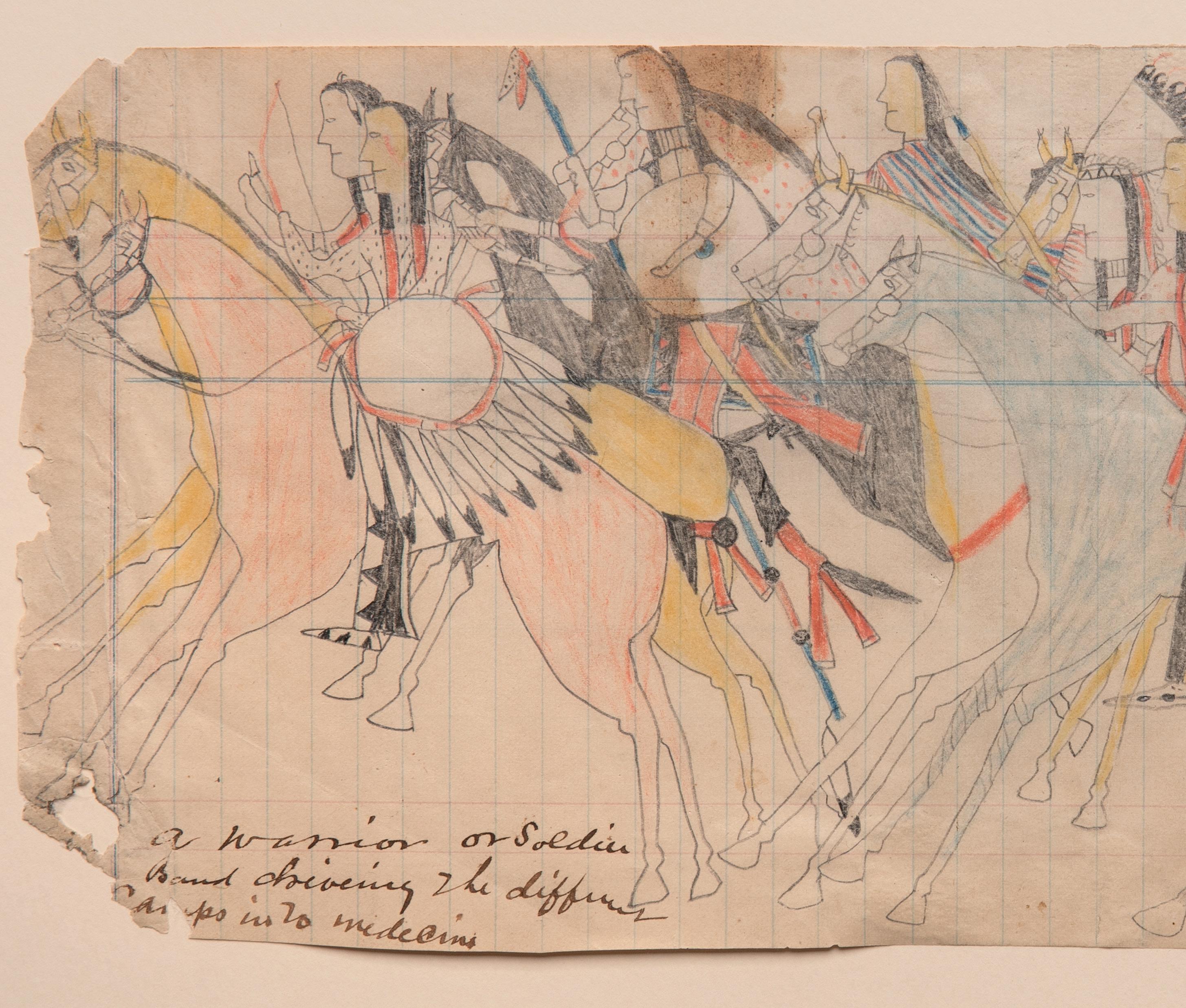
Unknown Artist
“A warrior or soldier band driving the different camps into medicine.”: A Battle Scene from the Mad Bull Ledger Book
Southern Cheyenne or Southern Arapaho, circa 1880 Oklahoma
Graphite and colored pencil, ink, ledger paper 5.75” long and 13” wide (unframed); 16.5” long and 23.5” wide (framed)
Collected by Lt. Palmer Tilton, 20th U.S. Infantry, Fort Reno, IT (c.1883); Ex E. Francis Riggs, Jr., Fort Reno, IT (March 27, 1884); Ex Carl Dentzel, Director of the Southwest Museum, Northridge, CA (c.1950); Handed down by descent.
#51194
This inscription is corroborated by another which exists on a separate page earlier in the book; it also confirms that the book was collected by Lieutenant Palmer Tilton (1852–1905) of the 20th Infantry Regiment, A-Company, in Fort Reno, Indian Territory. The latter inscription then goes on to say that the book was bequeathed on March 27, 1884, to Elisha Francis Riggs (1851–1910), a wealthy scion of a prominent banking family in Washington, D.C.
The most prominent and revealing of these inscriptions, however, comes to us from Ben Clark (1842–1914). A note in the upper right-hand corner of one of the featured drawings states that “the inscriptions in ink are by Ben Clark, a famous [scout] at Fort Reno, IT.” Clark was not only a lead scout in Custer’s 7th Cavalry, he was also married twice to different Cheyenne women. Clark’s unique knowledge of the Cheyenne and Arapaho cultures earned him a position as “Post Interpreter” at Fort Reno in 1878. It is perhaps no coincidence that many of the Mad Bull Ledger drawings are captioned with his notations, likely penned after the book’s creation, sometime between 1878 and 1883. In fact, the Mad Bull Ledger Book was given its initial name and attribution because, on page 82 of the book, there is an identification by Clark: “Ute chasing Cheyenne (Mad Bull).”
Although the book is historically attributed to Chief Mad Bull or Hota-e Mata-e (Southern Cheyenne), this portfolio alone features drawings by at least three separate artists. Five drawings are by the hand of one artist; two (“Honoring the Horse” and “Cheyenne Lancing a Pawnee”) are likely by another artist; and a final drawing was ostensibly executed by a third drawer. These warrior-artists have yet to be identified, leaving their exact tribal affiliation uncertain.
Several captions from Clark label the depicted warriors as “[Southern] Cheyenne.” Yet, careful study of the protagonists’ glyphs and shields suggests that this attribution is incorrect. Of the seven pages presented in this portfolio, most drawings appear to be illustrated by a Southern Arapaho hand, though the reverse drawing on the page marked ‘Sketches by an Indian’ could be Cheyenne. The Cheyenne and Arapaho lived and engaged in battle together, so it is conceivable there was some level of intertribal exchange of personal medicine, including shields. A Cheyenne individual could therefore be pictured holding an Arapaho shield, and visa-versa. Clark may have known the individuals depicted in this book but have purposefully chosen to omit their names and affiliations to avoid incriminating them. (Many interned warriors feared reprisal from the US government for their involvement in the Indian Wars. Ledger books which depicted combat scenes against US soldiers provided a direct record of their actions.) An alternative possibility is that this book represents both the Arapaho and Cheyenne in the same scenes.
[Editor’s note: Portions of this essay, including specific references and citations, have been modified and/or omitted to better suit the formatting needs of this catalog.]
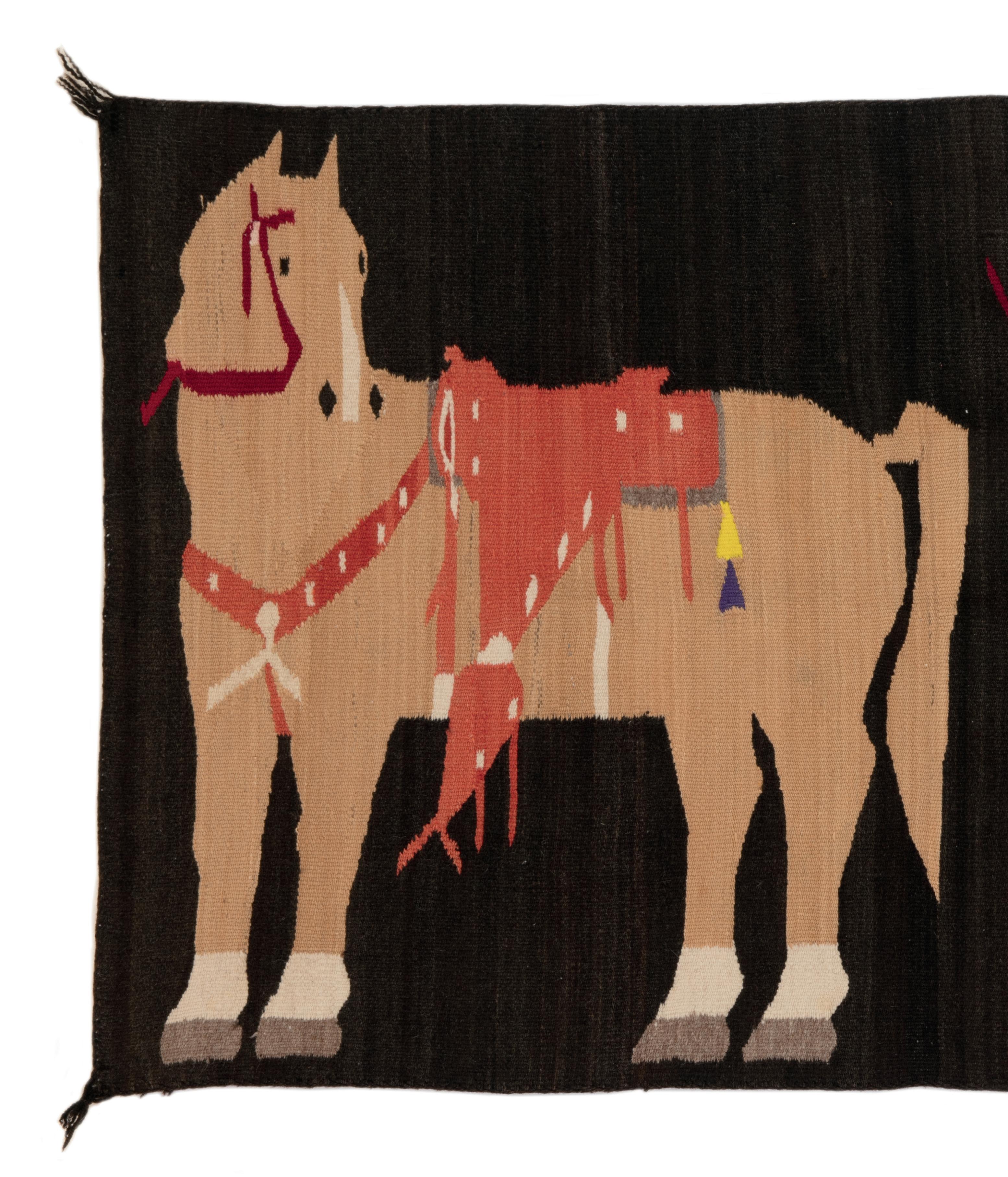
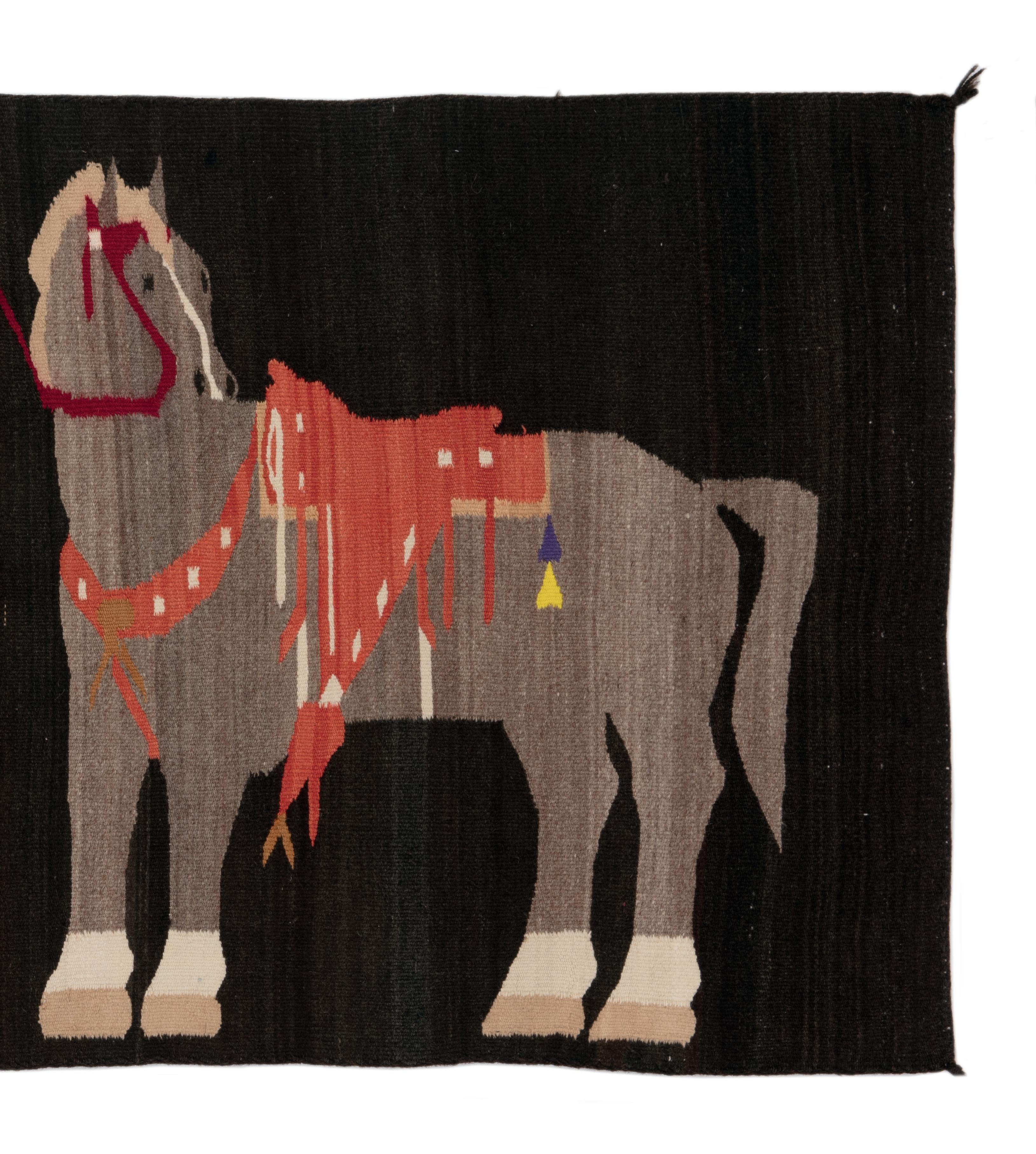
Unknown Artist Navajo, first half of the 20th century Arizona
Handspun wool, natural and synthetic dyes
31” long and 58.5” wide
#50856
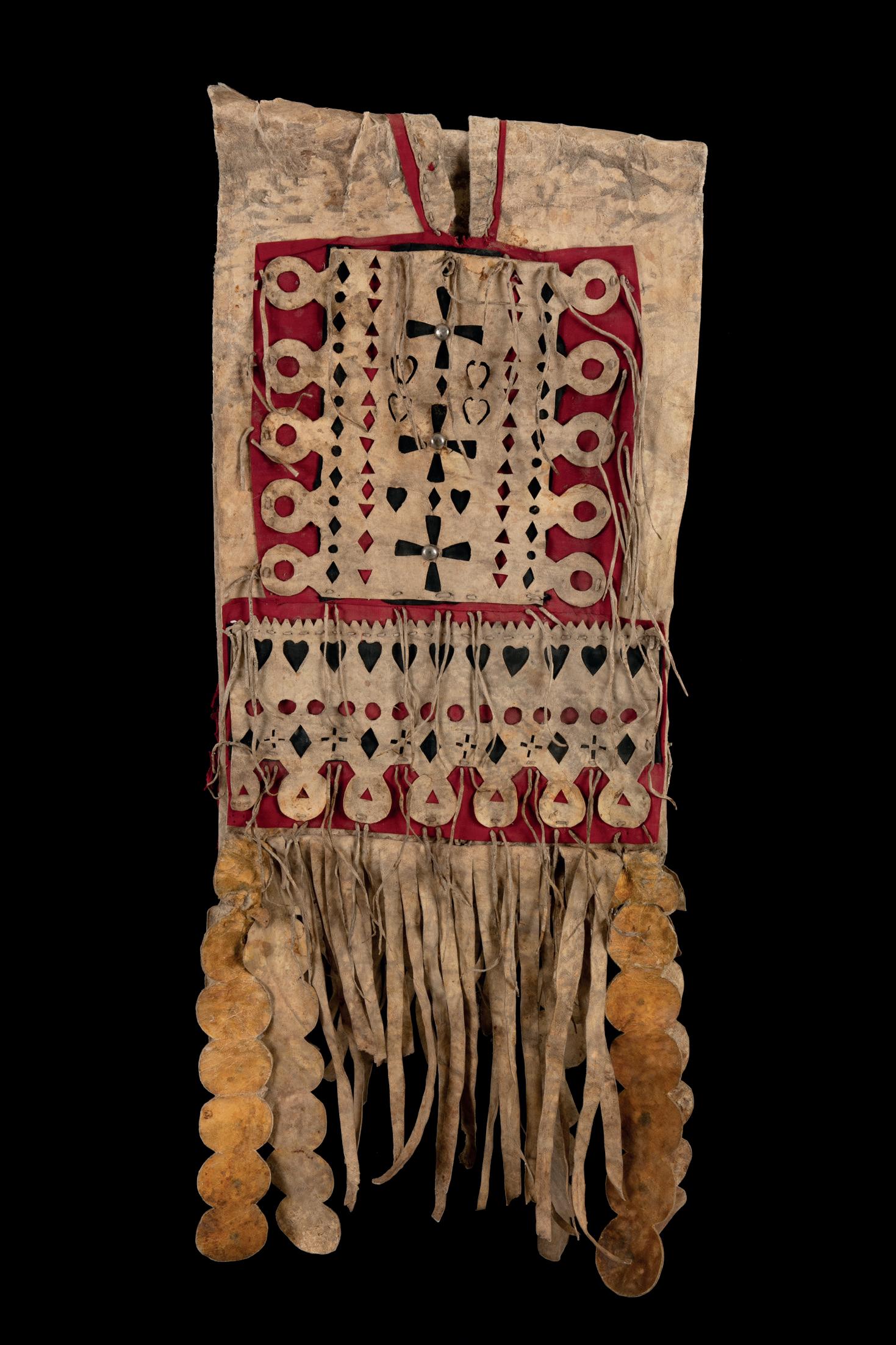
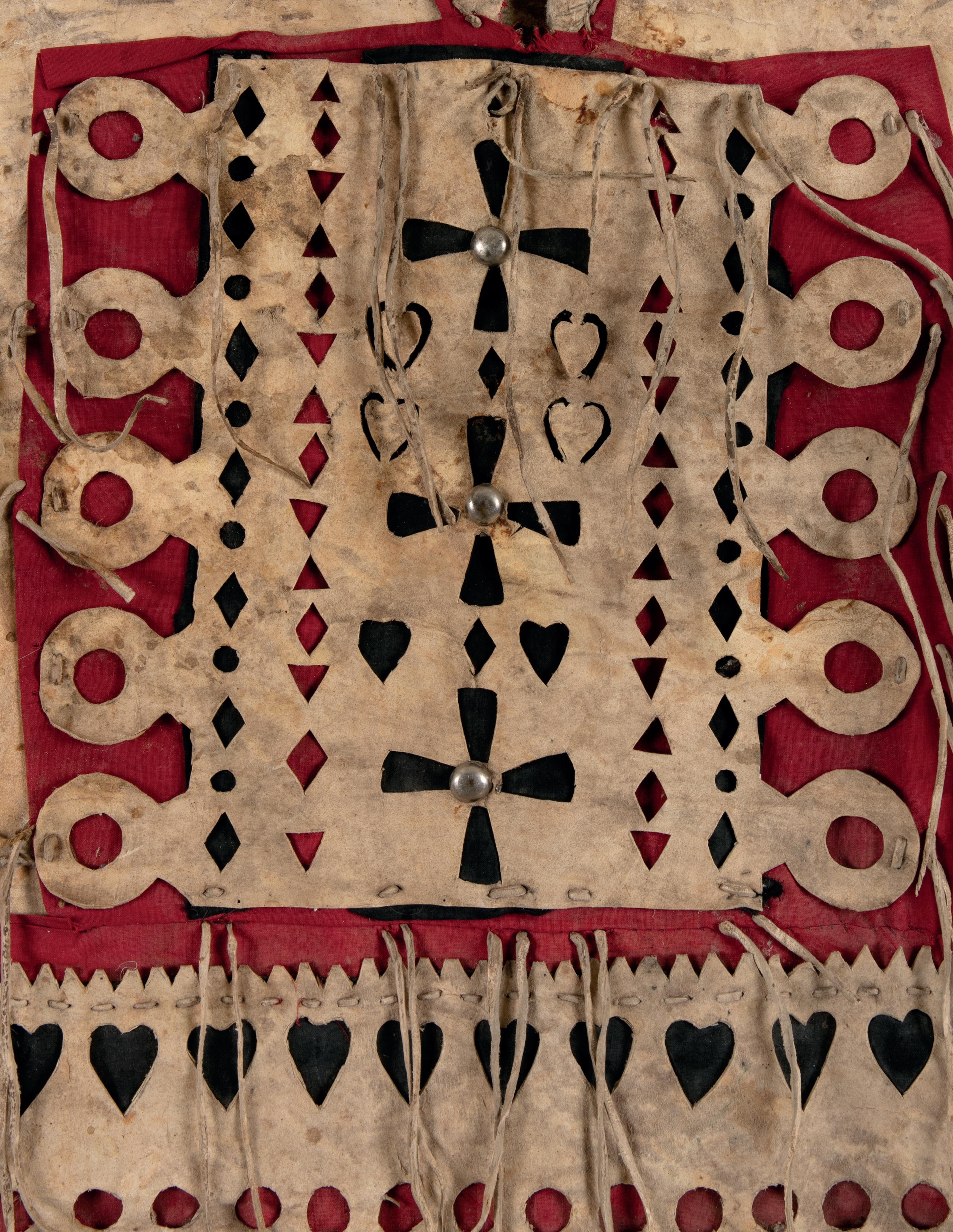
Unknown Artist Apache, circa 1880 Arizona
Native tanned hide, Stroud, cloth, metal buttons, pigment 47” long and 18” wide (as displayed)
Ex Jerrold Collings, AZ
#51203
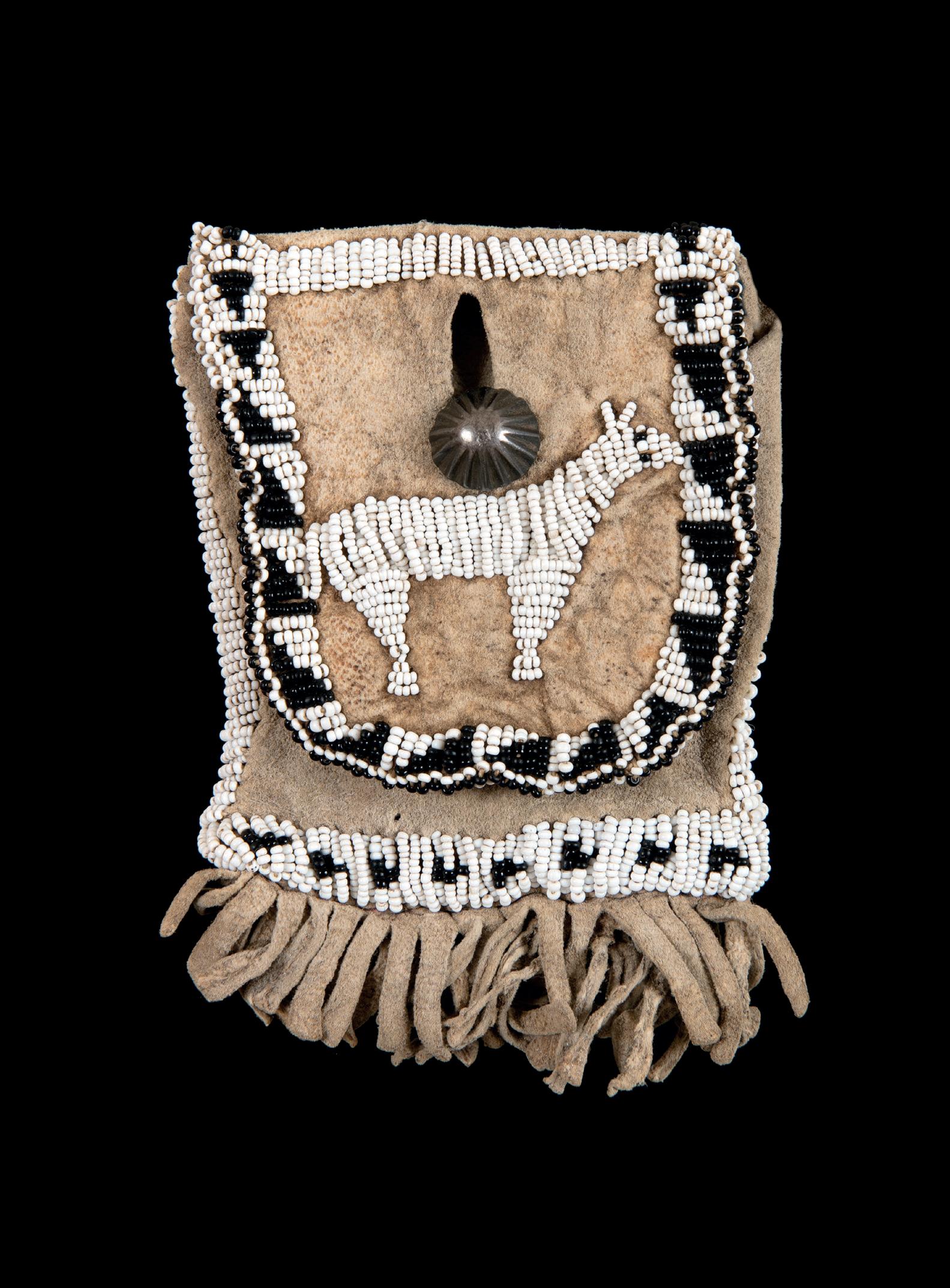
Unknown Artist
Jicarilla Apache or Navajo, late 19th century
New Mexico or Arizona
Native tanned hide, metal, seed beads, sinew 4.75” long
#51202
Unknown Artist Ute, 1870 Utah or Colorado Native tanned hide, seed beads, sinew 36” long and 13” wide
Exhibited: Nevada State Museum – Las Vegas, NV, short-term loan, October 1, 2024 – June 20, 2025. #51201
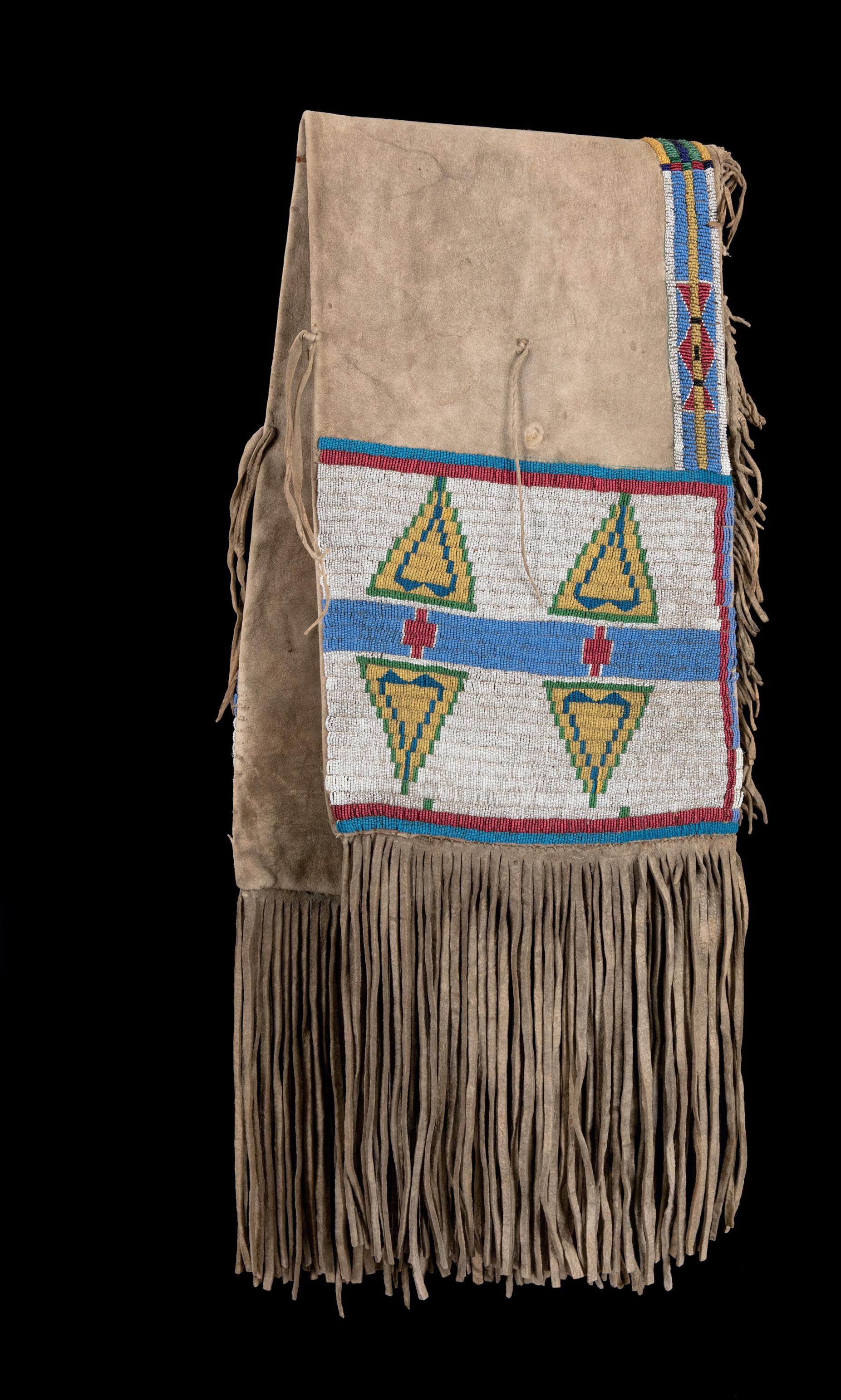
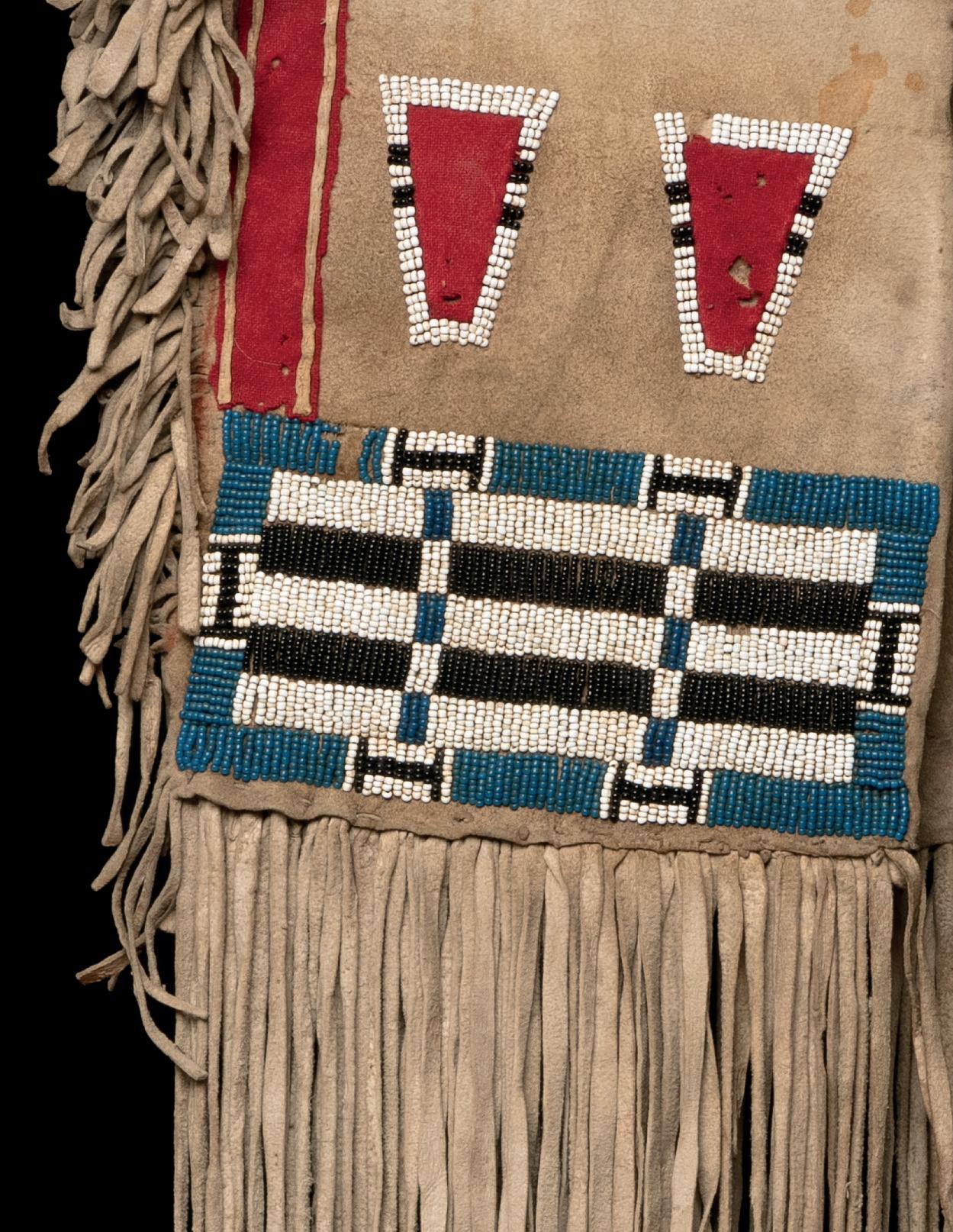
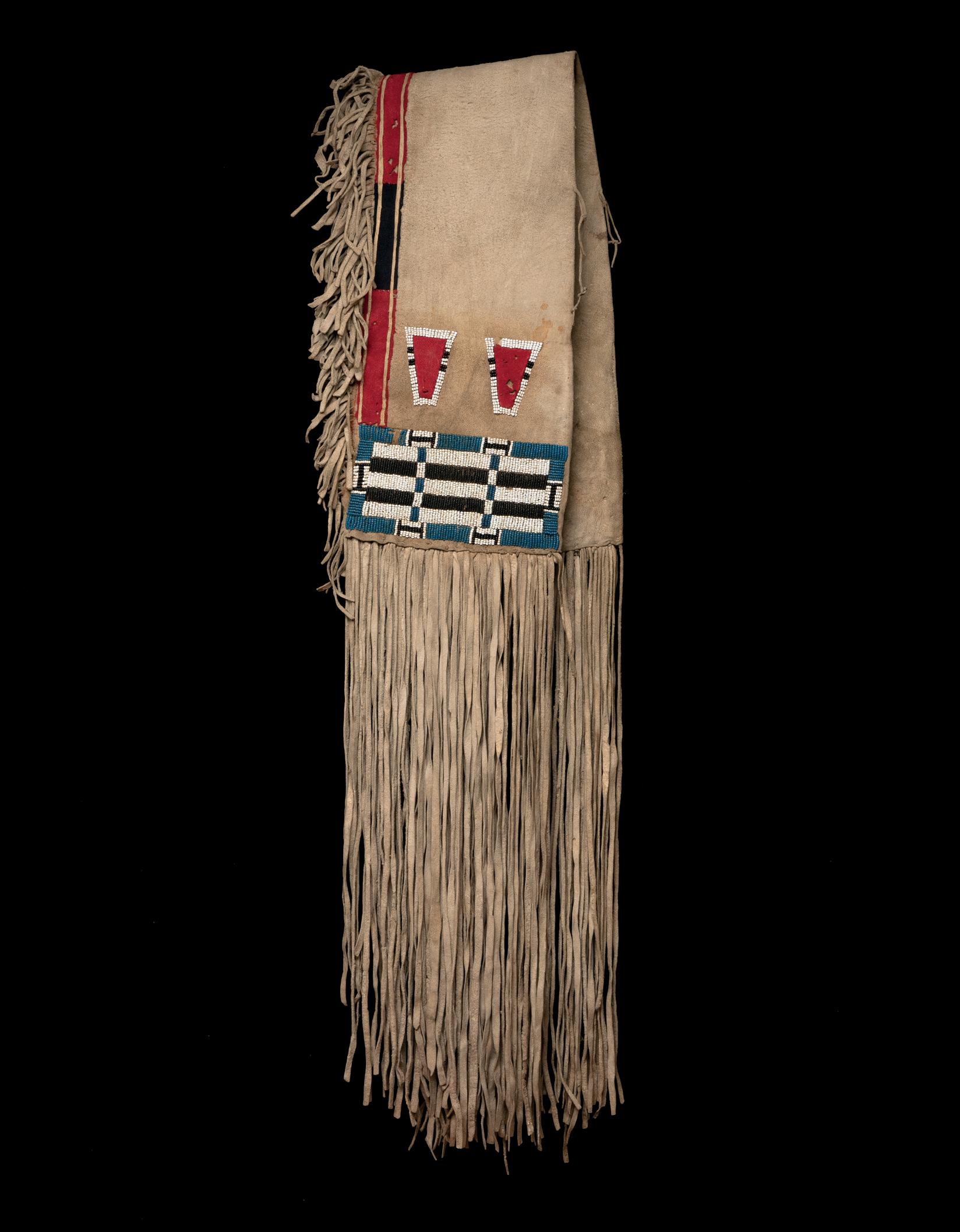
Cheyenne(?), mid-19th century Colorado, Wyoming, Nebraska, Kansas Native tanned hide, Stroud, pony beads, sinew 50” long and 11.5” wide
Ex H. Malcolm Grimmer, NM
#51112
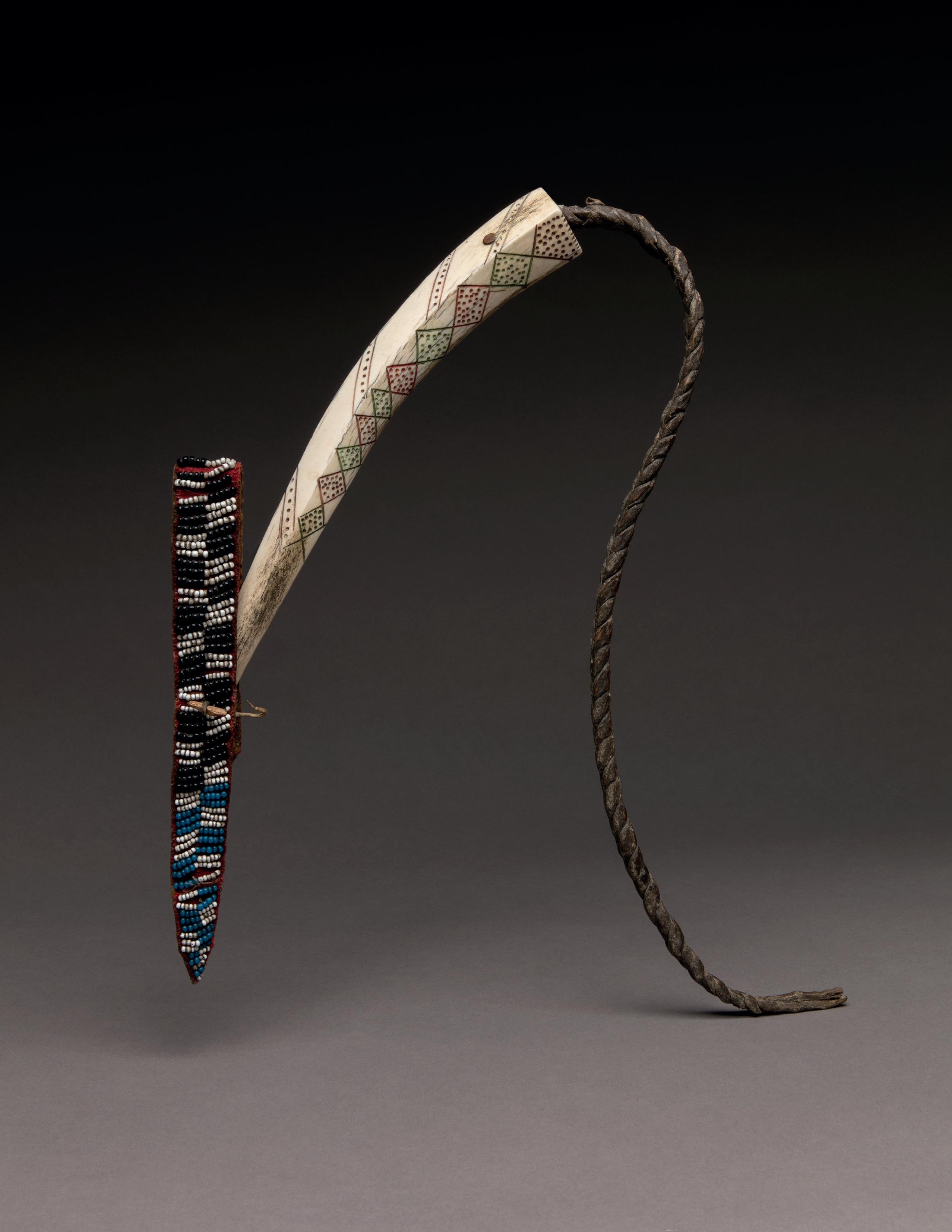
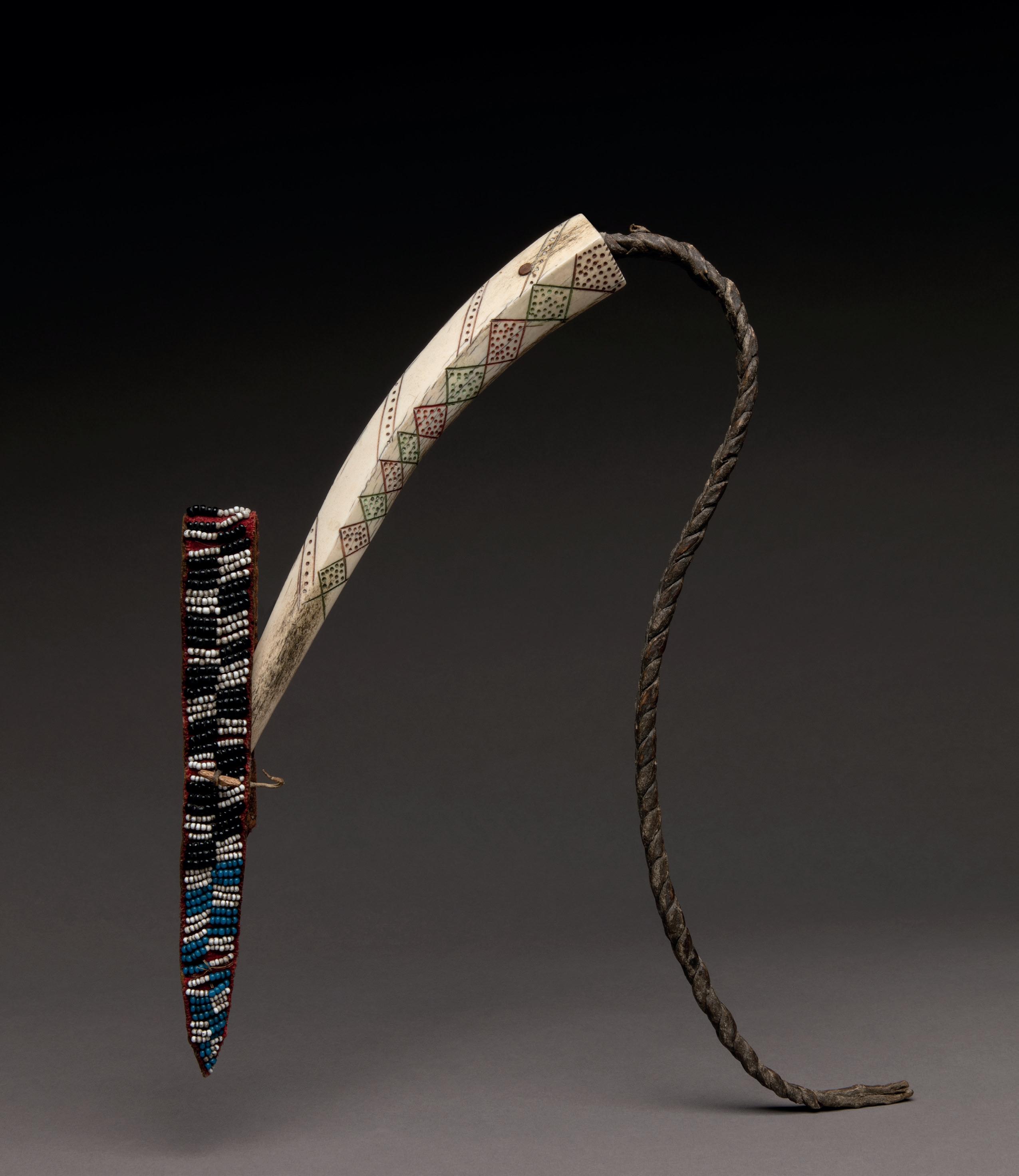
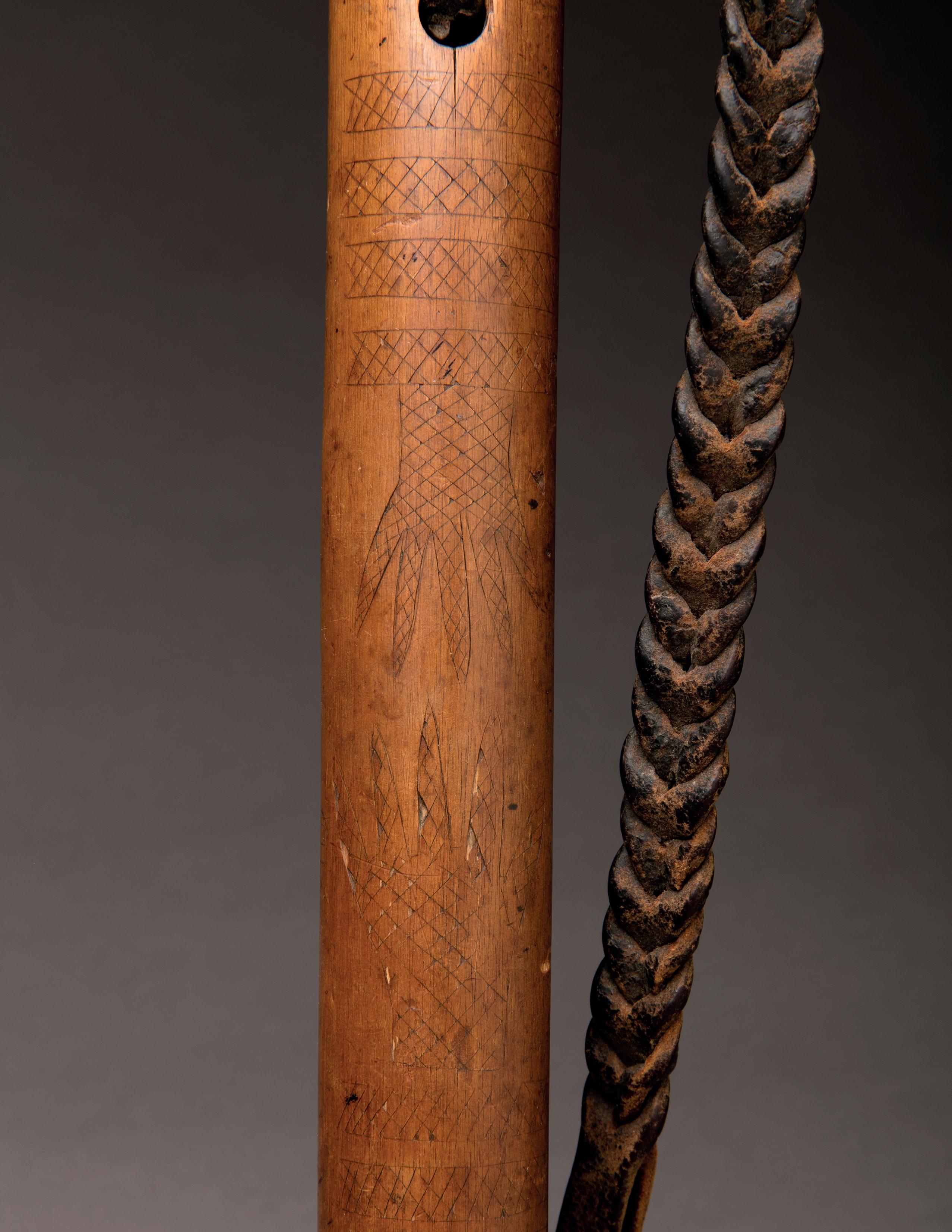
Unknown Artist Upper Missouri River Region, mid-19th century Montana, Wyoming, North Dakota, South Dakota, or Nebraska Native tanned hide, Stroud, elk antler, pigment, pony beads, sinew 12” long (quirt), 8.5” long (wrist strap) and 20” long (lash)
Ex Reagan Wilson, GA; Ex Helene Sage, VA.
#51151
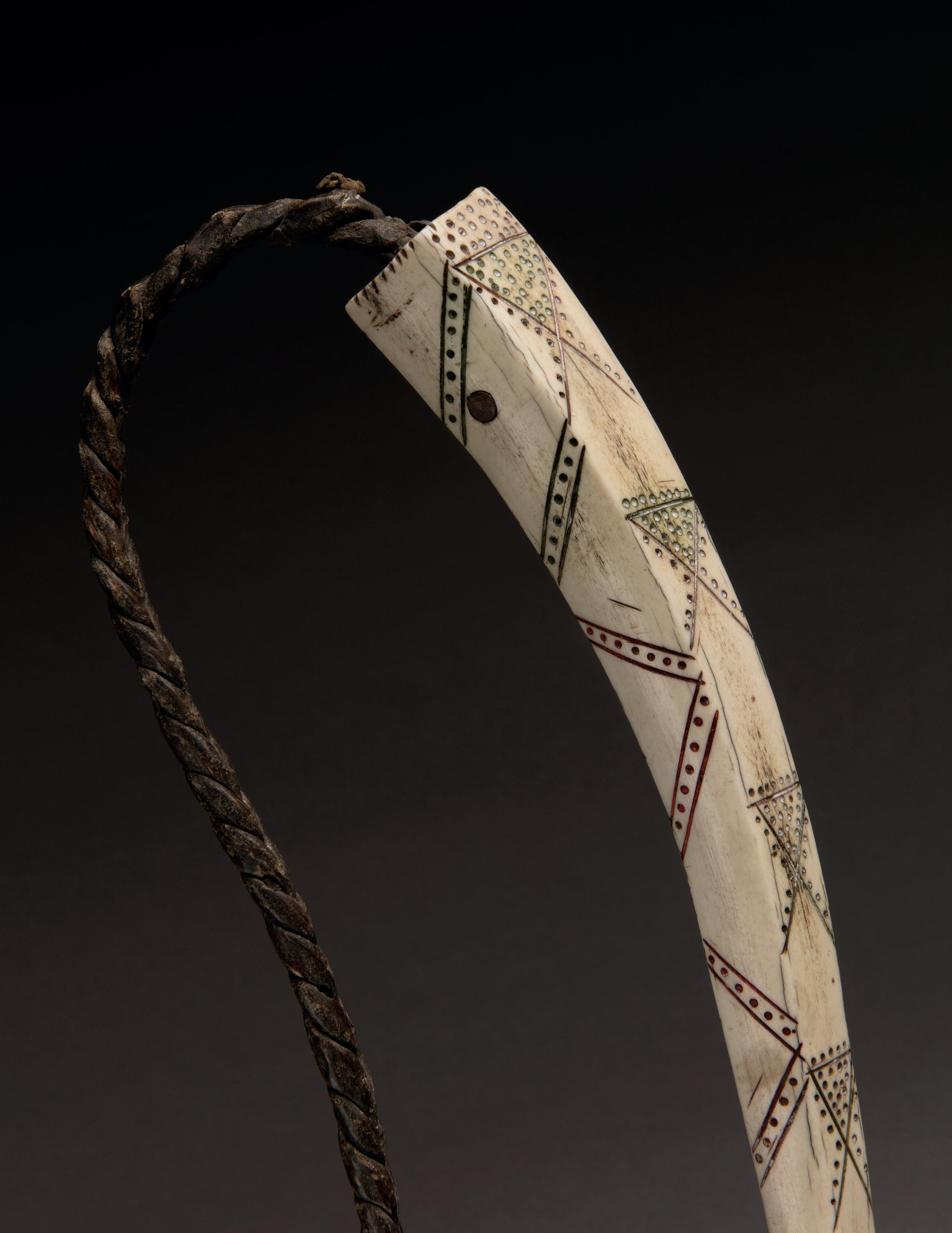
DETAIL: Early Quirt, mid-19th century; showing a carved andabstractedrepresentationtheThunderer,animportant cosmological deity to parts of the Great Plains.
Pre-Reservation sculptural art from the Plains and Plateau is rare; objects all too often proved cumbersome to carry and difficult to preserve among these nomadic peoples. Quirts, or horse whips, were a notable exception: early 19th century accounts suggest that most warriors possessed one. It is curious, then, that so few survive from the first half of the 19th century.
Despite regional and period variations, every quirt consists of three basic parts: a handle, a wrist strap, and a lash. Warriors fashioned their quirts from whatever materials were most readily available, adapting them to suit their specific needs. Some of the most elaborate surviving examples date to the first half of the 19th century — a time when Plains warrior-horse culture thrived, thwarting Anglo westward expansion. Elk antlers and repurposed wooden trade goods served as canvases on which warriors carved extensive programs of symbols. Some markings conveyed the owner’s rank and war honors; others reflected his spiritual, cosmological, or tribal allegiances. Given this degree of personalization, no two quirts are alike.
The quirt pictured opposite illustrates this customization well. On the verso of the antler handle, a series of hourglass carvings depicts abstract Thunderers. The Thunderbird was a powerful avian deity who ruled the upper cosmos and commanded natural phenomena such as lightning. Their presence here signals the owner’s spiritual allegiances. The glass “pony” beads decorating the wrist strap suggest that this is a particularly early example: this type of Venetian import fell out of favor with Central and Northern Plains artists around the mid19th century. Only a handful of similarly decorated quirts from this region and period are known to survive.
Quirts played a central role in the warrior complex of the Indigenous American West, particularly on the Great Plains. Beyond their immediate function on horseback, they served a variety of purposes. Warriors used them as weapons in combat and as instruments of discipline within camps and warrior societies. During the Reservation Period (1880–1920), quirts also became important heirlooms, allowing a younger generation of confined warriors to inherit their families’ war honors and establish social standing.
Most significantly, quirts were instruments through which warriors counted coup — the act of charging and merely touching an enemy rather than killing him. This gesture demonstrated superior courage and restraint; it was widely regarded as one of the highest expressions of bravery on the battlefield. The quirt afforded a warrior additional reach on horseback or foot, and consequently became a vital tool in a warrior’s arsenal for social advancement.
Quirts that predate the Reservation Period are genuinely rare, and their layered meanings — personal, spiritual, and social — make them among the most compelling objects to survive from the era of Plains nomadism. Their rise and fall mirrored that of the culture that produced them, documented faithfully by 19th century Western portrait artists such as Karl Bodmer, George Catlin, and Alfred Jacob Miller, who observed the form with fascination.
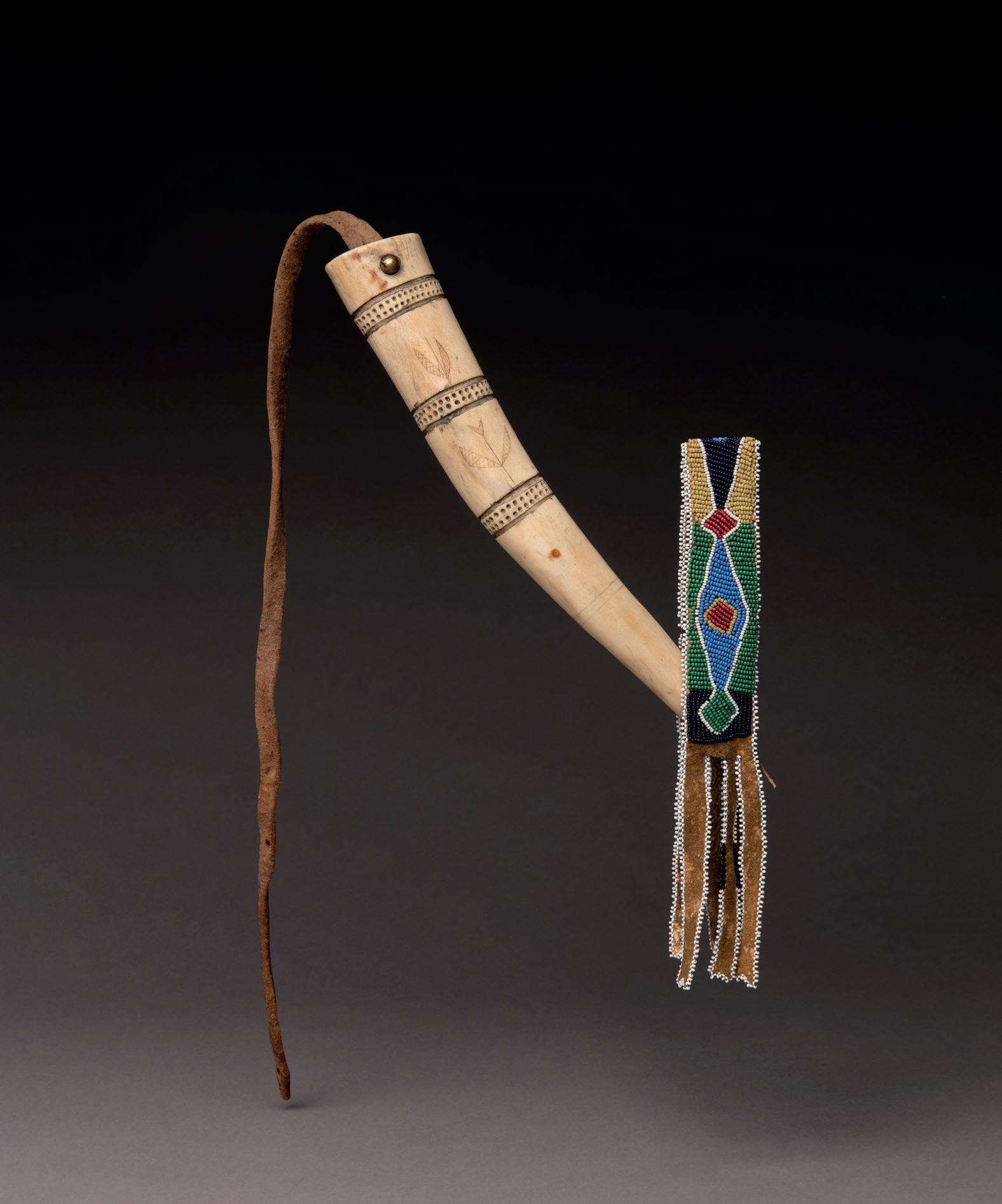
Unknown Artist Osage, second half of the 19th century Oklahoma
Elk antler, commercial leather, brass tacks, native-tanned hide, seed beads, commercial thread 12” long (quirt); 21” long (lash); 9” long and 1.5” wide (strap)
Ex Helene Sage, VA (quirt)
Published: Helene Sage, North American Horse Gear (New York, NY: Atglen, PA: Schiffer, 2012), pp. 100-101 (quirt).
#50549 and #50579
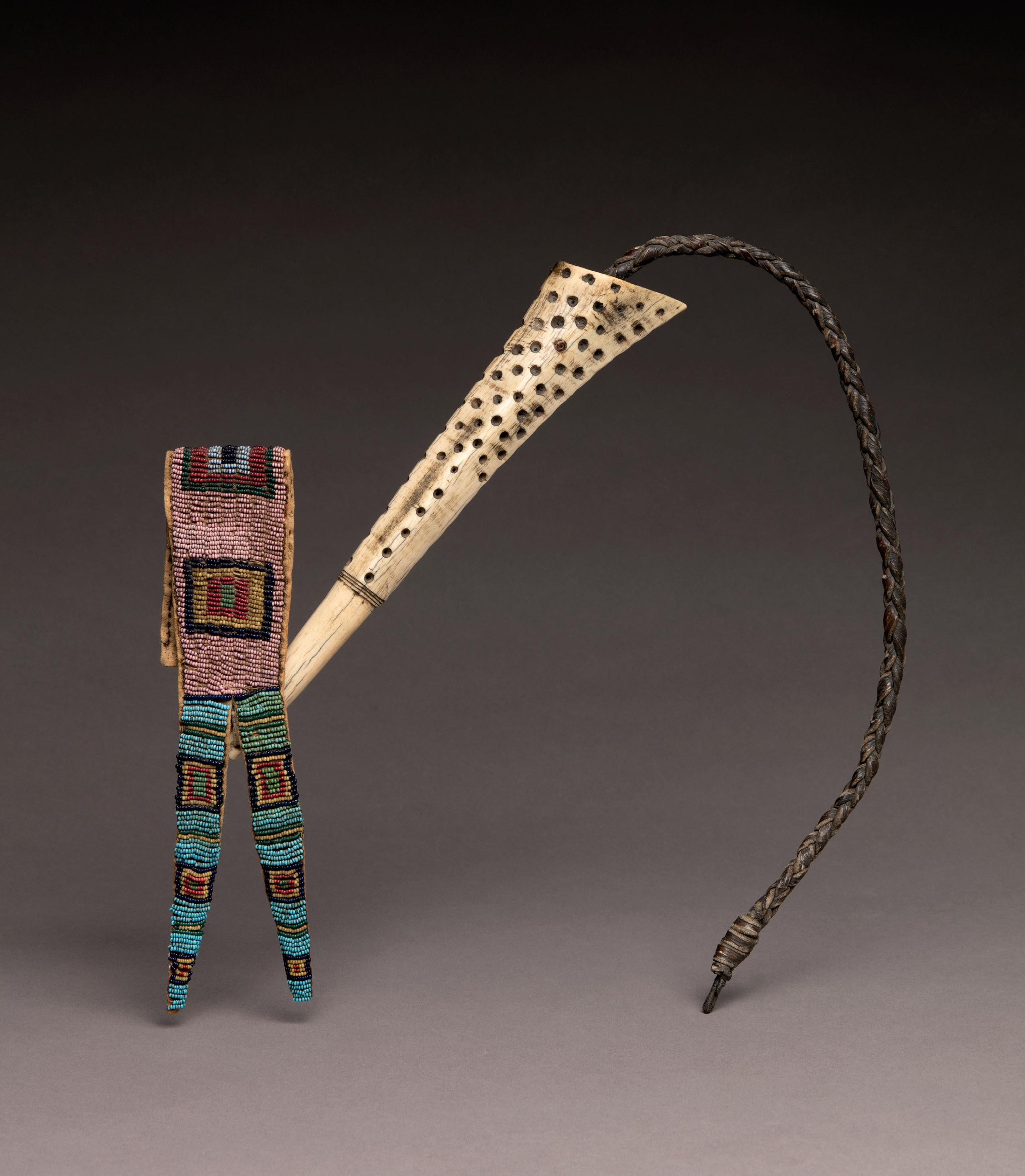
Unknown Artist Central Plains, probably Sioux, 1865-75 South Dakota, Nebraska, Colorado, Wyoming, Kansas Native tanned hide, elk antler, commercial cloth, brass tacks, seed beads, sinew 11.5” long (quirt), 18” long (lash) #51161

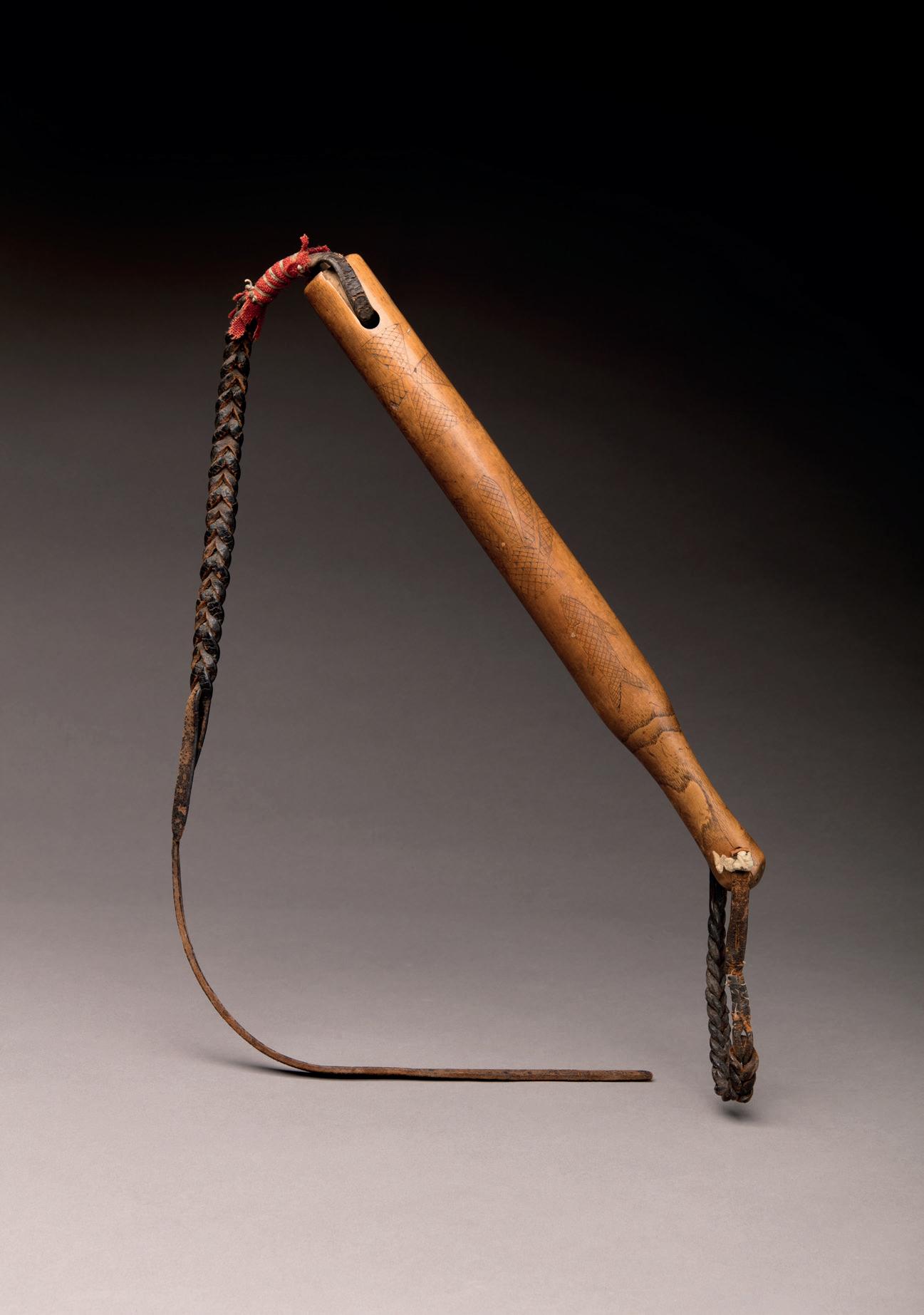
Unknown Artist Eastern Plains, 1860
Wood, commercial leather, Stroud 15” long (quirt); 27” long (lash)
Ex Helene Sage, VA
#51091

Unknown Artist Sioux, 1860
South Dakota, Nebraska, Colorado, Wyoming, or Kansas Native tamed hide, pigment, hawk bells, seed beads, pony beads, sinew 28.5” long and 5” wide
Ex Reagan Wilson, GA #51101
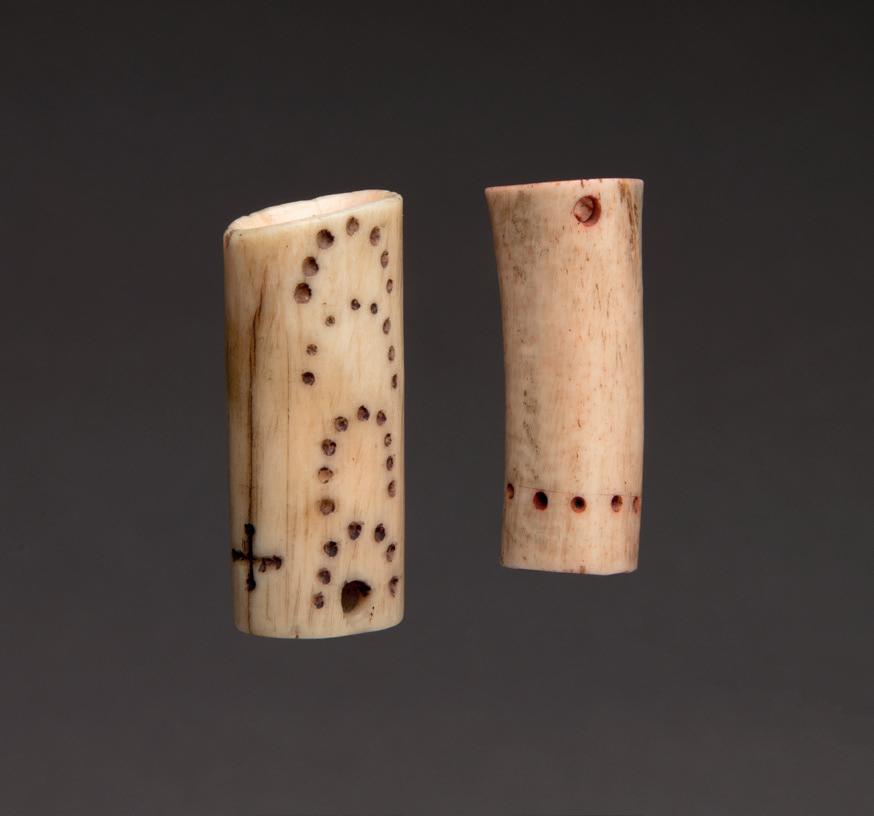
Unknown Artist
Eastern Sioux(?), mid-19th century
Minnesota
Antler or bone and pigment
1.75” tall (each)
Collected at the Upper Sioux Agency, Granite Falls, MN; Ex Larry Levin, MN; Ex Jake Thorson, MN.
#51183
On the Great Plains and Western Great Lakes, the highly competitive warrior-complex of the 19th century encouraged warriors to thoroughly record their military accomplishments. This act not only elevated an individual’s standing within his community; it also served as a warning to his enemies. Using a shared lexicon of symbols, seasoned warriors inscribed their battle records onto their equipment.
By the mid-19th century, horses had become a form of currency whereby the size of one’s herd often spoke to his affluence. The act of riding into an enemy encampment to steal horses was a heroic feat that enriched not only the warrior but also his family and his people. Among their most celebrated deeds, this act of stealing horses was thoroughly recorded.
The two objects featured here both record this practice through the inclusion of “U’s” – found drawn on the neck of the tobacco bag (opposite page) and carved on the shaft of a roach spreader attachment (found above) – denoting that the owner of each item successfully stole horses. The tobacco bag would have been essential to the owner’s participation in pipe-smoking gatherings, where leaders convened to negotiate peace or war. The attachments, meanwhile, would have secured a feather as part of a roach spreader to produce an elaborate hairstyle. In both cases, these items would have conveyed the social standing of the owner during important functions.
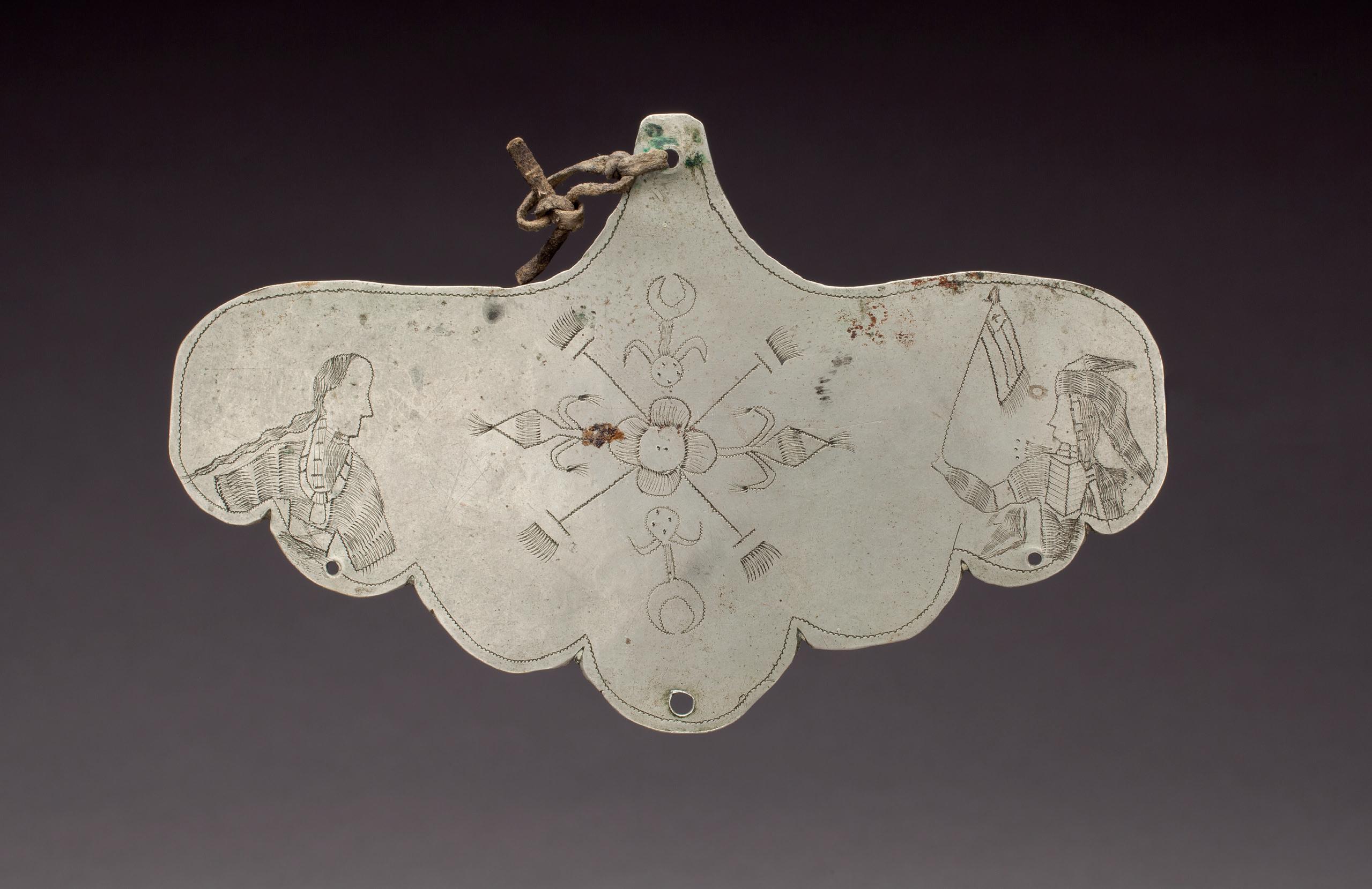
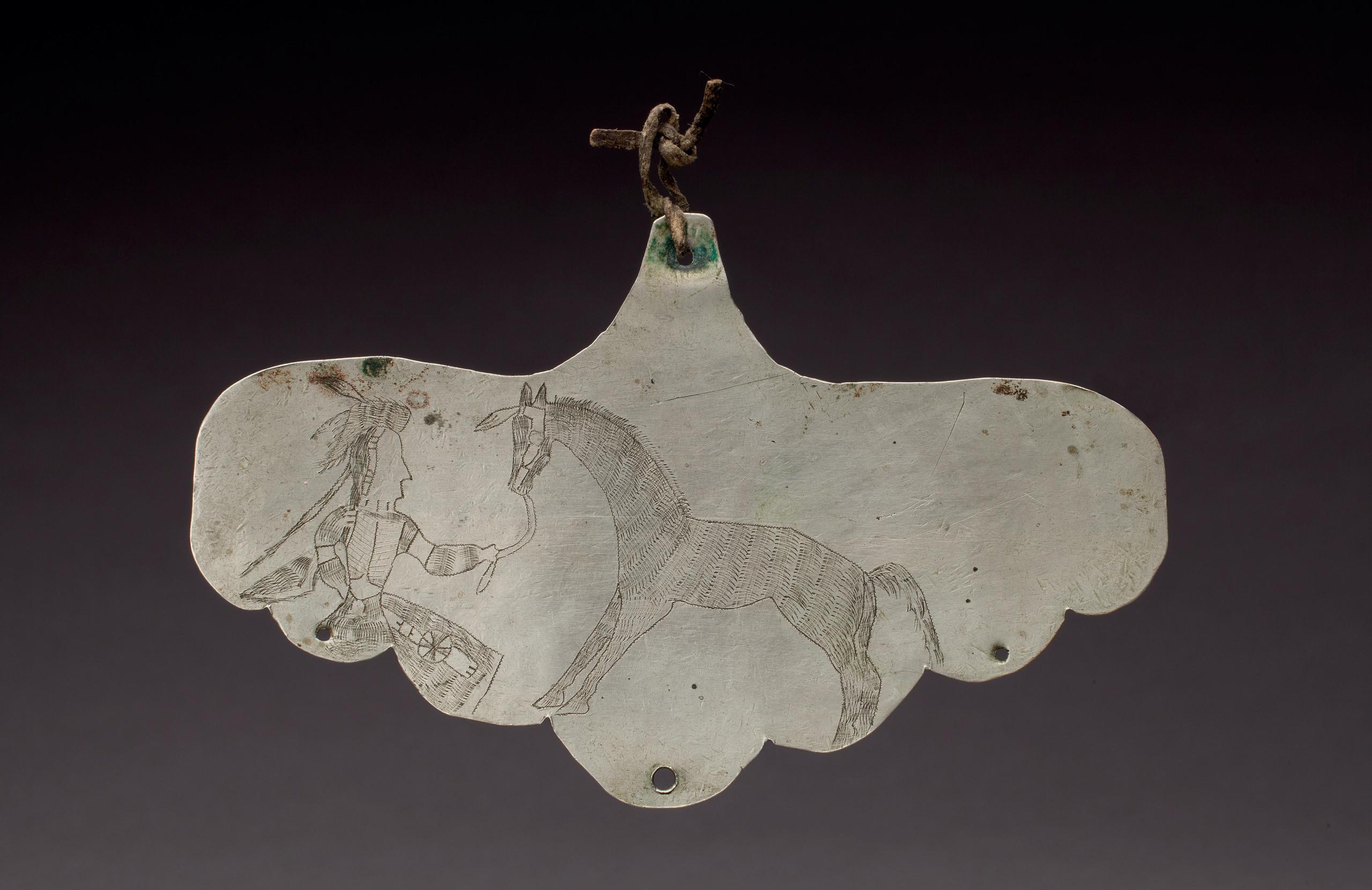
Unknown Artist Southern Plains, possibly Kiowa, circa 1870 Oklahoma German Silver, native tanned leather 3” tall and 5” wide
#51193
Unknown Artist, probably from the family of Young Chief (Hatswallatakapt) Cayuse, late 19th century Oregon Native tanned hide, Stroud, cloth, horsehair, seed beads, sinew Approximately 30” long and 9” wide
Published: Mike Cowdrey, “Horse Masks of the Plateau,” American Indian Art Magazine 33, no. 1 (Winter 2007): 56; Ned Martin et al., American Indian Horse Masks (Nicasio, CA: Hawk Hill Press, 2006), pp. cover, 88-89.

#51163
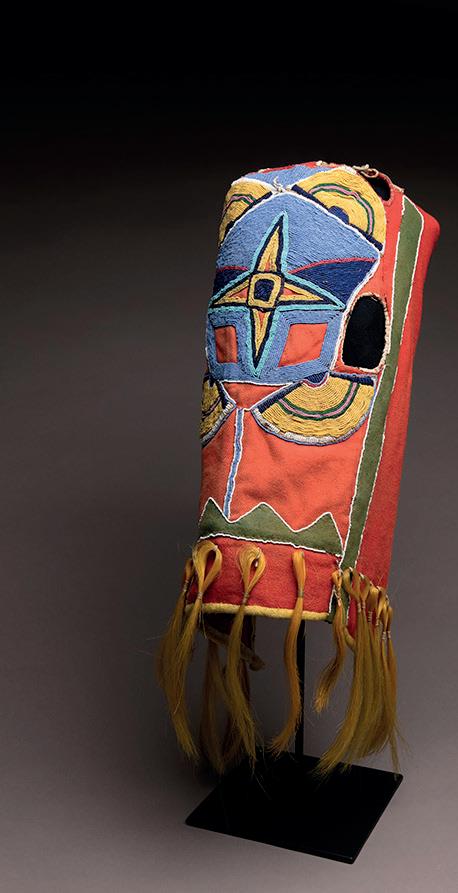
The horse mask is among the most celebrated object-types in American Indian Art. Some of the most remarkable examples, including the one seen here, come to us from inspired Plateau female artists from the late 19th century. Each mask is one-of-a-kind, uniquely decorated to reflect the wealth and artistic prowess of its maker.
By the beginning of the 19th century, more than a century after the Pueblo Revolt, the Plateau groups of Eastern Washington, Eastern Oregon and Idaho had developed a reputation for horse husbandry. They had accrued substantial wealth as middlemen in the lucrative Rocky Mountain horse trade, supplying their coveted horses to the bellicose nations of the Great Plains.
Newly affluent Plateau artists went to great lengths to ornament their most prized horses – much to the envy and awe of their neighbors. Between 1805 and 1806 in present-day Idaho, Meriwether Lewis took note of this phenomenon, remarking that the horses of the Nez Perce and Shoshone were not only well-bred, but also elaborately dressed in exotic and costly trade items like Spanish equestrian gear.
continued on page 36...
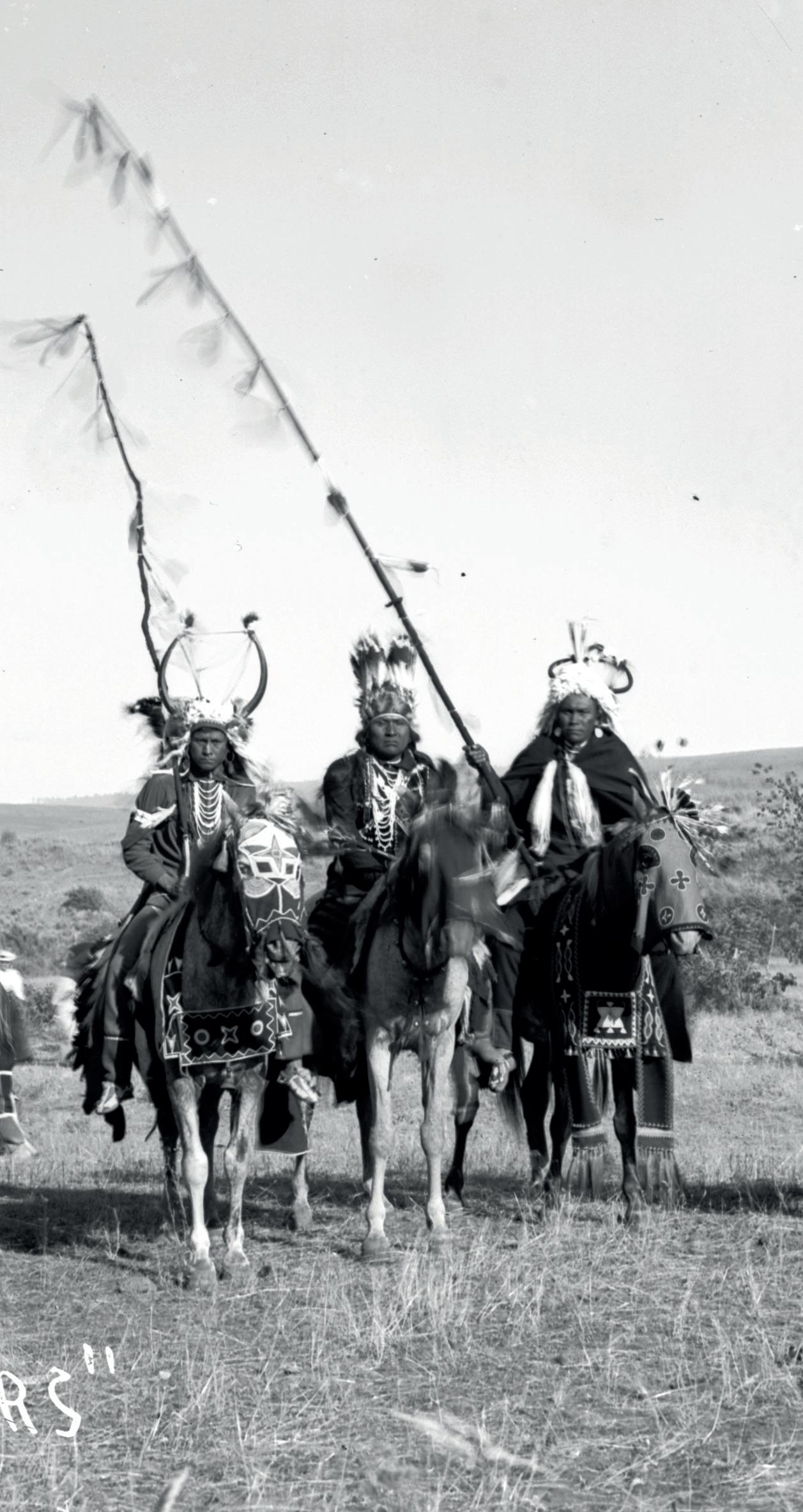
Detail of Thomas Moorhouse photo, “Cayuse Warriors”, c. 1902, featuringthesubjecthorsemaskontheleftmosthorse.LeeMoorhouse Photograph Collection (PH036-5136); courtesy of the Special Collections and University Archives, University of Oregon, Eugene.
While the genesis of the Plateau horse mask remains speculative, scholars infer that the form derived from conquistador cavalry armor. There is, however, an undeniable connection to the pre-Reservation military horse complexes on the Great Plains. The warriors of the Plateau and Great Plains believed in the power of the horse, but to ornament a horse with the horns of the sacred buffalo, lightning bolts, or celestial symbols was to transform a war horse into an altogether enhanced new being – one that was faster, stronger, and more powerful.
With the onset of the Reservation Period (1880–1920), Plateau horse masks took on a decorative function, and were often passed from generation to generation as important heirlooms. These masks adorned horses during important annual events – like the Pendleton Round-Up as well as 4th of July celebrations – to convey social standing and demonstrate artistic excellence. Over time, many acclaimed examples eventually found their way into prominent museum collections. The importance of this mask is evidenced by the fact that it was photographed several times, most notably by Indian agent Lee Moorehouse (1850–1926) around 1902, who captures it being worn on the horse of a Cayuse headman named Young Chief (Hatswallatakapt).
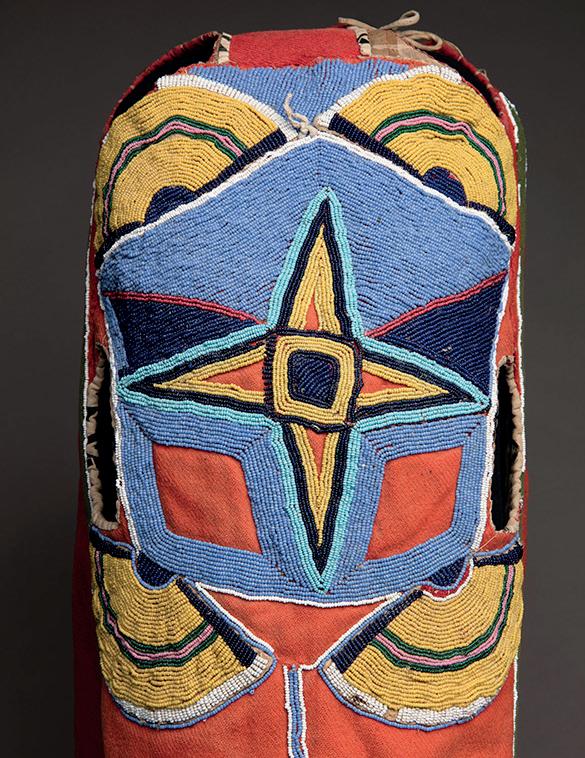
This mask’s decoration program – a four-pointed star which dissects a beaded circular rosette – has been the subject of scholarly debate over the years. Some scholars have asserted that the North Star design has emblematic ties to the Washat spiritual movement; others have suggested that this design might instead be more proprietary to the esteemed Young Chief family. What is clear is that an almost identical design was used on a horse mask which currently resides in the collection of Tamástslikt Cultural Institute on the Umatilla Indian Reservation in Mission, OR. That such a closely related example survives within a tribally held collection speaks to the enduring significance of this design tradition among the Plateau people who created it.
[Editor’s note: Portions of this essay, including specific references and citations, have been modified and/or omitted to better suit the formatting needs of this catalog.] continued...
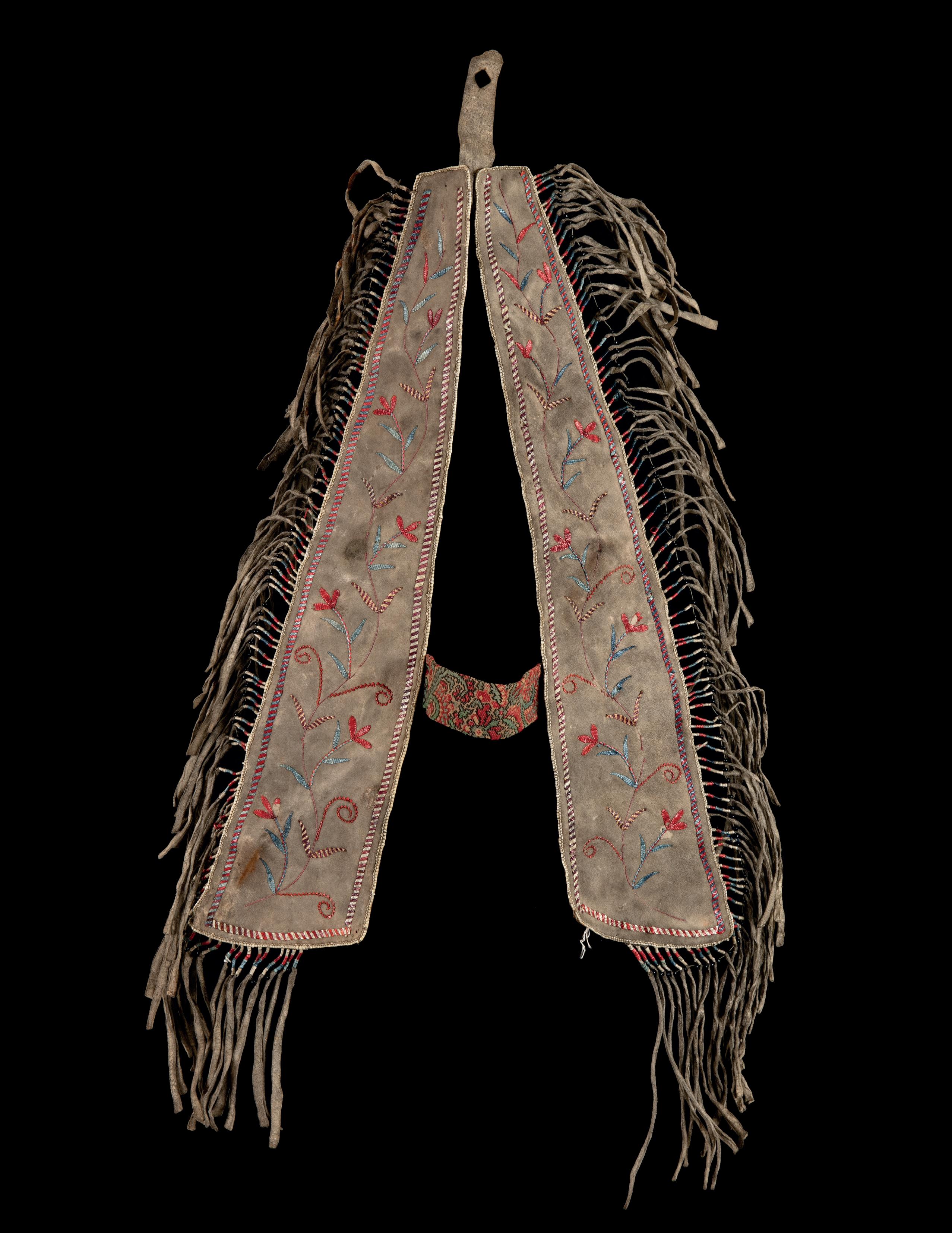
Unknown Artist Cree, circa 1840 Manitoba
Native tanned hide, trade cloth, porcupine quills, natural and synthetic dyes, pony beads, sinew
Approximately 30” long and 21” wide
Ex Dr. Colin Taylor, ENGLAND
Published: Colin Taylor, Native American Hunting and Fighting Skills (Essex, CT: Lyons Press, 2003), pp. 96.
#51200
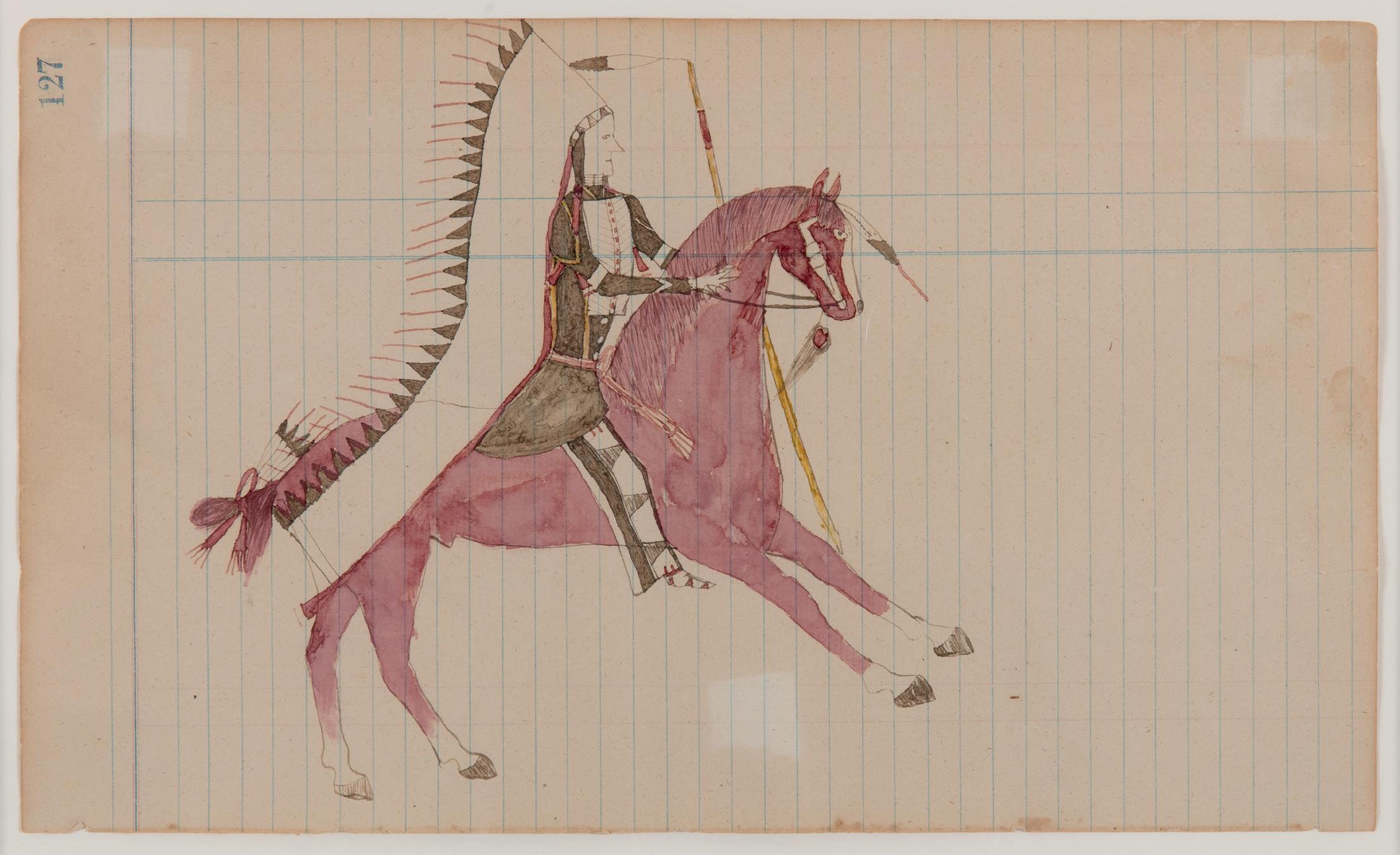
Attributed to Wabli Hito (Roan Eagle, b. 1863)
Page 127: A Battle Scene from the Roan Eagle Ledger Book Oglala (Sioux), circa 1890
South Dakota
Watercolor, ink, ledger paper
7.25” long and 12.125” wide
Ex Iris Apfel, NY (1921-2024)
#51174
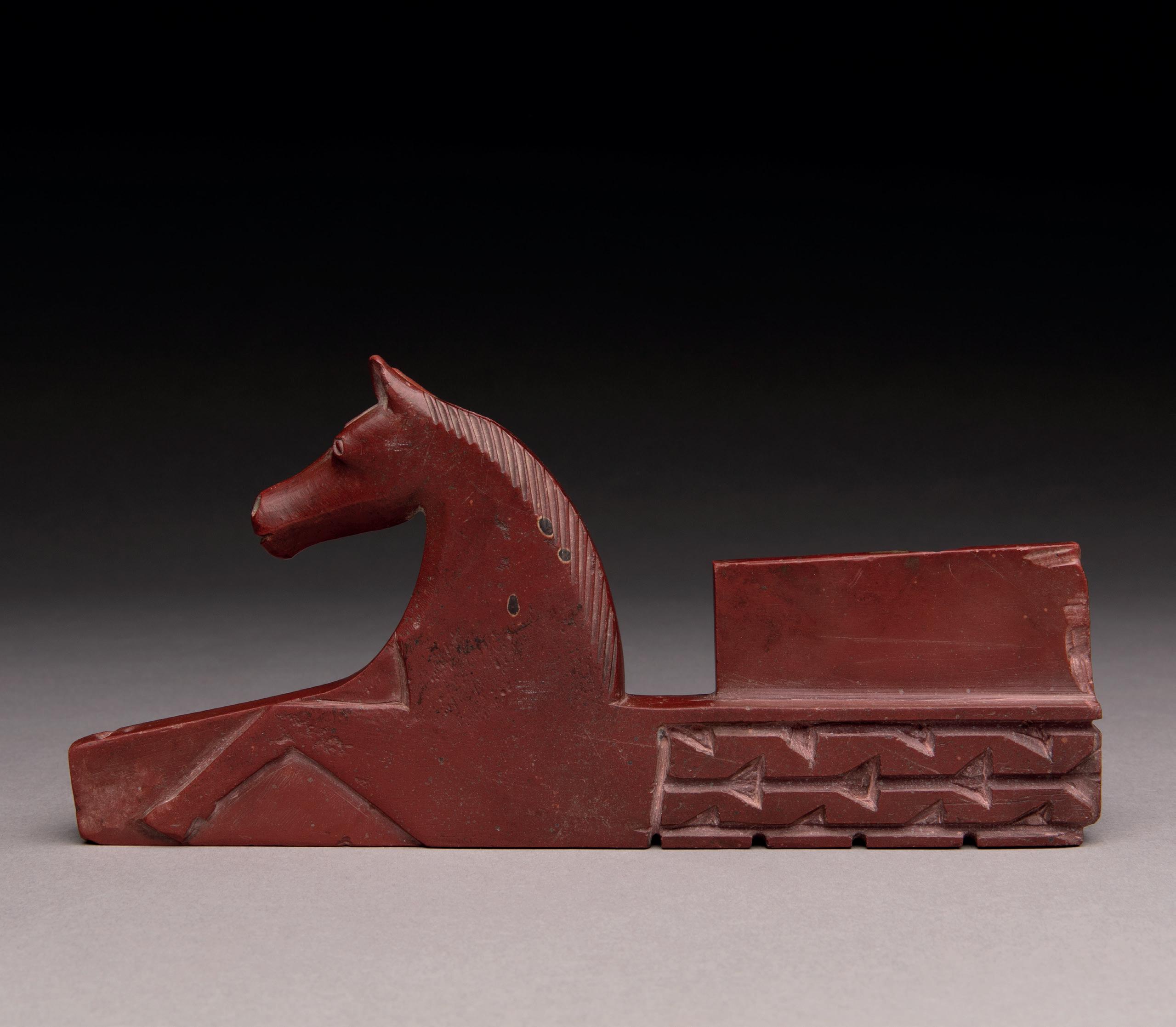
Unknown Artist Sioux, 1875
North Dakota or South Dakota
Catlinite 8” long
Ex Greg Nelson, MN
#51185
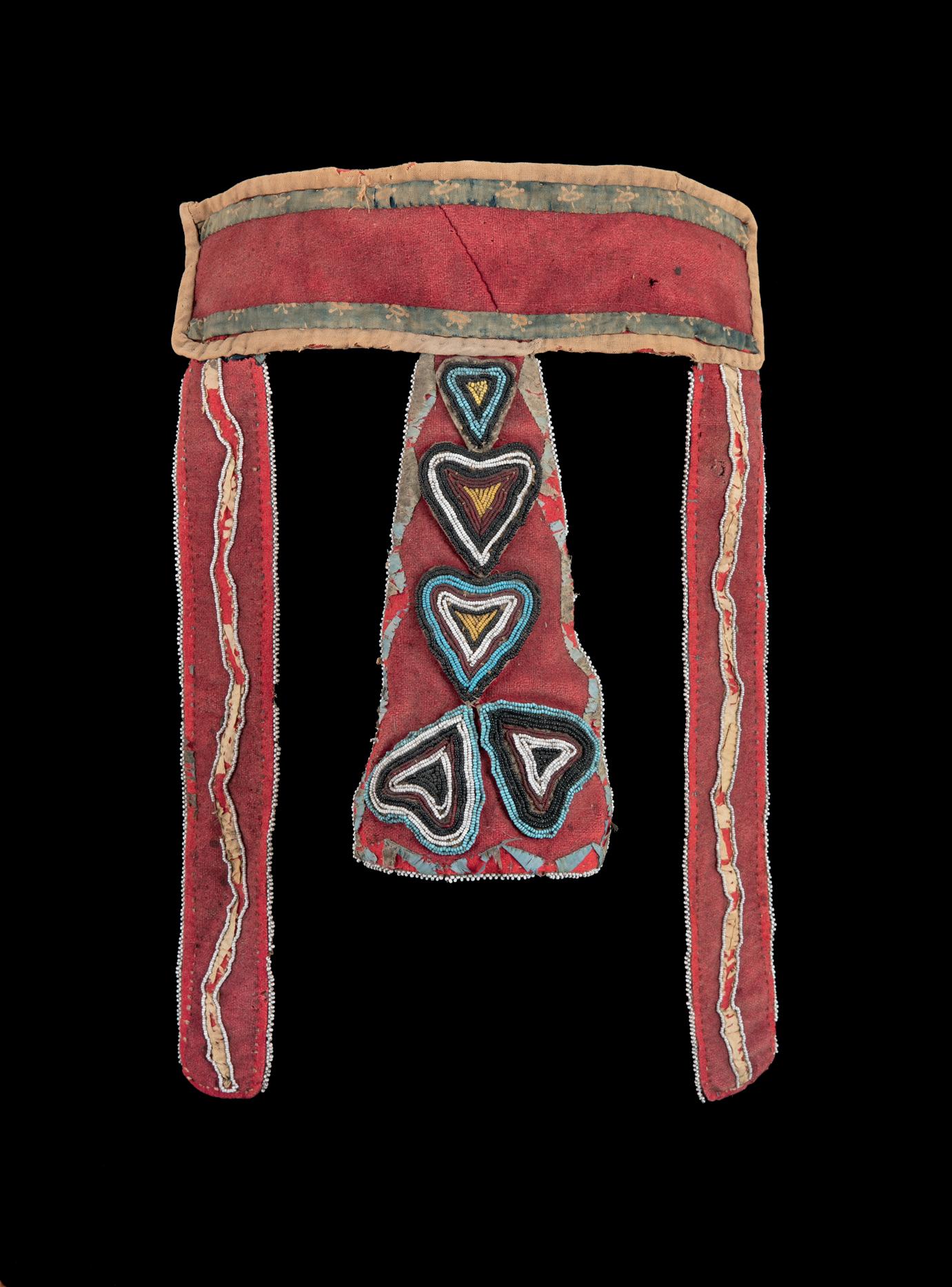
Unknown Artist Plateau, circa 1860
Eastern Washington, Oregon, Idaho, Western Montana
Stroud, commercial cloth, seed beads, sinew 21” long, 11’ wide and 11” deep
Published: Mike Cowdrey et al., Horses and Bridles of the American Indians (Nicasio, CA: Hawk Hill Press, 2012), pp. 74.
#50536