CEO | Melissa J. Schank • 512-646-2724 mschank@tcdla.com
DIRECTORS
Sam Adamo • Houston
Robert Barrera • San Antonio
Lara Bracamonte Davila • Rockwall
Anne Burnham • Houston
Garrett Cleveland • Kerrville
Angelica Cogliano • Austin
Justin Crisler • Austin
Cesar De Leon • Brownsville
Aaron Diaz • San Antonio
Clifford Duke • Dallas
Joseph Esparza • San Antonio
Don Flanary • San Antonio
Robert Gill • Fort Worth
John Gilmore • San Antonio
Paul Harrell • Gatesville
Sean Hightower • Nacogdoches
Kameron Johnson • Austin
Jolissa Jones • Houston
Deniz Kadirhan • Austin
Sean Keane-Dawes • Converse
Ryan Kreck • McKinney
Peter Lesser • Dallas
Chelsi Martin • Houston
Lauren McCollum • San Angelo
Addy Miró • Austin
Blakely Mohr • Southlake
Oliver Neel • Fredericksburg
Mitchell Nolte • McKinney
Mario Olivarez • Corpus Christi
Jose Ozuna • Edinburg
Jason Parrish • Longview
Stephanie Patten • Fort Worth
Rebekah Perlstein • Addison
Shawn Sareen • San Antonio
Annie Scott • Houston
Lisa Shapiro Strauss • Bellaire
Matthew Smid • Fort Worth
Sara Smitherman • Houston
Monique Sparks • Houston
Suzanne Spencer • Austin
Kayla Staley • Lubbock
Fred Stangl • Lubbock
Scott Stillson • Wichita Falls
Rebecca Tavitas • El Paso
Kyle Therrian • McKinney
Mark Thiessen • Houston
Keltin VonGonten • Lubbock
Amanda Webb • Conroe
Theodore Wenske • Abilene
Ronnie Wilkins • San Antonio
Benjamin Wolff • Austin
Judson Woodley • Comanche
Ronald Yeates • The Woodlands
Volume 55 No. 4 | May 2026
Features
Kayla Staley 13 16 27 31 05 06 08 11 38
Limited Rights Against Searches in Border Zone
Mike Hanson, Adela D Meraz
The “Top Ten” Issues Arising in the Defense Reviews of Forensic DNA Profiling Test Results
Dan Krane
Ten Grand Jury Practice Tips
Jeremy Rosenthal
The Presumption of Distrust
Columns
President’s Message Nicole DeBorde Hochglaube
Chief Executive Officer’s Perspective
Melissa J. Schank
Editor’s Comment Jeep Darnell
Ethics and the Law
Larry McDougal, Sr.
Significant Decisions Report
Kyle Therrian
3,868 Members!
TCDLA CLE & Meetings: Schedule and dates subject to change. Visit our website at www.tcdla.com for the most up-todate information. Register online at www.tcdla.com or call 512-478-2514
CDLP | 32nd Annual Judge David C. Guaderrama El Paso Criminal Law Ruidoso, NM
October 14
TCDLA | New Lawyer – Ethics/Grievance Matters Webinar
October 14
CDLP | Innocence for Students Austin, TX
October 15
TCDLA | Roundtable – Entry Level- He Said She Said Voir Dire (Family/Sexual Committee) Zoom
October 15-16
CDLP | 23rd Annual Forensics Austin, TX
October 22
CDLP | Capital Austin, TX
Texas Criminal Defense Lawyers Educational Institute (TCDLEI) offers scholarships to seminars for those with financial needs. Visit TCDLA.com or contact scholarship@tcdla. com for more information.
TCDLA, Some Buffalo and The Best Lawyers and Friends Anywhere
NICOLE DEBORDE HOCHGLAUBE
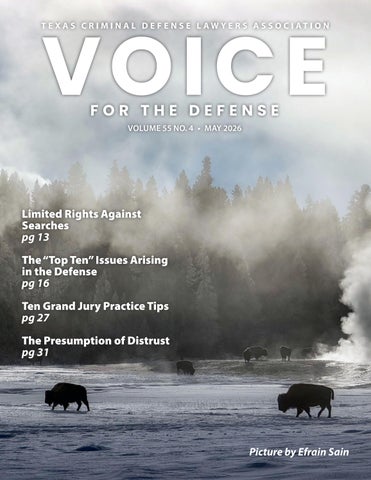
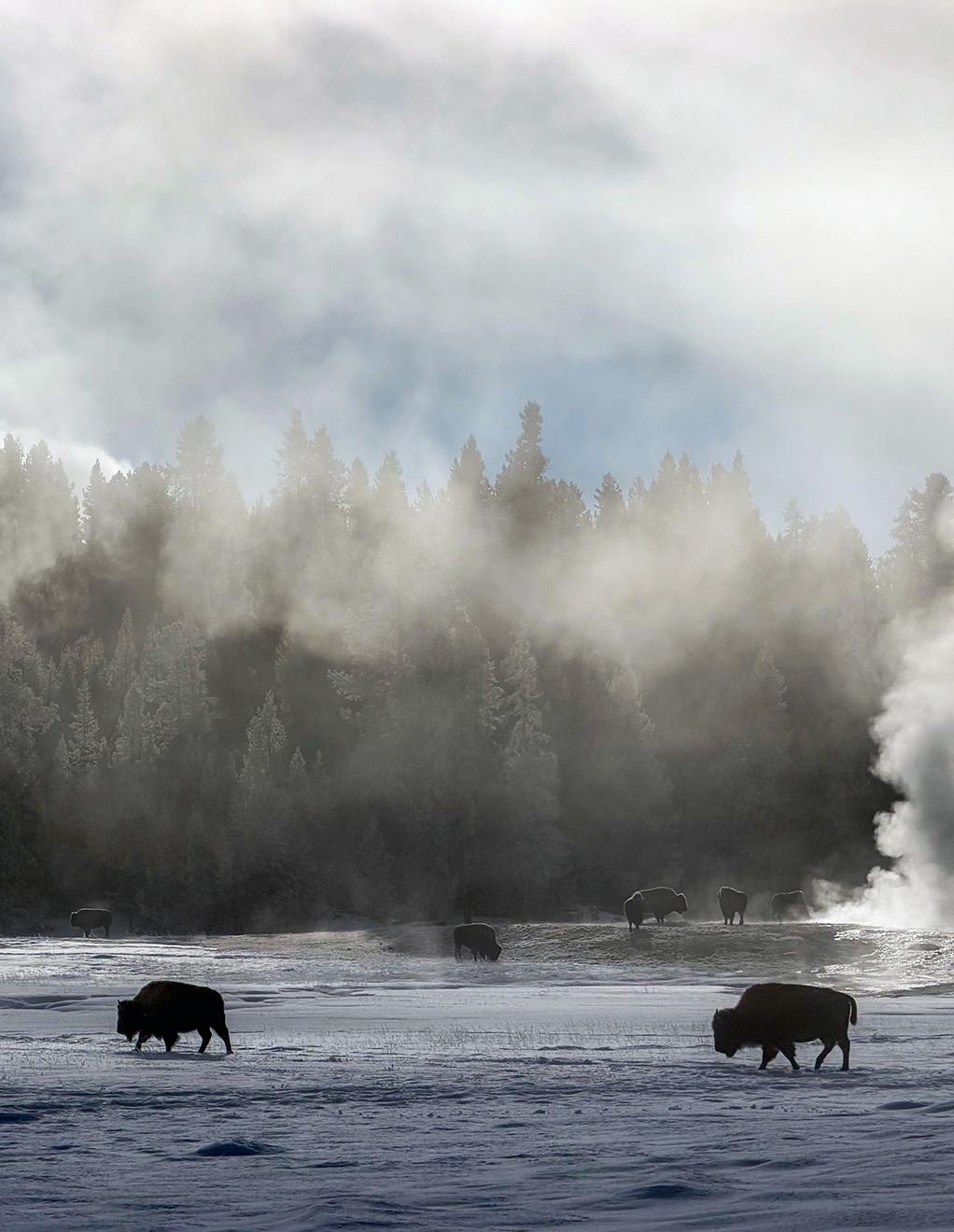
You may be wondering right now, “Why are there buffalo in the snow on the cover of the May issue of The Voice?” The photograph was taken by our amazing colleague and incredibly talented photographer, Efrain Sain on the 2026 TCDLA President’s Trip to Montana. This incredible photograph was taken on our group’s trip into Yellowstone Park in February, in the dead of winter. Efrain has a gift for capturing the beauty and complexity of the scenes he sees in his photographs so that he can share them with us. Here, this herd of buffalo navigates the otherworldly landscape of fire and ice in the often intensely harsh Montana winters. The park, inaccessible in the winter except for on preplanned guided tours, unfurled before us with one unforgettable moment after another. For those able to make this TCDLA trip, we had the privilege of witnessing this incredible scenery together as colleagues learning about the law together and friends sharing this unforgettable experience. It was a lifetime memory in the making that will be cherished by many for many years.
Efrain captured many scenes of indescribable beauty and fleeting encounters with wildlife, so, why did this picture make the cover over all the other impossibly beautiful ones he shared? The buffalo just seemed to tell our story. Buffalo congregate in the western geyser basin of the park as fall gives way to an unrelenting winter. Temperatures in this part of Montana can and, often do, dip well below zero with whipping winds and sometimes blinding snow. The geysers in the west basin produce swirling columns of steam against the already surreal backdrop of the dynamic park landscape, but these geysers also produce warmth. The herds of buffalo are drawn to this basin for that warmth, for protection and for the chance to find food while the rest of their world is
encapsulated in snow and ice. They are better together in this sacred place.
What better metaphor for what TCDLA is to so many of us and what it certainly is for me. We have all had times in our practice that feel like an unrelenting winter. We, as defense lawyers, have all had to navigate the brutal terrain of a difficult case with a client who is despised but for whom we fight with all our soul. We have also had the good fortune to know what it means to find success together, because we instinctively know we are better together. This last year, I have been gifted with the opportunity to see firsthand the beauty of the comradery, the depth of our collective knowledge, the unyielding strength of our brothers and sisters and the great benefit of traveling this journey of criminal defense with you. We are all on this journey in the fight for justice and the common good together. Your creativity and persistence in your fight for what is right no matter how difficult continues to leave me in awe, just as Efrain’s beautiful photography does. Thank you for the opportunity to share this journey with you this year as your President.
Forever grateful,
Nicole DeBorde Hochglaube
Strategic Plan 2024–2026: Three Years of Progress
MELISSA J. SCHANK
“ Strategy without tactics is the slowest route to victory. Tactics without strategy is the noise before defeat.”
Over the past three years, our strategic plan has focused on strengthening the organization, supporting our members under the leadership of Chairs Nicole DeBorde Hochglaube and Vice Chair Monique Sparks, and advancing the mission of criminal defense in Texas. Below is a snapshot of four key initiatives and their accomplishments.
1. Initiative: Understanding Member Resources to Increase Education Access
Goal: Identifying, improving, and promoting the tools, programs, and support systems available to members so they can more easily access educational opportunities.
• TCDLA Members: Kierra Preston, Meredith Pelt, Claire Pravednikov, Eric Garza, Paul Harrell, Mario Olivarez, Rick Russwurm, Monique Sparks, Clay Steadman, & Judson Woodley
• Staff Leads: Kierra Preston, Meredith Pelt
• Staff Members: Claire Pravednikov, Eric Garza
Key Accomplishments (3-Year Results):
• Increased remote education options – introducing more interactive webinars and roundtables with Q&A formats.
• Successfully rolled out the TCDLA Mentor-Mentee Program – 2025 2026 with 22 participants.
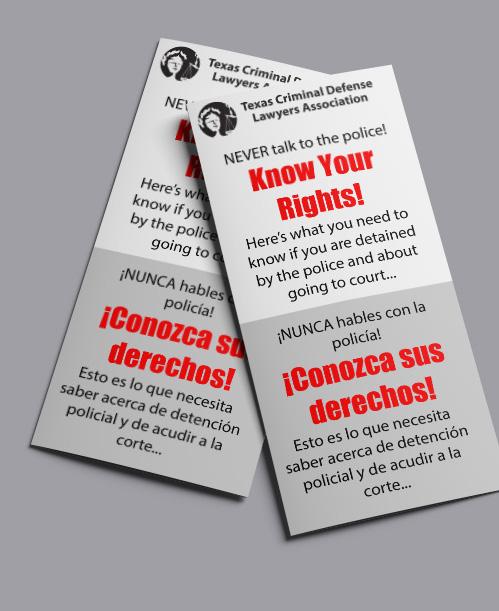
• Created and distributed a Know You Rights pamphlet – for community awareness of individual rights.
• Increased Federal Law Education – increasing online & in person Federal roundtables.
• Created flexible learning options by offering in person, on demand, livestream, audio, and mix and match formats to better meet diverse member needs.
• Created two Holistic Representation webinars to educate attorneys on effectively incorporating holistic approaches into client representation.
• Engaged Student awareness by increasing the number of law school events from 6 schools to 8
• Increased Rusty Duncan Scholarship awareness by creating a combined document, adding to the Rusty website, made it clearer in emails, and the Voice magazine.
2. Initiative: Enhancing Communication & Reorganizing Resources
Goal: To ensure intentional communication, protect member engagement, and support long term strategic marketing goals through streamlined resources and improved technology integration.
• TCDLA Members: Nicole DeBorde Hochglaube, Dustin Nimz, Paul Tu, Aaron Diaz, John Gilmore
• Staff Leads: Sonny Martinez and Alicia Thomas
• Staff Members: Lucas Seiferman, Jessica Steen, Ashley Ybarra, and Lohtse Hernandez
Key Accomplishments (3-Year Results):
• Website and Navigation Overhaul – Completed a comprehensive accessibility and navigation study, resulting in a completely redone alphabetized, indexed Membership Resource Page.
• Significant Technology Engagement – Achieved a 138% increase in views for technology resources, significantly exceeding the original 10% growth goal.
• Proactive Marketing and PR Framework – Established a formal TCDLA Marketing Plan using a visual calendar system and developed standardized PR guidelines, including a messaging plan for handling controversial topics.
• Digital Resource Development
– Created a comprehensive digital Ebook and integrated Google Analytics to track resource page usage and member interests.
Impact: This initiative successfully shifted TCDLA from a reactive communication style to a proactive, data driven strategy
Sun Tzu
that ensures members can efficiently find and use the defense tools they need. By streamlining resources and establishing clear PR protocols, the organization increased its transparency and strengthened its ability to support the membership during legislative and controversial shifts.
3. Initiative: Revitalizing the Organization
Goal: Strengthen and revitalize the organization by enhancing transparency, accountability, and member engagement—while improving communication, increasing member satisfaction, and establishing measurable benchmarks that support sustained growth and a more connected, actively involved membership base.
• TCDLA Members: Michael Edwards, Amanda Hernandez, Kameron Johnson, Sarah Roland, Ted Wenske
• Staff Lead: Mari Flores
• Staff Members: Cristina Abascal, Jayla Davis
Key Accomplishments (3-Year Results):
• Internal Staff Audit – Conducted staff interviews confirming high morale and strong satisfaction with benefits, resources, and workplace environment.
• Board Report Card – Implemented a report card outlining board responsibilities and expectations for board accountability and use by the nominations committee.
• Membership Satisfaction Survey – Deployed member surveys to assess needs and satisfaction, increasing satisfaction from 90% to 98%.
• Each One Reach One Membership Drive – Launched a peer driven membership campaign with promotional content, social media, and incentives to boost engagement and growth.
• Mission Statement Awareness – Expanded visibility through seminars, agendas, and marketing, increasing awareness from 0% to 93%.
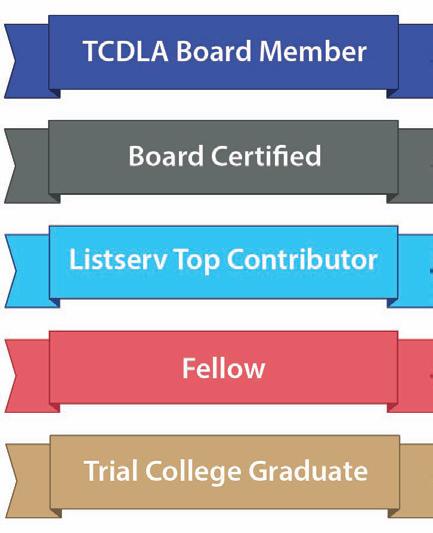
• Digital Ribbons Campaign – Introduced digital profile ribbons to enhance member recognition across directories and platforms.
• Website Badges – Promoted downloadable badges for members to display across professional materials and platforms.
• CDLP Chair on Budget Committee – Included the CDLP Chair into budgeting to understand impacts on seminars.
• Baseline Data Dashboard – Developed a dashboard to track key metrics and measure progress across all initiatives.
• Volunteer Engagement Initiative – Increased participation by identifying member interest gaps and improving access to volunteer opportunities through web, print, and seminar outreach.
Impact: These efforts strengthened organizational alignment, improved transparency, and significantly increased both member satisfaction and engagement. By establishing clear benchmarks and enhancing communication, the initiative created a more informed, connected, and actively involved membership base while positioning the organization for sustainable growth.
4. Initiative: Empowering & Supporting Members & Volunteers
Goal: To enhance the member experience by increasing awareness and utilization of available resources, strengthening engagement among members and volunteers, and delivering targeted programming that supports professional growth and connection.
• TCDLA Members: Jeep Darnell, Lance Evans, Lisa Greenberg, Thuy Le
• Staff Lead: Miriam Duarte
• Staff Members: Rick Wardroup, Dajon White, Ashley Ybarra
Key Accomplishments (3-Year Results):
• Expanded member benefits – adding new partnerships (Rev, JusticeText, LexReception), securing exclusive discounts, and creating a revenue generating opportunity
• Developed and distributed a volunteer resource guide – print and digital formats, improving access to involvement opportunities
• Launched a monthly membership email campaign – resulting in a 53% open rate (1,815 of 3,445), increasing awareness and utilization of member benefits
• Increased member engagement – 35 free roundtable sessions across diverse topics, providing consistent opportunities for participation, connection, and professional development
Impact: This initiative has strengthened member engagement by making it easier for individuals to connect with the organization, access valuable benefits, and find meaningful ways to get involved. Improved communication and expanded programming have contributed to a more informed, engaged, and supported membership, reinforcing the overall value of participation in the organization.
Our new Strategic Planning Committee began with a full day of planning on Zoom, followed by a two day in person planning session in April. These meetings will focus on identifying priorities, setting measurable goals, and continuing to strengthen the mission and impact of Texas Criminal Defense Lawyers Association for the years ahead.
Volunteer Resource Guide
Digital Ribbons
The End of the Road
JEEP DARNELL
This will be my last issue as Editor of Voice for the Defense. I want to begin this column with a thank you to everyone who has ever read my columns in each volume. I hope I wrote something at least once that every reader took away to make their lives, practices, or both a little better. Each column was written from my heart, and I hope my vulnerability paid off somewhere for someone. Over the last five years I have received a number of phone calls, emails, and text messages from lawyers and judges all over the State critiquing, commenting on, or complimenting not only my columns, but the magazine. Some of them were useful, some I was unsure of the context, but almost every single person who reached out added something to make the Voice better. I appreciate everyone who took the time to do so. That has been the point of what the Voice Committee and I have strived to accomplish during my term as Editor: take what was an already great legal magazine and make it better. Years ago, Sarah Roland was the Editor, and she asked me to come on as Vice Editor. I was amazed at the amount of work she undertook with the home office staff and Melissa Schank to put together such a quality product for the over 5,000 recipients of each volume. During my tenure, we have increased the number of Assistant Editors to six so that the quality of each volume is the best possible product that we can put out. I want to thank the Assistant Editors Anne Burnham, John Gilmore, Amanda Hernandez, Sarah Roland, Jeremy Rosenthal, Mehr Singh, and Kyle Therrian. I also want to thank incoming President Clay Steadman for serving as a past Assistant Editor. Moreover, I would like to send a huge thank you to Alicia Thomas, Meredith Pelt, and Melissa Schank, who have worked tirelessly to assist the Voice Committee over the
years. Working with each of those people has made me smarter, made me look better, and made me a better lawyer. Lastly, I would like to give a shout out to all the members who have submitted articles. Without your contributions, sharing knowledge and helping fellow members continue the fight, we would not have the Voice, one of our most valuable member benefits.
Rest assured, I am not leaving the Voice without a leader to continue the never ending task of making it better: Amanda Hernandez from San Antonio will be taking over as Editor of the Voice. Amanda is incredibly smart, a great lawyer, and has a very fine eye for making sure that every single page of every single volume is perfect. I am humbled by Amanda’s work as an Assistant Editor and excited for the future of the magazine in her hands. However, I want to challenge each of you who reads the magazine to assist. We cannot continue the work of producing, in my opinion, the best criminal defense magazine in the nation without input from each of you. If you have worked on a recent or past legal issue that you feel would provide valuable insight to our readers, please send us an article on that topic.
With that, I will sign off for the last time as Editor and repeat myself: thank you. It was an honor.
Stay safe,
Jeep Darnell
TCDLA Elkins Amicus Filed
Amicus
Committee
Overview
This amicus brief from the Texas Criminal Defense Lawyers Association argues that expanding federal prosecution of crimes traditionally handled by states would overwhelm the federal system and worsen the already strained indigent defense system. It explains that federalizing more offenses would require significantly more qualified defense attorneys, but there are too few trained lawyers and limited resources to meet that demand. The brief emphasizes that federal cases are more complex, require higher standards, and would force courts and defense systems to stretch beyond sustainable limits, risking ineffective representation and undermining defendants’ Sixth Amendment right to counsel. The association urges the Court to grant review and avoid shifting these burdens to the federal courts.
Scan QR Code for Amicus Brief!
How to Scan a QR Code:
On your compatible smart phone or tablet, open the built-in camera app. Point the camera at the QR code. Tap the banner that appears on your smart phone or tablet to navigate to the site!
Kyle practices criminal defense statewide with a focus on state criminal appellate law and federal criminal defense. His office, Rosenthal Kalabus & Therrian, is located in McKinney, Texas, and is Collin County's largest criminal defense firm. Kyle serves as Chair of TCDLA's Amicus Committee, Chair of Texas Criminal Defense Lawyers Education Institute, and is the author of the Significant Decisions Report. Locally he also serves as president of the Collin County Criminal Defense Lawyers Association. He enjoys being a resource for lawyers in need of quick answers to tricky legal problems and is always happy to take a call from a colleague in need.
Aubrey Noonan Bio
Aubrey Noonan is an attorney at Rosenthal Kalabus & Therrian law firm. She graduated from Texas Tech University School of Law in 2016 and has been a criminal defense attorney for the last 10 years, representing individuals accused of crimes in federal and state courts across North Texas. Her primary objective is to ensure justice and fair representation for all clients. She can be reached at 972-369-0577 or at aubrey@texasdefensefirm.com.
Aaron Diaz Bio
Aaron Diaz is a Visiting Clinical Assistant Professor of Law with the St. Mary’s Law School Criminal Justice Clinic. Before joining the criminal justice clinic, Aaron spent six years working with the Goldstein & Orr law firm in San Antonio, Texas. Prior to law school, Aaron spent over a decade as a paralegal working for a criminal defense firm in South Texas and various State agencies. During that time, Aaron received his Bachelor of Science degree in Criminal Justice from the University of Texas Pan-American, and a Master of Arts degree in Legal Studies from Texas State University. Aaron graduated from St. Mary’s University School of Law, cum laude, in May of 2020. Since becoming licensed, Aaron has solely practiced juvenile and adult criminal defense, representing clients charged with misdemeanor and felony crimes. He has also handled State and federal appeals and post-conviction writs of habeas corpus cases. Aaron is currently on the Texas Criminal Defense Lawyers Association Board of Directors and serves as Vice Chair of the Amicus Committee. He is also a member of the San Antonio Criminal Defense Lawyers Association.
TCDLA Staley Amicus Filed
Amicus Committee
Overview
The Texas Criminal Defense Lawyers Association filed an amicus brief arguing that the State’s position would weaken the Fourth Amendment by allowing search warrants without specific descriptions based solely on the type of crime alleged. The brief explains that both U.S. Supreme Court precedent and Texas law require strict particularity in warrants to prevent unconstitutional general searches and to preserve the independence of a neutral magistrate. It contends that letting offense type substitute for specificity revives the historically condemned practice of general warrants, creates a sliding scale of constitutional protections, and invites abuse. Because existing law already clearly rejects the State’s theory, the brief concludes that the Court should dismiss the State’s petition for discretionary review as improvidently granted and maintain established search and seizure protections.
Scan QR Code for Amicus Brief!
How to Scan a QR Code:
On your compatible smart phone or tablet, open the built-in camera app. Point the camera at the QR code. Tap the banner that appears on your smart phone or tablet to navigate to the site!
Drafters: Patrick F. McCann, Kyle Therrian, Aaron Diaz
Patrick F. McCann Bio
Patrick F. McCann has been in solo practice in Houston since 1994. He is a former President of the Harris County Criminal Lawyers Association, a former President of the Fort Bend County Criminal Defense Attorneys Association, a former legislative liaison for both organizations, former Chair of the Fort Bend Mental Health Defenders Advisory Board, and a member of the Governor’s Specialty Courts Advisory Council. He was a founding team member of both the Harris County and Fort Bend County Veterans Courts. He is certified to handle death penalty cases at trial, on appeal, and in state and federal habeas cases. He is a retired Navy officer with service in Europe, at Central Command, in Bosnia, and GTMO, Cuba. He can be reached at 713-444-2826 any time.
Kyle Therrian Bio
Kyle practices criminal defense statewide with a focus on state criminal appellate law and federal criminal defense. His office, Rosenthal Kalabus & Therrian, is located in McKinney, Texas, and is Collin County's largest criminal defense firm. Kyle serves as Chair of TCDLA's Amicus Committee, Chair of Texas Criminal Defense Lawyers Education Institute, and is the author of the Significant Decisions Report. Locally he also serves as president of the Collin County Criminal Defense Lawyers Association. He enjoys being a resource for lawyers in need of quick answers to tricky legal problems and is always happy to take a call from a colleague in need.
Aaron Diaz Bio
Aaron Diaz is a Visiting Clinical Assistant Professor of Law with the St. Mary’s Law School Criminal Justice Clinic. Before joining the criminal justice clinic, Aaron spent six years working with the Goldstein & Orr law firm in San Antonio, Texas. Prior to law school, Aaron spent over a decade as a paralegal working for a criminal defense firm in South Texas and various State agencies. During that time, Aaron received his Bachelor of Science degree in Criminal Justice from the University of Texas Pan-American, and a Master of Arts degree in Legal Studies from Texas State University. Aaron graduated from St. Mary’s University School of Law, cum laude, in May of 2020. Since becoming licensed, Aaron has solely practiced juvenile and adult criminal defense, representing clients charged with misdemeanor and felony crimes. He has also handled State and federal appeals and post-conviction writs of habeas corpus cases. Aaron is currently on the Texas Criminal Defense Lawyers Association Board of Directors and serves as Vice Chair of the Amicus Committee. He is also a member of the San Antonio Criminal Defense Lawyers Association.
Conflict of Interest Waivers: Are They Worth the Paper They are Written On?
LARRY MCDOUGAL, SR. Member of the Ethics Committee
As a baby lawyer, I learned that a wise lawyer never represents two clients in the same criminal matter. Yet as a prosecutor and a defense lawyer I have seen it done several times, except in a situation where co defendants are proceeding to trial. I have seen it attempted, but each time the judge said NO.
I had a case where I was representing two police officers that were under investigation for a felony offense. Without going too deep into the facts, both wanted me to represent them during the investigative phase. At that time, we had them both sign conflict of interest waivers. We did not think this case would be indicted. As the case progressed, I sat them down and advised them that it was time to get their own attorneys. One officer was adamant that they wanted me to continue to represent them. In response, I indicated that I can only do so if the other officer would sign a new conflict of interest waiver. The other officer did. During the investigative stage I obtained several statements from both officers.
So, the second officer went off and hired another attorney to represent them. The Grand Jury later indicted both officers for the felony. These two swore that they would use a joint defense, and it was believed if they stood together neither would be convicted. The problem arose because the second attorney had other plans unknown to my client. The second attorney turned that officer into a state’s witness, ultimately giving a statement implicating my client. That statement conflicted with all of the past statements provided in my pre indictment investigation cop would never lie, right? Unfortunately, that made me a witness against my former client.
The first place I turned to was Texas Disciplinary Rule 1.06 (c)(2)(d): “A lawyer who has represented multiple parties in a matter shall not thereafter represent any of such parties in a dispute among the parties arising out of the matter, unless prior consent is obtained from all such parties to the dispute.” Not only did I have one waiver from the other officer, but I had multiple waivers. There was no question that I had consent. That waiver was built upon the understanding that there was a joint defense between co defendants. Texas Ethics Opinion 448 states that the waiver must be in writing and signed by each client. It was.
However, I then read down to (e): “If a lawyer has accepted representation in violation of this Rule, or if multiple representation properly accepted becomes improper under this Rule, the lawyer shall promptly withdraw from one or more representations to the extent necessary for any remaining representation not to be in violation of these Rules.” I now suspected that the conflicting statements made my representation improper under this rule. Had this case gone to trial, could I use those prior statements to impeach?
We researched this and could not find a case directly on point.
However, Texas Disciplinary Rule 1.06, Cmt. 3 notes that: “[s]uch conflicts can arise in criminal cases as well as civil. The potential for conflict of interest in representing multiple defendants in a criminal case is so grave that ordinarily a lawyer should decline to represent more than one co defendant.”
But we were now only representing one.
When the defense counsel for the other police officer chose to cut a deal for their client to testify against the other, we deemed the waiver was no longer valid.
To confirm, we consulted with Elen Pitluck at the State Bar of Texas Ethics Help Line. The decision was made that the waiver was no longer valid with the change in defense strategy. We decided that we could continue to represent the client, however, we would not mention the inconsistent statements, nor could we disclose them to the new counsel should we withdraw. In this regard, should the case proceed to trial we would have no option but to withdraw at that time.
Luckily a new prosecutor was assigned to the case, and we entered into a plea bargain agreement.
This case was not about money or returning a fee. This was about representing a client we believed in.
Lesson learned: even in the investigative stage of a criminal case, do not advise or represent more than one client. What may look proper can change at any given time. Joint clients can become adversarial at any time.
There was a well known Houston Attorney who was sued because he represented one defendant and another lawyer in his firm represented a codefendant. In that case the jury found the lawyers committed malpractice but did not award any damages. Do not find yourself in that position. Do not rely on waivers of conflict of interest.
Larry McDougal, Sr. is Board Certified in Criminal Law and has been licensed since 1990. He began his legal career as an Assistant District Attorney and DA Investigator in Harris County, Texas. He has twice been awarded the TCDLA President's Award and serves on the TCDLA Ethics Committee and Strike Force. He was President of the Fort Bend Criminal Defense Lawyers Association in 2006. Served on a State Bar Grievance Panel and as Grievance Chair for District 5, State Bar Board of Directors 2012-2015, Named Outstanding Director 2015 and elected President of the State Bar 2020-2021. Larry has presented many ethics CLEs for TCDLA, State Bar and local bars and received the State Bar Standing Ovation Award. He has tried over 100 criminal jury trials. He is currently retired and lives on a ranch outside of Shiner, TX with Karen his wife of 47 years. Larry is still an active member of TCDLA.
2026–2027
TCDLA Committee Expression of Interest
TCDLA is seeking enthusiastic and motivated individuals for upcoming openings to its 2026–2027 committees. Committee descriptions and mission statements are listed on the website. Complete the form below and check one or more of the committees that you would be interested in serving on.
Responsibilities of a TCDLA Committee Member:
1. Member of TCDLA.
2. Committees will provide advice, guidance and recommendations to the TCDLA President and/or Board of Directors on relevant matters related to their particular committee.
3. Committees will have assigned responsibilities associated with TCDLA’s strategic plan and objectives.
4. Meet throughout the year via Zoom call and/or at quarterly board meetings.
5. Members are expected to review and respond to email requests in a timely fashion.
6. Committee Chairs are expected to prepare written reports for inclusion in the board packets for each board meeting. Any items requiring a decision of the Board should be included on the agenda. Committee members will assist chairs in the preparation of reports.
7. Visit TCDLA website for committee mission statements and procedures.
Your information
Last name First name
Law school Years in practice
Primary areas of practice
Contac t Information
Work phone Cell phone
Email
Committee preference: Select committees you would like to serve on or scan the QR code to complete the online form.
❏ Amicus (Brief) Curiae
❏ Attorney Outreach and Engagement
❏ Bylaws
❏ Cannabis
❏ Capital Assistance
❏ Class C Practice
❏ Client Mental Health
❏ Corrections & Parole
❏ Crimmigration
❏ Defense Team: NonAttorney
❏ DWI Resources
❏ Ethics
❏ Federal Assistance
❏ Health & Wellness
❏ Indigent Defense
❏ Judicial Conduct
❏ Juvenile Justice
❏ Law School Students
❏ Listserv
❏ Long-Range Planning
❏ Managed Assigned Counsel
❏ Membership
❏ Memo Bank
❏ Mentee/Mentor
❏ Motions Acquisition
❏ New Lawyers
❏ Nexus (Seminars)
❏ Prosecutorial Conduct
❏ Public Defender
❏ Rural Practice
❏ Sexual Assault/Family Violence
❏ Social Media
❏ Strike Force
❏ Technology
❏ Veterans Assistance
❏ Women’s Caucus
Email the completed form with a brief resume. The form may include a personal statement describing your interest in serving on a committee to monet@tcdla.com by July 1, but accepted year-round.
Limited Rights Against Searches in Border Zone
MIKE HANSON & ADELA D MERAZ
If you’re like me, you own one of those infamous TCDLA t shirts that proudly proclaim, “Come back with a warrant.” But do those same rights that so many of us criminal and immigration practitioners zealously defend apply when entering the United States? The answer may surprise you.
The Fourth Amendment and Its Texas Counterpart
Our analysis of searches and warrant requirements is grounded first and foremost in the Fourth Amendment to the United States Constitution. It provides:
“The right of the people to be secure in their persons, houses, papers, and effects, against unreasonable searches and seizures, shall not be violated, and no warrants shall issue, but upon probable cause, supported by oath or affirmation, and particularly describing the place to be searched, and the persons or things to be seized.” — U.S. Const. amend. IV.
So, if the Fourth Amendment and the Texas Constitution both emphasize reasonableness and probable cause, how did we arrive at a place where searches at the border, often without any suspicion, are deemed constitutional?
The Border Search Exception
Enter the border search exception, a longstanding doctrine that permits government agents to search individuals and their belongings at the nation’s borders without a warrant and, in many cases, without any suspicion of wrongdoing.
“Border searches” can involve inspecting the contents and data stored on electronic devices, including laptops, smartphones, and storage devices, belonging to any person entering the United States from abroad. All persons, U.S. citizens, lawful permanent residents, and non U.S. nationals, are subject to such searches when crossing a U.S. border or appearing at a U.S. port of entry.
Federal law explicitly authorizes Customs and Border Protection (CBP) officers to “inspect, search or detain” any person or item arriving in, or departing from, the territorial United States. 8 U.S.C. § 1582; 19 C.F.R. § 162.6. This portion of the code grants customs officers, port directors, and special agents’ broad discretion to inspect items upon entry into the United States.
The U.S. Supreme Court has consistently recognized the government’s heightened interest at the border. As the Court explained:
“[T]he Government’s interest in preventing the entry of unwanted persons and effects is at its zenith at the international border. Time and again, we have stated that ‘searches made at the border, pursuant to the longstanding right of the sovereign to protect itself by stopping and examining persons and property crossing into this country, are reasonable simply by virtue of the fact that they occur at the border.’”
— United States v. Flores-Montano, 541 U.S. 149, 153 (2004) (quoting United States v. Ramsey, 431 U.S. 606, 616 (1977)).
Routine vs. Intrusive Searches
The Supreme Court’s border search doctrine draws an important line between routine and non-routine searches. Routine searches involve actions such as checking luggage or vehicles. These types of searches require no individualized suspicion. However, more intrusive searches demand some level of justification.
In United States v. Montoya de Hernandez, 473 U.S. 531 (1985), the Court held that reasonable suspicion was required for
a highly invasive search of a traveler’s alimentary canal. The Court reasoned that
“The ‘reasonable suspicion’ standard. . . effects a needed balance between private and public interests when law enforcement officials make a limited intrusion on less than probable cause.” Id. at 541.
Following Montoya de Hernandez, lower federal courts have grappled with applying this distinction to modern technology, particularly electronic devices, which can contain vast amounts of personal and privileged information.
The Digital Age: Cell Phones, Laptops, and Privacy
Several circuits have recognized that electronic devices implicate heightened privacy interests and therefore cannot be treated the same as a suitcase or a gas tank. For example, in United States v. Cotterman, 709 F.3d 952, 967–68 (9th Cir. 2013), the Ninth Circuit held that reasonable suspicion was required for a forensic search of a laptop at the border. Likewise, the Fourth Circuit in United States v. Kolsuz, 890 F.3d 133, 148 (4th Cir. 2018), concluded that agents acted reasonably when they searched a traveler’s cell phone based on reasonable suspicion.
These cases reflect the judiciary’s growing recognition that a search of these devices reaches far beyond what traditional border inspections contemplated.
Current DHS and CBP Policy
In response to this evolving jurisprudence, the Department of Homeland Security (DHS) updated its policy in 2018. Under CBP Directive No. 3340-049A (2018), agents must have reasonable suspicion or a national security concern to justify a forensic examination of a digital device. However, they may still conduct basic searches, such as manually reviewing visible data, without any suspicion. Keep in mind that the “Advanced Search” is classified as, “any search which an Officer connects external equipment, through a wired or wireless connection, to an electronic device not merely to gain access to the device, but to review, copy, and/or analyze its contents.”
In practice, when a traveler is flagged for additional scrutiny, they are taken for what’s known as a secondary inspection
Secondary inspection
Secondary inspection occurs during CBP’s review of an applicant’s screening for admission to the U.S. The primary inspection is conducted in the line for admission at a port of entry where passports are presented, and entry documents are reviewed. Secondary inspection will mean that an officer pulls the applicant for admission into a separate office to conduct this inquiry and investigation. That inquiry may include 1) clarification about the person’s plans in the United States, 2) addressing a warrant or prior criminal history of a Lawful Permanent Resident or other non citizen and whether that history makes the person subject to termination of their status, or 3) to investigate a national security concern.
Secondary inspections are often reserved for non citizens who may have intentions exceeding the rights authorized by their visas. Usually, the goal is to find persons who have the immigrant intent, but who have only been authorized a non immigrant visa, like a tourist or student visa. Persons who present at a port of entry in a manner inconsistent with their visa, are more likely to be questioned.
This process is also used to identify persons who may be inadmissible due to criminal activity. A non citizen with a prior arrest is more likely to be stopped and set aside for screening. It is best practice to make sure that if your clients have any prior criminal history, they have copies of their arrest or case dispositions when traveling. In many cases, being able to confirm that a charge was dismissed alleviates the need for continued inquiry, so have those documents on hand.
Prior contacts with the criminal legal system, that do not materialize into convictions, are likely to be flagged. CBP will look at the history of arrests and charges as a signal of the person’s character. One area of risk is the drug trafficking ground of inadmissibility at INA 212(a)(2)(C); 8 U.S.C. 1182(a)(2)(C). This ground of inadmissibility attaches based on whether an officer “knows or has reason to believe” that the person has been involved in trafficking controlled substances regardless of an existing dismissal. Even if charges for possession have been dismissed in the past, it can lead to questioning at the port of entry and potentially being denied admission for a visa holder, or apprehension for a permanent resident to review their residency before an immigration judge. If your non-citizen client has a prior drug charge, even if dismissed, have them consult with an immigration attorney before traveling. Secondary inspection can be used to develop “reasonable suspicion” for digital searches as agents seek admissions, behavioral indicators, or corroborating intelligence suggesting that the device might contain evidence of a crime or a threat to national security. If the individual has been flagged by another federal agency, that information might already exist before the inspection begins. Nevertheless, officers often proceed with further questioning and evidence gathering.
CBP Searches of Electronic Devices Containing Privileged Data
The 5th Circuit issued a decision of special interest to attorneys travelling in border zones in
Malik v. Department of Homeland Security (DHS), 78 F.4th 191 (5th Cir. 2023).
Attorney Malik, a Texas immigration attorney, returned from abroad on January 3, 2021, via a Dallas airport. While in transit to Dallas, a CBP officer flagged him in the passenger screening system. When Attorney Malik landed in Dallas, border officers took him to secondary inspection for questioning. CBP Officers asked him to unlock his phone and Attorney Malik refused because of the privileged data on his phone. Officers seized his phone and due to Attorney Malik’s refusal to unlock the phone, sent it to a forensic lab for data extraction. The phone and data were returned to DHS after about three months. DHS returned the phone on May 21, 2021.
During that time, Attorney Malik sued the DHS seeking declaratory and injunctive relief, asking the district court to find that DHS’s seizure of the phone violated his constitutional rights, and was done in violation of an internal agency directive addressing border searches. He asked the court to declare that DHS’s directive violates the Administrative Procedure Act and sought a permanent injunction that would prohibit DHS from searching the phone and would require DHS to inform him of any search already completed and require DHS to securely destroy all copies of digital information that it had obtained from the phone.
The district court refused to grant relief, reasoning that DHS did not violate Mr. Malik’s constitutional rights, that he lacked standing to pursue declaratory relief for past events, and finding that any injury was self inflicted.
On appeal, the Fifth Circuit upheld many parts of the district court’s decision. First, it found that the Fourth Amendment’s protections are limited at the border due to a “tradition of inspection procedures at the border.” (United States v. MolinaIsidoro, 884 F.3d 287, 291 (5th Cir. 2018)). CBP has plenary authority to conduct routine searches and seizures at the border, without probable cause or a warrant, to regulate the collection of duties and prevent contraband from entering the country. It further found that he lacked standing to pursue declaratory relief related only to past events. Finally, it found no caselaw supporting a warrant requirement.
The Fifth Circuit declined to issue declaratory relief due to Attorney Malik’s failure to explain how that relief could redress the harm of DHS possessing confidential information.
Attorney-Client Privilege and Professional Concerns
For criminal defense lawyers, the implications are especially concerning. Many of us travel with client files, privileged communications, and other sensitive data stored on laptops or phones. While CBP maintains a policy governing the review and handling of privileged materials, that policy places the burden squarely on us to notify officers that the information may be privileged and to identify the “specific files, file types, folders, categories of files, attorney or client names, email addresses, phone numbers, or other particulars that may assist CBP in identifying privileged information.”
Even then, the policy stops short of declaring legal materials exempt from search and seizure. Instead, it merely provides for “special handling procedures.” This means that your confidential client communications could, in theory, be viewed or copied.
Passwords, Fingerprints, and the Fifth Amendment
Naturally, many attorneys (and travelers generally) wonder: what if I simply refuse to provide my password? The Fifth Amendment protects against compelled testimonial communications, meaning the government cannot force you to verbally disclose your password.
However, courts have drawn a distinction between testimonial acts (such as revealing a password) and non-testimonial physical acts (such as pressing your thumb on a device). Several courts have concluded that the government may compel a person to provide a fingerprint or facial recognition to unlock a device, reasoning that such physical acts are akin to producing a key, not testifying.
The Consequences of Non-Cooperation
If you decline to provide access, you may assert your rights, but you should expect consequences. CBP can detain you, delay your travel, and seize your device for forensic analysis. They may keep your property for days, weeks, or even months while the data is examined. For non U.S. citizens, the implications can extend to immigration status or admissibility.
The border remains a constitutional twilight zone. For defense lawyers and frequent travelers alike, understanding this reality is crucial. The “Come back with a warrant” mantra, though deeply ingrained in our defense culture, simply doesn’t carry the same weight at the nation’s ports of entry. Whether advising clients or protecting your own data, remember that the rules change the moment your feet hit U.S. soil after being abroad. At that threshold, sovereignty takes precedence. As Retired Army General Walter B. Huffman, THE former Judge Advocate General for the Army, once taught me in his National Security Law class, “Every country will do what is in its own self interest.” Similarly, defense attorneys should consider what is in their client’s best interest when navigating this space.
Michael Hanson leads the Houston office of Varghese Summersett serving as Senior Counsel for the firm. He handles high-stakes criminal and juvenile defense across Southeast Texas, primarily practicing in Fort Bend and Harris Counties. A former prosecutor turned relentless advocate, Hanson brings a dual-lens perspective to every case he takes on. Board Certified in Juvenile Law by the Texas Board of Legal Specialization, he has been recognized as a Super Lawyers Rising Star in 2025 and 2026 for his impact in the courtroom and beyond. In addition to his private practice, Hanson serves as a Captain in the U.S. Army Reserve JAG Corps. When not working, Hanson enjoys time with his family, church, and his three-monthold puppy named Ranger.
Adela D. Meraz is the founder of The Meraz Firm, PLLC. She graduated from the University of Saint Thomas School of Law in Minneapolis, MN in 2007. After law school she worked at several immigrant legal services organizations before starting her own practice. She may be reached at 512-710-8378 or adela@merazfirm.com.
The “Top Ten” Issues Arising in the Defense Reviews of Forensic DNA Profiling Test Results
DAN KRANE
Allele sharing
Some of the STR loci used for the purpose of human identification have relatively few different alleles that can be detected. The vWA locus, for instance, has only 11 “on ladder” alleles and just five of those alleles account for more than 80% of all those seen across all human populations. At the other end of the spectrum is the SE33 locus where more than 50 different alleles are seen at frequencies greater than 0.5% in most human populations.
Two individuals might have some alleles in common at a DNA profiling locus for one of only two reasons: 1) identity by state, or 2) identity by descent. Identity by state occurs because there just are not an infinite number of different alleles that might be found at any of the loci that test kits scrutinize. Identity by descent means that they are the same because the allele is derived from a common ancestor (for instance, two siblings might have gotten the same allele at a locus because they both inherited it from their mother).
Allele sharing can significantly complicate the interpretation of DNA profiling test results in a variety of ways. For instance, a mixture of related individuals might appear to contain DNA from a smaller number of individuals than gave rise to the mixture (especially if an allele counting approach is used to determine the number of contributors to a mixture). Allele sharing can also cause the likelihood ratios generated by probabilistic genotyping software to be misleading – several laboratories that have made three person mixtures have found that known non contributing siblings of known contributors to a mixture can give rise to false positives associated with very damning likelihood ratios (in some instances, more a damning likelihood ratio than that for their sibling who was a known contributor to the mixture!).
Degradation/inhibition
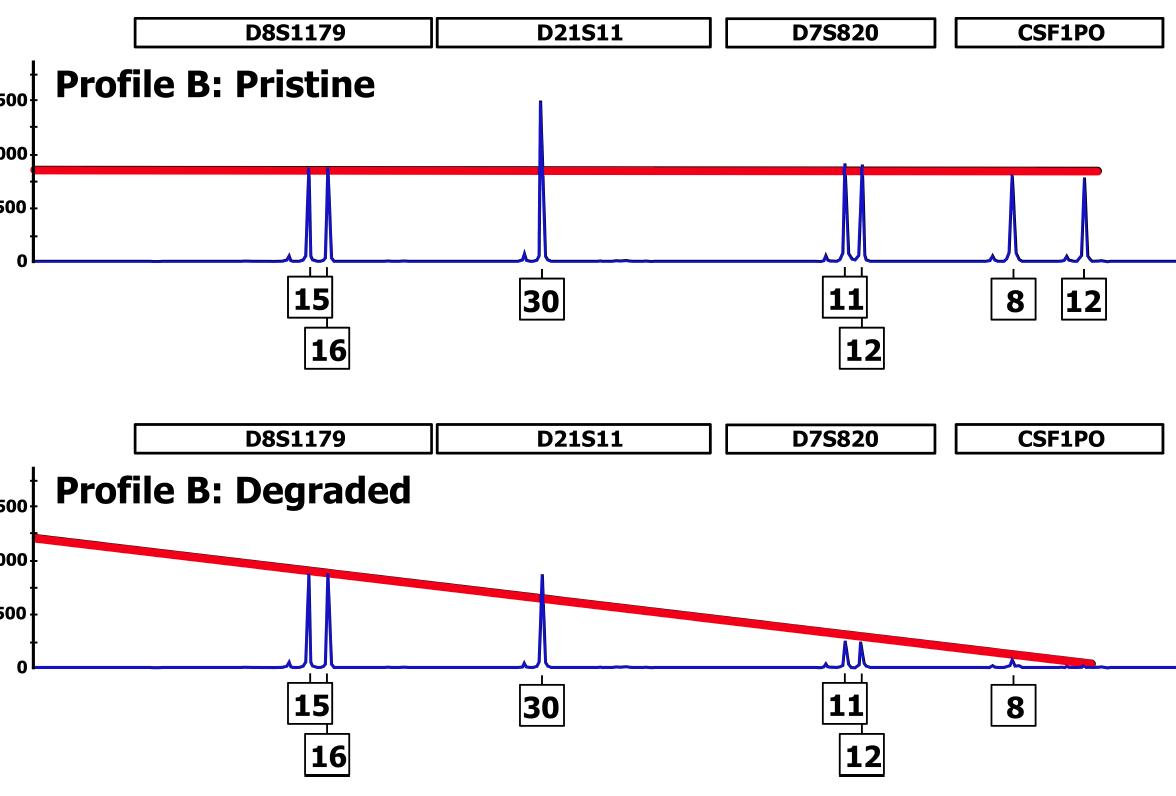
As samples age, DNA, like any chemical, begins to break down (or degrade). Degradation of DNA is a very unpredictable phenomenon. Under ideal circumstances, DNA molecules can persist unchanged for very long periods of time (e.g. the blood meals of insects trapped in amber for hundreds of thousands of years). But even brief exposure to unfavorable conditions such as warmth, moisture, and/or sunlight can (but sometimes not) result in significant loss of the largest DNA molecules within a sample. When degradation does occur, it skews the relationship between peak heights and the quantity of DNA present. Generally, degradation produces a downward slope across the electropherograms in the height of peaks because degradation is more likely to interfere with the amplification and detection of larger sequences of repeated DNA (the alleles on the right side of the electropherogram) than shorter sequences (alleles on the left side) of electropherograms. This process can occur rapidly when a sample is exposed for even a short time to unfavorable conditions, such as warmth, moisture, or sunlight. But degradation is not entirely predictable, and samples stored in cool, dark, dry environments can give rise to robust DNA profiles decades and even centuries after they have been created. As a result, it is not possible to reliably determine the age of a DNA sample based upon the extent to which DNA test results appear to be degraded.
Inhibition occurs when chemicals associated with an evidence sample interfere with the activity of the enzyme used to amplify DNA as part of the generation of a forensic DNA profile.
It is often difficult to determine if a sample is suffering from degradation, inhibition, or some combination of the two because degradation and inhibition both produce a downward slope from left to right on electropherograms in the height of peaks. In other words, they are more likely to interfere with longer sequences of repeated DNA (the alleles that show up on the right side of electropherograms) than shorter sequences (the alleles on the left side of electropherograms).
Commercially available quantitative real time PCR (qPCR) systems such as Promega’s PowerQuant System and ThermoFisher’s Quantifiler that are used to determine the amount of DNA in a sample contain primers that allow amplification of two different parts of the human genome – one short, and one long. The relative amounts of amplification product from the short and the long regions can be used to generate a degradation index (DI) because longer regions are more likely to exhibit signs of degradation than shorter regions. The inclusion of an internal PCR control (one that is more sensitive to inhibitors than the process that is used to amplify the short and the long regions) in these systems also allows a determination to be made regarding the extent to which chemical inhibitors are present in the sample.
Degraded/inhibited samples can be difficult to interpret in that the height of some peaks can be reduced to the point that they are too low to be distinguished reliably from background noise in the data while other peaks from the same source are still detected. In something of a worst case scenario, an individual who is a heterozygote (they have two different alleles at a tested locus) may appear to be a homozygote (they have only one allele at a tested locus because they inherited the same allele from both their mother and their father). It is also possible for the contributions of DNA to a mixed sample to exhibit different degrees of degradation either because some of the contributions have been associated with the sample for a longer period of time than the other or because of differences in the types of cells containing DNA (e.g. DNA in sperm cells is generally better protected from the environment than DNA in epithelial cells). Such possibilities make the interpretation of degraded mixed samples particularly prone to subjective (unscientific) interpretation.
Sub-optimal amounts of template quantity
The user guides for the commercially available test kits that are commonly used by crime laboratories performing DNA profile analyses (e.g., http://tools.thermofisher.com/content/sfs/manuals/cms_041201.pdf ) typically articulate a specific quantity of template DNA that should be used to generate optimum results. For instance, “The optimum amount of DNA for the Identifiler® Kit is 1.0 ng in a maximum input volume of 10 uL for 28 PCR cycles.” The quantities of DNA used to generate DNA profiles under the best of circumstances are much too small to be seen (even with a microscope) or to be weighed with a conventional scale. A newly minted US “Lincoln Penny” weighs 2.500 grams which is equivalent to 2,500 milligrams (mg), 2,500,000 micrograms (ug), 2,500,000,000 nanograms (ng), and 2,500,000,000,000 picograms (pg) such that the optimum amount of DNA for generating a DNA profile corresponds to less than a billionth of a US “Lincoln Penny.” It should be expected that a sample with low amounts of template DNA will exhibit stochastic effects (such as peak height imbalance,
allelic dropout, and exaggerated stutter) that make the interpretation of test results challenging.
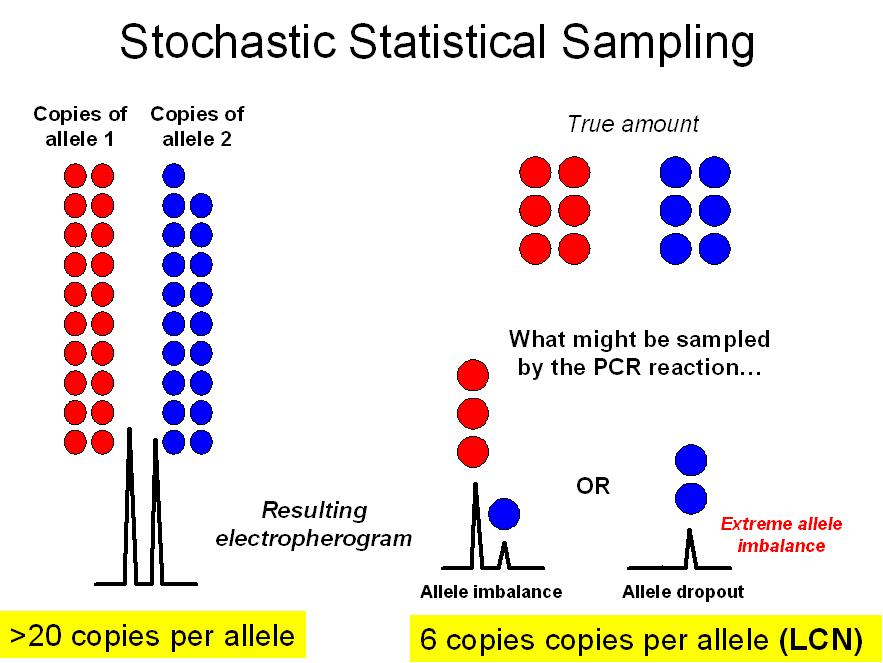
As long ago as 1992, Walsh et al. (“Preferential PCR amplification of alleles: Mechanisms and solutions.” PCR Meth. Appl. 1992 1:241 250) recognized that use of quantities of DNA below 1.0 ng (1,000 pg) starting amount could introduce a suite of problems for DNA profiling. “Stochastic” effects (sometimes also referred to as “preferential amplification”) are at the heart of the problems associated with small quantities of template. These stochastic effects essentially arise from sampling errors that can occur when very few samples are made (much like those that might happen when blindly drawing black and white beans from a bag – a small number of draws, but not a large number, might suggest that all the beans in the bag are black even though they account for only 50% of a large number of beans in the bag) (Figure 1). A single human cell contains approximately 6.5 pg of DNA. With starting quantities of DNA arising from fewer than 150 human cells (approx. 1,000 pg), it is possible that one of two alleles at a locus will be amplified by the PCR process more than its counterpart (resulting in peak height imbalance or even allelic drop out). It is also possible that stray alleles originating from just a few contaminating cells could be amplified preferentially, just by chance, relative to those that come from an evidence sample (resulting in allelic drop in). Another commonly observed stochastic effect associated with small amounts of starting DNA template is an increase in the prevalence of a technical artifact known as “stutter” (which occurs when the enzyme responsible for making copies of the STR regions either slips forward or back during the amplification process and makes a copy that is either one repeat unit shorter or longer, respectively, than what was present in the template DNA). Quite simply, if there is not enough starting quantity of DNA prior to the time the PCR is started, the PCR process can produce results that are inaccurate, unreliable, and very difficult to interpret.
PCR amplification. When more than 20 copies of an allele are being amplified at the start of a PCR amplification it is unlikely that sampling errors will result in a large difference in the number of copies that are made of two different alleles. Sampling errors are much more likely to occur when fewer copies of the alleles are present at the start of the process. Derived from a presentation by Dr. John Butler (United States’ National Institute of Standards and Technology, Office of Law Enforcement Standards) at the Midwestern Academy of Forensic Sciences annual meeting in Indianapolis, Indiana on October 11, 2006.
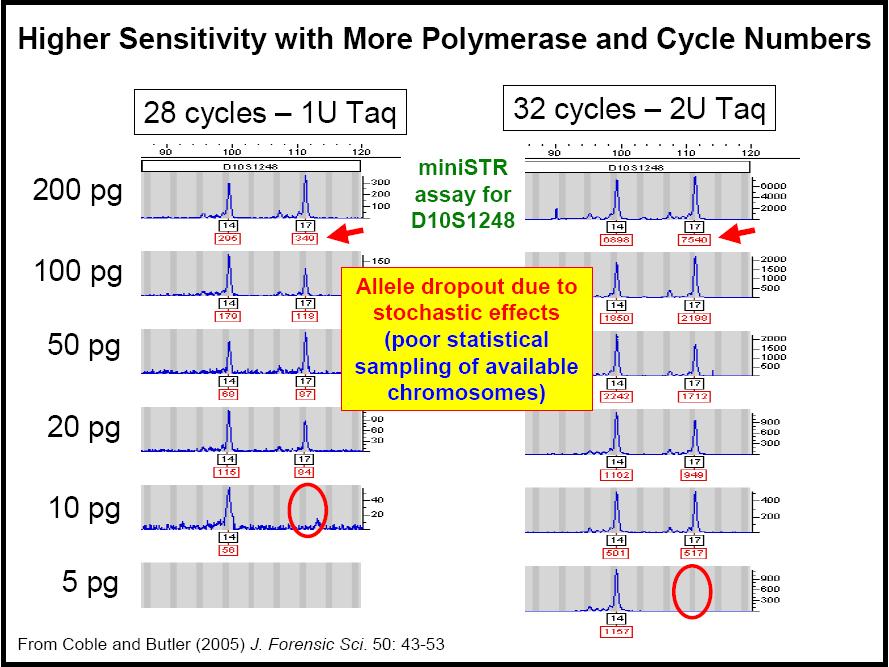
The propensity for stochastic effects in low template analyses is well documented in the scientific literature (i.e. Figure 2). Many have pointed to the problems associated with low template testing but Dr. Bruce Budowle, who while serving as the Chief of the Forensic Science Research Unit and as Senior Scientist in the Biology section of the Laboratory Division of the United States’ Federal Bureau of Investigation, summarized the issues succinctly when he said:
“Because of the successes encountered with STR typing, it was inevitable that some individuals would endeavor to type samples containing very minute amounts of DNA.…. When few copies of DNA template are present, stochastic amplification may occur, resulting in either a substantial imbalance of two alleles at a given heterozygous locus or allelic dropout.” (Budowle et al., Low copy number – consideration and caution. Proc. 12th International Symposium on Human Identification, 2001).
Figure 1. Stochastic statistical sampling during
Figure 2. Higher sensitivity with more enzyme and rounds of PCR amplification. Taken from Coble and Butler (2005), J. Forensic Sci. 50:43 53. Derived from a presentation by Dr. John Butler (United States’ National Institute of Standards and Technology, Office of Law Enforcement Standards) at the Midwestern Academy of Forensic Sciences annual meeting in Indianapolis, Indiana on October 11, 2006.
Dr. Budowle also points out that “Mixture analyses and confirmation of a mixture are not reliable with LCN typing, because of imbalance of heterozygote alleles, increased production of stutter products, and allele dropin can occur.”
Drop out and other stochastic effects (such as peak height imbalance, exaggerated stutter, and drop in) are more common in testing of samples that have less than the optimum amount of template DNA for a DNA profiling test kit. Drop out can make the contribution of a heterozygote at a locus appear to be a contribution from a homozygote. In such a circumstance a person who did contribute to a sample may not complain but an individual who did not contribute may lose the chance to show that someone else’s alleles (and not his) were present in a tested sample.
Number of contributors
Humans are diploid organisms, meaning we have two copies of all our genetic instructions, one from our mother and one from our father. At the polymorphic loci used for human identification, individuals will typically have either one (if their mother and father both give the same allele) or two (if their mother and father gave different alleles) alleles. The simplest explanation for a locus where three or four unique alleles are observed is to say that the tested sample was that of a mixture of at least two individuals. By the same token, the simplest explanation for a locus where five or six unique alleles are observed is that the tested sample was a mixture of at least three individuals. However, the process of determining the exact number of contributors to a sample is complicated by the fact that it is possible for individuals to have alleles in common. In short, the potential for individuals to have “overlapping” alleles can lead to an underestimate of the number of contributors to a sample. As a result, it is important to note that in this context “at least three individuals,” for instance, should not be taken to mean “three individuals” or even “most likely three individuals.”
The problem of determining the number of contributors to a mixed DNA sample becomes dramatically worse as the number of contributors to a mixture increases (Table 1). For instance, less than 3% of 2,118,760 conceptual five person mixtures generated from the genotypes of 50 individuals in the Caucasian NIST database had at least one locus of the 15 tested with the Identifiler® test kit where either nine or ten alleles would be detected – and almost 30% of these known five person mixtures would show no affirmative indication of more than three contributors. In simple terms, almost all five person mixtures would give rise to DNA profiles that would look as if they were from combinations of just three or four people's DNA.
Table 1. Allele count at the locus (or loci) across all 15 Identifiler® loci for which the
The possibility of allele sharing (such as that which occurs between closely related individuals) and the impact of allelic drop out on real world DNA samples only serve to exacerbate the problem illustrated in Table 1. Yet, widely used probabilistic genotyping approaches that attach statistical weights to complex DNA test results require analysts to specify a specific number of contributors to a sample for competing hypotheses to be evaluated and likelihood ratios to be generated. While it might be fair to characterize a sample as arising from a mixture of DNA from at least three contributors, an analyst must enter a specific number (e.g. “3”) at the start of probabilistic genotyping analyses. A study [Benschop CCG, Haned H, Jeurissen L, Gill P, Sijen T, The effect of varying the number of contributors on likelihood ratios for complex DNA mixtures, Forensic Sci. Int’l Genetics, Vol. 19 (2015)] suggests that underestimating the number of contributors to a mixture can cause likelihood ratio approaches to overestimate the significance of a failure to exclude an individual as a possible contributor to an evidence sample.
Despite widely cited papers that draw attention to this issue [e.g. Paoletti DR, Doom TE, Krane CM, Raymer ML, Krane DE. Empirical analysis of the STR profiles resulting from conceptual mixtures. J For Sci. 2005 50(6):1361; Buckleton JS; Curran JM; Gill P. Towards understanding the effect of uncertainty in the number of contributors to DNA stains. 2007 Forensic Sci Int Genet. (1)20 28; Coble MD, Bright JA, Buckleton JS, Curran JM. Uncertainty in the number of contributors in the proposed new CODIS set. 2015 Forensic Sci Int: Genet. 19:207 11], many analysts seem to be surprised at just how commonly “allele counting approaches” result in underestimates of the actual number of contributors to mixed DNA samples.
Supercharge your trial prep with VerdictHub System (VHS) A I -powered technology Get insights on whether your client’s case should be pled or tried and whether a jury is likely to assess probation or prison time.
Three Simple Steps:
In a recent federal criminal trial, we used VHS on our case and it predicted an 8–4 hung jury and that’s exactly how the case turned out
After decades in this profession, I don’t impress easily, but I was struck by how fast, affordable, and accurate this tool proved to be
The insights intrigued me and I came away inspired by the edge it can give criminal defense lawyers in trial preparation
Provenance
Even under the very best of circumstances, the presence of a DNA profile usually says nothing about the time frame or circumstances under which the DNA was transferred to an item. For instance, DNA profiles associated with evidence samples may have been deposited on objects months or even years prior to the objects being collected as part of an investigation. This problem is exacerbated by the inability to determine the tissue source of the biological material obtained from low level samples. Further, the chance of “innocent” or incidental DNA transfer greatly increases as the amount of starting material for DNA profiling tests becomes smaller. Quite simply, even if one’s DNA is found to be associated with an article of evidence, questions arise regarding both how and when that DNA was transferred.
Some scientists have proposed that a Bayesian network approach might be able to distinguish between primary and secondary transfer for trace DNA samples (Taylor et al, 2017; Taylor et al., 2019; Fonnelop et al., 2022). But this approach has not gained traction in US courts. Critics have been quick to point out that DNA in low quantities from a small number of cells can be more easily transferred from one article to another (e.g. from evidence sample, onto the analyst’s lab coat or gloves, then to another evidence sample; or by having been stored together in a single package; or by one individual shaking a second individual’s hand then transferring that second individual’s DNA to another object by handling it) – without the contributor having any knowledge that the transfer(s) has occurred. The large number of potentially important variables (including but not limited to: the abrasiveness of a surface, the moisture levels at time of contact, the duration and intensity of contact, and the varying propensity of individuals to transfer DNA) have made DNA transfer a difficult matter to study and have resulted in the publication of only preliminary investigations into this important area (as reviewed by Meakin, G. and Jamieson, A. 2013 DNA transfer: review and implications for casework. Forensic Sci Int Genet 4:434 43).
In short, no DNA tests are currently capable of distinguishing in any way between the presence of DNA due to contamination, secondary transfer, or direct contact between an individual and the object. A major contributor to a mixed DNA sample is not necessarily the person who encountered an object last or even most frequently.
Database (e.g. CODIS) searches
A “match” between the DNA profiles of two different samples means little without accompanying data on both the chance of coincidental matches and the possibility of false positives. DNA profiles that have been generated for forensic purposes are typically those that could be characterized as “probable cause matches” where DNA testing has been performed upon a reference sample taken from a suspect that has already been linked to a crime by direct or circumstantial evidence. Another category of DNA profile “matches” are those that are generated as a result of “cold hits” that result from the trawling of a large number of DNA profiles maintained in databases (usually those of previously convicted offenders). An emerging approach known as “genetic genealogy” offers an alternative source of investigative leads similar to “cold hits” but different in that the databases searched consist of profiles uploaded by non offenders primarily for the purpose of genealogical rather than criminal investigation.
Since the primary difference between “probable cause” and “cold hit” matches is the manner that a suspect is first identified, it is generally accepted that it is not possible to convert one type of case into the other (for instance, by simply retesting a reference sample once a “cold hit” has been identified). It has been broadly recognized for more than 30 years that the statistical significance of “cold hits” from offender databases and “probable cause” matches should be determined differently. However, there continue to be at least three different commonly held opinions on how the statistics associated with offender database “cold hits” should be generated and presented. Arguments that have been advanced regarding each of these three different opinions would apply equally to cold hits that arise through searches of offender databases (e.g. the FBI’s CODIS database) or genealogy databases.
The first group to address this issue was a body of experts appointed to the Committee on DNA Science by the National Research Council (NRC) in 1992. The position of this group is that database searches should be used to identify potential suspects but not to calculate frequency estimates. When successful, suspects identified by these searches would then be tested at a completely different group of independent genetic markers that would also be compared to the evidence. If these additional genetic loci also match between the suspect and evidence sample, they alone would be used to compute probabilities that reflect the significance of a match. With this approach the genetic markers used in the original database search are specifically and deliberately excluded from any statistical calculation.
This first proposed adjustment is impractical or perhaps impossible for database searches involving searches of genetic genealogy databases based upon single nucleotide polymorphisms (SNPs). The NRC recommendation requires the use of a second set of independent loci. However, the short tandem repeat (STR) loci that are scrutinized by commercially available test kits have been shown to be highly genetically linked to (i.e. not independent from) the SNP loci commonly used in genetic genealogy databases.1
A second committee of prominent experts advocated a significantly different approach in 1996. They specifically recommended that, “When the suspect is found by a search of DNA databases, the random match probability should be multiplied by N, the number of persons in the database.” (The Evaluation of Forensic DNA Evidence, 1996, National Research Council Press. P. 40, 161). Proponents of this approach feel that the first method is too conservative. Their alternative method differs in three ways: 1) no testing is performed at additional loci; 2) genetic markers used in the original database search are included in the statistical calculations: and 3) the size of the database being searched (N) is taken into consideration.
While the size of the genetic genealogy database being searched should be easily knowable, this adjustment has an implicit assumption that the N individuals in the database are unrelated. An assumption of un relatedness may be even less appropriate for a genetic genealogy database (whose existence is premised entirely on the ability to identify related individuals through searches of the database) than it is for an offender database (which are known to contain DNA profiles of related individuals; see: Paoletti et al. 2005, J. Forensic Sci. 50:1361 1366; Mueller 2008, J. Genet. 87:101 8).
A third group is comprised of individual scientists who have published peer reviewed manuscripts in which they argue that a “cold hit” should be given more weight than a match found in a “probable cause” case. Their position is based on the thinking that not only has the defendant been found to match the evidence, but many more individuals have been found to not match. In “probable cause” cases where only a single match is found during DNA testing, there is at least still a formal possibility that one or more untested people may also match the evidence that possibility becomes increasingly less likely as the database used for cold hits becomes larger. Proponents of this approach also feel that the first method is too conservative. Their method differs from it in three ways: 1) no testing is performed at additional loci; 2) genetic markers used in the original database search are included in the statistical calculations; and 3) the size of the database being searched (N) is taken into consideration. It also differs from the second in one very important way: the effect of the database size on the significance of a match is opposite large databases generate the most damning statistics for a defendant while, in the second approach, the larger the database the less damning the statistics become to a defendant. The second and third approaches are diametrically opposed with respect to implications of the size of the database that is searched.
The proponents of each of these three approaches include many eminent scholars in the field of genetics and statistics. For instance, the blue ribbon panel of experts that generated the first National Research Council on DNA typing report (which supports the first approach described above) includes Drs. Mary Claire King, Richard Lempert, Eric Lander, Ruth Macklin, Thomas Marr, Victor McKusic, and Philip Reilly. Members of the second National Research Council on DNA Typing (which recommends the second approach as described above) include prominent population geneticists and statisticians such as Drs. James Crow, Arno Motulsky, Thomas Nagylaki, Mashotoshi Nei, David Siegmund and Stephen Stigler. The third approach (described above) is one that has been principally advocated by very influential and often cited geneticists and statisticians such as Drs. David Balding, Peter Donnelly and Bruce Weir (as in publications such as: Errors and Misunderstandings in the Second NRC Report, D.1. Balding, Jurimetrics, Summer 1997, 37:469 476; Evaluating DNA Profile Evidence When the Suspect is Identified through a Database Search, D.J. Balding and P. Donnelly, Journal of Forensic Science, 1996, 41:603 607; and Interpreting DNA Evidence, I.W. Evett and B.S. Weir, Sinauer Press, 1998, pp. 219 222). This represents a genuine split between three fundamentally different approaches by experts who are significant both in number and in eminence within their fields and which, despite the decades since the emergence of the issue, has not yet been resolved for offender databases. Genetic genealogy databases, given their further complications, require additional considerations that have not yet been thoroughly explored by the relevant scientific community.
Validation of probabilistic genotyping systems
Probabilistic genotyping systems endeavor to aid human analysts in the interpretation of complex DNA mixtures. Testing laboratories use these complicated programs to attach statistical weights to results from evidence samples that cannot be confirmed by analysts using conventional statistical analyses like random match probability and the combined probability of inclusion/exclusion. Before relying on these systems in case work, it is essential that the software be subjected to rigorous internal validation that establishes the limits of their reliability. Complex mixtures encountered in casework often have attributes that make interpretation challenging, including low template
1 M. D. Edge, B. F. B. Algee Hewitt, T. J. Pemberton, J. Z. Li, and N. A. Rosenberg, “Linkage disequilibrium matches forensic genetic records to disjoint genomic marker sets,” Proc. Natl. Acad. Sci., vol. 114, no. 22, pp. 5671–5676, 2017.
levels, unknown/high number of contributors, high levels of allele sharing, differential degradation, and so forth. Each laboratory’s internal validation should critically evaluate its performance using the system on samples that mimic or exceed the complexity—with respect to these potential attributes, both individually and collectively—of those encountered in the laboratory’s casework. The results of carefully designed internal validation experiments must not only demonstrate a system’s utility but also clearly establish and articulate the limits of reliability for use in casework.
Because probabilistic genotyping systems: (1) purport to resolve DNA mixtures of such complexity that they exceed the bounds of human ability to interpret, and (2) will attempt to deconvolve any DNA data presented to them, it is particularly important for forensic DNA analysts to understand the limitations of these systems so that they are not used beyond the bounds of their reliability in casework2. Validation testing—the process of “push[ing] the system until it fails in order to understand the potential limitations—to define the scope of method (and interpretation) reliability”— plays a fundamentally important role in establishing and informing analysts of these boundaries3. While validation is necessary across the sciences, its importance to forensics, where the consequence of an errant interpretation may be measured in human lives, is undeniable4
Validation in forensics generally falls into one of two categories: developmental and internal. It is important to recognize the distinction between the two because one cannot serve as a substitute for the other. Developmental validation is testing, usually conducted by the developer of a technique or approach, to ensure that the system is practically useful and that it functions as expected. It should be informed by the developer’s understanding of the limitations associated with the algorithms it is implementing. However, it should not be presumed that a tool or system works the same in the hands of its developer as it does for an analyst working in a different laboratory environment5. Instead, a testing laboratory’s internal validation must confirm that the system yields reliable results from data generated by the laboratory using its own procedures, reagents, instrumentation, and personnel.
Internal validation is “an opportunity for the user (e.g., DNA analyst) to understand performance of a method in their forensic laboratory environment rather than trusting the provider’s (e.g., the software developer) claim that everything works fine”4. It is conducted by a practitioner or laboratory that intends to use the system in casework, serves both to verify that the system works as intended in their hands and to establish the limitations of the system within that laboratory, and must be done using samples that mimic those encountered in the laboratory’s casework6. Unlike developmental validation, internal validation is not transferable from one laboratory to another7. This should not be surprising, given that laboratory specific parameters and limitations established during internal validation serve as the foundation for each laboratory’s standard operating procedures and interpretation guidelines for use by its own personnel with its own facilities8. At the same time, laboratories are limited by the bounds of the system’s developmental validation as they design their internal validation: any conditions tested during internal validation that exceed the scope of developmental validation necessitate further developmental validation studies before they can be used to expand a laboratory’s validated range.
Software engineering standards and probabilistic genotyping
Software based probabilistic genotyping (PG) approaches are necessarily rooted in collaboration between experts in the areas of molecular biology, population genetics, statistics, forensic science, computer science, and software engineering. While it is important to consider the perspectives of all these disciplines when assessing the reliability of a PG system, the perspectives of software engineers might be especially important. Decades of experience with software failures have
2 Kelly H, Bright J A, Buckleton JS et al (2014) A comparison of statistical models for the analysis of complex forensic DNA profiles. Science & Justice 54:66–70
3 Butler JM (2014) Validation Overview. Presented at the NIST DNA Analysis Webinar Series: Validation Concepts and Resources – Part 1, Online, 6 Aug 2014
4 OSAC Human Factors Committee (2020) Human Factors in Validation and Performance
Testing of Forensic Science. NIST OSAC for Forensic Science. https://www.nist.gov/ system/files/documents/2020/05/22/OSACTechSeriesPub_HF%20in%20Validation%20 and%20Performance%20Testing%20of%20Forensic%20Science_March2020.pdf.
Accessed 12 Jun 2021
5 Butler JM, Iyer H, Press R, et al (2021) DNA Mixture Interpretation: A NIST Scientific Foundation Review. NIST. https://nvlpubs.nist.gov/nistpubs/ir/2021/NIST.IR.8351 draft. pdf. [DRAFT] Accessed 12 Jun 2021
6 Scientific Working Group on DNA Analysis Methods (SWGDAM) (2015) Guidelines for the Validation of Probabilistic Genotyping Systems. SWGDAM. https://1ecb9588 ea6f 4feb 971a 73265dbf079c.filesusr.com/ugd/4344b0_22776006b67c4a32a5ffc04fe3b56515.pdf. Accessed 12 Jun 2021
7 Butler JM (2012) REVIEW OF URBAN LEGENDS. In: Advanced topics in forensic DNA typing: methodology. Elsevier/Academic Press, Walthan, MA, p 190
8 Butler JM, Iyer H, Press R, et al (2021) DNA Mixture Interpretation: A NIST Scientific Foundation Review. NIST. https://nvlpubs.nist.gov/nistpubs/ir/2021/NIST.IR.8351 draft. pdf. [DRAFT] Accessed 12 Jun 2021
led to established practices (such as those promoted by the Institute of Electrical and Electronics Engineers, IEEE) for what is commonly known as verification and validation (V&V) of software.
In the world of software engineering, verification, and validation entail “evaluating a system or component during or at the end of the development process to determine whether it satisfied specified requirements” (IEEE, 2012). IEEE Standard 1012 2012, IEEE Standard for System and Software Verification and Validation (IEEE, 2012) spells out universally applicable and broadly accepted software V&V standards. It requires that each software component be assigned an integrity level that increases from 1 to 4 depending on the consequences of failure. Consequences are categorized as “negligible,” “minor,” “critical” (causing “major and permanent injury, partial loss of mission, major system damage, or major financial or social loss”) or “catastrophic” (causing “loss of human life, complete mission failure, loss of system security and safety, or extensive financial or social loss”). As the “criticality” of software increases across these integrity levels, the intensity and rigor of the V&V tasks required by the standards also increase. It is generally agreed (including by the developers of PG software) that a PG system used to generate evidence in criminal cases should be assigned a very high integrity level.
The most critical software also requires the greatest degree of independence of those performing V&V. IEEE Standard 1012 2012 describes three dimensions of independence of the V&V process: 1) managerial (e.g. the work is done by an organization that is separate from the that of the developer), 2) technical (e.g. the work is done be personnel who were not involved with the development of the software), and 3) financial (e.g. the V&V budget is controlled by an organization different than the organization that developed the software – typically amounting to 10 to 50% of the overall cost for the development of the software).
Software engineers are drawing attention to the current lack of adherence to IEEE Standards in the development of PG software (Abebe et al, 2022). They recognize structural and institutional challenges within the US criminal justice system that may create barriers to adequate V&V of PG software and discuss policy changes that could help address these concerns.
Understanding likelihood ratios
Probabilistic genotyping systems generate a likelihood ratio as their output. In his 2005 text Forensic DNA Typing, John Butler states, “A likelihood ratio is a ratio of two probabilities of the same evidence under different hypotheses.” It is important to note that the probabilities calculated here are probabilities of the evidence as explained by two competing hypotheses, not the probability or likelihood that either hypothesis is true.
Ian Evett, in his article “Avoiding the Transposed Conditional” clarifies, “Forensic scientists can state the probability of the evidence that has been found, given various hypotheses.” [Science & Justice, Vol. 35 No. 2, 1995].
The hypotheses commonly considered by crime laboratories are:
Hp (or H1): the sample from an evidence sample originated from a defendant and two unknown, unrelated persons.
Hd (or H2): the sample from an evidence sample originated from three unknown, unrelated persons.
Correct phrasing of the likelihood ratio for the comparison of the reference profile of a defendant to an evidence sample would be:
The DNA mixture found on the evidence sample is 1,000,000 times more probable if the sample originated from the defendant and two unknown, unrelated persons than if it originated from three unknown, unrelated persons.
Evett proceeds to describe the fallacy of the transposed conditional, “To state the probability of a hypothesis given the evidence requires a prior probability or odds which may not be within the scientist’s domain. The scientist is most likely to attract criticism when the hypothesis relates directly to the issue of whether the defendant can be connected with a particular feature of an incident.”
An analyst commits the fallacy of transposing the conditional when she says in her testimony from an actual trail that “The likelihood ratio is looking at how likely or probable it is that the mixture in an evidence sample came from the suspect and two unknown persons versus that that mixture came from three other unknown unrelated persons.”
Jurors (and judges) are charged with answering what is called “the ultimate question” – is a defendant guilty or not guilty. In that context it is natural, but incorrect, for them to think that a probabilistic genotyping likelihood ratio translates directly into the chance that a defendant is innocent. In a recent report (GAO 24 107206; https://www.gao.gov/products/gao 24 107206 ), the US Government Accountability Office concludes that one of the two biggest problems associated with probabilistic genotyping is the difficulty associated with conveying the correct meaning of a likelihood ratio to a jury (the other problem pertains to inadequate validation).
Serology
In a forensic setting, serology refers to analyses of the proteins associated with an evidence sample. It can also involve microscopic determination if sperm cells are present in a sample. It is important to bear in mind that serological tests are independent of DNA profiling tests – it is possible for a stain to test positive for the presence of blood yet for DNA associated with the same stain to have originated from someone other than the source of the blood (e.g. one person’s saliva could give rise to a DNA profile in a sample that also contains blood that came from another source like a cow, a pig, or a chicken).
Protein based serological tests in forensic settings are typically only used to determine the presence or absence of blood and seminal fluid (and, less commonly today than in the past, saliva). Most forensic serology tests are characterized as either being presumptive (typically inexpensive and sensitive but also prone to false positives) or confirmatory (often requiring greater technical expertise and more costly reagents but less prone to false positive results). Protein based serological tests are typically consumptive – they destroy the portion of a sample that they test and make it unsuitable for any subsequent analyses.
One commonly used test for the presence of blood is orthotolidine. Orthotolidine is a very sensitive presumptive test (blood can be detected to dilutions of about 1 in 100,000) but it is subject to interference from a wide variety of substances (e.g. catalase and peroxidases which can occur in both plant and animal materials, oxidizing chemicals, and metals such as copper and iron) and is therefore not specific for blood. If test results are positive, then blood (though not necessarily human blood) may or may not be present – a positive orthotolidine test does not necessarily mean that a sample is derived in whole or in part from human blood. In contrast, a negative orthotolidine result can be reasonably interpreted to mean that blood is absent (and that more expensive confirmatory tests would give the same result). Presumptive
tests for blood like orthotolidine (and luminol and phenolphthalein) are often used as screening tests and only positive samples are then subjected to confirmatory tests.
Resources:
Cale, C., et al. Forensic DNA evidence is not infallible. Nature.com; 2015:526:611.
Cale, C., et. al. Could Secondary DNA Transfer Falsely Place Someone at the Scene of a Crime. J. Forensic Sci., 2016;61:196 203.
Van Oorschot, et al. DNA transfer in forensic science: A review. Forensic Sci Int Genet, 2019;38:140 166.
Meakin G, Jamieson A. DNA transfer: review and implications for case work. Forensic Sci Int Genet, 2013;7:434 443.
Erin Murphy. Inside the Cell, 2015;29 47. Nation Books, New York. Fonnelop, AE, et al., Who packed the drugs? Application of Bayesian networks to address questions of DNA transfer, persistence, and recovery from plastic bags and tape. Genes 2022;13:18.
Taylor, D., et al. Using Bayesian networks to track DNA movement through complex transfer scenarios. Foren. Sci. International: Genetics, 2019;42:69 80.
Taylor, D., et al. Helping to distinguish primary from secondary transfer events for trace DNA. Foren. Sci. International: Genetics, 2017;28:155 177.
Rediet Abebe, Moritz Hardt, Angela Jin, John Miller, Ludwig Schmidt, and Rebecca Wexler. 2022. Adversarial Scrutiny of Evidentiary Statistical Software. In 2022 ACM Conference on Fairness, Accountability, and Transparency (FAccT ‘22), June 21–24, 2022, Seoul, Republic of Korea. ACM, New York, NY, USA 14 Pages. https://doi.org/10.1145/3531146.3533228
Dan E. Krane is a Professor in the Department of Biological Sciences and the Department of Computer Science at Wright State University in Dayton, OH. He graduated with a Bachelor’s degree with a double major in Biology and Chemistry from John Carroll University and a Ph.D. in Biochemistry from the Cell and Molecular Biology Department at the Pennsylvania State University followed by postdoctoral studies at Washington University’s Medical School and at Harvard University. He has published over fifty peer-reviewed papers in the areas of population genetics and molecular evolution and is the lead author of the best-selling undergraduate textbook in the field of bioinformatics (“Fundamental Concepts in Bioinformatics”). Many of his publications are directly related to forensic DNA testing, particularly in the areas of using DNA profiles to generate investigative leads (i.e. familial searching) and increasing the objectivity and sensitivity of current DNA typing methodologies. He has testified in more than 135 criminal cases since 1991 in the areas of population genetics, molecular biology and bioinformatics and served as a member of a Government Accountability Office panel on Forensic Algorithms. Krane is also the president and a co-founder of Forensic Bioinformatic Services, Inc. (www.bioforensics.com) where he has overseen the development and implementation of software designed to automatically and objectively review DNA testing results.
Welcome New TCDLA Members!
March 16, 2026 - April 15, 2026
Regular Members
AJeremiah Alvarez - Corpus Christi
Endorsed by Mario Olivarez
Hope DeLap - Austin
Endorsed by Ben Wolff
Jackson Downs - Austin
Endorsed by Angelica Cogliano
Scott Edmonds - Cleburne
Endorsed by Christine Maziurek
David Garcia - San Antonio
Endorsed by Knox Jones
Derek Israel - Austin
Endorsed by Amber Wagner
Kevin Laine - Beaumont
Reilly McAfee - Dallas
Endorsed by Brent Cahill
Holly Taylor - Austin
Endorsed by Michael Falkenberg
Public Defender Members
Charles Breaux - Abilene
Endorsed by Jenna Martin
Christina Cheek - Humble
Endorsed by Lori Gooch
Betsy Clark - Amarillo
Endorsed by Jason Howell
Lauryn Coleman - Austin
Endorsed by Ben Wolff
Seantyel Hardy - Austin
Endorsed by Ben Wolff
Madison Livingston - Dallas
Endorsed by Charles Vaughn
Dina Martinez - Dallas
Endorsed by Imani Lee
Nikita Srivastava - San Antonio
Endorsed by Sesenu Woldemariam
Rozita Woodruff - San Angelo
Endorsed by Lauren McCollum
Affiliate Members
James Crosnoe - Austin
Endorsed by Benjamin Wolff
Katherine Manning - Austin
Endorsed by Benjamin Wolff
Brandi Nelson - Austin
Endorsed by Ben Wolff
Ifechi Ugwu - Austin
Endorsed by Ben Wolff
Astrid Villarreal - Austin
Endorsed by Ben Wolff
Willis Weist - Austin
Endorsed by Ben Wolff
Investigator Members
Brandon Brucia - Nacogdoches
Endorsed by Dean Watts
Ramon Hernandez - Houston
Endorsed by Amanda Downing
Steven Spencer - Rockdale
Endorsed by Laurence A. Dunne, III
Paralegal Members
Vale McCaffrey - Austin
Endorsed by Benjamin Wolff
Student Members
Landon Adams - Houston
Endorsed by Lance Evans
Arjelio Garza - San Antonio
Endorsed by Stephanie Stevens
Jaylan Grey - Pleasanton
Endorsed by Neil Calfas
Elizabeth Larcenaire - Tyler
Endorsed by Jeremy Kyle Rosenstein
Caleb Smith - Dallas
Endorsed by Eric Smenner
Ten Grand Jury Practice Tips
JEREMY ROSENTHAL
Member of the Legislative Committee
The grand jury seems like a mystical, mysterious animal that is difficult to understand. Unless you were a prosecutor working directly with the grand jury before you defended people then you really don’t know its day to day operations. Understanding the grand jury is like peeking behind the Wizard of Oz’s curtain — many defense lawyers avoid it, but these secret proceedings offer significant value to the defense. At its core, the grand jury is really a safeguard. Consider – a prosecutor is granted certain powers and one of the greatest powers they have is to decide to charge someone with a misdemeanor offense by information.1 But only the citizens of the State of Texas have the power to indict another person with a felony.2
Grand juries can and do tell prosecutors “no” on cases – but effective grand jury practice takes skill to get great results for your client. Dismissals, not guilty verdicts, and reduced charges are fun – but refusals, no bills and grand jury reductions are just as fun and are just as attainable.
The Legal Nuts and Bolts:
Constitutional & Statutory
Basis
• Texas Constitution, Article I, Section 10: Guarantees indictment by a grand jury for felony offenses (unless waived in certain circumstances).
• Texas Code of Criminal Procedure, Chapter 19A: Governs how grand juries are selected, organized, and how they operate.
• Texas Code of Criminal Procedure, Chapter 20A: Governs how grand juries operate and conduct their proceedings.
Composition & Selection
• Size: 12 jurors, with up to 4 alternates.3
• Selection Process: Jurors are summoned from a pool in the county, similar to petit jurors. They must meet eligibility requirements (citizenship, residency, etc.).4
• Foreperson: Appointed by the judge to preside over proceedings.5
Proceedings
• Secrecy: Proceedings are secret. Jurors and prosecutors cannot disclose what occurs, except as authorized by law.6
• Presence in the Room:
• Prosecutor (District Attorney or Assistant DA).
1 Tex. Code Crim. Proc. art. 21.20
2 Texas Constitution, Article I, Section 10
3 Tex. Code Crim. Proc. art.
• Witness under examination.
• Court reporter (to record testimony, but transcript remains sealed).
• Interpreters if needed.
• No defense attorney inside the room (though witnesses may step out to consult counsel).
• Quorum: 9 grand jurors constitute a quorum.7
• Voting: 9 grand juror votes are required for a “true bill.”8
Additional Grand Jury Powers
• Investigative Authority: Can compel testimony and documents via subpoena.9
• Questioning Witnesses: Witnesses are sworn in and questioned directly by prosecutors and sometimes jurors.
Rights of the Accused
• Notice: A suspect typically does not get notice before presentation.
• Invitation to Testify: Prosecutors sometimes invite a target/ defendant to testify. If so, the defendant may appear with limited rights and is entitled to have their attorney present outside the jury room.
• Transcripts and Court Reporters: Court reporters are typically not allowed in Grand Jury but must record Defendant’s testimony if and when the accused testifies. The testimony cannot be released publicly unless there is a “particularized need” or it is otherwise authorized by law.10 It is important to note your client’s grand jury transcript may be used to impeach during trial.
Key Texas Cases & Principles
• Costello v. United States, 350 U.S. 359 (1956): Hearsay evidence may support an indictment.
• McManus v. State, 591 S.W.2d 505 (Tex. Crim. App. 1979): Texas courts generally will not second guess sufficiency of evidence behind an indictment.
• CCP art. 20.02: Secrecy provisions; violation can be punished as contempt.
Challenging the Grand Jury
• Texas Code of Criminal Procedure art. 19.27–19.29 and art. 27.03 allow objections to:
• The array (composition) of the grand jury.
• The manner of selection of grand jurors.
• The qualifications of an individual grand juror who participated in returning the indictment.
• Pre-indictment:
• A defendant who knows a specific person is about to be on the grand jury can challenge for cause (e.g., lack of qualification or bias) under arts. 19.27–19.29.
• Post-indictment (After Being Charged):
• An indictment may be set aside “when the grand jury was illegally impaneled,” or a particular grand juror was disqualified.
• Failing to raise the issue before trial waives most defects (Tex. Code Crim. Proc. art. 1.14(b)).
• Grounds for Challenge:
• A. Array (Whole Panel)
• Improper selection method—e.g., not following Tex. Code Crim. Proc. arts. 19.01–19.23 for random selection or jury commissioner method.
• Systematic exclusion or discrimination—e.g., based on race, gender, or other protected class (Castaneda v. Partida, 430 U.S. 482 (1977); Brooks v. State, 826 S.W.2d 141 (Tex. Crim. App. 1992)).
• B. Individual Juror
• Lacks a qualification under art. 19.08 (e.g., not a resident, under indictment or convicted of theft or a felony, cannot read/write).
• Has a bias or prejudice against the accused.
• Procedure to Challenge:
• Motion to Quash or Set Aside Indictment under art. 27.03.
• Affidavit or Proof: Must allege specific facts—conclusory statements are insufficient (DeBlanc v. State, 799 S.W.2d 701 (Tex. Crim. App. 1990)).
• Hearing: Court may take evidence on how the grand jury was selected or whether a juror was disqualified.
• Remedy: If granted, the indictment is dismissed without prejudice—the State can seek a new indictment from a properly impaneled grand jury.
Getting a Grand Jury No-Bill
The grand jury is a great place to kill a bad case. The main reason is due to the secret nature of grand jury proceedings and how it assists prosecutors in dealing with public pressure. Consider the dynamics of prosecuting felonies – particularly ones with complaining witnesses or where advocacy groups keep a watchful eye on your district attorney’s office.
Put yourselves in your prosecutors’ shoes for a minute. You’re instructed to keep ‘victims’ happy including hearing them out, holding their hand, and ‘giving them justice.’ You’d love to get promoted at your office – but you really don’t want to get in trouble, nor do you want to make a decision which lands your boss on the cover of the local newspaper.
We love to criticize prosecutors, but they’ve got a difficult balancing act between satisfying accusers, navigating their own bureaucracy, and doing what they believe to be in the best interests of justice. Those priorities are often aligned but they frequently compete with one another.
Great prosecutors can tell someone who insists they are a victim that there’s no legal case against the accused. Unfortunately,
many prosecutors simply don’t have that ability. This is where the secrecy of the grand jury helps.
Grand juries are an independent body, and the fact is they can have a collective “mind” of their own. There are probably plenty of situations where grand jurors will no bill a case without a prosecutor’s recommendation and the reverse is certainly true. More importantly – the fact a grand jury is independent gives the prosecutor the ability to deflect responsibility for a case getting no billed. The fact the grand jury is secret by law further allows the prosecutor more freedom and distance from an accuser, their administration, or even groups like the media or advocacy groups.
In other words, your prosecutor can rightfully blame the grand jury or simply hide behind the grand jury’s secrecy when an accuser or the accuser’s family gets upset over a no bill. This makes the grand jury the perfect place for your prosecutor to do what is in the best interests of justice when pressured to do otherwise.
Tip No. 1: Convince Your Prosecutor
The bottom line to getting a no bill is simple. Convince the prosecutor and you convince the grand jury.
We all like to think we’re King Midas with a golden touch in our advocacy — and some of us might be. But no matter how strong your packet is, it won’t be so brilliant that a prosecutor can ignore it while still losing a meaningful number of grand jurors to your side.
Grand jurors aren’t lawyers. Some haven’t even been on the grand jury very long. They will virtually always default to and take guidance from the lawyer in the room. Even if your prosecutor doesn’t take a position, you can bet the grand juror is taking even the most subtle verbal and non verbal cues from the prosecutor on how to feel about a case.
You need your prosecutor to give the case a big “thumbs down” if they’re willing to do it.
This doesn’t mean you can completely abdicate doing a great grand jury packet or presentation. But your odds are far better if you sell the prosecutor along with a strong packet.
Place enough resources into developing a ‘sales pitch’ for your prosecutor as to why a case should be no billed or reduced. Never leave a grand jury packet at the front desk – give it to the prosecutor in person along with your elevator pitch as to why this case ought to go in the trash.
Tip No. 2 – Grab the Reader’s Attention with Your Packet
Now isn’t the time to write like Shakespeare or Learned Hand. Now is the time to put your twitter/ insta/ Facebook skills to the test and hook your audience – fast! In bigger counties your grand jurors are reviewing upwards of 40 or 50 cases per day in session. That means they’re thoroughly beaten down before their first coffee break with state jail dope cases or gas station robberies caught on video.
When you hit the grand jury with the first sentence which talks about an ex wife’s revenge, a baby getting conceived in the back seat of a car, or a teenager who flipped the script by turning her consensual fling with her boyfriend into sex assault once her dad found out – then you’re going to get your grand jury to keep reading.
You are competing with 40 other cases for your grand juror’s attention. You must win that fight 21st century style.
Tip No. 3 -- “Tell me How You’re Going to Kick My Ass”
These are the words of a prosecutor who spoke to a defense
bar group several years ago about tips and tricks when dealing with the grand jury.
Your prosecutors don’t want to dump crappy cases on other people in their office. If you’re going to cream them in court – let them know in the most emphatic terms possible. Make it clear in cases with complainants that your client won’t be laying down if the case gets indicted and it’s better for the system to render a “mercy kill” now than to expose the ‘victim’ to even more grief and misery in trial.
Good prosecutors don’t want to hand loser cases to their office mates. Tell them how you’re going to kick their ass. Your prosecutor needs to hear how bad the case is.
Tip No. 4 – Be Careful with your Language
Even though grand jury proceedings are confidential – your packet is not. If you provide affidavits to the prosecutor from witnesses on behalf of your client, then those can boomerang at you later in trial.
You can usually hedge your bets with arguments to the grand jury by being very selective with your language. Instead of having your client admit to conduct in a case where identity might be hard to prove up later in court – consider using language like, “even if we were to concede for argument's sake he was the person with the weapon – he still only pointed it at the ground.”
Be careful not to concede unnecessary facts and remember that it’s always going to be safer for your clients when it’s your words and not theirs in the packet. I’m not a big fan of submitting affidavits on behalf of your client to the grand jury. Those can boomerang against your client at trial.
Tip No. 5 -- You Need an Emotional Hook
A good grand jury presentation has two main ingredients. A legal hook and an emotional hook.
Prosecutors and grand jurors like knowing everything.
They might occasionally over rule police and tell them an arrest was bad or that a case is simply no good – but it’s much easier to convince them your client is deserving of mercy, leniency or grace rather than your client is innocent. Your client might be both – but understand ultimately the grand jury will want to no bill a case out of mercy instead of innocence.
Make it clear when you can that your client has a clean record. Let the grand jury know your client makes a difference in people’s lives, and that he or she is a good person having a rough time for whatever reason.
Asking for leniency doesn’t mean you have to apologize and admit guilt either. But it’s really hard to get a no bill on cases where you don’t emotionally convince the grand jury that a no bill is simply the kind, just, and right choice.
Tip No. 6 – When
Should You Make Your Client Available to Testify?
This decision goes hand in hand with your emotional hook. What your client has to say is normally less important than having the grand jury make other observations about them. Are they a pip squeak charged with assaulting someone three times their size? Are they an emotional wreck over what happened? Are they sincere and can they own up to their conduct? These are the main reasons to recommend having your client testify to the grand jury.
Remember grand jury testimony is on the record. Explaining your way out of a situation or trying to charm the grand jury is typically a mistake.
Don’t be afraid to ask the prosecutor what they think if you’re up in the air. If you get a non committal “it’s your choice” or “do what you want” then you know your prosecutor will recommend indicting even if your client testifies. But you can tell by your prosecutor’s response if your client’s appearance will ‘move the needle.’ Sometimes, just offering to testify is enough to get the
Tip No. 7 – You Need a Legal Hook
Along with an emotional hook you always need to show the grand jury the law is on your side. An emotional hook with no legal reason for a no bill is begging. Begging and groveling is not a legal strategy.
Remember grand jurors are deferential to lawyers – and that includes you. They won’t give you the credibility the prosecutor gets but if you can cite chapter and verse of the penal code, the code of criminal procedure, or how case law says you win – then you at least plant seeds for a no bill.
Don’t be afraid to lay out the elements of the case and show where the case is defective and which element is missing or would be difficult to prove. Even if your request for a no bill is 100% sympathy or mitigation based – give the grand jury a touch of law to chew on.
Tip No. 8 - Make it Like a Newspaper (Especially Letters of Recommendation!)
Newspapers, magazines and web pages know how to grab a reader’s attention. They include elements like pictures, captions, and bullet points that immediately catch the reader's eye before anything else.
Try to have some type of graphic or picture on the upper half of the top page of your packet. It might be a picture of body camera where your client looks shaken, a picture of mishandled evidence, or even just a picture of your client with their family. Almost any newspaper you see has an image “above the fold” on page one. Don’t re think centuries of what works to grab attention.
Do you think a grand juror is going to read two or three recommendation letters you provide at the end of your packet? No way! First off – grandma, grandpa or the volleyball coach is probably a terrible writer and has buried the best part of your client’s character in paragraph 5 – and the grand jury will simply never get there. Also, grandma, grandpa, or the volleyball coach are nameless and faceless two dimensional people who mean nothing to the grand jury unless they can be shown more.
Here’s a great format for taking the strongest quotes from referral letters and giving them real meaning and context:
Tip No. 9 – Write Concisely
Write concisely and write in the active voice. What is the active voice? It’s a sentence where the subject performs the action of the verb. “Robert Hill designed the Washington Monument” is active voice and “The Washington Monument was designed by Robert Hill” is passive. Again – you’ve got your reader for a very short time and reading paragraphs in the passive voice makes readers' want to quit.
Read your work aloud before you submit it. They taught us in law school to use windy and topsy turvy run on sentences, but you’ve got to keep your writing with grand jurors at a very basic level.
Tip No. 10 – Keep Your Powder Dry for Trial
Are you going to lay all your cards out on the table in the hopes for a no bill or a reduction? That’s a gamble for sure. We don’t get many advantages defending cases but one of them is the element of surprise at trial. A strategic question you must answer is whether you save your magic bullet or smoking gun evidence for trial in front of the jury or do you reveal it to the grand jury in the hopes of a no bill?
After giving the prosecution fits and nightmares in trial –perhaps your prosecutor has turned to you and said something to the effect of, “Why didn’t you tell me these facts before, and we could have worked something out?”
The real answer is, “You’ve been making fun of my client in the docket room every time we come to court. You wouldn’t have believed anything.”
You might consider again how your prosecutor feels about the case. If you think nothing will convince your prosecutor your client is innocent – even the smoking gun evidence – then you might consider clobbering them with it at trial.
Bonus Tip – Some Cases Just Can’t Be No-Billed
If you’ve had success with getting no bills or reductions for felony drug possession cases, identity theft, credit card abuse, or child pornography charges then congratulations. Most cases which involve some types of possession are extremely hard to get a grand jury to throw out. Know what cases are worth the fight and know what cases you can either get a no bill or get your case chopped in half.
Jeremy Rosenthal is Certified
in Criminal Law by the Texas Board of Legal Specialization, is a Texas Top 100 Super Lawyer per Thomson Reuters, an inductee into the Curt Henderson Inn of Court, and has a nasty slice because he refuses to square his writs through impact.
The Presumption of Distrust
KAYLA STALEY
TCDLA Board Member
When I left the District Attorney’s Office and began representing the accused, I knew there would be a sharp learning curve. I knew there would be many things that I did not have to know while representing the Government that I would need to know to represent the accused. A lot of it is taught in CLEs: “How to Argue for a Bond Reduction for your Habitual Client,” and “How to Craft a Perfect Closing Argument.” Even still, some things cannot really be taught, only learned through experience. The interpersonal lessons that must be learned by anyone who represents the accused become trickier when dealing with the indigent person accused.
Why Indigent Clients Do Not Trust Defense Counsel
We all know the feeling of nailing a consult, being certain that the prospective client is going to hire you, and then they call with the down payment and retain you as their advocate. Even for the seasoned lawyer who has been practicing for twenty years, it’s always a good feeling, and a good reminder: people trust me to defend them. When dealing with indigent clients, that feeling is not there, and it’s not there on either side. On one hand, we know that the client did not choose us as their attorney; and in fact, at various stages of their case, they may want to choose anyone but us. On the other hand, they know that they have been given some “public pretender” who is going to come in and assist the prosecutor in walking them to prison. They did not choose you, they don’t know you from Adam, and they certainly don’t trust you. While defense attorneys, even State public defenders, separate themselves from the Government that works so hard to convict them and put them behind bars, our indigent clients see us as what Ronald Reagan warned against, “[t]he most terrifying words in the English language are, ‘I’m from the government and I’m here to help.”
These individuals are aware of the systemic problems with indigent defense, and excluding any opinion they may have formed of you as an attorney or the quality of your representation, they have likely had their distrust reaffirmed by previous experiences with the court system, public defense, probation, prison, and law enforcement. They are aware of the fact that most attorneys who represent indigent people have soul crushing caseloads, and they are quick to form a belief that their case is just another in the pile. It may sit on your desk for months before you even begin to review the discovery, and they will sit in jail in the meantime. They are aware that your job is easier if they just sign a plea deal and get the case closed as quickly as possible, so they are quick to form a belief that you will be a “plea pusher” and not genuinely invested in their interests. They know what they are charged with, they know the thoughts and opinions surrounding
their charge, and they form a belief that you will judge them if you think that they are guilty. They believe, in their heart of hearts, that if you, their advocate, believe they are guilty, you will not defend them to the best of your ability. Our clients are charged with a wide range of offenses: from theft at a grocery store to continuous sexual abuse of a minor. For some of our indigent clients, this may be their first time going through the criminal justice system; but for many others, this is not their first rodeo. They have experienced the judgment from cell mates, from friends and family members, from society at large, and from previous attorneys; they have experienced the misplaced trust in the system, the Government, and their previous attorneys. The fact that the starting point is a lack of trust is rational, not oppositional.
The Benefit of Trust
Knowing that the trust is not there at the outset and understanding why can go a long way, but what is the point in spending the time and effort to build that trust? It almost seems counterintuitive. Most indigent defenders experience high volume work, calendars are full, every jail visit consumes hours that we really don’t have to spare. So why make the investment? Clients who trust their attorneys communicate more. They share the important details – the text thread no one knew existed, the witness no one else knew to call, the trauma history that becomes your mitigation packet. Trust in the attorney encourages open, full, and honest communication from the client.
With so many of our indigent clients viewing us as plea pushers rather than true advocates for their cause, it should come as no surprise when they express distrust in our advice in their situation –and for many of them, it is a dire situation. Your client who is charged with a third degree possession case, 1.4 grams of methamphetamine in a rural county, but he has been to prison twice before on second degree possession charges and he is facing 25 to life at trial. He is three months into his current stint in jail and you have been out to see him twice in total for a brief 20 minute visit each time. On your third trip out, you bring with you the offer: ten years in the Texas Department of Criminal Justice, with one of the enhancements waived. Your advice? He should accept the offer because if he goes to trial and loses, the bottom line is 25. Establishing trust with your client gives the client confidence that you are looking out for their best interest, for their stated interest, and overall, for them. Instead of seeing you as the plea pusher they want to see you as, you become their trusted advisor, looking at saving years of the client’s precious life from being spent behind bars.
Many of our indigent clients go through the criminal justice
system more than once, and they rarely encounter anyone in the system who treats them with respect and dignity. When you spend the time to build and nurture the client’s trust in you, you go from being the “public pretender” to being the sole person whose duty, intention, and role it is to protect them and fight for them. Earning trust from your indigent client is extra work, but it is so much more than that: it is trial preparation, it is mitigation building, it is client control, and ultimately, it is one of the strongest forms of advocacy you have.
How to Build and Nurture that Trust from the Jump Show Up Prepared
When you receive a new appointed client, very rarely do you get discovery the same day. You go into meeting the client for the first time with no facts about the case: you’ve likely pulled the charging instrument; you may have a probable cause affidavit or an offense report. When you show up for the visit, it is tempting to jump straight into the case, talk about the allegations, and ask fact related questions. This can hurt trust building with the client. Instead, walk in with a warm introduction, a business card in hand, and a smile. Ask them how they are doing, how they are holding up, and whether they feel safe. Be prepared to talk about the process, where the case is within that process, and give preliminary updates such as, “I don’t have everything just yet, but I am working on getting all of the evidence quickly. I anticipate that I will have it by the end of next week and will begin
working on getting through it so that we can discuss everything the State has.” Filling the gaps with process and intent rather than leaving the client in silence in the interim, builds trust and demonstrates commitment to their case.
Expressly Establish the Essentials
The criminal justice system is a machine. It operates like a machine. It is difficult at times to function as an individual’s advocate instead of a cog in the machine at work. It’s tiring work, emotionally burdensome, and often, it feels cyclical and repetitive. It is imperative to go into each meeting with a new client with a checklist (even a mental one) of all of the essentials that need to be outlined at the outset. Something as simple as discussing attorney client privilege can go a long way in beginning a trust relationship with the client. At some time in the first visit with your client, take a moment to tell them, “What you tell me is confidential and I am not allowed to share it without your permission. It cannot be used against you. My job is to protect you, and that job started before I even walked into this room.”
Despite our best efforts, we all have had (and likely will continue to have) clients who cannot get out of jail while their case is pending. They sit in jail for days, weeks, months, and sometimes years while the case takes its progression from arrest or indictment all the way through to a dismissal, a plea deal, or a trial. Building trust is a two way street, and if we want our clients to have trust in us, then we should show trust in them. Something as simple as giving our clients a role in their defense. Tell them what you need. Have them think of names for their alibi or for character letters. Have them come up with the timeline of events. When your client feels like they are part of your defense team, their skepticism turns into an investment into their case. With a client you know will likely be in custody for the duration of their case, set reasonable expectations with them. Inform them of how often you will come by to visit with them, how often you expect to have an update in their case, what your timeline is for the case, how quickly you typically respond to client communications (calls, emails, letters). Giving a level of predictability to your client provides security which leads to continued trust in the relationship.
Critical Concerns
At the end of the day, our clients want to know that you are in their corner. Out of everyone in the justice system, you are the one entrusted to defend them and be on their team. When a client asks, “Am I going to prison?” they are really asking, “Am I safe? Are you fighting for me?” We work hard to defend the accused, and setting up a foundation of trust with our clients lightens the load, makes our advocacy more meaningful, and ultimately, is at the heart of what we do. Assuring our clients that we understand their fear, we are on their team, and we are fighting for them continues the trust relationship throughout their case. Build trust and maintain the trust, and it will never be a moment wasted.
Kayla Staley is an associate attorney at King Law in Lubbock, Texas, where she exclusively practices criminal defense. A former felony prosecutor, she has experience on both sides of the aisle, and uses it for the benefit of each client she represents. Kayla's heart is for the indigent, and over the past three years, has gotten to represent numerous indigent clients in West Texas. This year, she was selected as a Texas Super Lawyers Rising Star. She fights for the accused no matter what the charge, from intoxicationrelated offenses, violent crime, drugs, sex crime, and more. Kayla can be reached at (806) 478-1322 or kayla@kingcriminaldefense.com.
Save the date!
50th Annual Tim Evans Texas Criminal Trial College
March 21-26, 2027 | Huntsville, Texas
Now accepting applications! Email smartinez@tcdla.com to apply!
49th Annual Tim Evans Texas Criminal Trial College
March 22-27, 2026
Huntsville, Texas
Deans: Lance Evans
Deans Emeritus: Tim Evans & Lydia Clay-Jackson
Faculty:
Roberto Balli • Laredo
Heather Barbieri • Frisco
Robert Barrera • San Antonio
Samuel Bassett • Austin
Elizabeth Berry • San Angelo
Anne Burnham • Houston
John Convery • San Antonio
Jeep Darnell • El Paso
Christina Dean • Dallas
Nicole DeBorde Hochglaube • Houston
Danny Easterling • Purmela
Don Flanary • San Antonio
Lisa Greenberg • Corpus Christi
Michael Gross • San Antonio
David Guinn • Lubbock
Russell Gunter • Lubbock
Theodore Hargrove • San Angelo
Michael Heiskell • Fort Worth
Amanda Hernandez • San Antonio
Kameron Johnson • Austin
Steve Keathley • Corsicana
Laurie Key • Lubbock
Adam Kobs • San Antonio
Jim Lavine • Bellaire
Thomas Mayr • Houston
Dwight McDonald • Lubbock
Bobby Mims • Tyler
Tyrone Moncriffe • Houston
David Moore • Longview
Jose Ozuna • Edinburg
Damon Parrish • Houston
Stephanie Patten • Fort Worth
Scott Pawgan • Converse
Stanley Schneider • Houston
Thomas Sellers • Fort Worth
John Hunter Smith • Sherman
Sara Smitherman • Houston
Mark Snodgrass • Lubbock
Monique Sparks • Houston
Clay Steadman • Kerrville
Stephanie Stevens • San Antonio
Rebecca Tavitas • El Paso
Patty Tress • Denton
Paul Tu • Richmond
Ezekiel Tyson • Dallas
Rick Wardroup • Taos
Greg Westfall • Fort Worth
Wm. Wynn • Fort Worth
Thomas Wynne • Dallas
Class of 2026
Laurence Beaver • Arlington
Kristie Falbo • Fort Worth
Remington Giller • Dallas
Curtis Hargis • Dallas
Carl McPhail • Missouri City
Lia Polk • Dallas
Samuel Rosen • Austin
Raymundo Vazquez • Houston
Whitney Wayne • Burnet
Caleb Weeldreyer • Midland
China Ayala • Dallas
Faith Castillo • San Antonio
Christina Cheek • Humble
Maria Costilla • Dallas
Brandy Douglas • Denison
Joseph Johnston • Lubbock
Jessica Lieck • Austin
Charles Raadt • McAllen
Wilson Swierc • San Antonio
S. Tennent • Mesquite
Richmond Agymang • Conroe
Edelio Finales Pereles • Irving
Derrick Flemming • Houston
Daniel Henry • Houston
Sarah Kannel • Lubbock
Nancee Lu • Addison
Kathleen Neilson • Austin
Aubrian Sanders • Fort Worth
Taha Taha • Lubbock
Thomas Tijerina • San Antonio
Vanessa Botello • Houston
Dante Bria • Dallas
Christian Brown-Spears • Longview
Steven Franz • Mcallen
Phoebe Giglotti • Hereford
Laycie Hillstrom • Lubbock
Camaya Matthews • Dallas
Jennifer Reif • Houston
Lyndsey Rodriguez • San Antonio
Jordan White • San Angelo
Faculty: Adam Kobs & Tyrone Moncriffe
Faculty: John Hunter Smith & Stephanie Stevens
Faculty: Nicole DeBorde Hochglaube & Rick Wardroup
Join fellow practitioners for an engaging roundtable on the latest updates. Share strategies, explore trends, and gain insights—all via Zoom. Register by scanning the QR code, visiting tcdla.com, or submitting the form below to registration or aybarra@tcdla.com
Name Bar #
Email
Public Defender Handown Meeting
Public Defenders Committee
Wednesday, May 6, 2026 | 2 pm - 3 pm CST
Negotiating with a Difficult Prosecutor
Rural Committee
Thursday, May 7, 2026 | 12 pm - 1 pm CST
Voir Dire Ideas on a Continuance
Sexual Assault/Family Violence Committee
Friday, May 15, 2026 | 12 pm - 1 pm CST
Good Sentencing Memo & Pointers
Federal Committee
Wednesday, May 27, 2026 | 4 pm - 5 pm CST
Public Defender Handown Meeting
Public Defenders Committee
Wednesday, June 3, 2026 | 2 pm - 3 pm CST
Public Defender Handown Meeting
Public Defenders Committee
Wednesday, July 1, 2026 | 2 pm - 3 pm CST
Court Cost
Public Defenders/Rural Committee
Monday, July 13, 2026 | 12:30 pm - 1:30 pm CST
Sexual Assault Involving Children
Sexual Assault/Family Violence Committee
Thursday, July 16, 2026 | 12 pm - 1 pm CST
Public Defender Handown Meeting
Public Defenders Committee
Wednesday, August 5, 2026 | 2 pm - 3 pm CST
DWI Pretrial Strategy
DWI Committee
Wednesday, August 26, 2026 | 2 pm - 3 pm CST
Public Defender Handown Meeting
Public Defenders Committee
Wednesday, September 2, 2026 | 2 pm - 3 pm CST
1983 Cases
Federal Committee
Wednesday, September 23, 2026 | 4 pm - 5 pm CST
Entry Level — He Said She Said Voir Dire
Sexual Assault/Family Violence Committee
Thursday, October 1, 2026 | 12 pm - 1 pm CST
Public Defender Handown Meeting
Public Defenders Committee
Wednesday, October 7, 2026 | 2 pm - 3 pm CST
AI Discovery
Federal Committee
Wednesday, October 28, 2026 | 4 pm - 5 pm CST
Public Defender Handown Meeting
Public Defenders Committee
Wednesday, November 4, 2026 | 2 pm - 3 pm CST
Attacking the Cycle of Violence
Sexual Assault/Family Violence Committee
Thursday, November 12, 2026 | 12 pm - 1 pm CST
Public Defender Handown Meeting
Public Defenders Committee
Wednesday, December 2, 2026 | 2 pm - 3 pm CST
Kudos to Wade Smith and Matthew Hefti on securing a not-guilty verdict for their client charged with the Class A misdemeanor of using a wireless communication device while driving and causing serious bodily injury following a 2023 crash. Through effective examination of the investigating DPS trooper and careful legal research that led to favorable jury instructions, they demonstrated that the statutory exception for officers applied. The jury returned a not-guilty verdict after just over an hour of deliberation. Excellent result!
Congratulations to Bart Craytor on securing not-guilty verdicts on two serious felony charges: Continuous Aggravated Sexual Assault of a Young Child and Aggravated Sexual Assault of a Young Child. Following trial, the jury acquitted his client on both counts, which carried potential sentences ranging from 5 years to life. An outstanding defense and a powerful result for his client. Well done!
Kudos to Paul Looney, Wade B. Smith, and Matthew Hefti for securing a dismissal in a serious aggravated assault of a family member case after more than seven years of litigation. Their client was accused of striking his then-wife with a wine bottle, but their investigation uncovered conflicting statements and evidence contradicting the allegation. On the eve of trial, prosecutors dismissed the case, allowing their client to finally move forward. Top notch!
Kudos to Justin Tullius for his dedication to both his clients and colleagues. Known for his kindness and genuine passion for the work, Justin consistently strives to ensure those around him receive the support and attention they need. His curiosity and commitment to understanding every aspect of his cases and the roles of others make him an outstanding colleague and advocate. Cheers!
Congratulations to Gonzalo Serrano on securing a significant reduction for his client. In a case involving a third-degree felony, which carried potential prison time, steep fines, and lasting collateral consequences, he successfully negotiated the charge down to a Class C misdemeanor with deferred adjudication. His work helped the client avoid a felony conviction and its life-altering impact. Bravo!
Kudos to Jacob Hill on securing an acquittal in Bowie County in a state jail felony theft case. After the defense argued for a lesser-included offense, the jury ultimately returned not-guilty verdicts on both the charged offense and the lesser. Hill’s strong closing argument helped achieve the result, earning his client a full acquittal. Outstanding!
ANOTHER congratulations to Jacob Hill on securing a not-guilty verdict in a DWI first offense with an open container allegation. In this case, critical evidence was discarded at the scene, raising significant questions about the investigation and testing process. Despite the case proceeding to trial, his advocacy resulted in a full acquittal for his client. Keep it up!
Significant Decisions Report
KYLE THERRIAN
Who would have thought I could quote Alexander Pope twice in as many months? “A little bit of learning is a dangerous thing.” This is the closest quote I could find to the adage “lawyers make the worst clients.” We are loathe to relinquish control; we think we know best. Watching parts of the Afroman trial, I couldn’t help but think how this is equally true about having cops as clients. We’ve all cross examined an officer who thinks he or she is the smartest person in the room, who treats testimony as a chess match, and who thinks they are going to win the match. There was no shortage of meme worthy quotes, but my absolute favorite was this exchange. Lawyer: “You’re claiming that the defamation statement is that he said he had sex with your wife? We all know that’s not true, correct?” Sgt. Walters: “I don’t know.” Of course, the humor is in the fact that the Afroman case was a defamation suit brought by Sgt. Walters and others, where the plaintiff officers had the burden of proving falsity. “I knew I should have admitted, but then I denied (la la ta, ta ta ra ra).”
TCDLA thanks the Court of Criminal Appeals for graciously administering a grant that underwrites the majority of the costs of our Significant Decisions Report. We appreciate the Court’s continued support of our efforts to keep lawyers informed of significant appellate court decisions. The selection of summarized cases and all editorial comments reflect the editor’s decisions and viewpoints alone.
Please do not rely solely on the summaries set forth below. The reader is advised to read the full text of each opinion in addition to the brief synopses provided. This publication is intended as a resource for the membership, and I welcome feedback, comments, or suggestions: kyle@texasdefensefirm.com (972) 369 0577.
Sincerely,
Kyle Therrian Editor, SDR
United States Supreme Court
Villarreal v. Texas, No. 24-577 (2026)
Attorneys. Stuart Banner (appellate), Alex Scharff (trial) Issue & Answer. When a trial court orders a lengthy recess (overnight in this case) while a defendant is mid testimony, does a restriction on attorney client consultation prohibiting only discussing the topic of the defendant’s ongoing testimony violate the defendant’s Sixth Amendment right to confer with counsel? No.
Facts. The trial court decided to recess the trial in the middle of the defendant’s testimony. Because the defendant was mid testimony during the recess, the trial court admonished the defendant that “you can’t confer with your attorney, but at the same time you have a [Sixth] Amendment right to talk to your attorney.” When pressed for clarification, the trial court explained: “I don’t want you discussing what you couldn’t discuss with him if he was on the stand in front of the Jury.” The record does not indicate whether the defendant was or was not able to confer or speak to his lawyer during the 24 hour overnight recess. Villarreal's lawyers objected to the restriction under the Sixth Amendment.
Analysis. A criminal defendant has an unassailable right to access his lawyer. But a defendant’s status shifts when he takes the stand. He assumes some burdens of a testifying witness. This case balances the entitlement to advice of counsel unrestricted by judicial interference with the importance of “sworn testimony uninfluenced by a lawyer’s midstream tinkering.” The facts of this case differ from those of others addressed by the court; it is not an outright ban on communicating with counsel, but merely a limitation on the content of the discussion. There is a distinction between short and long recesses. Attorney client communications during a short recess are inherently suspect as they almost necessarily would involve a discussion about the testimony, whereas longer recesses implicate a potential for a variety of discussion topics. Regardless, the court’s precedent focuses on the content of the restriction, not its length. The defendant has no mid testimony Sixth Amendment right to confer with counsel regarding ongoing testimony. The trial court’s restriction properly restricted attorney client consultation in this manner.
Comment. This is a good sauce for the goose, sauce for the gander case. In fact, it may (should) be enforced far more frequently against the State as the party that must sponsor witnesses.
Fifth Circuit
The Fifth Circuit did not hand down any significant or published opinions since the last Significant Decisions report.
Texas Court of Criminal Appeals
Davis v. State, No. AP-77,106 (Tex. Crim. App. Mar. 12, 2026)
Attorneys. Douglas Parks (appellate)(trial), Raoul Schonemann (appellate), Thea Posel (appellate), Phillip Hayes (trial)
Issue & Answer 1. Multiple homicide is one way of committing capital murder. The offense requires proof of a predicate murder and at least one additional aggravating murder. A jury does not have to be unanimous about the manner and means of an offense. Are the alleged aggravating murders a manner and means of committing capital murder? Yes.
Issue & Answer 2. Rule 404 prohibits extraneous offense evidence to prove character conformity. Evidence of recurring unusual events is admissible under the doctrine of chances and is not character conformity evidence. Is evidence that a nurse was in the hospital room of multiple patients shortly before each patient suffered unusual strokes admissible under the doctrine of chances? Yes.
Facts. The State convicted Davis of capital murder and wants to kill him. Davis was an intensive care nurse who murdered multiple patients by injecting air into their arteries.
Analysis 1. The relevant statute, Penal Code 19.03(A)(7), requires two murders to constitute the offense of capital murder. The unit of prosecution is the killing of multiple people, not each individual killed. The jury need only be unanimous on the murder of an alleged individual (predicate murder) and that the defendant committed at least one other murder.
Quoted 1. [W]e have consistently held that the gravamen of capital murder is “intentionally (or knowingly) causing a death, plus any one of various different types of aggravating elements.” See, e.g., Gardner v. State, 306 S.W.3d 274, 302 (Tex. Crim. App. 2009). This holding “applies equally to all alternate theories of capital murder contained within Penal Code § 19.03, whether they are found in the same or different subsections, so long as
the same victim is alleged for the predicate murder.” Id. (internal quotation marks and brackets omitted) (quoting Gamboa v. State, 296 S.W.3d 574, 583–84 (Tex. Crim. App. 2009)). * * *
Nothing prohibits a single capital murder from containing alternate underlying offenses that are the same statutory offense but with different victims or different underlying methods of commission, so long as the same victim is alleged with respect to the predicate murder
Analysis 2. Davis contends that people suffering strokes in a hospital is not unusual, nor is a nurse being in a hospital room before that person suffers a stroke.
Quoted 2. If only by a nudge, the [Survivor 1] and [Survivor 2] incidents tended to show that what happened to [the victims] was not a function of happenstance. [The defendant’s conduct surrounding the rash of strokes at the hospital] undermined the defensive theory that “sometimes people die in a hospital.”
Comment. I guess we have Gen Z lawyers now. Here is your summary: if there is evidence the defendant is being sus, is it Gucci? Bet.
Attorneys. Mark Bennett (appellate)(trial), Armen Merjanian (trial), Brianne D. Boiarsky (trial)
Issue & Answer. The statute criminalizing online solicitation of a minor (Penal Code § 33.021) provides that it is a defense to prosecution if “the actor was not more than three years older than the minor and the minor consented to the conduct.” In a sting operation where a police officer poses as a minor, may the defendant assert this defense when there is not more than three years’ difference between his age and the investigator’s age? No. Facts. The State convicted Robinson of Online Solicitation of a Minor. The facts of the sting operation are unremarkable— Robinson sent messages soliciting sex to an adult investigator posing as a 15 year old.
Quoted. The gravamen of the offense of online solicitation of a minor is the knowing solicitation of a minor to meet a person, with the intent that the minor will engage in some form of sexual contact with that person. Ganung v. State, 502 S.W.3d 825, 829 (Tex. App.—Beaumont 2016, no pet.). The prohibited conduct is the act of soliciting. Id. (citing Ex parte Zavala, 421 S.W.3d 227, 231–32 (Tex. App.—San Antonio 2013, pet. ref’d)).
The defendant may raise section 32.021(e)(2) defense only if he believed that he was not more than three years older than the minor portrayed by the officer. Sanchez, 400 S.W.3d at 599–600 (noting that similar age difference defense in sexual assault statute applied if defendant believed that he was not more than three years older than fictitious minor portrayed by detective) .
Comment. I’m not convinced (neither is Mark Bennett, who has requested PDR). Statutorily, the investigator is a “minor.” The relevant definition of “minor” in this case is “an individual whom the actor believes to be younger than 17 years of age. That minor’s name is (Officer) Vanessa. Vanessa has a birthdate. Her birthdate is not more than three years after the defendant’s birthdate. Officer Vanessa, who is legally a minor and who consented to having sex with the defendant, is not more than three years younger than the defendant. Tell me what is incorrect about that sentence? If the court does not want to include an adult investigator under the definition of “minor,” the court must use a definition other than the one provided by the Legislature.
The law needs to be consistent, and that is one of my biggest grievances with twisting pretzels out of statutes to affirm convictions. Fidelity to the twisted pretzel inevitably leads to absurd results. Despite the citation to CCA authority indicating that the defendant’s belief controls, that is simply not what the statute says. But fine . . . the defendant’s belief control . . . except it doesn’t when the defendant says something like “I thought she was 18” or “I knew it was an adult posing as a child.” So, does the defendant’s belief control, or does it not?
Ex parte Gildon (Tex. App.—Houston [1st Dist.] Mar. 5, 2026)
Attorneys. Keith Hampton (writ)
Issue & Answer. A magistrate can perform certain judicial functions. As it relates to ruling on an application for writ of habeas corpus, the magistrate’s authority is limited to issuing findings and recommendations. The statute outlining this authority indicates that failure to act on findings and recommendations constitutes acceptance by the district court. However, Article 11.072 (post conviction writ in probation case) requires the trial court to rule on the application. Is adoption by inaction a sufficient ruling to constitute an appealable order? No.
Facts. The State prosecuted Gildon and others in the 1980s for Aggravated Sexual Assault of a Child. The accusations were made during an era of “satanic panic,” a time during which daycare workers across the country were being accused of abusing children during satanic rituals. Gildon pled guilty and was placed on deferred adjudication. Her instant writ raises the issue of actual innocence and, among other things, cites a recantation by one of the victims.
Analysis. An associate judge appointed by a county or district judge may rule on the admissibility of evidence and on pretrial motions. For all other matters, the associate judge may make findings and issue recommendations. If the county or district judge does not act on the recommendations, the associate judge’s actions “becomes the decree of the court.” Notwithstanding this analysis, Article 11.072 requires that “the trial court shall enter a written order granting or denying the relief sought in the application.” “Accordingly, we hold that the associate judge’s orders purporting to deny Appellants’ writ applications are not appealable.”
Comment. “We won. We win on appeal because we didn’t technically win. On remand, we will win because we will technically win [*pushes bridge of glasses closer to nose*].”
3rd District Austin
Ex parte Martinez, 03-25-00314-CR (Tex. App.—Austin, Mar. 4, 2026)
Attorneys. Rick Oliver (writ), Jorge Vela (writ), Issue & Answer. Article 17.151 requires release on personal bond when the State fails to obtain an indictment within 90 days of arrest. When the State arrests a person for Offense A and later adds a charge for Offense B arising in the same criminal episode, does the shot clock for Offense B start upon the arrest for Offense A (the earliest arrest within the same criminal episode)? No. Quoted. [A]rticle 17.151 does not include the term “criminal episode.” Rather, it measures the 90 days based on “the criminal action for which [the defendant] is being detained.”
The Texas Penal Code treats “criminal action” and “criminal episode” as different concepts. For example, section 3.02. provides that “[a] defendant may be prosecuted in a single criminal action for all offenses arising out of the same criminal episode.”
Thus, we conclude that the plain language of article 17.151 applies to “criminal actions,” and not “criminal episodes.”
Boehm v. State, No. 03-24-00357 (Tex. App.—Austin, Mar. 6, 2026)
Attorneys. Robert Daniel (appellate), Bill Hines (trial), Gene Anthes (trial)
Issue & Answer 1. A person commits the offense of cruelty to a non livestock animal when they do any number of listed acts with a mens rea of “intentionally, knowingly, recklessly, or with criminal negligence.” One subsection is worded as an omission: “fails unreasonably to provide necessary food, water, care, or shelter for an animal in the person’s custody.” Is it possible for a person to “recklessly fail unreasonably” (is the recklessness mens rea applicable to this subsection)? Yes.
Facts. Osvaldo dropped his dog Jax off with his regular veterinarian before going on vacation. Jax was an Old English Bulldog with spine and leg issues. During vacation, Osvaldo periodically checked in with the clinic. The clinic reported initially that Jax was happy and well. Shortly before picking Jax up, the clinic’s tone changed. The clinic reported that Jax had not been doing well since he arrived, had a urinary tract infection, had not been eating, and expressed curiosity about whether these symptoms began before arriving at the clinic. When Osvaldo arrived, Jax was limp and zombie like, had bandages on his legs, smelled like urine, and was apparently drugged. Osvaldo had to carry Jax out in bedsheets and returned home. Jax’s condition deteriorated until Osvaldo was required to euthanize Jax. Boehm was the veterinarian.
Quoted. Dr. Boehm argues that [a hypothetically correct jury charge would require proof that she intentionally or knowingly failed, knowing that the failure was unreasonable, to provide care for Jax that she knew was required to maintain the animal in a state of good health]:
a subsection 42.092(b)(3) offense is a combined nature of conduct (“the failure to provide care”) and circumstances of conduct (“the failure is unreasonable” and “the care is required to
TCDLEI Memorializes the Fallen, But Not Forgotten...
Charles Baldwin
Roy Barerra, Sr.
Quinn Brackett
Peter Bright
Jack H. Bryant
Phil Burleson
Charlie Butts
Ward Casey
Byron Chappell
Emmett Colvin
Rusty Duncan
C. David Evans
Elaine Ferguson
C. Anthony Friloux Jr.
Jim Greenfield
Richard W. Harris
Richard ‘Race -
Horse’ Haynes
David Hazlewood
Odis Ray Hill
Weldon Holcomb
Floyd Holder
Clifton “Scrappy” Holmes
W. B. “Bennie” House
David Isern
Hal Jackson
Knox Jones
Joe Kegans
George F. Luquette
Carlton McLarty
Ken McLean
Kathy McDonald
George R. Milner
Daniel Mims
Roy Minton
Ebb Mobley
Brian E. Murray
Harry Nass
Anthony Nicholas
Charles Rittenberry
George Roland
Travis Shelton
Randy Wilson
Robert William Tarrant
Charles Tessmer
Doug Tinker
Don R. Wilson Jr.
Philip Wischkaemper
To memorialize a loved one, email athomas@tcdla.com
maintain the animal in good health”) offense; the nature of conduct element (“the failure to provide care”) can only be committed intentionally or knowingly because subsection 6.03(c) only defines the reckless mens rea as it relates to circumstances surrounding conduct or result of conduct; and the circumstances of conduct elements (“the failure is unreasonable” and “the care is required to maintain the animal in good health”) can only be committed knowingly because the mental state that modifies the nature of conduct also modifies the circumstances that make the conduct an offense and subsection 6.03(a) only.
All offenses require some kind of voluntary conduct (be it an act, omission, or possession). So, in some sense, all offenses contain a nature of conduct element. . . But, as Dr. Boehm recognizes, some subsection (b) offenses are at least partially defined by a result, like bodily injury or serious bodily injury to the animal. Whether the subsection (b) offense at issue here is first and foremost a nature or result or circumstances of conduct offense is a matter of semantics. Subsection (b)(3), whatever its primary focus, requires a result too—the unreasonably, uncared–for animal. There is no offense if there is no unreasonably uncared for animal. . . We disagree with Dr. Boehm’s underlying premise that a person cannot recklessly (or intentionally), unreasonably fail to provide necessary food, water, care, or shelter for an animal in the person’s custody. We will not write the reckless mens rea out of the statute based on the definitions set out in section 6.03.
Comment. I wanted to learn more – like what the heck did the vet do? Don’t Google it . . . there are pictures.
5th District Dallas
Woods v. State, No. 05-24-01305-CR (Tex. App.—Dallas, Feb. 20, 2026)
Attorneys. Sarah MacNivin Morin (appellate), Bree West (trial), Tulani Washington (trial)
Issue & Answer 1. Are the facts below sufficient to sustain a conviction for murder? Yes.
Issue & Answer 2. Are the facts below sufficient to require jury instructions on the lesser included offenses of manslaughter and criminally negligent homicide? No.
Facts. A witness discovered a body lying in the road and called 911. Investigators discovered wounds suggesting that the victim had been maimed elsewhere and dumped at the location of discovery. The victim also had a hotel receipt between her toes. Investigators went to the hotel and identified the victim and another individual, Woods, who had been staying with her. Investigators discovered clean up efforts in the room in which Woods and the victim had been staying, including the smell of bleach. During this part of the investigation, officers discovered Woods attempting to return to the hotel, when they attempted to detain him, he fled and eventually crashed out. When officers made contact, they discovered an overpowering smell of bleach coming from the Woods’ vehicle.
Woods testified at trial. He indicated that he had bipolar disorder and another issue with his mental capacity stemming from being shot in the head when he was younger. He admitted being in the hotel room with the victim and explained that she was a prostitute he had picked up for sex. Woods described an altercation over money where the victim became physical, and he became threatened. Woods testified that he eventually pulled
out a box cutter and sliced the victim’s chest, and when a struggle ensued for control of the box cutter, he then sliced her throat— more than once. Franks admitted that, in a panic, he removed the victim’s body, dumped it where the 911 caller discovered it, and returned to clean the room with bleach.
Woods gave a different story to the police. He explained this in his testimony by asserting he was intoxicated when he was interviewed initially and that he cleaned the crime scene and evaded arrest because he was scared of being arrested for murder.
Analysis 1. Even though the only direct testimony of the altercation came from Franks himself, the jury had enough evidence to disbelieve his trial testimony. Franks lied to the police in numerous ways. The nature and extent of the egregious injuries suffered by the victim demonstrated an intent to maim. Franks’ attempt to dispose of the body and efforts to bleach the room show he was aware of his guilt.
Analysis 2. Franks testified that he inflicted injuries intentionally but in self defense. His requested lesser offenses require some evidence that he only acted recklessly or negligently. The record does not establish this.
Analysis 3. “A photograph should add something that is relevant, legitimate, and logical to the testimony that accompanies it and that assists the jury in its decision making duties.” “If there are elements of a photograph that are genuinely helpful to the jury in making its decision, the photograph is inadmissible only if the emotional and prejudicial aspects substantially outweigh the helpful aspects.” A reviewing court reviews a trial court’s ruling under Rule 403 using the Gigliobianco factors [legend below]. As it relates to photos, the court must also consider the number of photos, their gruesomeness, their detail, their size, their color, whether they are close up, and the state of the body (clothed, naked, altered since the crime). Here, the autopsy photos show a dissection of the victim’s skull with the scalp retracted over her face and a portion of the skull removed. They show areas where bleeding occurred from inflicted injuries. The photos were relevant to rebut Woods’ theory of self defense. None of the 403 factors weigh in favor of excluding the evidence. “Woods was on trial for murder, and images of death and the tragedy of that death are part of a murder trial.”
Comment. I can’t imagine how none of the considerations weighed in favor of excluding the autopsy photos under Rule 403. The court evaluates some of the factors by effectively stating, “but it was relevant.” Relevance is its own distinct consideration.
Johnson v. State, No. 05-24-01019-CR (Tex. App.—Dallas, Feb. 23, 2026)
Attorneys. Brad Setterberg (appellate)
Issue & Answer 1. If, over the defendant’s objection, the trial court is going to include in the jury charge a pro state explanation for the undefined concept of proof beyond a reasonable doubt (that it is not beyond all doubt), must the trial court also give a correct statement requested by the defendant (that it is a standard greater than clear and convincing evidence)? No.
Issue & Answer 2. Must the trial court instruct the jury on knowing possession by including a requested instruction that the defendant knew a controlled substance was the substance the state charged him with possessing (fentanyl)? No.
Facts. The State convicted Johnson of Possession of a
Controlled Substance with Intent to Deliver. Police were dispatched to a Valero gas station to respond after Johnson got into a verbal altercation with the clerk. Prior to the officers’ arrival, the gas station clerk had moved Johnson’s vehicle from the pump to the parking spot. However, when officers arrived, Johnson appeared not to have his normal faculties and was pulling his vehicle in and out of the same parking spot. Some Officers began a DWI investigation while others looked in the vehicle and discovered ammunition and an envelope with M30 pills (a stamp indicating oxycodone). Based on the pills being stored in an envelope rather than a pill bottle, they believed the pills were counterfeit and likely fentanyl. They were correct. When asked about the pills, Johnson said the pills belonged to “Mike.”
Analysis 1. Johnson contends that the trial court’s failure to instruct on the lower threshold of the State’s burden resulted in a failure to give a correct and complete instruction and that “Telling the jurors not to require too much from the State while simultaneously refusing to instruct them not to accept too little undoubtedly weighted the jury’s calculation in favor of the State.” Case law permits the trial court to give the instruction on “not all possible doubt,” and there is no similar requirement that the court make a comparison to lower standards of proof. Accordingly, there is no error.
Analysis 2. Johnson contends that he did not know the pills marked as oxycodone were fentanyl and, because he had a valid prescription for oxycodone, the jury should have been instructed that they must believe beyond a reasonable doubt he knew the pills were in fact fentanyl. “[Case law does not support the contention that] the State is required to prove the defendant knew he possessed the specific drug named in the indictment and that the trial court is required to charge the jury accordingly.” Some intermediate courts have addressed the issue in other contexts and have indicated the State’s burden is only to show that the defendant possessed a controlled substance. The closest case supporting Johnson’s argument is one involving trace amounts of a controlled substance, in which the Court of Criminal Appeals held that mere possession of a trace amount cannot be shown as knowing possession by mere possession alone. The Health and Safety Code defines the offense as knowing possession of a controlled substance; the specific substance, in turn, defines the offense level.
Comment. Texas courts truly do not want to acknowledge that Apprendi v. New Jersey, 530 U.S. 466 (2000) is a case— especially its holding: any fact that increases punishment is an element of the offense that must be proven beyond a reasonable doubt.
8th District El Paso
State v. Lankford, No. 08-24-00089-CR (Tex. App.—El Paso, Feb. 12, 2026)
Attorneys. Todd Morten (appellate), Octavio A. Dominguez (trial), Gabriel Bombara (trial)
Issue & Answer 1. Article 18.0215 provides that only a judge may issue a warrant to seize and search a person’s phone. Can a justice of the peace who is not an attorney issue a warrant to search a person’s cellphone? Yes.
Issue & Answer 2. When an officer’s warrant application
indicates a desire to both seize and search a cellphone, but the judge’s warrant only authorizes seizure, is the officer’s forensic search of the cellphone excused under the doctrine of good faith? Yes, at least here.
Facts. This case involves two search/seizure warrants. The first was issued by a justice of the peace and requested by Officer Reyes. Reyes requested “a warrant that will authorize the search of [Lankford’s home] for [] personal property, the seizure of the same [and] the forensic examination of the seized items . . .” The justice of the peace issued a warrant that incorporated Reyes’s affidavit. The warrant authorized the seizure of what Reyes was seeking, but not the forensic examination. Reyes seized Lankford’s phone and conducted the forensic examination even though the forensic examination had not been authorized. The examination produced the images of child pornography that are the basis of the instant prosecution.
At a hearing on Lankford’s motion to suppress, Reyes recalled that he obtained a second search warrant two years after the fact (and five months after Lankford filed his motion to suppress). The purpose of the second search warrant was to clean up issues perceived with the first search warrant. Reyes prepared a substantially similar affidavit, but included what he discovered pursuant to the first search warrant. Reyes submitted his affidavit to a district judge and obtained his second search warrant that specifically authorized the forensic examination.
Analysis 1. Article 18.0215 provides that a warrant must be issued by a “judge” located in “the same judicial district as the site [or likely location]” as the cellular phone. This provision does not place limits on the type of judge who may issue warrants. It can be inferred the legislature did not intend to limit the types of judges who may sign warrants pursuant to Article 18.0215 because the legislature did place such limits on the authority to issue evidentiary warrants under Article 18.02(10)(must be a licensed attorney). Recent precedent from the CCA suggests that any “magistrate” may issue a cellphone search warrant. See State v. Baldwin, 664 S.W.3d 122 (Tex. Crim. App. 2022) (repeated reference to “magistrates”).
Analysis 2. The exclusionary rule is designed to deter police misconduct. If an officer relies on a warrant with objective good faith, the exclusion of evidence because of a warrant defect is not justified. Here, the first warrant incorporated a warrant affidavit expressing a desire to search the electronic devices he seized. This forms the basis of a good faith belief on the part of the officer that he was authorized to conduct the forensic examination of the cellphone, even though one was not specifically authorized under the warrant.
Comment 1. The court impliedly takes issue with defense counsel filing a “generic” motion to suppress. The State objected (to the defendant’s objection – so they are objecting to an objection) to the lack of specificity in the motion. I almost always file a generic motion to suppress. I’m sure there’s some stupid case that says that we shouldn’t expect prosecutors to have actually paid attention when they took criminal procedure, but I’d rather deal with their objection than give them the opportunity to find a 1974 unpublished opinion from Eastland that says I lose, or worse, teach the law to the cop who will then fudge the facts to beat the motion. So . . . kudos on the generic motion. That’s called
good lawyering.
Comment 2. There are two important questions in a motion to suppress hearing like this, in my opinion: (1) who prepared the warrant containing the judge’s signature, and (2) if the answer is the justice of the peace, why did he leave out the forensic examination? If the officer prepared a warrant for the judge to sign, I think sloppy police work would constitute a degree of misconduct and cut against good faith.
14th
District Houston
Smith v. State, No. 14-24-00149-CR (Tex. App.—Houston [14th Dist.], Feb. 19, 2026)
Issue & Answer. To convict a defendant for Continuous Sexual Abuse of a Child, the state must prove qualifying sexual acts occurring during a period that was 30 days or more during which the complainant was under the age of 14. Is testimony that qualifying sexual acts began “closer” rather than “farther” away from the complainant’s 13th birthday and continued for “too many times to count” “every couple of weeks to a month.”
Sufficient to satisfy this requirement? Yes.
Analysis. The fact finder could assume that the qualifying acts occurred for more than a month.
Comment. The analysis really is that underwhelming.
Attorneys. Doug Gladden (appellate), Brent Mayr (trial), Kimberly McTorry (trial), Lewis Thomas (trial)
Issue & Answer. In a murder case the trial court explained
the State’s burden as follows:
So one person’s beyond a reasonable doubt is 99 percent and another person’s beyond a reasonable doubt is 60 percent or a gut feeling or whatever else it is or I’m a reasonable person and I have a doubt or I have a doubt and the doubt seems reasonable to me and it goes to one of the elements of the offense. However you individually . . . interpret that that’s your individual interpretation. But the State has to prove every element beyond a reasonable doubt, whatever that means to you.
Did this judicial comment violate the defendant’s right to due process by lowering the burden of proof to 60 percent? Yes.
Analysis. As an initial matter, the court addressed issue preservation as no objection was lodged to the trial court’s comment. Such an error affects, at a minimum, the fundamental right to the proper functioning of the adjudicatory process and enjoys special protection. It is a category 2, waiver only right under Marin v. State, 851 S.W.2d 275 (Tex. Crim. App. 1997). Accordingly, the defendant may complain about the error without an objection so long as the defendant did not affirmatively waive the error. To the extent there is nuance in this case that distinguishes it from other cases holding that such a comment is a waiver only error, it is compelling that the trial judge also has the sua sponte duty to correctly charge the jury on the burden of proof. If this is true, then so must the trial court’s duty to correctly state the burden of proof in voir dire.
The trial court’s suggestion was incorrect under the law. The beyond a reasonable doubt standard is not satisfied unless the evidence impresses upon the factfinder “a subjective state of near certitude of the guilt of the accused.” Jackson v. Virginia, 443 U.S. 307, 315 (1979). “Sixty percent is far short of a near certitude. It’s not even a high probability.”
Comment. I’m not even 60% sure I summarized this correctly. The following District Court of Appeals did not hand down any significant or published opinions since the last Significant Decisions Report.
• 2nd District Fort Worth
• 4th District San Antonio
• 6th District Texarkana
• 7th District Amarillo
• 9th District Beaumont
• 10th District Waco
• 11th District Eastland
• 13th District Corpus Christi/Edinburg
Abbreviations
AFV: assault family violence
AFV-S: assault family violence strangulation
CCA: Court of Criminal Appeals
CCP: Texas Code of Criminal Procedure
COA: court of appeals
IAC: ineffective assistance of counsel
MTA: motion to adjudicate guilt
MTR: motion to revoke probation
SCOTX: Supreme Court of Texas
SCOTUS: Supreme Court of the United States
TBC: trial before the court
UPF: unlawful possession of firearm by a felon
Concepts
Open plea: guilty plea and trial on punishment to a judge
Slow plea: guilty plea and trial on punishment to a jury
Factor Tests
Almanza v. State (unobjected-to jury charge factors)
(1) the entire jury charge, (2) the state of the evidence, (3) the final arguments, (4) other relevant information
Barker v. Wingo (Speedy Trial Factors)
(1) length of delay, (2) reason for delay, (3) assertion of right, (4) prejudice
Gigliobianco v. State (403 Factors)
(1) probative force, (2) proponent’s need, (3) decision on an improper basis, (4) confusion or distraction, (5) undue weight, (6) consumption of time