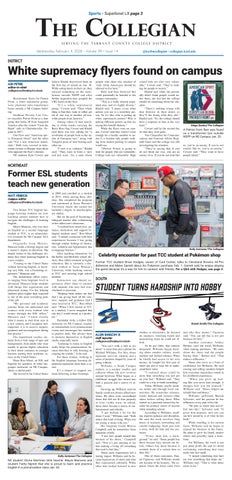
Solaris Khalid discovered them on the first day of school on Jan. 20.
Recruitment flyers for Patriot Front, a white nationalist group, were plastered onto transformer boxes outside a NE Campus building.
Southern Poverty Law Center classifies Patriot Front as a hate group that broke off from Vanguard America after the violent “Unite the Right” rally in Charlottesville, Virginia in 2017.
One flyer said “American spirit, European blood” and the other said “For a new American nationstate.” Both were covered in statements written in Sharpie from those who opposed the flyer’s rhetoric.
NE students Kyle Cowart and
While eating lunch in their car, they noticed something on the transformer outside NDPP and after further inspection they googled the URL listed on the flyer.
“It’s a white supremacist group,” Cowart said. “Their whole thing is that they want to either get rid of, one way or another, all nonwhite people from America.”
Among videos of men marching in white masks carrying the Betsy Ross flag, Cowart and Khalid said there was text calling for “a revolution of people born to the nation of European race,” along with Telegram posts of men beating each other up.
“I view it as violence,” Khalid said. “They want to form a ‘new and just state.’ So, a state where
Former ESL students teach new generation
Two former TCC English language learning students are now teaching current students how to navigate the challenges of learning English.
Mayra Mancera, who was once an English as a second language student at TCC, is an administrative assistant for NE Campus’ ELL department.
Originally from Mexico, Mancera holds a biology degree and a master’s degree in education. She deeply relates to the challenges students face when learning English in a new country.
“Coming to the United States without knowing English, or knowing very little, was a frustrating experience,” Mancera said.
The department offers courses ranging from beginner level to advanced. Mancera helps students with things like registration and placement testing. For her, helping students place higher than expected is one of the most rewarding parts of her job.
“My personal and academic journey helps me understand and connect with every student who comes through the ESL office,” Mancera said. “I know exactly what it means to start from zero in a new country, and I recognize how important it is to receive support, guidance and encouragement during that process.”
The department teaches students from a wide range of ages and backgrounds, from adults who were unable to pursue higher education in their home countries to younger learners starting their academic careers in the United States.
Elena Roa-Albert, an ESL and English for speakers of other languages instructor on NE Campus, shares a similar path. She moved to the United States
in 2008 and enrolled as a student in 2011, while raising three children. She completed the program and continued at Texas Woman’s University where she earned her bachelor’s degree in interdisciplinary studies.
She set the goal of becoming a bilingual teacher after volunteering in her oldest son’s classroom.
“I realized how much love, patience, dedication and support bilingual students need,” Roa-Albert said. “I deeply connected with their experiences because I was going through similar feelings of frustration, isolation and helplessness due to language barriers.”
After teaching elementary for the Keller and Birdville school districts, Roa-Albert returned to higher education. She is currently a doctoral student at Texas Woman’s University while teaching courses at TCC and tutoring high school students.
Instructors say shared experiences allow them to connect with students who may feel overwhelmed or uncertain.
“Helping them makes me feel that I am giving back all the care, love, support and guidance that I once received at TCC,” Roa-Albert said. “When I first started at TCC as a student, I never imagined that one day I would return as a professor.”
Parminder Avila, a fellow ESL instructor on NE Campus, teaches an intermediate level pronunciation course and encourages her students to practice daily. She advises them to immerse themselves in English media, especially music.
“Listening to music in English really helps the pronunciation, because then they’re only focusing on copying the sounds,” Avila said.
For these women, working in the English language learning department represents more than a career.
It’s a chance to support students following in their footsteps.
people who share this mindset of ‘only white Americans should be allowed to live here.’”
Both said they believed this could potentially be harmful to the campus community.
“This is a really densely populated area, and it’s highly diverse,” Khalid said. “I mean, every other person you see is a nonwhite person. So it’s like, who is putting up white supremacist posters? Who is putting different posters up that are saying this hateful rhetoric.”
While the flyers were on campus, Cowart said they weren’t close enough for a faculty member to notice it, a location only people walking from student parking to campus would see.
“[Patriot Front] is going to look for people who are vulnerable. College kids are vulnerable. High
school kids are also very vulnerable,” Cowart said. “They’re looking for people to recruit.”
Khalid said while she personally didn’t think people would notice them, she did feel the college should do something about the situation.
“There’s nothing wrong with that rhetoric in their mind, so they’ll die doing what they did,” Khalid said. “So, the college should have a response to that, at the very least.”
Cowart said by the second day of class they were gone.
Vice Chancellor for Communications and External Affairs Reginald Gates said the college was still investigating the situation.
“They’re saying that if you do not think our way, you are an enemy of us. If you do not look like
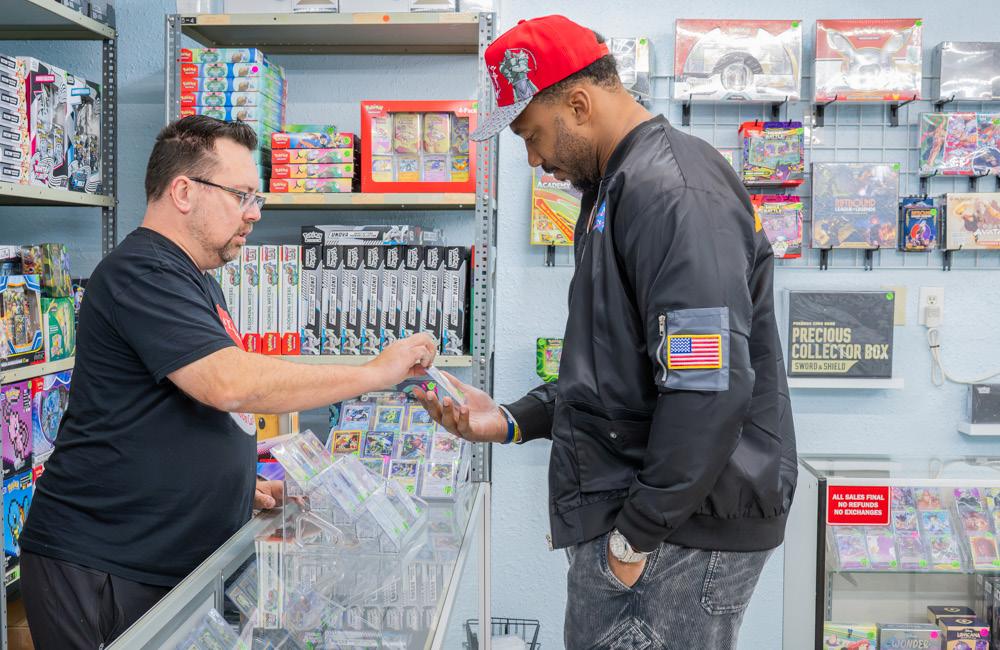
Celebrity encounter for past TCC student at Pokémon shop
Student turns hardship into hobby
“You can’t walk a mile in my shoes” is more than just a phrase for Michael Williams. For him, shoes represent survival, identity and a sense of purpose shaped by years of going without.
Williams, a South Campus student, is a sneaker reseller and collector whose life now revolves around footwear. What began as a childhood struggle has turned into both a passion and a source of income.
Growing up, Williams said his family could not always afford new shoes. He often wore secondhand shoes that did not fit him properly or were visibly worn. At school, those shoes became a source of embarrassment and ridicule.
“I got bullied a lot for the shoes I wore,” Williams said. “Kids notice that kind of thing. When you are young, it sticks with you.”
His longtime friend Marcus Campbell said he remembers those moments vividly.
“I saw how people treated him because of his shoes,” Campbell said. “Now it’s just amazing to see him making a living off something that used to hurt him.”
Those early experiences left a lasting impact. Williams said he became hyperaware of shoes and what they represented culturally. While other kids looked forward to new
clothes or electronics, he focused on sneakers, watching trends and memorizing styles he could not afford.
As he got older, that interest deepened. Williams began learning about sneaker culture, resale markets and limited releases. When he finally had access to his own money, he bought his first pair of shoes not just to wear but to understand their value.
“I realized shoes could be more than something you just put on your feet,” Williams said. “They could be a way to build something.”
Today, Williams resells sneakers online and through local connections. He researches releases, tracks demand and restores older shoes before selling them. What started as a personal interest has become his primary source of income while attending school.
According to Williams, reselling requires patience and discipline. He said the work involves long hours of research, networking and careful budgeting. Each pair tells a story, both for him and the customer.
“Every shoe has a background,” he said. “Some people buy them because they missed out before. Others buy them because it reminds them of a certain time in their life.”
One of those customers, Daniel Figueroa, said Williams stands out because of his honesty. “He explains where the shoes came from
and why they matter,” Figueroa said. “You can tell this is not just business for him.”
Another customer, Ashley Bethea, said she trusts Williams when making purchases. “He cares about the shoes and the people buying them,” Bethea said. “That makes a difference.”
Shoes also serve as a form of confidence for Williams. He said owning and selling sneakers helped him overcome insecurities rooted in his childhood experiences.
“When you grow up feeling like you never had enough, it changes how you see yourself,” Williams said. “Shoes helped me rebuild that confidence.”
Williams’ girlfriend, Mariah Sylvester, said the passion he has influences every part of his life.
“He puts so much time and effort into this,” Sylvester said. “It gives him purpose, and you can see how proud he is of what he has built.”
While reselling is his current focus, Williams said he hopes to expand his business in the future. He plans to grow his brand, mentor others and possibly open a storefront.
For Williams, the work is not just about profit. He said it’s about reclaiming something that once made him feel small.
“I turned something that hurt me into something that helps me,” Williams said. “That is what shoes mean to me.”
Kelly Amtower/The Collegian
Diego Santos/The Collegian
Kiarah Smith/The Collegian
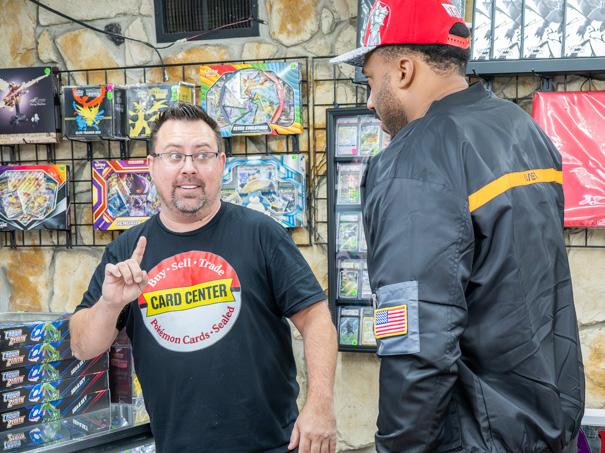
Former TCC student Brian Hodges, owner of Card Center, talks to Cleveland Browns All-Pro defensive end Myles Garrett about his Pokemon purchase Feb. 1. Garrett said he enjoys playing the game because it’s a way for him to connect with friends. For a Q&A with Hodges, see page 4.
A Patriot Front flyer was found on a transformer box outside NDPP on NE Campus Jan. 20.
Kelly Amtower/The Collegian NE student Gloria Martinez tells teacher Mayra Mancera and student Fathy Ngindi that she is proud to learn and practice English in a pronunciation class Jan. 30. SOUTH
Put your money where your beliefs are
If Americans want their government to change, they’ll have to speak to politicians in a language they understand, money.
How can we speak in money?
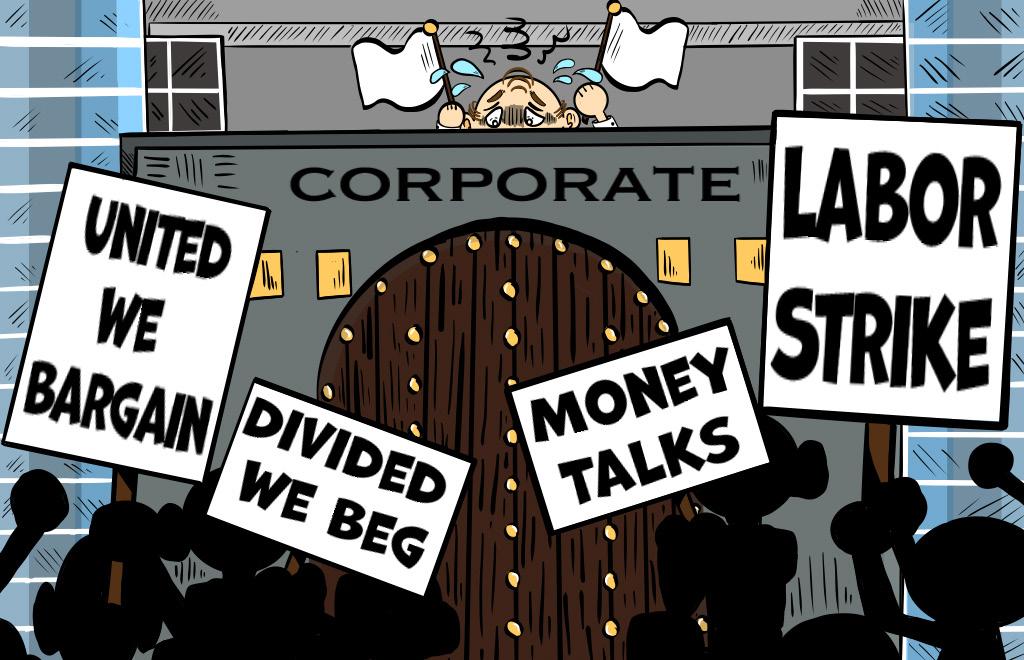
Through labor strikes. Historically, labor strikes have been successful at forcing management to negotiate with its employees’ demands.
In 1936, General Motors workers demanded GM to provide safer working conditions and better pay.
When GM didn’t listen, a 44-day sit-down strike took place where workers didn’t produce anything.
Thousands of UPS workers participated in a strike to demand full-time jobs, job security and higher pay in 1997.
Their efforts shut down the company’s operations for 15 days, costing UPS millions of dollars.
These are just two examples of labor strikes successfully leading to employees’ demands being heard. This proves people can demand their rights by decreasing a corporation’s profit.
However, it seems there has been a rapid decline in these attempts.
Many people attribute this to the increase in corporations’ power within the government by using Political Action Committees and super PACs to fund candidates.
Since federal candidates and political parties receive corporate donations, it isn’t surprising to know our government’s decisions
are swayed more by what benefits the corporation rather than the people.
While boycotting corporations to get them to stop funding certain people or organizations has been organized, the attempts have been lackluster and unsuccessful.
Most Americans will eventually break a boycott either because of their loyalty to a corporations product or because they’re dependent on its convenience.
Convenience drives us to con-
tinue this way, and it’s for good reasons. Our 12-plus-hour workdays can make it almost impossible for us to not use Amazon, go through a drive-thru or buy a Keurig coffee machine.
While we know it’s not the greatest for the planet or humanity, if it means our lives are just a little easier, then so be it.
So, due to corporations controlling politics and Americans needing convenience, the possibil-
ity of change seemed to dwindle more and more after each failed attempt. However, in the past year, strikes have proven to be successful again.
The Target boycott started in January 2025 after the company rolled back its diversity, equity and inclusion initiatives.
By October, the company lost nearly $12.5 billion in market value and had a 7.9% drop in foot traffic, according to Ultima Markets.
The Minnesota general strike called for an economic blackout on Jan 23., protesting ICE taking over the state. Over 700 businesses reportedly closed while thousands marched in the streets. It only took two days for the strike to get 60 of the biggest CEOs to give in and formally write a letter asking the current administration for an immediate de-escalation of tension.
Posted onto Minnesota Chamber of Commerce’s website, the letter acknowledges the murder of Alex Pretti by a Border Patrol officer on Jan. 24 as the reason it was created.
But what the 60 CEOs signed is a plea to get ICE out of Minnesota so they can properly function economically again.
“We call for peace and focused cooperation ... to resume our work to build a bright and prosperous future,” the letter said.
Among the signatures are CEOs from the companies Best Buy, General Mills, Mayo Clinic, Sleep Number, Target and UnitedHealth Group.
This should reignite a spark in all of us. What we’re seeing is proof our actions do speak louder than our words.
While corporations can persuade politicians with their money, we affect how much money a corporation makes.
Stop relying on convenience and think about who and what you support when you make a purchase.
Reposting videos of Zohran Mamdani or infographics on police brutality will ultimately do nothing if you are not involved in your own community.
In a time of such political and economic uncertainty, it is important to understand the difference between spreading information versus physical strides for social change.
Everyone wants to feel as if they are helping usher in positive change. It is a good thing to want to inform others of social issues. These are good intentions.
However, this form of activism often feels shallow and unproductive when you are face to face with suffering people who need tangible community support.
Within the past few years, I have seen so many people post black squares on their socials or add pronouns in their bios.
But when it comes to in-person involvement such as protests, mutual aid or community service,
many simply aren’t willing to get involved.
This phenomenon is called slacktivism, which, according to Merriam-Webster, is “the practice of conspicuously showing support for a cause, like posting on social media or hanging a flag or sign, without taking any real steps to effect change.”
Slacktivism was posting a black square on your Instagram for Black Lives Matter in 2020 but removing it in 2021 because it “no
longer matched your page’s aesthetic.”
Slacktivism was sharing a post about the famine in Gaza but not donating to help Gazans, pressuring your representatives or boycotting companies that benefit from Palestinian suffering.
I understand each person has individual circumstances that may affect their ability to participate in their communities.
Disability, age, access to transportation, immigration status, financial hardship — these are all factors that could limit someone’s activism in their communities.
However, I believe that if you truly care about something, you will find a way to show up.
I’ve seen elderly couples in wheelchairs show up in solidarity at marches.
I’ve watched friends with no money to spare give the little they can to help.
Students across the country are
organizing walkouts in response to ICE raids in Minneapolis.
Not only does direct involvement demonstrate the power of the cause, it also fosters an environment of camaraderie that’s hard to find online. Coming together with others for a common goal builds community and can positively impact mental health.
No one wants to feel as if they are all alone for caring deeply about something. Knowing people who also care deeply about the same cause reminds you that you are not alone.
Martin Luther King was not alone in his fight for racial equality in America.
The Black Panther Party did not feed people through political tweets.
Women did not gain the right to vote in America by shouting their opinions into the void. Who are your local organizers?
What is the rate of homelessness in your area?
Which businesses support your cause? When is your county’s next local election?
These are important questions to be asking yourself. The best time to get involved is now.
Donate food to your local food bank. Spend a few hours a week handing out life-saving supplies to unhoused people. Check up on your neighbors, make sure they have enough to eat. Use your vote to uplift and protect the vulnerable.
I think online activism is important, don’t get me wrong. Social media has the ability to connect people from anywhere in the world in real time. Digital platforms reach wider audiences. But, posting online cannot replace real action.
Please, before you type the words “it takes a village,” at least learn your neighbor’s names.
If you’re anything like me, fashion has the ability to turn your world upside down, completely infatuating you.
As we’ve observed time and time again, trends can often fade as quickly as they appear. But something that has stood the test of time challenges this theory: quiet luxury.
Quiet luxury is a fashion philosophy that centers around welltailored clothes and high-quality materials.
Through the simplicity of this aesthetic, it takes pride in the longevity of the garment to subtly signal wealth.
There are no loud logos or visible signs on the clothing piece itself.
This is a good thing, right?
Clothes that emphasize sustainability? Not quite. People have been using this style not as a sense of self, but to manipulate social perception. It is an obsession to look rich, only to really cover up financial uncertainty. In 2023, millions of Ameri -
cans were faced with harsh realities. Prices skyrocketed due to postpandemic adjustments, and major companies like Boeing cut approximately 2,000 jobs.
People were experiencing an unstable economy and financial hardships, yet quiet luxury was still the leading fashion trend on social media.
The attraction of people wanting to rewrite their reality became clearer than ever. Fashion became a coping mechanism instead of artistic expression.
Stylish outfits defined by color, texture or size were no longer as popular. To dress nicely, you had to be rigid and precise. Now, you must wear a white top to go with those pants, but make sure there’s no holes in them. Instead of a jack-
et, opt for a trench coat. Make sure you look classy, though. These new rules leave no room for personal style. If fashion was originally an art form, a way to express yourself through clothing, then how weird is it for a trend to tell you what to wear?
This is what makes quiet luxury so performative and pointless.
I hate how this aesthetic benefits people’s desire for validation. Why is the main objective ultimately to just look richer than you actually are? It’s pretentious.
If people are already struggling financially, then who cares about your white tank top that costs $100?
Because it most certainly won’t be me. Does it not get tiring secret -
ly hoping people see the invisible price tag of the outfit you’re wearing?
As much as I hate it, I do understand that some people might be fond of dressing like this. However, I want you to ask yourself this: When did you start enjoying this?
If it began recently as a way to cope with our economic reality, you might want to reexamine whether you truly enjoy this fashion trend. Although it may be hard, it’s important that we resist the temptation to follow trends.
Instead of looking at social media to decide what to wear and treating clothes as a uniform, fashion should be personal.
Fashion should be about dressing for ourselves, not for others.
Izzy Webb/The Collegian
Super Bowl LX Preview
Seahawks: Patriots:
Darnold’s Redemption
At the beginning of the season, picking the Seattle Seahawks to win the Super Bowl would have sounded insane.
They rolled the dice during the offseason by signing free agent quarterback Sam Darnold to lead their team. Darnold’s NFL career began with getting drafted third overall by the New York Jets. Expectations were high, but Darnold never came close to meeting them.
Early in his career, the Jets were getting crushed by the New England Patriots, and he was filmed on the sideline explaining his struggles.
“I’m seeing ghosts,” said Darnold.
After being labeled a bust and bouncing around to a few different teams, he finally found his footing last year with the Minnesota Vikings, putting together an impressive season. However, after poor performances in the two most important games of the season, many fans questioned his ability to lead a team to the Super Bowl.
Obviously, those doubts were incorrect. Darnold’s redemption is undeniable. His draft class in 2018 included MVP quarterbacks Josh Allen and Lamar Jackson, yet Darnold is the first to reach a Super Bowl.
Defensive Dominance
The Seahawks have the No. 1 scoring defense in the NFL, only allowing about 17 points per game. An instrumental piece of this defense is former Dallas Cowboys defensive end Demarcus Lawrence, who also joined the Seahawks during the offseason.
“Dallas is my home. ... But I know for sure I’m not going to win a Super Bowl there,” said Lawrence.
Seeking Revenge
The Seahawks have won one of their three Super Bowl appearances in franchise history. Their most recent appearance was a heartbreaking 28-24 loss to the Patriots in 2015.
They will be wearing navy blue jerseys with navy blue pants, the same combination they wore in their two Super Bowl losses.
The Seahawks are the favorites to win. However, Darnold has never beaten the Patriots, losing all four career matchups and throwing nine interceptions in the process.
Vrabel’s Super Bowl Return
The New England Patriots are arguably the most successful franchise in NFL history.
This is their 12th Super Bowl appearance, a league record. They are looking to break the record for most Super Bowl wins, as they are currently tied at six with the Pittsburgh Steelers.
The credit for this historical success belongs mostly to former quarterback Tom Brady and former head coach Bill Belichick. They built a dynasty spanning nearly 20 years. During the first half of the dynasty, a key member of their defense was linebacker Mike Vrabel.
Vrabel is now the head coach of the Patriots, getting them back on track after a few disappointing seasons following the departure of Brady. He is looking to make history of his own by becoming the first person to win a Super Bowl as a player and a head coach for the same franchise.
Following a Legend
• Tailgate Concert – Teddy Swims with LaRussell
• Opening Ceremony – Green Day
• National Anthem – Charlie Puth
• “America the Beautiful” - Bran di Carlile
“Lift Every Voice and Sing”Coco Jones
• Halftime Show – Bad Bunny
Music Commercials
• A 30-second commercial costs roughly $8 million. That’s over $265,000 per second.
• Pepsi has taken out an ad using polar bears, the signature mascot of Coca-Cola, reigniting a soda war.
Drake Maye is now the quarterback, taking on the impossible task of following in Brady’s footsteps. It’s just his second season, but he already has the Patriots back in the Super Bowl, and his stats are impressive to the point of possibly winning the league’s MVP award over Matthew Stafford, a potential hall-of-famer.
Strength vs. Strength
While the Patriots defense isn’t as strong as the Seahawks, they’re still the No. 4 scoring defense in the NFL, only allowing around 19 points per game. Their secondary is led by cornerback Christian Gonzalez. He will attempt to shut down Seahawks wide receiver Jaxon SmithNjigba, the league’s leader in receiving yards.
Diggs Gets His Shot
New England’s receivers are led by veteran Stefon Diggs. Diggs is playing in his first Super Bowl after losing in two previous conference championship games with the Minnesota Vikings and Buffalo Bills.
They will be wearing white jerseys with white pants, a combination they have never worn in the Super Bowl.
The Patriots are the underdogs. However, they were also the underdogs in Tom Brady’s first Super Bowl.
Father captures dreams selling Pokémon
Brian Hodges opened a Pokémon business after being inspired by his son Nathan, who is an expert on the franchise. The former TCC student-turned-entrepreneur has owned several welding businesses over the years and is now venturing into the world of Pokémon cards as the owner of Card Center in North Richland Hills.
When did your Pokémon business start?
March of 2025. I didn’t know anything about Pokémon at all. My son has been into it for over 20 years. We kind of bantered at lunch, like “What do you want to do for a living?” And he was like, “Man, I’d love to open up a Pokémon store.” ... A little while later, we saw this building with a piece of paper in the window that said “for rent.” The price was way cheaper than I expected. We got the keys on May 15 and did our first soft opening on June 1. We started small, but now we’re open seven days a week.
You mentioned a welding business. What’s that like?
I started welding right out of high school and started my own business basically almost right off the bat, just working on cars, welding and doing fabrication. I started my first business with $2,500 on credit cards, and it did great. In 2009, when the economy was not doing well at all, I closed that down and took a manager position at a Sears Auto Center. I learned about big business there, which that’s something I did not know about. Two years later, I opened up another welding shop, and it’s been running since.
What has been your favorite part about this business?
I absolutely love people. That’s one thing the welding shop never provided me. Because I’m doing these big contracts for these big companies, I don’t meet probably 75% of my customers. I always missed talking to people. The interactions, I love it. I love telling my story. I talk to a lot of younger people about how I started, how I messed up and what I would do differently in life. I really love the community on this. Everybody’s been super, super, super nice. I get hundreds and hundreds of people in every week. It puts a smile on my face.
Did having your prior business help you with this one?
One hundred percent, no questions asked. My first business was BBJ’s Racing. It was a storefront for performance car parts for imports, which nobody was really doing back in 1995. I had my own thing in Fort Worth, kind of like this Pokémon store. ... I try to pick one niche and be the best at it. If you are doing six things at once, you can’t be the best at all of them. Since we didn’t have any competition doing just exclusive Pokémon, I wanted to make sure when I did it, I was the best.
Would you say being a fan helps you run the business better, rather than someone who’s just in it for the money?
This is 100% business for me. ... I know how to run a business. I know how I could buy this for X amount of money, and I can sell it
for this X amount of money. So, on the business side, I understood very well. My son is the Pokémon guru. He’s teaching me all the knowledge on the other side. ... At our one-year mark, on June 1, I will open up my first packs, something big and crazy on live streaming. We’ve been building it up so people can watch my journey going from a businessman in Pokémon to it being a fun hobby. What makes it all worth it?
It’s really cool to see. You’ll have a family come in with a 5- or 6-year-old boy and girl, and their smiles look like my face did when I grew up. I can see that same smile on the kids’ faces as I had 40 years ago. ... I have 40to 60-year-old grown men that have been in it for 25 years. They have the same smile as the 5-year-old kid does. Pokémon brings everybody together.
CAMPUS VOICES
Q:“How did the winter storm affect you?”
Chris Stewart TR Campus
“Well I mean, it just made the week really boring, to be honest. I was just at home all week, and then finally came over here, and now I can, actually study here. I have trouble studying at home. I usually come here to study and get homework done... Just having to stay home the entire time is really boring.”
Alyssa Coffey TR Campus
“I definitely spent more time than I wanted inside, but I feel like I got a lot done as far as organizing my house and catching up on shows. So I appreciated that. I was lucky to not be affected as far as power, water, all the things. So I was cozy and happy, but ready to be back into the real world today.”
Alexa Barajas TR Campus
“I wish it had lasted longer. My friend actually had messed up my car. However, I had a beautiful time. You’d slide in the streets like Frozone. It was amazing. I love the snow. It also just felt kind of like no one was around, like everything was quieter and brighter because of the snow. It was beautiful. I think it affected me, and made me feel better.”
Tala Larson NE Campus
“It affected me by having my classes online instead of being at school, because it made me sleep in and almost miss one of my classes. But it didn’t really have a negative effect, because my life was still running. I still had work, so I was still doing my business, doing what I got to do.”
Photo by Kelly Amtower/The Collegian
TCC graduate Brian Hodges, who owns the store Card Center, explains to NFL star Myles Garrett about his recent bulk purchase of Pokémon trading cards and games. Hodges’ son inspired the business idea.