December 2025 – December 2027

![]()

December 2025 – December 2027

TBB Planning acknowledges the Whadjuk people of the Noongar nation as the Traditional Custodians of the land on which we live and work, and recognises their continuing connection to land, waters and culture.
We also acknowledge the custodianship of the many lands and waters across which we design, plan and engage, and pay our respects to Elders past and present, who hold the traditions and culture that continue to guide us in planning for communities now and into the future.

This Innovate Reconciliation Action Plan (RAP) marks an important step in TBB Planning’s reconciliation journey. It reflects our commitment to building meaningful relationships with Aboriginal and Torres Strait Islander peoples and to deepening our understanding of Country through the work we do.
As planners and designers, every project is an opportunity to listen, learn and connect — to consider how the stories, knowledge and values of Traditional Custodians can guide better outcomes for communities today and into the future.
We have chosen to begin our reconciliation journey at the Innovate stage, recognising the foundation we have already built through many years of collaboration, engagement and learning across the communities and lands where we work. This RAP strengthens that foundation, embedding reconciliation more intentionally in our everyday practice.
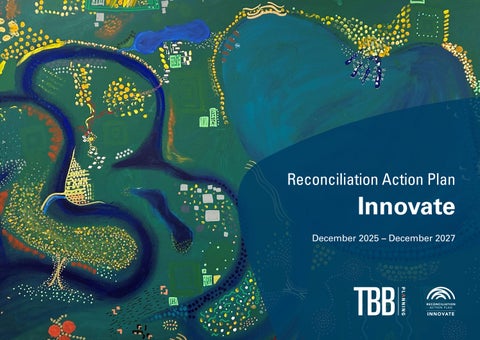
This document features TBB Dreaming, an artwork by Noongar artists Troy Bennell and Aurora Abraham, created in collaboration with the TBB Planning team. The artwork represents our shared journey of connection, respect and learning. (The full story is shared on page 19).
Reconciliation Australia commends TBB Planning on the formal endorsement of its inaugural Innovate Reconciliation Action Plan (RAP).
Commencing an Innovate RAP is a crucial and rewarding period in an organisation’s reconciliation journey. It is a time to build strong foundations and relationships, ensuring sustainable, thoughtful, and impactful RAP outcomes into the future.
Since 2006, RAPs have provided a framework for organisations to leverage their structures and diverse spheres of influence to support the national reconciliation movement.
This Innovate RAP is both an opportunity and an invitation for TBB Planning to expand its understanding of its core strengths and deepen its relationship with its community, staff, and stakeholders.
By investigating and understanding the integral role it plays across its sphere of influence, TBB Planning will create dynamic reconciliation outcomes, supported by and aligned with its business objectives.
An Innovate RAP is the time to strengthen and develop the connections that form the lifeblood of all RAP commitments. The RAP program’s framework of relationships, respect, and opportunities emphasises not only the importance of fostering consultation and collaboration with Aboriginal and Torres Strait Islander peoples and communities, but also empowering and enabling staff to contribute to this process, as well.
With close to 3 million people now either working or studying in an organisation with a RAP, the program’s potential for impact is greater than ever.
TBB Planning is part of a strong network of more than 3,000 corporate, government, and not-for-profit
This Reconciliation Action Plan was visually brought to life by Nani Creative, an Aboriginal-owned and led graphic design studio. We are grateful for their culturally grounded and creative approach in translating our reconciliation journey into visual form.

Karen Mundine Chief Executive Officer Reconciliation Australia
organisations that have taken goodwill and intention, and transformed it into action.
Implementing an Innovate RAP signals TBB Planning’s readiness to develop and strengthen relationships, engage staff and stakeholders in reconciliation, and pilot innovative strategies to ensure effective outcomes.
Getting these steps right will ensure the sustainability of future RAPs and reconciliation initiatives, and provide meaningful impact toward Australia’s reconciliation journey.
Congratulations TBB Planning on your Innovate RAP and I look forward to following your ongoing reconciliation journey.


I am honoured to present our Reconciliation Action Plan (RAP), a vibrant expression of our commitment to building authentic and meaningful relationships with Aboriginal and Torres Strait Islander Peoples. This plan goes beyond regulatory compliance; it embodies our moral obligation and deep dedication to the communities we serve, ensuring that our urban development initiatives are inclusive and sustainable.
We acknowledge and celebrate the rich histories, cultures, and contributions of Aboriginal and Torres Strait Islander communities, integrating these vital perspectives into our urban planning and design processes. This RAP is not just a document; it is a living commitment to action, accountability, and continuous learning, reflecting our ambition to weave First Nations knowledge into the fabric of our workplace culture and project designs.
Guided by the principles of respect, partnership, and equity, we are dedicated to engaging meaningfully with Aboriginal and Torres Strait Islander communities. Through genuine consultation, we will ensure their voices are heard and valued, shaping the spaces we create to honour cultural heritage and promote inclusivity.
To realise our reconciliation goals, we will implement dynamic initiatives, including immersive cultural awareness training for our staff, collaborative projects with Aboriginal and Torres
Strait Islander communities, and pathways for employment and business partnerships. Our aim is to cultivate an environment where First Nations knowledge and practices are not only recognised but celebrated, enriching our urban planning strategies.
We believe that true reconciliation demands sustained commitment and meaningful action. This RAP is our roadmap toward building a more equitable and just society, elevating all voices, and acknowledging the invaluable contributions of Aboriginal and Torres Strait Islander Peoples.
As we evolve, we are committed to transparent monitoring and evaluation of our actions, continuously refining our approaches to ensure that our projects contribute positively to urban resilience and community well-being.
We invite all our stakeholders to join us on this transformative journey towards reconciliation, as we collaborate to create a more inclusive and vibrant future for all our communities.
Our detailed actions, deliverables, and timeframes are outlined at the end of this report with highlighted examples of our actions in focus included throughout.
Thank you for placing your trust in us as we strive together towards a brighter, more equitable future.
Samantha Thompson Managing Director
“
We are committed to listening, learning and working alongside Aboriginal and Torres Strait Islander people.
Increase understanding, value and recognition of Aboriginal and Torres Strait Islander cultures, histories, knowledge and rights through cultural learning. RAP Working Group and senior leaders to participate in an on-Country cultural immersion program with Traditional Owners for the area.
Every meaningful relationship requires reconciliation - the courage to acknowledge mistakes, repair trust, and forge new understanding. This fundamental human need transcends all boundaries of identity, origin, or circumstance. It’s how we heal friendships, families, and communities by confronting uncomfortable truths, making amends, and choosing better paths forward together.
In Australia, this universal truth takes on profound significance as we work toward genuine reconciliation with Aboriginal and Torres Strait Islander Peoples, acknowledging both historical injustices and ongoing impacts.
The RAP Working Group began this journey recognising that meaningful change starts at the individual level. We must be vulnerable and empathetic, opening our hearts to speak and listen with kindness, generosity, and humility. Through genuine conversation with people different from ourselves, we demonstrate that everyone deserves dignity, love, and respect.
The wonderful Marilyn Morgan embodied this approach in her work with our terrific Working Group, providing great support, guidance, wisdom, and courage in creating our Innovate RAP. She helped us understand how TBB Planning’s core values of public equity and positive impact can drive our team to create places and communities where First Peoples’ aspirations are realised and their contributions are recognised, valued, and honoured.
On our collective journey ahead, we will strengthen relationships between our industry and First Peoples. We aim to help transform how our industry works, nurturing meaningful connections to place and each other. We’re excited to use our role in planning and designing places collaboratively with First Nations Peoples and industry partners to advance reconciliation. Together, we will create enduring places that build a strong sense of belonging for everyone.
This isn’t just our professional responsibility – it’s our human one. We invite others to join with us in our RAP actions, as we commit to being active participants in Australia’s reconciliation journey, one relationship and one place at a time.

Langton & Partners are proud to support the work of TBB Planning in their journey of Reconciliation. TBB have taken the time and committed to the process of Reconciliation including Cultural Awareness Training across the whole company. They have worked with Aboriginal artists & Elders to understand the meaning of Country and what Country means to Aboriginal people. TBB they have listened to members of the Stolen Generations in truth telling sessions and listened to Aboriginal leaders on the importance of truth telling & Aboriginal language in bringing landscapes alive. Every member of TBB team understands the real meaning of sharing space, standing with Aboriginal people, holding space for Aboriginal values in landscapes and real Reconciliation.
We congratulate TBB Planning on their Innovate RAP 2025 - 2028


Governance Action 11
Provide appropriate support for effective implementation of RAP commitments.
Appoint and maintain an internal RAP Champion from senior management.
Every member of the TBB team understands the real meaning of sharing space, standing with Aboriginal people, and holding space for Aboriginal values.
Our reconciliation journey began in 2019 when we first engaged an Aboriginal consultancy to help us prepare our RAP.
Since then, reconciliation has been woven into our learning and practice. In 2021 we formed our RAP Working Group to guide this work. That year, our entire team took part in cultural awareness training, which included a Smoking Ceremony and a truth-telling session with a Noongar Elder. It was a powerful introduction to understanding Country, spirituality, and the ongoing impacts of dispossession — and it shaped our resolve to take reconciliation seriously as part of who we are. In 2023 we hosted a special edition of TBB Talks – Closing the Gap Yarn. The event brought together more than 50 people from government, industry and community, with guest speakers Professor Marcia Langton AO and Duncan Ord OAM, alongside local Aboriginal leaders. The conversation reinforced the importance of Aboriginal and Torres Strait Islander voices being central in shaping housing, land and community outcomes.
These milestones have built our foundation. They have reminded us that reconciliation is everybody’s business — and that we must play our part through our projects, our workplace, and our influence in the planning industry.
Relationships Action 1
Establish and maintain mutually beneficial relationships with Aboriginal and Torres Strait Islander stakeholders and organisations. .
Meet with local Aboriginal and Torres Strait Islander stakeholders and organisations to develop guiding principles for future engagement.
For generations, we’ve helped shape some of Western Australia’s most recognisable placesplaces that bring communities together, solve complex urban and liveability challenges and deliver lasting outcomes for the future.
Our story has been shaped by our founders Russell Taylor and Bill Burrell, and early partner Lex Barnett, who each left a lasting mark on planning and design in WA. Russell’s timeless advice — “Walk the site, talk to the locals, research landform and history” — still guides us today. Bill’s pioneering thinking elevated urban design, while Lex’s expertise in statutory and strategic planning established our reputation as trusted advisors on major projects and policy.
From masterplanned communities and urban transformation projects to navigating energy transition and complex policy, our role is to bring the right people and insights together to connect people, place and opportunity. We are supported by an Aboriginal reference group in addition to working collaboratively with stakeholders and peers.
Today, we are one of WA’s largest dedicated urban design and planning consultancies. We employ around 32 full-time professional staff in our Perth office in Western Australia. We currently have no Aboriginal or Torres Strait Islander employees, and have developed actions to identify work experience and employment pathways over the next two-year period.
We care deeply about the people and communities we work with, and we believe our first reconciliation action plan will help us achieve socio-economic outcomes through employment and procurement of good and services, creating space for Aboriginal and Torres Strait Islander Peoples participation in the town planning industry more broadly, and opportunities to work with communities to lead certain design aspects of new projects.
At TBB Planning, we don’t just plan places. We create opportunity.
Our reconciliation journey as a team began in 2021 with a full-day cultural awareness workshop that took the whole team out of the office and onto Country. Held at Mounts Bay Yacht Club on the banks of the Derbarl Yerrigan (Swan River), the day was led by a local Noongar Elder who guided us through ceremony, storytelling and history.
The experience was deeply immersive. We took part in a Smoking Ceremony, listened to truth-telling about the impacts of colonisation, and learned about the deep spiritual connection Noongar people have with Country, waterways and community.
For many of us, this was a first step in understanding how past policies of dispossession and disconnection continue to affect Aboriginal and Torres Strait Islander Peoples today.
It was also a chance to reflect on our role as planners — recognising that reconciliation begins with listening, learning and respecting the stories of the land we work on.
That day set the foundation for everything that has followed. It reminded us that reconciliation is not a box to be ticked, but an ongoing responsibility to show up with openness, humility and care.
Our team continue to participate in Cultural Awareness Training as a part of new onboarding processes.
Demonstrate respect to Aboriginal and Torres Strait Islander Peoples by observing cultural protocols.
Increase staff’s understanding of the purpose and significance behind cultural protocols, including Acknowledgement of Country and Welcome to Country protocols.
Reconciliation begins with listening, learning and respecting the stories of the land we work on.

On 7 September 2023, TBB Planning hosted a special edition of our TBB Talks series: the Closing the Gap Yarn — bringing together more than 50 people from government, industry, the planning profession, and Aboriginal community leadership.
The evening opened with a Welcome to Country by Nick Abrahams and a personal reflection on our reconciliation journey by Director Ben De Marchi. We were honoured to hear from Professor Marcia Langton AO and Duncan Ord OAM, who offered insightful perspectives on how planning and development intersect with the National Agreement on Closing the Gap — especially in areas like culturally appropriate housing and sustaining spiritual connections to land and water. Attendees also emphasised the importance of co-design, better-tailored planning, and , First Nations-led housing solutions.
This yarn reminded us that reconciliation in planning isn’t abstract — it’s about real people, respectful partnerships and designing with Country, not just for it.
Relationships Action 3
Promote reconciliation through our sphere of influence.
Collaborate with RAP organisations and other like-minded organisations to develop innovative approaches to advance reconciliation.


At TBB Planning, our vision for reconciliation is an Australia where Aboriginal and Torres Strait Islander Peoples have the same opportunities to thrive in education, employment and economic participation – and where outcomes for communities are genuinely improved.
We believe First Nations voices should not just be heard, but amplified. We are committed to listening, learning and working alongside Aboriginal and Torres Strait Islander People across Western Australia, and to advocate within our industry for stronger partnerships and more inclusive outcomes.
Australia’s Aboriginal and Torres Strait Islander cultures and heritage are something all Australians should be proud of. We will continue to grow our team’s understanding through truth-telling, cultural learning and engagement. And we will celebrate the contribution of Aboriginal and Torres Strait Islander Peoples – past, present and future – as part of our contribution towards building a better shared future.
Through our RAP, we aim to:
Ensure reconciliation is meaningfully reflected in our planning and design projects.
Share this vision more widely, encouraging our friends and families to recognise and appreciate the deep and enduring beauty of this Country and its First Peoples. 1 2 3 4 5
Connect reconciliation to our day-today business activities.

Empower and enrich our team by nurturing shared values and understanding.
Influence the people we work with – local and state government, co-consultants, clients and communities – to value reconciliation.
Opportunities Action 8
Improve employment outcomes by increasing Aboriginal and Torres Strait Islander recruitment, retention, and professional development. Employ TBB’s first Aboriginal or Torres Strait Islander employee over the next two years.
Planning is about people, places and futures. For us, reconciliation is central to that. Every project we work on takes place on Country with tens of thousands of years of history. Respecting and learning from that history helps us create stronger, more inclusive places.
As planners and designers, we have a responsibility to ensure First Nations voices are heard as a part of the decisions that shape land and communities. Reconciliation strengthens our work — by deepening our understanding of place, by helping us co-create better outcomes with Traditional Owners, and by challenging us to think differently about what planning can achieve.
By embedding reconciliation into our practice, we aim to make a genuine impact: shaping places where communities can thrive, and building a future that acknowledges and celebrates Aboriginal and Torres Strait Islander cultures at the heart of Australia’s story.


TBB Planning has long supported Aboriginal communities in the Pilbara and Kimberley through the preparation of Community Layout Plans (CLPs). Commissioned by the Department of Planning across the 2000s, these plans provided the foundation for funding housing and infrastructure upgrades in communities including Warralong, Jigalong, Warmun (Frog Hollow), Parnpajinya, Punmu, Wurreranginy, Yiyili, Ganinyi, Girriyoowa and Kurinyjarn.
Our role was to bring the same level of planning consideration to remote Aboriginal communities as to any other town in WA — ensuring housing was located away from noise, dust and odour sources, safeguarding amenity, and planning for sustainable services. Consultation with Traditional Owners, community representatives and local government was at the centre of the process.
For us, these projects were about more than compliance. They were about respect — making sure communities had a voice in shaping their future, and that planning supported safe, liveable and sustainable outcomes on Country.


Establish and maintain mutually beneficial relationships with Aboriginal and Torres Strait Islander stakeholders and organisations.
Develop and implement an engagement plan to work with Aboriginal and Torres Strait Islander stakeholders and organisations.


Our RAP is guided by principles that connect directly to our work and how we show up every day. These commitments keep us accountable to our people, our clients, and the communities we serve, both existing and future.
To ensure reconciliation meaningfully shapes the planning and design projects we deliver.
Shared vision
To embed reconciliation in the way TBB Planning works with clients, collaborators and communities.

Positive influence
To use our position in the industry to influence local and state government, co-consultants, clients and communities towards reconciliation.
Increase Aboriginal and Torres Strait Islander supplier diversity to support improved economic and social outcomes.
Develop and communicate opportunities for procurement of goods and services from Aboriginal and Torres Strait Islander businesses to staff.
To connect reconciliation to our day-today decisions, operations and culture.
Empowered people
To nurture understanding and values across our team, enriching and empowering every individual.
To encourage our friends, families and networks to appreciate the ancient beauty of this Country and its First Peoples.
Our RAP principles align with the values that guide TBB Planning — seeing opportunity and making a positive impact, empowering our team, driving shared success through collaboration, and being agile and innovative in pursuit of great outcomes. These values, and our ethos of “we do this with heart”, are what connect our reconciliation commitments to the way we plan, design and engage every day.
At TBB Planning, reconciliation is not something that sits on paper — it’s something we take part in together. Each year, our team joins events that mark National Reconciliation Week and NAIDOC Week, creating space to listen, learn and celebrate.
Reconciliation Week has given us opportunities to reflect on the importance of truth-telling and to engage with speakers and organisations leading change. We’ve shared resources across our team, taken part in community events, and built our understanding of how reconciliation is everyone’s business.
NAIDOC Week has been a chance for our team to come together in a different way — to celebrate the oldest continuing cultures on earth. We’ve connected through art, storytelling and yarning, and each year we encourage our people to participate in community activities across Perth and beyond.
These moments of learning and celebration help us bring reconciliation into our everyday work. They remind us that every project takes place on Country, and that showing respect for culture, history and community strengthens the places we help shape.
Build respect for Aboriginal and Torres Strait Islander cultures and histories by celebrating NAIDOC Week
Promote and encourage participation in external NAIDOC events to all staff.


In 2021, the Maalak Aboriginal Corporation (MAC) engaged TBB Planning to help unlock the planning and tenure pathways for an Eco-Tourism Precinct in the Shire of Cranbrook.
The project envisioned a tourism destination that would share Noongar culture through a purpose-built learning centre, short-stay accommodation and a base for locally led tours. TBB guided the rezoning and land tenure processes — working closely with MAC and the Shire to rezone land, close an adjoining road and amalgamate lots into a development-ready site.
The project created a pathway for MAC to pursue funding and extend tenure, even though development has not yet progressed. For TBB, this work was about enabling opportunities — helping an Aboriginal-led vision move closer to reality, and showing how planning can support cultural, social and economic outcomes together.
Relationships Action 3
Promote reconciliation through our sphere of influence.
Explore opportunities to positively influence our external stakeholders to drive reconciliation outcomes.

We were fortunate to attend Reconciliation Memoirs with Carol Innes, hosted by Reconciliation WA. Carol has been a driving force in reconciliation across Western Australia — from her role in settling the South West Native Title Claim, to shaping cultural narratives in major redevelopment projects such as Yagan Square, Elizabeth Quay and Midland.
Carol spoke with warmth and courage about truth-telling, trust, and the ongoing fight against racism. She reminded us of the word Meliorism — the belief that the world can be made better through human effort — a powerful idea that underpins reconciliation.
One of the strongest lessons was the importance of embedding First Nations ways of thinking into projects. Carol described an approach built on Kaart Koort Waarnginy (Head, Heart, Talking), where culture and community guide decision-making, leadership and opportunity.
For us as planners, the message was clear: reconciliation means being brave enough to revisit history, tackle racism, and design with culture at the centre. It means building hope and solidarity, and creating opportunities for Aboriginal and Torres Strait Islander Peoples to prosper.
Increase understanding, value and recognition of Aboriginal and Torres Strait Islander cultures, histories, knowledge and rights through cultural learning.
Provide opportunities for RAP Working Group members, HR managers and other key leadership staff to participate in formal and structured cultural learning.


During NAIDOC Week 2022, our team came together to create a collaborative artwork guided by Noongar artists Troy Bennell and Aurora Abraham. What began as a blank canvas soon became TBB Dreaming — a piece that now anchors our Reconciliation Action Plan and represents our ongoing journey.
The artwork reflects land meeting water — a reminder of the places where stories converge, where journeys cross, and where new paths begin. Inspired by storytelling shared on the day, elements of the canvas represent rivers, marinas, communities, songlines and the connection between people and Country. Each team member left their own mark — their “DNA” — on the canvas, showing that reconciliation is something we all take part in, together.
Troy and Aurora helped us connect the artwork to our history as a planning and design practice. Just as Russell Taylor once reminded us to “walk the site, talk to the locals, research

landform and history”, this artwork reminds us to respect place and context — and to consider what should be left untouched as much as what we create.
The finished piece carries many layers, but at its heart it represents connection: between land and water, past and future, and between TBB Planning and the Aboriginal and Torres Strait Islander communities we are proud to work alongside. Aurora even embedded our initials — TBB — into the curves of the river, making it clear that our story is now part of this Dreaming.
TBB Dreaming is more than artwork. It is a symbol of our commitment to walk this journey with heart, to keep listening and learning, and to make reconciliation a visible and lasting part of the places we help shape.

Promote reconciliation through our sphere of influence.
Showcase Aboriginal artwork and language/ culture within the office and throughout document publications that has a connection to our areas of work within the state.
Strong governance is central to the success of our RAP. At TBB Planning, we’ve embedded clear structures and responsibilities to ensure our reconciliation commitments are actively led, measured and sustained across the business.
Our RAP Working Group (RWG) sits at the core of this framework—bringing together representatives from across the company. There are two members of the RWG who identify as being Aboriginal or Torres Strait Islander persons. They are instrumental in helping to guide our journey and shape the delivery of our actions. The RWG meets quarterly to review achievements, address challenges and ensure our actions remain meaningful and connected to our purpose.
Beyond oversight, our governance commitments emphasise transparency and accountability. We report RAP progress quarterly to all staff, and annually to Reconciliation Australia, sharing both successes and lessons learned. At senior leadership level, Ben De Marchi (TBB Director and RAP Chair) and Rachel Chapman (TBB Director and RAP Champion) play an active role advocating for reconciliation across our projects and workplace. These efforts are supported by clear systems for tracking and reporting, and by maintaining open communication channels—such as a dedicated RAP Teams channel and regular discussion at Friday Yarn—to engage every team member in the journey.
Our detailed actions, deliverables and timeframes for governance are outlined in the following section, ensuring that each commitment is transparent, measurable and owned across the business. Together, these mechanisms enable us to uphold the integrity of our RAP and strengthen our contribution to reconciliation across the planning and design industry.
We aim to:
• Meet four times a year to track our progress and keep reconciliation front of mind.
• Report openly on what we’ve achieved — and where we still need to do more.
• Continue the journey by developing our next RAP when this one concludes.

Governance Action 10
Establish and maintain an effective RAP Working group (RWG) to drive governance of the RAP.
Maintain Aboriginal and Torres Strait Islander representation on the RWG.


Operating within the development industry—across local and state government and private investment—building strong relationships with Aboriginal and Torres Strait Islander Peoples is essential to our work. Our purpose is to shape and enable exceptional places of enduring prosperity. Meaningful engagement helps us understand the stories, histories and aspirations connected to the places we plan.
It also helps us create places where communities can connect, feel supported and see their identity reflected. We are committed to working with Traditional Owners in each community to deliver outcomes that respect Country and support long-term well-being.
1. Establish and maintain mutually beneficial relationships with Aboriginal and Torres Strait Islander stakeholders and organisations. Meet with local Aboriginal and Torres Strait Islander stakeholders and organisations to develop guiding principles for future engagement.
and implement an engagement plan to work with Aboriginal and Torres Strait Islander stakeholders and organisations.
2. Build relationships through celebrating National Reconciliation Week (NRW). Circulate Reconciliation Australia’s NRW
Encourage and support staff and senior leaders to participate in at least one external event to recognise and celebrate NRW.
3. Promote reconciliation through our sphere of influence.
Develop and implement a staff engagement strategy to raise awareness of reconciliation across our workforce.
Organise TBB’s RAP launch event and invite staff and key clients and consultants.
Communicate our commitment to reconciliation publicly through website and social media.
Prepare and continuously update a calendar of local and national reconciliation occasions and events, with corresponding actions to prepare and publicly communicate our initiatives for, and commitment to, reconciliation (e.g. National Apology Day, National Sorry Day, Reconciliation WA events, Reconciliation Australia events).
Showcase Aboriginal artwork and language/culture within the office and throughout document publications that has a connection to our areas of work within the state
Regularly engage with team members to seek input on what they would like to learn more about in regard to reconciliation, culture, history, language.
Purchase and display a map of Indigenous Australia in the office.
Explore opportunities to positively influence our external stakeholders to drive reconciliation outcomes.
Collaborate with RAP organisations and other like-minded organisations to develop innovative approaches to advance reconciliation.
November 2026 Director of Planning
February 2026 Director of Design
February 2026 Senior Graphic Designer
June 2026/27 People & Culture Lead
4. Promote positive race relations through anti-discrimination strategies.
Conduct a review of HR policies and procedures to identify existing anti-discrimination provisions, and future needs.
Develop, implement, and communicate an anti-discrimination policy for our organisation.
Engage with Aboriginal and Torres Strait Islander staff and/or Aboriginal and Torres Strait Islander advisors to consult on our antidiscrimination policy.
Educate senior leaders on the effects of racism.
May 2026 Managing Director
May 2026 People & Culture Lead
May 2026 Director of Planning
January 2027 Director of Planning
January 2027 General Manager
July 2027 People & Culture Lead
July 2027
People & Culture Lead
July 2027 People & Culture Lead
5. Increase understanding, value and recognition of Aboriginal and Torres Strait Islander cultures, histories, knowledge and rights through cultural learning.
6. Demonstrate respect to Aboriginal and Torres Strait Islander Peoples by observing cultural protocols.
7. Build respect for Aboriginal and Torres Strait Islander cultures and histories by celebrating NAIDOC Week.
We acknowledge and respect Aboriginal and Torres Strait Islander spirituality, culture and traditional stories that shape the places on Country where we work. We value learning about local customs, languages and histories, and strive to reflect this cultural knowledge meaningfully in our projects.
Conduct a review of cultural learning needs within our organisation.
Consult local Traditional Owners and/or Aboriginal and Torres Strait Islander advisors prior to informing our cultural learning strategy.
Develop, implement, and communicate a cultural learning strategy document for our staff.
Provide opportunities for RAP Working Group members, HR managers and other key leadership staff to participate in formal and structured cultural learning.
RAP working group and senior leaders participate in on Country cultural immersion program, with Traditional Owners for the area,
March 2026
March 2026
March 2026
& Culture Lead
of Planning
& Culture Lead
March 2026 General Manager
June 2026
Ensure all staff undertake Cultural Awareness Training following completion of the probation period. March 2026
Encourage use of and understanding of Noongar language through selection of ‘word of the week’ for display in office reception area and message to all staff.
Increase staff’s understanding of the purpose and significance behind cultural protocols, including Acknowledgement of Country and Welcome to Country protocols.
Develop, implement and communicate a cultural protocol document, including protocols for Welcome to Country and Acknowledgement of Country.
Invite a local Traditional Owner or Custodian to provide a Welcome to Country or other appropriate cultural protocol at significant events each year.
Include an Acknowledgement of Country or other appropriate protocols at the commencement of important meetings.
RAP Working Group to participate in an external NAIDOC Week event.
Review HR policies and procedures to remove barriers to staff participating in NAIDOC Week.
Promote and encourage participation in external NAIDOC events to all staff.
& Culture Lead
& Culture Lead
December 2025/26 Senior Graphic Designer
December 2026 Director of Design
December 2026 General Manager
December 2025-2027 Director of Design
December 2025-2027 Managing Director
First week in July, 2026/27 People & Culture Lead
July 2026/27 People & Culture Lead
First week in July, 2026/27 General Manager
8. Improve employment outcomes by increasing Aboriginal and Torres Strait Islander recruitment, retention, and professional development.
9. Increase Aboriginal and Torres Strait Islander supplier diversity to support improved economic and social outcomes.
We are committed to creating meaningful opportunities for Aboriginal and Torres Strait Islander Peoples and organisations, supporting greater equity in our industry. We actively seek to work with Aboriginal and Torres Strait Islander–owned businesses and promote their expertise within our networks. Our People and Culture strategy reinforces this commitment by embedding diversity and equity in our policies and everyday practice.
Build understanding of current Aboriginal and Torres Strait Islander staffing to inform future employment and professional development opportunities.
Engage with Aboriginal and Torres Strait Islander staff to consult on our recruitment, retention and professional development strategy.
Develop and implement an Aboriginal and Torres Strait Islander recruitment, retention and professional development strategy.
January 2026 Managing Director
February 2027
April 2027
Advertise job vacancies to effectively reach Aboriginal and Torres Strait Islander stakeholders. May 2027
Review HR and recruitment procedures and policies to remove barriers to Aboriginal and Torres Strait Islander participation in our workplace.
Employ TBB’s first Aboriginal or Torres Strait Islander employee over the next two years
Investigate opportunity for TBB to support the Planning Institute of Australia (PIA) Indigenous planning student sponsorship or other suitable programmes with Curtin University.
October 2027
June 2027
February 2027
Research and identify work experience opportunities being sought by Aboriginal and Torres Strait Islander peoples and how TBB can host work experience opportunities or cadetships. July 2027
Develop and implement an Aboriginal and Torres Strait Islander procurement strategy.
& Culture Lead
& Culture Lead
& Culture Lead
& Culture Lead
& Culture Lead
& Culture Lead
December 2026 General Manager
Increase procurement spend with Aboriginal and Torres Strait Islander businesses year on year June 2026/27 General Manager
Investigate the feasibility of Supply Nation membership.
Develop and communicate opportunities for procurement of goods and services from Aboriginal and Torres Strait Islander businesses to staff.
Review and update procurement practices to remove barriers to procuring goods and services from Aboriginal and Torres Strait Islander businesses.
Develop commercial relationships with Aboriginal and/or Torres Strait Islander businesses.
December 2026 Client Services Manager
December 2026 Business Support Lead
December 2026 General Manager
December 2026 Director of Planning
10. Explore providing inkind support to an Aboriginal-controlled organisation or Aboriginal owned enterprise to help meet their vision in community infrastructure development and create economic development opportunities
Create a list of Aboriginal-controlled organisations in WA with current or upcoming community infrastructure projects where planning, urban design or place-based advice may be relevant.
Review these projects to identify where TBB’s services could provide meaningful in-kind support.
Contact relevant Aboriginal-controlled organisations to explore opportunities for in-kind support on projects that align with TBB’s expertise.
Where TBB is involved in community infrastructure projects, identify opportunities to collaborate with or recommend Aboriginal-owned businesses and organisations within the broader project team.
11. Establish and maintain an effective RAP Working group (RWG) to drive governance of the RAP.
12. Provide appropriate support for effective implementation of RAP commitments.
Maintain Aboriginal and Torres Strait Islander representation on the RWG. August 2026
Determine and support RWG members responsible for undertaking, overseeing and monitoring actions and budget compliance and report on progress of actions to RWG meeting
Establish and apply a Terms of Reference for the RWG.
Meet at least four times per year to drive and monitor RAP implementation.
Define resource needs for RAP implementation.
Engage our senior leaders and other staff in the delivery of RAP commitments.
Define and maintain appropriate systems to track, measure and report on RAP commitments.
Appoint and maintain an internal RAP Champion from senior management.
August 2026
December 2026
May 2027
2027
2027
August 2026
March, June, August and October, 2026/27
October 2026
& Culture Lead
Managing Director
March, June, August and October 2026/27 Director of Design
March, June, August and October 2026/27
General Manager
December 2025 Director of Planning
13. Build accountability and transparency through reporting RAP achievements, challenges and learnings both internally and externally.
Contact Reconciliation Australia to verify that our primary and secondary contact details are up to date, to ensure we do not miss out on important RAP correspondence. June annually
Contact Reconciliation Australia to request our unique link, to access the online RAP Impact Measurement Questionnaire.
Complete and submit the annual RAP Impact Measurement Questionnaire to Reconciliation Australia.
Report RAP progress to all staff and senior leaders quarterly.
Publicly report our RAP achievements, challenges and learnings, annually.
August annually
March, June, August and October 2026/27
October 2026/27 General Manager
Investigate participating in Reconciliation Australia’s biennial Workplace RAP Barometer. May 2026
Submit a traffic light report to Reconciliation Australia at the conclusion of this RAP.
Create a dedicated TBB wide MS Teams channel for the RAP which communicates progress of actions and opportunities for all staff to participate and provide ideas
Include an item in the quarterly business update presentation to TBB staff on progress of RAP and initiatives and provide opportunities weekly at Friday Yarn for discussion on RAP.
14. Continue our reconciliation journey by developing our next RAP.
Register via Reconciliation Australia’s website to begin developing our next RAP – 6 months prior to RAP expiry
2027
December 2025 General Manager
March, June, August and October 2026/27
2027
Reconciliation is a journey that takes time, care and commitment. This Innovate RAP is just one step — but it’s a step we are proud to take together.
At TBB Planning, we see reconciliation as part of our purpose: connecting people, place and opportunity in ways that respect history and create positive impact for the future. We know there’s more to learn, more to do, and more to share — and we are committed to walking this path with heart.
TBB RAP
Working Group
We thank our RAP Working Group for their leadership, energy and guidance throughout this process.

Ben De Marchi

Katherine Shirley

Rachel Chapman

Farida Farrag

Gemma Maughan

Jodie Bell
Reconciliation is a journey we walk with heart — connecting people, place and opportunity with respect and purpose.


Michael Willcock


Marilyn Morgan Jimmy Sebire
And our former RAP Working Group members: Karen Hyde and Mark Elliss.
We welcome conversations with clients, collaborators and community about how we can work together to advance reconciliation in planning and design. 28
Gemma Maughan People & Culture Lead e: gemma@tbbplanning.com.au
Connecting People, Place and Opportunity.