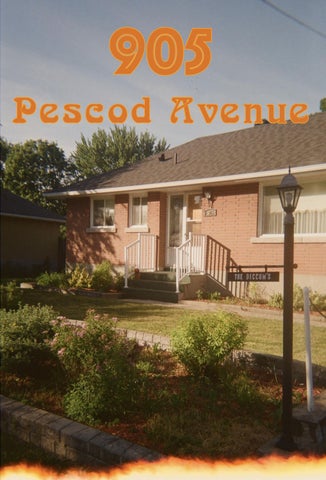
Trimmed page area
905 Safe area
Pescod Avenue
Time Time moved moved slower, slower, the the Earth Earth was was hotter, hotter, and and life life was was better. better. Welcome Welcome back back to to the the 70’s. 70’s. We We missed missed you. you. The faint smell of du Maurier cigarettes and Captain Black, cherry flavoured, pipe tobacco still lingers around that basement 50 years later. The brown geometric rugs still cover the cold tiled floor. The velvet, mustard yellow arm chair and green tweed couch still sit there waiting to be used again. Similarly, the brown and orange paisley curtains still cover the small windows on the wall protecting our family’s very own time capsule. When you walk into that basement, you get transported back to a time when the world spun slower. This basement makes you feel like you’re in a film photo; the feeling of nostalgia is incredible. This is the basement where my dad listened to some of his first rock albums on vinyl, it’s where my mom met my grandparents for the first time, it’s where so many parties were had, it’s a trip down memory lane. It signifies so many important moments in my family’s life, and it symobolizes the era that my parents grew up in; the era of freedom and change.
I love being able to feel all the memories in that house from when my grandparents were alive and used the basement to entertain; You can feel it in the air. You can see it in the 70s ‘memorabilia’ around the house: the dishware, homeware, in the old clothes hanging around, and smell of the house. As someone who has only been able to experience the 70s through movies, music, and many, many stories from my parents, I have grown up romanticizing this decade and all it holds. However, it is because of 905 Pescod Ave, that I am passionate about this decade: the fashion, the music, the art, and what it meant to so many people. Especially my family, and now me.
This is 905 Pescod Avenue. Welcome in!
What is the fa The rise, widespread popularity, decline, then ultimately, rejection of a fashion trend is known as “the fashion cycle”. It is normally broken down into 5 stages. 1: Introduction - when a new style emerges into the ‘fashion world’. It normally starts out only being available in smaller batches. 2: Rise (or Acceptance) - when the new style gains popularity amongst “early adopters”. It finally gets recognized as a “trend”. 3: Peak - when the ‘trend’ has reached maximum popularity and acceptance amongst consumers. This ‘trend’ will be mass produced and available at various price points. 4: Decline - when the’trend’ has beccome overdone and is starting to be replaced with a new style. Most early adopters will ahve discaarded this trend since it will have become “mainstream”. 5: Obsolescence (or Rejection) - the trend has finally reached the end of its life cycle. It is now considered “out of date” or “out of fashion”. This stage does not mean that the trend haas been rejected forever, but it means that it has the possiblility to come back into fashion a number of years later.
ashion cycle? Throughout the past 50 years, we have seen many trends go through the fashion cycle. And about every 20 years or so, trends come back around from two decades prior. For example, now in the 2020’s, the late 90’s and early 2000’s, or Y2K, style has come back. In the 90’s apparently the 70’s came back as well. Now, it’s been almost 50 years since the 70’s began, but we are seeing a rise in 70’s fashion today. Why?
are about. Change and freedom We are living through historty, revolutions of change, and trying times.
I am inspired everyday by life in the 70s. It is my favourite decade. Personally, I have taken much inspiration from my family and what they went through during the 70’s. I noticed that I wear very similar things that they did back then, Not only because of the fashion and I started to notice that cycle, but because there have been other around me were wearing so many parallels within the start of them too. this decade and the 70’s. The globe went through a pandemic that infringed on evereyone’s freedoms. In the US, we saw various civil rights movements take place. We were forced to stay inside and be left to our own devices, literally. Now, we are all slowing crawling out of our homes and are starting to enjoy our freedoms again. It’s no surprise that the 70’s, a decade all about change and freedom, are starting to come back. That is what the 2020’s
The 70’s are back. Let’s take a look at what they wore back then and what we’re wearing now.
CHRISTMAS IN CORNWALL LOUISE AND GARRY 1979
Orange Jacket: Thrifted Brown shirt: The Loft Vest: Thrifted Pants: Thrifted Boots: ASOS
PARTY @ HELEN & RHEAL’S LOUISE AND GARRY 1979
Brown sweater: thrifted from Portobello Market in Nottinghill, London
UNCLE OMER 1977 CORNWALL, CANADA
Graphic T-Shirt: Rolling Stones Tour Tee x Free People Jeans: Super Flares x Free People
LOUISE - SCHOOL PICTURE 1973 CORNWALL, CANADA
Shirt: Thrifted from the 70’s Necklace: Thrifted Bolo Necklace
PAPA AND NANA - CORNWALL, CANADA 1976
Zara 70’s Sunglasses - SS 2022 collection
Pretty Little Thing 70’s reading and sunglasses 2022 Collection
Brown Overshirt: Thrifted from Loot Vintage Brown Undershirt: The Loft Pants: Thrifted from Loot Vintage
LOUISE - CHRISTMAS CORNWALL 1976
S IN
BEATRICE, FLORENCE, AND LOUISE IN CORNWALL 1974
Sweater: The Loft Pants: Plaid Jules Pants x Free People Shoes: Doc Martens
GARRY IN HIS HIGHSCHOOL FOOTBALL UNIFORM IN 1973
GARRY IN HIS LETTERMAN JACKET IN 2022
Zara letterman jacket SS 2022 collection
LOUISE - CHRISTMAS IN CORNWALL 1976
Zara FW/SS 2021-22 70s Patterned Knit Cardigans
Urban Outfitters & Free People 70s Graphi Band Tees
GARRY - CHRISTMAS IN CORNWALL 1978
That Inter
70’s rview
The 70’s were a special decade for many people. Since, I am not able to share my personal experiences, I wanted to highlight the experiences of those who love the 70s as much as I do. These are the “That 70’s Interviews”. With special special guests: guests: Sara Sara Hassan, Hassan, With Harriet Posner, Posner, and and Paul Paul Tierney. Tierney. Harriet
So, I guess we can start with the first queestion: What defined 70’s fashion for you? Sara: Um, ... I would say the one thing that really defines it for me is ‘Le Smoking’ image by Helmut Newton. It was taken in 1975. And it was very, you know, being woman. I love what it stands for. It’s so ahead of its time, you know, it’s kind of hitting that diversity button. But it was, you know, women smoking wearing trousers, which was obviously, you know, it wasn’t a big, particularly big trend. Pre the 70s. You know, seeing women in trousers was pretty much unheard of. So it was it kind of ticks all the boxes, that picture for me, you know, she’s androgynous, she’s masculine. She’s confident, she’s smoking. She’s wearing trousers. She’s in Paris, my favorite city in the world. And it was shot by my favorite photographer Helmut Newton. And yeah, that to me, is the 70s. Harriet: I’ve got just a few memories. I don’t know what year it would have been. But, you know, in those days, he kind of saved up to get a coat. ... Probably up till then, you know, we would buy one coat for a lifetime, you know, not every season kind of thing. And I don’t know if you would know it, but it was a shop called Wallace and they were very famous for their coat collection. I later ended up working for them. It was my first job. And so, I bought this coat and it was rust colored down, you know, a maxi coat with a belt and a collar. And I just thought this was amazing. You
know, I, I arrived. I’ve got a maxi coat. So, you know, that was really exciting. ... But yeah, I felt quite grown up; ‘I’ve got my long Maxi coat’ I was important. I went to Bieber and had a Bieber jumper. And that was amazing. It was purple and sort of two tones of purple strike really skinny. And that was I don’t know what age I was when I have that flared trousers. Brown. There was a lot of brown. That’s a big memory of the 70s everything was kind of brown and orange. Paul: Well, the 70s are a very interesting decade, because if you think about 1970, at the beginning of the decade, and 1979, at the end of the decade, so much happened in those 10 years. And it was one of those periods of time, one of those decades where, with fashion, there was about six major fashion movements within 10 years. And we don’t have that very often. And so within that 10 year period, if you think about the start of the decade, it was very, like the kind of hangover of the hippie era. So people were still it was all still kind of peace and love long hair, then in flowers, you know, that kind of like post hippie thing, then that more people got bored of that and started to splinter off and diversify. And then you had something completely different, which was glam rock. So this idea of taking rock music, and making it sparkle, you know, making it kind of glittery, and fun and young. And then, of course, Bowie being the big catalyst
and the big leader of everything, but by the middle of the decade. You either had kind of young glam people or very sort of old prog rock people. And definitely, there was a need for change. And that’s when punk happened. So punk was probably like the defining, for me personally, as well as the most defining Youth Movement fashion statement of that whole decade. So everything that had gone before was rejected, you know, long hair, flared jeans, smoking pot, being philosophical, being idealistic, was seen to be very kind of middle class. And like, it only really worked if you were a student. But of course, there was a whole swathe of young people in the country that weren’t going to university that felt like the government were letting them down. And music needed to change and so everything kind of got pared back, you know, with punk, it was about getting rid of that flabby, hippie excess, and taking everything back to the bare bones, things being kind of ripped and torn and safety pins and you know, a kind of ugliness. They were kind of sort of enchanted with this idea that ugliness and not being vain and not being pompous, was cool. And of course, it did end up being cool. When you think of your time living through the 70’s, is there a certain outfit or clothing item that was your favorite or that sticks out to you?
Sara:There was one dress that I absolutely loved. And it was a like, it was a smock basically, It was very, very typically 1970s. It was that kind of Bieber esque kind of deep purples. And there were little kinds of flowers embroidered at the top parts of the paneling. I used to wear it with what looked like brown corduroy, kind of esque red tights. But just the colors and just the freedom, I think of being out of a romper suit, and in a dress, you know, I’ll never forget that feeling. And that dress... I was gutted when I outgrew it. But that was my dress. And it was like, it was like a little, you know, a little adults dress from the 70s. It was very cute. Harriet:The coat, and again, now I hate rust. Perhaps it was a rust tweed with little colored flecks on it. Or Lowe’s, that kind of family. I can’t imagine why I bought it, though. We thought it was cool at the time. Paul: So I wanted a belted trench coat. So the idea of a trench coat with a with a collar up and belt was always really appealing. I mean, you know, we’d seen that with spy movies. And it always looked very kind of debonair. And so I wanted a black belted Mac. Yeah, that’s what I wanted. And I want to delete Charles’s we call them peg, Peg trousers, when they have the pleats at the front. I wanted because you had those before, since the war, they suddenly came back in fashion pet trousers wanted those and I wanted sort of Winkle picker, pointed shoes. Even though I’ve got very broad feet, and I could hardly get my feet in the shoes I’ve managed to do. And they
had a little gold tip on the front of the last 10 years in not such nice ways. And I shoe, which I love that as well. So yeah, actually think, technology, what we think that was my, that was my dream outfit. has given us freedom, has actually stripped us of freedom. And in a way the 70s was It’s been 50 years since the 70s the last point of true freedom for us. started. What are some of the biggest changes you’ve seen Harriet: Um, consumerism, you know? since then? Are some of the When we were young, you saved up to biggest parallels you’ve seen get a coat, you might get one coat a year, since then? but certainly, it would have been one coat until it fell apart type of thing. And it’s Sara:I mean,the 70s came with its only looking back in the 70s, at the very own kind of issues and many political end and the beginning of the 80s, we all problems. But, it almost seemed that went and bought secondhand clothes. tt it was the last point of this liberation was called secondhand, it wasn’t “vintage”, and freedom. What the 70s did was it was secondhand. I bought most of my set us up for post modernism and the stuff secondhand, because that was trendy. post modernist movement. Obviously, And it was alternative. And you know, it’s “punk” is the massive part of the whole been made into a thing now it’s “vintage”, post modernist movement and I think and it’s “saving the world”. But we all did without the 70s, we couldn’t have had post it. I think it just was although it was dark, modernism. So, it kind of introduced us and we had power cuts and everything. to this new radical thinking, and opened I think it was just a simpler time. our minds. It seems to me that there’s been so much change post the 70s, you know? Paul: Well, undoubtedly the biggest We then had the Wall Street crash and the change is that we have entered some kind of 90s where, you know, everyone was power Metaverse now, haven’t we? Where we are hungry, trying to regain the money that all in this digital realm, and we all have these we lost in the 80s. And then another wave online identities. So the difference being of feminism in the 90s, where women that the way that people communicate, were wearing power suits. When we hit the way that people consume and look at the 2000s, we were then just obsessed with fashion, get influenced by fashions change. technology and then obviously, COVID It’s gone from walking down the street, bit us on the bum. I’d say there’s been a finding a tiny magazine cutting, happening lot of change, but there was something to watch something on television and, just incredibly steady about the 70s, and very by chance, to having reams of information, nostalgic, because of the steadiness. There come back at you. That’s definitely the was nothing particularly scary about the biggest change for sure, it’s not necessarily 70s. It just seems that it was, and IS an a bad thing, but it’s definitely 100% amazing decade to reflect on, and to different. I’m glad that I experienced both. remember. You know, I’ll remember the
905
This zine is dedicated to my family and our house at 905 Pescod Avenue. Where my fascination of the 70s began and where my favourite memories remain.You have my heart. Thank you for always being with me, and beliving in me. This one is for you.