ROOTS
the art of FLOWERS
EDITOR IN CHIEF TAYLOR ALLRED
CREATIVE DIRECTOR TAYLOR ALLRED
EXECUTIVE EDITOR SAIRA COSTO
ART DIRECTOR CLAIRE BUTLER
SENIOR DESIGNER EMMA ALLRED
PRODUCTION DESIGNER JUAN JOSE LINO
FEATURES EDITOR LAUREN MONTY
CONTRIBUTING EDITOR KIRI FERREIRO
RESEARCH EDITOR SANDRA BADEM
EDITORIAL ASSISTANT LEVI ROMMELLY
PHOTO DIRECTOR MICHAEL GROOS
PHOTO ASSISTANT MATHILDA OMAN
PHOTO EDITOR AGNI BRIGGS
PUBLISHER OAKLEY SIMON
ACCOUNT MANAGER NOOR AIOLFI
SALES MANAGER BRANDE LYONS
SALES ASSOCIATE VERONICA VALENTI
This magazine was created for educational purposes only at California Polytechnic State University, San Luis Obispo. Images found on Google and Unsplash
58 THE BIG BLOOM
How flowering plants changed the world
101
ARTIST HIGHLIGHT
Get to know this month’s featured floral design artist
34
FLORAL ART
Leaves embroidered with care and detail
45
EXOTIC FLOWERS
Lush centerpieces to inspire creativity
67
Five steps to create floral arrangements at home
116
DRIED BOTANICALS
Trends around the globe
89
FLORA & FAUNA Feature Article
132 IKEBANAS
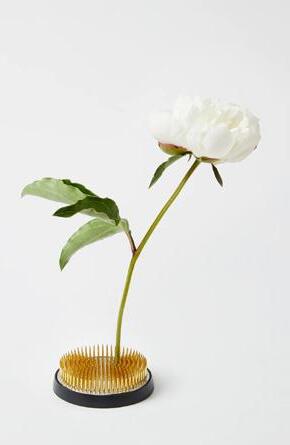
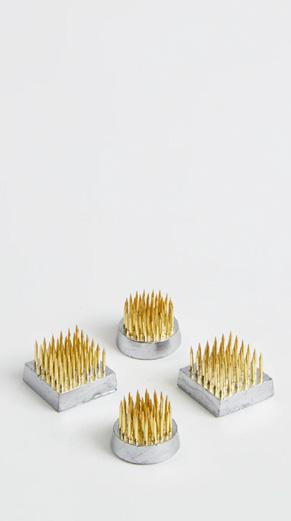
The floral design tool everyone needs

Artist:
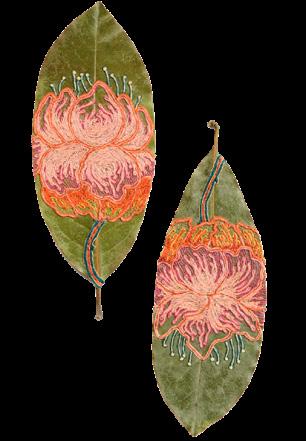
Hillary Waters Fayle
Using dainty embroidery stitches worked on fragile collected leaves, Hillary Waters Fayle creates pieces that represent the relationship between humans and nature. As artist Hillary Waters Fayle says, “When we are connected to the land, we’re connected to ourselves, and one another.” Her collection of hand-embroidered leaves is a testament to that. Using dainty embroidery stitches worked on fragile collected leaves, Hillary creates pieces that perfectly represent the intricate relationship between humans and nature.
As Hillary explains, “My work is a celebration of what can be done when we are gentle and act with care.” Plants and cloth both represent specific and symbolic connections to place, time, people and memory. Leaves are infinitely replenish-able, uniquely exquisite, ubiquitous to the point of being taken for granted- remarkable, yet invisible. Plants connect us directly to the land, grounding us in our understanding of our place on the planet. We all have a deep historical and lived experience with cloth. Powerful and ever present.
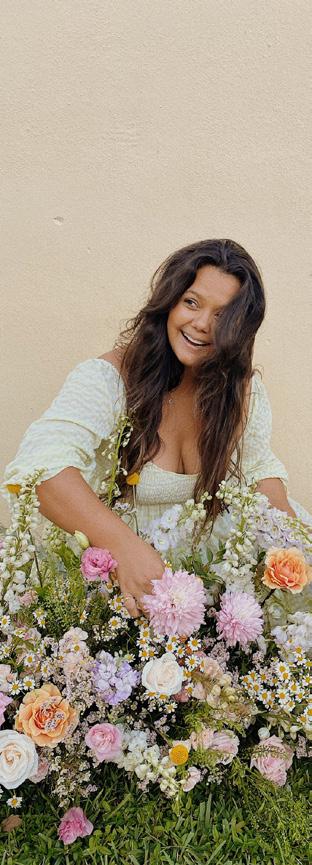
As a rule, make your bouquet about one and a half times taller than its container. You should also balance the width and the height.
Remove any thorns or leaves from flowers. This will prevent harmful bacteria from entering the water and reducing their lifespan.
To help roses open more quickly, blow into the center of the bud. This allows the rose to breathe and extends the width of the bloom.
For a farmgirl-esque arrangement, choose one type of flower in either a single color or two complementary hues and two types of greenery, one that’s typically hardier and one that’s lighter and more whimsical.
Make the greenery higher on one side and let it spill over on the other to give your arrangement a slight S-curve, to balance out the design and make you look like a pro!
Article written by Hadley Keller
By Rose Courteau
In the Tuscan countryside, scattered in a postcard landscape between Val d’Orcia and Val di Chiana, sits the town of Pienza, with its softly rounded hills and rows of cypresses and only a few houses scattered here and there. This is where sisters Teresa and Laura Cugusi grew up in the farmhouse of their grandfather, who arrived in Tuscany from Sardinia between the 1960s and ’70s. All around it are 50 hectares (123 acres) of farmland; olive trees; woods; and, today, thanks to the two sisters, a lush flower garden or, rather, a flower farm with a floral design workshop.
“After studying and working in a wide range of fields in various parts of Italy, we decided to go back home, where our roots are, and start a project bound to tradition and to our land, but innovative as well,” they say. “We wanted to invest here where we were born.” The pastureland, unused for a long time by their veterinarian father, has become a colorful reserve of flowers—a sort of open-air laboratory. And Puscina Flowers, named for the ancient farm, is now the sisters’ family farm.
“We began about six years ago picking the seeds of plants in the area—wild cornflowers and poppies, ornamental cosmos and zinnias, grasses, and other varieties from the garden that we used to compose our first bouquets,” say the pair, who then moved on to the actual cultivation, drawing on both ancient seeds and new rhizomes, tradition and research. “Today we passionately cultivate over 200 species and 400 varieties of cut flowers and foliage.”
