Katherine Bradford
Lois Dodd Maja Ruznic
Katherine Bradford
Lois Dodd
30 July — 13 September 2026
Maja Ruznic
MAYA FRODEMAN GALLERY
Katherine Bradford
Lois Dodd
30 July — 13 September 2026
By John Yau
This exhibition brings together three artists from three different generations and historical circumstances. Maja Ruznic was born in 1983 in the former Socialist Federal Republic of Yugoslavia (now Bosnia and Herzogovina). Katherine Bradford was born in New York in 1942, grew up in Connecticut, and, while living in Maine in the early 1970s, committed herself to becoming an artist and soon after moved to New York as single mother of two children to pursue her dream. Dodd was born in Montclair, New Jersey, in 1927 and attended Cooper Union, a tuition-free art school, on the edge of Manhattan’s Greenwich Village and East Village. While they are separated by nearly half-a-century, and took very different paths to becoming an artist, they share the following traits: they are fiercely independent painters whose work is imbued with unmistakable formal strengths—mastery of their mediums, inventive compositions, richness of color, attention to tonal relationships, use of mark, transparency, layering, and opacity. The result of this synthesis is work that is visually immediate but slow to reveal itself.
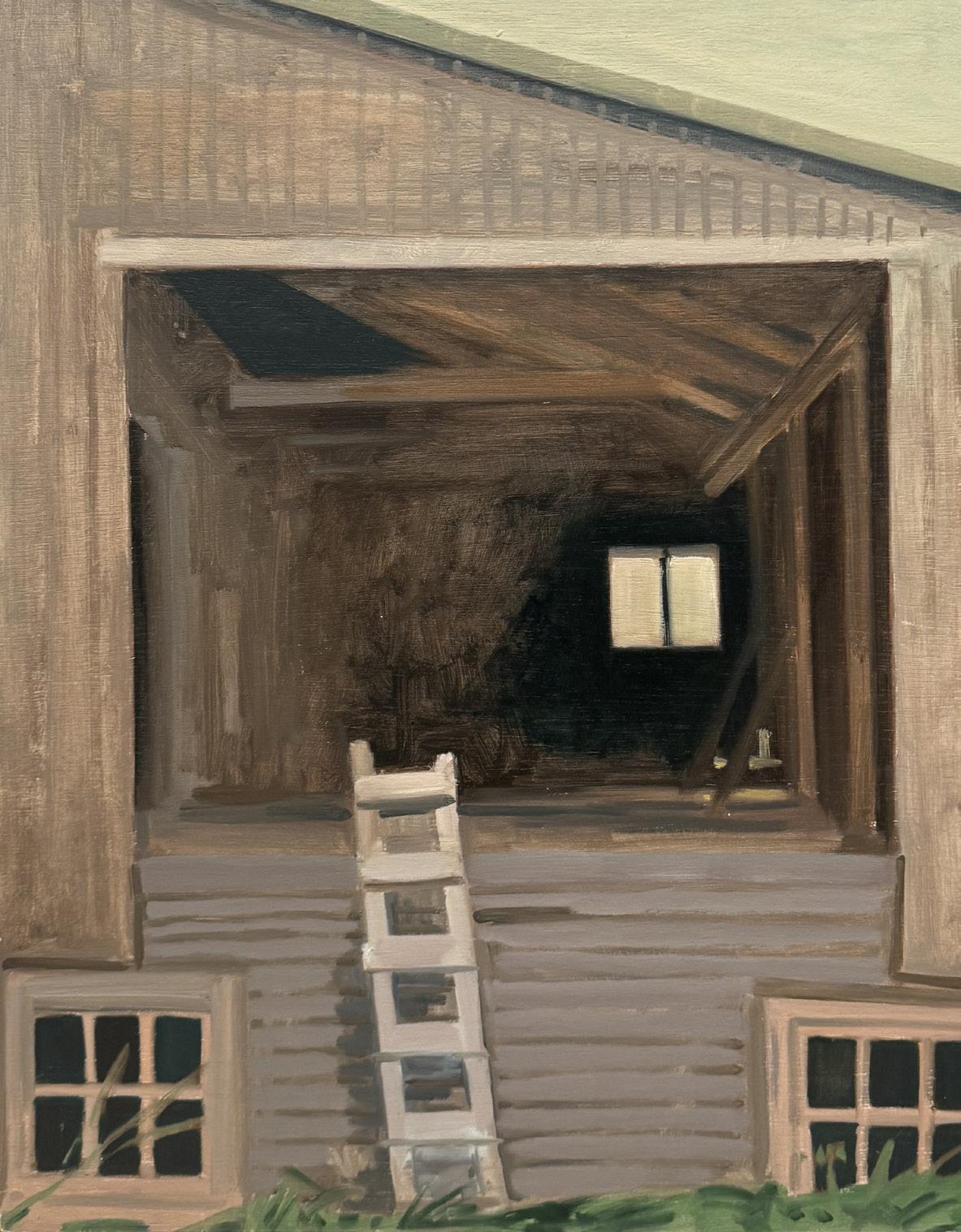
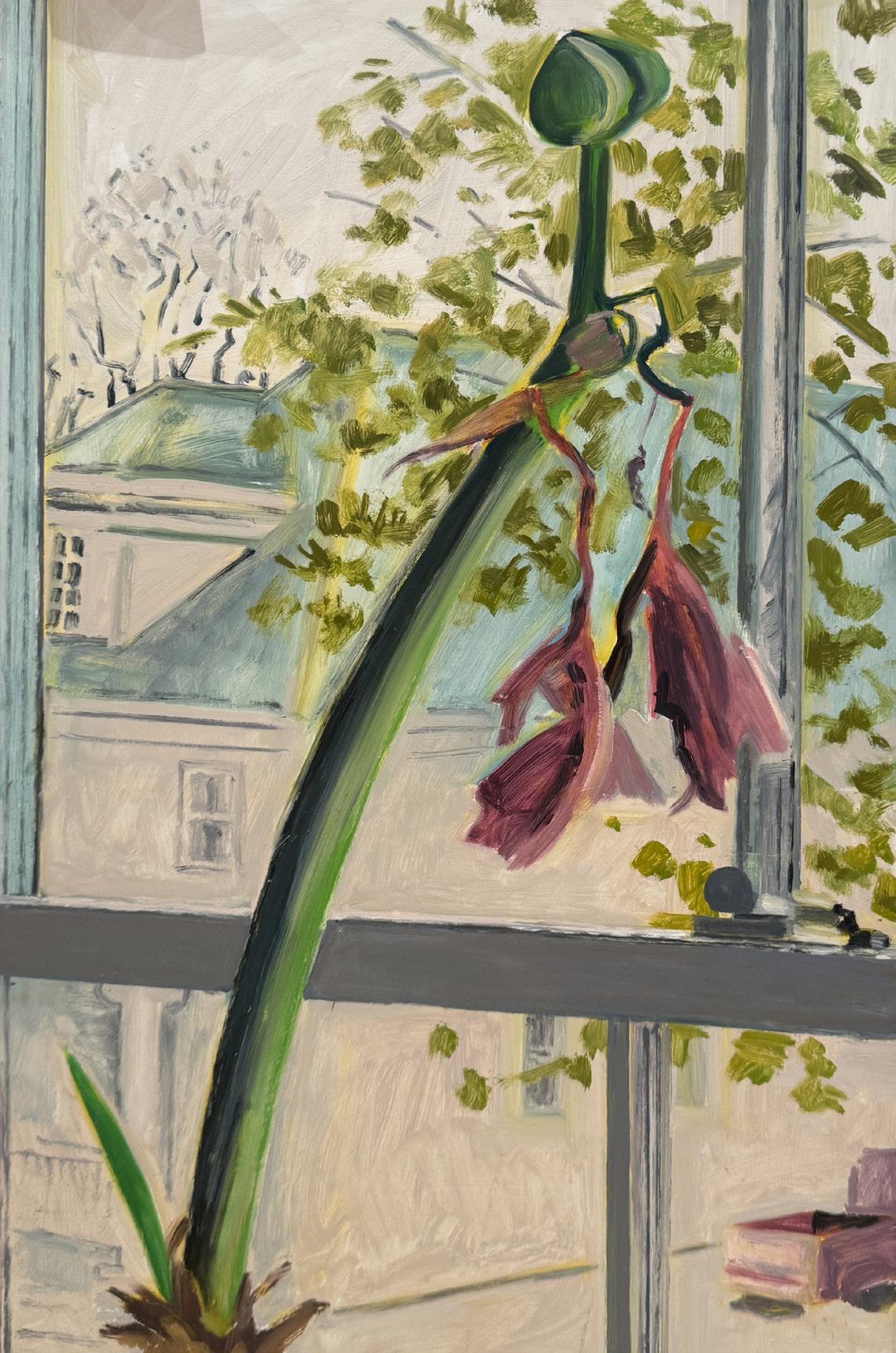
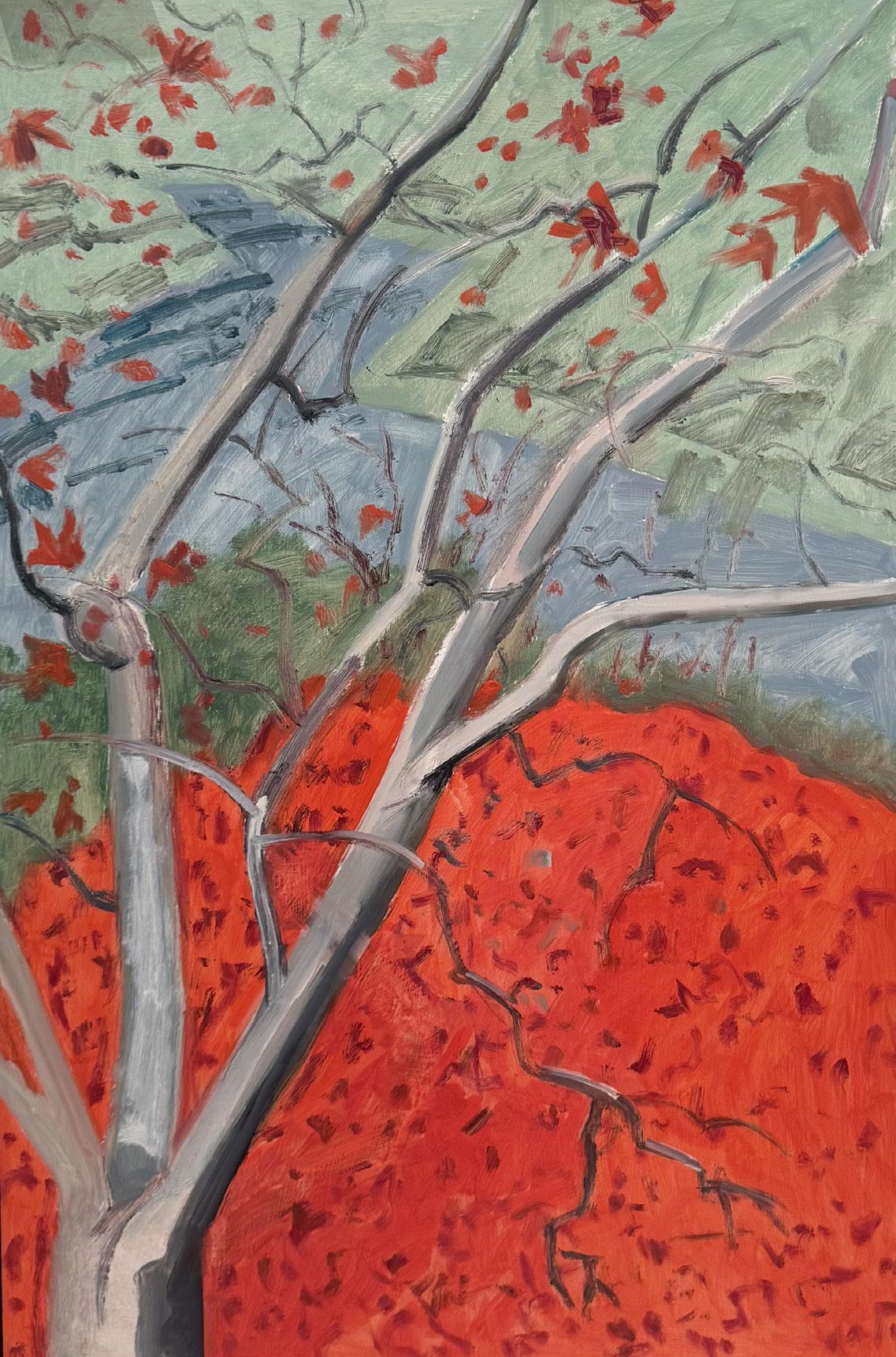
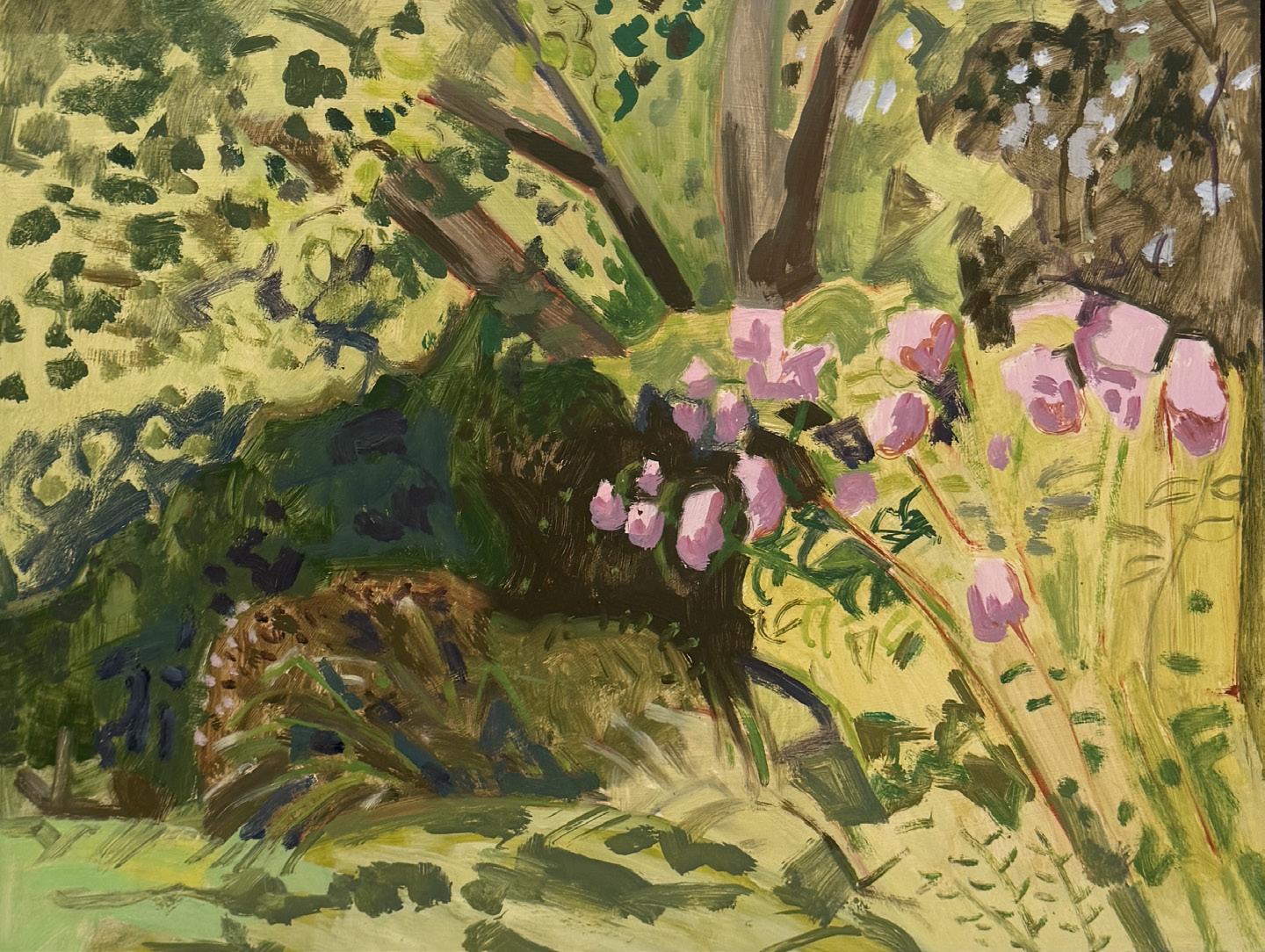
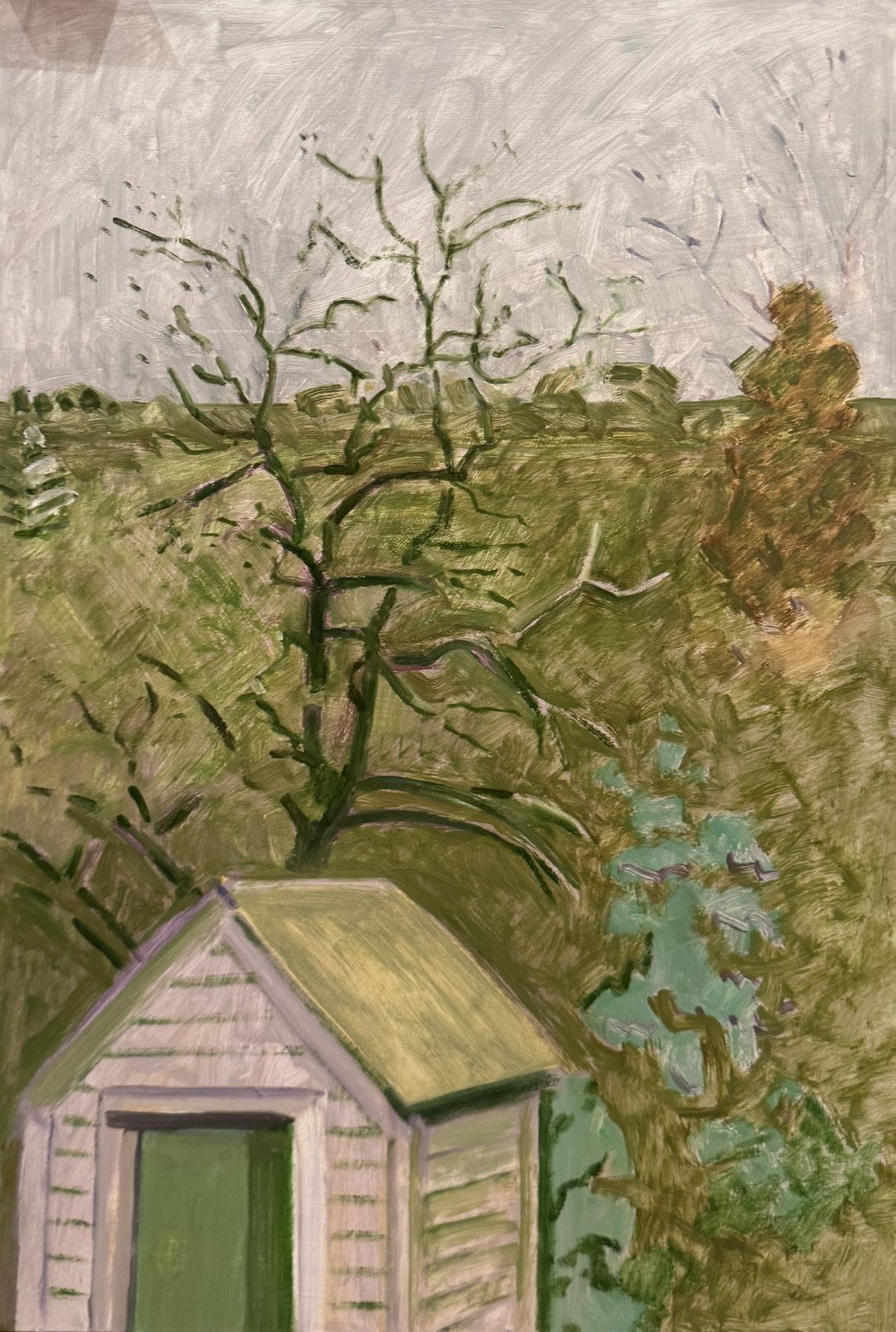
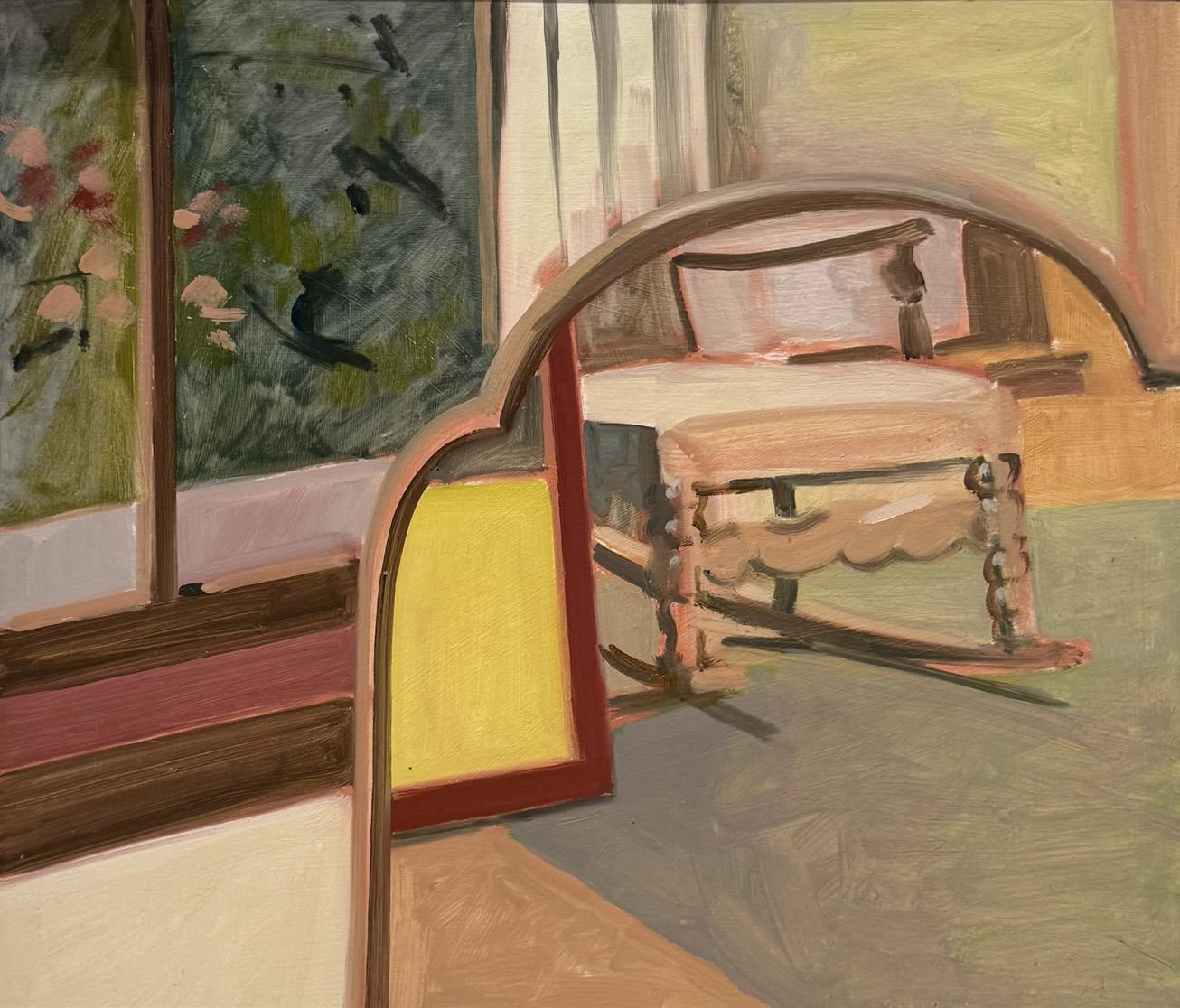
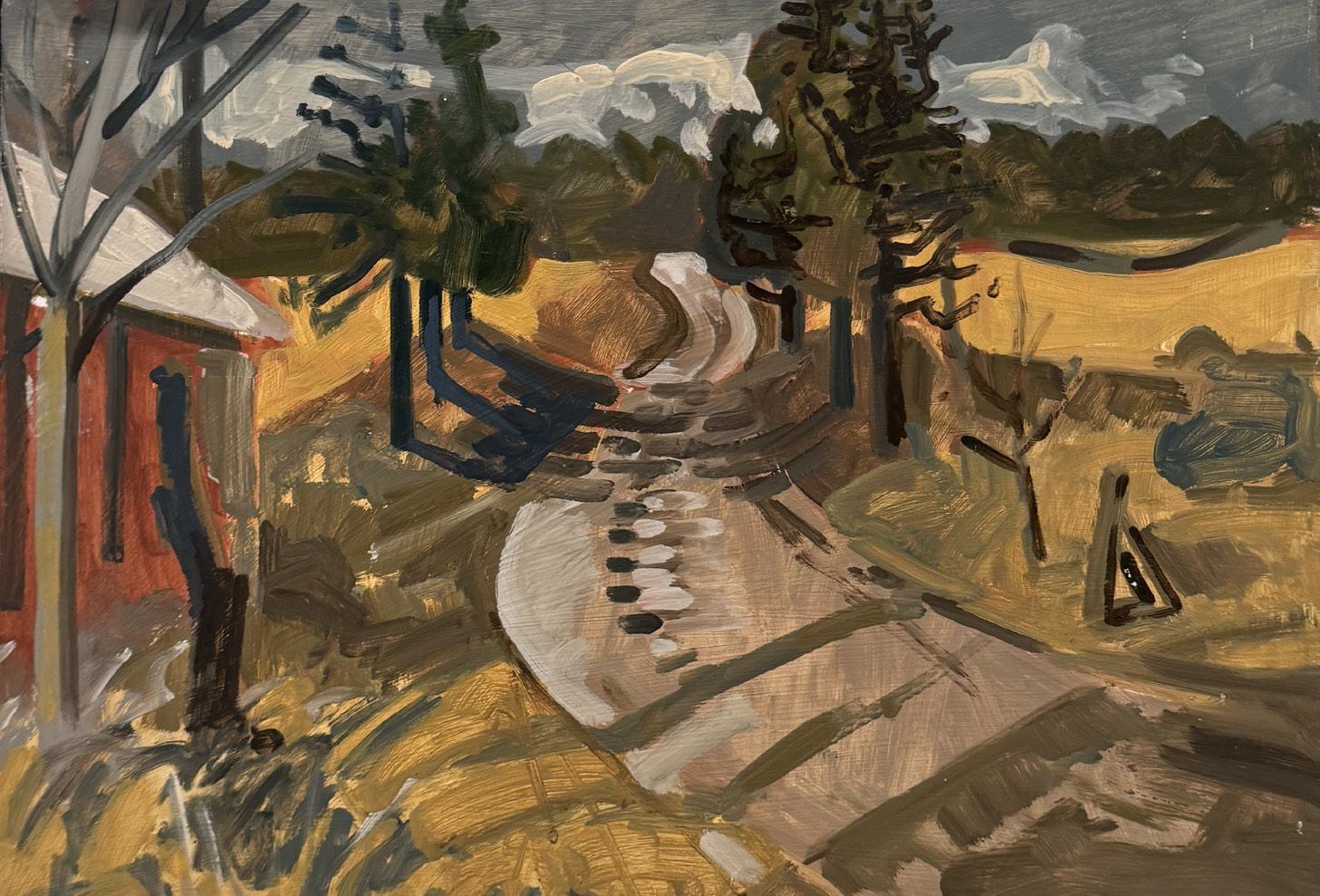
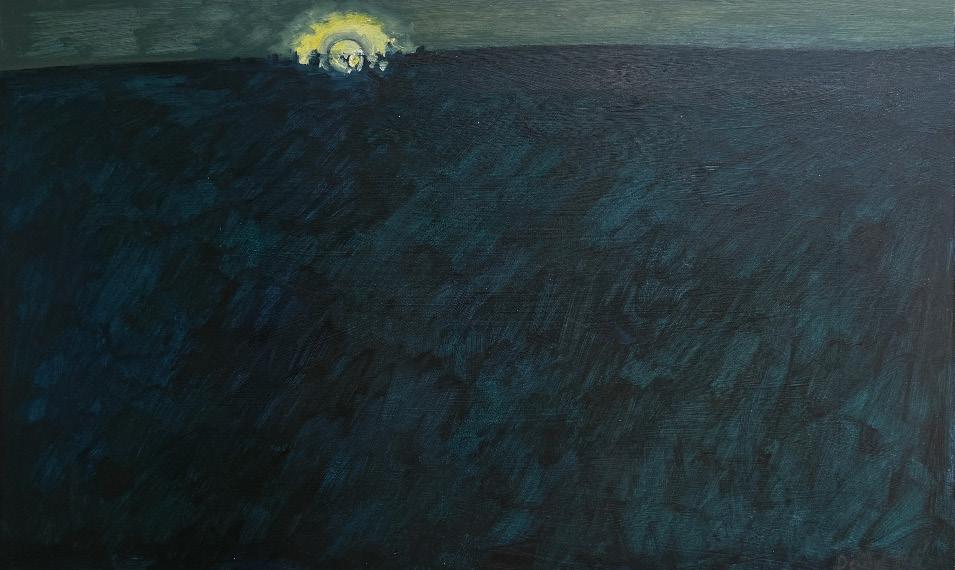
Modest in scale and done on site in oil, Dodd’s paintings span 35 years (1982-2017). The tallest one is 19 ¾ inches, while the widest is 20 inches. She uses thin paint and completes them in one sitting. In Moon Set at Water Gap (1982), it is the specificity of a moment so ordinary you would not pay a second thought to it if Dodd had not transformed it into a painting. We are looking at the moon setting near the top of the painting. This precision is true of all her work, no matter how commonplace the view or subject initially appears. We are looking at a painting of a particular moment.
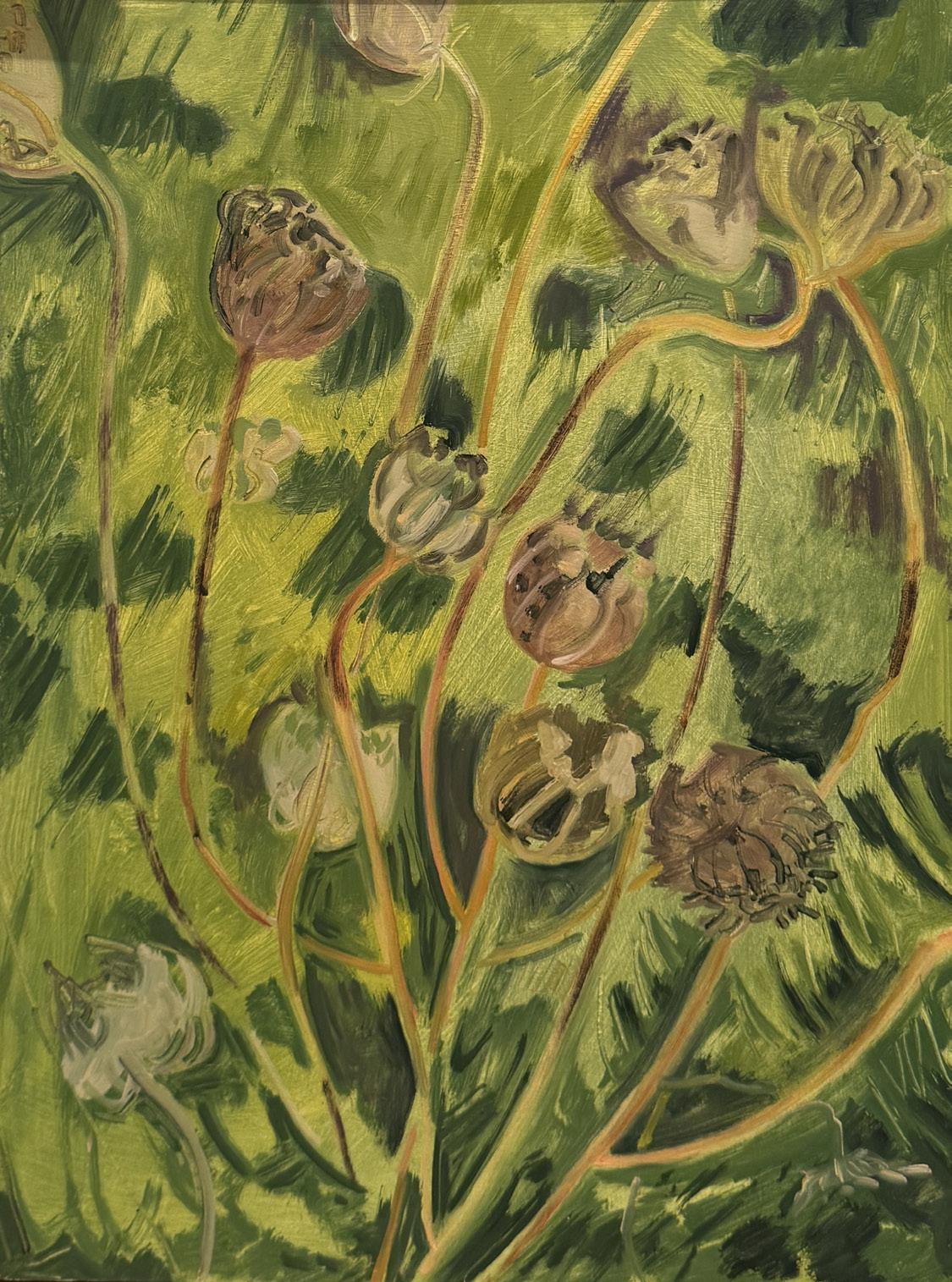
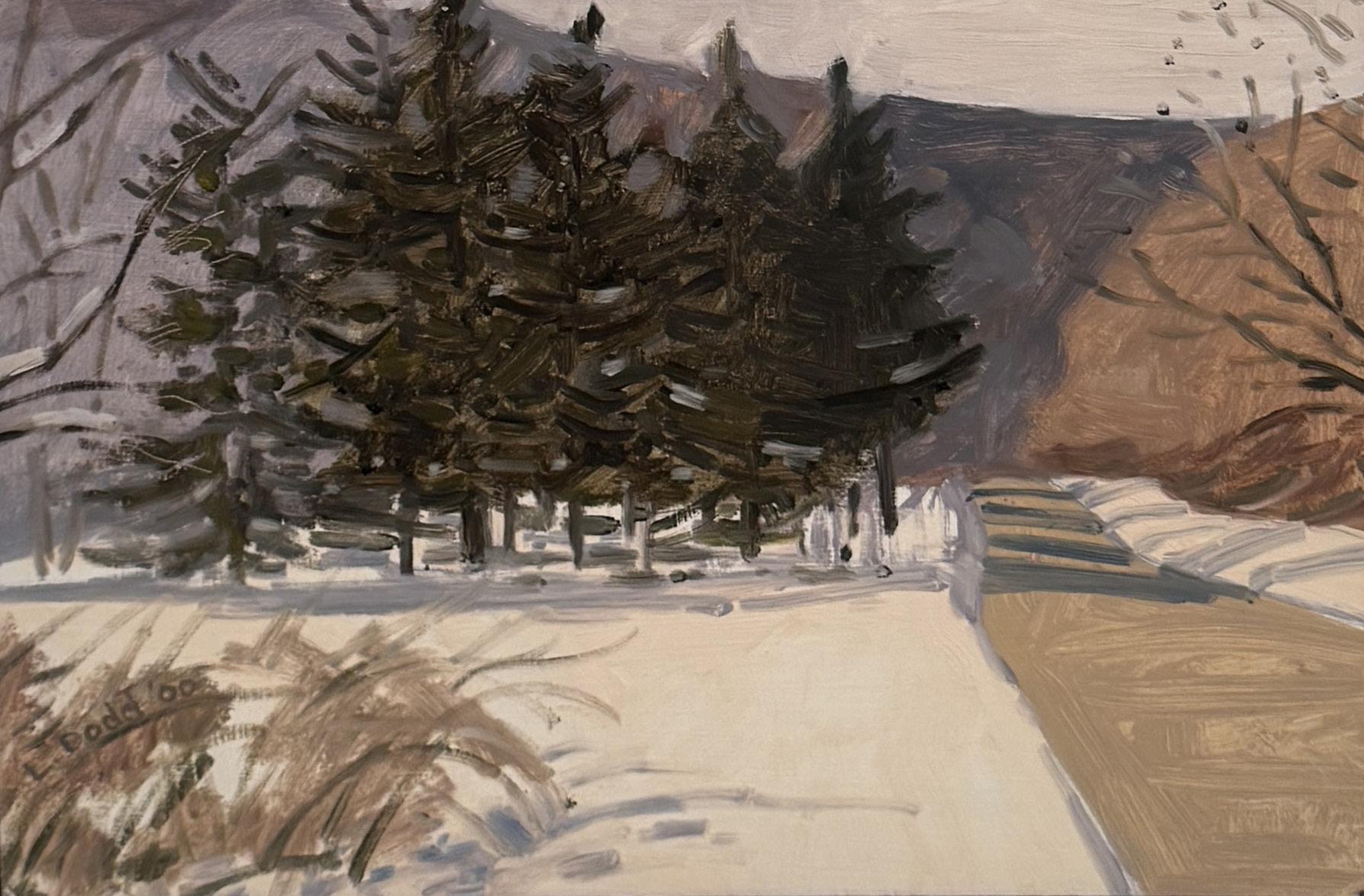
Dodd’s paintings speak to an essential human condition, our solitary existence in a constantly changing world. She is looking at Dried Up Queen Anne’s Lace (2008), and a field of snow, a stand of fir trees, and an empty road in At Water Gap (2000). In At Water Gap, the road cuts in diagonally from the painting’s lower right corner, stopping halfway up the painting. Four gray shadows of bare tree trunks stretch across the road, like obstacles. A mountain range, grey on one side and brown on the other, rises where the road vanishes. The painter is standing in the field to the left of the road, having reached her destination. She is looking at what is in front of her. Whether she is standing beside a road in late autumn or looking at dead flowers in a field, there is no other place she would rather be. There are no panoramic or elevated views in Dodd’s work, no feeling of yearning. The contentment and joy we feel in her painting comes from seeing the everyday world in all its forlorn beauty.
Dodd’s views recall the chapter, “Solitude,” which is part of Henry David Thoreau’s Walden (1854). In it, he describes his relation to things in the physical world and to space, the infinite universe in which he exists:
“I am no more lonely than a single mullein or dandelion in a pasture, or a bean leaf, or sorrel, or a horsefly, or a bumble-bee. I am no more lonely than the Mill Brook, or a weathercock, or the northstar, or the south wind, or an April shower, or a January thaw, or the first spider in a new house.”
One can easily imagine Dodd seeing and painting any one of the things Thoreau writes about or him being exactly in the physical place standing where Dodd first glimpsed a view that captivated her and writing sentences that would fit in with the ones I have cited. Thoreau’s oft quoted words resonate;
“If a man does not keep pace with his companions, perhaps it is because he hears a different drummer. Let him step to the music which he hears, however measured or far away.”
Never a stylish painter, Dodd never resorted to gesture, working large advertising, or celebrity in her work. She worked quietly on her own for decades, until the world caught up with her.
*
In 2007, I characterized Katherine Bradford’s paintings as follows:
“We can’t figure out exactly what is going on. The longer we look, the more suggestive Bradford’s abraded brushstrokes, dabs, irregular patches and scumbling become. It’s as if we have entered a trance-like state that is similar to the one possessing the figures in her paintings. Bradford knows her medium well enough to trust it, and, more importantly, to let her marks become evocative without nudging them into an easily definable realm.”
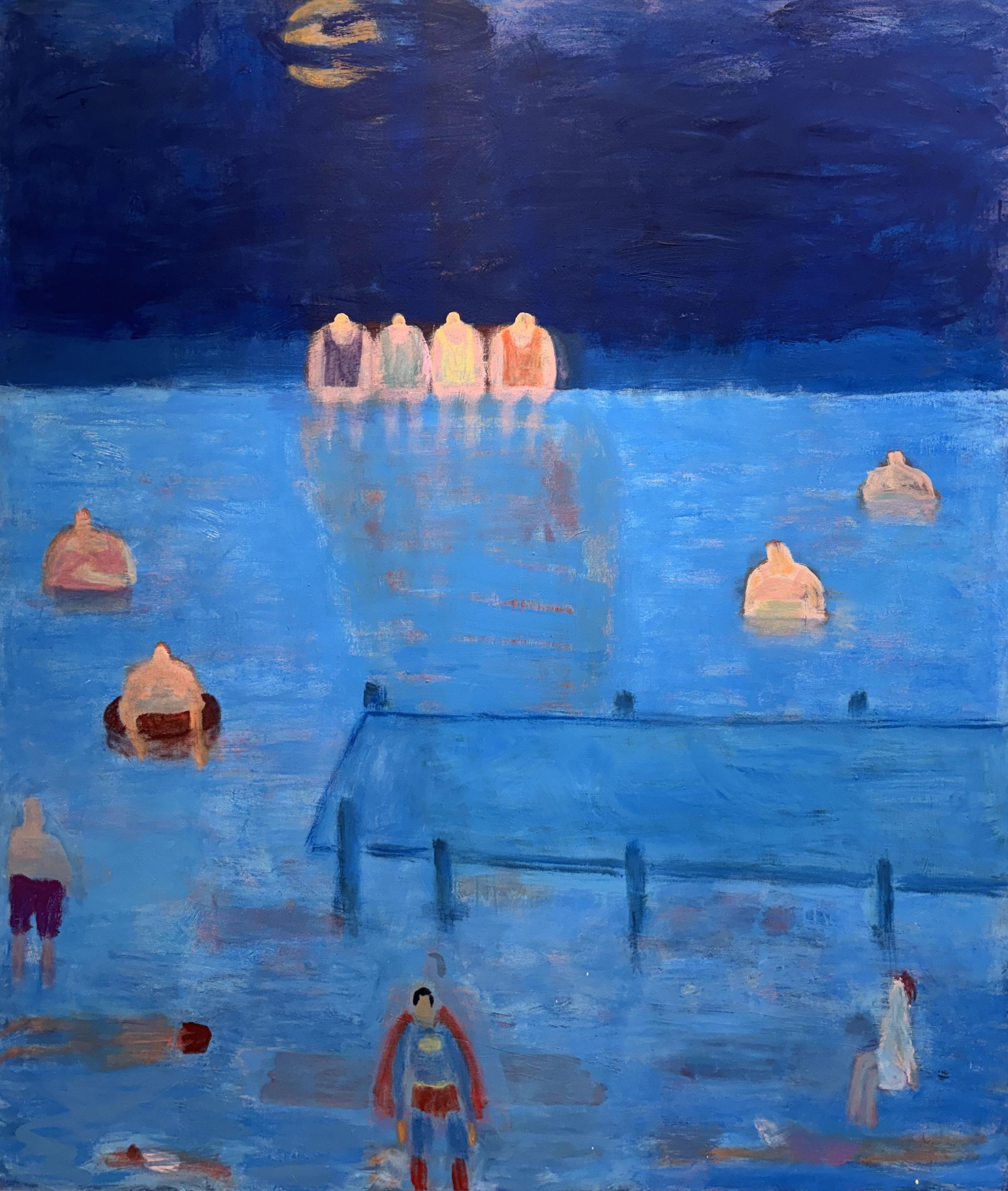
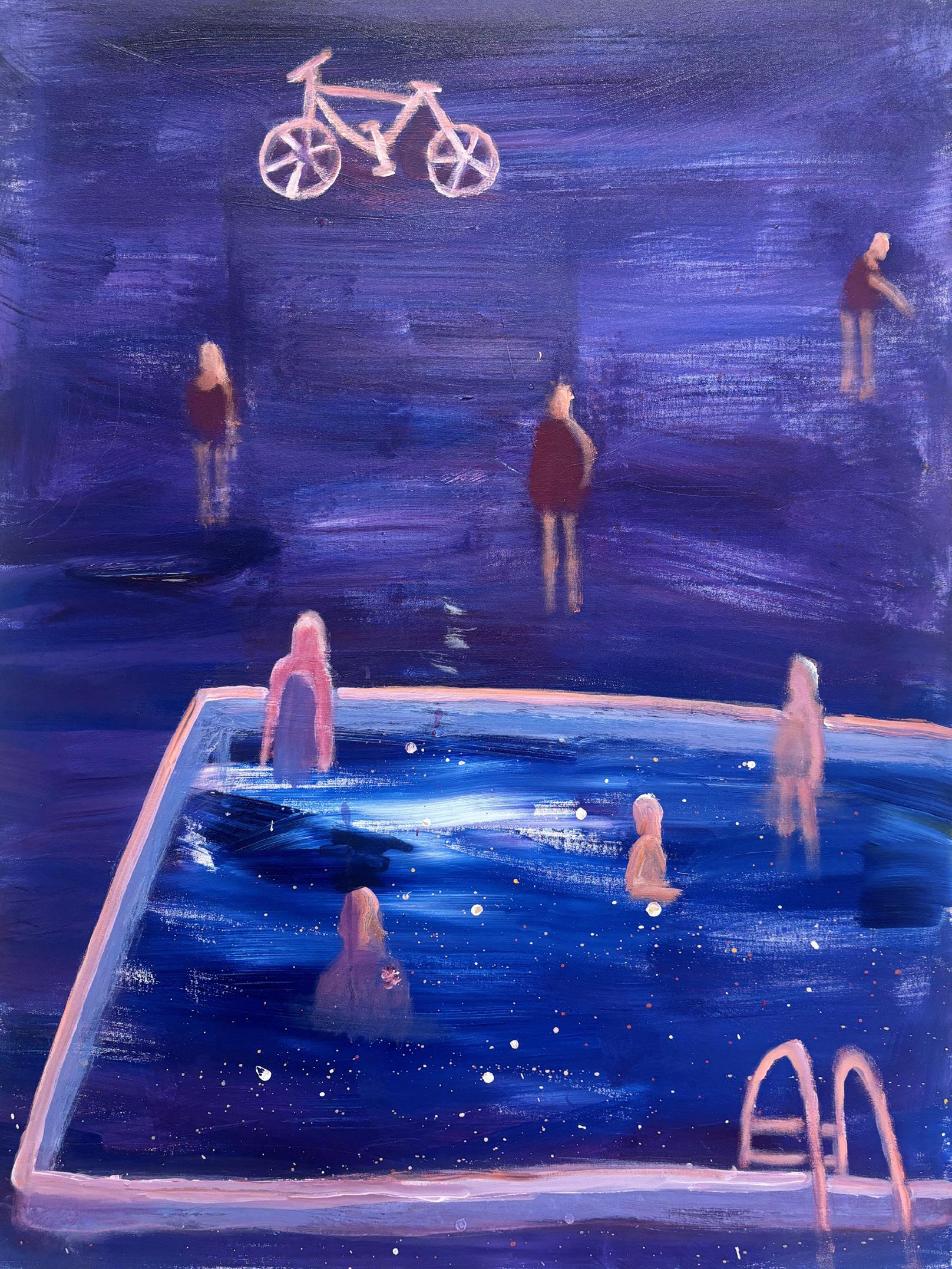
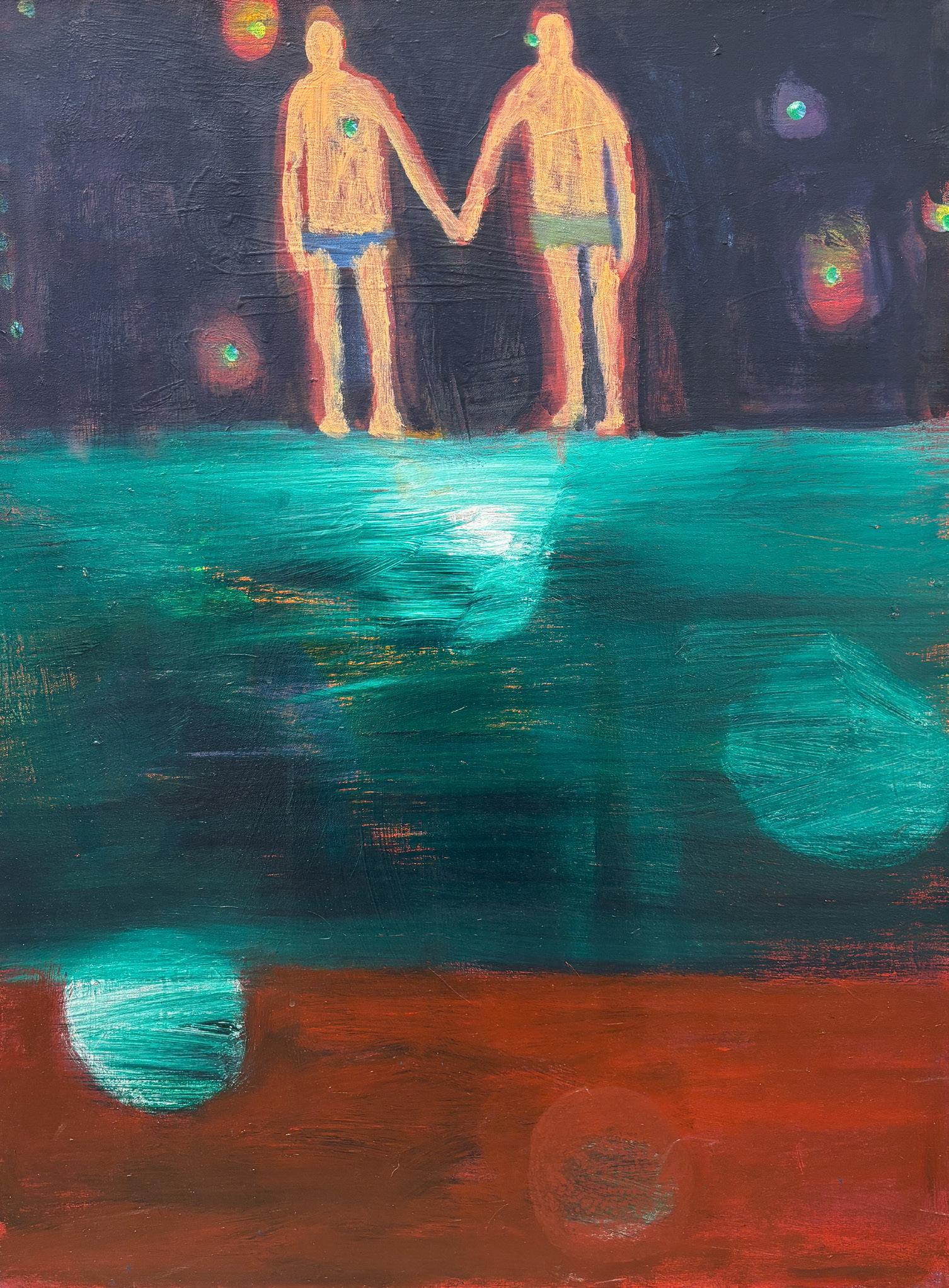
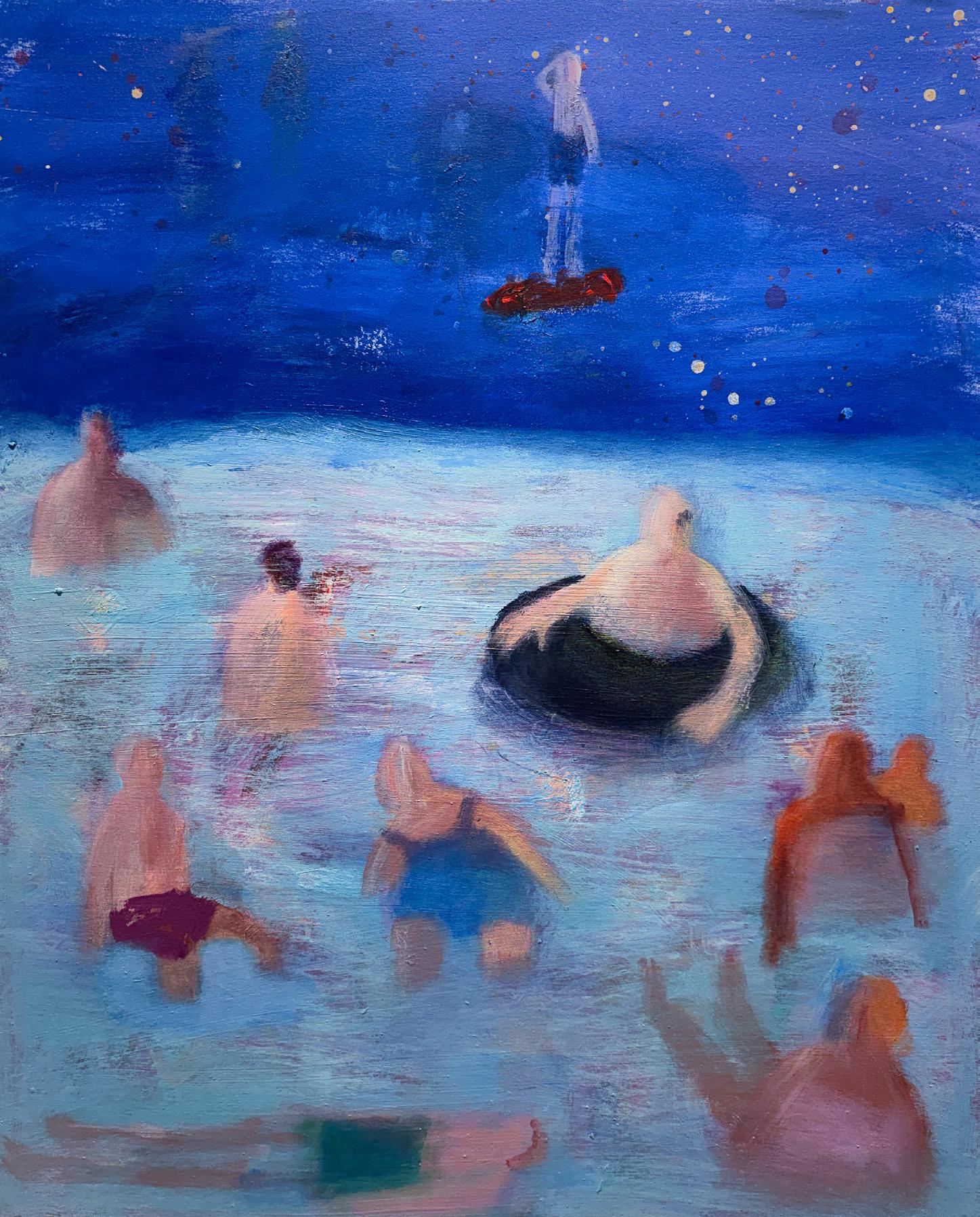
Nearly twenty years later, I would not change a word of this paragraph to describe Bradford’s recent work. This is because – while her work has undergone several transfigurations since then – she has never abandoned her original preoccupations with paint’s evocative capacity to create mysterious, self-contained worlds. Completed this year, the paintings depict an elemental world of water and light populated by featureless swimmers, either as affectionate couples or in groups. Bradford’s elemental world is distinguished by its emphasis on communities, whether made of same-sex couples, friends, or strangers who share a love for water and swimming. In contrast to Dodd, who paints what she sees, Bradford’s paintings arise from her imagination mixed with a quirky humor.
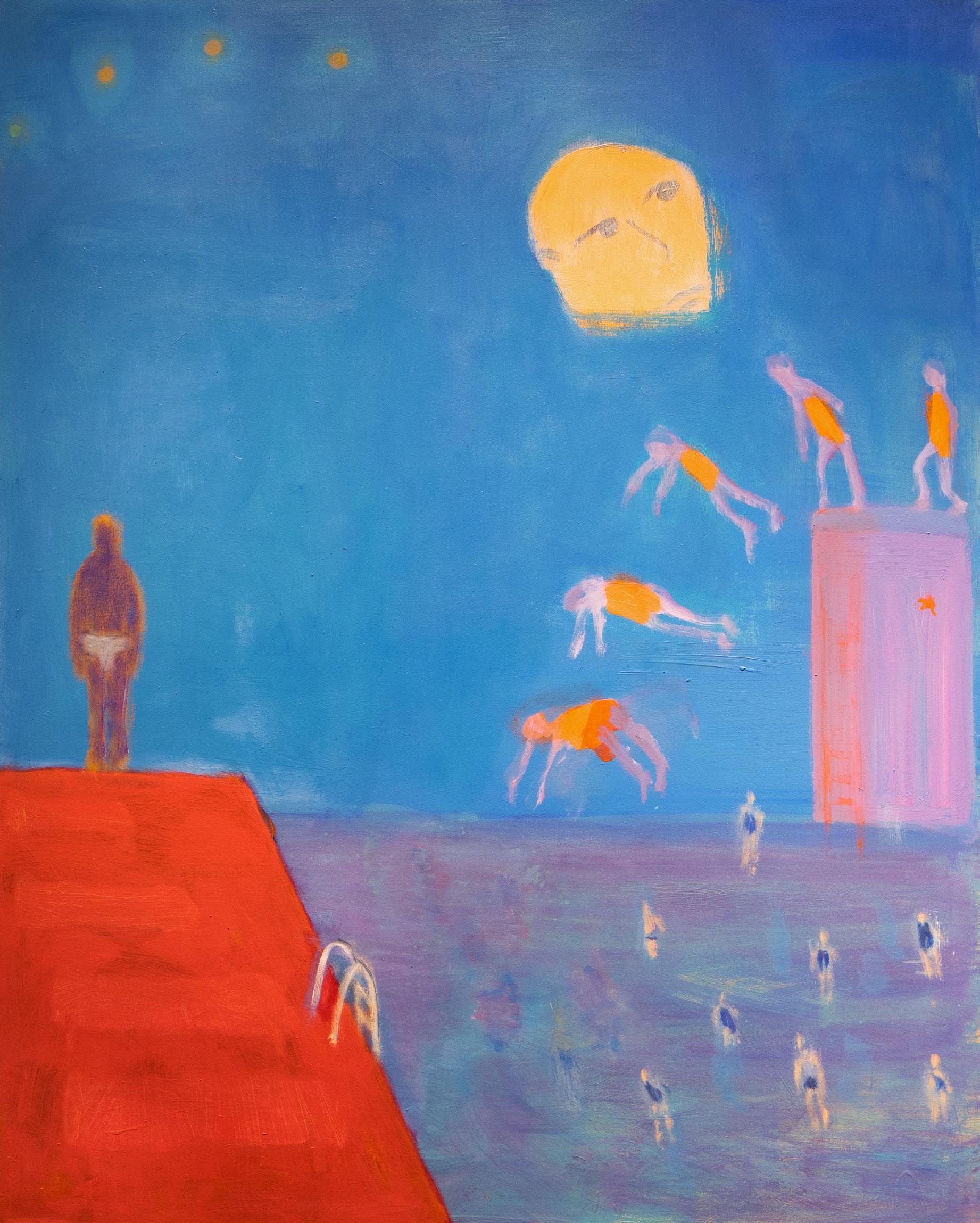
The Diving Team (2026) is a rectangle that can be read as vertically divided down the middle. On the painting’s right side, Bradford depicts five violet-skinned women in orange bathing suits diving off a violet monolith extending in from the middle-third of the painting’s right side. As they jump, one after another, they look awkward as if they could be falling face down into the water, with the lead figure and the largest landing in the lower middle of the of the painting. Is the diving synchronized or are they lemmings following their leader? Bradford leaves this question unanswered, as she does in many of her paintings. She does not want to explain what is inherently mysterious about the world.
Above the divers we see a large, bald, misshapen, yellow faced head, looking up. Is this the man in the moon? Below the moon and divers, in the water, we see a group of diminutive figures wearing blue bathing suits. Are they members of the other team? The shift in scale from the large divers to the tiny swimmers underscores the internal logic of Bradford’s world making.
On the painting’s left side, a large irregular red rectangle has been fitted into the painting’s lower corner. Tilting forward in space, and opposite the monolith, the top edge ends about one third up the painting. A violet-skinned man with yellow halation outlining his body is standing on the top edge, hands straight down, stiff. In the luminous blue sky above his head, we see four small yellow circles (stars) form an arc.
The Diving Team seamlessly joins two worlds together; each is an inhabited watery world below a night sky. The moon floats above a world largely populated by women, while the stars preside over a lone male. The symbolism and metaphor are there to be gleaned but never becomes heavy-handed. At the same time,
this gives the painting further depth, as solitude and community are seen as inseparable. Once we see these distinct but connected worlds, we notice rhymes between them, the stars’ arc echoes the one formed by the diving women. As suggestive as this composition is, the painting resists any reductive reading. We see the different worlds populated by the separate groups, each identified by the color of what they are wearing, all held together in an elemental world of sky and water. There is no single story to explain this painting, as each of us will have our own interpretation.
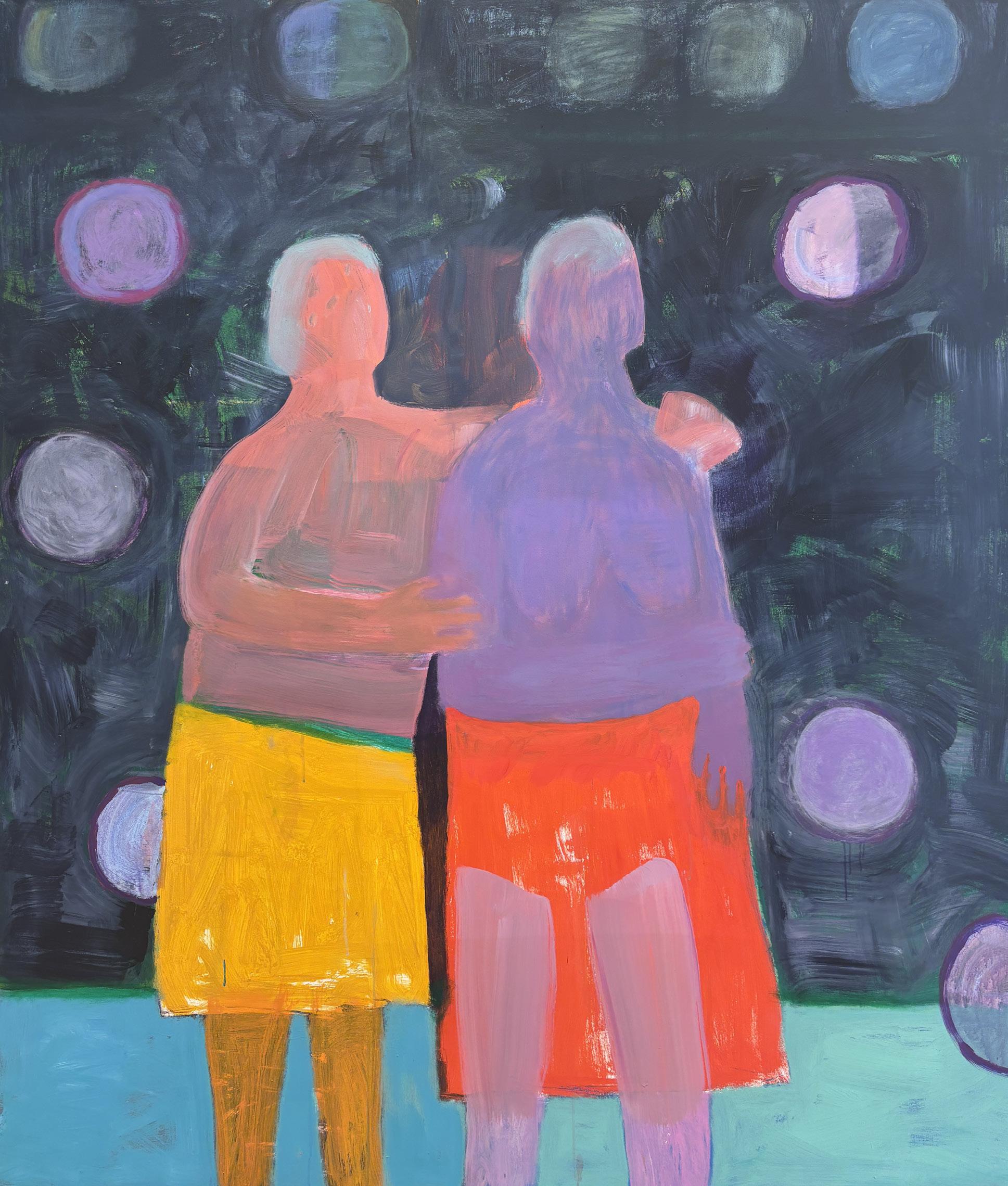
This openness combined with luminous light and rich, upbeat colors enables Bradford to touch upon loaded subject matter, such as same sex relationships, as in the tripartite painting, Men Holding Hands (Night) (2026). Surrounded by different-colored cosmic orbs with green centers in the dark charcoal gray sky behind them, the two men, who are standing in the upper third of the painting, are poised at the edge of a wide swath of scumbled green water directly below them. The green water is stacked above a band of red water, each of which contain large, submerged orbs. Men Holding Hands (Night) is brimming with a joyful tenderness that goes beyond any socially conscious message. The green circle on one of the men’s chests underscores what the astronomer Carl Sagan said of humankind: “we are all made of star-stuff” and, as Bradford’s paintings suggest, water.
* Invited by the art historian Phyllis Tuchman to write about abstraction for The Brooklyn Rail (September 2024), Maja Ruznic concluded her essay “What is abstraction” with these words:
“Art should not tell us what we already know. It should allow us to question our beliefs; in fact, it should make us uncomfortable. Abstraction has a way of doing this in a subtle way, it has a way of working on us by undoing us.”
Ruznic’s belief in the necessity of discomfort connects her with the Surrealists and their insistence on the disorienting jolt of the “marvelous.” Like the Surrealists, she channels unsettling memories and inexplicable dreams into her work. It is her connection to the occult, what is hidden but never absent, that informs her work, makes it both alluring and unsettling, riveting and opaque. She is inspired by the invisible.
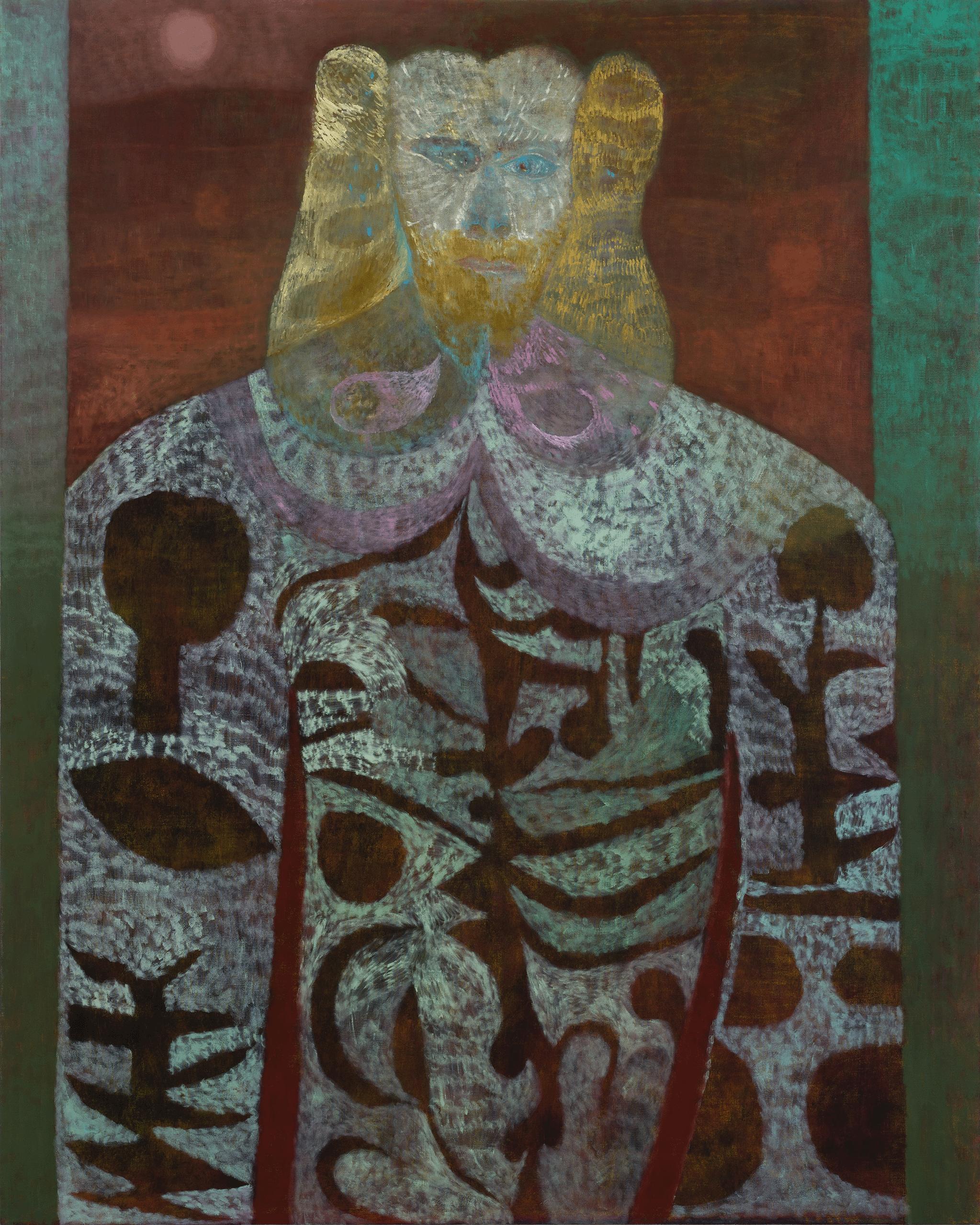
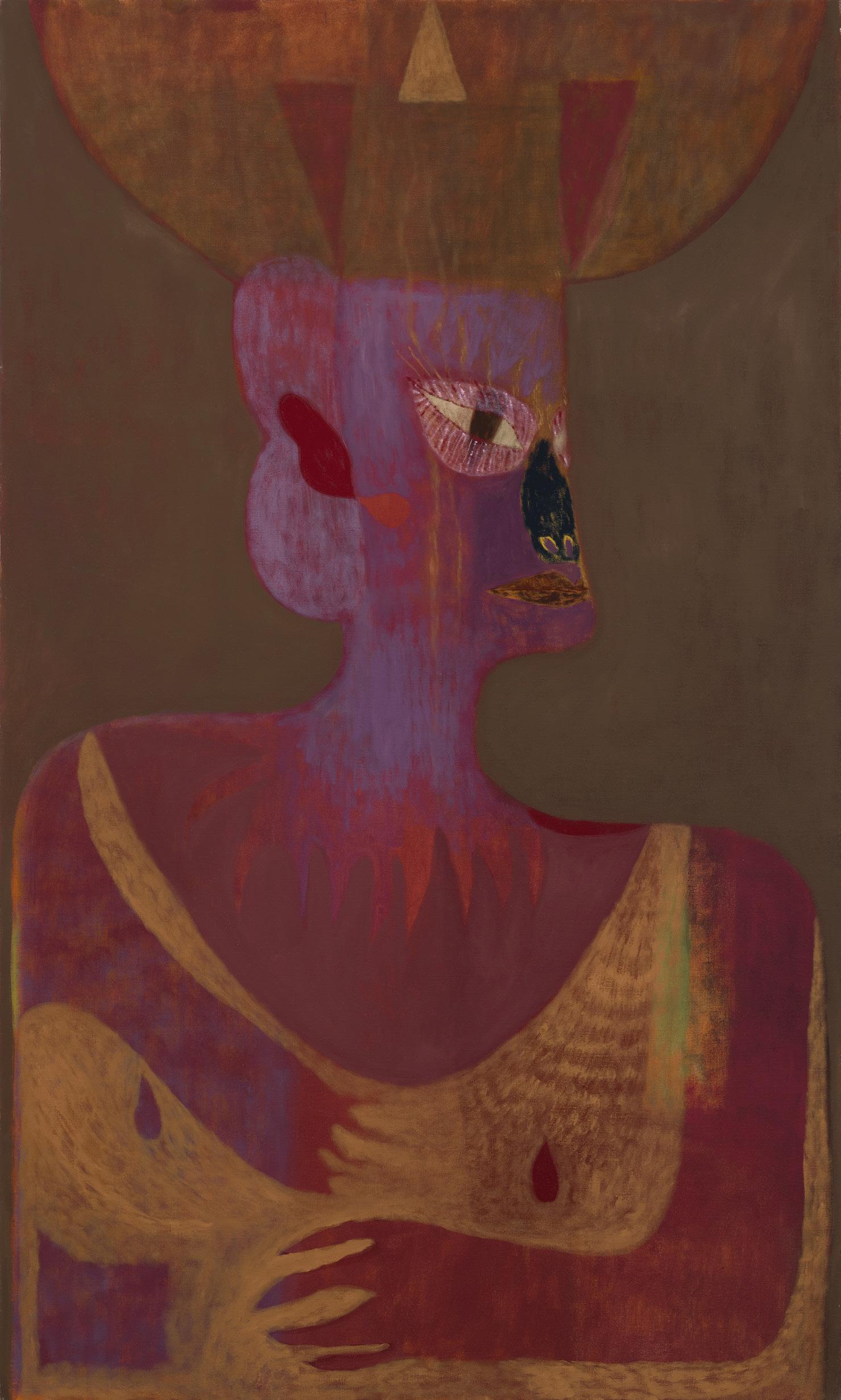
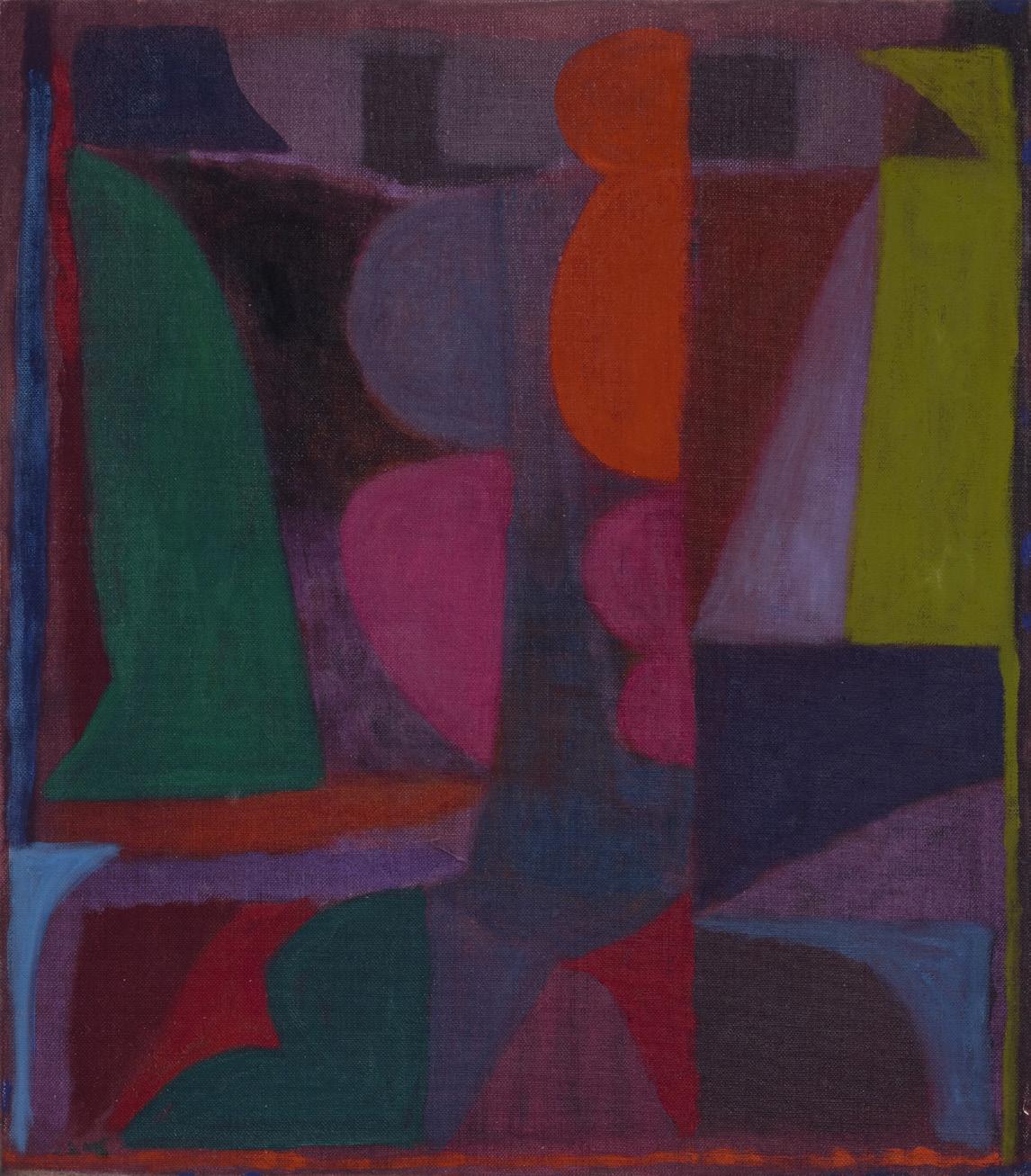
For this exhibition, Ruznic has contributed four paintings, two figurative and two abstract. The two figurative paintings, which are significantly larger than the abstract ones, are titled GriefBearer(2025) and GriefBearer II(2026), while the latter, modestly scaled paintings are titled The Inside of My Liver and Drive Your Plow Over the Bones of the Dead (both 2026). By having her titles provide a context for how to see the paintings, they pull the viewer into a territory, where abstraction is no longer pure and about itself, and subjectivity and the illogical have replaced objectivity and the rational. We are invited into a world turned upside-down.
On a visual level, Ruznic’s work bears little resemblance to Dodd’s observed views or Bradford’s color saturated worlds springing from her imagination. They conjure an arcane world of private mythology, personal symbols, and chthonic light. Her paintings slowly emerge from the caves of her unconscious, layer by layer, until they are finished, lit by an inner light. What elevates them beyond the dream’s susceptibility to narrative is their resistance to clarity. What we encounter in Ruznic’s work is an enthralling ambiguity.
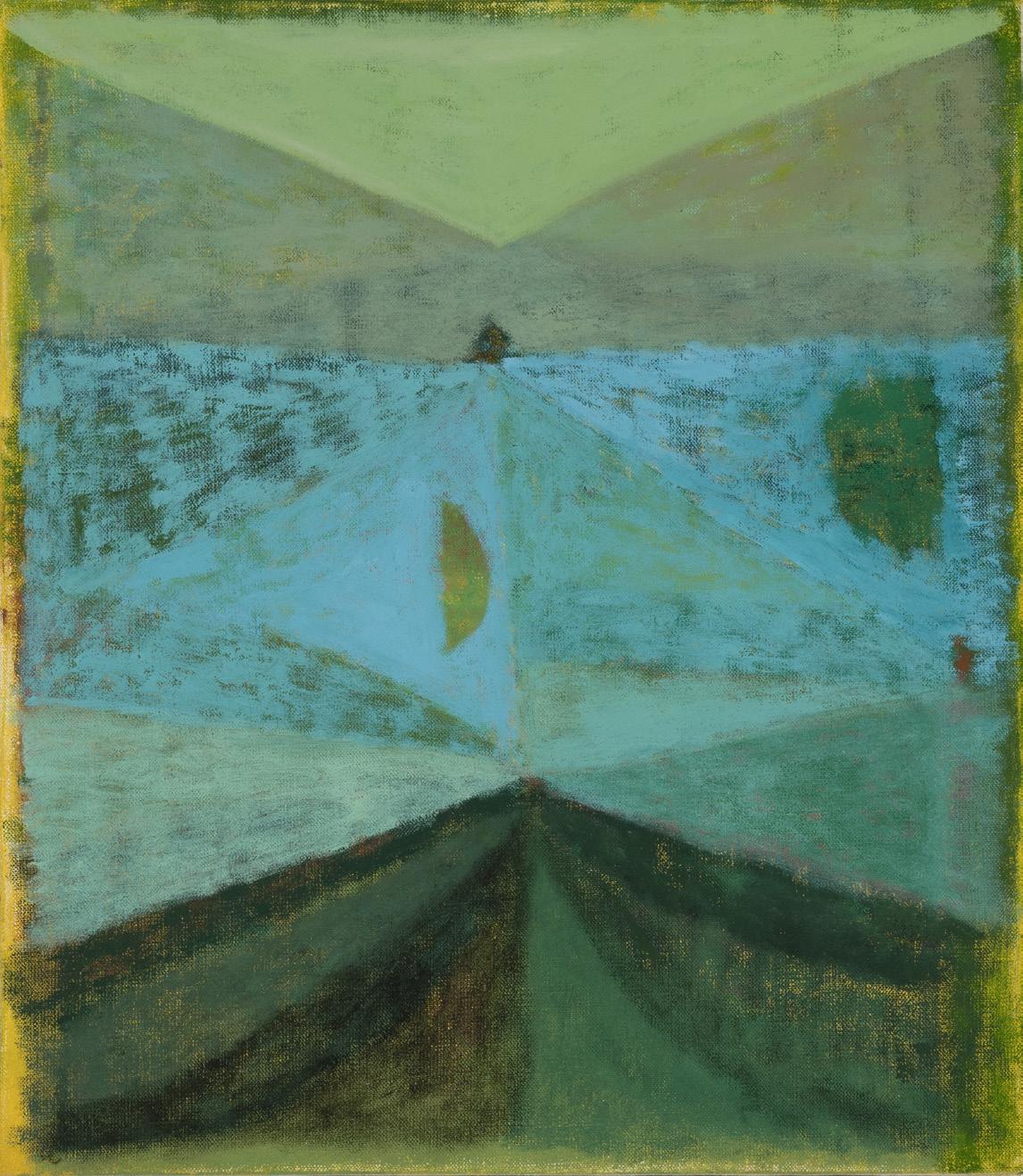
In Drive Your Plow Over the Bones of the Dead , a kaleidoscopic landscape of fitted together triangles, who
is the imperative being addressed to? Is it the painter or the viewer or both? What will the plow cover and what will it uncover? Does this process lead to recovery or recovering? Is the celadon green triangle descending from the top of the painting sky or landscape? How do we read the other triangles, each with their distinct identity? Isn’t the unstable relationship between seeing and naming one of the keys to Ruznic’s work? Doesn’t this instability challenge the Biblical story of God bringing Adam the animals to name? Isn’t Ruznic asking us to consider how we name what we see or, more precisely, witness in the world?
In The Inside of My Liver , Ruznic pivots from the external world to the liver, which the medieval world considered the body’s most important organ as it converted food to blood. Not only does Ruznic change her focus, but she uses a different lexicon of shapes and colors. If we are to take any cues from our reading of Drive Your Plow Over the Bones of the Dead , shouldn’t we consider what meanings can be assigned to the colors and abstract shapes. What can we conclude from Ruznic’s use of different reds? How are we to read the other colors, such as the different greens and violets? This is what I think Ruznic was getting at when she stated that abstraction was capable of subtly undoing us. She wants to heighten our consciousness as well as to become more alert to the occult world, its signs and intimations.
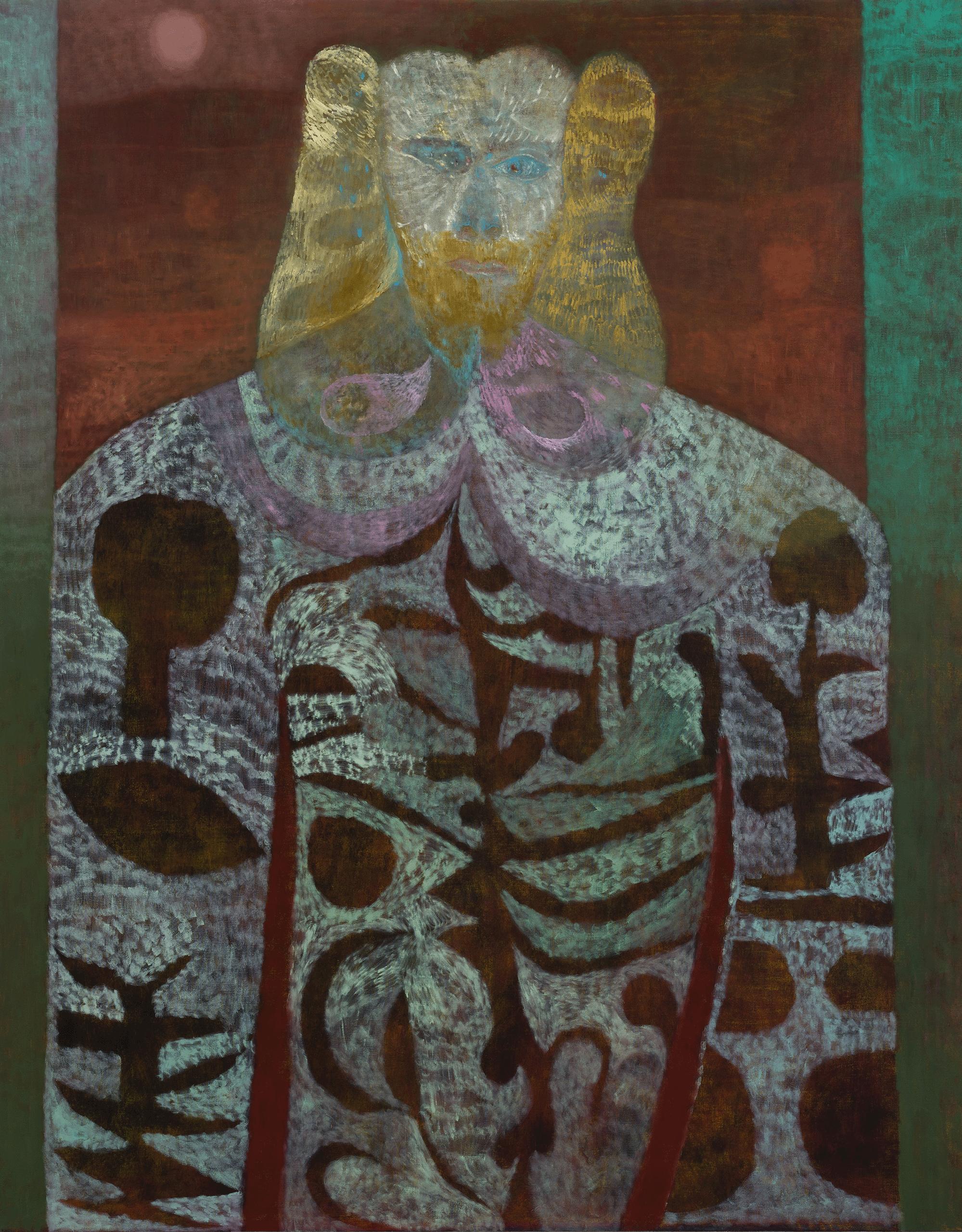
Grief Bearer and Grief Bearer II are personnages, representative beings in Ruznic’s cosmic view of reality. Their collective title suggests they exist to help us endure what we will inevitably suffer in our lifetimes, while acknowledging that we cannot bear this burden alone. In these paintings, which address a central feature of daily life, Ruznic refuses to embrace the masculine “I” that has long played a central role in Western painting. Grief Bearer strikes me as being male and Grief Bearer II female; both are descendants of ancient gods whose names are lost to us, having been transformed by time, the unexplained disappearance of civilizations, and the artist.
Grief strikes this viewer as an ambiguous synthesis of human and animal. Is he wearing a coat or is it his skin? What do the emblazoned silhouettes signify? The one on the right beneath his shoulder and on the lower left side can read as forms of plant life, but what do we make of the others? We are both invited in and turned back. Behind him, near the top of the painting, we see a horizon line and dusty pink orb floating in the sky, leading us ask where we are. The green bars on each side of him feel like a doorway that he is passing through from his world into ours. He has come to help us endure what is inevitable in our lives: irrevocable loss and the hole we feel.
Done in muted mixes of color (red, violet, green, umber) and one area of black (nose), GriefIIis simultaneously looking to the right (the future) and at us. Whatever path we are on, and however we get there, grief will accompany us and be ready to help us withstand what the future brings.
This is the question each of these artists asks in paint. What place to which they have transported us to? What can we learn from seeing it through their eyes? The questions we ask and the answers we reach, tell us as much about ourselves as it does about them. This is painting’s gift: it gets us to see and think in ways we haven’t before.
Guggenheim Award winner Katherine Bradford (American, b. 1942) is a New York based painter. She is best known for her large paintings of swimmers under dramatic skies of planets and stars.
In her 40’s she moved from her home in Maine to New York City bringing her school age twins with her as a single mother. She taught at the Pennsylvania Academy of Fine Arts (1997-2012) and was Senior Critic in the Yale MFA program (2016-2017). Now in her 80’s, she paints full time in a studio in the Williamsburg section of Brooklyn where she was among the first group of artists to move there. This past season she has had solo shows at her New York gallery, Canada, at Hyundai Gallery in Seoul Korea, and at Haverkampf Gallery in Berlin. Museum survey shows include the Portland Museum of Art, the Frye Museum in Seattle, Modern Museum at Fort Worth Texas and Kunsthaus Graz Contemporary Museum, Austria. Groups shows include David Zwirner, the ICA Boston, and Sperone Westwater. She is also represented by Kaufman Repetto in Milan, Tomio Koyama in Tokyo and Matthew Brown in LA. Her work is in the collections of the Metropolitan Museum, the Whitney Museum, the Brooklyn Museum, the Musée d’Art Moderne de Paris, the Hirshhorn Museum and Sculpture Garden in DC, and the Menil Family Collection in Texas, among others. Her glass mosaic murals can be found in L line subway stop at First Ave in New York City.
Biography courtesy of the artist.
“Bradford’s elemental world is distinguished by its emphasis on communities, whether made of same-sex couples, friends, or strangers who share a love for water and swimming.” - John Yau
For over fifty years, Lois Dodd (American, b. 1927) has painted her immediate everyday surroundings at the places she has chosen to live and work – the Lower East Side, rural Mid-Coast Maine and the Delaware Water Gap. Dodd’s small, intimately-scaled paintings are almost always completed in one plein-air sitting. Her subjects include rambling New England out buildings, lush summer gardens, dried leafless plants, nocturnal moonlit skies and views through interior windows. She often returns to familiar motifs repeatedly at different times of the year with dramatically varied results. Lois Dodd studied at the Cooper Union in the late 1940s. In 1952 she was one of the five founding members of the legendary Tanager Gallery, among the first artist-run cooperative galleries in New York. Dodd is an elected member of the American Academy of Arts and Letters and the National Academy. In 1992 she retired from teaching at Brooklyn College. Since 1954 her work has been the subject of over fifty one-person exhibitions. In 2012, The Kemper Museum of Contemporary Art organized a retrospective of Dodd’s work which traveled to the Portland Museum of Art in Maine. In 2017 she was the subject of a monograph published by Lund Humphries with text by Faye Hirsch.
Biography courtesy of Alexandre Gallery.
“Dodd’s
paintings speak to an essential human condition, our solitary existence in a constantly changing world.” - John Yau
Maja Ruznic (b. Bosnia and Herzegovina, 1983) fuses personal narrative, psychoanalysis, mythology, and esoteric thought into vivid paintings that hybridize figuration and abstraction. Painting variably with oils and gouache on immense and small scales alike, she extracts order from layers of diluted pigment. Ruznic’s practice is informed by her studies, from Slavic shamanism and alchemy to Jungian psychoanalysis and sacred geometry. Imbued with a discordant beauty, her compositions emerge without a premeditated outcome. Ruznic’s introspective, mystical approach places her into a lineage of visionary painters including Paul Klee and Hilma af Klint. Ruznic lives in Placitas, New Mexico.
Recent solo exhibitions include those held at Karma (Los Angeles, 2025 and New York, 2024); Contemporary Fine Arts, Berlin (2024); Tamarind Institute, Albuquerque, New Mexico (2022); and Harwood Museum of Art, Taos, New Mexico (2021). Ruznic’s work is held in the collections of the Berkeley Art Museum and Pacific Film Archive, California; Crocker Art Museum, Sacramento, California; Dallas Museum of Art; EMMA – Espoo Museum of Modern Art, Finland; Harwood Museum of Art; Metropolitan Museum of Art, New York; Musée d’Art Moderne de Paris; Portland Art Museum, Oregon; San Francisco Museum of Modern Art; and the Whitney Museum of American Art, New York. Ruznic was included in the 12th SITE SANTA FE International (2025–26) and the 2024 Whitney Biennial.
Biography courtesy of Karma Gallery.
“Isn’t Ruznic asking us to consider how we name what we see or, more precisely, witness in the world?” - John Yau
Drive Your Plow Over the Bones of the Dead, 2026
15 x 13 inches
“This is the question each of these artists asks in paint. What place to which they have transported us to? What can we learn from seeing it through their eyes? The questions we ask and the answers we reach, tell us as much about ourselves as it does about them. This is painting’s gift: it gets us to see and think in ways we haven’t before.” - John Yau
TEL 307 733 0555
This catalog complements the group exhibition
Katherine Bradford, Lois Dodd and Maja Ruznic
Maya Frodeman Gallery
30 July - 13 September 2026
Images © Katherine Bradford, courtesy the artist
Images © Lois Dodd, courtesy Alexandre Gallery, New York
Images © Maja Ruznic, courtesy the artist and Karma
© 2026 All Rights Reserved
Grief Bearer, (detail), Oil on linen