Sample Read
© Taxmann Price : ` 165 Law stated in this book is as updated till 30th November, 2025 Published by : Taxmann Publications (P.) Ltd. Sales & Marketing : 59/32, New Rohtak Road, New Delhi-110 005 India Phone : +91-11-45562222 Website : www.taxmann.com E-mail : sales@taxmann.com Regd. Office : 21/35, West Punjabi Bagh, New Delhi-110 026 India Printed at : Tan Prints (India) Pvt. Ltd. 44 Km. Mile Stone, National Highway, Rohtak Road Village Rohad, Distt. Jhajjar (Haryana) India E-mail : sales@tanprints.com Disclaimer Every effort has been made to avoid errors or omissions in this publication. In spite of this, errors may creep in. Any mistake, error or discrepancy noted may be brought to our notice which shall be taken care of in the next edition. It is notified that neither the publisher nor the author or seller will be responsible for any damage or loss of action to any one, of any kind, in any manner, therefrom. It is suggested that to avoid any doubt the reader should cross-check all the facts, law and contents of the publication with original Government publication or notifications. No part of this book may be reproduced or copied in any form or by any means [graphic, electronic or mechanical, including photocopying, recording, taping, or information retrieval systems] or reproduced on any disc, tape, perforated media or other information storage device, etc., without the written permission of the publishers. Breach of this condition is liable for legal action. For binding mistake, misprints or for missing pages, etc., the publisher’s liability is limited to replacement within seven days of purchase by similar edition. All expenses in this connection are to be borne by the purchaser. All disputes are subject to Delhi jurisdiction only.
Contents WATER (PREVENTION AND CONTROL OF POLLUTION) ACT, 1974 PAGE
CHAPTER I PRELIMINARY 1. Short title, application and commencement
1
2. Definitions
2 CHAPTER II
THE CENTRAL AND STATE BOARDS FOR PREVENTION AND CONTROL OF WATER POLLUTION 3. Constitution of Central Board
4
4. Constitution of State Boards
6
5. Terms and conditions of service of members
7
6. Disqualifications
8
7. Vacation of seats by members
9
8. Meetings of Board
10
9. Constitution of committees
10
10. Temporary association of persons with Board for particular purposes
10
11. Vacancy in Board not to invalidate acts or proceedings
10
11A. Delegation of powers to Chairman 12. Member-secretary and officers and other employees of Board I-5
10 10
CONTENTS
I-6 PAGE
CHAPTER III JOINT BOARDS 13. Constitution of Joint Board
11
14. Composition of Joint Boards
12
15. Special provision relating to giving of directions
14
CHAPTER IV POWERS AND FUNCTIONS OF BOARDS 16. Functions of Central Board
15
17. Functions of State Board
16
18. Powers to give directions
18 CHAPTER V
PREVENTION AND CONTROL OF WATER POLLUTION 19. Power of State Government to restrict the application of the Act to certain areas
19
20. Power to obtain information
19
21. Power to take samples of effluents and procedure to be followed in connection therewith
20
22. Reports of the result of analysis on samples taken under section 21
21
23. Power of entry and inspection
22
24. Prohibition on use of stream or well for disposal of polluting matter, etc.
23
25. Restrictions on new outlets and new discharges
24
26. Provision regarding existing discharge of sewage or trade effluent
27
27. Refusal or withdrawal of consent by State Board
28
27A. Power to issue guidelines
29
28. Appeals
29
29. Revision
30
30. Power of State Board to carry out certain works
30
31. Furnishing of information to State Board and other agencies in certain cases
31
32. Emergency measures in case of pollution of stream or well
31
33. Power of Board to make application to Courts for restraining apprehended pollution of water in streams or wells
32
I-7
CONTENTS PAGE
33A. Power to give directions
33
33B. Appeal to National Green Tribunal
34
CHAPTER VI FUNDS, ACCOUNTS AND AUDIT 34. Contributions by Central Government
34
35. Contributions by State Government
34
36. Fund of Central Board
34
37. Fund of State Board
35
37A. Borrowing powers of Board
35
38. Budget
35
39. Annual report
35
40. Accounts and audit
36 CHAPTER VII
PENALTIES AND PROCEDURE 41. Failure to comply with provisions of section 20 or directions issued thereunder
36
41A. Failure to comply with provisions of section 32, or directions issued under section 33 or section 33A
37
42. Penalty for certain acts
37
43. Penalty for contravention of provisions of section 24
39
44. Penalty for contravention of section 25 or section 26
40
45. [Omitted by the Water (Prevention and Control of Pollution) Amendment Act, 2024, w.e.f. 15-2-2024]
40
45A. Penalty for contravention of certain provisions of Act
40
45B. Adjudicating officer
41
45C. Appeal
42
45D. Penalty amount to be credited to Environmental Protection Fund
42
45E. Offences for failure to comply with provisions of section 25 or 26 and for failure to pay penalty
42
46. Publication of names of offenders
45
47. [Omitted by the Water (Prevention and Control of Pollution) Amendment Act, 2024, w.e.f. 15-2-2024]
45
48. Penalty for contravention by Government Department
46
49. Cognizance of offences
47
50. Members, officers and servants of Board to be public servants
47
CONTENTS
I-8 PAGE
CHAPTER VIII MISCELLANEOUS 51. Central Water Laboratory
48
52. State Water Laboratory
48
53. Analysts
48
54. Reports of analysts
49
55. Local authorities to assist
49
56. Compulsory acquisition of land for the State Board
49
57. Returns and reports
49
58. Bar of jurisdiction
49
59. Protection of action taken in good faith
49
60. Overriding effect
50
61. Power of Central Government to supersede the Central Board and Joint Boards
50
62. Power of State Government to supersede State Board
51
63. Power of Central Government to make rules
51
64. Power of State Government to make rules
53
SUBJECT INDEX
57
WATER (PREVENTION AND CONTROL OF POLLUTION) RULES, 1975 CHAPTER I PRELIMINARY 1. Short title and commencement
61
2. Definitions
61 CHAPTER II
TERMS AND CONDITIONS OF SERVICE OF THE MEMBERS OF THE CENTRAL BOARD AND OF COMMITTEES OF CENTRAL BOARD 3. [Omitted by the Water (Prevention and Control of Pollution) Amendment Rules, 2011, w.e.f. 24-11-2011]
62
4. Salaries, allowances and other conditions of service of membersecretary
62
I-9
CONTENTS PAGE
5. Terms and conditions of service of members of the Central Board
63
6. Fees and allowances to be paid to such members of a committee of the Central Board as are not members of the Board under subsection (3) of section 9
63
CHAPTER III POWERS AND DUTIES OF THE CHAIRMAN AND MEMBER-SECRETARY AND APPOINTMENTS OF OFFICERS AND EMPLOYEES 7. Powers and duties of the Chairman
63
8. Creation and abolition of posts
64
9. Powers and duties of the Member-Secretary
64
CHAPTER IV TEMPORARY ASSOCIATION OF PERSONS WITH CENTRAL BOARD 10. Manner and purpose of association of persons with Central Board
65
CHAPTER V CONSULTING ENGINEER 11. Appointment of consulting engineer
66
12. Power to terminate appointments
66
13. Emoluments of the consulting engineer
66
14. Tours by consulting engineer
67
15. Consulting engineer not to disclose information
67
16. Duties and functions of the consulting engineer
67
CHAPTER VI BUDGET OF THE CENTRAL BOARD 17. Form of the budget estimates
67
18. Submission of budget estimates to the Central Board
67
19. Estimates of establishment expenditure and fixed recurring charges
67
20. Re-appropriations and emergent expenditure
68
21. Power to incur expenditure
68
22. Operation of fund of the Central Board
68
23. Saving
68
CONTENTS
I-10 PAGE
CHAPTER VII ANNUAL REPORT OF THE CENTRAL BOARD 24. Form of annual report
68 CHAPTER VIII
ACCOUNT OF THE CENTRAL BOARD 25. Form of annual statement of accounts of the Central Board
68
CHAPTER IX REPORT OF CENTRAL BOARD ANALYST AND THE QUALIFICATIONS OF ANALYSTS 26. Form of report of Central Board analyst 26A. A Qualification of Analysts
69 69
CHAPTER X CENTRAL WATER LABORATORY 27. Functions of the Central Water Laboratory
69
28. Fees for report
69 CHAPTER XI
POWERS AND FUNCTIONS OF THE CENTRAL BOARD IN RELATION TO UNION TERRITORIES 29. Central Board to act as State Board for Union Territories
70
30. Power to take samples
70
31. Form of notice
70
32. Application for consent
70
33. Procedure for making inquiry into application for consent
70
34. Directions
71
35. Manner of giving notice
72
SCHEDULE I
73
SCHEDULE II : Budget and Account Heads
86
SCHEDULE III : Annual report for the financial year
87
SCHEDULE IV : Rates of fees payable in respect of a report of the Central Water Laboratory
88
Water (Prevention and Control of Pollution) Act, 1974 [6 OF 1974]1 An Act to provide for the prevention and control of water pollution and the maintaining or restoring of wholesomeness of water, for the establishment, with a view to carrying out the purposes aforesaid, of Boards for the prevention and control of water pollution, for conferring on and assigning to such Boards powers and functions relating thereto and for matters connected therewith. Whereas it is expedient to provide for the prevention and control of water pollution and the maintaining or restoring of wholesomeness of water, for the establishment, with a view to carrying out the purposes aforesaid, of Boards for the prevention and control of water pollution and for conferring on and assigning to such Boards powers and functions relating thereto; And whereas Parliament has no power to make laws for the States with respect to any of the matters aforesaid except as provided in articles 249 and 250 of the Constitution; And whereas in pursuance of clause (1) of article 252 of the Constitution resolutions have been passed by all the Houses of the Legislatures of the States of Assam, Bihar, Gujarat, Haryana, Himachal Pradesh, Jammu and Kashmir, Karnataka, Kerala, Madhya Pradesh, Rajasthan, Tripura and West Bengal to the effect that the matters aforesaid should be regulated in those States by Parliament by law; Be it enacted by Parliament in the Twenty-fifth Year of the Republic of India as follows— CHAPTER I PRELIMINARY Short title, application and commencement. 1. (1) This Act may be called the Water (Prevention and Control of Pollution) Act, 1974. (2) It applies in the first instance to the whole of the States of Assam, Bihar, Gujarat, Haryana, Himachal Pradesh, Jammu and Kashmir, Karnataka, Kerala, Madhya
1. Dated 23-3-1974.
1
S. 2
WATER (PREVENTION AND CONTROL OF POLLUTION) ACT, 1974
2
Pradesh, Rajasthan, Tripura and West Bengal and the Union Territories; and it shall apply to such other State which adopts this Act by resolution passed in that behalf under clause (1) of article 252 of the Constitution. (3) It shall come into force, at once in the States of Assam, Bihar, Gujarat, Haryana, Himachal Pradesh, Jammu and Kashmir, Karnataka, Kerala, Madhya Pradesh, Rajasthan, Tripura and West Bengal and in the Union Territories, and in any other State which adopts this Act under clause (1) of article 252 of the Constitution on the date of such adoption and any reference in this Act to the commencement of this Act shall, in relation to any State or Union Territory, means the date on which this Act comes into force in such State or Union Territory. Definitions. 2. In this Act, unless the context otherwise requires,— (a) “Board” means the Central Board or State Board; [(b) “Central Board” means the Central Pollution Control Board constituted under section 3;]
2
(c) “member” means a member of a Board and includes the chairman thereof; [(d) “occupier”, in relation to any factory or premises, means the person who has control over the affairs of the factory or the premises, and includes, in relation to any substance, the person in possession of the substance;]
3
[(dd) “outlet” includes any conduit pipe or channel, open or closed, carrying sewage or trade effluent or any other holding arrangement which causes, or is likely to cause, pollution;]
4
(e) “pollution” means such contamination of water or such alteration of the physical, chemical or biological properties of water or such discharge of any sewage or trade effluent or of any other liquid, gaseous or solid substance into water (whether directly or indirectly) as may, or is likely to, create a nuisance or render such water harmful or injurious to public health or safety, or to domestic, commercial, industrial, agricultural or other legitimate uses, or to the life and health of animals or plants or of aquatic organisms; (f) “prescribed” means prescribed by rules made under this Act by the Central Government or, as the case may be, the State Government; (g) “sewage effluent” means effluent from any sewerage system or sewage disposal works and includes sullage from open drains; 2. Substituted by the Water (Prevention and Control of Pollution) Amendment Act, 1988, w.e.f. 29-9-1988. Prior to its substitution, clause (b) read as under: ‘(b) “Central Board” means the Central Board for the Prevention and Control of Water Pollution constituted under section 3;’ 3. Substituted, ibid. Prior to its substitution, clause (d), read as under: ‘(d) “occupier” in relation to any factory or premises means the person who has control over the affairs of the factory or the premises and where the said affairs are entrusted to a managing agent, such agent shall be deemed to be the occupier of the factory or the premises;’ 4. Inserted by the Water (Prevention and Control of Pollution) Amendment Act, 1978, w.e.f. 12-12-1978.
3
WATER (PREVENTION AND CONTROL OF POLLUTION) ACT, 1974
S. 2
[(gg) “sewer” means any conduit pipe or channel, open or closed, carrying sewage or trade effluent;]
4a
[(h) “State Board” means a State Pollution Control Board constituted under section 4;]
5
(i) “State Government” in relation to a Union territory means the Administrator thereof appointed under article 239 of the Constitution; (j) “stream” includes— (i) river; (ii) water course (whether flowing or for the time being dry); (iii) inland water (whether natural or artificial); (iv) subterranean waters; (v) sea or tidal waters to such extent or, as the case may be, to such point as the State Government may, by notification in the Official Gazette, specify in this behalf; (k) “trade effluent” includes any liquid, gaseous or solid substance which is discharged from any premises used for carrying on any 6[industry, operation or process, or treatment and disposal system], other than domestic sewage. COMMENTS SECTION NOTES
2.1 Pollution definition [Section 2(e)] u
u
“Pollution” means: n
Contamination of water.
n
Alteration of the physical, chemical, or biological properties of water.
n
Discharge of any: l
Sewage.
l
Trade effluent.
l
Any other liquid, gaseous, or solid substance into water (whether directly or indirectly).
Where such Contamination/Alteration/Discharge: n
May, or is likely to, create a nuisance.
n
Render such water harmful or injurious to: l
Public health or safety.
4a. Inserted by the Water (Prevention and Control of Pollution) Amendment Act, 1978, w.e.f. 12-12-1978. 5. Substituted by the Water (Prevention and Control of Pollution) Amendment Act, 1988, w.e.f. 29-9-1988. Prior to its substitution, clause (h) read as under: ‘(h) “State Board” means a State Board for the Prevention and Control of Water Pollution constituted under section 4;’ 6. Substituted for “trade or industry”, ibid.
S. 3
WATER (PREVENTION AND CONTROL OF POLLUTION) ACT, 1974 l
Domestic, commercial, industrial, agricultural, or other legitimate uses.
l
The life and health of animals or plants or of aquatic organisms.
4
2.2 Trade effluent definition [Section 2(k)] u
“Trade Effluent” includes: n
Any liquid, gaseous or solid substance. l
Discharged from any premises used for carrying on any:
Industry.
Operation or process.
Treatment and disposal system.
Other than domestic sewage.
CASE LAWS u
Abuse of PIL mechanism - In a case alleging environmental pollution caused by mills and plants, the Supreme Court found that the petitioner’s claims were motivated by personal enmity rather than genuine public interest. The Court noted that the mills and plants had complied with statutory requirements under the Air and Water Acts, and there was no evidence of violations leading to ecological imbalance. Emphasizing the need for judicial caution, the Court held that the misuse of Article 32 to settle personal scores is a misuse of the PIL mechanism and dismissed the petition as legally baseless.– Chhetriya Pardushan Mukti Sangharsh Samiti v. State of U.P. AIR 1990 SUPREME COURT 2060.
CHAPTER II THE CENTRAL AND STATE BOARDS FOR PREVENTION AND CONTROL OF WATER POLLUTION Constitution of Central Board. 3. (1) The Central Government shall, with effect from such date (being a date not later than six months of the commencement of this Act in the States of Assam, Bihar, Gujarat, Haryana, Himachal Pradesh, Jammu and Kashmir, Karnataka, Kerala, Madhya Pradesh, Rajasthan, Tripura and West Bengal and in the Union territories) as it may, by notification in the Official Gazette, appoint, constitute a Central Board to be called the 7[Central Pollution Control Board] to exercise the powers conferred on and perform the functions assigned to that Board under this Act. (2) The Central Board shall consist of the following members, namely:— (a) a full-time chairman, being a person having special knowledge or practical experience in respect of 8[matters relating to environmental protection] or a person having knowledge and experience in administering institutions dealing with the matters aforesaid, to be nominated by the Central Government; 7. Substituted for “Central Board for the Prevention and Control of Water Pollution” by the Water (Prevention and Control of Pollution) Amendment Act, 1988, w.e.f. 29-9-1988. 8. Substituted for “matters relating to the use and conservation of water resources or the prevention and control of water pollution” by the Water (Prevention and Control of Pollution) Amendment Act, 1978, w.e.f. 12-12-1978.
5
WATER (PREVENTION AND CONTROL OF POLLUTION) ACT, 1974
S. 3
(b) 9[such number of officials, not exceeding five,] to be nominated by the Central Government to represent that Government; (c) such number of persons, not exceeding five, to be nominated by the Central Government, from amongst the members of the State Boards, of whom not exceeding two shall be from those referred to in clause (c) of sub-section (2) of section 4; (d) 10[such number of non-officials, not exceeding three,] to be nominated by the Central Government, to represent the interests of agriculture, fishery or industry or trade or any other interest which, in the opinion of the Central Government, ought to be represented; (e) two persons to represent the companies or corporations owned, controlled or managed by the Central Government, to be nominated by that Government; [(f) a full-time member-secretary, possessing qualifications, knowledge and experience of scientific, engineering or management aspects of pollution control, to be appointed by the Central Government.]
11
(3) The Central Board shall be a body corporate with the name aforesaid having perpetual succession and a common seal with power, subject to the provisions of this Act to acquire, hold and dispose of property and to contract, and may, by the aforesaid name, sue or be sued. COMMENTS CASE LAWS u
Invocation of bank guarantees for non-compliance - The Supreme Court examined the Andhra Pradesh Pollution Control Board’s invocation of ` 25 lakhs in bank guarantees from CCL Products (India) Ltd. for non-compliance with environmental directives under the Water Act. The guarantees were executed to ensure adherence to effluent treatment and operational standards. The Court upheld the invocation, emphasizing that bank guarantees constitute an independent contract and can be invoked without additional procedural requirements if terms are violated. It set aside the Tribunal’s ruling, reinforcing that guarantees serve as a mechanism to secure compliance with environmental norms.– Andhra Pradesh Pollution Control Board v. CCL Products (India) Limited AIR 2019 SC 2595.
9. Substituted for “five officials” by the Water (Prevention and Control of Pollution) Amendment Act, 1978, w.e.f. 12-12-1978. 10. Substituted for “three non-officials”, ibid. 11. Substituted by the Water (Prevention and Control of Pollution) Amendment Act, 1988, w.e.f. 29-9-1988. Prior to its substitution, clause (f) read as under: “(f) a full-time member-secretary qualified in public health engineering and having administrative experience, to be appointed by the Central Government.”
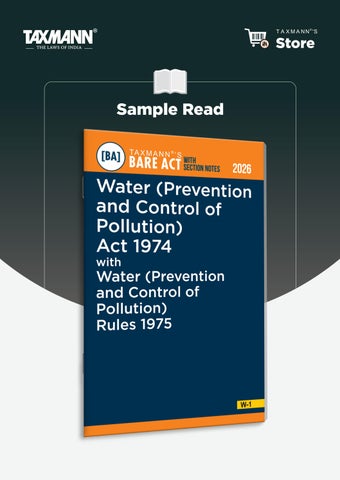
WATER (PREVENTION AND CONTROL OF POLLUTION) ACT 1974 WITH WATER (PREVENTION AND CONTROL OF POLLUTION) RULES 1975 – BARE ACT WITH SECTION NOTES AUTHOR : PUBLISHER : DATE OF PUBLICATION : EDITION : ISBN NO : NO. OF PAGES : BINDING TYPE :
Taxmann's Editorial Board Taxmann December 2025 2026 Edition 9789375610915 104 Paperback
Rs. 165 DESCRIPTION Water (Prevention and Control of Pollution) Act 1974 with Water (Prevention and Control of Pollution) Rules 1975 [Bare Act with Section Notes] by Taxmann is a reliable statutory reference for India's primary legislation on water pollution control. This thoroughly revised 2026 Edition presents the complete, updated text of the Act and Rules, along with clear section-wise notes, key judgments, forms, and compliance tools. It serves as both a legal reference and a practical manual for those engaged in water law and environmental compliance. This book is intended for the following audience: • Legal Professionals & Consultants • Corporate Entities • Environmental & Pollution Control Boards • Industry & Business Entities • Government Departments & Policy Makers • Students & Academics • NGOs, Environmental Activists & General Public The Present Publication is the 2026 Edition, covering the amended and updated text of the Water (Prevention and Control of Pollution) Act [Act No. 6 of 1974] and Rules, with the following noteworthy features: • [Comprehensive Coverage] Complete, amended text of the Water Act 1974 and Rules 1975, with all updates up to date • [Recent Legislative Developments] Latest amendments, including those from the Water (Prevention and Control of Pollution) Amendment Act 2024 • [Pre-amendment Provisions] Footnotes providing text of provisions as they existed before the amendment • [Section Notes] Concise, practical notes under each section for statutory clarity • [Landmark Case Law] Important Supreme Court and High Court judgments summarised for reference • [Model Forms & Procedures] Forms and compliance templates for practical application • [Practical Commentary] Clarifications, compliance checklists, and step-by-step procedural guidance • [User-friendly Indexing] Structured subject index and logical arrangement for easy access • [Authoritativeness] Trusted statutory resource, widely cited and based on official notifications • [Practice Orientation] Practical guidance for day-to-day compliance and litigation needs
Buy Now