
Sample Read
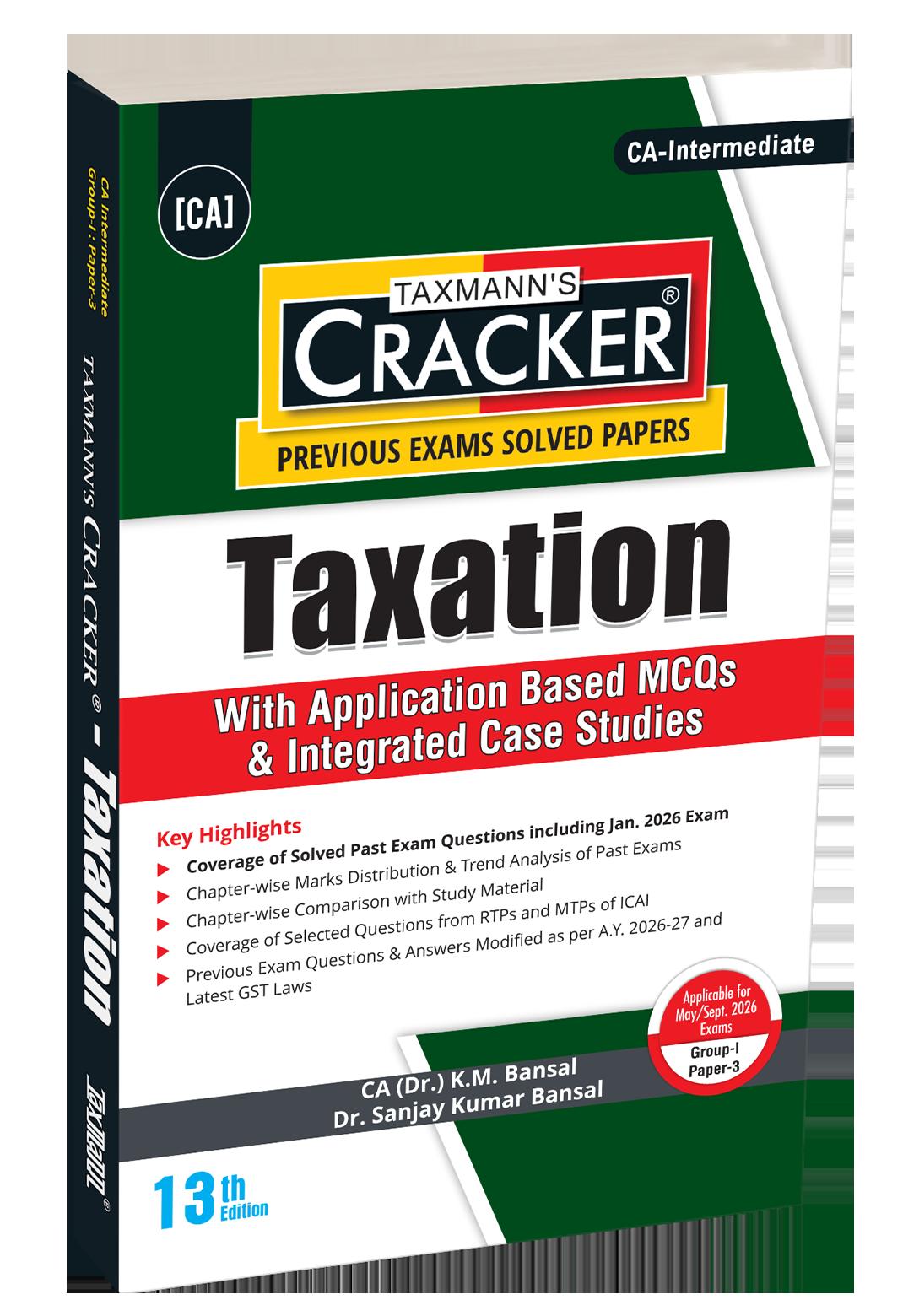


© All rights reserved
Price : ` 795
Thirteenth Edition : February 2026
Published by :
Taxmann Publications (P.) Ltd.
Sales & Marketing :
59/32, New Rohtak Road, New Delhi-110 005 India
Phone : +91-11-45562222
Website : www.taxmann.com
E-mail : sales@taxmann.com
Regd. Office : 21/35, West Punjabi Bagh, New Delhi-110 026 India
Printed at :
Tan Prints (India) Pvt. Ltd.
44 Km. Mile Stone, National Highway, Rohtak Road Village Rohad, Distt. Jhajjar (Haryana) India
E-mail : sales@tanprints.com
Disclaimer
Every effort has been made to avoid errors or omissions in this publication. In spite of this, errors may creep in. Any mistake, error or discrepancy noted may be brought to our notice which shall be taken care of in the next edition. It is notified that neither the publisher nor the author or seller will be responsible for any damage or loss of action to any one, of any kind, in any manner, therefrom. It is suggested that to avoid any doubt the reader should cross-check all the facts, law and contents of the publication with original Government publication or notifications.
No part of this book may be reproduced or copied in any form or by any means [graphic, electronic or mechanical, including photocopying, recording, taping, or information retrieval systems] or reproduced on any disc, tape, perforated media or other information storage device, etc., without the written permission of the publishers. Breach of this condition is liable for legal action.
For binding mistake, misprints or for missing pages, etc., the publisher’s liability is limited to replacement within seven days of purchase by similar edition. All expenses in this connection are to be borne by the purchaser. All disputes are subject to Delhi jurisdiction only.


CHAPTER
Q1. Raja is the owner of a residential house property having two independent floors of equal size in Chennai. The ground floor of the property has been let out to a tenant at rent of ` 16,000 per month from 1st June, 2025. The first floor of the property is occupied by Raja for his residential purpose.
Other particulars relating to the property are as follows:
Compute income from house property of Raja for the Assessment Year 2026-27.
Ans. Computation of Income from House Property (Assessment Year 2026-27)
Amount (`)
IGround Floor (Let out)(1/2 portion of house)
Gross Annual Value (Actual Rent) 1,60,000
Less: Municipal Taxes paid (28,500 × 1/2) (14,250) Net Annual Value (NAV) 1,45,750
Less: Deduction under section 24 Standard (30% of ` 1,45,750) (43,725)
Interest on Borrowed Capital (Pre-construction Period) (30,000 × ½ × 1/5) (3,000)
Income from House property (Let out) 99,025
IIFirst Floor (Self-occupied))(1/2 portion of house)
Net Annual Value (Note 1)Nil
Less: Deduction under section 24
Interest on Borrowed Capital (Pre-construction Period)
(30,000 × ½ × 1/5) (3,000)
Income from House property (Self-occupied)(3,000)
Taxable Income from House property (after intra head adjustment-Note 2) (96,025)
Working Notes:
1. The NAV of self-occupied property is always taken as nil.
2. As per section 70, the loss from one house property can be set-off against income from another property.
3. The GAV of both the houses are determined as under:
)Expected
of (c) and (d):
f)Actual Rent: ` 1,60,000 (g)Gross Annual value Higher of ( e) and (f) : ` 1,60,000
Gross Annual value: The Actual rent received and Expected rent both are equal. Thus, ` 1,60,000 shall be GAV.
4. Section 23 of the Income-tax Act, the annual value of any property shall be deemed to be:
(a) the sum for which the property might reasonably be expected to let from year to year; or
(b) where the property or any part of the property is let and the actual rent received or receivable by the owner in respect thereof is in excess of the sum referred to in clause (a), the amount so received or receivable; or
(c) where the property or any part of the property is let and was vacant during the whole or any part of the previous year and owing to such vacancy the actual rent received or receivable by the owner
in respect thereof is less than the sum referred to in clause (a), the amount so received or receivable.
Explanation: For the purposes of clause (b) or clause (c) of this sub-section, the amount of actual rent received or receivable by the owner shall not include, subject to such rules as may be made in this behalf, the amount of rent which the owner cannot realize.
Q2. Nisha has two houses, both of which are self-occupied. The particulars of these are given below:
Compute Nisha’s income from the House Property for the Assessment Year 2026-27 and suggest which house should be opted by Nisha to be assessed as self-occupied so that her tax liability is minimum. [May 2014, 8 Marks]
Ans. Computation of Income from House Property (Assessment Year 2026-27)
Net Annual Value (Note 1)NilNil
Less: Deduction under section 24
Standard Deduction (Not Available in case of selfoccupied) Interest on loan for Repair (Note 2)Nil(30,000)
Total taxable income = (30,000)
Working Notes:
1. The NAV of self-occupied property is always taken as nil.
2. The maximum allowable amount for interest on loan for repair on self-occupied is ` 30,000
3. Now two houses may be self-occupied.
Q3. Mr. Raphael constructed a shopping complex. He had taken a loan of ` 25 Lakhs for construction of the said property on 1-8-2023 from SBI @ 10% for 5 years. The construction was completed on 30-6-2024. Rental income received from shopping complex ` 30,000 per month being let out for the whole year. Municipal Taxes paid for shopping complex ` 8,000. Arrears of rent received from shopping complex ` 1,20,000.
Interest paid on loan taken from SBI for purchase of house for use as own residence for the period 2025-26 is ` 3 lakhs.
You are required to compute Income from House property of Mr. Raphael for A.Y. 2026-27 as per Income-tax Act, 1961. [Nov. 2015, 8 Marks]
Ans.
Computation of Income from House Property (Assessment Year 2026-27)
ISelf-occupied residential house
Net Annual Value (Note 1)Nil
Less: Deduction under section 24
Interest on Borrowed Capital (Subject to max. limit: Note 2) (2,00,000)
Amount (`)
Income from House property (self-occupied)(2,00,000)
IIShopping Complex (Let out)
Gross Annual Value (Actual Rent: ` 30,000 × 12) 3,60,000
Less: Municipal Taxes paid (8,000)
Net Annual Value (NAV)3,52,000
Less: Deduction under section 24
Standard (30% of ` 3,52,000) (1,05,600)
Interest on Loan for current Previous year (` 25,00,000 × 10%) (2,50,000)
Amount (`)
Interest on Loan for pre-construction period (Note 3) (33,333)
Income from let out shopping complex(36,933)
Arrears of rent received from shopping complex
Arrear of Rent received1,20,000
Less: Deduction under section 25A
Standard (30% of ` 1,20,000) (Note 4)(36,000)
Income from arrears of rent84,000
Total Income from Shopping Complex47,067
Taxable Income from House property (after inter source adjustment-Note 5) (1,52,933)
Working Notes:
1. The NAV of self-occupied property is always taken as nil.
2. The maximum allowable amount for interest on loan for construction on self-occupied is ` 2,00,000.
3. The interest for pre-construction period deductible in previous year is determined as under:
(a) Pre-Construction Period (PCP) :1-8-2023 to 31-3-2024 i.e. 8 Months
(b) Loan amount: ` 25,00,000
(c) Rate of Interest:10%
(d) Total Pre-construction Interest :25,00,000 × 10% × 8/12 = ` 1,66,666.67
(e) PCP Interest deductible in current Yr. : ` 1,66,666.67 × 1/5 = ` 33,333
4. As per section 25A, the arrears of rent received are taxable in the year in which arrears have been received. However, deduction shall be allowed @ 30% of such arrears and only the balance amount is taxable.
5. As per section 70, the loss from one house property can be set-off against income from another property.
Q4. Mr. Kamal Haasan has two independent residential flats in an apartment, both of them being of identical size. First flat is self-occupied and the second flat is occupied by his daughter, from whom he does not receive any rent.
For each flat the relevant annual rent details are as under:
Compute income of Mr. Kamal Haasan under the head income from house property for assessment year 2026-27.
[June 2016, 8 Marks] Ans.
Computation of Income from House Property (Assessment Year 2026-27)
Net Annual Value (Note 1)NilNil Less: Deduction under section 24
Standard deduction (Not Available in case of selfoccupied)
(For each flat: 1,50,000 × 1/5)
The total comes to (3,90,000), but in case of self-occupied, the total interest on borrowed capital is deductible up to ` 2,00,000 only. Hence, total taxable income from house property = (2,00,000)
Working Note:
1. The NAV of self-occupied property is always taken as nil.
Q5. Mr. Ganesh owns a commercial building whose construction got completed in June 2024. He took a loan of ` 15 lakhs from his friend on 1-8-2023 and had been paying interest calculated at 15% per annum. He is eligible for pre-construction interest as deduction as per the provisions of the Income-tax Act.
Mr. Ganesh has let out the commercial building at a monthly rent of ` 40,000 during the financial year 2025-26. He paid municipal tax of ` 18,000 each for the financial years 2024-25 and 2025-26 on 1-5-2025 and 5-4-2026 respectively.
Compute income under the head ‘House Property’ of Mr. Ganesh for the Assessment Year 2026-27. [May 2017, 4 Marks] Ans.
Computation of Income from House Property (Assessment Year 2026-27)
(`)
Gross Annual Value (Actual Rent: ` 40,000 × 12)4,80,000
Less: Municipal Taxes paid (Note 1)(18,000) Net Annual Value (NAV)4,62,000
Less: Deduction under section 24
Standard (30% of ` 4,62,000) (1,38,600)
Interest on Loan for current Previous year (` 15,00,000 × 15%) (2,25,000)
Interest on Loan for pre-construction period (Note 2)(30,000)(3,93,600)
Income from House property 68,400 Working Notes:
1. Municipal taxes paid on 5-4-2026 are not considered because these are not paid in financial year 2025-26.
2. The interest for pre-construction period deductible in previous year is determined as under:
(a) Pre-Construction Period (PCP):1-8-2023 to 31-3-2024 i.e. 8 Months
(b) Loan amount: ` 15,00,000
(c) Rate of Interest:15%
(d) Total Pre-construction Interest:15,00,000 × 15% × 8/12 = ` 1,50,000
(e) PCP Interest deductible in current Pr. Yr.: ` 1,50,000 × 1/5 = ` 30,000
Q6. Mr. Nitin owns two houses, both of which are occupied by him for residential purpose. The details are given below:
rent6,00,0006,00,000 Date of completion 1-1-20051-7-2011
Date of loan1-7-20011-5-2008
Interest on loan for the financial year 2025-261,10,0001,70,000
Compute his income from house property.
Ans.
Computation of Income from House Property (Assessment Year 2026-27)
Net Annual Value (Note 1)NilNil
Less: Deduction under section 24
Standard (Not Available in case of self-occupied)
Interest on loan X(1,10,000)(1,70,000)
Taxable Income from House property (1,10,000) (1,70,000)
The total comes to (2,80,000), but in case of self-occupied, the total interest on borrowed capital is deductible up to ` 2,00,000 only. Hence, total taxable income from house property = - (2,00,000)
Working Notes:
1. The NAV of self-occupied property is always taken as nil.
Q7. Mr. Nitin completed construction of a residential house on 1-4-2025.
Interest paid on loans borrowed for the purpose of construction during the 30 months prior to completion was ` 60,000. The house was let-out on a monthly rent of ` 18,000.
He had also received arrears of rent of ` 36,000 during the year, which had not been charged to tax in the earlier year.
Compute the income under the head “Income from House Property” for the assessment year 2026-27.
Ans.
Computation of Income from House Property (Assessment Year 2026-27)
Gross Annual Value (Note 1)1,44,000 Less: Municipal Taxes paid (35,000)
Less: Deduction under section 24
Standard (30% of ` 1,09,000) (32,700)
Interest on Borrowed Capital
Current Year (25,000)
Pre-construction Period (60,000 × 1/5) (12,000)(69,700)
Income from House property (Let out portion)39,300
Arrears of rent received
Arrear of Rent received36,000
Less: Deduction under section 25A
Standard (30% of ` 36,000) (Note 2)(10,800)
Working Notes:
1. The GAV of the house property is determined as under: Step 1: Computation of Expected Rent
(a) Municipal Valuation : ` 1,50,000
(b) Fair Valuation:NA (c) Higher of (a) and (b): ` 1,50,000 (d) Standard Rent :NA
Expected Rent = Lower of (c) and (d) = ` 1,50,000
Step 2: Computation of Gross Annual value
(i) Expected Rent (As per step 1) : ` 1,50,000
(ii) Actual Rent received/receivable (After unrealized Rent)
(a) If there is no vacancy (18,000 × 12) : ` 2,16,000
(b) In case of Vacancy (18,000 × 8) : ` 1,44,000
Gross Annual value: The rent received/receivable is lower than expected rent due to vacancy. Thus, the rent received or receivable (considering vacancy) i.e. ` 1,44,000 shall be GAV.
2. As per section 25A, the arrears of rent received are taxable in the year in which arrears have been received. However, deduction shall be allowed @ 30% of such arrears and only the balance amount is taxable.
Q8. Mr. Aditya, a resident but not ordinarily resident in India during the Assessment Year 2026-27. He owns two houses, one in Dubai and the other in Mumbai. The house in Dubai is let out there at a rent of DHS 20,000 p.m. (1 DHS = INR 18). The entire rent is received in India. He paid Property tax of DHS 2,500 and Sewerage Tax DHS 1,500 there, for the Financial Year 2025-26. The house in Mumbai is self-occupied. He had taken a loan of ` 25,00,000 to construct the house on 1st June, 2022 @12%.
The construction was completed on 31st May, 2024 and he occupied the house on 1st June, 2024. The entire loan is outstanding as on 31st March, 2026. Property tax paid in respect of the second house is ` 2,400 for the Financial Year 2025-26. Compute the income chargeable under the head “Income from House property” in the hands of Mr. Aditya for the Assessment Year 2026-27. [Nov. 2017, 5 Marks] Ans.
Computation of Income from House Property (Assessment Year 2026-27)
ISelf-occupied residential house in Mumbai
Net Annual Value (Note 1)Nil
Less: Deduction under section 24
Interest on Borrowed Capital (25,00,000 × 12/100) (3,00,000)
Interest on loan for construction period) (Note 2) (1,10,000)
Total Interest (4,10,000)
Deduction allowed (up to ` 2,00,000) (Note 3)(2,00,000)
Amount (`)
Income from House property (self-occupied)(2,00,000)
Taxation (Tax) | CRACKER
AUTHOR : K.M. Bansal, Sanjay Kumar Bansal
PUBLISHER : Taxmann
DATE OF PUBLICATION : January 2026
EDITION : 13th Edition
ISBN NO : 9789375615712
No. of Pages : 696
BINDING TYPE : Paperback
Rs. 795
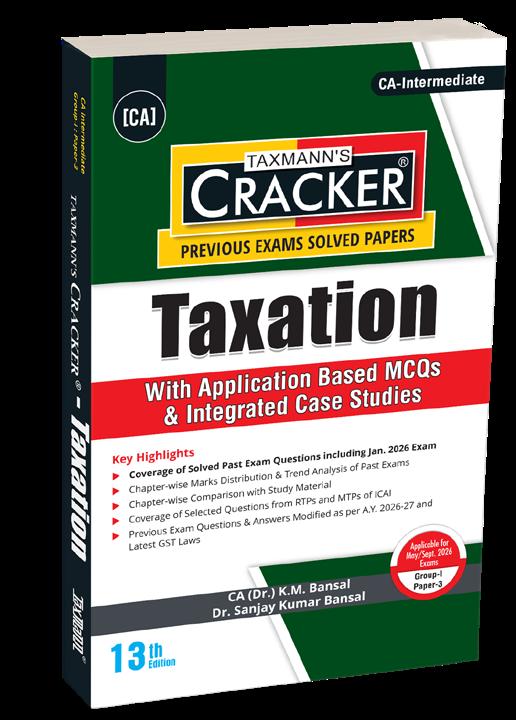
DESCRIPTION
Taxation – CRACKER with Application-Based MCQs and Integrated Case Studies is an examination-focused problem compendium for CA Intermediate – Group I | Paper 3 (Taxation), designed to translate the ICAI syllabus into exam-ready questions, patterns, and evaluative logic. The book acts as a comprehensive past-exam decoder, integrating descriptive questions, ICAI-style MCQs, and integrated case studies across Income-tax Law and GST. This Edition is fully updated for A.Y. 2026-27, incorporates the latest GST law, and includes solved past examination questions up to the January 2026 exam. All solutions are structured in line with ICAI’s marking scheme, computational flow, and legal reasoning, making the book a practical simulation of the examination environment.
The Present Publication is the 13th Edition, authored by CA. (Dr) K.M. Bansal & Dr Sanjay Kumar Bansal, with the following noteworthy features:
• [Exhaustive Solved Past Examination Questions] Covers ICAI past exam questions across multiple years, including the January 2026 exam, with fully worked-out solutions
• [Dedicated MCQs & Integrated Case Studies] Separate, well-structured sections for MCQs and integrated case studies in Income-tax and GST, aligned with ICAI’s application-based testing approach
• [ICAI Evaluation-aligned Answer Framework] Step-wise computations, statutory references, and working notes strictly aligned with ICAI evaluation standards
• [Chapter-wise Marks Distribution & Trend Analysis] Historical marks weightage and trend insights to help prioritise high-scoring areas
• [Chapter-wise Mapping with ICAI Study Material] Ensures complete syllabus coverage and examination relevance
• [Coverage of RTPs & MTPs] Selective questions from ICAI RTPs and MTPs included with solutions
• [Updated for A.Y. 2026-27 & Current GST Regime] Questions revised to reflect current tax provisions, slab structures, regimes (including section 115BAC), and GST law