

Sample Read
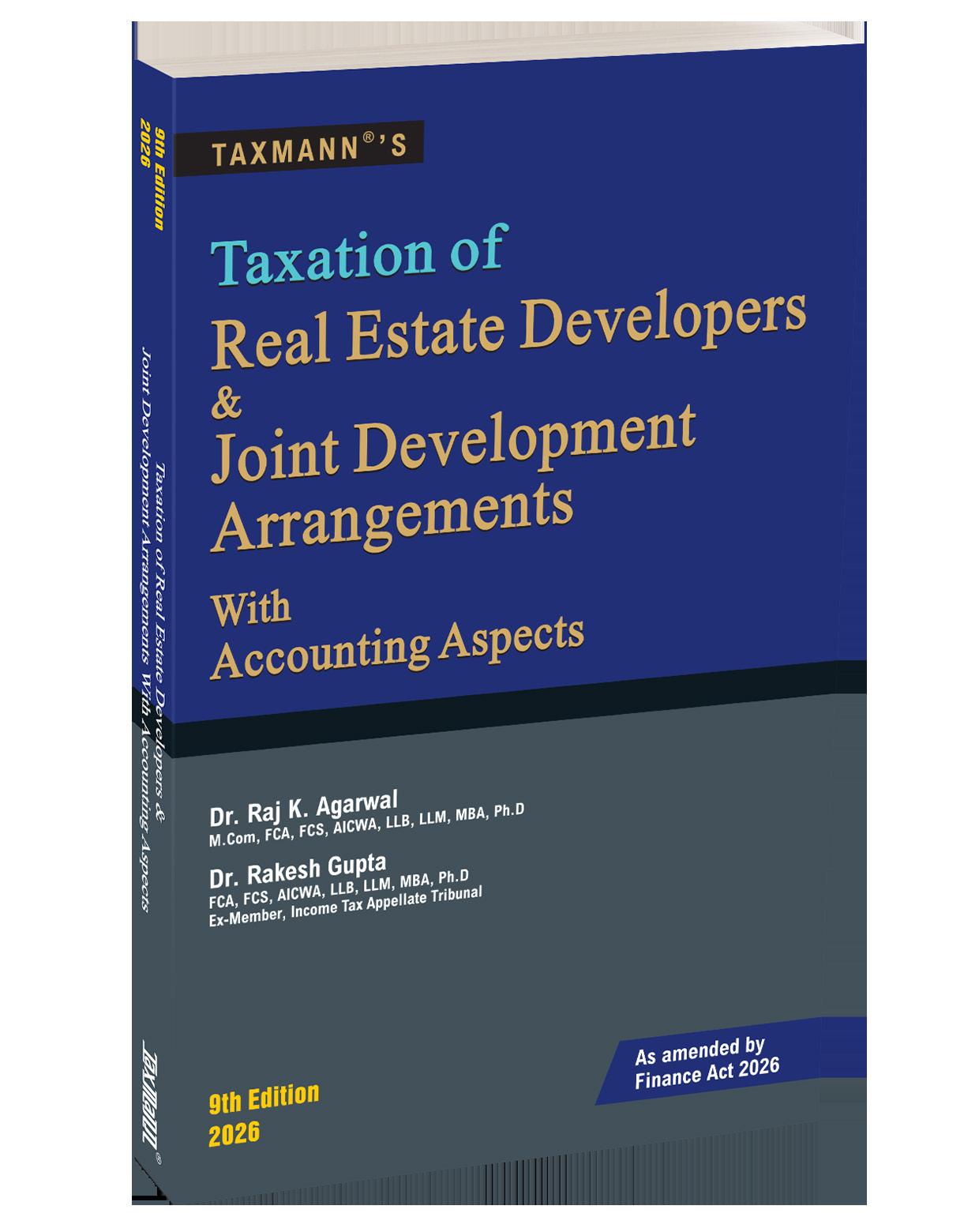

© All rights reserved
Price : ` 1645
Law stated in this book is as amended by the Finance Act, 2026
Published by :
Taxmann Publications (P.) Ltd.
Sales & Marketing :
59/32, New Rohtak Road, New Delhi-110 005 India
Phone : +91-11-45562222
Website : www.taxmann.com
E-mail : sales@taxmann.com
Regd. Office : 21/35, West Punjabi Bagh, New Delhi-110 026 India
Printed at :
Tan Prints (India) Pvt. Ltd.
44 Km. Mile Stone, National Highway, Rohtak Road Village Rohad, Distt. Jhajjar (Haryana) India
E-mail : sales@tanprints.com
Disclaimer
Every effort has been made to avoid errors or omissions in this publication. In spite of this, errors may creep in. Any mistake, error or discrepancy noted may be brought to our notice which shall be taken care of in the next edition. It is notified that neither the publisher nor the author or seller will be responsible for any damage or loss of action to any one, of any kind, in any manner, therefrom. It is suggested that to avoid any doubt the reader should cross-check all the facts, law and contents of the publication with original Government publication or notifications.
No part of this book may be reproduced or copied in any form or by any means [graphic, electronic or mechanical, including photocopying, recording, taping, or information retrieval systems] or reproduced on any disc, tape, perforated media or other information storage device, etc., without the written permission of the publishers. Breach of this condition is liable for legal action.
For binding mistake, misprints or for missing pages, etc., the publisher’s liability is limited to replacement within seven days of purchase by similar edition. All expenses in this connection are to be borne by the purchaser. All disputes are subject to Delhi jurisdiction only.
Preface to Ninth Edition

In 2011, we came out with a book on the subject “Law Relating to Income Tax Search and Seizure”, incorporating our practical experience of professional practice of more than 25 years. The overwhelming response and appreciation received by the above book has encouraged us to address another complex income tax subject regarding tax issues of joint development arrangement of real estate.
Joint development of real estate by land owner and developer involves several intricacies and complexities from the civil and taxation point of view. Determination of the quantum and the year of taxability of the income generated by land owner and developer involves several complex tax issues.
There is no specific income tax provision under the Income Tax Act to address various tax issues relating to such special arrangement of development of real estate except introduction of section 45(5A) by the Finance Act, 2017. Joint development of real estate is a new phenomena and the income tax law in this respect is in the process of development by way of judicial pronouncements. However, Courts have, at times, rendered divergent views on various complex issues.
Joint development of real estate involves various complex issues relating to VAT, GST, Stamp Duty Act etc. also but in this book we have addressed only accounting and income tax issues, which is the area of our specialization.
We have addressed tax issues relating to land owner and developer. In the case of joint development of real estate, the other stake holder is flat owner or buyer of real estate also. There are certain tax issues relating to buyer of real estate which have not been covered in the book.
Finance Act, 2017 has introduced new section 45(5A) providing for chargeability of Capital Gain on transfer of asset in the hands of Land Owner in the case of joint development arrangement under certain circumstances. A new chapter has been added in the book “Analysis of Provision of Section 45(5A)” alongwith controversial issues emanating therefrom.
The fourth edition of the book covers two new Chapters relating to analysis of deeming provisions of sections 43CA, 50C, 56(2)(x)(b) and 23(5) and analysis of provision of section 80-IBA granting deduction to developers for construction of affordable housing. The 5th to 8th editions of the book were published by giving effect to the amendments made by Finance Act, 2022 to Finance Act, 2025 respectively and various court decisions rendered. This 9th edition is being published giving effect to the Finance Act, 2026 and incorporating the provisions of New Income Tax Act,2025 which has been made effective from 1st April, 2026 relating to Tax Year 2026-27.
There has been overwhelming response from the professionals and others about this book for which we express our gratitude and thanks. Development of law is a continuing process and with the passage of time and changing circumstances, new kind of issues and situations keep on emerging. We have tried to comprehend and address various tax issues which are faced by the land owner and developer, still there may be existing several more such issues. We welcome and invite suggestions in this regard from our esteemed readers so as to enrich the future edition of the book by incorporating such issues.
E-mail :- raj@taxindia.net
Dr. RAJ K. AGARWAL rakesh@taxindia.net
Dr. RAKESH GUPTA
M. No. 9810002906, 9810420515
2.6 Whether Accounting Standard/Guidance Note issued by ICAI are binding for computation of income even when not notified under section 276(2) of the Income-tax Act, 2025 (corresponding to section 145(2) of the Income-tax Act,
Assessing Officer
change the estimates used by the assessee for the purpose of accounting and finalization of financial
2.37 Disallowance under section 35(b)(i) of the Income-tax Act, 2025 (corresponding to section 40(a)(ia) of the Income-tax Act, 1961) - Whether to be reduced from WIP?
HISTORY OF ACCOUNTING STANDARDS
ANALYSIS OF GUIDANCE NOTE ON ACCOUNTING FOR REAL
REVENUE RECOGNITION FOR REAL ESTATE DEVELOPER UNDER IFRS
IMPACT OF INCOME COMPUTATION AND DISCLOSURE STANDARD
7.1
TAX ISSUES FOR REAL ESTATE OWNER
of Tax Liability of the Real Estate Owner
7.2 Determination of Real Estate/Land Transferred by the OwnerWhether in the nature of Capital Asset or Business Asset and tax issues emerging therefrom
(i)Whether entering into Joint Development Agreement can be said to be carrying on business by the land owner?
(ii)Whether obtaining Change of Land Use (CLU) converts the land into business asset?
(iii)Whether Receipt of Sale Consideration in Kind or Linked with the Revenue Recognition of the Project by the Developer Would Convert the Land as Business Asset in the Hands of Land Owner?
7.3 Conversion of Capital Asset into Business Asset - Applicability of section 67(6) of the Income-tax Act, 2025 (corresponding to section 45(2) of the Income-tax Act, 1961)
(i)Transfer of Asset in case of Joint Development Arrangement in terms of Provision of section 2(109) of the Income-tax Act, 2025 (corresponding to section 2(47) of the Income-tax Act, 1961)
(ii)Determination of the Event of Transfer of Land in case of Joint Development Arrangement
(iii)Judicial View with respect to the Year of ‘Transfer’ of Land in the hands of Land Owner
Power to Dispose property in Absolute Discretion to the Developer is Significant Factor to determine ‘transfer’
Not Mere Possession but Effective Control over the Property should be assumed by the Developer to Constitute Transfer
Clause (g) of section 2(109) of the Income-tax Act, 2025 (corresponding to clause (v) of section 2(47) of the Income-tax Act, 1961), should comply with the conditions of section 53A of Transfer of Property Act, to constitute ‘transfer’
Developer should be willing to perform his obligations before section 2(109)(g) of the Income-tax Act, 2025 (corresponding to section 2(47)(v) of the Income-tax Act, 1961) is invoked
Possession handed over in the capacity as licencee
when sale consideration is received in Kind
(
(
)Whether consideration received from the developer can be taxed in the year of Receipt?
)Whether sale consideration to be received in future to be discounted at its present value
to determine value of sale consideration to be received in kind
(v)Whether provision of section 80 of the Income-tax Act, 2025 (corresponding to section 50D of the Income-tax Act, 1961) can be applied in such situation?
(vi)When sale consideration receivable by land owner is linked with uncertainties of the business venture of the developer - Can it be said that land becomes business asset for
8.3
9.1 Text of section 67(6) of the Income-tax Act, 2025 (corresponding to section 45(2) of the Income-tax Act, 1961)
9.2
of section 67(6) of the Income-tax Act, 2025 (corresponding to section 45(2) of the Income-tax Act, 1961)
9.3 Objective behind Insertion of section 45(2)
9.4 Provision of section 67(6) of the Income-tax Act, 2025 (corresponding to section 45(2) of the Income-tax Act, 1961) - In Nutshell
9.5 Salient Features of section 67(6) of the Income-tax Act, 2025 (corresponding to section 45(2) of the Income-tax Act, 1961)
9.6 Significant Issues Emerging out of the Provision of section 67(6) of the Income-tax Act, 2025 (corresponding to section 45(2) of the Income-tax Act, 1961)
(i)Manner of Conversion of Capital Asset into Stock in Trade of Business and determination of the year of conversion
(ii)Conversion for Existing Business or New Business
(iii)Determination of Fair Market Value of Asset on the Date of Conversion to be Treated as Consideration for Transfer of Asset
(iv)Rate of tax on such capital gain applicable relating to which year?
(v)Determination of the Year in which such Stock in Trade is sold or otherwise Transferred
(vi)Chargeability of capital gain to tax in different year in case converted business asset is transferred in different years
(vii)Chargeability of capital gain to tax when land as such is not sold but flats constructed on such land are sold/transferred
269
(viii)Chargeability of capital gain to tax in the situation when revenue is recognized by the real estate developer following PCM 270
(ix)Determination of the year of sale of land converted as business asset in the case of joint development arrangement 271
(x)When rural agricultural land not covered under the definition of capital asset under section 2(22) of the Income-tax Act, 2025 (corresponding to section 2(14) of the Income-tax Act, 1961) is converted into Stockin-trade, cost of acquisition of such asset how to be
determined – Whether original cost of acquisition or FMV as on the date of conversion?
(xi)Attraction of provision of sections 2(110) and 78 of the Income-tax Act, 2025 (corresponding to section 50C of the Income-tax Act, 1961) in case of applicability of section 67(6) of the Income-tax Act, 2025 (corresponding to section 45(2) of the Income-tax Act, 1961) when converted business asset is sold
ANALYSIS OF PROVISIONS OF SECTION 2(109) OF THE INCOME-TAX ACT, 2025 (CORRESPONDING TO SECTION 2(47) OF THE INCOME-TAX ACT, 1961)
10.1 Text of section 2( 109 ) of the Income-tax Act, 2025 (corresponding to section 2(47) of the Income-tax Act, 1961)
10.2 Historical Background of section 2(47)
10.3 Scope of section 2( 109 ) of the Income-tax Act, 2025 (corresponding to section 2(47) of the Income-tax Act, 1961)
10.4 Salient Features of section 2(109) of the Income-tax Act, 2025 (corresponding to section 2(47) of the Income-tax Act, 1961)
10.5 Significant Components of section 2(109) of the Income-tax Act, 2025 (corresponding to section 2(47) of the Income-tax Act, 1961)
(i)Analysis of sub-clause (a): Sale, exchange or relinquishment of the asset
(ii)Analysis of sub-clause (b): Extinguishment of any rights in a capital asset
(iii)Analysis of sub-clause (c) - Compulsory acquisition of a capital asset under any law
(iv)Analysis of sub-clause (d) - Conversion of capital asset into stock in trade
(v)Analysis of sub-clause (g) - Transaction involving the allowing of the possession of an immovable property in part performance of a contract of the nature referred to in section 53A of Transfer of Property Act, 1882 treated as ‘transfer’
(vi)Analysis of clause (f) - Enjoyment of immovable property by becoming member of a society, company etc.
(vii)Memorandum of Object introducing clauses (v) and (vi) in section 2(47)
10.6 Significant Issues Emerging out of Clause (g) relating to Part Performance of a Contract
(i)Transaction Involving the Allowing of the Possession – Nature and Intent
(ii)Whether mere handing over of physical possession is enough
(iii)Meaning of transfer of ownership rights
(iv)Analysis of the Judicial decisions on the aspect of Handing over the Possession
(v)Whether registration of contract relating to part performance mandatory for recognition of ‘transfer’ under section 2(109)(g) of the Income-tax Act, 2025 (corresponding to section 2(47)(v) of the Income-tax Act, 1961)
(vi)Transferee should be willing to perform his part of obligation 308
(vii)Land is generally not transferred in favour of developer as per Joint Development Agreement - Whether still arrangement may fall in the ambit of section 2(109)(g) of the Income-tax Act, 2025 (corresponding to section 2(47)(v) of the Income-tax Act, 1961)
(viii) Whether Joint Development Agreement is in the nature of contract contemplated u/s 53A of Transfer of Property Act, 1882
ANALYSIS OF PROVISION OF SECTION 80 OF THE INCOME-TAX ACT, 2025
TO SECTION 50D OF THE INCOME-TAX ACT, 1961)
11.1 Fair Market Value Deemed to be Full Value of Consideration in Certain Cases as Provided under section 80 of the Incometax Act, 2025 (corresponding to section 50D of the Incometax Act, 1961)
11.2 Background for Introduction of section 50D
11.3 Salient Features of the Provision of section 80 of the Incometax Act, 2025 (corresponding to section 50D of the Incometax Act, 1961)
11.4 Applicability of section 80 of the Income-tax Act, 2025 (corresponding to section 50D of the Income-tax Act, 1961) to Joint Development Transactions of Real Estate
11.5 Significant Issues arising out of section 80 of the Income-tax Act, 2025 (corresponding to section 50D of the Income-tax Act, 1961)
(i)Section 80 of the Income-tax Act, 2025 (corresponding to section 50D of the Income-tax Act, 1961) diluting the concept of actual sale consideration for calculating capital gain
(ii)Whether transfer with no consideration is hit by section 80 of the Income-tax Act, 2025 (corresponding to section 50D of the Income-tax Act, 1961)?
(iii)Meaning of the words “not ascertainable or cannot be determined”?
(iv)Whether there can be Sale Consideration which can be said to be “not ascertainable or cannot be determined” in the case of Joint Development Arrangement?
(v)Taxability of Difference between the Actual Sale Consideration if ascertained or determined in future and fair market value as on the date of transfer
(vi)Full Value of Consideration - Meaning
ANALYSIS OF PROVISION OF SECTION 67(14) OF THE INCOME-TAX ACT, 2025 (CORRESPONDING TO SECTION 45(5A) OF THE INCOME-TAX ACT, 1961)
12.1 Text of section 67(14) of the Income-tax Act, 2025 (corresponding to section 45(5A) of the Income-tax Act, 1961)
12.3 Applicability of provision to whom?
12.4 Salient features
(i)In case land has been transferred or conveyance deed has been executed by land owner in favour of developer in earlier year
(ii)Issue of period of holding to determine the nature of land/asset transferred by the land owner - Whether long term or short term?
(iii)Non-availability of liquidity to discharge tax liability not tenable plea to defer taxability of capital gain
(iv)Tax liability can be deferred when land owner holds or converts land as business asset in terms of provision of section 67(6) of the Income-tax Act, 2025 (corresponding to section 45(2) of the Income-tax Act, 1961)
(v)Whether profit on sale of developed real estate shall be in the nature of business income or capital gain
(vi)Whether exemption under section 83/85/86 of the Income-tax Act, 2025 (corresponding to section 54B/54F/54EC of the Income-tax Act, 1961) etc. can be claimed with reference to the year in which capital gain is taxable
(vii)In case Stamp Duty Value of developed real estate is higher than its Fair Market Value - Whether provision of sections 2(110) and 78 of the Income-tax Act, 2025 (corresponding to section 50C of the Income-tax Act, 1961) is attracted
(viii)Certificate of completion issued for part of the project – Whether capital gain to be calculated on proportionate basis?
(ix)In case agricultural land, not covered within the definition of capital asset under section 2( 22) of the Income-tax Act, 2025 (corresponding to section 2(14) of the Income-tax Act, 1961) is contributed for joint development - Whether capital gain liability shall be attracted? 342
(x)In case ownership rights in land are retained by the land owner - Whether provision of section 67(14) of the Income-tax Act, 2025 (corresponding to section 45(5A) of the Income-tax Act, 1961) shall be attracted? 343
(xi)Whether section 67(14) of the Income-tax Act, 2025 (corresponding to section 45(5A) of the Income-tax Act, 1961) can be applied retrospectively?
344
12.6 Nature of joint development arrangement not covered within the scope of section 67(14) of the Income-tax Act, 2025 (corresponding to section 45(5A) of the Income-tax Act, 1961)
13
TAXABILITY OF CAPITAL GAIN ARISING ON TRANSFER OF AGRICULTURAL LAND
13.1 Text of section 2( 22 )( iii ) of the Income-tax Act, 2025 (corresponding to section 2(14)(iii) of the Income-tax Act, 1961)
13.2 Historical Background of Definition of ‘Capital Asset’ in the Nature of Agricultural Land
13.3 Meaning of Rural Agricultural Land w.e.f. A.Y. 2014-15
13.4 Significant Issues to Determine Whether Land Transferred is Agricultural Land
(i)Whether land on which agricultural operations have actually been carried out can alone be termed as agricultural land or the land which is capable of being used for agricultural operations but no such operations where carried out at the time of transfer or to or more years prior to such transfer, can also be termed as agricultural land?
(ii)Agricultural activity suspended temporarily
(iii)Whether land classified as agricultural land in the revenue records but no agricultural operation carried out on such land for a fairly long period, be treated as agricultural land?
(iv)Land originally used for agricultural purpose, later unfit for cultivation, but still registered as “agricultural land” in revenue records
(v)Land registered as Urban Land on which agricultural activity carried out
(vi)Whether it is necessary to show agricultural income/ loss in the income tax return to claim the land as agricultural land?
355
355
356
(vii)Land sold after plotting but of agricultural nature 357
(viii)Whether future use of the agricultural land by the buyer is of relevance to determine the character of land at the time of transfer?
357
(ix)Whether acquisition of agricultural land by the real estate developer entities per se would alter the character of such land as non-agricultural land?
(x)Agricultural Land Falling Concurrently within the Jurisdiction of Two Municipalities
(xi)Method for Measurement of Distance
13.5 Whether gain arising from sale of rural agricultural land liable for MAT
13.6 Profit arising on sale of rural agricultural land may be exempt as agricultural income under section 2(5) and 2(22) of the Income-tax Act, 2025 (corresponding to section 2(1A) of the Income-tax Act, 1961) even if the transaction is treated as adventure in the nature of trade
13.7 Agricultural land held as business asset - No capital gain on acquisition by Government
14
ANALYSIS
OF THE PROVISIONS OF SECTIONS 2(110), 78, 53, 92(2)(m)(ii) & 21(5) OF THE INCOME-TAX ACT, 2025 (CORRESPONDING TO SECTIONS 50C, 43CA, 56(2)(x) (b) & 23(5) OF THE INCOME-TAX ACT, 1961)
14.0 Analysis of sections 2(110) and 78 of the Income-tax Act, 2025 (corresponding to section 50C of the Income-tax Act, 1961)
14.1 Text of sections 2(110) and 78 of the Income-tax Act, 2025 (corresponding to section 50C of the Income-tax Act, 1961)
14.2 Historical Background
14.3 Salient Features of sections 2(110) and 78 of the Income-tax Act, 2025 (corresponding to section 50C of the Income-tax Act, 1961)
14.4 Significant Issues emerging out of sections 2(110) and 78 of the Income-tax Act, 2025 (corresponding to section 50C of the Income-tax Act, 1961) 368
(i)Whether sections 2(110) and 78 of the Income-tax Act, 2025 (corresponding to section 50C of the Income-tax Act, 1961) is applicable in case of transfer of property by way of gift, will, merger or any other such mode? 368
(ii) When would sections 2(110) and 78 of the Income-tax Act, 2025 (corresponding to section 50C of the Income-tax Act, 1961) be applicable in the case of Joint Development Agreement?
(iii)Whether sections 2(110) and 78 of the Income-tax Act, 2025 (corresponding to section 50C of the Income-tax Act, 1961) is applicable in case of transfer of ‘rural agricultural land’?
(iv) In which circumstances stamp duty value as on the date of agreement can be taken?
(v) Whether a registered agreement without banking transaction may be considered for this purpose?
(vi) Whether the word ‘assessable’ inserted with the stamp duty value can be applied retrospectively?
(vii) Whether the proviso specifying the date of agreement to be taken for stamp duty valuation can be applied retrospectively?
(viii) In case stamp duty value as on the date of transfer of property gets reduced in comparison to stamp duty value as on the date of sale agreement, is there any option of the assessee to consider lower stamp duty value for applying sections 2(110) and 78 of the Income-tax Act, 2025 (corresponding to section 50C of the Income-tax Act, 1961)?
(viiia)Burden to prove that the fair market value of the property is less than the stamp duty value 374
(ix) How claim can be raised before Assessing Officer that the fair market value of the property is less than the stamp duty value?
(x) If claim raised by the assessee is not considered by referring the matter of valuation to the valuation officer, whether addition sustainable based on stamp duty value?
375
(xi) Whether the valuation made by Valuation Officer is binding on the Assessing Officer? 377
(xii) Whether stamp duty value of the property is to be considered in case equity shares of the company holding the property are transferred? 377
(xiii) Whether provision of sections 2(110) and 78 of the Income-tax Act, 2025 (corresponding to section 50C of the Income-tax Act, 1961) is applicable in case of transfer of leasehold rights in immovable property?
(xiv) Whether sections 2(110) and 78 of the Income-tax Act, 2025 (corresponding to section 50C of the Income-tax Act, 1961) is applicable on transfer of development rights?
(xv) Whether sections 2(110) and 78 of the Income-tax Act, 2025 (corresponding to section 50C of the Income-tax Act, 1961) is applicable in case of transfer of rights in property before taking the possession/ownership of the property?
(xvi) Whether provision of sections 2(110) and 78 of the Income-tax Act, 2025 (corresponding to section 50C of the Income-tax Act, 1961) is applicable on transfer of building being depreciable asset?
380
(xvii) Whether sections 2(110) and 78 of the Income-tax Act, 2025 (corresponding to section 50C of the Income-tax Act, 1961) may be applicable in case of transfer of property to a person being ‘relative’ for inadequate consideration? 380
(xviii) Whether exemption under section 82 or 86 of the Income-tax Act, 2025 (corresponding to section 54 or 54F of the Income-tax Act, 1961) or such other provision is available with respect to actual sale consideration or deemed sale consideration as enhanced due to applicability of sections 2(110) and 78 of the Income-tax Act, 2025 (corresponding to section 50C of the Income-tax Act, 1961)?
(xix) Applicability of sections 2(110) and 78 of the Income-tax Act, 2025 (corresponding to section 50C of the Income-tax Act, 1961) when consideration as per Joint Development Agreement is paid by the developer in kind?
(xx) Whether safe harbour rule may be made applicable retrospectively?
383
384
(xxi) Whether provisions of sections 2(110) and 78 of the Income-tax Act, 2025 (corresponding to section 50C of the Income-tax Act, 1961) are applicable in case of contribution of capital asset by the partner to the partnership firm covered under section 67(9) of the Income-tax Act, 2025 (corresponding to section 45(3) of the Income-tax Act, 1961)
(xxii) Provision of sections 2(110) and 78 of the Income-tax Act, 2025 (corresponding to section 50C of the Income-tax Act, 1961) not applicable in case of compulsory acquisition
14.5 Analysis of the provisions of section 53 of the Income-tax Act, 2025 (corresponding to section 43CA of the Income-tax Act, 1961)
14.6 Text of section 53 of the Income-tax Act, 2025 (corresponding to section 43CA of the Income-tax Act, 1961)
14.7 Salient Features of section 53 of the Income-tax Act, 2025 (corresponding to section 43CA of the Income-tax Act, 1961)
14.8 Significant Issues emerging out of the provisions of section 53 of the Income-tax Act, 2025 (corresponding to section 43CA of the Income-tax Act, 1961)
(i) Whether deemed consideration can be introduced in the books of account and what accounting treatment should be given to deemed consideration?
(ii) In case of different sale consideration based upon terms of payment between the parties, what would be considered as actual sale consideration for comparison with the stamp duty value?
(iii) How to apply the provision of section 53 of the Income-tax Act, 2025 (corresponding to section 43CA of the Income-tax Act, 1961) in case of developer following Percentage of Completion Method (PCM) for revenue recognition?
(iv) Whether various other charges taken by the developer may form part of actual sale consideration?
(v) What may be the implications if difference between deemed consideration & actual consideration is introduced in the books of the developer as cash received?
388
389
391
391
(vi) In case difference of deemed sale consideration & actual sale consideration is taxed in the hands of the developer, what may be the corresponding impact in the hands of the buyer?
(vii) In case land owner treats land as business asset & receives sale consideration as certain percentage of total revenue from the developer, whether provision of section 53 of the Income-tax Act, 2025 (corresponding to section 43CA of the Income-tax Act, 1961) would be applicable to the developer as well as land owner?
(viii) In case on-money evidence is found regarding unaccounted cash transacted between the developer & the customers, what would be the taxability for the developer?
(ix) In case on-money evidence is found regarding unaccounted cash transacted between the developer & the land owner, what would be the taxability for the developer?
(x) Section 53 of the Income-tax Act, 2025 (corresponding to section 43CA of the Income-tax Act, 1961) not applicable in case of transfer of rights in the property before property coming into existence
14.9 Analysis of section 92(2)(m)(ii) of the Income-tax Act, 2025 (corresponding to section 56(2)(x)(b) of the Income-tax Act, 1961) relating to Immovable Property
14.10 Text of sections 2(105) and 92 of the Income-tax Act, 2025 (corresponding to section 56 of the Income-tax Act, 1961) 394
14.11 Salient Features of section 92(2)(m)(ii) of the Income-tax Act, 2025 (corresponding to section 56(2)(x)(b) of the Income-tax Act, 1961) 399
14.12 Significant Issues emerging from the provisions of section 92(2)(m)(ii) of the Income-tax Act, 2025 (corresponding to section 56(2)(x)(b) of the Income-tax Act, 1961)
(i) Whether provision of section 92(2)(m) of the Incometax Act, 2025 (corresponding to section 56(2)(x) of the Income-tax Act, 1961) may be applicable to the recipient of the property held as stock in trade?
400
400
(ii) Whether provision of section 92(2)(m) of the Incometax Act, 2025 (corresponding to section 56(2)(x) of the Income-tax Act, 1961) is applicable to the purchase of Rural agricultural land?
(iii) Whether provision of section 92(2)(m) of the Incometax Act, 2025 (corresponding to section 56(2)(x) of the Income-tax Act, 1961) would be applicable to the recipient of the property who is ‘relative’ of the seller?
(iv) In case on-money evidence is found regarding unaccounted cash transacted between the developer & the land owner, what would be the taxability for the developer?
(v) What would be the cost of acquisition to the buyer of the property on further sale of the property in different situations?
(vi) What if the different valuation is arrived at by the valuation officers appointed by the Assessing Officers of the seller and the buyer separately?
14.13 Analysis of the Provision of section 21(5) of the Income-tax Act, 2025 (corresponding to section 23(5) of the Income-tax Act, 1961)
14.14 Text of section 21(5) of the Income-tax Act, 2025 (corresponding to section 23(5) of the Income-tax Act, 1961)
Background of section 23(5)
14.16 Memorandum explaining the provision of section 21(5) of the Income-tax Act, 2025 (corresponding to section 23(5) of the Income-tax Act, 1961)
14.17 Significant Issues emerging out of the provision of section 21(5) of the Income-tax Act, 2025 (corresponding to section 23(5) of the Income-tax Act, 1961)
(i) Whether notional annual rental value of unsold inventory of the real estate is taxable as per provision of sections 20 and 21 of the Income-tax Act, 2025 (corresponding to sections 22 and 23 of the Incometax Act, 1961)?
ANALYSIS OF PROVISIONS OF SECTION 142 OF THE INCOME-TAX ACT, 2025 (CORRESPONDING TO SECTION 80-IBA OF THE INCOME-TAX ACT, 1961)
15.1 Text of section 142 of the Income-tax Act, 2025 (corresponding to section 80-IBA of the Income-tax Act, 1961)
15.2 Historical Background
15.3 Significant Issues emerging out of the provisions of section 142 of the Income-tax Act, 2025 (corresponding to section 80-IBA of the Income-tax Act, 1961)
(i) In case an assessee has undertaken eligible project entitled for deduction under section 142 of the Income-tax Act, 2025 (corresponding to section 80-IBA of the Income-tax Act, 1961) along with the other activities, whether deduction under section 142 of the Income-tax Act, 2025 (corresponding to section 80-IBA of the Income-tax Act, 1961) may be claimed and in what manner?
(ii) What would be the impact of subsequent amendments in section 80-IBA on the conditions for the eligibility of deduction prescribed in the section?
(iii) What would be the impact in case completion certificate is issued after the prescribed period?
(iv) Which is the relevant date with reference to which stamp duty value of Rs. 45 lacs should be considered? 413
(v) How the period of completion of project is to be reckoned?
(vi) Whether there would be any extension of time limit due to lockdown during COVID-19 or under any other force majeure circumstance?
(vii) In case developer is recognizing revenue as per percentage of completion method, deduction under this section can be claimed on year to year basis before completion of the project?
415
(viii) Whether any audit report or audit certificate is required to be submitted for claiming the deduction under this section?
(ix) Whether affordable housing project consisting of plots of land only is entitled to deduction under section 142 of the Income-tax Act, 2025 (corresponding to section 80-IBA of the Income-tax Act, 1961)?
(x) Whether interest received on the delayed payments from the customers would be eligible for deduction under section 142 of the Income-tax Act, 2025 (corresponding to section 80-IBA of the Income-tax Act, 1961)?
(xi) Whether deduction under section 142 of the Income-tax Act, 2025 (corresponding to section 80-IBA of the Income-tax Act, 1961) may be available with respect to on-money receipts of the eligible project?
(xii) Whether deduction under section 142 of the Incometax Act, 2025 (corresponding to section 80-IBA of the Income-tax Act, 1961) is allowed on higher business profits increased due to disallowance of business expenses?
(xiii) Whether in the case of Joint Development Agreement, land owner may get deduction under section 142 of the Income-tax Act, 2025 (corresponding to section 80-IBA of the Income-tax Act, 1961) if land is treated as business asset?
(xiv) Whether MAT under sections 2(30), 2(61) and 206 of the Income-tax Act, 2025 (corresponding to section 115JB of the Income-tax Act, 1961) would be applicable to the developer claiming deduction under section 142 of the Income-tax Act, 2025 (corresponding to section 80-IBA of the Income-tax Act, 1961)?
(xv) Whether deduction under section 142 of the Income-tax Act, 2025 (corresponding to section 80-IBA of the Income-tax Act, 1961) would be available to a works contractor?
417
(xvi) Whether assessee may get deduction under section 142 of the Income-tax Act, 2025 (corresponding to section 80-IBA of the Income-tax Act, 1961) on proportionate basis in case certain units in the housing project are of larger size?
(xvii) Whether developer can get the development executed through contractor
(xviii) Developer eligible for deduction in case of JDA when he is not owner of land
APPENDICES
2

TAX ISSUES FOR REAL ESTATE DEVELOPER
The activity of development of real estate is in the nature of business activity and the income arising from such activity is to be treated as business income in the case of real estate developer. The real estate activity may consist of development of Township, Residential Complex, Commercial or Industrial Complex etc. Real Estate Projects are generally of large volume and take several years in completion. Since the activity relating to real estate project is spread over several years, it involves complex accounting and taxation issues regarding recognition of income in different years.
The Institute of Chartered Accountants of India (ICAI) has issued Accounting Standard-9 for income recognition. However, complex accounting issues relating to real estate development could not be convincingly addressed by general principles of income recognition as prescribed by Accounting Standard on Revenue Recognition (AS-9). Therefore, Guidance Note on Recognition of Revenue by Real Estate Developers was issued by ICAI, first in the year 2006, which has recently been revised comprehensively in the year 2012 and presently, this revised guidance note for accounting and income recognition of real estate transactions (Revised 2012) is applicable for real estate developers. Apart from the above, Accounting Standard-7 is applicable for real estate transactions prescribing accounting principles for preparation of financial statement by the contractors. The principles of accounting prescribed for construction contracts as per AS-7 are also relevant for real estate developers since the Guidance Note issued for real estate developers is based upon the principles propounded in AS-7 for construction contracts.
Under the Income-tax Act, 2025, there is no specific provision as such regarding taxability of income of the real estate developers and therefore,
general provisions of computation of business income prescribed under the Income-tax Act, 2025 shall be applicable along with other relevant provisions of the Act. Since, there is no specific provision under the Income-tax Act regarding taxability of income of real estate developers, the income recognized by the developers in the financial statement prepared in accordance with various Accounting Standards and Guidance Note issued by Institute of Chartered Accountants of India/Ministry of Corporate Affairs (ICAI/ MCA) shall be relevant and form the basis for computation of taxable income under the Income-tax Act. Moreover, provisions of section 276 of the Income-tax Act, 2025 (corresponding to section 145 of the Income-tax Act, 1961) regarding method of accounting regularly employed by the assessee are also relevant.
2.1 METHOD OF ACCOUNTING FOR REVENUE RECOGNITION FOR REAL ESTATE DEVELOPER
Primary issue in the case of real estate developers is to decide whether they are required to follow Completed Contract Method (CCM) or Percentage of Completion Method (PCM) for revenue recognition while preparing their Annual Financial Statement. Before we proceed further, let us understand the features and tax implications of both the methods.
(
i) Completed Contract Method (CCM)
As per general principle of revenue recognition as discussed under Accounting Standard-9, revenue relating to any sales transaction is recognized when significant risks and rewards of ownership of goods are transferred.
In the case of sale of immovable property, ownership of the property is transferred as per the Transfer of Property Act, 1882 when legal title of ownership is transferred. As per the Transfer of Property Act, 1882 legal title of the property is transferred by way of registration of sale deed or in accordance with the provision of section 53A of the Transfer of Property Act.
Under Completed Contract Method, revenue is recognized as per the above principle when ownership of property is transferred. In the case of real estate project, ownership of the property can be transferred only when property comes into existence and physical possession of the property is handed over. A real estate project generally takes several years to be completed. Therefore under the Completed Contract Method, no revenue is recognized during the years when project is under development and whole of the revenue is recognized in the year
when the project is physically completed, possession is handed over and ownership is transferred.
(a) Features of Completed Contract Method
(CCM)
1. Revenue is recognized in the financial statements only on completion of the project.
2. There does not remain consistency in the income to be recognized in the financial statement of the real estate developer on year to year basis. In some year(s), there may be huge income recognized while in other years, there may not be any income reflected in profit and loss account.
3. Income is recognized in the profit and loss account on actual basis and not on estimated basis from year to year as is recognized in the case of Percentage of Completion Method (PCM).
4. Such inconsistency of profits/financial performance reflected in the financial statement may create hardship in getting the credit limits from the banks/financial institutions or raising public funds by way of other means.
(b)
Tax Implications of Completed Contract Method (CCM)
1. Under Completed Contract Method, no taxable income is generated in the year(s) when project is under development.
2. Assessee may prefer to follow Completed Contract Method to defer the tax liability.
3. Due to deferment of taxable income, sometimes assessee may lose the benefit of set off of brought forward losses, as unabsorbed business losses brought forward from earlier year(s) may lapse.
4. There shall remain uncertainty till the completion of project regarding claiming of deduction under section 80-IB or under any other provisions of the Act.
5. Tax authorities do not appreciate the adoption of this method as it results into deferment of payment of tax liability.
(ii) Percentage of Completion Method (PCM)
In view of the peculiarity of the real estate project i.e. it takes several years in development and completion of project, it is more appropri-
ate to follow Percentage of Completion Method (PCM) for revenue recognition.
Under Percentage of Completion Method, revenue is recognized as per the stage of completion of the project on year to year basis during the development of the project.
The underlying principle for adoption of Percentage of Completion Method for revenue recognition is that in case of real estate project, generally, significant risks and rewards of ownership of property are transferred to the buyer at the time of entering into binding sale agreement. Once sale agreement is entered, the developer effectively acts for the buyer in the capacity as contractor.
(a) Features of Percentage of Completion Method
1. Revenue is recognized in the financial statement on year to year basis as per the stage of completion of the project at the end of each year.
2. There remains consistency of profit to be reflected in the profit and loss account every year.
3. Revenue is recognized in the financial statement even before property comes into existence and physical possession of property is handed over by the developer.
4. Income is recognized on estimated basis by estimating the total project revenue to be earned and total project expenses to be incurred in future.
(b) Tax Implications of Percentage of Completion Method
1. Taxable income is resulted & offered to tax consistently on year to year basis.
2. Tax liability is discharged by the assessee on year to year basis and it is not accumulated to be paid in one go.
3. Tax authorities prefer this method as it results into early collection of tax.
2.2 APPROPRIATE METHOD FOR TAXABILITY OF REAL ESTATE DEVELOPERS
Income-tax Act does not prescribe any specific method to be adopted to compute taxable income of real estate developer. There is no specific provision under the Income-tax Act in this regard and therefore, business income of the real estate developer is to be computed and assessed in accordance with the normal provisions of computation of business income prescribed under
the Act. The tax authorities cannot impose and do not have power to insist to adopt any particular method for revenue recognition and computation of taxable income by the real estate developer.
Income under the head business or profession is computed by taking the profit or loss shown in the profit and loss account and then making adjustments to such profit or loss in accordance with the specific provisions given under the Income-tax Act. Profit and loss account is drawn and profit and loss for the year is computed in accordance with the Accounting Standards/ Guidance Note prescribed by the Institute of Chartered Accountants of India (ICAI)/Ministry of Corporate Affairs (MCA). It is settled principle of law that in case there is any provision under the Income-tax Act which is in deviation to the Accounting Standards, the provision of Income-tax Act shall prevail. In the absence of any specific provision under the Income-tax Act, the profit computed in accordance with the Accounting Standards shall be considered for the purpose of computation of taxable income as has been held by different courts including the apex court consistently in several judicial decisions which have been discussed in the foregoing paragraphs of this chapter.
The accounting principles for recognition of revenue by the real estate developer have remained in evolving stage in India during last decade. There have been different methods of revenue recognition by the real estate developers prescribed at different times by the Institute of Chartered Accountants of India (ICAI) which have been discussed in detail in a separate chapter. Therefore, the manner of taxability of income for the real estate developer shall be applicable in accordance with method of revenue recognition prescribed and applicable as per the Accounting Standard/Guidance Note issued by the ICAI effective for the relevant period.
Presently, the accounting principles for revenue recognition by real estate developer are governed by the revised ‘Guidance note on Accounting for Real Estate Transactions (Revised 2012)’ issued by the ICAI applicable from the accounting year commencing on or after 01.04.2012. Detailed discussion analyzing the applicability of the Guidance Note to the real estate developer for revenue recognition in the financial statement has been made in a separate chapter.
Revenue recognition by the real estate developers during the development of the project on year to year basis as per the stage of completion of the project following Percentage of Completion Method (PCM) as prescribed in the Guidance Note is subject to several contingencies and fulfilment of various conditions. Revenue under the Guidance Note cannot, inter alia, be recognized unless the ultimate outcome of the project can be estimated
reliably and there is no uncertainty prevailing regarding ultimate collection of revenue.
In cases where the Guidance Note does not permit to recognize revenue during the development of project even after completion of particular stage of the project, revenue has to be recognized in such a case as per the general principles of revenue recognition as enumerated in AS 9 which effectively means recognizing revenue as per Completed Contract Method (CCM). In such situations, the tax authorities cannot be justified to make assessment of taxable income following the Percentage of Completion Method.
2.3 JUDICIAL CONTROVERSY REGARDING ADOPTION OF COMPLETED CONTRACT METHOD (CCM) OR PERCENTAGE OF COMPLETION METHOD (PCM) BY THE REAL ESTATE DEVELOPER
There has been controversy regarding the adoption of the accounting method based upon which income is to be computed by the real estate developer from the real estate project. The Institute of Chartered Accountants of India has prescribed the adoption of CCM or PCM at different periods under AS 7 and AS 9 read with the Guidance Note for accounting applicable to the real estate transactions. There have been frequent changes made in the above guidelines by the Institute during last decade which have been discussed in detail in a separate chapter.
Since income under the head business in case of real estate developer is based on the accounting profit read with the provisions of section 276 of the Income-tax Act, 2025 (corresponding to section 145 of the Income-tax Act, 1961), the computation of taxable income has also been mired in judicial controversies. There have been divergent decisions of various courts rendered in this regard from time to time.
It has been observed that the judicial decisions have primarily followed the principles of consistency as given in section 276 of the Income-tax Act, 2025 (corresponding to section 145 of the Income-tax Act, 1961). Frequent changes made in the accounting treatment have not been strictly approved by the courts in some cases.
Here is an attempt to give the significant cases rendered by the different courts from time to time classifying the cases relating to period prior to 01.04.2003 when option to adopt CCM or PCM was available with the assessee as per old Accounting Standard-7 and post 01.04.2003 when such option was not available as per revised Accounting Standard-7 and as per Guidance Note for real estate developers issued by the Institute of Chartered Accountants of India. The classification has been made based upon the year of dispute involved in the case and not on the basis of the year in which decision has been rendered.
(i) Cases relating to year in dispute prior to 1st April, 2003 i.e. when old AS-7 was applicable
In the following cases courts have laid down the proposition that it is the option of the real estate developer assessees to choose either CCM or PCM for computation of income. Courts have approved adoption of CCM or PCM whichever method was being followed by the developers. These decisions are in line with the accounting principle prescribed in old AS-7 which also provided option to adopt either CCM or PCM by the real estate developer for accounting purpose relating to the year prior to 1.4.2003. However these decisions may not be applicable relating to the period after 1.4.2003 since accounting principle to be adopted by the developer has undergone a change as prescribed in the revised AS-7 and other guidelines issued by the Institute of Chartered Accountants of India in this regard.
(a) Option of the assessee to Choose CCM or PCM
(1) In the case of CIT, Meerut v. Hyundai Heavy Industries Co. Ltd. [2007] 210 CTR 178/291 ITR 482/161 Taxman 191 (SC), assessment years 1987-88 and 1988-89, it was held by the Supreme Court that “Lastly, there is a concept in accounts which is called as the concept of Contract Accounts. Under that concept, two methods exist for ascertaining profit for contracts, namely, ‘Completed Contract Method’ and ‘Percentage of Completion Method’. To know the results of his operations, the contractor prepares what is called as Contract Account which is debited with various costs and which is credited with the revenue associated with a particular contract. However, the rules of recognition of cost and the revenue depend on the method of accounting. Two methods are prescribed in Accounting Standard-7 (AS-7). They are - ‘Completed Contract Method’ and ‘Percentage of Completion Method’.”
(2) In the case of CIT v. Bilahari Investment (P.) Ltd. [2008] 215 CTR (SC) 201/299 ITR 1/168 Taxman 95 (SC), A.Ys. 1991-92 to 1997-98, it was held by the court that “Recognition/identification of income under the 1961 Act is attainable by several methods of accounting. It may be noted that the same result could be attained by any one of the accounting methods. The completed contract method is one such method. Similarly, the percentage of completion method is another such method.”
(3) In the case of MKB (Asia) (P.) Ltd. v. CIT [2007] 294 ITR 655/[2008] 167 Taxman 256 (Gauhati), A.Ys. 1992-93 to 1995-96, an assessee has the option to adopt any recognized method of accounting for his business and the income has to be computed in accordance with such regularly maintained accounting system. Assessee company engaged in the business of works contracts, regularly valuing its closing work-in-progress as per AS-7 as laid down by the Institute of Chartered Accountants of India, the IT authority had no option or jurisdiction to meddle with the matter.
(4) In the case of CIT v. Doom Dooma India Ltd. [1993] 200 ITR 496 (Gauhati), A.Y. 1979-80, it was held that the assessee had the option to adopt one or the other method of accounting and the taxing authority can object only if it is of the opinion that the method employed is such that the income cannot be properly deduced therefrom. The Tribunal has taken the view that the assessee adopted the same system of accounting for valuing the opening stock and closing stock and that there is no basis for taking the view that the income cannot be properly deduced from the method employed by the assessee. This view is consistent with law. However, it is not open to assessee to adopt one method for valuing opening stock and a different method for valuing closing stock so as to suppress the income in the previous years.
(b) Adoption of Completed Contract Method (CCM) approved by the Courts
Relating to the period prior to 1.4.2003, i.e. A.Y. 2003-04 when as per the AS 7, option was available with the assessee, courts have approved the adoption of CCM on the basis of principle of consistency as enshrined in section 276 of the Income-tax Act, 2025 (corresponding to section 145 of the Income-tax Act, 1961) & attempt of the Revenue to introduce PCM or the like method was disapproved in the following judicial decisions-
(1) In the case of CIT v. Realest Builders & Services Ltd. [2008] 307 ITR 202/170 Taxman 218 (SC) A.Y. 1994-95; Contention of the assessee was that income did not accrue to it till the date of conveyance since there was no transfer of right, title and interest upto the date of execution of
conveyance and, therefore, there was no accrual of income at the time of execution of the tripartite agreement when the assessee received consideration. As per section 145, it is open to the Department to insist on change in the method of accounting followed by the assessee if it results in under-estimation of profits/net income. If the AO comes to the conclusion that there is under-estimation of profits, he must give relevant facts and figures in that regard and demonstrate that the method of accounting adopted by the assessee results in under-estimation of profit. There was neither allegation nor such exercise was undertaken in this case. Therefore, it has to be accepted that the income from the sale of plots accrued to the assessee only on the date of conveyance and not at the time of execution of tripartite agreement when the assessee receive consideration.
(2) CIT v. Triveni Engg. & Industries Ltd. [2011] 196 Taxman 94/336 ITR 374/[2010] 8 taxmann.com 146 (Delhi), A.Y. 2000-01 in the present case, the assessee had followed consistently mercantile method of accounting. In respect of project related activities, the assessee had consistently and regularly followed the completed contract method in terms of Accounting Standard (AS 7) issued by the ICAI. This method had been accepted by the revenue all along. Even in this year, this method was not rejected from which it would be evident that the Assessing Officer was satisfied with the correctness and completeness of the accounts of the assessee and further with the method of accounting regularly employed as being scientific and rationale. In such circumstances, argued the learned counsel for the assessee that it is not open to the Assessing Officer to deviate from the regularly and consistently followed method of accounting followed by the assessee and accepted by the revenue. He argued that the Courts have highlighted the primacy of the method of accounting and held that the consistent and regular method of accounting is supreme unless the Assessing Officer finds that accounts of the assessee are not correct or complete or that the method of accounting is not regularly followed/not in accordance with the notified accounting standards.
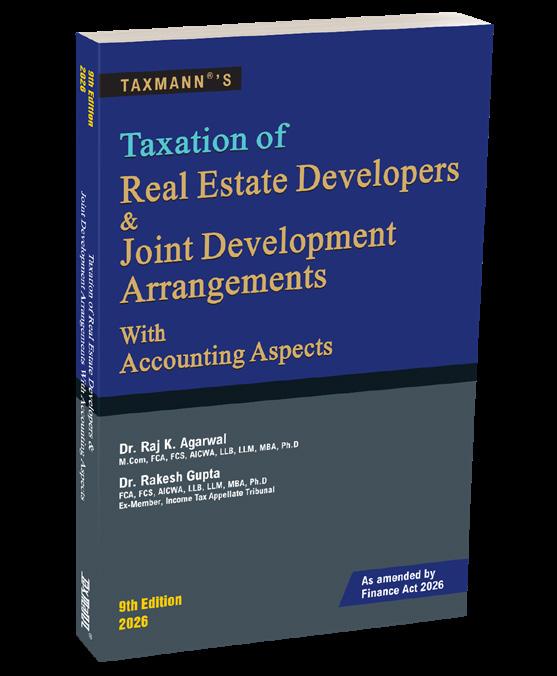
Taxation of Real Estate Developers & Joint Development Arrangements with Accounting Aspects
AUTHOR : Rakesh Gupta, Raj
PUBLISHER : Taxmann
DATE OF PUBLICATION : April 2026
EDITION : 9th Edition | 2026
ISBN NO : 9789375612582
No. of Pages : 608
BINDING TYPE : Paperback
Rs. 1,645
K. Agarwal
DESCRIPTION
Taxation of Real Estate Developers & Joint Development Arrangements with Accounting Aspects is an authoritative treatise on the taxation of real estate transactions in India, with a specialist focus on joint development arrangements (JDAs). It integrates the provisions of the new Income-tax Act 2025 (effective 1st April 2026) with cross-references to the Incometax Act 1961 throughout—making it an indispensable reference during the statutory transition.
The authors—both Fellows of ICAI and ICSI with over four decades of practice—bring professional depth, appellate tribunal experience, and academic rigour to a subject that straddles income tax, accounting standards, and commercial law. The book covers the tax positions of the land owner and the developer, with accounting fully integrated into the analysis rather than treated as a standalone subject.
The book is written for practitioners operating at the intersection of real estate, taxation, and accounts. Its primary readership includes:
• Chartered Accountants
• Advocates and Tax Consultants
• Company Secretaries and Cost Accountants
• Corporate Finance and Legal Teams
• Tax Officials and ITAT Members
• Academics and Researchers
The Present Publication is the 9th Edition | 2026, amended by the Finance Act 2026. This book is authored by Dr Raj K. Agarwal & Dr Rakesh Gupta with the following noteworthy features:
• [Dual-Statute Cross-Referencing] Every provision of the Income-tax Act 1961 is mapped to its corresponding section in the Income-tax Act 2025 systematically throughout the text—not merely in footnotes—keeping the book actionable for both pending matters under the 1961 Act and fresh assessments under the 2025 Act
• [Issue-Based Architecture] Content is structured around discrete, practical tax issues and controversies—each framed as a question or problem, followed by statutory analysis, accounting treatment, and judicial view, including conflicting High Court and ITAT decisions
• [Comprehensive Judicial Digest] The List of Cases covers Supreme Court, all major High Courts, and ITAT decisions up to 2025, with each case cross-referenced to the specific paragraph where it is discussed
• [Accounting Standards Fully Integrated] The evolution from AS-7 (1983 and Revised 2002) through AS-9, ICAI Guidance Notes of 2006 and 2012, IFRS 15, IFRIC 15, and ICDS-III and ICDS-IV is mapped directly onto the income tax computation framework throughout
• [Section 45(5A)/Section 67(14)—Dedicated Chapter] A full chapter analyses this provision—introduced by the Finance Act 2017 and now re-enacted as section 67(14) of the Income-tax Act 2025—covering its scope, conditions, stamp duty valuation, and unresolved controversies
• [‘On Money’ and Search Case Scenarios] The book uniquely addresses search and seizure proceedings in real estate cases—including tax treatment of ‘on money’ receipts, departmental extrapolation methodologies, best judgment assessments, and additions where both unaccounted income and expenses are evidenced