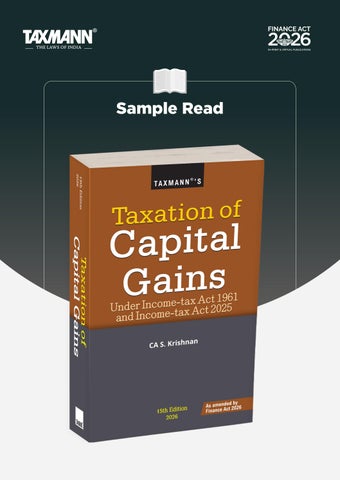

Sample Read

© All rights reserved
Price : ` 3695
Law stated in this book is as amended by the Finance Act, 2026
Published by :
Taxmann Publications (P.) Ltd.
Sales & Marketing :
59/32, New Rohtak Road, New Delhi-110 005 India
Phone : +91-11-45562222
Website : www.taxmann.com
E-mail : sales@taxmann.com
Regd. Office :
21/35, West Punjabi Bagh, New Delhi-110 026 India
Printed at :
Tan Prints (India) Pvt. Ltd.
44 Km. Mile Stone, National Highway, Rohtak Road Village Rohad, Distt. Jhajjar (Haryana) India
E-mail : sales@tanprints.com
Disclaimer
Every effort has been made to avoid errors or omissions in this publication. In spite of this, errors may creep in. Any mistake, error or discrepancy noted may be brought to our notice which shall be taken care of in the next edition. It is notified that neither the publisher nor the author or seller will be responsible for any damage or loss of action to any one, of any kind, in any manner, therefrom. It is suggested that to avoid any doubt the reader should cross-check all the facts, law and contents of the publication with original Government publication or notifications.
No part of this book may be reproduced or copied in any form or by any means [graphic, electronic or mechanical, including photocopying, recording, taping, or information retrieval systems] or reproduced on any disc, tape, perforated media or other information storage device, etc., without the written permission of the publishers. Breach of this condition is liable for legal action.
For binding mistake, misprints or for missing pages, etc., the publisher’s liability is limited to replacement within seven days of purchase by similar edition. All expenses in this connection are to be borne by the purchaser. All disputes are subject to Delhi jurisdiction only.


author of articles and then elevating him to that of an Author of a Book on an important topic of “Capital Gains”. The author is indeed really privileged to be associated with Taxmann in revising and updating this 2026 edition.
All the Chapters have been thoroughly revised and updated with comparative charts of sections bridging both 2025 Act and 1961 Act with practical examples and latest case laws. The author has also explained the latest provisions of relevant sections vis-à-vis case laws. The decisions and orders including the one rendered even as late 18th March, 2026 have been covered. This book also provides an in-depth and thorough analysis of each aspect of capital gains with the help of ‘relevant’ judicial pronouncements, Circulars and Notifications, and illustrations.
A separate chapter [No.34] entitled “Other important case laws” has been devoted to cover latest case laws.
An old CBDT Circular dated 11-4-1955 has been printed in the initial pages of Chapter 1 highlighting the responsibilities of income-tax authorities in guiding the assessees. The importance of this circular has to be understood and followed by professionals while dealing with assessments of their clients.
A separate chapter captioned “NRIs and Taxation of Their income-A Brief Note” has been devoted for NRIs and has been updated wherein, among other things, it has been clearly explained the procedure to be adopted when an NRI disposes of his property in India. The special feature of this Chapter also includes tips for people returning to India or those who become Resident Indians from Non-Resident Indians after being Residents but not ordinarily residents (RNORs) for two years after they return to India.
The present-day topic of Tax planning through Family Arrangement/ Settlement has been discussed in detail with examples and case laws. The author has lucidly explained the order passed by the ITAT Chennai in the second round of litigation in the case of Y. Shanmuga Durai v. Asstt. CIT [2025] 173 taxmann.com 187 (Chennai - Trib.) wherein, it is submitted with respect, the Chennai Bench through a detailed and wellreasoned order has held that “The settlement deed(s) as such executed as per the process known to law would definitely fall within the ambit of the exception of Section 47(iii) of the Act and consequently levy of Capital Gains tax would get negated /vitiated.” In other words, the Tribunal agreeing with the contentions raised on behalf of the assessee finally held that “the gift transaction that had occurred between relatives
(Brothers in the present case) should be reckoned as settlement so as to reckon the same as not a transfer for the purpose of settlement in Section 2(47) read with Section 45/48 of the Act.” The Tribunal also observed that “the above fact was not disputed by the Departmental Representative.” Thus, the tax planning judiciously adopted by the assessee in this case was well recognized by the Tribunal though the assessee lost in the first round before the High Court as he was not represented. This issue (order) has been covered exhaustively in para 4.19-6B of this book. This book has also discussed pros and cons of exemption claims made under sections 54, 54B and 54F arising out of investment made in the name(s) of relatives from funds emanating out of transfer of capital asset.
The author has not hesitated to offer his views whenever and wherever the situation demanded whether it was with reference to interpretation of relevant provisions by the judicial authorities or interpretation by a later Bench of orders/decisions passed by earlier Bench(es).
Exclusive chapter has been devoted to “slump sale” and issue of “demerger” has been covered in an exhaustive way.
The author will be failing in his duty if he does not wholeheartedly thank his entire team members especially Vaibhav Ramanathan and Sailakshmi Balaji who worked with him throughout by supporting him in this interesting assignment of updating this book. The support rendered by the senior staff members Yamuna, Madhavi and Jayasree also deserve special mention. Of course, in the sincere opinion of the author, full support rendered by four generation of family members at home can never be equated with any degree of thanks.
Before concluding, let the conversation the author had with a Senior Government Official from the Income-tax Department recently be shared which highlights the importance of coordination between assessees, the professionals and the income-tax department. The Senior Government Official explained about noncompliance by NRIs unintentionally and the consequences that follow as detailed below-
Let us presume that the NRI deposits few lakhs of rupees in NRE fixed deposit Account. He had taken PAN either when he was an Indian or at the time of leaving the country through a friend or some agency with some local address which he may not even remember. The NRI has not informed the tax department in India that he is an NRI. He also has not created income-tax password and id.
The income-tax department on noticing this deposit in NRE account, picking up the case from non-tax filers’ folder, serves a notice on the address mentioned in the PAN Card advising the NRI to file the return for that year. The tax department would not be able to issue a notice electronically because no id was created by the NRI. As the NRI is not aware of such notice being served on him, he does not respond. The second notice proposing to treat the amount lying in fixed deposit as income of the previous year is served on him on the same address which notice is also not responded to by the NRI. The third communication is the assessment order treating the entire deposit as income raising a huge demand. The NRI is not aware of the assessment order framed on him raising a huge demand. Now the fourth stage is, when recovery proceedings are initiated by the tax department by recourse to his bank account, the NRI becomes aware of such proceedings in different stages but it is too late for him without much remedy.
The senior official conceded that it is not the intention of the tax department to collect more tax than what is required but it is left with no other choice in a case like this. He advised tax practitioners to act as catalyst between the NRI assessees and the tax department so that there is due tax compliance on the part of the NRIs and the tax department takes only its share of taxes. The author suggested to that senior officer that the tax department should (also) come out with advertisements through social media about the tax obligations of NRIs and how such obligations can be fulfilled by NRIs with the help of role to be played by the tax authorities and professionals.
Chennai April, 2026
S. KRISHNAN
Chartered Accountant
ariyurkrish@gmail.com 09840701449


WHAT IS “CAPITAL ASSET”?
3.1
3.3
3.4
3.5
3.9
WHAT IS TRANSFER?
4.0
4.4 Transactions deemed to be transfers under sub-sections (1A), (2A), (3) and (4) of section
4.5
TRANSFERS DO NOT GIVE RISE TO TAXABLE CAPITAL GAINS?
5.11 Transfer of shares in amalgamation or demerger of co-operative banks
Transfer by a shareholder in a scheme of amalgamation
5.13 Transfer outside India by non-resident of bonds/GDRs to another non-resident [Section 47(viia)]
5.14 Transfer of rupee denominated bonds outside India by one non-resident to another non-resident [Section 47(viiaa)]
5.14A Transfer of FCEBS/FCCBS/GDR/rupee denominated bonds of Indian co./derivatives/notified securities by a non-resident on a recognised stock exchange located in any IFSC [Section 47(viiab)]
Transfer, in a relocation, of a capital asset by the original fund to the resulting fund [Section 47(viiac)]
5.14C Allotment of shares of the resultant fund to the shareholders of the original fund as a result of relocation [Section
5.14D
5.14E Any transfer of capital asset under a plan approved by Central Govt. by a public sector co. to another notified public sector co./Central Govt./State Govt. [Section 47(viiaf
5.19/
5.26
5.27 Transfer in a scheme for lending of any securities
5.28 Reverse mortgage transactions by senior citizens - i.e., individuals aged 60 years or more [Section 47(xvi)]
5.28A Extension of “Transactions not regarded as transfer” to joint venture vis-à-vis public sector company
5.29 Taxation of capital gains on conversion of SPV shares into units of business trust [Section 47(xvii)]
5.30 Tax neutrality on merger of similar schemes of mutual funds [Section 47(xviii)]
5.31 Tax neutrality on merger or consolidation of plans within a scheme of a mutual fund [Section 47(xix)]
6
YEAR OF TAXABILITY OF CAPITAL GAINS
6.6A Receipt of money or capital asset or both by a partner or member from firm/LLP/AoP/BoI on connection with the reconstitution of such firm/LLP/AoP/BoI [Section 45(4) as substituted by the Finance Act, 2021]
6.6B Receipt of capital asset/stock-in-trade by partner/member from firm/LLP/AoP/BoI in
or
6.11 Transfer by partner of right in firm’s asset for consideration
6.12
TAXATION OF UNIT LINKED INSURANCE POLICY
6A.0 Table of corresponding sections
6A.1 What is a Unit Linked Insurance Policy (ULIP)?
6A.2 Terminology associated with ULIPs
6A.3 What is the tax treatment for proceeds received from any old ULIP i.e., any ULIP issued before February 1, 2021?
6A.4 What is the tax treatment for proceeds received from any new ULIP i.e., any ULIP issued on or after February 1, 2021?
6A.5 Date of issue of ULIP
6A.6 Whether GST has to be excluded or included for reckoning premium limit of ` 2,50,000 in the 4th and 5th provisos?
6A.7 Whether rider premiums have to be included in annual premium for the purposes 507
6A.8 How is the cap of ` 2,50,000 on annual premium to be reckoned when a person buys just one ULIP on or after 1-2-2021?
6A.9 How is the cap of ` 2,50,000 on annual premium payable by a person in respect of new ULIPs to be reckoned when a person has multiple new ULIPs?
6A.10 Annual cap is on “premium payable by a person”, not “premium paid by a person”
6A.10A Whether firm can take out a ULIP in each partner’s name a “Keyman Insurance Policy” and claim deduction under section 37(1) for ` 2,50,000 premium p.a. and each partner take out a ULIP from personal fund where premium does not exceed ` 2,50,000 p.a.? Whether, in this case, section 10(10D) will be available to partners?
6A.11 What will be taxability in case of premium paid on new ULIPs in the name of any other family member?
6A.12 What happens if a new ULIP is not eligible for exemption under section 10(10D) by reason of the violation of the fourth proviso or the fifth proviso?
6A.13 What is fund switching in ULIPs?
6A.14 Whether benefit under sections 54 to 54GB available in respect of long-term capital gains from ULIP arising under section 45(1B)
6A.15 Capital loss can also arise under section 45(1B)
6A.16 Guidelines issued by CBDT on calculation of capital gains on ULIPs
6A.17 The Finance Act, 2023 changes the rule of taxation with regard to section 10(10D)
6B
TRANSACTIONS BETWEEN A FIRM AND ITS PARTNERS OR BETWEEN AN AOP/BOI AND ITS MEMBERS
6B.0 Table of corresponding sections
6B.1 Definitions of “firm”, “partner” and “partnership” 534
6B.2 Contribution of capital asset to firm/LLP/BoI/AoP by partner/ member [Section 45(3)]
6B.3 Pre-amended section 45(4) - Distribution of capital assets on dissolution of a firm/AoP/BoI or otherwise
6B.4 Executive summary on new provisions of section 45(4), section 9B and section 48(iii)
6B.5 Money or capital asset or both received by partner/member on reconstitution of firm/LLP/AoP/BoI [Section 45(4)]
6B.6 Income on receipt of capital asset or stock-in-trade by specified person from specified entity [Section 9B]
6B.7 In case of reconstitution of firm/LLP/AoP/BoI, which provision will apply when and how?
6B.8 FAQs on reconstitution of specified entities
6B.9 Change in Profit Sharing Ratio (PSR) among existing partners-compensation received by assessee-partner from other existing partners for reduction in profit sharing ratio
6B.10 Deductions under sections 54 to 54GB that may be claimed by firm/LLP/AoP/BoI from resulting long-term capital gains
COMPUTATION OF CAPITAL GAINS - SHORT-TERM
AND
7.0 Table of corresponding sections
7.0A Amendments made by the Finance (No. 2) Act, 2024
7.1 Tax incidence depends upon whether capital gains is long-term capital gains or short-term capital gains
7.3
7.4
compute long-term capital gains in respect of listed equity shares, equity-oriented MFs and units of business trust u/s 112A
7.5 Cases in which benefit of indexation of cost of acquisition/ cost of improvement is not available for computing long-term
7.6 Surcharge applicable on capital gains tax in respect of individual/HUF/AoP/BoI/AJP
HOW TO COMPUTE FULL VALUE
8.9
8.13
of consideration where assessee-buyer gets excess amount of compensation received by seller over agreed sale consideration where land
WHAT IS EXPENDITURE ON TRANSFER OF CAPITAL ASSET
WHAT IS COST OF ACQUISITION ?
of acquisition of shares of amalgamated company in exchange for shares of amalgamating company [Section 49(2)]
of shares/debentures acquired on conversion of bonds/ debentures/deposit certificates/FCCBs into shares/debentures [Section 49(2A)]
Cost of acquisition of ESOPs/sweat equity shares [Section 49(2AA)/section 49(2B)]
rities, paintings, sculptures, etc. taxed as gifts under section 56(2)(vii)/(viia)/(
Calves, colts, trees, etc.
WHAT IS COST OF IMPROVEMENT
WHAT IS INDEXED COST OF ACQUISITION
ROLLOVER DEDUCTION IN RESPECT OF PROFIT ON SALE
Assessee availing section 54 relief required to file ITR w.e.f. A.Y. 2020-21 even if his total income after relief is below threshold exemption limit
DEDUCTION OF ROLLOVER OF GAIN ON TRANSFER OF LAND USED FOR AGRICULTURAL PURPOSES
ROLLOVER DEDUCTION IN RESPECT OF CAPITAL GAIN
ROLLOVER DEDUCTION IN RESPECT OF INVESTMENT
16A.1
16A.2 Exemption denied under section 54 when investment made in the name of son, grandson
16A.3 Exemption denied under section 54 when investment made in the name of unmarried daughter
16A.4 Exemption denied under section 54B when investment made in the name of married daughter
16A.5 No exemption under section 54 when property purchased in the name of sister-in-law
16A.6 Agricultural lands purchased in the name of son and grandson not entitled to section 54B relief
16A.7
16A.8 No denial of exemption under section 54F in the case of investment made in the names of son and daughter
16A.9 Investment made in the name of member of HUF entitled to relief under section 54F
16A.10 Investment made in the name of karta of HUF in his individual capacity entitled to relief under section 54F
16A.11
16A.17
16A.19 Exemption under section 54B available when purchased in name of son
16A.20 Exemption under section 54F not available if investment made in the name of mother
16B
NRIs AND TAXATION OF THEIR INCOME - A BRIEF NOTE
16B.0
16B.3
16B.4
16B.5
16B.6
16B.7 Dealing with tax liability of an NRI
16B.8 Checklist to obtain non-deduction of tax at source/lower deduction of tax at source from income tax department in the case of NRI selling/transferring property in India
16B.8A NRIs to pay more tax on capital gains vis-à-vis sale of unlisted
16B.10
DEDUCTION IN RESPECT OF LONG-TERM CAPITAL
18.7
TAX INCENTIVES FOR TRANSFER OF ASSETS ON SHIFTING OF INDUSTRIAL UNDERTAKINGS FROM URBAN AREA/SHIFTING OF INDUSTRIAL UNDERTAKING FROM URBAN AREA TO ANY SPECIAL ECONOMIC ZONE (SEZ) [SECTION 54G/54GA]
19.0 Table of corresponding sections 1156
19.1 Provisions of section 54G/54GA of the 1961 Act 1156
19.2 Transfer of assets on shifting of industrial undertakings [Section 54G] 1158
19.3 Conditions for deduction under section 54G
19.4 Quantum of deduction under section 54G
19.5 Sale of new asset within three years-tax implications 1164
19.6 Shifting of industrial undertaking from urban area to any Special Economic Zone (SEZ) [Section 54GA] 1164
19.7 Capital gains accounts scheme 1167
19.8 Assessee availing section 54G/54GA relief required to file ITR w.e.f. A.Y. 2020-21 even if his total income after relief is below threshold exemption limit
19.9 Non-disclosure of capital gains in ITR will not bar assessee from claiming deduction u/s 54G or u/s 54GA in assessment proceedings 1170
Annex 19.1 : Notified urban areas under Explanation to section 54G(1) 1171
TAX EXEMPTION FOR CAPITAL GAINS FROM SALE OF RESIDENTIAL
PROPERTY
IF INVESTED IN CAPITAL OF START-UP COMPANY [SECTION 54GB]
20.0 Table of corresponding sections 1174
20.1 Tax exemption for long-term capital gains from selling residential property if the same is invested in equity shares of start-up company 1174
20.2 Conditions to be satisfied for availing tax relief in respect of capital gains by investment in shares of a company which is “eligible start-up” 1175
20.3 Promoter selling his residential property and investing monies in its shares is it efficient from point of view of explaining “source of source” under section 68
20.4 Assessee availing section 54GB relief required to file ITR w.e.f. AY 2020-21 even if his total income after relief is below threshold exemption limit
20.5 Non-disclosure of capital gains in ITR will not bar assessee from claiming deduction u/s 54GB in assessment proceedings 1178
20.6
20.6A Finance Bill, 2022 - Long due amendment to section 68 proposed now
Section 54GB as on
POWER OF CBDT TO RELAX ANY REQUIREMENT FOR CLAIMING DEDUCTIONS
21.0
21.2 Section 119(2)(c) of the 1961 Act applies to sections 54 to 54GB of the 1961 Act
21.3
TAX COMPUTATION IN RESPECT OF STCG
TAX COMPUTATION IN CASE OF LONG-TERM CAPITAL GAINS
23.2 Amendments to section 112 of
23.3
23.4 Tax on long-term capital gains other than from shares, securities and units
23.5 Concessional tax rate of 10% not applicable to long-term capital gains from units of GETFs/debt-oriented mutual funds [Section 112(1)]
23.6 Tax rebate on Special rate income (e.g. Short-term capital gain, Long-term capital gain)
LONG-TERM CAPITAL GAINS TAX ON LISTED EQUITY
24.2 New scheme of taxation of long-term capital gains from listed equity shares, units of equity-oriented MFs and units of business
24.3
24.17
24.18
24.20
24.22
REFERENCE TO VALUATION OFFICER
26.2
LOSS UNDER THE HEAD “CAPITAL GAINS”
DISTRIBUTION OF ASSETS BY COMPANIES IN LIQUIDATION
HOW TO COMPUTE CAPITAL GAINS IN CASE OF
CAPITAL GAIN AND DEPRECIABLE ASSETS
29.1
29.2
29.3
29.5 Legal decisions - In revenue’s favour
29.6 Legal decision - Partly allowed in assessee’s favour
SLUMP SALE [SECTION 50B]
30.0
30.1
30.2 One of the earliest decisions of the Supreme Court on nontaxability in the case of transfer of business
30.7 Supreme Court explains the difference between slump sale and several sale
30.8 Cases wherein it was held that the transfer was outside the purview of “slump sale” 1334
30.9 Cases wherein it has been held that transactions fell within the ambit of section 50B of the Act
30.12 Why has an amendment been brought out now by the Finance Act, 2021 to the definition of the term “slump sale” in section 2(42C) vis-à-vis section 50B?
30.13 The following additional information may be noted
30.14 Comparative study of slump sale and demerger 1355
CAPITAL GAIN ON INTANGIBLE ASSETS
31.0
CHARITABLE TRUST AND CAPITAL GAINS
33.2
CAPITAL GAIN IN REAL ESTATE TRANSACTIONS
of holding immovable property before transfer to maximize tax advantages
33.2A Increase in safe harbour limit from 10% to 20% for home buyers and real estate developers selling such residential units if transfer takes place from 12-11-2020 to 30-06-2021
33.3
33.4
OTHER IMPORTANT CASE LAWS
APPENDICES
APPENDIX 1: Taxation and Other Laws (Relaxation and Amendment of Certain Provisions) Act, 2020
APPENDIX 2: Section 3 of the Taxation and Other Laws (Relaxation of Certain Provisions) Ordinance, 2020 - Relaxation of certain provisions of specified Acts - Notified dates for extension of due dates of various completions or compliances under specified Acts
APPENDIX 3: Extension of time limit for compliance to be made for claiming any exemption under sections 54 to 54GB of the Income-tax Act, 1961 in view of the then-COVID-19 pandemic
1445
1462
1464


CHAPTER 3


TYPES OF CAPITAL ASSETS: SHORT-TERM CAPITAL ASSETS AND LONG-TERM CAPITAL ASSETS
3.0 TABLE OF CORRESPONDING SECTIONS
ITA 1961
Section 2(14)
Section 2(29A)
Section 2(29B)
Section 2(42A)
Section 2(42B)
Section 2(47)
Section 2(48)
Section 47(x)
Section 47(xb)
Section 47(xvii)
Section 47(xix)
Section 49(1)
Section 49(2AG)
Section 49(2AH)
Section 54
Section 54EC
Section 54F
Section 64(2)
Section 115AC(1)(b)
ITA 2025
Section 2(22)
Section 2(67)
Section 2(68)
Section 2(101)
Section 2(102)
Section 2(109)
Sections 2(112) & 2(98)
Section 70(1)(z)
Section 70(1)(zb)
Section 70(1)(zi)
Section 70(1)(zk)
Section 73(1) & its Table Sl. No.1
Section 73(1) & its Table Sl. No.11
Section 73(1) & its Table Sl. No.12
Section 82
Section 85
Section 86
Section 99(3) & 99(4)
Section 209(1) Table Sl. No.2
3.1 DISTINCTION BETWEEN SHORT-TERM CAPITAL GAINS AND LONG-TERM CAPITAL GAINS
Section 2(42B) of the Act defines ‘short-term capital gain’ to mean ‘capital gain arising from the transfer of a short-term capital asset’.
Section 2(102) of the 2025 Act defines short-term capital gain on the same lines.
Section 2(29B) of the Act defines ‘long-term capital gain’ to mean ‘capital gain arising from the transfer of a long-term capital asset’. Section 2(29AA) of the Act defines ‘long-term capital asset’ as capital asset which is not a short-term capital asset.
Section 2(68) of the 2025 Act defines long-term capital gain to mean capital gains arising from the transfer of a long-term capital asset; -viz. on the same lines like the 1961 Act.
Section 2(67) of the 2025 Act defines a capital asset which is not a shortterm capital asset and this definition is also on the sale lines of definition of capital asset under the 1961 Act.
Similarly, while section 2(42A) of the 1961 Act defines short-term capital asset, section 2(101) of the 2025 Act defines the same phrase. The Supreme Court in the case of CIT v. Vimal Lalchand Mutha [2001] 116 Taxman 242 (SC) held that whether capital gain that arose to assessee on sale of immovable property was a long-term capital gain and would depend on a correct interpretation of various clauses in purchase agreement of particular property entered into by assessee with vendors, and, therefore, it would be a question of law.
Transfer of a short-term capital asset [Para 3.3] gives rise to ‘Short Term Capital Gains’ (STCG) and transfer of a long-term capital asset gives rise to ‘Long Term Capital Gains’ (LTCG). Identifying gains as STCG and LTCG is a very important step in computing the income under the head Capital Gains as method of computation of gains and tax payable on the gains and treatment of losses is different for STCG and LTCG.
It may be mentioned that long-term capital gain gets more favourable tax treatment as compared to short-term capital gains.
3.1-1 Definition of month
As the term month assumes importance especially in cases of capital gains let us discuss as to how “month” has been considered by various judicial authorities.
During the course of discussion let reference to section 54EC of the Act may be made. Briefly as per provisions of section 54EC of the Act- for detailed discussion refer to Para16 in order to claim exemption under section 54EC
of the Act, deposit in capital gain bonds has to be made within 6 months from the date of transfer of the capital asset.
The Special Bench of ITAT in the case of Alkaben B. Patel v. ITO [2014] 43 taxmann.com 333/148 ITD 31 (Ahd. - Trib.) (SB) adopting the reasoning which found favour with ITAT Mumbai Bench in the case of Yahya E. Dhariwala v. Dy CIT [2012] 17 taxmann.com 159/49 SOT 458 (Mum. - Trib.) that in the absence of any definition of the word ‘month’ in the Act, the definition of the General Clauses Act,1897 will be applicable, held that time limit of ‘six months’ in sec 54EC of the Act means ‘six British Calendar months’ in view of the General Clauses Act, 1897. The Special Bench also observed that “Legislature in its wisdom has chosen to use the word ‘month’ and this was done keeping in view the definition in section 3(35) of the General Clauses Act, 1897.” The Special Bench rejected the Revenue’s interpretation that ‘month’ should be understood in the ordinary sense i.e., the month is a period from a specified date in a month to the date numerically corresponding date in the following month.
The following observations from the above referred decision of the Special Bench are worth noticing-
“The subtle question is that whether the word “month” refers in this section a period of 30 days or it refers to the months only. Section 54EC, prescribes that an investment is required to be made within a period of six months. Whether the intention of the legislature was to compute six calendar months or to compute 180 days. To resolve this controversy, one has to be guided by a decision of Allahabad High Court pronounced in the case of CIT v. Munnalal Shrikishan [1987] 167 ITR 415 where answering the dispute in respect of law of limitation, the Court has clearly held that there is nothing in the context of section 256(2) to warrant the conclusion that the word ‘month’ in it refers to a period of 30 days, therefore, refers to six months in section 256(2) is to six calendar months and not 180 days. [Para 6]”
The Kolkata Bench of ITAT in the case of Kartick Chandra Mondal v. Principal CIT [2020] 113 taxmann.com 586/181 ITD 89 (Kol. - Trib.) has also held that the period of 6 months would start from the end of the month in which capital asset was sold. The Kolkata Bench in this case also relied on the decision of the Allahabad High Court in the case of Munnalal Shrikishan (supra) and held that “we are of the view that the term “Month””means calendar month (and not period of thirty days), which should be applied for the purpose of section 54EC of the Act.”
AUTHOR
As per provisions of section 253(3) of the 1961 Act (corresponding provisions are contained in section 362(3) of the 2025 Act) “Every appeal under sub-section (1) or sub-section (2) shall be filed within two months from the end of the month in which the order sought to be appealed against is com-
municated to the assessee or the Principal Commissioner or Commissioner, as the case may be.
The time limit till 30.09.2024 was “sixty days of the date on” and this time limit has been extended by the Finance (No.2) Act, 2024.
From this it is clear that whenever the Legislature desires to fix the timelimit it does so in clear terms.
So, it is submitted, with respect, that the order passed by the ITAT Kolkata Bench in the case of Kartick Chandra Mondal v. Principal CIT (supra) has to be read with little caution.
However if reference is made to section 54EC of the Act it clearly states that “the assessee has, at any time within a period of six months after the date of such transfer, ....................................................................................
It is therefore submitted that the section nowhere refers to a period of six months from the end of the month but only refers to only “six months after date of transfer”. Of course, this issue has not yet been tested before any High Court like calculating period of 6 months- i.e., whether it has to be calculated from the date of receipt of amounts/instalments or from the date of transfer of capital asset.
The Kolkata Bench of ITAT in the case of Chanchal Kumar Sircar v. ITO [2012] 18 taxmann.com 304/50 SOT 289 (Kol. - Trib.) held that in case of receipt of sale consideration in instalments, period of six months for claiming deduction under section 54EC of the Act has to be calculated from the date of actual receipt of amount. The Pune Bench of ITAT in the case of Mahesh Nemichandra Ganeshwade v. ITO [2012] 21 taxmann.com 136/51 SOT 155 (URO) (Pune - Trib.) also echoed the same views.
But the Gujarat High Court in the case of Jyotindra H. Shodhan v. ITO [2015] 54 taxmann.com 342/229 Taxman 299 (Guj.) affirming the decision of the Special Bench in the case of Jyotindra H Shodhan v. ITO [2003] 87 ITD 312 (Ahd. - Trib.) (SB) held that the investment in capital gain bonds has to be made within 6 months from the date of transfer and the period of 6 months cannot be calculated from the receipt of final instalment.
Applying the same analogy as adopted by the Gujarat High Court in the case of Jyotindra H. Shodhan (supra) as provisions of section 54EC are clear that investment in capital gain bonds has to be made within a period of 6 months from the date of transfer, let there be an amendment to section 54EC of the Act by replacing 6 months period by 180 days to get over this controversy.
With regard to “month” Halsbury’s Laws of England, in para 143, volume 37, third edition states as under:
“When the period prescribed is a calendar month running from any arbitrary date, the period expires with the day in the succeeding month immediately
preceding the day corresponding to the date upon which the period starts, save that, if the period starts at the end of the calendar month, which contains more days than the next succeeding month, the period expires at the end of the latter month.”
This definition has continuously been taken by the Courts in India as the correct definition of a “month”, which would mean that if the period of limitation starts on, say, the 15th of a month, and the period of limitation is one month, then the period of limitation would be on the 14th of the successive month [P. G. M. Spinning Ltd. v. A. P. S. F. Corporation [2000] 100 Comp. Cas. 449 (AP)], but if the period starts at the end of the calendar month the period would expire at the end of the subsequent month.
3.2 OVERVIEW OF SECTION 2(42A) - DEFINITION OF SECTION 2(42A)
General rule: Holding period of 36 months or less before transfer to qualify as short-term asset [Para 3.3]
Exceptions to the general rule of 36 months or less holding period: 1st proviso: The following assets to be regarded as short-term capital assets if held for 12 months or less before transfer [Para 3.4]
Security (other than a unit) listed on a recognized stock exchange in India
Units of UTI
Units of equity oriented mutual funds
Zero Coupon Bond
2nd proviso: Holding period of 12 months or less for unlisted shares and units of mutual fund units transferred during the period 01.04.2014 to 10.07.2014
3rd proviso: Unlisted shares of companies and immovable property to be regarded as short-term capital assets if held for 24 months or less before transfer. [Para 3.5]
Explanation 1: How to compute the holding period....what periods of time to be included or excluded [Paras 3.6 to 3.6-18]
Minimum holding period for various assets to qualify as long-term capital assets [Para 3.7]
Explanation 2: Definition of ‘security’ [Para 3.7-1]
Explanation 3: Definition of ‘specified security’ and ‘sweat equity shares’ [Para 3.6-9]
Explanation 4: Definition of ‘equity-oriented fund [See Chapter 24]
3.2A FOR LATEST OF HOLDING PERIOD
Refer to Chapter Zero – under the heading “Amendments made by the Finance (No. 2) Act, 2024 Serial No. 2 under the caption “Rationalisation of capital gains”.
3.3 CLASSIFICATION OF CAPITAL ASSET INTO SHORT-TERM CAPITAL ASSET AND LONG-TERM CAPITAL ASSET
The incidence of tax on Capital Gains depends upon the length of the time period for which the capital asset was held before the transfer. In terms of section 2( 42A ) which defines a ‘short-term capital asset’, ordinarily, a capital asset held for 36 months or less is called a ‘short-term capital asset’ and the capital asset held for more than 36 months is called ‘long-term capital asset’.
Exceptions to the “36 months or less holding period” rule is given in Paras 3.4 and 3.5 below.
3.4 CAPITAL ASSETS WHICH WILL BE REGARDED AS STCA IF HELD FOR 24 MONTHS OR LESS
The following assets shall be regarded as short-term capital assets if held for 24 months or less and long-term assets if held for more than 24 months:
Unlisted shares of companies (share of a company not listed in a recognized stock exchange in India)
Immovable property, being land or building or both. [See Para 3.8]
3.5 CAPITAL ASSETS WHICH WILL BE HELD AS SHORT-TERM CAPITAL ASSETS IF HELD FOR 12 MONTHS OR LESS BEFORE TRANSFER
The following assets shall be regarded as short-term capital assets if held for 12 months or less and long-term assets if held for more than 12 months:
Security (other than a unit) listed in a recognized stock exchange in India
Unit of UTI
Unit of equity-oriented mutual funds
Zero Coupon bond [Para 3.5-2]
Units of debt-oriented mutual funds, GETFs/REITs/InVITs to be held for more than 36 months to qualify as long-term capital assets - Section 2(42A)
3.5-1 Securities transacted through stock exchanges
When the securities are transacted through stock exchanges it is the established procedure that the brokers first enter into contracts for purchase/sale of securities and thereafter, follow it up with delivery of shares, accompanied by transfer deeds duly signed by the registered holders. The seller is entitled to receive the consideration agreed to as on the date of contract. Thus, it is the date of broker’s note that should be treated as the date of transfer in case of sale transactions of securities provided such transactions are followed up by delivery of shares and also the transfer deeds. Similarly, in respect of the purchasers of the securities, the holding period shall be reckoned from the date of the broker’s note for purchase on behalf of the investors. In case the transactions take place directly between the parties and not through stock exchanges the date of contract of sale as declared by the parties shall be treated as the date of transfer provided it is followed up by actual delivery of shares and the transfer deeds.
Where securities are acquired in several lots at different points of time, the First-in-first-out (FIFO) method shall be adopted to reckon the period of the holding of the security, in cases where the dates of purchase and sale could not be correlated through specific numbers of the scrips. In other words, the assets acquired last will be taken to be remaining with the assessee while assets acquired first will be treated as sold. Indexation, wherever applicable, for long-term assets will be regulated on the basis of the holding period determined in this manner - Circular No. 704, dated 28-4-1995.
3.5-2 Zero Coupon Bond
According to section 2(48) of the Act, “zero coupon bond” means a bond(a) issued by any infrastructure capital company or infrastructure capital fund or public sector company or scheduled bank on or after the 1st day of June, 2005;
(b) in respect of which no payment and benefit is received or receivable before maturity or redemption from infrastructure capital company or infrastructure capital fund or public sector company or scheduled bank; and
(c) which the Central Government may, by notification in the Official Gazette, specify in this behalf.
3.6 HOW TO COMPUTE THE HOLDING PERIOD OF A CAPITAL ASSET?
In Bharti Gupta Ramola v. CIT [2012] 20 taxmann.com 762/207 Taxman 178
(Delhi), the Delhi High Court held that the holding period of a capital asset (36 months/24 months/12 months) has to be computed as under:
“Holding period of capital asset u/s. 2(42A) (36 months/24 months/12 months) to be reckoned in calendar months by including both date of its acquisition and date of its transfer and without excluding even a fraction of a day.
The term ‘month’ has not been defined in the Act and, therefore, ‘month’ would have to be understood in the sense of ‘calendar month’ as defined in section 3(35) of the General Clauses Act, 1897.
Period of 12 calendar months would begin on the day when the assessee became the holder of the asset and end one day before in the relevant calendar month, next year. Thus, if an assessee acquires an asset on 2nd January in a preceding year, the period of 12 months would be complete on 1st January, next year and not on 2nd January. This position will apply to all cases, except when an asset is transferred/purchased on 1st January. In such cases, the period of one year or 12 months would expire and would be complete on 31st December in the same year.
There is nothing in section 2(42A) to show that the time period would not include fraction of a day.”
The ITAT Mumbai Bench in the case of Anita D. Kanjani v. Asstt. CIT [2017] 79 taxmann.com 67/163 ITD 451 (Mum. - Trib.) held that in order to determine nature of asset in terms of section 2(42A) of the Act, holding period has to be computed from date of issue of allotment letter and not from date when agreement to sell was registered.
The question which arose before the Madras High Court in the case of CIT v. Exim Rajathi India (P.) Ltd. [2021] 130 taxmann.com 316/283 Taxman 480 (Mad.) was “Whether on the facts and in the circumstances of the case, the Tribunal was right in holding that the shares/debentures not listed in the recognized stock exchange could be treated as a long-term capital asset as per Section 2(42A) read with its proviso?” and the High Court answered the question as under-
“Shares/debentures not listed in a recognized Stock Exchange could be treated as long-term capital asset on its transfer after 12 months as per section 2(42A). All shares whether listed or unlisted have enjoyed benefit of shorter period of holding and even any investment in shares of private limited companies enjoyed long-term capital gains on its transfer after twelve months; so far as term used ‘shares held in a company’ is concerned, there is no category mentioned as listed or unlisted shares, albeit condition for being listed in recognized stock exchange in India is for ‘any other security’. Expression listed in a recognized stock exchange in India is only used for category of ‘any other security’ and not for category of ‘share held in a company’. Further after taking into consideration that condition for period of holding was curtailed from 36 months to 12 months by Finance Act, 1987, it was only for ‘share held in a company’. Further, when amendment to Finance Act, 1994 was brought
in statute so far as category ‘shares held in a company’ was concerned, same was not disturbed, albeit, new category was included like ‘any other security listed in recognized stock exchange in India’”
The Karnataka High Court in the case of Mohan Virwani v. Dy. CIT [2014] 51 taxmann.com 43/227 Taxman 131 (Mag.) (Kar.) after taking into consideration the definition of “short-term capital asset” as defined under Section 2(42A) of the Act, the circular issued by the Central Board of Direct Taxes (CBDT) bearing Circular No.684 dated 10.06.1994 pointed out that the shares held in a company, which may be a private limited company, a public limited company or a listed company or any other security other than those shares listed in a recognized stock exchange in India, if it is held for a period of twelve months, then it ceased to be a short term capital asset and it becomes a long-term capital asset.
The ITAT Delhi Bench in the case of Shiv Kumar Jatia v. ITO [2021] 127 taxmann.com 179/190 ITD 181 (Delhi - Trib.) (referred to in Para 2.3.3) held that a right in an uncompleted building or a flat is clearly a property as contemplated by section 2(14) of the Act and period of holding is to be reckoned from date of first agreement while calculating capital gain on sale of such property.
The ITAT Mumbai Bench in the case of Yogesh Mavjibhai Gala v. Principal CIT [2020] 117 taxmann.com 783/183 ITD 665 (Mum. - Trib.) held that holding period for purpose of capital gains has to be reckoned from date of allotment of flat and not date of possession of flat. The earlier co-ordinate Bench in the case of Anita D. Kanjani v. Asstt. CIT [2017] 79 taxmann.com 67/163 ITD 451 (Mum. - Trib.) also expressed the same views.
The ITAT Bangalore Bench in the case of L. Vivekananda v. Asstt. CIT [2021] 124 taxmann.com 67/187 ITD 238 (Bang. Trib.) held that for computing indexed cost of property, date to be reckoned is date of allotment of property and not date on which possession certificate was issued.
The ITAT Delhi Bench in the case of Govind Singh Grewal v. ITO in ITA No. 3232/Del./2018 - Assessment Year 2013-14 - Date of order 31st March 2021 held that date of allotment of flat determines the period of holding. The Tribunal referred to its earlier decision in the case of Praveen Gupta v. Asstt. CIT [2012] 20 taxmann.com 308 (Delhi) wherein it was it was held as under at para 29 of its order-
“According to the aforementioned definition (reference is to section 2(14) of the Act), capital asset means property of any kind held by an assessee whether or not connected with the business or profession and it excludes certain items which while considering the facts of the present case are not relevant. Therefore, it has to be seen that whether by entering into an agreement vide which the assessee was allotted a particular flat by allotment letter whether the assessee has held any asset or not. By entering into an agreement to allot a flat, the assessee has identified a particular property which he intended to buy
from the builder and the builder is also bound to provide the applicant with that property by accepting certain advance amount and making agreement for balance payment as scheduled in the agreement. Thus, going into the provisions, it is not necessary that to constitute a capital asset the assessee must be the owner by way of a conveyance deed in respect of that asset for the purpose of computing capital gain. The assessee had acquired a right to get a particular flat from the builder and that right of the assessee itself is a capital asset. The word ‘held’ used in section 2(14) as well as Explanation to section 48 clearly depicts that assessee must have some right in the capital asset which is subject to transfer. By making the payment to the builder and having received allotment letter in lieu thereof, the assessee will be holding capital asset and, therefore, the benefit of indexation has to be granted to the assessee on the basis of payments made by him for acquiring the said asset and the assessee has rightly claimed the indexation benefit from the dates when he has made the payments to the builder. Therefore, we see force in the claim of the assessee. The Assessing Officer is directed to provide the benefit of indexation to the assessee in the manner in which the assessee has claimed.”
The ITAT Mumbai Bench in the case of Mr. Jaiprakash A. Mishra v. ITO in ITA No. 1505/MUM/2019 vide order dated 30th March, 2021 extracted the following passages from the order passed by the Coordinate Bench in ITA No. 445/Mum/2014-(Same) Assessment Year 2007-08 and allowed the appeal of the assessee on the same points as decided by this earlier Bench to which reference was made. The issue was with regard to period of holding of the asset. The Tribunal extracted the following passages from its earlier order“2.8. It is true that the words of a statute are to be understood in their natural and ordinary sense unless the object of the statute suggests to the contrary. Thus, in construing the words ‘asset was held by the assessee’ in cl. (iii) of Expln. To s. 48 of the Act, one has to see the object with which the said words are used in the statute. If one reads Expln. 1(i)(b) to section 2(42A) together with sections 48 and 49 of the Act, it becomes absolutely clear that the object of the statute is not merely to tax the capital gains arising on transfer of a capital asset acquired by an assessee by incurring the cost of acquisition, but also to tax the gains arising on transfer of a capital asset inter alia acquired by an assessee as provided under section 49 of the Act where the assessee is deemed to have incurred the cost of acquisition. Therefore, if the object of the legislature is to tax the gains arising on transfer of a capital asset acquired under a gift or will or inheritance by including the period for which the said asset was held by the previous owner in determining the period for which the said asset was held by the assessee, then that object cannot be defeated by excluding the period for which the said asset was held by the previous owner while determining the indexed cost of acquisition of that asset to the assessee. In other words, in the absence of any indication in cl. (iii) of the Explanation to section 48 of the Act that the words ‘asset was held by the assessee’ has to be construed differently, the said words should be construed in accordance with the object of the statute, that is, in the manner set out in Expln. 1(i)(b) to section 2(42A) of the Act.
2.9. Apart from the above, section 55(1)(b)(2)(ii) of the Act provides that where the capital asset became the property of the assessee by any of the modes specified under section 49(1) of the Act, not only the cost of improvement incurred by the assessee but also the cost of improvement incurred by the previous owner shall be deducted from the total consideration received by the assessee while computing the capital gains under section 48 of the Act. The question of deducting the cost of improvement incurred by the previous owner in the case of an assessee covered under section 49(1) of the Act would arise only if the period for which the asset was held by the previous owner is included in determining the period for which the asset was held by the assessee. Therefore, it is reasonable to hold that in the case of an assessee covered under section 49(1) of the Act, the capital gains liability has to be computed by considering that the assessee held the said asset from the date it was held by the previous owner and the same analogy has also to be applied in determining the indexed cost of acquisition. For determining the capital gain, the cost of acquisition of capital asset is crucial. Thus, keeping in view, the totality of facts, we hold that the long terms capital gains has to be from the date from which the capital asset in question was held by the previous owner and the indexed cost of acquisition also has to be determined on the very same basis, consequently, the indexed cost of acquisition has to be computed with reference to the year in which the previous owner first held the asset and not the year in which the assessee became the owner of such asset. The ratio laid down in B.N. Vyas v. CIT [1986] 25 Taxman 133/159 ITR 141 (Guj.), CIT v. N.N. Mohan & Sons [2001] 115 Taxman 252/250 ITR 131 (Del.), CIT v. Harbhagwan [1998] 145 CTR (P & H) 332, Syndicate Bank Ltd. v. Addl. CIT [1986] 29 Taxman 32/[1985] 155 ITR 681 (Kar.), Ranchhodbhai Bhairibhai Patel v. CIT [1971] 81 ITR 446 (Guj.), CIT v. M. Ramaiah Reddy [1986] 24 Taxman 764/158 ITR 611 (Kar.), CIT v. Smt. M. Subaida Beevi [1987] 30 Taxman 50/[1986] 160 ITR 557 (Ker.), CIT v. Steel Group Ltd. [1981] 7 Taxman 295/131 ITR 234 (Cal.), CIT v. Duncan Brothers & Company Ltd. [1994] 74 Taxman 283/209 ITR 44 (Cal.), Arun Sunny v. DCIT [2009] 184 Taxman 498 (Ker.) further supports the case of the assessee. Respectfully following the decision from Hon’ble jurisdictional High Court in Manjula J. Shah (Supra), we affirm the conclusion drawn by the ld. Commissioner of Income Tax (Appeals), therefore, the appeal of the Revenue is dismissed.”
The ITAT Mumbai Bench in the case of Deputy CIT v. Shri Narendra Gehlaut in ITA No. 1101/Mum/2022 - Assessment Year 2017-18 - Date of order 31st July, 2023 held that for computing holding period for capital gain the period to be taken from date of allotment of the flat.
The ITAT Mumbai Bench of ITAT in the case of Minaxi Mahesh Pawani v. ITO (International Taxation) [2024] 164 taxmann.com 255 (Mumbai - Trib.) held that where assessee sold right to a under-construction flat conferred by an allotment letter by a builder, holding period should be computed from date of allotment letter and not date of registration of agreement of sale between assessee and builder.
The Tribunal referred to number of precedents on this issue and also referred to Circular No. 471 dated 15-10-1996 “whereby instructions were issued regarding treatment of capital gains tax, in case of a flat purchased under self-financing scheme. In para 3 of the said circular, it was stated that “it has been decided that cases of allotment of flats under the self-financing scheme of the Delhi Development Authority shall be treated as cases of construction for the purpose of capital gains.” In para 2, facts of the case were described according to which under the self-financing scheme of the Delhi Development Authority the allotment letter is issued on payment of the 1st instalment of the cost of construction. The allotment is final unless it is cancelled or the allottee withdraws from the scheme. The allotment is cancelled only under exceptional circumstances. The allottee gets title to the property on the issuance of the allotment letter and the payment of instalments is only a follow-up action and taking the delivery of possession is only a formality. If there is a failure on the part of the Delhi Development Authority to deliver the possession of the flat after completing the construction, the remedy for the allottee is to file a suit for recovery of possession.”
The Calcutta High Court in the case of Anuj Agarwal v. Principal Commissioner of Income Tax [2025] 172 taxmann.com 536 (Calcutta) (Judgment dated 25th February, 2025) has held where an assessee was allotted an office unit by a letter of allotment dated 1-8-2006 and after allotment, entire sale consideration was paid, since a direct interest on property stood created in favour of the assessee as and when letter of allotment was issued, date of acquisition of the subject property should be reckoned as 1-8-2006 and not 18-3-2008 when agreement for sale was executed and registered.
The Calcutta High Court referred to the definition of transfer as defined under section 2(47) of the Act.
The Calcutta Hight Court made the following important observations at paras 15 to 18 of its judgment.
“15. In the instant case, Explanation 2 as contained therein would be relevant and applicable. Explanation 2 states that for removal of doubts, it is clarified that “transfer includes and shall be deemed to have always included disposing of or parting with an asset or any interest therein, or creating any interest in any asset in any manner whatsoever, directly or indirectly, absolutely or conditionally, voluntarily or involuntarily by way of an agreement or otherwise....”. Thus, Explanation 2 in section 2(47) of the Act gives the widest to possible meaning to the definition of transfer.
16. At this juncture, we need to bear in mind that the definition of transfer as defined under the Transfer of Property Act should not be emerged while considering whether a transaction is a transfer under the provisions of the Income Tax Act.
17. Undoubtedly, on the date of allotment, namely, 1.8.2006 a right has accrued in favour of the appellant/assessee. This is more so because the developer has accepted that the assessee has paid a sum of Rs. 3,13,000 by cheque dated 29-72006 which was prior to the allotment order dated 1-8-2006.
18. Therefore, this payment coupled with the terms of allotment has created an interest in the asset and it cannot be said to be indirectly but it should be said to be a direct interest and it is deemed to be an agreement as in Explanation 2 the expression “or otherwise” has been used. The revenue does not dispute the fact that the payment schedule has been adhered to by the assessee and ultimately on the date when the agreement for sale was executed, namely, 27-12-2007, 82.5% of the entire sale price payable has been paid by the assessee. Prior to the date of sale in favour of the third party which took place on 29-4-2010 the entire consideration has been paid by the assessee which has been acknowledged by the developer. All these payments are a consequence of an allotment made on 1-8-2006 and, therefore, it has to be held that the right over the property in question accrued in favour of the assessee as on the date of allotment i.e. 1-8-2006. The effect of a letter of allotment was considered by the Hon’ble Division Bench of this court in the case of Rupa & Co. Ltd. v. State of West Bengal 2020 SCC OnLine Cal 256. Though this decision did not arise out of the proceedings under the Income-tax Act, 1961, yet the observation contained qua the rights created pursuant to a letter of allotment has been dealt with in the said judgment and to that extent the judgment would apply to the facts and circumstances of the case. The Hon’ble Division Bench taking note of the decision in Chiranjit Lal Chowdhuri v. Union of India AIR 1951 SC 41 observed that it cannot be disputed that the letter of allotment, unregistered and unstamped did not create a legal right to property. Nevertheless, some right concerning the property had been created in favour of the appellant therein and it could not have been taken away by an administrative act. The Special Leave Petition filed against the said decision in Special Leave to Appeal (C) No.10473 of 2020 was dismissed by the Hon’ble Supreme Court by order dated 19-7-2021. The facts of the case on hand is much better as we are to decide the matter by taking note of the definition of the transfer as defined under Section 2(47) Explanation 2, Income-tax Act, 1961 which, as noted above has given the widest meaning for the word “transfer” as it has been clarified that “transfer” includes and shall be deemed to have always included disposing of or parting with an asset or any interest therein, or creating any interest in any asset in any manner whatsoever, directly or indirectly, absolutely or conditionally, voluntarily or involuntarily by way of an agreement or otherwise.”
The Calcutta High Court also referred to the decision of the Punjab & Haryana High Court in the case of Madhu Kaul v. Commissioner of Income tax, Chandigarh [2014] 43 taxmann.com 417/225 Taxman 86/363 ITR 54 (Punjab & Haryana) wherein a flat was allotted to the assessee on 7.6.1986 and the assessee paid the first instalment on 4-7-1986 but the possession of the flat was delivered at a later date and thereafter the assessee sold the flat on 5-7-1989 and the question was whether the capital gain arising from the sale of flat was long term capital gain or short term capital gain. The Punjab & Haryana High Court held the case to be one of long term capital gain by reckoning the date of allotment, namely, 7-6-1986 and the payment made by the assessee therein towards the first instalment on 4-7-1986 thereby confirming a right upon the payment therein to hold a flat which was later identified and possession delivered on a later date. It was further held by the Court that the mere fact that possession was delivered later, did not detract from the fact that the allottee was conferred a right to hold the property on issuance of an allotment order.
The payment of balance of instalments, identification of a particular flat and delivery of possession are consequential acts would relate back to and arise from the rights conferred by the allotment letter.
The Supreme Court in the case of M.S. Ananthamurthy v. J. Manjula M.S. [2025] 172 taxmann.com 7 (SC) [27-02-2025] has held that “where original owner executed General Power of Attorney (POA) and agreement to sell in favour of holder, however, POA and agreement to sell were not registered, even though POA and agreement to sell were contemporaneous documents executed by original owner in favour of same beneficiary, in absence of registration under section 17(1)( b ) of Registration Act, it would not be open for holder of POA to contend that she had a valid right, title and interest in immovable property to execute registered sale deed in favour of appellant, hence, sale deed executed by General POA holder after death of original owner was invalid.”
The Supreme Court held that “POA was general in nature and did not secure agent’s right in subject matter of agency and, an agreement to sell simpliciter did not confer ownership in immovable property so as to transfer a better title to anyone else Transfer of immovable property by way of sale could only be by a deed of conveyance, an agreement to sell is not a conveyance and it is not a document of title or a deed of transfer of deed of property and does not confer ownership right or title.”
The Supreme Court in this case referred to its earlier decision in the case of Suraj Lamp & Industries Pvt. Ltd. v. State of Haryana , reported in [2012] 1 SCC 656 wherein the earlier Bench of the Supreme Court had reiterated that an agreement to sell does not meet the requirements of sections 54 and 55 of the Transfer of Property Act to effectuate a ‘transfer’.
The ITAT Mumbai Bench in the case of Mrs. Urmila Jagdish Mehta v. Asstt. CIT [2026] 182 taxmann.com 12 (Mumbai - Trib.) has held that where the assessee sold a redeveloped flat in respect of which rights had crystallized pursuant to allotment and agreement in 2006, mere subsequent payment of instalments or date of completion of construction did not defer date of acquisition; accordingly, period of holding was to be reckoned from date of allotment and gains were assessable as long-term capital gains.
The ITAT Bangalore Bench in the case of Shreshta Sheel Patil v. ITO [2026] 183 taxmann.com 39 (Bangalore - Trib.) held that where purchase deed of property clearly recorded that entire sale consideration was paid and possession of property was handed over to the assessee on 20-4-1996, merely because sale deed was registered at a later point of time on 24-4-1998, date of acquisition could not be shifted to year of registration when substantial rights in property stood transferred earlier and, accordingly, CII applicable to financial year 1996-97 was to be adopted for purpose of computing indexed cost of acquisition.
The Madras High Court in the case of ITO v. Bakthavatsalam Gowtham [2025] 175 taxmann.com 1075 (Madras) has held that where the assessee had already offered capital gains on transfer of property in assessment year 2004-05 which was duly assessed under section 143(3) of the Act, it was not open to the Assessing Officer to again treat the same property as transfer by the same assessee in the assessment year 2007-08 merely because the sale deed was registered in year 2007.
The Commissioner of Income-tax (Appeals) allowed the appeal of the assessee on the consideration that (i) all the conditions stated in Section 53A of the Transfer of Property Act, 1882 were satisfied in the financial year 2003-04 since the assessee had received the sale consideration and had given an irrevocable power of attorney in favour of the purchaser in the said period; (ii) Hence, the transfer was completed in the financial year 2003-04 and the capital gains were assessed in the financial year 2003-04; and (iii) the jurisdictional High Court’s decision in the case of D. Kasturi v. CIT [2002] 121 Taxman 2/[2001] 251 ITR 532 (Madras) and the ratio followed by the Jaipur bench of the Income Tax Appellate Tribunal in the case of Smt. Vijay Laxmi Dhaddha v. CIT [2009] 20 DTR (AT) 365 (Jaipur) would apply to the present scenario.
The appeal filed by the Revenue was dismissed by the Tribunal and the High Court concurred with this view of the Tribunal.
The Calcutta High Court in the case of Tamal Kundu v. Addl. CIT [2025] 175 taxmann.com 266 (Calcutta) has held that where the assessee entered into an agreement for sale with vendor for purchase of a rice mill and the entire sale consideration was paid on date of execution of agreement, and the possession of rice mill along with plant and machinery was handed over to the assessee, transfer of capital asset took place under section 2(47) of the Act on the date of agreement for sale and not on date of execution and registration of sale deed.
The order passed by the ITAT Kolkata Bench in the case of Tamal Kundu v. ITO in ITA No.1797/Kol/2024-Assessment Year 2018-19-Date of order 20th November, 2024 was reversed by the High Court even though the Tribunal made the following observations at para 8 of its order-
“8. Perusal of the aforesaid agreement would reveal that it is not a transfer deed. In the heading of the agreement, the words mentioned are ‘Agreement for sale’. Further, in clause 1 of the agreement, it has been written that the second party will pay ` 86 lacs, as full and final payment for sale of the property, which shows that no money was transferred at the time of execution of agreement. Though the sale consideration was to be paid on the same date i.e. on 30th December, 2016, however, Clause 3 of the agreement shows that the first party
will be bound to execute the sale deed within two years of receipt of entire sale consideration, which shows that the transfer was dependent upon the execution of the sale deed. Though, in clause 4 of the agreement, it has been written that the first party on receipt of sale consideration, will deliver the possession of the premises of the said property to second party, however, that does not imply, in any manner that mere delivery of possession will complete the transfer of the property, which in fact, was dependent upon execution of the registration of the sale deed in favour of the purchasers. As per clause 5, it has been mentioned that purchaser will have the right to take electric connection and other licenses and permission for running the business. However, the contents of the aforesaid clause, itself, show that all permissions were subject to the approval of the seller. Under the circumstances, and a complete reading of the said agreement shows that the transfer of the sale of the property was not complete on the execution of agreement rather the same was dependent on future actions. The ld. Counsel for the assessee stated that the agreement was executed on 30th December, 2016 itself, and that the entire sale consideration was paid on the said date itself. However, as discussed above, on perusal of the clauses of the agreement would show that it was not a transfer deed in itself. Even in the light of the provision of Section 2(47)(vi) of the Act, in our view, the transfer was not complete on the said date as there is no mention in the agreement that the first party will enjoy the property on the execution of the agreement as owner and that the transferor from the said date will not have any right or interest left in the said property. Transfer was dependent upon future action of registration of sale deed. The copy of the registered sale deed has been placed at page 5 of the paper book which is dated 28th March, 2018. A perusal of the said sale deed would also reflect that the rights in the property have been transferred, on the date of execution of the sale deed. There is no mention in the sale deed that, in fact, the property was transferred on an earlier date, or that, the sale deed has been executed as formality on a subsequent date. All the rights in the said property were transferred as per the contents of the sale deed on the date of the execution/registration of the sale deed. Under these circumstances, we are not convinced with the arguments of the ld. Counsel for the assessee that the transfer was complete on the date of execution of the sale agreement.”
With regard to the applicability of the decision of the Supreme Court in the case of Balbir Singh Maini (supra) to the facts of the case, this is what the Tribunal observed at para 10 of its order-
“------ we note that even the said decision of the Hon’ble Supreme Court is not applicable to the facts of the case in hand. The Hon’ble Supreme Court in the said case, while considering the provisions of section 2(47)(vi) of the Act, has observed that the idea is to bring within the tax net a de facto transfer of any immovable property, where though title may not be transferred in law, there is, in substance, a transfer
of title, in fact. However, in the case in hand, as observed above, there is no transfer of title in this case on mere execution of the agreement. Moreover, the object and purpose of the said provision, as held by the Hon’ble Supreme Court also, is to bring to the tax net the capital gains on de facto transfer, and that an assessee may not defer the payment of taxes pleading that the transfer deed is not registered. However, the said provision cannot be allowed to be misused by a defaulting assessee, who himself concealed the execution of unregistered agreement in the year in which it was executed and there was no information available to the AO that any such transfer of property has taken place. The assessee, otherwise, cannot be allowed to take the benefit of his own wrong. Under the circumstances, the case laws relied upon by the ld. Counsel for the assessee in the facts and circumstances of the case in hand, are not applicable.”
Author- The order of the Tribunal has been extracted in detail above to indicate as to how the agreement for sale accompanied by possession by the Buyer of the property was misinterpreted by the Tribunal warranting correction by the High Court.
The ITAT Bangalore Bench in the case of K.S. Akhilesh Babu v. Asstt. CIT [2025] 181 taxmann.com 293 (Bangalore - Trib.) has held that where, in a JDA, sale consideration of villas was determined on basis of saleable/super built-up area, cost of acquisition of land also had to be computed with reference to such saleable area and not entire land surrendered, and thus, adoption of a lower per sq. ft. land cost by spreading it over total land was incorrect
The Bench also held that where land distributed by partnership firm was transferred by the partners under a JDA in the same year, period of holding of firm could not be carried forward and capital gains were rightly taxable as short-term.
The basis on which the decision was rendered in favour of the Revenue can be tracked to para 18.2 which has been extracted below-
“Undisputedly, the property was originally held in the name of the firm in which the assessee was one of the partners. Due to dispute between the partners, the land which was owned by the partnership firm was distributed among the partners in their respective sharing ratio by virtue of compromise petition filed before the Civil Court. The partnership firm had paid the capital gains on the distribution of land to the partners which is also not disputed. The Co-owners thereafter entered into a JDA and executed the power of attorney with the developer on 01/03/2007 in their individual capacity as co-owners and not in the capacity of Partnership firm. Further, on-going through the compromise petition, we also take a note of the fact that all the co-owners will receive their share of sales consideration directly from the developer. Thus, once the assets have been distributed to the partners, the partners/co-owners had entered into the JDA in the
same year i.e. FY 2006-07 relevant for the Asst. year 2007-08. Thus, we are of the considered opinion that since the asset was held by the co-owners for a short period i.e. less than 36 months, the AO had correctly computed the gain as short term capital gain. We also agree with the contention of the ld. DR that the decision relied upon by the council of the assessee are totally distinguishable from the fact of the present case and therefore the contention of the A.R. of the assessee is not acceptable.”
The Tribunal repelled the contention raised on behalf of the assessee that in case of succession, inheritance, gift or acquisition by will, the holding period of the previous owner being (of) the firm should be considered and has to be taxed as long-term capital gains by holding that “it is neither a case of distribution of capital asset in the partition of HUF nor it is a case of transfer of capital asset under a gift, will or by succession, inheritance and therefore the question of the consideration of the period for which the asset was held by the previous owner does not arise.”
The ITAT Mumbai Bench in the case of Braj Kishore Singh v. Assessing Officer, International Taxation [2025] 176 taxmann.com 222 (Mumbai - Trib.) held that where the assessee entered into agreement to sale in November 2007 and paid substantial portion of consideration in financial year 2007-08, the assessee acquired right to hold asset from that year and was therefore entitled to indexation benefit from financial year 2007-08, not from year of possession in December 2010. The holding period of the asset has to be counted from the financial year 2007-08.
3.6-1 Computation of holding period of share held in a company in liquidation
In the case of a share held in a company in liquidation, the period subsequent to the date on which the company goes into liquidation shall be excluded in determining the period for which such share was held by the assessee. [Explanation 1(i)(a) to section 2(42A)]. In other words, the date on which company goes into liquidation shall be included in computing the holding period for determining whether the share was held for 12 or 24 months or less or for more than 12/24 months.
3.6-2 Computation
of holding period of a capital asset which becomes the property of the assessee in the circumstances mentioned in section 49(1)
A capital asset may become the property of an assessee in the circumstances mentioned in section 49(1) viz:
(A) on any distribution of assets on the total or partial partition of a Hindu undivided family;
(B) under a gift or will;
(C) (a) by succession, inheritance or devolution, or
(b) on any distribution of assets on the liquidation of a company, or
(c) under a transfer to a revocable or an irrevocable trust, or
(d) under any such transfer as is referred to in clause (iv) or clause (v) [Para 5.4] or clause (vi) [Para 5.5] or clause (via) [Para 5.6] or clause (viaa) [Para 5.7] or clause (viab) [Para 5.1] or clause (vib) [Para 5.8] or clause (vic) [Para 5.9] or clause (vica) [Para 5.10] or clause (vicb) [Para 5.11] or clause (vicc) [Para 1.4] or clause (viiac) [Para 5.14B] or clause (viiad) [Para 5.14C] or clause (viiae) [Para 5.14D] or clause (viiaf) [Para 5.14E] or clause (xiii) or clause (xiiib) [Para 5.21/Para 5.22] or clause (xiv) [Para 5.26] of section 47;
(D) such assessee being a Hindu undivided family, by the mode referred to in sub-section (2) of section 64 - i.e., conversion of self-acquired property of member of HUF into HUF property.
In above cases, the period for which the asset was held by the previous owner shall be included in determining the period for which such asset was held by the assessee. [Explanation 1(i)(b) to section 2(42A)]. The expression ‘previous owner of the property’ in relation to any capital asset owned by an assessee means the last previous owner of the capital asset who acquired it by a mode of acquisition other than that referred to section 49(1) - i.e. (A) to (D) above.
3.6-2.1 Indexation and cost of acquisition when the property was acquired through inheritance, Will etc.
In the case of property acquired through will, inheritance, settlement or gift the indexation relates back to the year of acquisition of the property by the first owner. This view is supported by the decision of the Bombay High Court in the case of CIT v. Manjula J. Shah [2011] 16 taxmann.com 42/[2012] 204 Taxman 691 (Bom.), which while approving the decision of the Mumbai Special Bench of ITAT in the case of Dy. CIT v. Manjula J. Shah [2010] 35 SOT 105 (Mum. - Trib.) (SB), has held that indexation relates back to the year of acquisition of the property by the first owner. The High Court of Bombay in a subsequent decision in the case of CIT v. Raman Kumar Suri [2013] 29 taxmann.com 231/212 Taxman 411 (Bom.) has followed this decision in the case of Manjula J. Shah (supra) with regard to relating indexation back to the year of acquisition of the property by the first owner. The High Court
of Bombay in the case of CIT v. Ms. Janhavi S. Desai [2012] 24 taxmann. com 314/209 Taxman 289 (Bom.) has held that previous owner of property for purpose of sections 2(42A) and 49(1) does not include a person who acquired property by a mode of acquisition referred to in sub-clauses (i) to (iv) of section 49(1). In other words, it refers to the first owner. In fact, the Punjab & Haryana High Court in the case of CIT v. Sathish Kumar Arora in ITA No.633 of 2009 (Date of decision 20-09-2010) was the first High Court to hold that in case of inheritance the date of acquisition by the present owner relates back to the date of acquisition by the first owner. The Delhi High Court in the case of Arun Shungloo Trust v. CIT [2012] 18 taxmann. com 261/205 Taxman 456 (Delhi) following the decision of the Bombay High Court in the case of Manjula J. Shah (supra) has held in favour of assessee by observing that benefit of indexed cost of inflation is given to ensure that tax payer pays capital gains tax on ‘real’ or actual ‘gain’ and not on increase in capital value of property due to inflation; this is the object or purpose in allowing benefit of indexed cost of improvement, even if the improvement was made by previous owner in cases covered by section 49 of the Income-tax Act. The Gujarat High Court in the case of CIT v. Rajesh Vitthalbhai Patel [2013] 37 taxmann.com 439/218 Taxman 301 (Guj.) has held that where assessee’s brother acquired a property prior to 1-4-1981 and had gifted said property to assessee on 23-5-1995 and subsequently the assessee had sold property on 7-2-2006, while computing capital gain indexed cost of acquisition was to be worked out with reference to 1-4-1981 and not with reference to date on which assessee acquired property by gift, i.e., 23-5-1995. The following observations made by the Gujarat High Court at para.8 of its order are worth noticing.
“Additionally in sub-section (1) of section 49 the legislature has provided that cost of acquisition of the asset shall be deemed to be the cost for which the previous owner of the property acquired it, as increased by any cost of improvement of the asset incurred or borne by the previous owner or the assessee, as the case may be. If the interpretation of the revenue was correct, this later reference to the cost of improvement borne by the assessee would not have been necessary, since section 48 itself would take care of any improvement on the capital asset to be included for the cost of acquisition. It is precisely because such improvement referred to in section 48 would have reference only to that made by the previous owner that the additional provision had to be made in the deeming fiction provided in sub-section (1) of section 49. Further the interpretation sought to be given by the revenue would be unacceptable because there is no provision under which the cost of acquisition in the hands of the assessee in cases such as gift on the date of acquisition of the property can be made and found in the Act. A serious road-block would be created if such property is acquired through Will and would, therefore, have no reference to its actual cost or the date of operation of the Will.”
The Madras High Court in the case of CIT v. Saroja Naidu [2021] 128 taxmann.com 127/281 Taxman 305 (Mad.) by affirming the order passed by the ITAT Chennai Bench in the case of ITO (International Taxation) v. Mrs. Saroja Naidu [2017] 88 taxmann.com 784 (Chennai - Trib.) held that while computing capital gains arising on transfer of a capital asset acquired by assessee by inheritance, indexed cost of acquisition has to be computed with reference to year in which previous owner first held asset and not year in which assessee became owner of asset. One of the decisions followed by the Madras High Court was the decision rendered by the Bombay High Court in the case of Manjula J. Shah (supra).
The Gujarat High Court in a subsequent decision in the case of CIT v. Gautam Manubhai Amin [2013] 38 taxmann.com 42/218 Taxman 319 (Guj.) following the decision in the case of Manjula J. Shah (supra) has reiterated the same principle by holding that period of holding of inherited property would include duration of possession of asset by previous owner. The ITAT, Chennai Bench in the case of Asstt. CIT v. Syed Maqbul Hussain [2010] 4 ITR (Trib.) 44 (Chennai - Trib.) has also adopted the same view. The first view in favour of the assessee in this direction was expressed by Chandigarh Bench of the Income-tax Appellate Tribunal in the case of Mrs. Pushpa Sofat v. ITO [2002] 81 ITD 1 (Chd. - Trib.) (SMC).
The Karnataka High Court in the case of CIT, Mysore v. Smt. Asha Machaiah [2014] 48 taxmann.com 381/227 Taxman 155 (Mag.) (Kar.) has also held that when an asset is acquired by way of inheritance, cost of acquisition of asset should be calculated on basis of cost of acquisition to previous owner and said cost of acquisition of previous owner has to be calculated on basis of indexed cost of acquisition as provided in Explanation (3) to section 48.
In fact, number of Tribunal Benches has adopted the same line of reasoning while deciding the issue of cost and period of indexation in favour of assessees.
The Karnataka High Court in a subsequent decision in CIT v. Smt. Kaveri Thimmaiah [2014] 49 taxmann.com 545/[2015] 228 Taxman 323 (Mag.) (Kar.) has echoed the same views.
The Chennai Bench of ITAT in the case of Assistant Commissioner of Incometax v. M. Sankar Trading and Consultancy Private Ltd. in ITA No. 2103/ Mds/2012 (order dated 26th March, 2013) following number of precedents on this issue has held that for the purpose of computation of long-term capital gains arising from the transfer of a capital asset which had become property of the assessee under gift, the first year in which the capital asset was held by the assessee had to be determined to work out the indexed cost of acquisition, as envisaged in the Explanation (iii) of Sec. 48 after taking into account the period for which the said capital asset was held by the previous owner.
The ITAT Chennai Bench in the case of S. Krishnan v. Deputy Director of income Tax (International Taxation) (2015) 44 CCH 0132 (Chennai - Trib) (order dated 15th May 2015) following the decision of the Bombay High Court in the case of Manjula J. Shah (supra) has also held that Capital gains under section 48 of the Act had to be computed by applying the deemed fiction and the indexed cost of acquisition had to be computed with effect from 01.04.1981 or the date of acquisition if the property had been acquired later (i.e. on or after 01-04-1981) when the first owner acquired the property.
The ITAT Chennai Bench in the case of Padmanabhan Venkatramanan v. ITO in ITA No. 712/Mds/2016 - Order dated 15-07-2016 has also held that indexation relates back to the year in which the previous owner first held the capital asset.
The ITAT Chennai Bench in the case of Shri Bharathan Anand v. ITO in ITA No.2630/Mds/2016- Order dated 23-12-2016 has also held that indexation relates back to the year in which the previous owner first held the capital asset.
Kindly note the following-
The ITAT Chennai Bench in the case of ITO v. Shri. Mustafa Yakub in ITA No.1872/Mds/2012-Assessment Year 2009-10 vide order dated 7th January, 2013 has observed as under at para 13 of its order-
“The CIT/DR could not point out any good reason why the above settled law applied by the CIT(A) in the instant case was erroneous. The only contention of the CIT/DR is that the Department has not accepted the decision of the Hon’ble Bombay High Court in the case of CIT v. Manjula J. Shah [2011] 16 taxmann.com 42/[2012] 204 Taxman 691 (Bom.) as the Department has filed a SLP before the Hon’ble Supreme Court against the said order. However, the CIT/DR could not bring any material before us to show that the Hon’ble Supreme Court has varied the order of the Hon’ble Bombay High Court or even stayed the operation of the order. We, accordingly, dismiss the grounds of appeal taken by the Revenue.”
The issue pertained to the adoption of index point pertaining to the year of acquisition by the assessee who acquired the property through a Memorandum dated 04-10-2000 followed by declaration executed on 30-10-2000 which was covered by the provisions of section 49(1) of the Income-tax Act. The assessee’s father became entitled to his share in the properties on 14-121985 on the demise of his father (assessee’s grandfather) who inherited it prior to 01-04-1981. Thus, the assessee adopted 100 points pertaining to 01- 04-1981 whereas the assessing officer adopted 406 points pertaining to the financial year 2000-01 the year in which Memorandum was entered into followed by declaration. The Commissioner of Income-tax (Appeals), following the decision of the Bombay High Court in the case of Manjula J. Shah (supra) held that indexation relates back to the year in which the asset was first acquired by the first owner.
The Tribunal, on appeal by the Revenue, dismissed the appeal after making the observations as quoted above in the first paragraph.
Point to note
The ITAT Chennai Bench in the case of T.T. Siddarth v. Dy. CIT [2016] 71 taxmann.com 117/159 ITD 519 (Chennai - Trib.) held that for purpose of section 49(1)(ii) of the Act, there is no difference between gift and settlement and, therefore, settlement of asset in favour of assessee has to be considered as gift in terms of section 49(1)(ii) of the Act and, accordingly, Explanation 1(i)(b) to section 2(42A) of the Act has to be applied so as to compute period of holding of asset after taking into consideration holding period of said capital asset by previous owner i.e. settlor. Earlier the ITAT Chennai Bench in the case of ITO v. Abdul Hameed Khan Mohammed [2016] 65 taxmann.com 211/156 ITD 778 (Chennai - Trib.) held that where the assessee had sold his residential property in April, 2010 and invested sale proceeds in August, 2010 in another residential property and in November, 2010 he had settled new property on his daughter out of love and affection, settlement of property was a gift falling under section 47(iii) of the Act and the assessee was entitled to exemption under section 54 in respect of capital gains arising on sale of property.
However, the Madras High Court in the case of Principal CIT v. S. Yogarathnam [2020] 118 taxmann.com 54/273 Taxman 513 (Mad.), where they was no representation from assessee’s side, found fault with the order passed by the Tribunal, when following its earlier order in the case of Abdul Hameed Khan Mohammed (supra) it held that “for the purpose of Section 49(1)(ii) of the Act, there was no difference between gift and settlement and that in the instant case, the settlement made with the assessee’s brother could not attract capital gains on this count “, on the ground that the Tribunal did not assign any reason as to how the said decision of the Coordinate Bench in the case of Abdul Hameed Khan Mohammed (supra) would apply to the assessee’s case. The High Court set aside the issue to the Tribunal as, in the opinion of the High Court, the Tribunal “without assigning any reasons, concluded that properties exchanged between the assessee and his brother in terms of settlement deed did not attract provisions of section 2(47) of the Act.”
However in second round of litigation consequent to the setting aside of the earlier order passed in the case of S. Yogarathnam (supra) by the Madras High Court, the ITAT Chennai Bench in the case of Y. Shanmuga Durai (L/R of S.Yogarathnam) v. Asstt. CIT [2025] 173 taxmann.com 187 (Chennai - Trib.) has held that where the assessee and his brother had purchased certain properties jointly and in order to avoid dispute between family members, family settlement deed was made and joint holding properties between brothers were settled, such transaction of settlement could not be termed as ‘transfer’
for purpose of section 2(47) of the Act, and hence, settlement transactions could not be brought under ambit of taxation under head capital gains.
AUTHOR - For detailed discussion on this case, reference may be made to para. 4.19.6B.
3.6-3 Computation of holding period of a capital asset resulting from conversion of inventory into capital asset
In case of conversion of inventory into capital asset or treatment of inventory as capital asset, the period for which the resulting capital asset is held shall be reckoned from the date of such conversion or treatment. [Explanation 1(i)(ba) to section 2(42A)]. The holding period for the resulting capital asset is to be determined from the date of conversion and not from the date of its acquisition.
3.6-4 Computation of holding period of a share or shares in an Indian company which becomes assessee’s property as consideration for transfer in amalgamation of companies
If a share or shares in an Indian company (amalgamated company) becomes property of assessee (who was a shareholder of amalgamating company) as consideration for his shares in amalgamating company [See section 47(vii)], the period for which shares in amalgamating company were held by the assessee shall be included in determining the holding period of shares in amalgamated company. [Explanation 1(i) to section 2(42A)].
For example, Mr. X is a shareholder of ABC Ltd. (amalgamating company) and holds 100 shares in it. He had acquired it two years back. ABC Ltd. is amalgamated into PQR Ltd., an Indian company and he receives 50 shares in PQR Ltd. as consideration for his 100 shares in ABC Ltd. This transfer of ABC Ltd. shares for PQR Ltd. shares is exempt from taxation as capital gains under section 47(vii). Suppose he sells the shares of PQR Ltd. after 6 months. In this case, the holding period of 2 years of shares in ABC Ltd. should be added to the 6 months holding period of shares in PQR Ltd. and holding period of shares of PQR Ltd. shall be treated as 2 years and 6 months and hence shares of PQR Ltd. shall be treated as long-term asset.
For latest period of holdings kindly refer to amendments made by the Finance (No. 2) Act, 2024 as also para 3.7 (infra).
3.6-5 Computation of holding period in case of rights shares/ other security issued on rights basis
In the case of a share or any other security (‘financial asset’) subscribed to by the assessee on the basis of his right to subscribe or by the enounce of
the right to subscribe (i.e., the person in whose favour the right to subscribe is renounced by the assessee), the period shall be reckoned from the date of allotment of such financial asset for determining whether the financial asset was held for 12 months or less or for more than 12 months. [Explanation 1(i)(d) to section 2(42A)]
The words used are ‘from the date of allotment’. A question arises whether date of allotment is to be included in the holding period or not. Stroud’s Judicial Dictionary defines “from the date of ……” as under:
“From the date of incorporation of the company” in section 16, Companies (Consolidation) Act, 1908 (c. 69) – see now Companies Act, 1985 (c. 6), section 13 – held to include any portion of the day on which the company was incorporated: see Re Jubilee Cotton Mills [1924] A.C. 958.”
As noted earlier in Bharti Gupta Ramola v. CIT [2012] 20 taxmann.com
762/207 Taxman 178, the Delhi High Court held that the clause [section 2(42A)] refers to the holding period. It will not be appropriate to exclude or include any day of the holding for computing the said period. The date on which the asset is acquired is not to be excluded because the holding starts from the said date.
In view of the above, the date of allotment or any portion of that day has to be included in computing the holding period.
It must be noted that ‘rights share’ is a capital asset distinct from ‘rights’ or the right to subscribe. Explanation 1(i)(d) to section 2(42A) applies to the former. Explanation 1(i)(e) to section 2(42A) [See Para 3.6-6] applies to the latter.
3.6-6 Computation of the holding period of the right to subscribe to shares/other security - i.e., ‘rights’
In the case of right to subscribe to any financial asset which is renounced in favour of any other person, the period shall be reckoned from the date of offer of such right by the company or institution making such offer for determining whether the right was held for 12 months or less or for more than 12 months. [Explanation 1(i)(e) to section 2(42A)].
As regards the phrase ‘from the date of offer’, remarks in Para 3.6-5 above as regards ‘from the date of allotment’ shall apply here also.
Crucial date is date on which right to subscribe comes into existence. For determining whether the gains/loss of renunciation of right to subscribe is a short-term or long-term gains/loss, the crucial date is the date on which such right to subscribe for additional shares/debentures comes into existence and the date of renunciation [transfer] of such right - Navin Jindal v. Asstt. CIT [2010] 187 Taxman 283 (SC).
3.6-7 Computation of holding period in case of bonus shares/ bonus debentures
In the case of a financial asset allotted without any payment and on the basis of holding of any other financial asset, the period shall be reckoned from the date of allotment of such financial asset for determining whether the right was held for 12 months or less or for more than 12 months. [Explanation 1(i)(f) to section 2(42A)].
As regards the phrase ‘from the date of allotment’ [See Para 3.6-5 above].
Bonus shares issued by a company are acquired by a shareholder when they are issued and they must be taken to be held by shareholder from the date of their issue and not from the date when the original shares, in respect of which they are issued, were acquired by the shareholder - Executive of the Will of Late Shri Manecklal Premchand v. CIT [1990] 48 Taxman 310/186 ITR 554 (Bom.)/CIT v. D.V. Paranjape [2014] 49 taxmann.com 245/226 Taxman 169 (Bom.).
3.6-8 Computation of holding period of share/shares in an Indian company which becomes the property of the assessee in consideration of demerger
If a share or shares in an Indian company (resulting company) becomes property of assessee (who was a shareholder of demerged company) as consideration for his shares in demerged company, the period for which shares in demerged company were held by the assessee shall be included in determining the holding period of shares in resulting company. [Explanation 1(i)(g) to section 2(42A)]
3.6-9 Computation of holding period of specified security or sweat
equity shares
In the case of a capital asset, being any specified security or sweat equity shares allotted or transferred, directly or indirectly, by the employer free of cost or at concessional rate to his employees (including former employee or employees), the period shall be reckoned from the date of allotment or transfer of such specified security or sweat equity shares for determining whether the right was held for 12 months or less or for more than 12 months. [Explanation 1(i)(hb) to section 2(42A)]
The following definitions may be noted:
‘Specified security’ means the securities as defined in clause (h) of section 2 of the Securities Contracts (Regulation) Act, 1956 [See Para 3.7-1] and, where employees’ stock option has been granted under
any plan or scheme therefor, includes the securities offered under such plan or scheme;
‘Sweat equity shares’ means equity shares issued by a company to its employees or directors at a discount or for consideration other than cash for providing know-how or making available rights in the nature of intellectual property rights or value additions, by whatever name called.
As regards the phrase ‘from the date of allotment’ [See Para 3.6-5 above].
3.6-10 Computation of holding period of unit of business trust allotted pursuant to transfer of shares
In the case of a capital asset, being a unit of a business trust, allotted pursuant to transfer of share or shares as referred to in clause (xvii) of section 47 [see Para 5.29], there shall be included the period for which the share or shares were held by the assessee. [Explanation 1(i)(hc) to section 2(42A)].
3.6-11 Computation of holding period of units which become property of the assessee in consideration of transfer referred to in Section 47(xviii)
In the case of a capital asset, being a unit or units, which becomes the property of the assessee in consideration of a transfer referred to in clause (xviii) of section 47 [see Para 5.30], there shall be included the period for which the unit or units in the consolidating scheme of the mutual fund were held by the assessee. [Explanation 1(i)(hd) to section 2(42A)].
3.6-12 Computation of holding period of shares acquired by non-resident on redemption of GDRs
In the case of a capital asset, being share or shares of a company, which is acquired by the non-resident assessee on redemption of Global Depository Receipts [ See clause (b) of sub-section (1) of section 115AC] held by such assessee, the period shall be reckoned from the date on which a request for such redemption was made. [Explanation 1(i)(he) to section 2(42A)].
3.6-13 Computation of holding period of equity shares acquired by way of conversion of preference shares into equity shares
In the case of a capital asset, being equity shares in a company, which becomes the property of the assessee in consideration of a transfer referred to in clause (xb) of section of section 47, there shall be included the period for which the preference shares were held by the assessee; [Explanation 1(i) (hf) to section 2(42A)].
3.6-14 Computation of holding period of unit or units acquired in consideration of a transfer referred to in clause (xix) of section 47
In the case of a capital asset, being a unit or units, which becomes the property of the assessee in consideration of a transfer referred to in clause (xix) of section 47, there shall be included the period for which the unit or units in the consolidating plan of a mutual fund scheme were held by the assessee. [Explanation 1(i)(hg) to section 2(42A)].
3.6-15 Holding period in case of unit or units in segregated portfolios
SEBI has vide circular SEBI/HO/IMD/DF2/CIR/P/2018/160 dated December 28, 2018, permitted creation of segregated portfolio of debt and money market instruments by Mutual Fund Schemes. As per the SEBI circular, all the existing unit holders in the affected scheme as on the day of the credit event shall be allotted equal number of units in the segregated portfolio as held in the main portfolio. On segregation, the unit holders come to hold same number of units in two schemes –the main scheme and segregated scheme.
In view of the above, the Finance Act, 2020 has inserted a new clause (hh) in Explanation 1 to sub-section (42A) of section 2 of the Act to provide that in the case of a capital asset, being a unit or units in a segregated portfolio, referred to in sub-section (2AG) of section 49, there shall be included the period for which the original unit or units in the main portfolio were held by the assessee.
Further, a new sub-section (2AG) has been inserted by the Finance Act, 2020 in section 49 of the Act to provide that the cost of acquisition of a unit or units in the segregated portfolio shall be the amount which bears to the cost of acquisition of a unit or units held by the assessee in the total portfolio, the same proportion as the net asset value of the asset transferred to the segregated portfolio bears to the net asset value of the total portfolio immediately before the segregation of portfolios.
Sub-section (2AH) has been inserted in the said section to provide that the cost of the acquisition of the original units held by the unit holder in the main portfolio shall be deemed to have been reduced by the amount as so arrived at under the proposed sub-section (2AG).
The Explanation below these two new sub-sections, as inserted by the Finance Act, 2020, provide that for the purposes of sub-sections (2AG) and (2AH), the expressions “main portfolio”, “segregated portfolio” and “total portfolio” shall have the meaning respectively assigned to them in the said circular dated 28th December, 2018 issued by SEBI.
These amendments have taken effect from 1st April, 2020 and accordingly apply in relation to the assessment year 2020-21 and subsequent assessment years.
3.6-16 Computation of holding period of a share or debenture which becomes the property of the assessee in the circumstances mentioned in clause (x) of section 47
In the case of a capital asset, being a share or debenture of a company, which becomes the property of the assessee in the circumstances mentioned in clause (x) of section 47 [see Para 5.17] of the Act, there shall be included the period for which the bond, debenture, debenture-stock or deposit certificate, as the case may be, was held by the assessee prior to the conversion. [Explanation 1(ii) to section 2(42A); Rule 8AA].
Where assessee was allotted convertible debentures and later on same were converted into shares, while computing capital gains arising from sale of said shares, it would be logical to reckon date of acquisition of convertible debentures as date of acquisition of such shares - CIT v. Naveen Bhatia [2015] 62 taxmann.com 87/235 Taxman 178 (Punj. & Har.).
3.6-17 Computation of holding period of a
capital asset declared in IDS, 2016
In the case of a capital asset, declared under the Income Declaration Scheme, 2016,-
being an immovable property, the period for which such property is held shall be reckoned from the date on which such property is acquired if the date of acquisition is evidenced by a deed registered with any authority of a State Government; and in any other case, the period for which such asset is held shall be reckoned from the 1st day of June, 2016. [Explanation 1(ii) to section 2(42A); Rule 8AA].
3.7 PERIOD OF HOLDING OF CAPITAL ASSETS AFTER THE AMENDMENTS MADE BY THE FINANCE (NO. 2) ACT, 2024
The Finance (No. 2) Act, 2024 has simplified the holding periods; now only two categories prevail, 12 month and 24 month period, for classification of any capital asset into long term or short term. Holding period of 36 months (except in the case of business undertaking) has been done away with. The following table summarizes the classification: In case of business undertaking, there is still a requirement of 36 months for long term categorization.
PERIOD OF HOLDING OF CAPITAL ASSET
Period of holding for a long-term capital asset
Nature of Security
Equity Shares12 months24 months No change
Units of Equity Oriented Funds 12 months12 months
Units of UTI12 months12 months
Units of Business Trust36 months36 months12 months24 months
Other Units36 months36 months12 months24 months
Preference Shares12 months24 monthsNo change
Debentures12 months36 months12 months24 months
Government Securities12 months36 months12 months24 months
Zero coupon bonds12 months12 monthsNo change
Other Bonds12 months36 months12 months24 months
Other securities12 months36 months12 months24 months
Immovable property (Land and building both) 24 monthsNo change
Any other asset36 months24 months
Note: Market Linked Debentures (MLDs), Specified Mutual Funds (SMFs) and depreciable assets are always treated as short-term capital assets irrespective of the period of holding. Further, Section 50AA has been amended to provide that an unlisted bond or an unlisted debenture which is transferred or redeemed or matures on or after the 23 July, 2024 shall also be treated as short-term capital assets irrespective of the period of holding.
3.7-1 ‘Security’
Explanation 2 to section 2(42A) provides that for the purposes of this clause ‘security’ shall have the same meaning as assigned to it in clause (h) of section 2 of the Securities Contracts (Regulation) Act, 1956. According to the said clause (h), ‘securities’ include— shares, scrips, stocks, bonds, debentures, debenture stock or other marketable securities of a like nature in or of any incorporated company or other body corporate; derivative; units or any other instrument issued by any collective investment scheme to the investors in such schemes;
security receipt as defined in clause (zg) of section 2 of the Securitisation and Reconstruction of Financial Assets and Enforcement of Security Interest Act, 2002; units or any other such instrument issued to the investors under any mutual fund scheme; Government securities; such other instruments as may be declared by the Central Government to be securities; and rights or interest in securities.
In Sahara India Real Estate Corporation Limited v. SEBI [2011] 14 taxmann. com 141/110 SCL 217 (SAT - Mum.), it was held as under:
A mere look at the definition of securities in clause (h) of section 2 of SCRA would make it clear that the first three types of instruments namely, shares, scrips and stocks belong to the family of equity instruments whereas the other three like bonds, debentures and debenture stock fall within the category of debt instruments. When shares and debentures are included in the term ‘securities’, any instrument having the characteristics of both would also be covered. Having included all the six types of instruments in the definition, it goes on to include ‘other marketable securities of a like nature’. Even if one were to assume that hybrid securities being a combination of any two or more of these instruments are not ‘debentures’, they come under ‘any other marketable security’ within the meaning of section 2(h) of the SCRA.
Thus, merely because ‘Optionally Fully Convertible Debentures’ (OFCD) is a hybrid security, which is a combination of more than one type of instruments, it will not go out of the purview of the definition of securities.
The word ‘marketable’ would imply that a product is capable of being bought and sold in the market. There need not be an actual sale.
3.8 COMPUTATION OF HOLDING PERIOD IN CASE OF IMMOVABLE PROPERTIES
The following points must be kept in mind while computing the holding period of 24 months for classifying immovable properties as short-term capital assets and long-term capital assets.
3.8-1 Plots/Flats/Apartments
Where assessee was allotted a flat under scheme of DDA, for purpose of computing capital gain on sale of such flat, date of acquisition would be taken when allotment letter was given to assessee and not date on which delivery of possession of said flat took place after payment of instalments - Vinod Kumar Jain v. CIT [2010] 195 Taxman 174 (Punj. & Har.). Where a flat was allotted to assessee on 7-6-1986 and she paid first instalment on 4-7-1986 and possession of flat was delivered on a later date and thereafter she sold flat on 5-7-1989, capital gain arising from sale of flat was a longterm capital gain - Ms. Madhu Kaul v. CIT [2014] 43 taxmann.com 417/225 Taxman 86 (Punj. & Har.)/CIT v. K. Ramakrishnan [2014] 48 taxmann.com 55/225 Taxman 123 (Delhi).
Holding period for purpose of capital gains has to be reckoned from date of allotment of flat and not date of possession of flat. In case of sale of flat it is date of allotment of flat and not date of possession of flat which has to be considered for computing holding period of 36 months for purpose of capital gains. Yogesh Mavjibhai Gala v. Principal CIT [2020] 117 taxmann. com 783/183 ITD 665 (Mum. - Trib.) In order to determine nature of asset in terms of section 2(42A), holding period has to be computed from date of issue of allotment letter and not from date when agreement to sell was registered. In view of provisions of section 2(42A), holding period has to be computed from date of issue of allotment letter and, since, it was undisputed that when period was computed from the said date, assessee held capital asset for more than 36 months, asset in question was to be regarded as longterm capital asset and, consequently gain arising from sale of it was taxable as long-term capital gain. A perusal of definition of section 2(42A) shows that the legislature has used the expression ‘held’. It is further noted that in various other allied or similar sections, the Legislature has preferred to use the expression ‘acquired’ or ‘purchased’, e.g., in section 54/54F.
The Bombay High Court in the case of Principal CIT v. Vembu Vaidyanathan [2019] 101 taxmann.com 436/261 Taxman 376 (Bom.) held that CBDT in its Circular No. 471 dated 15-10-1986 has clarified that when an assessee purchases a flat to be constructed by Delhi Development Authority (D.D.A.) for which allotment letter is issued, date of such allotment would be relevant date for purpose of capital gain tax as date of acquisition. Further, it has been clarified by circular dated 16-12-1993 that if terms of schemes of allotment and construction of flats/houses by cooperative societies or other institutions are similar to those mentioned in Board’s Circular No.471, dated 15-101986, such cases may also be treated as cases of construction for purposes of sections 54 and 54F of the Act. The Supreme Court dismissed the SLP preferred by the Revenue-refer Principal CIT v. Vembu Vaidyanathan [2019] 108 taxmann.com 339/265 Taxman 535 (SC).
Taxation of Capital Gains
AUTHOR : S. Krishnan
PUBLISHER : Taxmann
DATE OF PUBLICATION : April 2026
EDITION : 15th Edition | 2026
ISBN NO : 9789371266963
No. of Pages : 1544
BINDING TYPE : Paperback
3,695
DESCRIPTION
Taxation of Capital Gains is a comprehensive practitioner-grade reference on capital gains taxation in India. The 2026 Edition is the first to span two coexisting statutory frameworks simultaneously—the Income-tax Act 1961 and the Income-tax Act 2025— both as amended by the Finance Act, 2026. It integrates statutory text, judicial decisions, CBDT Circulars and Notifications, worked illustrations, and the author’s own views on interpretational controversies.
Every chapter opens with a dual-column cross-reference table mapping 1961 Act provisions to their 2025 Act counterparts, supported by a comprehensive master cross-reference in the preliminary pages. The author does not merely restate the law—he flags interpretational controversies, analyses conflicting Bench decisions, identifies legislative gaps, and offers his own reasoned views, making this as much an analytical companion as a statutory commentary.
This title is designed for professionals who advise at an expert level on capital gains and cannot afford gaps in either statutory currency or judicial coverage. The primary audiences are:
• Chartered Accountants
• Tax Advocates and Litigation Professionals
• Corporate Tax Departments and Transaction Advisors
• NRI Taxpayers and their Advisors
• Senior Tax Officials and Assessees in Assessment Proceedings
• Advanced Tax Law Students and Academic Researchers
The Present Publication is the 15th Edition | 2026, amended by the Finance Act 2026. This book is authored by CA. S. Krishnan with the following noteworthy features:
• [Dual-Act Cross-Reference Architecture] A master cross-reference table in the preliminary pages maps the entire capital gains framework across both enactments, with section-level tables in every chapter. Critical in the 2026 assessment season—the 1961 Act governs tax years ending 31st March 2026; the 2025 Act governs years from 1st April 2026. Specific deletions and differences are identified: Section 54GB has no 2025 Act counterpart; the sick company land transfer exemption and stock exchange demutualisation provision from Section 47 have been removed; and the tabular restructuring of Section 70 introduces its own interpretational questions—all addressed explicitly
• [Statutory Currency Through Finance Act 2026] All provisions, tax rates, exemption thresholds, investment limits, and computation mechanics reflect the law as amended by the Finance Act, 2026—a single fully updated reference for current assessments, advance rulings, and transactional work
• [Judicial Coverage Up to March 2026] Decisions incorporated up to March 2026 and analysed in context, not merely cited. Coverage extends to unreported ITAT orders (by ITA number and order date), Supreme Court SLP dismissals, and Third Member decisions. The author compares co-ordinate Bench reasoning, flags conflicts, and in several instances expresses disagreement with particular rulings
• [Worked Illustrations] Practical numerical examples across computation-intensive provisions—Section 50 block-of-assets mechanics, Section 50C stamp duty value override, the Section 54EC Rs. 50 lakh ceiling across consecutive financial years, and the Section 112A loss interaction
• [Author’s Independent Analytical Views] Explicitly offered views on contested interpretational questions—the soundness of a court’s reasoning, conflicts between Bench decisions, and the appropriate practitioner position following legislative amendments. Clearly attributed and grounded in reasoning, making the book useful as a second opinion in assessment and appellate proceedings
• [Dedicated NRI Chapter] Chapter 16B covers property disposal procedures, TDS obligations, RNOR transitional status, and guidance for returning Indians—including a candid account of a senior Income-tax Department official’s observations on the pattern of unintentional NRI non-compliance
• [Historical CBDT Circular (April 1955)] Chapter 1 opens with the CBDT Circular of 11-4-1955 on the responsibilities of income-tax authorities in guiding assessees—framing the practitioner’s role as a bridge between taxpayer and department
• [Appendices on COVID-19 Compliance Relaxations] Three appendices preserve the legislative record of deadline extensions under the Taxation and Other Laws (Relaxation and Amendment of Certain Provisions) Act 2020, including the final extension to 31st March 2023 for exemption claims under Sections 54 to 54GB