Sample Read
© Taxmann Price : ` 175 Law stated in this book is as updated till 1st December, 2025 Published by : Taxmann Publications (P.) Ltd. Sales & Marketing : 59/32, New Rohtak Road, New Delhi-110 005 India Phone : +91-11-45562222 Website : www.taxmann.com E-mail : sales@taxmann.com Regd. Office : 21/35, West Punjabi Bagh, New Delhi-110 026 India Printed at : Tan Prints (India) Pvt. Ltd. 44 Km. Mile Stone, National Highway, Rohtak Road Village Rohad, Distt. Jhajjar (Haryana) India E-mail : sales@tanprints.com Disclaimer Every effort has been made to avoid errors or omissions in this publication. In spite of this, errors may creep in. Any mistake, error or discrepancy noted may be brought to our notice which shall be taken care of in the next edition. It is notified that neither the publisher nor the author or seller will be responsible for any damage or loss of action to any one, of any kind, in any manner, therefrom. It is suggested that to avoid any doubt the reader should cross-check all the facts, law and contents of the publication with original Government publication or notifications. No part of this book may be reproduced or copied in any form or by any means [graphic, electronic or mechanical, including photocopying, recording, taping, or information retrieval systems] or reproduced on any disc, tape, perforated media or other information storage device, etc., without the written permission of the publishers. Breach of this condition is liable for legal action. For binding mistake, misprints or for missing pages, etc., the publisher’s liability is limited to replacement within seven days of purchase by similar edition. All expenses in this connection are to be borne by the purchaser. All disputes are subject to Delhi jurisdiction only.
Contents SUPREME COURT RULES, 2013 PAGE
PART I GENERAL I. Interpretation, etc.
1
II. Offices of the Court: Sittings etc.
3
III. Officers of the court, etc.
4
IV. Advocates
5
V. Business in Chambers
11
VI. Constitution of Division Courts and powers of a Single Judge
14
VII. Proceedings by or against minors or persons of unsound mind
16
VIII. Documents
18
IX. Affidavits
20
X. Inspection, Search, etc.
22
XI. Notices of motion
22
XII. Judgments, decrees and orders
23
XIII. Copying
24
XIV. Payment into and out of court of suitors’ funds
25
XV. Petitions generally
27
I-5
CONTENTS
I-6 PAGE
PART II APPELLATE JURISDICTION (A) GENERAL XVI. Hearing of appeals
28
XVII. Miscellaneous
29
XVIII. Appeals and applications by indigent person
29
(B) CIVIL APPEALS XIX. Appeals on certificate by high court
31
(C) CRIMINAL APPEALS XX.
39
(D) PROVISIONS REGARDING SPECIAL LEAVE PETITIONS UNDER ARTICLE 136 OF THE CONSTITUTION XXI. Special Leave Petitions (Civil)
43
XXII. Special Leave Petitions in Criminal Proceedings
47
(E) APPEALS UNDER THE SPECIAL ACTS XXIII. Appeals under section 38 of the Advocates Act, 1961 (25 of 1961)
49
XXIV. Appeals under section 23 of the Consumer Protection Act, 1986 (68 of 1986)
51
PART III ORIGINAL JURISDICTION (A) ORIGINAL SUITS XXV. Parties to suits
52
XXVI. Plaints
53
XXVII. Issue and service of summons
54
XXVIII. Written statement, set-off and counter-claim
54
XXIX. Pleadings generally
55
XXX. Discovery and inspection
56
XXXI. Admissions
57
XXXII. Summoning and attendance of witnesses
57
XXXIII. Adjournments
57
I-7
CONTENTS PAGE
XXXIV. Hearing of the suit
57
XXXV. Withdrawal and adjustment of suits
57
XXXVI. Payment into court
58
XXXVII. Special case
58
(B) PETITIONS UNDER ARTICLE 32 OF THE CONSTITUTION XXXVIII. Applications for enforcement of fundamental rights (Article 32 of the constitution)
58
(C) APPLICATIONS FOR TRANSFER OF CASES XXXIX. Applications for transfer of Criminal Proceeding under section 406 of the Criminal Procedure Code, 1973 and section 11 of the Terrorist affected areas (Special Courts) Act, 1984
62
XL. Applications for transfer under article 139A(1) of the constitution
62
XLI. Applications for transfer under article 139A(2) of the constitution and section 25 of the code of civil procedure, 1908
65
(D) REFERENCES XLII. Special reference under article 143 of the constitution
66
XLIII. Reference made by the president under article 317(1) of the constitution or any statute, or by Governor under any statute
66
XLIV. Reference made by the Central Government/Statutory Tribunals under statutes
67
XLV. Reference under section 257 of the Income-tax Act, 1961
68
(E) ELECTION PETITIONS XLVI. Election Petitions under Part III of the presidential and Vicepresidential Elections Act, 1952 (31 of 1952)
69
PART IV XLVII. Review
74
XLVIII. Curative petition
74 PART V
XLIX. Costs L. Taxation
75 75
CONTENTS
I-8 PAGE
PART VI MISCELLANEOUS LI. Notice of proceedings to the Attorney-General for India or Advocate-General of states
79
LII. Forms to be used
79
LIII. Service of documents
80
LIV. Commissions
81
LV. Power to dispense and inherent powers
82
PART VII LVI. Destruction of records
83 PART VIII
LVII. Repeal
85 PART IX SCHEDULES
FIRST SCHEDULE: Rules as to printing of record
85
SECOND SCHEDULE: Fees payable to advocates
87
THIRD SCHEDULE: Table of court fees
89
FOURTH SCHEDULE: Forms
95
FORM NO. 1: Application for the Registration of a Clerk
95
FORM NO. 2: Form of Summons for an order in Chambers
95
FORM NO. 3: Notice of Appeal from Registrar
96
FORM NO. 4: Notice of Motion
97
FORM NO. 5 : Form of Oath by Translator
98
FORM NO. 6: Application for Production of Record
98
FORM NO. 7 : Notice to the Respondent of Lodgement of Petition of Appeal
99
FORM NO. 8: Memorandum of Appearance in Person
100
FORM NO. 9: Memorandum of Appearance through advocate-on-record
100
FORM NO. 10: Certificate to the Advocate Appointed at the Cost of the State
101
FORM NO. 11: Notice to Respondent of Lodging of Appeal
101
FORM NO. 12: Summons for Disposal of Suit
102
FORM NO. 13: Notice of Appearance
103
FORM NO. 14: Summons for Directions
106
FORM NO. 15: Notice of Payment of Money into Court
104
I-9
CONTENTS PAGE
FORM NO. 16: Acceptance of Sum Paid into Court
105
FORM NO. 17: Notice to the Attorney-General for India of Reference under Article 143 of the Constitution of India
105
FORM NO. 18: Notice to Parties of Reference under Article 143 of the Constitution of India
106
FORM NO. 19: Summons to attend Taxation
106
FORM NO. 20: Affidavit of Service of Summons
107
FORM NO. 21: Affidavit of Service by Post
108
FORM NO. 22: Certificate of Taxation
108
FORM NO. 23: Notice for Proceedings to Attorney-General for India or Advocate-General of a State
109
FORM NO. 24: Writ of Commission
110
FORM NO. 25: Form of Lodgment Schedule
111
FORM NO. 26: Supreme Court of India Revenue Deposits
112
FORM NO. 27: Form of Bank Guarantee
112
FORM NO. 28: Special Leave Petition
113
FORM NO. 29: Application for Issue of Certified copy/Unauthenticated “Copy”
115
FORM NO. 30: Appearance Slip
116
REGULATIONS REGARDING ADVOCATES-ON-RECORD EXAMINATION
Regulations Regarding Advocates-On-Record Examination
117
RULES TO REGULATE PROCEEDINGS FOR CONTEMPT OF THE SUPREME COURT, 1975
Rules to Regulate Proceedings for Contempt of the Supreme Court, 1975
121
SAMPLE CHAPTER
Supreme Court Rules, 2013 [NOTIFICATION NO. G.S.R. 368(E), DATED 27-5-2014] In exercise of the powers conferred by Article 145 of the Constitution, and all other powers enabling it in this behalf the Supreme Court hereby makes, with the approval of the President, the following rules, namely:— PART I GENERAL ORDER I INTERPRETATION, ETC. 1. (1) These rules may be cited as the Supreme Court Rules, 2013. (2) They shall come into force on such date1 as the Chief Justice of India may, by notification in the Official Gazette, appoint and different dates may be appointed for different provisions of these rules. 2. (1) In these rules, unless the context otherwise requires,— (a) ‘advocate’ means a person whose name is entered on the roll of advocates prepared and maintained by a State Bar Council under the Advocates Act, 1961 (25 of 1961); (b) ‘advocate-on-record’ means an advocate who is entitled under these rules to act as well as to plead for a party in the Court; (c) ‘appointed day’ means the date on which these rules shall come into force; (d) ‘Chief Justice’ means the Chief Justice of India, and includes a Judge appointed under article 126 of the Constitution to perform the duties of the Chief Justice; (e) ‘Code’ means the Code of Civil Procedure, 1908 (5 of 1908) or the Code of Criminal Procedure, 1973 (2 of 1974), as the case may be; (f) ‘Constitution’ means the Constitution of India; (g) ‘Court’ and ‘this Court’ means the Supreme Court of India;
1. With effect from 19-8-2014, vide Notification No. G.S.R. 367(E), dated 27-5-2014.
1
Ord. I, R. 4
SUPREME COURT RULES, 2013
2
(h) ‘Court appealed from’ includes a Tribunal or any other judicial body from which an appeal is preferred to the Court; (i) ‘High Court’ means— (i) as respects anything done before the commencement of the Constitution, a High Court within the meaning of section 219 of the Government of India Act, 1935; and (ii) as respects anything done or to be done after the commencement of the Constitution, a High Court established by or recognized under the Constitution; (j) ‘Judge’ means a Judge of the Court; (k) ‘judgment’ includes decree, order, sentence or determination of any Court, Tribunal, Judge or Judicial Officer; (l) ‘prescribed’ means prescribed by or under these rules; (m) ‘record’ in Part II of these rules means the aggregate of papers relating to an appeal (including the pleadings, proceedings, evidence and judgments) proper to be laid before the Court at the hearing of the appeal; (n)
(i) ‘Secretary General’ means the Secretary General of the Court. (ii) ‘Registrar’ means the Registrar of the Court and shall include Additional Registrar of the Court. (iii) ‘Registry’ means the Registry of the Court.
(o) ‘respondent’ includes an intervener; (p) ‘the rules’ and ‘rules of Court’ means these rules and include the forms appended to these rules; (q) ‘Senior advocate’ means any advocate so designated under sub-section (2) of section 16 of the Advocates Act, 1961 (25 of 1961), and all such advocates whose names were borne on the roll of the senior advocates of the Court immediately before the commencement of Chapter III of the Advocates Act, 1961; (r) ‘Taxing Officer’ means the Officer of the Court whose duty is to tax costs of proceedings in the Court. (2) The General Clauses Act, 1897 (10 of 1897), shall apply for the interpretation of these rules as it applies for the interpretation of an Act of Parliament. 3. Where, by these rules or by any order of the Court any step is required to be taken in connection with any cause, appeal, or matter before the Court, that step shall, unless the context otherwise requires, be taken in the Registry. 4. 2[Where any particular number of days is prescribed by these rules, or is fixed by an order of the Court, in computing the same, the day from which the said period 2. Substituted by the Supreme Court (Second Amendment) Rules, 2024, w.e.f. 5-11-2024. Prior to its substitution, rule 4 read as under: “4. Where any particular number of days is prescribed by these rules, or is fixed by an order of the Court, in computing the same, the day from which the said period is to be reckoned shall be excluded, and, if the last day expires on a day when the Court is closed, that day and any succeeding days on which Court remains closed shall also be excluded.”
3
SUPREME COURT RULES, 2013
Ord. II, R. 4
is to be reckoned shall be excluded, and, if the last day expires on a day when the Court is closed, including partial Court working days, that day and any succeeding days on which Court remains closed or partially open shall also be excluded.] ORDER II [OFFICES OF THE COURT: SITTINGS ETC.]
3
[1. Except during partial Court working days and on Saturdays and holidays, the offices of the Court, shall, subject to any order by the Chief Justice, be open daily from 10.00 A.M. to 5.00 P.M., but no work, unless of an urgent nature, shall be admitted after 4.30 P.M. 2. The offices of the Court shall, except during partial Court working days, be open on Saturdays from 10.00 A.M. to 1.00 P.M., but no work, unless of an urgent nature, shall be admitted after 12 Noon. 3. Except on the days which are holidays both for the Court and the offices of the Court, the offices of the Court shall be open during partial Court working days and Christmas and New Year holidays of the Court at such times as the Chief Justice may direct.] 6 [4. (1) The Court shall sit in two terms annually, the first commencing from the termination of the partial Court working days and ending with the day immediately preceding such day in December as the Court may fix for the commencement of the Christmas and New Year holidays, and the second commencing from the termination of the Christmas and New Year holidays and ending with the commencement of the partial Court working days. (2) The length of the partial Court working days and the number of holidays for the Court and the offices of the Court shall be such as may be fixed by the Chief Justice and notified in the Official Gazette so as not to exceed ninety-five days excluding Sundays.] 4-5
3. Substituted for “OFFICES OF THE COURT: SITTING AND VACATION, ETC.” by the Supreme Court (Second Amendment) Rules, 2024, w.e.f. 5-11-2024. 4-5. Substituted by the Supreme Court (Amendment) Rules, 2025, w.e.f. 14-7-2025. Prior to substitution, rules 1, 2 and 3 as substituted by the Supreme Court (Amendment) Rules, 2024, w.e.f. 1-8-2024 and later on rule 3 as substituted by the Supreme Court (Second Amendment) Rules, 2024, w.e.f. 5-11-2024 read as under: “1. Subject to any order by the Chief Justice, the working hours of the offices of the Court shall be from 10:00 A.M. to 05:00 P.M. 2. The offices of the Court shall remain closed on Gazetted holidays and on the second and fourth Saturdays of each month. 3. During partial Court working days and holidays, the offices of the Court shall remain open for such times as the Chief Justice may direct.” 6. Substituted by the Supreme Court (Second Amendment) Rules, 2024, w.e.f. 5-11-2024. Prior to substitution, rule 4 read as under: “4. (1) The Court shall sit in two terms annually, the first commencing from the termination of the summer vacation and ending with the day immediately preceding such day in December as the Court may fix for the commencement of the Christmas and New Year holidays and the second commencing from the termination of the Christmas and New year holidays and ending the commencement of the summer vacation. (2) The period of the summer vacation shall not exceed seven weeks. (3) The length of the summer vacation of the Court and the number of holidays for the Court and the offices of the Court shall be such as may be fixed by the Chief Justice and notified in the Official Gazette so as not to exceed one hundred and three days (excluding Sundays not falling in the vacation and during holidays).”
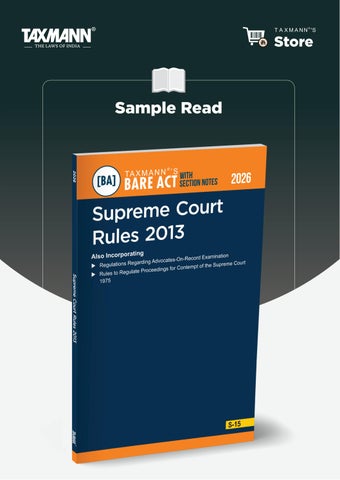
SUPREME COURT RULES 2013 – BARE ACT WITH SECTION NOTES AUTHOR : PUBLISHER : DATE OF PUBLICATION : EDITION : ISBN NO : NO. OF PAGES : BINDING TYPE :
Taxmann's Editorial Board Taxmann December 2025 2026 Edition 9789375616412 136 Paperback
Rs. 175 DESCRIPTION Supreme Court Rules 2013 [Bare Act with Section Notes] by Taxmann is an authoritative legal publication presenting the complete and updated text of the procedural rules governing practice and proceedings before the Supreme Court of India. This Edition also incorporates key allied regulatory instruments, including the Regulations Regarding Advocates-on-Record Examination and the Rules to Regulate Proceedings for Contempt of the Supreme Court 1975, making it a comprehensive, single-volume reference on Supreme Court procedure. The publication is designed for clarity, accuracy, and ease of reference for both practical use and academic study. This book is intended for the following audience: • Advocates & Advocates-on-Record • Judicial Officers & Court Personnel • Law Students & Researchers • Government Officers & Litigants The Present Publication is the 2026 Edition, covering the amended and updated text of the Supreme Court Rules [Notification No. G.S.R. 368(E) | Dated 27-5-2014] and Rules & Regulations, with the following noteworthy features: • [Authentic Bare Act Text] Consolidated and updated statutory text of the Supreme Court Rules 2013 • [Pre-amendment Provisions] Earlier versions of amended provisions are included in footnotes for understanding the pre-amendment legal position • [Latest Amendments & Notifications] Updated to reflect amendments and substitutions in force as on date • [Incorporates Contempt Rules & AoR Regulations] Includes the Contempt Rules 1975 and AoR Examination Regulations as a single procedural reference • [User-friendly Layout] Clear headings, organised indices, amendment footnotes, and cross-references for quick navigation
Buy Now