CHAPTER 1
BASIC CONCEPTS OF GST
CHAPTER 1
BASIC CONCEPTS OF GST
CHAPTER 4
EXEMPTIONS FROM GST
CHAPTER 5
PLACE OF SUPPLY
CHAPTER 6
TIME OF SUPPLY
CHAPTER 7
VALUE OF TAXABLE SUPPLY
CHAPTER 8
REVERSE CHARGE MECHANISM
CHAPTER 9 INPUT TAX CREDIT
CHAPTER 10
COMPOSITION SCHEME AND ALTERNATIVE COMPOSITION SCHEME
CHAPTER 11 REGISTRATION
CHAPTER 12 TAX INVOICE, CREDIT AND DEBIT NOTES
CHAPTER 13 RETURNS, TAX PAYMENT AND INTEREST
CHAPTER 14
PROVISIONS GOVERNING REAL ESTATE SERVICES
CHAPTER 15
PROBLEMS ON GST
CHAPTER 16
BASIC CONCEPTS OF CUSTOMS LAW
CHAPTER 17
TYPES OF CUSTOMS DUTY
CHAPTER 18 VALUATION
CHAPTER 19
CUSTOMS PROCEDURES, BAGGAGE, EXEMPTIONS
APPENDIX
GST EXAMINATION QUESTIONS AND ANSWERS
CA Intermediate, January 2025
CA Intermediate, September 2024
CA Intermediate, May 2024
CA Intermediate, November 2023
CA Intermediate, May 2023
CA Intermediate, November 2022
CA Intermediate, May 2022
CA Intermediate, December 2021
CA Intermediate, July 2021
CA Intermediate, January 2021
CA Intermediate, November 2020
Delhi University B.Com. (Hons.), May 2018


AUTHOR:VinodK.Singhania
PUBLISHER:Taxmann
DATEOFPUBLICATION:January2026
EDITION:14thEdition|January2026
ISBNNO:9789371263580
No.ofPages:340
BINDINGTYPE:Paperback




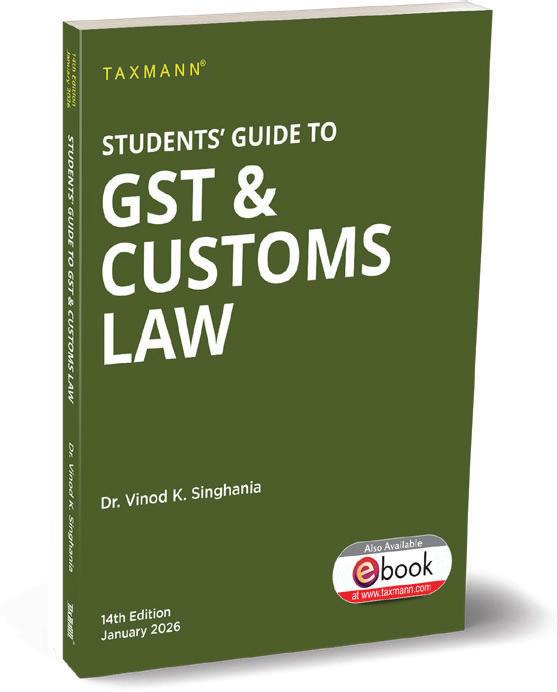
Students’ Guide to GST & Customs Law is a student-focused, application-oriented textbook that presents the Goods and Services Tax (GST) and Customs Law as an integrated, fully operational indirect tax system in India. The book re ects the mature phase of GST and the evolving customs law framework governing cross-border trade. It explains GST not merely as a statutory text, but as a practical compliance and economic system, with focused coverage of levy, classi cation, valuation, place and time of supply, exemptions, input tax credit, and compliance mechanisms. Customs Law is considered an equally important pillar of indirect taxation, with comprehensive coverage of customs duties, valuation rules, clearance procedures, baggage provisions, and exemptions. The book is designed to eliminate fragmented learning by o ering a single, consolidated resource that systematically moves from statutory concepts to analytical reasoning and practical application. Written on a teach-yourself methodology, it serves as a classroom textbook, self-study guide, and examination companion.
This book caters to multiple audiences, as listed below:
•Students of CA, CS, CMA, & Other Professional Courses
•Undergraduate & Postgraduate Students
•Faculty Members & Academic Institutions
•Learners Preparing for Examinations
•Early-career Professionals
The Present Publication is the 14th Edition | 2026 and amended up to 1st January 2026. This book is authored by Dr Vinod K. Singhania, with the following noteworthy features:
•[Teach-yourself Pedagogical Design] Structured to enable independent progression from fundamentals to advanced application

•[Concept-to-Application Continuum] Each topic progresses from statutory principle to analytical explanation and problem-based practice
•[Paragraph-wise Analytical Presentation] Clearly numbered paragraphs for precision, ease of reference, and e ective revision

•[Extensive Original Problem Bank] Over 300 original problems and illustrations covering valuation, exemptions, place of supply, reverse charge, ITC, and duty computation
•[Dedicated Consolidated Practice Modules] Includes a separate chapter exclusively devoted to Problems on GST
•[Equal Depth for GST and Customs Law] Independent, chapter-wise treatment of Customs Law, including duties, valuation, procedures, baggage rules, and exemptions
•[Quick-reference Rate Summaries] Annexures providing at-a-glance GST rate summaries for goods and services
•[Exam-oriented Appendix] Compilation of GST examination questions and answers, including CA Intermediate papers up to January 2025
•[Updated Law] e ects statutory provisions, noti cations, and legal developments as amended up to 1st January 2026