
Sample Read



not only strengthen both businesses, but also facilitates organizations to focus on delivering quality products and services at the right time which ensure value creation. Thus, efficiently managed vendor relationship process enable quality increments and improves Total Cost of Ownership (TCO) and ensures smoother flow of data.
1.4: Supply Chain Management
A QUICK REVIEW
Supply Chain
A network of facilities and distribution options that performs the functions of procurement of materials, transformation of these materials into intermediate and finished products, and the distribution of these finished products to customers.
Objective of Supply Chain Management:
Supply chain Management takes into consideration every facility that has an impact on cost and plays a role in making the product conform to customer requirements: from supplier and manufacturing facilities through warehouses and distribution centres to retailers and stores.
The supply chain management is to be efficient and cost-effective across the entire system; total system wide costs from transportation and distribution to inventories of raw materials, work-in-process and finished goods are to be minimized. Finally, supply chain management revolves around efficient integration of suppliers, manufacturers, warehouses and stores; it encompasses the firm’s activities at many levels, from the strategic level through the tactical to the operational level.
Demand from customers
PAST EXAMINATION QUESTIONS
OBJECTIVE QUESTIONS
Q.1 In which discipline supply chain concept was originated?
(a) Production
(b) Operation
(c) Marketing
(d) Logistics
[Dec. 2017, Dec. 2018, June 2023, 2 Marks]
Ans. (c) Marketing
Q. 2 The program which encompasses the planning and management of all activities involved in sourcing procurement, conversion and logistics management activities is called.
(a) Supply Chain Management
(b) Customer Relationship Management
(c) Total Quality Management
(d) None of the above
[Dec. 2019, June 2023, 2 Marks]
Ans. (a) Supply Chain Management
Q. 3 A supply chain is made up of a series of processes that involve an input, a ________ and an output.
(a) Shipment
(b) Supplier
(c) Transformation
(d) Customer
[Dec. 2021, 1 Mark]
Ans. (c) Transformation
Q. 4 Location, production, distribution and inventory are the major decision areas in _____.
(a) Productivity management
(b) CRM
(c) Supply chain management
(d) BSC
[Dec. 2023, 2 Marks]
Ans. (c) Supply chain management
THEORY QUESTIONS
Q. 1 State the problems that are to be addressed by Supply Chain Management. [June 2015, 5 Marks]
Ans. : Supply Chain Management (SCM) aims to address several key problems that arise in coordinating and optimizing the flow of goods, services, and information across the entire supply chain.
Demand Forecasting and Planning: Inaccurate demand forecasts can lead to overstocking or stock outs, both of which are costly. SCM works to align production with actual demand using data and predictive analytics.
Inventory Management: Managing the right level of inventory at different stages of the supply chain is critical. Too much inventory ties up capital; too little results in missed sales.
Supply and Supplier Reliability: Suppliers may face delays, quality issues, or disruptions. SCM ensures reliable sourcing and builds contingency plans.
Logistics and Transportation: Optimizing the movement of goods to reduce costs and delivery times while ensuring product quality is a major SCM challenge.
Coordination across Partners: Ensuring effective communication and coordination between manufacturers, suppliers, distributors, and retailers is essential for smooth operations.
Cost Control: Reducing operational costs across procurement, production, transportation, and distribution without compromising service quality is a core SCM goal.
Risk Management: SCM must identify and mitigate risks such as natural disasters, political instability, cyber-attacks, and pandemics that can disrupt supply chains.
Globalization and Complexity: Global supply chains add layers of complexity involving time zones, regulations, tariffs, and cultural differences that SCM must manage efficiently.
Sustainability and Ethics: Addressing environmental concerns, reducing carbon footprint, and ensuring ethical labour practices are growing concerns in modern SCM.
Customer Satisfaction: Delivering the right product at the right time in good condition is crucial for customer satisfaction and retention.
Distribution Strategy: Questions of operating control, delivery scheme, mode of transportation and transportation control.
Information: Integration of processes through the supply chain to share valuable information, including demand signals, forecasts, inventory, transportation, potential collaboration, etc.
Cash-Flow: Arranging the payment terms and methodologies for exchanging funds across entities within the supply chain, is fully recurrent artificial network where every basic building block (artificial neuron) is directly connected to every other basic building block in all direction.
Q. 2 Define the following terms in the context of Supply Chain Management: Customer Relationship Management. [Dec. 2015, 2 Marks, Dec. 2021, 3 Marks]
Ans. : CRM is a business strategy comprised of process, organizational and technical change whereby a company seeks to better manage its enterprise around its customer behaviours. It entails acquiring and deploying knowledge about customers and using this information across the various customers touch points to increase revenue and achieve cost reduction through operational efficiencies.
CRM is an integrated approach to identifying, acquiring and retaining customers. By enabling organizations to manage and coordinate customer interactions across multiple channels, departments, lines of business and geographies, CRM helps
organizations maximize the value of every customer interaction and drive superior corporate performance.
A marketing philosophy based on putting the customer first. It involves the collection and analysis of information designed for sales and marketing decision support to understand and support existing and potential customer needs. It includes account management, catalogue and order entry, payment processing, credits and adjustments and other functions.
The adoption of CRM is being fuelled by recognition that long-term relationships with customers are one of the most important assets of an organization. CRM entails all aspects of interaction that a company has with its customer, whether it is sales or service related.
Q. 3 What are the components of supply chain management?
[Dec. 2018, 3 Marks]
Ans. :
Production: Producing as per requirements of the market is the primary requirement of supply chain management. It needs immaculate planning. Master production schedules have to be in place which takes into account plant capacities, workload balancing, quality control and equipment maintenance scheduling.
Inventory: In supply chain management, decisions regarding inventory to be held at each stage of the supply chain is crucial as a wrong decision has a cascading effect. Inventory often acts as a buffer against uncertainty in the supply chain. However higher the inventory, higher is the cost of holding. Thus, optimal inventory levels need to be fixed which will have a positive impact on all the links of the supply chain.
Location: The next important decision-making issue, in supply chain management, is the selection of location for production and storage of inventory. The underlying issue is cost efficiency. These decisions facilitate products to flow through the supply to the final customer.
Transportation: Decision regarding inventory, discussed previously, is related to the mode of transportation. Cost effective mode of transportation results in delayed movement of products and uncertainty in transportation. The uncertainty may be countered with higher stock levels which will increase the cost of investment in inventory. Thus, deciding upon the mode of transportation is critical to the success of the supply chain.
Information: Smooth flow of information is the key to successful implementation of supply chain and its management. With good information, people can make effective decisions about what to produce and how much, about where to locate inventory, and how best to transport it.
Q. 4 Supply chain management program integrates manufacturing operations, purchasing, transportation and physical distribution into a unified program. Explain the objectives and various components of supply chain management. [June 2023, 10 Marks]
Ans. : Chopra and Meindl (2003) defined a supply chain as consisting of “all stages involved, directly or indirectly, in fulfilling a customer request. The supply chain not only includes the manufacturer and suppliers, but also transporters, warehouses, retailers, and customers themselves.”
“Supply chain management is the coordination of production, inventory, location, and transportation among the participants in a supply chain to achieve the best mix of responsiveness and efficiency for the market being served.”
Objectives of Supply Chain Management:
Supply chain Management takes into consideration every facility that has an impact on cost and plays a role in making the product conform to customer requirements: from supplier and manufacturing facilities through warehouses and distribution centers to retailers and stores.
The supply chain management is to be efficient and cost-effective across the entire system; total system wide costs from transportation and distribution to inventories of raw materials, work–in–process and finished goods are to be minimized.
Finally, supply chain management revolves around efficient integration of suppliers, manufacturers, warehouses and stores; it encompasses the firm’s activities at many levels, from the strategic level through the tactical to the operational level.
Component of Supply Chain Management:
Please refer Question 3.
Q. 5 Supply chains need to be designed for and operated in uncertain environments, thus creating enormous risks to the organization. Discuss the factors contributing to these risk. [Dec. 2023, 10 Marks]
Ans. :
Globalization: As supply chains become more global, they are exposed to geopolitical issues, trade restrictions, and cross-border regulations, increasing the complexity and risk.
Natural Disasters and Climate Change: Events like earthquakes, floods, and storms can disrupt transportation and manufacturing, causing delays and increased costs.
Political and Economic Instability: Political unrest, policy changes, inflation, and currency fluctuations can disrupt supply chain operations and financial planning.
Technological Disruptions: Cyber security threats, system failures, or delays in adopting new technologies can severely impact supply chain coordination and efficiency.
Supplier Reliability: Dependency on a limited number of suppliers or geographically concentrated sources increases vulnerability if a key supplier fails to deliver.
Demand Fluctuations: Rapid and unpredictable changes in customer demand can lead to overstocking or stock outs, affecting revenue and customer satisfaction.
Transportation and Logistics Issues: Delays, fuel price volatility, and infrastructure problems can disrupt timely delivery of goods.
Regulatory Compliance: Constantly evolving laws and regulations regarding safety, quality, and environmental standards create compliance risks.
Pandemics and Health Crises: Events like COVID-19 expose supply chains to labour shortages, lockdowns, and reduced production capacity.
Inventory and Capacity Constraints: Poor inventory management or inadequate production capacity can exacerbate disruptions during periods of high demand or supply shortages.
Matching Supply and Demand: This difficulty stems from the fact those months before demand is realized; manufacturers have to commit themselves to specific production levels. These advance commitments imply huge financial and supply risks.
Forecasting does not solve the problem: It is impossible to predict the precise demand for a specific item, even with the most advanced forecasting technique.
Demand is not the only source of uncertainty: Delivery leads times, manufacturing yields, transportation times, and component availability also can have significant chain impact.
Recent trends have a role to play: Lean manufacturing, outsourcing and off shoring that focus on cost reduction increases risk significantly.
CASE STUDIES
Q. 1 This Case Study explains why Nestle Inc. needs a first class Supply Chain, with high quality linkages from where the coffee is grown in the field, to the way in which it reaches the consumer. For Nestle’s, the Supply Chain is a bit complex and includes:
Growers of Coffee
Intermediaries like dealers/brokers/roasters/retailers, etc.: Some Intermediaries may buy coffee and doing some of the primary processing.
Growing and processing of Coffee: This includes activities like coffee picking, drying and hulling sorting, grading & picking.
Price-Balancing Supply and Demand: Coffee prices are determined on day-to-day basis on the world commodity markets in London and New York. The price of Coffee is determined by the relationship between the
amount of coffee available to be sold (supply) and the amount which the company would like to buy (demand). If there is more coffee available than what the company would desire to buy at current prices, the prices will fall. The market, thus, ultimately determines the price that the farmer receives.
Nestle’s Trading Methods: Nestle is a pioneer in purchasing coffee direct from growers. A growing % of the company’s coffee is bought direct from the producer and it is now one of the world’s largest direct purchasers. In Countries, where this is not possible, Nestle operates in a way that takes it as close to the growers as possible.
Buying from dealers: In countries like UK, it is impossible for Nestle to buy from the hundreds of thousands of farmers, who ultimately supply the company and so the coffee is bought from dealers, using the international market.
Conclusion: Creating wonderful cups of coffee is not only Nestle’s business, it is the business of everyone involved in the supply chain. It is in everyone’s interest (the farmers’ and Nestle’s) that farmers receive a fair income from their coffee. This ensures that they will continue to grow coffee and to invest in increasing their yield and quality and this in turn, guarantees the supply of quality coffee, which companies like Nestle require.
In the context of the above case study, answer the following questions:
(i) What is supply chain management? Explain clearly its basic concept?
(ii) What are the basic objectives of a supply chain?
(iii) State the way Nestle Inc., manages its supply chain?
[Dec. 2015, 20 Marks]
Ans. :
(i) Chopra and Meindl defined supply chain as consisting of all stages involved, directly or indirectly, in fulfilling a customer request achieve a sustainable competitive advantage. The supply chain not only includes the manufacturer and suppliers, but also transporters, warehouses, retailers, and customers themselves.
Supply chain management is the coordination of production, inventory, location, and transportation among the participants in a supply chain to achieve the best mix of responsiveness and efficiency for the market being served.
Supply Chain exists in both Service and Manufacturing Organizations. The complexity of the chain may vary greatly from Industry to Industry and from firm to firm. The concept of supply chain management is based on the core idea that every product that reaches an end user represents the cumulative effort of multiple organizations and collectively referred to as supply chain.
Supply chain management represents a conscious effort by the supply chain firms to develop and run supply chains in the most effective and efficient ways possible.
Many companies are discovering that effective SCM is the next step that must be taken to increase Profit and market share. SCM is a strategy/ mechanism, through which different functions can be integrated.
SCM is not a new innovation in management philosophy. Rather it existed since the time of Napoleon, as he commended once “Army marches on its stomach.” He did not explain his statement but the inner meaning is unquestionable i.e., to make a strategy successful, it should have a strong line of supply be it food, clothes, arms or anything else.
Thus, SCM is the management of upstream and downstream value-added flow of materials, final goods and related information among suppliers, company, re-sellers and final customers. It is a systematic and strategic co-ordination of the traditional business functions with a view to improving the long-term performance of the company. It encompasses the planning and management of all activities involved in sourcing, procurement, conversions and logistics management.
In a nutshell, SCM implies all such activities by which the final product is delivered in the hands of customers.
But in SCM, we take into account all the aspects of the Product like:
Sales demand analysis
Production Planning
Procurement of Raw-Material
Ware-housing
Production Process/Conversion
Operations Management
Logistics Management
Distribution of Finished goods to the ultimate customers in a well-synchronized manner.
One Supplier is dependent on the other’s service and the very other is depending on some other unit’s performance. If one unit of the chain does not meet the demand of the very next level producer, members of the whole chain face problems. That is the importance of Supply Chain.
(ii) Objectives of Supply Chain:
Supply chain management takes into consideration every facility that has an impact on cost and plays a role in making the product conform to customer requirements from supplier and manufacturing facilities through warehouses and distribution centers to retailers and stores.
The supply chain management is to be efficient and cost-effective across the entire system; total system wide costs from transportation and distribution to inventories of raw materials, work-in-process and finished goods are to be minimized.
Maximization of the overall value created
Increase the Supply Chain Profitability.
Balancing the Demand and the Supply.
Supply chain management revolves around efficient integration of suppliers, manufacturers, warehouses and stores; it encompasses the firm’s activities at many levels, from the strategic level through the tactical to the operational level.
(iii) Nestle’s Supply Chain:
Nestle Inc. manages its supply chain with a focus on high-quality linkages and close relationships throughout the chain. Key strategies include:
Direct Sourcing: Nestle buys a growing percentage of its coffee directly from producers to ensure better control over quality and fairer pricing for farmers.
Local Engagement: In countries where direct sourcing is not possible, Nestle works closely with intermediaries who are as close as possible to the growers.
Complex Network: Nestle’s supply chain includes growers, dealers, brokers, roasters, and retailers, with multiple steps like picking, drying, sorting, grading, and pricing.
Market-Based Pricing: Coffee prices are determined by global markets (London and New York), influenced by supply and demand.
Fair Trade Focus: Nestle supports fair income for farmers, which encourages them to invest in quality and sustainability, ensuring long-term supply.
Q. 2 Whirlpool Corporation is a leader of the $100 billion global home appliance industry. In fact, it is the World’s leading manufacturer and marketer of major home appliances, with an annual sale of around $30 billion, with a man-power strength of about 80,000 and having 80 manufacturing and technology research centers around the world. Its main products are Washing Machines, Refrigerators, Dishwashers, Water-filters etc., Whirlpool is committed to a brand value creation strategy focusing on Innovation, Cost Productivity, Product Quality and Consumer Value. The company continues to improve its global operating platform to ensure that it is the best-cost and best-quality appliance manufacturer worldwide.
Whirlpool's supply chain has been transformed to better deliver products to its trade customers and consumers. The benefits of action are evident through a stronger network, increased efficiencies and timely deliveries. Until recently, the company's strategic focus was on its products and brands. In recognition of environmental changes, attention was shifted to their supply chain and how best to manage it. The need to focus on the supply chain was also instigated by major internal and organizational changes. Furthermore, it was recognized that two issues required attention: The desire for trade partners to hold lots of inventory (which impacted cash flows)
Customers needing their products quickly.
One of the goals constraining the redesign of their Supply Chain was to ensure that a customer's order could be fulfilled and delivered to the customer at the earliest.
The company set about its operations/supply chain strategy with the aim of improving cash flow, reducing costs, improved inventory management, improved customer satisfaction, improved cash flow and providing the right service to customers.
The first aspect of Whirlpool’s strategy was the order process. Process, technology and inventory changes were made. Systems required replacement and integration with its system. Overall, there was a need to improve visibility within the supply chain.
Secondly, the company rationalized facilities, reducing the no. of buildings from 184 to 84. The company consolidated major warehouses into 10 regional distribution centers, resulting in cost savings of over $60 Million.
Thirdly, they optimized supply and demand with changes to demand planning models and Software and integration with upstream suppliers.
Required:
(i) Briefly state the importance of Supply Chain Management.
(ii) Describe the objectives of Supply Chain Management.
(iii) Describe the challenges that are faced by Whirlpool. What were the drivers for change to the Supply Chain?
(iv) What are the benefits of change to the Supply Chain?
(v) Describe the Whirlpool’s Strategy? [June 2016, 20 Marks]
Ans. :
(i) Importance of Supply Chain Management:
Supply Chain Management is crucial for ensuring that products and services are delivered efficiently, cost-effectively, and in a timely manner. It improves customer satisfaction, reduces operational costs, enhances cash flow, and enables better coordination between suppliers, manufacturers, and distributors. SCM is essential for gaining a competitive advantage in today’s global market.
Supply Chain Management is a network of facilities and distribution options that performs the functions of procurement of materials, transformation of these materials into intermediate materials and finished goods and the distribution of these finished goods to the customers.
Supply Chain Management has an important role to play in moving goods more quickly to their destination.
Managers these days recognize that getting products to customers faster than those of the competitors will improve the company’s competitive position. To remain competitive, companies must seek new solutions to introduce SCM issues. Companies must face corporate challenges that impact SCM such as Re-engineering, globalization and outsourcing. Faster Product availability is
the key to increasing Sales. Further, the ability to deliver a product faster also can make or break a sale.
Many companies are discovering that effective SCM is the best step now that must be taken to increase Profit and market share.
(ii) Objectives of Supply Chain:
Supply chain management takes into consideration every facility that has an impact on cost and plays a role in making the product conform to customer requirements from supplier and manufacturing facilities through warehouses and distribution centers to retailers and stores.
The supply chain management is to be efficient and cost-effective across the entire system; total system wide costs from transportation and distribution to inventories of raw materials, work-in-process and finished goods are to be minimized.
Maximization of the overall value created
Increase the Supply Chain Profitability.
Balancing the Demand and the Supply.
Supply chain management revolves around efficient integration of suppliers, manufacturers, warehouses and stores; it encompasses the firm’s activities at many levels, from the strategic level through the tactical to the operational level.
(iii) Until recently, the company’s strategic focus was on its products and brands. In recognition of environmental Changes, attention was shifted to their supply chain and how best to manage it. The need to focus on the supply chain was also instigated by major internal and organizational changes.
Challenges faced by Whirlpool:
Trade partners wanted to hold large inventories, affecting cash flow.
Customers demanded faster delivery.
Inefficient order processes and poor supply chain visibility.
Dispersed and excessive number of facilities leading to high operational costs.
Drivers for change to the supply chain management:
Internal organizational restructuring.
Need for better customer satisfaction and faster order fulfilment.
Desire to improve cash flow and cost productivity.
Recognition that supply chain performance directly impacts brand value and competitiveness.
A customer’s order could be fulfilled and delivered to the customer at the earliest.
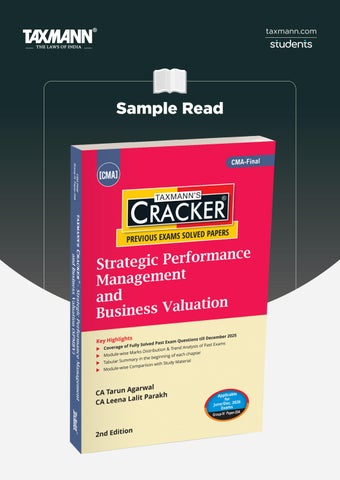
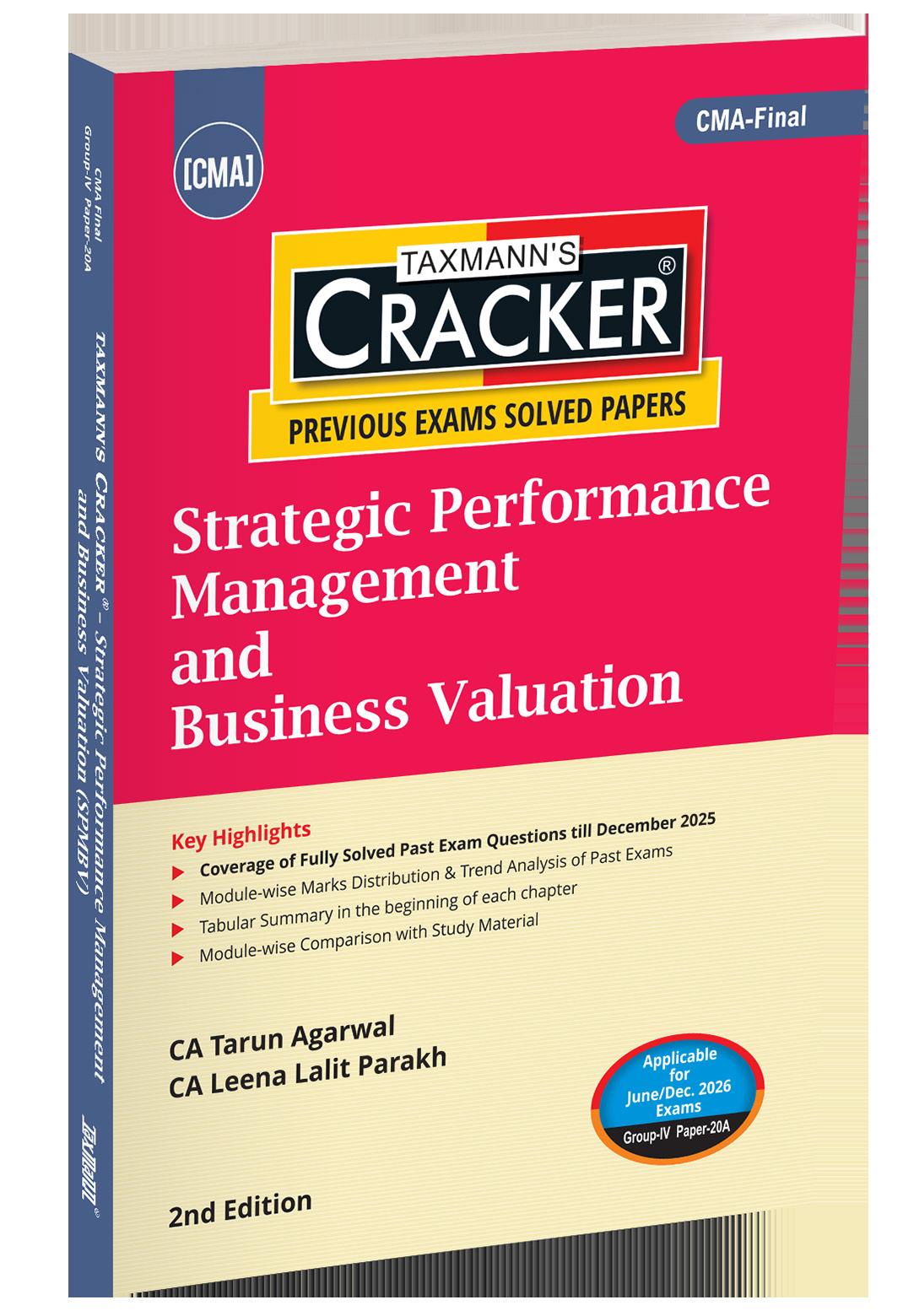
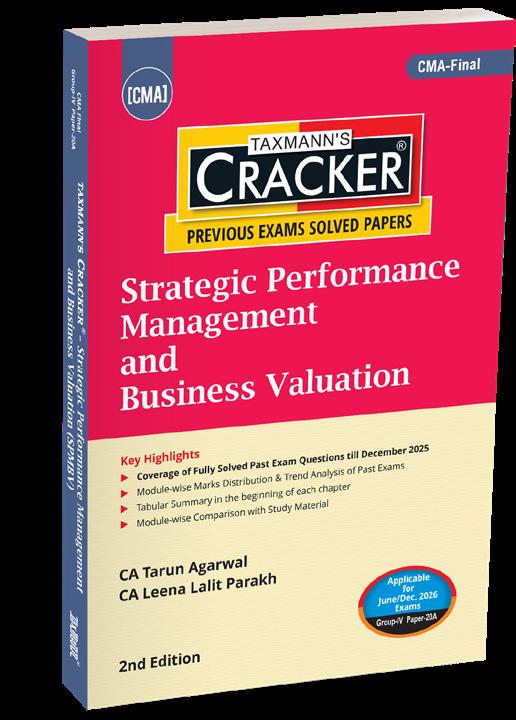
Strategic Performance Management and Business Valuation (SPMBV) | CRACKER
AUTHOR : Tarun Agarwal, Leena Lalit Parakh
PUBLISHER : Taxmann
DATE OF PUBLICATION : January 2026
EDITION : 2nd Edition
ISBN NO : 9789375617426
No. of Pages : 398
BINDING TYPE : Paperback
Rs. 695
DESCRIPTION
Strategic Performance Management and Business Valuation – CRACKER (Previous Exams Solved Papers) is an exam-focused preparation resource for CMA Final – Group IV | Paper 20A, applicable for the June/December 2026 examinations. It is designed to translate the analytical syllabus of strategic performance management and business valuation into a high-scoring, practice-oriented study tool, based entirely on past examination questions up to December 2025. Beyond a conventional solved-papers book, this CRACKER integrates fully solved answers, module-wise marks analysis, exam trend insights, and direct alignment with ICMAI Study Material, enabling targeted preparation aligned with examiner expectations.
The Present Publication is the 2nd Edition, authored by CA. Tarun Agarwal & CA. Leena Lalit Parakh, with the following noteworthy features:
• [Fully Solved Past Examination Questions] Coverage of CMA Final questions up to December 2025 with structured, exam-oriented solutions
• [Module-wise Marks Distribution & Weightage Analysis] Analytical tables highlighting marks trends across multiple examination attempts
• [Previous Exams Trend Analysis] Exam-wise insights into chapter recurrence, question patterns, and theory–practical mix
• [Chapter-opening Tabular Summaries] Quick reference tables for orientation, revision, and last-minute recall
• [Module-wise Comparison with ICMAI Study Material] Direct mapping of modules and chapters with the relevant Study Material