

CHAPTER

Q1.What is Business Policy? Give its definition and features.
Ans.:Business Policy: Business Policy defines the scope or spheres within which decisions can be taken by the subordinates in an organization. It permits the lower level management to deal with the problems and issues without consulting top level management every time for decisions. Business policies are the guidelines developed by an organization to govern its actions. They define the limits within which decisions must be made. Business policy also deals with acquisition of resources with which organizational goals can be achieved. Business policy is the study of the roles and responsibilities of top level management, the significant issues affecting organizational success and the decisions affecting organization in long-run.
Features of Business Policy: An effective business policy must have following features –
(1)Specific: Every policy must have a basic feature of being specific/definite. If it is uncertain, then its implementation will become difficult.
(2)Clear: Policy must be unambiguous and as clear as possible in order to guide the subordinates effectively. It should avoid frequent use of jargons and connotations to create any chaos.
(3)Reliable & Uniform: Policy must be uniform and reliable enough to be efficiently followed by the subordinates.
(4)Appropriate: Policy should be appropriate to represent the organizational goals.
(5)Simple: A policy should be simple and easily understood by each and every person in the organization. For example, “No smoking within 100 feet of welding operations designated by the painted yellow floor lines.”
(6)Inclusive/Comprehensive: In order to have a wide scope, a policy must be comprehensive.
(7)Flexible: Policy should be flexible in application. It should be wide in scope so as to ensure that the line managers use them in repetitive/routine scenarios.
(8) Stable: Policy should be stable so as to avoid the scope of any indecisiveness and uncertainty in minds of those who look into it for guidance. For example, “Cell phones are not permitted in the conference room.”
Q2. Discuss the importance of Business Policy.
Ans.: Good and proper business policy is the key for success of business. Policies offer great advantages to the management if they are stated with clarity. It raises the confidence of the line managers. They make the decisions within a given boundary. The managers act without the need for consulting the senior managers every time which minimizes the need for close supervision. It also builds the confidence of the managers.
The importance of business policies are discussed as follows:
(1) Control: Policy facilitates effective control on the working of the organization. It indirectly controls the managers at different levels without directly interfering in their routine working.
(2) Effective Communication: Generally policies are written and well drafted statements. Hence there is not a remote chance of confusion or miscommunication. By setting policies the management ensures that decisions made will be consistent and in the best interest of the organization. Clearly laid down policies try to eliminate personal hunch and biasness.
(3) Clarity: Policies clarify the viewpoint of management for the purpose of running particular activity/activities.
(4) Motivation: Policy enables the line managers to be self reliant. They take the decision on their own in the confined border of the policy. This raises their confidence and motivates them. A well drafted policy provides a pattern within which delegation of authority is possible.
(5) Policy Review: Regular review of policy is must to see to it that the existing policies are relevant in the given situation. If required policy may be modified or altered depending on as per business environment. Review of policy at regular intervals provides a method of anticipating future conditions and situations and helps to resolve how to deal with them.
(6) Economical and Efficient: Policy enables the management to carry out its operations effectively and efficiently. It enhances the working of the organization.
(7) Co-ordination of Efforts: Policies ensure co-ordination of efforts and activities at different levels in the organization. Activities and duties are assigned in such a way that all activities in the organization are integrated effectively. Policy coordinates with individual efforts.
(8) High Morale: A well crafted policy can raise the overall morale of an enterprise. Policy enables the managers to understand the intention of the management.
Ans.: Strategic Management is the process of formulating, implementing, and evaluating cross functional decisions that enable an organization to achieve its objectives. The strategic management model entails strategy assessment, formulation/planning, execution and evaluation. It asks the basic questions like –
- Where are we now?
- Where do we want to go?
- How do we get there?
The Strategic Management Framework has multiple phases which are discussed below:
(1) Business Assessment: Every Strategic Management Framework starts with assessment of business. This is the phase of gathering data and information to understand the needs of the business, the company’s strategic direction, and the initiatives that will assist in growth and expansion. It is the phase to evaluate the internal and external factors influencing the business. The internal analysis looks at organizational structure, internal processes and core competencies of the employees. It also reviews employee interaction with each other and the management layer. The external analysis helps to identify industry and socio-economic factors that impact the competitive position of the business. Analytical tools, such as SWOT Analysis, are helpful during this phase.
(2) Strategy Formulation: Based on the results of the analysis, the business can then formulate a strategy. Strategy Formulation is the phase of deciding the best course of action for accomplishing the business’s objectives and purpose. This is the stage to develop a vision and mission, long term objectives, generate alternative strategies and choose which strategies to pursue.
(3) Translate strategy to action: To translate strategy into action strategic planning is required. It is the process of converting the strategies into an integrated plan of action that can be implemented. It also involves creating a strategic plan which summarizes the time-phased outputs and drivers.
(4) Strategy Execution: Strategy execution (implementation) is the phase of putting the strategy into action. It includes designing organization’s structure, distributing resources, setting policies, developing decision making process, and managing human resources.
The bottom line is that there is not one prescription that fits all. Businesses have to create and adapt a strategic management process that works best for them and those that they serve.
Q4. A Vision Statement is a company’s road map, indicating both what the company wants to become and guiding transformational initiatives by setting a defined direction for the company’s growth. Explain.
Ans.: Your vision statement is where you want your business to reach at. It is your future dream for your business. It is your optimum version of your business or where you can visualize being positioned in 3, 5 or 7 years time.
Examples of Vision Statements:
Disney – “To make people happy”.
ICSI – “To be a global leader in promoting good corporate governance”.
Google – “To organize the world’s information and make it universally accessible and useful”.
Instagram – “Capture and Share the World’s Moments”.
Vision serves the purpose of stating what an organization wishes to achieve in the long run. It articulates the position that the organization would like to occupy in future. The vision is about looking forward and about formalizing where you, and the business, are going. It is a future aspiration that leads to an inspiration of being the best in one’s business sphere. It creates a common identity and a shared sense of purpose.
A vision statement is a company’s road map, indicating both what the company wants to become and guiding transformational initiatives by setting a defined direction for the company’s growth. Vision statements undergo minimal revisions during the life of a business, unlike operational goals which may be updated from year-to-year.
Features:
(1) Inspiring: It motivates employees and is something that employees view as desirable.
(2) Clear: It defines a prime goal.
(3) Future-oriented: It describes where the company is going from the current level.
(4) Stable: It offers a long-term perspective and is unlikely to be impacted by market or technology changes.
(5) Concise: It should be easy to remember and repeat
(6) Time horizon: It defines a time horizon within which the company’s desires to achieve its long term goals.
(7) Challenging: It should not be something that can be easily met and discarded.
(8) Abstract: It is general enough to encompass all of the organization’s interests and strategic direction
Purpose:
Vision statements may fill the following functions for a company:
It serves as foundations for a broader strategic plan.
It motivates existing employees and also attracts potential employees by clearly categorizing the company’s goals and attracting like-minded individuals.
It focus company efforts and facilitate the creation of core competencies by directing the company to only focus on strategic opportunities that advance the company’s vision.
It helps companies differentiate from competitors. For example, profit is a common business goal, and vision statements typically describe how a company will become profitable rather than list profit directly as the long-term vision.
Q5. “A Mission Statement is an enduring statement of purpose that distinguishes one business from other similar firms. A mission statement identifies the scope of a firm’s operations in product and market terms.” Discuss.
Or
What is a Mission Statement? State the points that may be considered while writing a Mission Statement of a company?
Or
‘‘A mission statement is an enduring statement of purpose that distinguishes one business from other similar firms’’. What is a mission statement and what are the questions to be considered while preparing a mission statement? [Dec. 2025 (2 + 3 = 5 Marks)]
Ans.: Where your vision is your ultimate goal, your mission is how you will get there. Your mission explains why your business exists.
A mission statement defines the basic reason for the existence of that organization. The mission statement should define its customers, products or services, markets, technology, philosophy and self-concept.
Following questions to be considered while preparing for a mission statement:
1. What is the basic purpose of your organization?
2. What is unique about your organization?
3. What is likely to be different about your business five years down the line?
4. Who are, and who should be, your core customers?
5. What are, and what should be, your principal economic concerns?
6. What are the basic beliefs, values and philosophical priorities of your firm?
Elements of Mission Statement
Clearly Articulated
Relevant
Written in a positive tone
Unique Enduring
Adapted to the Target Audience.
Mission statement reflects the corporate philosophy, identity, character, and image of an organization.
A mission statement is a short statement of an organization’s purpose, identifying the goal of its operations: what kind of product or service it provides, its primary customers or market, and its geographical region of operation. It communicates primarily to the people who make up the organization – its members or employees – giving them a shared understanding of the organization’s intended direction.
Q6. Vision leads to mission and mission leads to objectives (which are designed to achieve the mission), objectives lead to goals (which are designed to achieve the objectives) and goals lead to targets (which are set to achieve the goals). How will you compare the Vision and Mission statements of a business unit? [June 2025 (5 Marks)]
Ans.:
Vision serves the purpose of stating what an organization wishes to achieve in the long run. It articulates the position that the organization would like to occupy in future. The vision is about looking forward and about formalizing where the business is going, while a mission statement is an enduring statement of purpose that distinguishes one business from other similar firms. A mission statement identifies the scope of a firm’s operations in product and market terms. In nutshell, A vision is the “what” (what the entity wants to become, achieve), and the mission is the “why” and “how” (why does the entity exist in the first place).
The vision and mission statements compared as follows:
Mission StatementVision Statement
About A Mission statement talks about HOW you will get to where you want to be. Defines the purpose and primary objectives related to your customer needs and team values.
A Vision statement outlines WHERE you want to be. Communicates both the purpose and values of your business.
Mission StatementVision Statement
Answer It answers the question, “What do we do? What makes us different?” It answers the question, “Where do we aim to be?”
Time A mission statement talks about the present leading to its future. A vision statement talks about your future.
Function It lists the broad goals for which the organization is formed. Its prime function is internal; to define the key measure or measures of the organization’s success and its prime audience is the leadership, team, and stockholders. It lists where you see yourself some years from now. It inspires you to give your best. It shapes your understanding of why you are working here.
Developing a statement
Features of an effective statement
What do we do today? For whom do we do it? What is the benefit? In other words, Why we do? What we do? Questions on What, for Whom and Why?
Purpose and values of the organization: Who are the organization’s primary “clients” (stakeholders)? What are the responsibilities of the organization towards the clients?
Where do we want to be going forward? When do we want to reach that stage?
Clarity and lack of ambiguity: Describing a bright future (hope); Memorable and engaging expression; realistic aspirations, achievable; alignment with organizational values and culture.
Q7. What are the three main levels of management in any organization?
Ans.: An organization is divided into several functions and departments that work together to bring a particular product or service to the market. There are three main levels of management: corporate, business, and functional.
(1) Corporate Level: Corporate level of management consists of the Chief Executive Officer (CEO), other senior executives, the board of directors, and corporate staff. The role of corporate-level managers is to oversee the development of strategies for the whole organization. This role includes defining mission and goals of the organization, determining what businesses it should be in, allocating resources among the different businesses, formulating and implementing strategies that span individual businesses, and providing leadership for the organization.
(2) Business Level: Business level general managers are concerned with strategies that are specific to a particular business. The strategic role of these managers is to translate the general statements of direction and intent that come from the corporate level into concrete strategies for individual businesses.
(3) Functional Level: Functional level managers are responsible for the specific business functions or operations (human resources, purchasing,
product development, customer service, and so on) that constitute a company or one of its divisions. Thus, a functional manager’s sphere of responsibility is generally confined to one organizational activity.
Q8. Write a short note on: Corporate Strategy
Ans.: Corporate level of management consists of the Chief Executive Officer (CEO), other senior executives, the board of directors, and corporate staff. The role of corporate-level managers is to oversee the development of strategies for the whole organization. This role includes defining the mission and goals of the organization, determining what businesses it should be in, allocating resources among the different businesses, formulating and implementing strategies that span individual businesses, and providing leadership for the organization.
Corporate strategy helps an organization to achieve and sustain success. It is basically concerned with the choice of businesses, products and markets. It is often correlated with the growth of the firm.
Corporate strategy in the first place ensures the growth of the firm and its correct alignment with the environment. Corporate strategies are concerned with the broad and long-term questions of what businesses the organization is in or wants to be in, and what it wants to do with those businesses. They set the overall direction the organization will follow. It serves as the design for filling the strategic planning gap. It also helps to build the relevant competitive advantages. A right fit between the organization and its external environment is the primary contribution of corporate strategy. Basically the purpose of corporate strategy is to harness the opportunities available in the environment and countering the threats embedded therein. With the help of corporate strategy, organizations match their unique capabilities with the external environment so as to achieve its vision and mission.
Q9. What is the role of Corporate Level Managers in Strategic management? Or
ABC Limited is in a wide range of businesses which include apparels, lifestyle products, furniture, real estate and electrical products. The company is looking to hire a suitable Chief Executive Officer. Consider yourself as the HR consultant for ABC limited. You have been assigned the task to enlist the activities involved with the role of the Chief Executive Officer. Name the strategic level that this role belongs to and enlist the activities associated with it.
Ans.: There are three main levels of management in a typical organization: Corporate, Business, and Functional.
In given case, the role of Chief Executive Officer pertains to Corporate Level.
The corporate level of management consists of the Chief Executive Officer (CEO), other senior executives, the board of directors, and corporate staff.
These individuals occupy the apex of decision making within the organization and broadly have following roles:
1. Oversee the development of strategies for the whole organization.
2. Defining the mission and goals of the organization.
3. Determining what businesses it should be in.
4. Allocating resources among the different businesses.
5. Formulating and implementing strategies that span individual businesses.
6. Providing leadership for the organization.
7. Provide a link between the people who oversee the strategic development of a firm and those who own it.
Q10. Write a short note on: Business Level Strategy
Ans.: Business Strategy is the strategy framed by the business managers to strengthen the overall performance of the enterprise. The strategic role of these managers is to translate the general statements of direction and intent that come from the corporate level into concrete strategies for individual businesses. Business-level strategy focuses on how to attain and satisfy customers, offer goods and services that meet their needs, and increase operating profits. To do this, business-level strategy focuses on positioning itself against competitors and staying up to date on market trends and technology changes.
Economist Michael Porter theorizes that there are two main types of business strategy: cost leadership and differentiation.
A business can also integrate these two strategies.
Cost Leadership: Cost leadership is the tactic of winning over customers through aggressive pricing and making profits through high efficiency. For example, a car manufacturing company like Kia that prices its vehicles on the lower end of the price spectrum is employing a cost leadership strategy.
Differentiation: A company that differentiates adds unique features or services that command a higher selling price. A car company like Tesla that offers premium electric vehicles is using differentiation to create a competitive advantage in the market. Although cost leadership and differentiation may seem like opposite ends of the spectrum, many businesses use aspects of both strategies. For example, Toyota offers a hybrid electric vehicle that offers unique features but maintains a modest price point.
Q11. Distinguish between: Business Strategy & Corporate Strategy. Or
How Business Level Strategies differ with Corporate Level Strategies?
Ans.: Following are the main points of distinction between Business Strategy & Corporate Strategy:
PointsBusiness StrategyCorporate Strategy
Meaning Business Strategy is framed by the business managers to strengthen overall performance of the enterprise.
Created by Corporate Strategy is created by top level management.
Nature Corporate Strategy is decisive and legislative.
Term Corporate Strategy is Long term strategy.
Major strategies
Expansion, Stability and Retrenchment.
Deals with Corporate Strategy deals with entire business organization.
Focus Maximization of business growth and profitability.
Approach
Corporate Strategy uses extroverted approach, which links the business with its environment.
Corporate Strategy is stated in the mission statement, which explains the type of business and ultimate goal of the firm.
Business Strategy is created by middle level management.
Business Strategy is executive and governing.
Business Strategy is short term strategy.
Cost Leadership, Focus and Differentiation.
Business Strategy deals with particular business unit or division.
Competing successfully in the marketplace.
Business Strategy has an introverted approach i.e. it is concerned with the internal working of the organization.
Q12. What are the financial goals and metrics that are established based on benchmarking the “best-in-industry”?
Ans.: A financing strategy is integral to an organization’s strategic plan. It sets out how the organization plans to finance its overall operations to meet its objectives now and in future.
A financing strategy summarizes targets, and the actions to be taken over 3 to 5 year period to achieve the targets. It also clearly states key policies which will guide those actions.
Financial metrics have long been the standard for assessing firm’s performance. Financial goals and metrics are established based on benchmarking the “best-in-industry” and include:
(1) Free Cash Flow: Free cash flow can be a tremendously useful measure for understanding the true profitability of a business. It’s harder to manipulate and it can tell a much better story of a company than more commonly used metrics like net income.
Free cash flow is a measure of the firm’s financial soundness. It shows how efficiently financial resources are being utilized to generate additional cash for future investments. It represents the net cash available after deducting the investments and working capital increases from operating cash flow. Companies should utilize this metric when they anticipate substantial capital expenditures in the near future.

AUTHOR:N.S.Zad,DivyaBajpai
PUBLISHER:Taxmann
DATEOFPUBLICATION:January2026
EDITION:4thEdition
ISBNNO:9789375611530
No.ofPages:480
BINDINGTYPE:Paperback



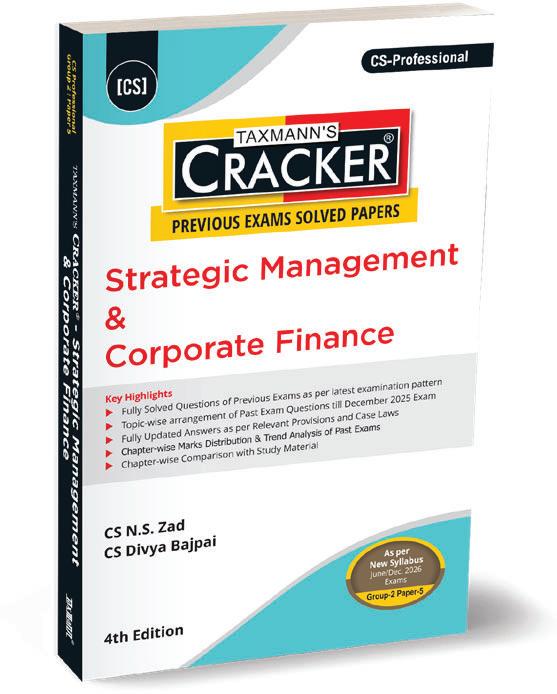
Strategic Management & Corporate Finance – CRACKER is a previous–examination–driven

•[Topic-wise & Chapter-wise Arrangement]

•[Complete Coverage of Previous Exams up to December 2025] Covers all relevant CS

•[Fully Updated, Examiner-Oriented Solutions]
•[Chapter-wise Marks Distribution Tables]
•[Previous Exams Trend Analysis]
•[Chapter-wise Mapping with ICSI Study Material]