Store
Contents SCHEDULED CASTES AND THE SCHEDULED TRIBES (PREVENTION OF ATROCITIES) ACT, 1989 PAGE
CHAPTER I PRELIMINARY 1. Short title, extent and commencement
1
2. Definitions
1 CHAPTER II OFFENCES OF ATROCITIES
3. Punishments for offences of atrocities
4
4. Punishment for neglect of duties
20
5. Enhanced punishment for subsequent conviction
22
6. Application of certain provisions of the Indian Penal Code
22
7. Forfeiture of property of certain persons
22
8. Presumption as to offences
23
9. Conferment of powers
23 CHAPTER III EXTERNMENT
10. Removal of person likely to commit offence
I-5
23
CONTENTS
I-6 PAGE
11. Procedure on failure of person to remove himself from area and enter thereon after removal
24
12. Taking measurements and photographs, etc. of persons against whom order under section 10 is made
25
13. Penalty for non-compliance of order under section 10
25
CHAPTER IV SPECIAL COURTS 14. Special Court and Exclusive Special Court 14A. Appeals
25 26
15. Special Public Prosecutor and Exclusive Public Prosecutor
27
CHAPTER IVA RIGHTS OF VICTIMS AND WITNESSES 15A. Rights of victims and witnesses
27
CHAPTER V MISCELLANEOUS 16. Power of State Government to impose collective fine
29
17. Preventive action to be taken by the law and order machinery
29
18. Section 438 of the Code not to apply to persons committing an offence under the Act
30
18A. No enquiry or approval required
31
19. Section 360 of the Code or the provisions of the Probation of Offenders Act not to apply to persons guilty of an offence under the Act
31
20. Act to override other laws
31
21. Duty of Government to ensure effective implementation of this Act
31
22. Protection of action taken in good faith
32
23. Power to make rules
32
SCHEDULE
32
SUBJECT INDEX
35
I-7
CONTENTS PAGE
SCHEDULED CASTES AND THE SCHEDULED TRIBES (PREVENTION OF ATROCITIES) RULES, 1995 1. Short title and commencement
37
2. Definitions
37
3. Precautionary and preventive measures
38
4. Supervision of prosecution and submission of report
39
5. Information to police officer in-charge of a police station
40
6. Spot inspection by officers
40
7. Investigating officer
41
8. Setting up of the Scheduled Castes and the Scheduled Tribes Protection Cell
42
9. Nomination of Nodal Officer
42
10. Appointment of a Special Officer
43
11. Travelling allowance, daily allowance, maintenance expenses and transport facilities to the victim of atrocity, his or her dependant and witnesses
44
12. Measures to be taken by the District Administration
44
13. Selection of officers and other staff members for completing the work relating to atrocity
46
14. Specific responsibility of State Government
46
15. Contingency plan by the State Government
46
16. Constitution of State-level Vigilance and monitoring Committee
47
17. Constitution of district level vigilance and monitoring committee
48
17A. Constitution of Sub-division Level Vigilance and Monitoring Committee
49
18. Material for annual report SCHEDULE
50 50
NATIONAL COMMISSION FOR THE SCHEDULED TRIBES (SPECIFICATION OF OTHER FUNCTIONS) RULES, 2005
National Commission for the Scheduled Tribes (Specification of Other Functions) Rules, 2005
121
CONTENTS
I-8 PAGE
RULES OF PROCEDURE OF THE NATIONAL COMMISSION FOR SCHEDULED CASTES CHAPTER I GENERAL 1. Constitutional Provisions
123
CHAPTER II DIVISION OF RESPONSIBILITIES AND ALLOCATION OF WORK 2.0 Chairperson
124
3.0 Vice-Chairperson
124
4.0 Members
124
5.0 Secretary
125
6.0 Joint Secretary
126 CHAPTER III
7.0 Investigation and Inquiry by the Commission
126
CHAPTER IV 8.0 Meetings of the Commission
132
CHAPTER V 9.0 Sittings of the Commission
133
CHAPTER VI 10.0 Duties of the State Offices of the Commission
134
CHAPTER VII 11.0 Advisory Role of the Commission
135
12.0 Interaction with the Planning Commission
136
13.0 Interaction of the State Offices with the State Governments
136
14.0 Research/Studies/Surveys/Evaluation
136
I-9
CONTENTS PAGE
CHAPTER VIII 15.0 Monitoring Functions of the Commission
137
16.0 Follow-up action
137 CHAPTER IX
17.0 Non-formal actions by the Commission
138
18.0 Applicability of rules, etc., of the Central Government
138
19.0 Use of Staff cars
138
20.0 Decision on matters not specified in these rule
138
FORM I : National Commission for Scheduled Castes
139
FORM II : Before the National Commission for Scheduled Castes
139
FORM III : National Commission for Scheduled Castes
140
Scheduled Castes and the Scheduled Tribes (Prevention of Atrocities) Act, 1989 [33 OF 1989]1 An Act to prevent the commission of offences of atrocities against the members of the Scheduled Castes and the Scheduled Tribes, to provide for 2 [Special Courts and the Exclusive Special Courts] for the trial of such offences and for the relief and rehabilitation of the victims of such offences and for matters connected therewith or incidental thereto. BE it enacted by Parliament in the Fortieth Year of the Republic of India as follows:— CHAPTER I PRELIMINARY Short title, extent and commencement. 1. (1) This Act may be called the Scheduled Castes and the Scheduled Tribes (Prevention of Atrocities) Act, 1989. (2) It extends to the whole of India 2a[***]. (3) It shall come into force on such date3 as the Central Government may, by notification in the Official Gazette, appoint. Definitions. 2. (1) In this Act, unless the context otherwise requires,— (a) “atrocity” means an offence punishable under section 3; (b) “Code” means the Code of Criminal Procedure, 1973 (2 of 1974)†; 4 [(bb) “dependent” means the spouse, children, parents, brother and sister of the victim, who are dependent wholly or mainly on such victim for his support and maintenance; 1. Dated 11-9-1989. 2. Substituted for “Special Courts” by the Scheduled Castes and the Scheduled Tribes (Prevention of Atrocities) Amendment Act, 2015, w.e.f. 26-1-2016. 2a. Words “except the State of Jammu and Kashmir” omitted by the Jammu and Kashmir Reorganisation Act, 2019, w.e.f. 31-10-2019. 3. With effect from 30-1-1990, vide Notification No. S.O. 106(E), dated 29-1-1990. 4. Inserted by the Scheduled Castes and the Scheduled Tribes (Prevention of Atrocities) Amendment Act, 2015, w.e.f. 26-1-2016. †Now the Bharatiya Nagarik Suraksha Sanhita, 2023 (46 of 2023) [Vide Notification No. S.O. 2790(E), dated 16-7-2024]
1
S. 2
SC&ST (POA) ACT, 1989
2
(bc) “economic boycott” means— (i) a refusal to deal with, work for hire or do business with other person; or (ii) to deny opportunities including access to services or contractual opportunities for rendering service for consideration; or (iii) to refuse to do anything on the terms on which things would be commonly done in the ordinary course of business; or (iv) to abstain from the professional or business relations that one would maintain with other person; (bd) “Exclusive Special Court” means the Exclusive Special Court established under sub-section (1) of section 14 exclusively to try the offences under this Act; (be) “forest rights” shall have the meaning assigned to it in sub-section (1) of section 3 of the Scheduled Tribes and Other Traditional Forest Dwellers (Recognition of Forest Rights) Act, 2006 (2 of 2007); (bf) “manual scavenger” shall have the meaning assigned to it in clause (g) of sub-section (1) of section 2 of the Prohibition of Employment as Manual Scavengers and their Rehabilitation Act, 2013 (25 of 2013); (bg) “public servant” means a public servant as defined under section 21 of the Indian Penal Code (45 of 1860), as well as any other person deemed to be a public servant under any other law for the time being in force and includes any person acting in his official capacity under the Central Government or the State Government, as the case may be;] (c) “Scheduled Castes” and “Scheduled Tribes” shall have the meanings assigned to them respectively under clause (24) and clause (25) of article 366 of the Constitution; (d) “Special Court” means a Court of Sessions specified as a Special Court in section 14; (e) “Special Public Prosecutor” means a Public Prosecutor specified as a Special Public Prosecutor or an advocate referred to in section 15; 4a
[(ea) “Schedule” means the Schedule appended to this Act; (eb) “social boycott” means a refusal to permit a person to render to other person or receive from him any customary service or to abstain from social relations that one would maintain with other person or to isolate him from others; (ec) “victim” means any individual who falls within the definition of the “Scheduled Castes and Scheduled Tribes” under clause (c) of sub-section (1) of section 2, and who has suffered or experienced physical, mental, psychological, emotional or monetary harm or harm to his property as a result of the commission of any offence under this Act and includes his relatives, legal guardian and legal heirs;
4a. Inserted by the Scheduled Castes and the Scheduled Tribes (Prevention of Atrocities) Amendment Act, 2015, w.e.f. 26-1-2016.
3
SC&ST (POA) ACT, 1989
S. 2
(ed) “witness” means any person who is acquainted with the facts and circumstances, or is in possession of any information or has knowledge necessary for the purpose of investigation, inquiry or trial of any crime involving an offence under this Act, and who is or may be required to give information or make a statement or produce any document during investigation, inquiry or trial of such case and includes a victim of such offence;] 5
[(f) the words and expressions used but not defined in this Act and defined in the Indian Penal Code (45 of 1860), the Indian Evidence Act, 1872 (1 of 1872) or the Code of Criminal Procedure, 1973 (2 of 1974), as the case may be, shall be deemed to have the meanings respectively assigned to them in those enactments.]
(2) Any reference in this Act to any enactment or any provision thereof shall, in relation to an area in which such enactment or such provision is not in force, be construed as a reference to the corresponding law, if any, in force in that area. COMMENTS SECTION NOTES
Atrocity [Section 2(1)(a)] “Atrocity” means an offence specified in Section 3 which is committed on an SC/ST
by anyone who is not a member of a Scheduled Caste (SC) or a Scheduled Tribe(ST) Scheduled Castes and Scheduled Tribes [Section 2(1)(c)] “Scheduled Castes and Scheduled Tribes” shall have the meanings assigned to them
respectively under clause (24) and clause (25) of article 366 of the Constitution Code [Section 2(1)(b)] “Code” means the Code of Criminal Procedure, 1973(Cr.PC) With effect from 01.07.2024, the Code has been repealed and replaced with the
Bharatiya Nagarik Suraksha Sanhita, 2023 (BNSS/Sanhita for brevity’s sake) In view of such repeal and Section 8 of the General Clauses Act,1897, with effect
from 01.07.2024, Code means BNSS. Social Boycott [Section 2(1)(eb)] “Social boycott” means a refusal to permit a person to render to other person or receive from him any
customary service or to abstain from social relations that one would maintain with other person or to isolate him from others;
Victim [Section 2(1)(ec)] “Victim” means any individual 5. Substituted by the Scheduled Castes and the Scheduled Tribes (Prevention of Atrocities) Amendment Act, 2015, w.e.f. 26-1-2016. Prior to its substitution, clause (f) read as under: “(f) words and expressions used but not defined in this Act and defined in the Code or the Indian Penal Code (45 of 1860) shall have the meanings assigned to them respectively in the Code, or as the case may be, in the Indian Penal Code.”
S. 3
4
SC&ST (POA) ACT, 1989
who falls within the definition of the “Scheduled Castes and Scheduled Tribes” [See
clause (c) of sub-section (1) of section 2], and who has suffered or experienced physical, mental, psychological, emotional or
monetary harm or harm to his property as a result of the commission of any offence under this Act and includes his relatives, legal guardian and legal heirs;
Thus, the term “victim” not only covers SC/ST victims of atrocities under Section 3 but also SC/ST victims of offences of neglect of duties committed by Non-SC/ST public servant Witness [Section 2(1)(ed)] “Witness” means any person who is acquainted with the facts and circumstances, or is in possession of any information or has knowledge necessary for the purpose of investigation, inquiry or trial of
any crime involving an offence under this Act, and who is or may be required to give information or make a statement or produce any
document during investigation, inquiry or trial of such case The term “witness” also includes a victim of such offence. Words and Expressions used but not defined in this Act [Section 2(1)(f)] Such words and expressions which are defined in the Indian Penal Code, the Indian
Evidence Act, 1872 or the Code of Criminal Procedure, 1973, as the case may be, shall be deemed to have the meanings respectively assigned to them in those enactments. With effect from 01.07.2024, the Indian Penal Code, the Indian Evidence Act, 1872
and the Code of Criminal Procedure, 1973 have been repealed and replaced with the Bharatiya Nyaya Sanhita, 2023, the Bharatiya Sakshya Adhiniyam, 2023 and the Bharatiya Nagarik Suraksha Sanhita, 2023 respectively. Therefore, in view of such repeal and replacement and the provisions of the General
Clauses Act, 1897, with effect from 01.07.2024, the words and expressions used in this Act but not defined in this Act but defined in the Bharatiya Nyaya Sanhita, 2023, the Bharatiya Sakshya Adhiniyam, 2023 or the Bharatiya Nagarik Suraksha Sanhita, 2023 shall have the meanings respectively assigned to them in the said Sanhitas or the said Adhiniyam
CHAPTER II OFFENCES OF ATROCITIES Punishments for offences of atrocities. 3. 6[(1) Whoever, not being a member of a Scheduled Caste or a Scheduled Tribe,— 6. Substituted by the Scheduled Castes and the Scheduled Tribes (Prevention of Atrocities) Amendment Act, 2015, w.e.f. 26-1-2016. Prior to its substitution, sub-section (1) read as under: “(1) Whoever, not being a member of a Scheduled Caste or a Scheduled Tribe,— (i) forces a member of a Scheduled Caste or a Scheduled Tribe to drink or eat any inedible or obnoxious substance; (Contd. on p. 5)
5
SC&ST (POA) ACT, 1989
S. 3
(a) puts any inedible or obnoxious substance into the mouth of a member of a Scheduled Caste or a Scheduled Tribe or forces such member to drink or eat such inedible or obnoxious substance; (b) dumps excreta, sewage, carcasses or any other obnoxious substance in premises, or at the entrance of the premises, occupied by a member of a Scheduled Caste or a Scheduled Tribe; (c) with intent to cause injury, insult or annoyance to any member of a Scheduled Caste or a Scheduled Tribe, dumps excreta, waste matter, carcasses or any other obnoxious substance in his neighbourhood; (d) garlands with footwear or parades naked or semi-naked a member of a Scheduled Caste or a Scheduled Tribe; (e) forcibly commits on a member of a Scheduled Caste or a Scheduled Tribe any act, such as removing clothes from the person, forcible tonsuring of head, removing moustaches, painting face or body or any other similar act, which is derogatory to human dignity; (f) wrongfully occupies or cultivates any land, owned by, or in the possession of or allotted to, or notified by any competent authority to be allotted to, a member of a Scheduled Caste or a Scheduled Tribe, or gets such land transferred; (g) wrongfully dispossesses a member of a Scheduled Caste or a Scheduled Tribe from his land or premises or interferes with the enjoyment of (Contd. from p. 4)
(ii) acts with intent to cause injury, insult or annoyance to any member of a Scheduled Caste or a Scheduled Tribe by dumping excreta, waste matter, carcasses or any other obnoxious substance in his premises or neighbourhood; (iii) forcibly removes clothes from the person of a member of a Scheduled Caste or a Scheduled Tribe or parades him naked or with painted face or body or commits any similar act which is derogatory to human dignity; (iv) wrongfully occupies or cultivates any land owned by, or allotted to, or notified by any competent authority to be allotted to, a member of a Scheduled Caste or a Scheduled Tribe or gets the land allotted to him transferred; (v) wrongfully dispossesses a member of a Scheduled Caste or a Scheduled Tribe from his land or premises or interferes with the enjoyment of his rights over any land, premises or water; (vi) compels or entices a member of a Scheduled Caste or a Scheduled Tribe to do “begar” or other similar forms of forced or bonded labour other than any compulsory service for public purposes imposed by government; (vii) forces or intimidates a member of a Scheduled Caste or a Scheduled Tribe not to vote or to vote to a particular candidate or to vote in a manner other than that provided by law; (viii) institutes false, malicious or vexatious suit or criminal or other legal proceedings against a member of a Scheduled Caste or a Scheduled Tribe; (ix) gives, any false or frivolous information to any public servant and thereby causes such public servant to use his lawful power to the injury or annoyance of a member of a Scheduled Caste or a Scheduled Tribe; (x) intentionally insults or intimidates with intent to humiliate a member of a Scheduled Caste or a Scheduled Tribe in any place within public view; (xi) assaults or uses force to any woman belonging to a Scheduled Caste or a Scheduled Tribe with intent to dishonour or outrage her modesty; (Contd. on p. 6)
S. 3
SC&ST (POA) ACT, 1989
6
his rights, including forest rights, over any land or premises or water or irrigation facilities or destroys the crops or takes away the produce therefrom. Explanation.—For the purposes of clause (f) and this clause, the expression “wrongfully” includes— (A) against the person’s will; (B) without the person’s consent; (C) with the person’s consent, where such consent has been obtained by putting the person, or any other person in whom the person is interested in fear of death or of hurt; or (D) fabricating records of such land; (h) makes a member of a Scheduled Caste or a Scheduled Tribe to do “begar” or other forms of forced or bonded labour other than any compulsory service for public purposes imposed by the Government; (i) compels a member of a Scheduled Caste or a Scheduled Tribe to dispose or carry human or animal carcasses, or to dig graves; (j) makes a member of a Scheduled Caste or a Scheduled Tribe to do manual scavenging or employs or permits the employment of such member for such purpose; (k) performs, or promotes dedicating a Scheduled Caste or a Scheduled Tribe woman to a deity, idol, object of worship, temple, or other religious institution as a devadasi or any other similar practice or permits aforementioned acts; (l) forces or intimidates or prevents a member of a Scheduled Caste or a Scheduled Tribe— (A) not to vote or to vote for a particular candidate or to vote in a manner other than that provided by law; (B) not to file a nomination as a candidate or to withdraw such nomination; or
(Contd. from p. 5)
(xii) being in a position to dominate the will of a woman belonging to a Scheduled Caste or a Scheduled Tribe and uses that position to exploit her sexually to which she would not have otherwise agreed; (xiii) corrupts or fouls the water of any spring, reservoir or any other source ordinarily used by members of the Scheduled Castes or the Scheduled Tribes so as to render it less fit for the purpose for which it is ordinarily used; (xiv) denies a member of a Scheduled Caste or a Scheduled Tribe any customary right of passage to a place of public resort or obstructs such member so as to prevent him from using or having access to a place of public resort to which other members of public or any section thereof have a right to use or access to; (xv) forces or causes a member of a Scheduled Caste or a Scheduled Tribe to leave his house, village or other place of residence, shall be punishable with imprisonment for a term which shall not be less than six months but which may extend to five years and with fine.”
7
SC&ST (POA) ACT, 1989
S. 3
(C) not to propose or second the nomination of a member of a Scheduled Caste or a Scheduled Tribe as a candidate in any election; (m) forces or intimidates or obstructs a member of a Scheduled Caste or a Scheduled Tribe, who is a member or a Chairperson or a holder of any other office of a panchayat under Part IX of the Constitution or a municipality under Part IXA of the Constitution, from performing their normal duties and functions; (n) after the poll, causes hurt or grievous hurt or assault or imposes or threatens to impose social or economic boycott upon a member of a Schedule Caste or a Scheduled Tribe or prevents from availing benefits of any public service which is due to him; (o) commits any offence under this Act against a member of a Scheduled Caste or a Scheduled Tribe for having voted or not having voted for a particular candidate or for having voted in a manner provided by law; (p) institutes false, malicious or vexatious suit or criminal or other legal proceedings against a member of a Scheduled Caste or a Scheduled Tribe; (q) gives any false or frivolous information to any public servant and thereby causes such public servant to use his lawful power to the injury or annoyance of a member of a Scheduled Caste or a Scheduled Tribe; (r) intentionally insults or intimidates with intent to humiliate a member of a Scheduled Caste or a Scheduled Tribe in any place within public view; (s) abuses any member of a Scheduled Caste or a Scheduled Tribe by caste name in any place within public view; (t) destroys, damages or defiles any object generally known to be held sacred or in high esteem by members of the Scheduled Castes or the Scheduled Tribes. Explanation.—For the purposes of this clause, the expression “object” means and includes statue, photograph and portrait; (u) by words either written or spoken or by signs or by visible representation or otherwise promotes or attempts to promote feelings of enmity, hatred or ill-will against members of the Scheduled Castes or the Scheduled Tribes; (v) by words either written or spoken or by any other means disrespects any late person held in high esteem by members of the Scheduled Castes or the Scheduled Tribes; (w) (i)
intentionally touches a woman belonging to a Scheduled Caste or a Scheduled Tribe, knowing that she belongs to a Scheduled Caste or a Scheduled Tribe, when such act of touching is of a sexual nature and is without the recipient’s consent;
S. 3
SC&ST (POA) ACT, 1989
8
(ii) uses words, acts or gestures of a sexual nature towards a woman belonging to a Scheduled Caste or a Scheduled Tribe, knowing that she belongs to a Scheduled Caste or a Scheduled Tribe. Explanation.—For the purposes of sub-clause (i), the expression “consent” means an unequivocal voluntary agreement when the person by words, gestures, or any form of non-verbal communication, communicates willingness to participate in the specific act: Provided that a woman belonging to a Scheduled Caste or a Scheduled Tribe who does not offer physical resistance to any act of a sexual nature is not by reason only of that fact, is to be regarded as consenting to the sexual activity: Provided further that a woman’s sexual history, including with the offender shall not imply consent or mitigate the offence; (x) corrupts or fouls the water of any spring, reservoir or any other source ordinarily used by members of the Scheduled Castes or the Scheduled Tribes so as to render it less fit for the purpose for which it is ordinarily used; (y) denies a member of a Scheduled Caste or a Scheduled Tribe any customary right of passage to a place of public resort or obstructs such member so as to prevent him from using or having access to a place of public resort to which other members of public or any other section thereof have a right to use or access to; (z) forces or causes a member of a Scheduled Caste or a Scheduled Tribe to leave his house, village or other place of residence: Provided that nothing contained in this clause shall apply to any action taken in discharge of a public duty; (za) obstructs or prevents a member of a Scheduled Caste or a Scheduled Tribe in any manner with regard to— (A) using common property resources of an area, or burial or cremation ground equally with others or using any river, stream, spring, well, tank, cistern, water-tap or other watering place, or any bathing ghat, any public conveyance, any road, or passage; (B) mounting or riding bicycles or motor cycles or wearing footwear or new clothes in public places or taking out wedding procession, or mounting a horse or any other vehicle during wedding processions; (C) entering any place of worship which is open to the public or other persons professing the same religion or taking part in, or taking out, any religious, social or cultural processions including jatras; (D) entering any educational institution, hospital, dispensary, primary health centre, shop or place of public entertainment or any other public place; or using any utensils or articles meant for public use in any place open to the public; or
9
SC&ST (POA) ACT, 1989
S. 3
(E) practicing any profession or the carrying on of any occupation, trade or business or employment in any job which other members of the public, or any section thereof, have a right to use or have access to; (zb) causes physical harm or mental agony of a member of a Scheduled Caste or a Scheduled Tribe on the allegation of practicing witchcraft or being a witch; or (zc) imposes or threatens a social or economic boycott of any person or a family or a group belonging to a Scheduled Caste or a Scheduled Tribe, shall be punishable with imprisonment for a term which shall not be less than six months but which may extend to five years and with fine.] (2) Whoever, not being a member of a Scheduled Caste or a Scheduled Tribe,— (i) gives or fabricates false evidence intending thereby to cause, or knowing it to be likely that he will thereby cause, any member of a Scheduled Caste or a Scheduled Tribe to be convicted of an offence which is capital by the law for the time being in force shall be punished with imprisonment for life and with fine; and if an innocent member of a Scheduled Caste or a Scheduled Tribe be convicted and executed in consequence of such false or fabricated evidence, the person who gives or fabricates such false evidence, shall be punished with death; (ii) gives or fabricates false evidence intending thereby to cause, or knowing it to be likely that he will thereby cause, any member of a Scheduled Caste or a Scheduled Tribe to be convicted of an offence which is not capital but punishable with imprisonment for a term of seven years or upwards, shall be punishable with imprisonment for a term which shall not be less than six months but which may extend to seven years or upwards and with fine; (iii) commits mischief by fire or any explosive substance intending to cause or knowing it to be likely that he will thereby cause damage to any property belonging to a member of a Scheduled Caste or a Scheduled Tribe, shall be punishable with imprisonment for a term which shall not be less than six months but which may extend to seven years and with fine; (iv) commits mischief by fire or any explosive substance intending to cause or knowing it to be likely that he will thereby cause destruction of any building which is ordinarily used as a place of worship or as a place for human dwelling or as a place for custody of the property by a member of a Scheduled Caste or a Scheduled Tribe, shall be punishable with imprisonment for life and with fine; (v) commits any offence under the Indian Penal Code (45 of 1860) punishable with imprisonment for a term of ten years or more against a person or property 7[knowing that such person is a member of a 7. Substituted for “on the ground that such person is a member of a Scheduled Caste or a Scheduled Tribe or such property belongs to such member” by the Scheduled Castes and the Scheduled Tribes (Prevention of Atrocities) Amendment Act, 2015, w.e.f. 26-1-2016.
S. 3
SC&ST (POA) ACT, 1989
10
Scheduled Caste or a Scheduled Tribe or such property belongs to such member], shall be punishable with imprisonment for life and with fine; 8 [(va) commits any offence specified in the Schedule, against a person or property, knowing that such person is a member of a Scheduled Caste or a Scheduled Tribe or such property belongs to such member, shall be punishable with such punishment as specified under the Indian Penal Code (45 of 1860) for such offences and shall also be liable to fine;] (vi) knowingly or having reason to believe that an offence has been committed under this Chapter, causes any evidence of the commission of that offence to disappear with the intention of screening the offender from legal punishment, or with that intention gives any information respecting the offence which he knows or believes to be false, shall be punishable with the punishment provided for that offence; or (vii) being a public servant, commits any offence under this section, shall be punishable with imprisonment for a term which shall not be less than one year but which may extend to the punishment provided for that offence. COMMENTS SECTION NOTES
3.1 Objective of this Section The Preamble to this Act says that one of the avowed aims of this Act is “to prevent
the commission of offences of atrocities against the members of the Scheduled Castes and the Scheduled Tribes” To deter the commission of offences of atrocities against the members of the a
Scheduled Caste (SC) or a Scheduled Tribe (ST), sub-sections (1) and (2) of this section provide an exhaustive list of atrocities which would be an offence if committed on a member of SC/ST by whoever is not a member of SC/ST. 3.2 Applicability of this Section In short, the penal provisions of this Act apply where the offender is not a member
of SC/ST and the victim of the atrocity is a member of SC/ST. 3.3 No anticipatory bail for offences under this Section No anticipatory bail under Section 438 of Cr.PC/Section 482 of BNSS can be granted
in any case involving the arrest of any person on an accusation of having committed an offence under this Act notwithstanding any judgment or order or direction of any Court [See section 18/Section 18A(2)] 3.4 No release of offender under this Section after admonition/on probation of good conduct unless offender is aged 18 or less The provisions of Section 360 of Cr.PC/Section 401 of BNSS and the provisions of
the Probation of Offenders Act, 1958 shall not apply to any person above the age of eighteen years who is found guilty of having committed an offence under this Act. [See Section 19] 8. Inserted by the Scheduled Castes and the Scheduled Tribes (Prevention of Atrocities) Amendment Act, 2015, w.e.f. 26-1-2016.
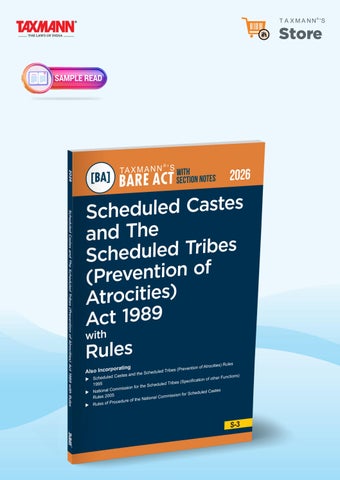
SCHEDULED CASTES AND THE SCHEDULED TRIBES (PREVENTION OF ATROCITIES) ACT 1989 WITH RULES – BARE ACT WITH SECTION NOTES AUTHOR PUBLISHER DATE OF PUBLICATION EDITION ISBN NO NO. OF PAGES BINDING TYPE
: : : : : : :
TAXMANN’S EDITORIAL BOARD TAXMANN DECEMBER 2025 2026 EDITION 9789375611691 152 PAPERBACK
Rs. 205
DESCRIPTION Scheduled Castes and the Scheduled Tribes (Prevention of Atrocities) Act, 1989, with Rules [Bare Act with Section Notes] by Taxmann is a comprehensive legal reference that brings together the principal Act, allied Rules, and focused commentary. It outlines the law’s background, scope, application, and judicial interpretations, helping users address offences against SCs and STs and implement protective measures effectively. This book is intended for the following audience: •
Legal Professionals & Advocates
•
Judiciary & Law Enforcement
•
Government Officials & Policymakers
•
Academicians & Law Students
•
NGOs & Civil Society Organisations
The Present Publication is the 2026 Edition, covering the amended and updated text of the Scheduled Castes and the Scheduled Tribes (Prevention of Atrocities) Act [Act No. 33 of 1989] and Rules, with the following noteworthy features: •
[Comprehensive Coverage] Contains the principal Act and the 1995 Rules, along with pertinent notifications and guidelines
•
[Updated for 2026] Reflects the latest amendments, with references to recent Supreme Court/High Court rulings
•
[Pre-amendment Provisions] Provides earlier text in amendment footnotes for context on pre-amendment scenarios
•
[Section-by-section Notes] Offers concise explanations, landmark judgments, and cross-references under each provision
•
[User-friendly Presentation] Maintains the Bare Act format with commentary, enabling smooth navigation
•
[Supplementary Materials] Includes references to National Commission Rules for a broader contextual view
BUY NOW