
Sample Read

© Taxmann
Price : ` 135
Law stated in this book is as updated till 1st December, 2025
Published by : Taxmann Publications (P.) Ltd.
Sales & Marketing :
59/32, New Rohtak Road, New Delhi-110 005 India
Phone : +91-11-45562222
Website : www.taxmann.com
E-mail : sales@taxmann.com
Regd. Office :
21/35, West Punjabi Bagh, New Delhi-110 026 India
Printed at :
Tan Prints (India) Pvt. Ltd.
44 Km. Mile Stone, National Highway, Rohtak Road Village Rohad, Distt. Jhajjar (Haryana) India
E-mail : sales@tanprints.com
Disclaimer
Every effort has been made to avoid errors or omissions in this publication. In spite of this, errors may creep in. Any mistake, error or discrepancy noted may be brought to our notice which shall be taken care of in the next edition. It is notified that neither the publisher nor the author or seller will be responsible for any damage or loss of action to any one, of any kind, in any manner, therefrom. It is suggested that to avoid any doubt the reader should cross-check all the facts, law and contents of the publication with original Government publication or notifications.
No part of this book may be reproduced or copied in any form or by any means [graphic, electronic or mechanical, including photocopying, recording, taping, or information retrieval systems] or reproduced on any disc, tape, perforated media or other information storage device, etc., without the written permission of the publishers. Breach of this condition is liable for legal action.
For binding mistake, misprints or for missing pages, etc., the publisher’s liability is limited to replacement within seven days of purchase by similar edition. All expenses in this connection are to be borne by the purchaser. All disputes are subject to Delhi jurisdiction only.



RIGHT OF CHILDREN TO FREE AND COMPULSORY EDUCATION RULES,
TEACHERS

Right of Children to Free and Compulsory Education Act, 2009
[35 OF 2009]*
An Act to provide for free and compulsory education to all children of the age of six to fourteen years.
BE it enacted by Parliament in the Sixtieth Year of the Republic of India as follows:—
CHAPTER I
PRELIMINARY
1[Short title, extent, Application and commencement.]
1. (1) This Act may be called the Right of Children to Free and Compulsory Education Act, 2009.
(2)It shall extend to the whole of India 1a[***].
(3)It shall come into force on such date2 as the Central Government may, by notification in the Official Gazette, appoint.
3[(4) Subject to the provisions of articles 29 and 30 of the Constitution, the provisions of this Act shall apply to conferment of rights on children to free and compulsory education.
(5)Nothing contained in this Act shall apply to Madrasas, Vedic Pathsalas and educational institutions primarily imparting religious instruction.]
COMMENTS
CASE LAWS
Scope of the Act – No Compulsion of Language or Land Rights – The Supreme Court held that the Right of Children to Free and Compulsory Education Act, 2009, merely defines its extent and scope and cannot be invoked to compel private schools
*Dated 26-8-2009.
1.Substituted for “Short title, extent and commencement” by the Repealing and Amending Act, 2017, w.e.f. 5-1-2018.
1a. Words “except the State of Jammu and Kashmir” omitted by the Jammu and Kashmir Reorganisation Act, 2019, w.e.f. 31-10-2019.
2. With effect from 1-4-2010 vide Notification S.O. 428(E), dated 16-2-2010.
3.Inserted by the Right of Children to Free and Compulsory Education (Amendment) Act, 2012, w.e.f. 1-8-2012.
to adopt a particular medium of instruction or claim entitlements not granted under the Act. In a constitutional challenge by the State of Karnataka, seeking to enforce a government order mandating mother tongue or Kannada as the sole medium of instruction for Classes I to IV in all government-recognized schools, the Court ruled that such a directive violated the rights of private unaided schools under Articles 19(1)(a), 19(1)(g), 29(1), and 30(1) of the Constitution. Section 1 of the RTE Act does not authorize such compulsion and cannot be used as a tool to enforce uniform language policy on private institutions. The Court clarified that while the Act enables free and compulsory education, it does not override the constitutional freedoms of individuals or educational entities regarding medium of instruction – State of Karnataka v. Associated Management of (Government Recognised Unaided English Medium) Primary and Secondary Schools AIR 2014 SUPREME COURT 2094.
Scope of Application – No Right to Land Allotment for Schools – The Supreme Court clarified that the Right of Children to Free and Compulsory Education Act, 2009 does not confer any right on educational institutions for the allotment or sale of land. In this case, City Montessori School, after being declared the highest bidder for a Nazul plot, failed to pay the full bid amount and defaulted for over 13 years. Despite this, the High Court directed the execution of a sale deed in favour of the school by relying on the 2009 Act. The Supreme Court reversed the High Court’s decision, holding that section 1 of the RTE Act merely defines the extent and applicability of the Act and does not deal with the issue of land allotment. The Court emphasized that invoking the Act to justify a land transfer to a defaulting school was misplaced, especially when no relief under the Act was even claimed in the original petition. This judgment reinforces that the RTE Act is not a mechanism to validate or regularize land acquisition or property claims by educational institutions – Smt. Khela Banerjee v. City Montessori School AIR 2012 SUPREME COURT 3776.
Exclusion of Minority Institutions – Compatibility with Article 21A and Right to Religious Education – The Supreme Court upheld the constitutional validity of the Uttar Pradesh Board of Madarsa Education Act, 2004, setting aside the Allahabad High Court’s judgment that declared the Act violative of secularism and Articles 14 and 21A. A key issue before the Court was whether education in Madarsas, which includes religious instruction, violates the right to free and compulsory education under Article 21A. The Court clarified that section 1(5) of the RTE Act expressly excludes Madarsas and institutions imparting primarily religious education from its application. It observed that this carve-out preserves the autonomy of religious minorities under Article 30 to establish and administer institutions that also impart religious education. The judgment emphasized that Madarsas regulated by the Madarsa Board offer both secular and religious education and that their functioning is subject to regulatory oversight by the State to ensure minimum education standards. The exclusion under section 1(5) was thus upheld as constitutionally sound, aligning with the broader objective of ensuring educational diversity while respecting minority rights – Anjum Kadari v. Union of India AIR ONLINE 2024 SC 770.
Definitions.
2. In this Act, unless the context otherwise requires,—
(a) “appropriate Government” means—
(i) in relation to a school established, owned or controlled by the Central Government, or the administrator of the Union territory, having no legislature, the Central Government;
(
(
(
(ii) in relation to a school, other than the school referred to in sub-clause (i), established within the territory of—
(A) a State, the State Government;
(B) a Union territory having legislature, the Government of that Union territory;
b) “capitation fee” means any kind of donation or contribution or payment other than the fee notified by the school;
c) “child” means a male or female child of the age of six to fourteen years;
d) “child belonging to disadvantaged group” means 4[a child with disability or] a child belonging to the Scheduled Caste, the Scheduled Tribe, the socially and educationally backward class or such other group having disadvantage owing to social, cultural, economical, geographical, linguistic, gender or such other factor, as may be specified by the appropriate Government, by notification;
(
e) “child belonging to weaker section” means a child belonging to such parent or guardian whose annual income is lower than the minimum limit specified by the appropriate Government, by notification;
4[(ee) “child with disability” includes,—
(A) a child with “disability” as defined in clause (i) of section 2 of the Persons with Disabilities (Equal Opportunity, Protection of Rights and Full Participation) Act, 1995 (1 of 1996);
(B) a child, being a person with disability as defined in clause (j) of section 2 of the National Trust for Welfare of Persons with Autism, Cerebral Palsy, Mental Retardation and Multiple Disabilities Act, 1999 (44 of 1999);
(C) a child with “severe disability” as defined in clause (o) of section 2 of the National Trust for Welfare of Persons with Autism, Cerebral Palsy, Mental Retardation and Multiple Disabilities Act, 1999 (44 of 1999).]
(f) “elementary education” means the education from first class to eighth class;
(
g) “guardian”, in relation to a child, means a person having the care and custody of that child and includes a natural guardian or guardian appointed or declared by a court or a statute;
(h) “local authority” means a Municipal Corporation or Municipal Council or Zila Parishad or Nagar Panchayat or Panchayat, by whatever name called, and includes such other authority or body having administrative control over the school or empowered by or under any law for the time being in force to function as a local authority in any city, town or village;
4. Inserted by the Right of Children to Free and Compulsory Education (Amendment) Act, 2012, w.e.f. 1-8-2012.
(i) “National Commission for Protection of Child Rights” means the National Commission for Protection of Child Rights constituted under section 3 of the Commissions for Protection of Child Rights Act, 2005 (4 of 2006);
(j) “notification” means a notification published in the Official Gazette;
(k) “parent” means either the natural or step or adoptive father or mother of a child;
(l) “prescribed” means prescribed by rules made under this Act;
(m) “Schedule” means the Schedule annexed to this Act;
(n) “school” means any recognised school imparting elementary education and includes—
(
i) a school established, owned or controlled by the appropriate Government or a local authority;
(ii) an aided school receiving aid or grants to meet whole or part of its expenses from the appropriate Government or the local authority;
(iii) a school belonging to specified category; and
(iv) an unaided school not receiving any kind of aid or grants to meet its expenses from the appropriate Government or the local authority;
(o) “screening procedure” means the method of selection for admission of a child, in preference over another, other than a random method;
(p) “specified category”, in relation to a school, means a school known as Kendriya Vidyalaya, Navodaya Vidyalaya, Sainik School or any other school having a distinct character which may be specified, by notification, by the appropriate Government;
(q) “State Commission for Protection of Child Rights” means the State Commission for Protection of Child Rights constituted under section 3 of the Commissions for Protection of Child Rights Act, 2005 (4 of 2006).
COMMENTS
SECTION NOTES
2.1 Child belonging to Disadvantaged Group [Section 2(d)]
A child belonging to disadvantaged group includes: A child with disability
As defined or recognized under relevant disability legislation (e.g., RPWD Act, 2016). A child belonging to:
Scheduled Castes (SC),
Scheduled Tribes (ST),
Socially and educationally backward classes.
Any other child belonging to a group that faces disadvantage due to:
Social factors (e.g., caste discrimination),
Cultural barriers (e.g., traditional exclusion),
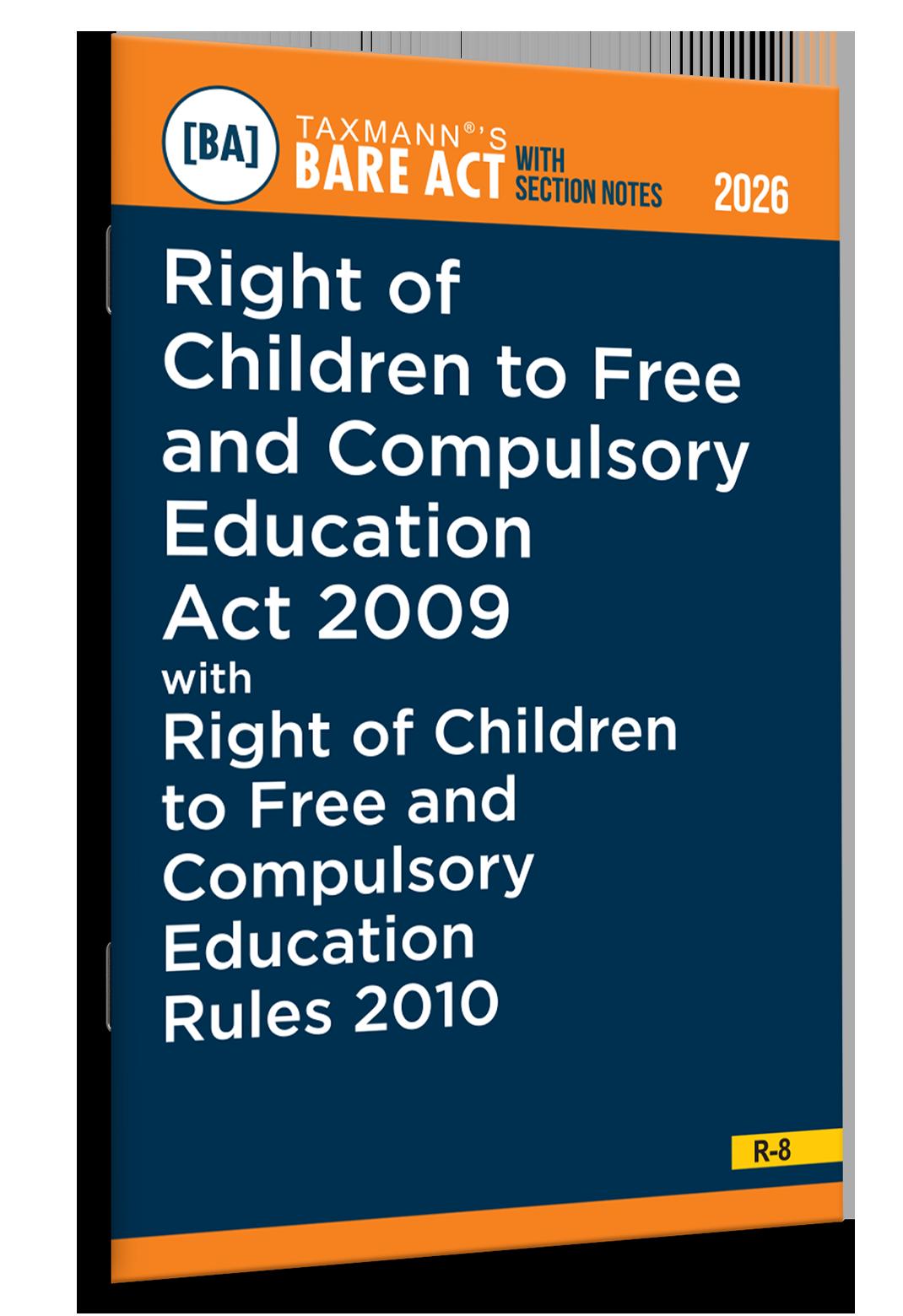
Right of Children to Free and Compulsory Education Act 2009 with Right of Children to Free and Compulsory Education Rules 2010 – Bare Act with Section Notes
AUTHOR : Taxmann’s Editorial Board
PUBLISHER : Taxmann
DATE OF PUBLICATION : January 2026
EDITION : 2026 Edition
ISBN NO : 9789371265133
No. of Pages : 64
BINDING TYPE : Paperback
DESCRIPTION
Right of Children to Free and Compulsory Education Act 2009 (RTE Act) with the Right of Children to Free and Compulsory Education Rules 2010 [Bare Act with Section Notes] by Taxmann is an authoritative statutory reference that presents the complete and operative text of India’s foundational education rights legislation. The 2026 Edition reproduces the verbatim provisions of the Act and Rules, supplemented with section-wise explanatory notes, select judicial pronouncements, statutory schedules, and prescribed forms, ensuring both conceptual clarity and practical applicability. The publication serves as a reliable, ready reference and an interpretive aid for understanding statutory obligations, implementation mechanisms, and judicial interpretation under the RTE framework.
This book is intended for the following audience:
• Advocates & Legal Practitioners
• Judicial Officers & Legal Researchers
• Education Administrators & Government Officials
• School Managements, Trusts & NGOs
• Academicians & Students
• Child Rights Bodies & Policy Institutions
The Present Publication is the 2026 Edition, covering the amended and updated text of the Right of Children to Free and Compulsory Education Act [Act No. 35 of 2009] and Rules, with the following noteworthy features:
• [Authentic Bare Act Text] Full and updated statutory text of the RTE Act 2009 and the Central RTE Rules 2010
• [Section-wise Notes] Concise explanatory notes clarifying scope, applicability, duties, and operational impact
• [Latest Amendments & Notifications] Incorporates all relevant amendments, rules, and notifications, with the law stated as updated to date
• [Pre-amendment Provisions] Earlier versions of amended provisions are included in footnotes for historical and transitional reference
• [Judicial Commentary & Case Law] Select Supreme Court and High Court rulings with summaries highlighting legal impact
• [Schedules & Forms] Complete statutory Schedules, norms and standards for schools, and prescribed procedural forms
• [Practical Compliance Guidance] Section notes highlighting procedural requirements and regulatory responsibilities
• [Subject Index & Appendices] Exhaustive subject index and appendices for quick navigation and research
• [Designed for Practical Use] Suitable for academic reference and day-to-day statutory compliance
• [Cross-referencing] Internal cross-references facilitating efficient statutory navigation