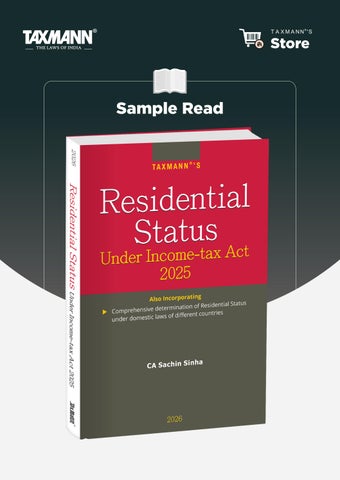
Sample Read
© Taxmann Price : ` 645 Law stated in this book is as updated till August, 2026 Published by : Taxmann Publications (P.) Ltd. Sales & Marketing : 59/32, New Rohtak Road, New Delhi-110 005 India Phone : +91-11-45562222 Website : www.taxmann.com E-mail : sales@taxmann.com Regd. Office : 21/35, West Punjabi Bagh, New Delhi-110 026 India Printed at : Tan Prints (India) Pvt. Ltd. 44 Km. Mile Stone, National Highway, Rohtak Road Village Rohad, Distt. Jhajjar (Haryana) India E-mail : sales@tanprints.com Disclaimer Every effort has been made to avoid errors or omissions in this publication. In spite of this, errors may creep in. Any mistake, error or discrepancy noted may be brought to our notice which shall be taken care of in the next edition. It is notified that neither the publisher nor the author or seller will be responsible for any damage or loss of action to any one, of any kind, in any manner, therefrom. It is suggested that to avoid any doubt the reader should cross-check all the facts, law and contents of the publication with original Government publication or notifications. No part of this book may be reproduced or copied in any form or by any means [graphic, electronic or mechanical, including photocopying, recording, taping, or information retrieval systems] or reproduced on any disc, tape, perforated media or other information storage device, etc., without the written permission of the publishers. Breach of this condition is liable for legal action. For binding mistake, misprints or for missing pages, etc., the publisher’s liability is limited to replacement within seven days of purchase by similar edition. All expenses in this connection are to be borne by the purchaser. All disputes are subject to Delhi jurisdiction only.
Contents PAGE
Foreword
I-5
About the Author
I-9
Preface
I-11
Acknowledgement
I-13
Chapter-heads
I-15
Abbreviations
I-25
Key takeaways from this book
I-27
List of Cases
I-29
CHAPTER 1 INTRODUCTION 1.1
Income chargeable to tax in India
1
1.2
Determining the residential status of individuals from neighbouring countries
2
1.3
Residency test and accrual of salary
3
1.4
Residency of the payer
4
1.5
Resident as defined in the DTAA
4
1.6
Residency test for administrative purposes
5
1.7
Resident for one source is resident for each source
5
1.8
Control and management vis-a-vis POEM
5
1.9
Tax residency and applicability of GAAR
5
1.10
Tax Residency Certificate (TRC)
6
1.11
Residency test for foreign tax credit
6
I-17
CONTENTS
I-18 PAGE
CHAPTER 2 SIGNIFICANCE OF THE RESIDENCY TEST 2.1 2.2 2.3 2.4 2.5 2.6 2.7 2.8 2.9 2.10 2.11
Meaning of the term “residence” Scope of total income Business controlled in India Business controlled in India vs. Business controlled from India Meaning of the term ‘set up’ Meaning of the term ‘ordinarily resident’ Income to a non-resident Income accrues or arises outside India Resident for part of the year Residence during the tax year Residency test and DTAA applicability
8 8 10 11 11 12 13 13 13 14 14
CHAPTER 3 MEANING OF RESIDENT AND NON-RESIDENT 3.1
Background
16
3.2
Resident in India
17
3.3
Section 6(2)(a) and section 6(2)(b) are separate
19
3.4
Stay in India
19
3.5
DTAA provisions and tie breaker
19
3.6
Gravity of personal and economic relationships
22
3.7
Split residency
22
3.8
Dual Residency
24
3.9
Transparent entities
25
CHAPTER 4 RESIDENTIAL STATUS FOR INDIVIDUALS 4.1
Background
26
4.2
Stay for a total period of 182 days
26
4.3
Calculation of the number of days stayed in India
27
4.4
Time of arrival and departure
30
4.5
Meaning of the term ‘day’
30
4.6
Meaning of the term ‘year’
31
4.7
Section 6(2)(b) – An alternative test
31
I-19
CONTENTS PAGE
4.8
Meaning of ‘leaves India for the purposes of employment’
33
4.9
Leaves India
34
4.10
Any tax year
35
4.11
Types of Visa
35
4.12
Computation of period of stay for the crew members of Indian Ship
35
4.13
Computation of period of stay for the crew members of a foreign-bound ship
36
4.14
Meaning of foreign-bound ship
36
4.15
Rule 8 of the Income-tax Rules, 2026
37
4.16
CBDT Circular 13/2017 read with 17/2017
37
4.17
Evidence for calculation of number of days
38
4.18
Person compelled to stay in India
38
4.19
Being outside India, comes on a visit to India
39
4.20
Being outside India
39
4.21
Total Income, other than the income from foreign sources
41
CHAPTER 5 RESIDENTIAL STATUS OF HUF, FIRM AND AOP 5.1
Background
43
5.2
Whether a foreign LLP is a company or a partnership firm?
43
5.3
Meaning of the term ‘partner’ and ‘partnership’
44
5.4
Is the firm a separate legal entity for tax purposes?
44
5.5
Meaning of ‘control and management’
45
5.6
Meaning of the term ‘affairs’
46
5.7
Meaning of the term ‘situated wholly’
46
CHAPTER 6 DEEMED RESIDENT OR STATELESS PERSON 6.1
Background
48
6.2
Citizen of India
48
6.3
Domicile
49
6.4
Any other criteria of a similar nature
49
6.5
Liable to tax
50
6.6
Charged to tax vs. liable to tax
51
6.7
Deemed residency as per DTAA
51
CONTENTS
I-20 PAGE
6.8
Treaty benefits
52
6.9
Withholding tax in the case of deemed resident
53
6.10
Interplay of section 6(7) and section 9(8)
53
6.11
Tax filing compliances
54
6.12
Whether deemed resident can obtain TRC?
54
CHAPTER 7 ORDINARY RESIDENT AND NOT ORDINARY RESIDENT IN INDIA 7.1
Background
56
7.2
In the case of an individual
57
7.3
What is the benefit of being RNOR?
58
7.4
Section 6(13) is applicable to HUF also
58
7.5
Change of karta during the previous year
59
7.6
Section 6(13)(b) is applicable for individuals
59
7.7
Section 6(13)(c) is applicable for deemed resident
60
7.8
Interplay of section 6(13) with DTAA
62
CHAPTER 8 RESIDENTIAL STATUS OF A COMPANY 8.1
Background
63
8.2
Indian Company
63
8.3
Definition of company
64
8.4
Foreign Company
64
8.5
Domestic company
64
8.6
Non-resident company vs. foreign company
65
8.7
Budget memorandum of Finance Bill, 2016
65
8.8
Practical challenges relating to POEM
66
8.9
Place of effective management
67
8.10
Whether the concept of POEM is aligned with DTAA?
68
8.11
How to test the POEM?
70
8.12
Registered place of business vs. actual place of business
70
8.13
Dual resident entities – the MLI effect
71
8.14
Guiding principles for determination of POEM of a company
72
I-21
CONTENTS PAGE
CHAPTER 9 INTERPLAY OF GAAR WITH RESIDENCY TEST 9.1
Background
82
9.2
Modes of treaty abuse
82
9.3
Treaty override
85
CHAPTER 10 RESIDENTIAL STATUS OF THE TRUST 10.1
Background
86
10.2
Creation of trust
87
10.3
Who may create trust?
87
10.4
Who may be beneficiary?
88
10.5
Who may be trustee?
88
10.6
Accounts and information (Section 19)
88
10.7
Investment of trust-money (Section 20)
88
10.8
Right to title-deed (Section 31)
89
10.9
Right to reimbursement of expenses (Section 32)
89
10.10
Right to indemnity from gainer by breach of trust (Section 33)
89
10.11
Right to settlement of accounts (Section 35)
89
10.12
General authority of trustee (Section 36)
89
10.13
Types of trust
89
10.14
Status of the trust
90
10.15
Residential status in the case of a specific trust
92
10.16
Residential status in the case of a discretionary trust
92
CHAPTER 11 TAX RESIDENCY CERTIFICATE 11.1
Background
93
11.2
Provision as mentioned in section 159(8)
93
11.3
Requirement of TRC is mandatory
94
11.4
Whether TRC is a conclusive proof?
94
11.5
TRC constitutes sufficient evidence
94
11.6
Budget Memorandum 2012 and 2013
95
11.7
TRC is sufficient evidence to claim treaty
95
CONTENTS
I-22 PAGE
11.8
TRC alone is insufficient to establish DTAA entitlement
96
11.9
Resident of a contracting state
96
11.10
TRC is not binding on any statutory authority or Court
96
11.11
Whether interposed entity was a device to avoid tax?
97
11.12
Circular No. 789 is no longer binding?
97
11.13
Provisions u/r 75 [corresponding Rule 21AB of Income-tax Rules, 1962]
97
CHAPTER 12 INTERPLAY OF DOMESTIC PROVISIONS OF RESIDENTIAL STATUS VIS-A-VIS TREATY PROVISIONS 12.1
Background
99
12.2
Why the residency test is important under the treaty?
99
12.3
Tie-breaker Rule for individual
100
12.4
Tie breaker Rule for other than individual
101
12.5
Resident of a contracting state
101
12.6
Object and purpose
101
12.7
Liable to tax
103
12.8
Commentary on the provisions of the Article — OECD MC
104
12.9
Observations on the commentary
112
12.10
Reservations on the Article
112
12.11
Commentary on Article 4 — UN MC
113
CHAPTER 13 RESIDENTIAL STATUS IN DIFFERENT CONTRACTING STATES 13.1 13.2 13.3 13.4 13.5 13.6 13.7 13.8 13.9 13.10
Singapore Domestic Tax Law Mauritius Domestic Tax Law UAE Domestic Tax Law United Kingdom Domestic Tax Law USA Domestic Tax Law Australian Domestic Tax Law Chinese Domestic Tax Law French Domestic Tax Law German Domestic Tax Law Hong Kong Domestic Tax Law
124 125 126 126 128 129 130 131 132 133
13.11
Netherlands Domestic Tax Law
134
I-23
CONTENTS PAGE
CHAPTER 14 FAQs ON RESIDENTIAL STATUS 14.1
Has the basic test of residence for individuals changed under the Income-tax Act, 2025?
136
14.2
Does the special relaxation under the 1961 Act continue to apply, under which a citizen of India leaving India for employment outside India or as a crew member of an Indian ship is considered a resident only if he stays in India for 182 days or more?
136
14.3
Has the rule for Indian citizens or Persons of Indian Origin visiting India been modified in the new Act?
136
14.4
What is meant by deemed to be a resident? Has the ‘deemed residency’ provision of the Income-tax Act, 1961 undergone any change?
137
14.5
Has the concept of ‘Not Ordinarily Resident’ (NOR) been altered under the new Act?
137
14.6
Has the Residency Test for a Company Changed under the Income-tax Act, 2025?
137
14.7
Which law will determine residential status for tax years prior to 1 April 2026?
137
14.8
If reassessment for AY 2025 -26 is initiated after 1 April 2026, which provisions will apply for determining the tax residency of a person?
137
14.9
From which year will residential status be governed by the Income-tax Act, 2025?
138
14.10
If a person’s stay in India spans a period when both Acts are in effect, how is residential status evaluated?
138
14.11
Does the repeal affect the continuity conditions relevant for ‘Not Ordinarily Resident’ status?
138
14.12
How does deemed residency interplay with the repeal clause?
138
14.13
If a person was treated as a resident for a particular year under the Income-tax Act, 1961, can that status be reopened under the Income-tax Act, 2025?
139
14.14
Whether the provisions relating to concessional tax regimes for NRIs as contained in sections 115D, 115E and 115F of the Income-tax Act, 1961, have undergone any change under the Income-tax Act, 2025?
139
14.15
Has the return filing exemption for NRIs under section 115G of the 1961 Act been continued in the Income-tax Act, 2025?
139
CONTENTS
I-24 PAGE
14.16
Has the continuation of benefits after becoming a resident under section 115H of the old Act been preserved in the Income-tax Act, 2025?
140
14.17
An NRI had claimed an exemption under section 115F of the Income-tax Act, 1961. He transfers the new asset after 01.04.2026 (i.e., after commencement of the Income-tax Act, 2025) but within the three-year lock-in period. Which Act will apply for the claw-back of exemption/computation of capital gains?
140
14.18
Does a declaration filed by an NRI under section 115H of the Income-tax Act, 1961, to continue concessional taxation after becoming a resident remain valid under the Incometax Act, 2025?
140
14.19
Has the exemption for interest earned on NRE account as available under section 10(4)(ii) of the Income-tax Act, 1961, been retained in the Income-tax Act, 2025?
140
CHAPTER 15 CASE STUDIES Case Studies
142
APPENDIX
155
ATbXST]cXP[ bcPcdb X] SXUUTaT]c R^]caPRcX]V BcPcTb
13
CHAPTER
SINGAPORE 13.1 SINGAPORE DOMESTIC TAX LAW Singapore has no statutory day-count definition for “resides”. The core test in section 2(1) of the Income-tax Act, 1947 is that an individual is resident if they reside in Singapore, “except for such temporary absences as may be reasonable and not inconsistent with a claim to be resident.” Around this, two bright-line and two concessionary tests operate: Sl. No.
Test
Rule
1
Physical presence/ Present or exercising employment (other than employment as a board director) in Singapore for 183 days or more in the calendar year preceding the YA (year of assessment).
2
Ordinarily resident
3
3-years administra- A foreigner present/working continuously tive concession across three consecutive calendar years (not necessarily three complete years) is treated as resident for all three, even if one year falls short of 183 days
4
2-year administrative Employment spanning two calendar years concession where total stay is 183 days or more, treated as resident for both years
Resides in Singapore except for reasonable temporary absences
.H\ IHDWXUHV (a) Calendar year basis, assessed on a preceding year basis (income earned in CY 2025 is taxed in YA 2026). (b) No worldwide “ordinarily resident” concept layered with a separate “not ordinarily resident” intermediate category, unlike India. (c) Once resident, an individual is taxed on Singapore-sourced income and foreign income remitted into Singapore is generally not taxed for individuals (Singapore operates a largely territorial system, and foreign-sourced income received by individuals, other than through a partnership, is exempt). 124
125
MAURITIUS DOMESTIC TAX LAW
Para 13.2
&RPSDQLHV DQG RWKHU HQWLWLHV Under section 2(1) of the Income-tax Act, 1947, a company is resident in Singapore if the control and management of its business is exercised in Singapore in the preceding calendar year. “Control and management” is undefined in the Act and is a question of fact, generally understood as the place where the board of directors exercises its powers of control and management i.e., where strategic decisions are actually made, not merely where day-to-day operations sit or where the company is incorporated. A Singapore-incorporated company can therefore be non-resident if managed from abroad, and a foreign-incorporated company can be Singapore-resident if managed from Singapore. For partnerships, LLPs, and other tax-transparent entities, Singapore does not test the entity itself; it looks through to the residency of each partner.
MAURITIUS 13.2 MAURITIUS DOMESTIC TAX LAW Sl. No.
Test
Rule
1
Governing law
Income-tax Act, Mauritius
2
Purpose
Determine tax residence under Mauritian law
3
Relevant provision
Mauritius Income-tax Act
4
Connecting factors Physical presence (individuals), incorporation, central management and control (companies)
'HWHUPLQDWLRQ RI 5HVLGHQFH XQGHU 0DXULWLXV 'RPHVWLF /DZ (i) Individuals: An individual is generally resident if: (a) present in Mauritius for 183 days or more during the income year; or (b) present for an aggregate of 270 days or more during the current and preceding two income years. Mauritius therefore uses a statutory day-count test, similar in concept to India but with different thresholds. (ii) Companies: A company is generally regarded as resident if: (a) it is incorporated in Mauritius; or (b) its central management and control is exercised in Mauritius. Mauritius focuses on the location where strategic decisions are actually taken rather than merely where day-to-day operations are conducted.
Para 13.4
RESIDENTIAL STATUS IN DIFFERENT CONTRACTING STATES
126
UAE 13.3 UAE DOMESTIC TAX LAW Sl. No.
Test
Rule
1
Governing law UAE Corporate Tax Law (Federal Decree-Law No. 47 of 2022), UAE Tax Residency Rules
2
Purpose
3
Relevant pro- UAE Corporate Tax Law, Cabinet Decision No. 85 of vision 2022, Ministerial Decision No. 27 of 2023
4
Connecting factors
Determine domestic tax residence
Physical presence, incorporation, effective management and control, tax residency rules
'HWHUPLQDWLRQ RI 5HVLGHQFH XQGHU 8$( 'RPHVWLF /DZ The UAE residence framework has evolved significantly following the introduction of Corporate Tax from 1 June 2023. (i) Individuals: For tax residency purposes, an individual may qualify as a UAE tax resident if the statutory residence conditions are met under the UAE tax residency rules, including prescribed physical presence thresholds and other connecting factors. The India–UAE DTAA itself contains a specific definition for UAE-resident individuals, referring to an individual present in the UAE for an aggregate of at least 183 days in the relevant calendar year. (ii) Companies: Under the UAE Corporate Tax Law, a juridical person is generally treated as a Resident Person if: (a) it is incorporated or established in the UAE (including many Free Zone entities); or (b) although incorporated abroad, it is effectively managed and controlled in the UAE.
UNITED KINGDOM 13.4 UNITED KINGDOM DOMESTIC TAX LAW Sl. No.
Test
Rule
1
Governing law
Income-tax Act, 2007, Finance Acts, and the Statutory Residence Test (SRT) under Finance Act, 2013
2
Purpose
Determine UK tax residence
3
Relevant provision Statutory Residence Test (SRT)
4
Connecting factors Statutory Residence Test, incorporation, central management and control
127
UNITED KINGDOM DOMESTIC TAX LAW
Para 13.4
'HWHUPLQDWLRQ RI 5HVLGHQFH XQGHU 8. 'RPHVWLF /DZ The United Kingdom has one of the world’s most comprehensive residence tests, known as the Statutory Residence Test (SRT).
,QGLYLGXDOV The SRT determines residence through three stages: (a) Automatic Overseas Tests: A person is automatically non-resident if specified conditions are satisfied, such as limited UK presence combined with previous residence history. (b) Automatic UK Tests: A person is automatically UK resident if, for example: (i) they spend 183 days or more in the UK during the tax year; (ii) their only home is in the UK for the prescribed period; or (iii) they work full-time in the UK. (c) Sufficient Ties Test: Where neither automatic test applies, residence depends upon: (i) family ties; (ii) accommodation; (iii) work ties; (iv) previous residence; (v) number of days spent in the UK. Unlike India’s largely mechanical day-count test, the UK SRT combines objective day-count rules with factual connecting factors.
13.4.3 Companies A company is generally UK resident if: (a) incorporated in the UK; or (b) its central management and control is exercised in the UK. The concept of central management and control is derived from longestablished UK case law and focuses on where the highest level of strategic decision-making occurs.
1RQ 'RPLFLOHG µ1RQ GRP¶ FRQFHSW Under the United Kingdom Income Tax Law this is a unique feature of the UK’s tax system. It is distinct from tax residence and has historically allowed certain UK tax residents whose permanent home (domicile) is outside the UK to be taxed on a more limited basis.
Para 13.5
RESIDENTIAL STATUS IN DIFFERENT CONTRACTING STATES
128
0DMRU UHIRUP IURP $SULO The UK Government abolished the non-dom regime for most purposes from 6 April 2025. The new system no longer relies primarily on domicile for income tax. Instead, it focuses on residence. Broadly: (i) the remittance basis has been replaced by a residence-based foreign income and gains regime for qualifying new arrivals; (ii) the tax treatment now depends more on how long an individual has been UK resident rather than on domicile status. Accordingly, the traditional non-dom regime is now of historical significance, although transitional rules apply for existing non-doms. The reforms were introduced through the Finance Act, 2025 following proposals announced in the Spring Budget 2024
UNITED STATES OF AMERICA 13.5 USA DOMESTIC TAX LAW Sl. No.
Test
Rule
1
Governing law
Internal Revenue Code (IRC), Treasury Regulations
2
Purpose
Determine U.S. tax residence
3
Relevant provision
IRC §§ 7701(b), 7701(a); Green Card Rules; Substantial Presence Test (SPT)
4
Connecting factors
Citizenship, lawful permanent residence (Green Card), Substantial Presence Test, incorporation
'HWHUPLQDWLRQ RI 5HVLGHQFH XQGHU 8 6 'RPHVWLF 7D[ /DZ The U.S. system is fundamentally different from most countries because it taxes not only residents but also U.S. citizens on their worldwide income irrespective of where they reside.
,QGLYLGXDOV An individual is treated as a U.S. tax resident if any of the following applies: (a) U.S. Citizenship: Every U.S. citizen is generally taxable on worldwide income regardless of physical location. Unlike India, citizenship itself can create full tax residence. (b) Green Card Test: An individual holding lawful permanent resident (Green Card) status is generally treated as a U.S. tax resident until that status is formally relinquished or otherwise terminated under U.S. tax rules.
129
AUSTRALIAN DOMESTIC TAX LAW
Para 13.6
(c) Substantial Presence Test (SPT): 4O MEET THIS TEST YOU MUST BE PHYSICALLY PRESENT IN THE 5 3 ON AT LEAST 1. 31 days during the current year, and 2. 183 days during the 3 years period that includes the current year and the 2 years immediately before that, counting: All the days you were present in the current year, and 1/3 of the days you were present in the first year before the current year, and 1/6 of the days you were present in the second year before the current year. This is considerably more sophisticated than India’s simple annual daycount.
13.5.3 Companies A corporation is generally treated as a U.S. corporation if it is incorporated in the United States. Unlike India, the United States does not generally determine corporate residence using POEM or central management and control.
13.5.4 Incorporation is the principal test Foreign corporations remain foreign corporations even if management is exercised in the United States, although they may become subject to U.S. taxation on effectively connected income or under specific anti-deferral rules.
AUSTRALIA 13.6 AUSTRALIAN DOMESTIC TAX LAW Sl. No.
Test
Rule
1
Governing law
Income Tax Assessment Act, 1936 and Income Tax Assessment Act, 1997
2
Purpose
Determine Australian tax residence
3
Relevant provision
Judicial and statutory residency tests
,QGLYLGXDO 5HVLGHQWLDO 6WDWXV Australia follows a far more factual approach.
7KH $XVWUDOLDQ 7D[DWLRQ 2I¿FH $72 UHFRJQL]HV IRXU SULQFLSDO tests (a) Resides Test (Primary Test) : The person resides in Australia according to ordinary concepts. Factors include:
Para 13.7
RESIDENTIAL STATUS IN DIFFERENT CONTRACTING STATES
130
(i) family location (ii) social connections (iii) employment (iv) accommodation (v) continuity of stay This is the principal and most important test (b) Domicile Test: Even if physically outside Australia, a person remains resident if: (i) Australian domicile continues, and (ii) no permanent place of abode outside Australia exists (c) 183 Days Test: A person staying in Australia for at least 183 days during the income year is generally treated as resident unless: (i) usual place of abode is outside Australia, and (ii) there is no intention to reside in Australia. (d) Commonwealth Superannuation Test: Applies to certain Australian Government employees serving overseas.
&RUSRUDWH 5HVLGHQFH Australia uses three principal tests. A company is resident if: (a) Incorporated in Australia, or (b) Carries on business in Australia and its Central Management and Control (CM&C) is in Australia, or (c) Carries on business in Australia and its voting power is controlled by Australian resident shareholders.
CHINA 13.7 CHINESE DOMESTIC TAX LAW Sl. No.
Test
Rule
1
Governing law
Individual Income Tax Law (IIT Law), Corporate Income Tax Law (CIT Law), and implementing regulations
2
Purpose
Determine Chinese tax residence
3
Relevant provision Statutory tests based on domicile, habitual residence and physical presence
5HVLGHQWLDO 6WDWXV RI ,QGLYLGXDOV China follows a combination of domicile and physical presence tests. An individual is regarded as a tax resident if:
131
FRENCH DOMESTIC TAX LAW
Para 13.8
(a) Domicile Test: An individual has domicile in China because of household registration (hukou), family ties, or economic interests. Such persons are residents irrespective of the number of days spent in China. (b) 183-Days Test: An individual without domicile becomes resident if present in China for 183 days or more during a tax year. This threshold was introduced by the 2019 amendments to the Individual Income Tax Law. (c) Six-Year Rule: Foreign individuals residing in China for 183 days or more in each tax year for six consecutive years may become taxable on worldwide income. The six-year period can generally be reset by spending more than 30 consecutive days outside China or by not meeting the 183-day threshold in a tax year. This rule mitigates immediate worldwide taxation for expatriates.
5HVLGHQWLDO 6WDWXV RI &RPSDQLHV Under the Corporate Income Tax Law, an enterprise is resident if it is incorporated in China or incorporated outside China but its de facto management body is located in China.
FRANCE 13.8 FRENCH DOMESTIC TAX LAW Sl. No.
Test
Rule
1
Governing law
French General Tax Code (Code général des impôts CGI)
2
Purpose
Determine France tax residence
3
Relevant provision
Statutory criteria based on home, principal place of stay, professional activity, and centre of economic interests
5HVLGHQWLDO 6WDWXV RI ,QGLYLGXDOV France adopts a multi-factor approach. An individual is regarded as a French tax resident if any one of the following principal criteria is satisfied: (a) Home (Foyer): The individual’s permanent home or the usual residence of the family is located in France. (b) Principal Place of Stay: The individual spends the greater part of the year in France (generally interpreted as more than 183 days, although the legal analysis focuses on the principal place of stay rather than a strict statutory day-count).
Para 13.9
RESIDENTIAL STATUS IN DIFFERENT CONTRACTING STATES
132
(c) Principal Professional Activity: The individual’s principal professional or business activity is carried on in France, unless the activity is merely ancillary. (d) Centre of Economic Interests: France is the place where the individual’s principal investments, business interests, assets, or main source of income are located. Unlike India, satisfying any one of these criteria may establish French tax residence.
5HVLGHQWLDO 6WDWXV RI &RPSDQLHV A company is generally regarded as resident if: (a) it is incorporated in France; or (b) its effective place of management (siège de direction effective) is located in France.
GERMANY 13.9 GERMAN DOMESTIC TAX LAW Sl. No.
Test
Rule
1
Governing law
German Income Tax Act, Fiscal Code, Corporate Income-tax Act.
2
Purpose
Determine German tax residence
3
Relevant provision
Residence based on domicile (or habitual abode)
5HVLGHQWLDO 6WDWXV RI ,QGLYLGXDOV Germany determines residence using two principal statutory tests. (a) Residence: An individual is resident if he maintains a dwelling in Germany under circumstances indicating that it is available for regular use. Actual occupation throughout the year is not essential; maintaining a usable residence can suffice. (b) Habitual Abode: An individual who has no permanent residence may nevertheless become resident if he is physically present in Germany for more than six months (generally more than 183 consecutive days). Temporary absences are usually ignored when determining continuity.
5HVLGHQWLDO 6WDWXV RI &RPSDQLHV A company is generally regarded as resident if either of the following applies:
133
HONG KONG DOMESTIC TAX LAW
Para 13.10
(a) Registered Office: The company’s registered office is situated in Germany. or (b) Place of Management: The place where the day-to-day and overall business management is actually exercised is located in Germany.
HONG KONG 13.10 HONG KONG DOMESTIC TAX LAW Sl. No.
Test
Rule
1
Governing law
Inland Revenue Ordinance (IRO)
2
Purpose
Determine Hong Kong tax residence
3
Relevant provision
“Ordinarily resides”, physical presence, incorporation or management and control
5HVLGHQWLDO 6WDWXV RI ,QGLYLGXDOV Unlike India, Hong Kong follows a comparatively flexible residence framework. An individual is regarded as a Hong Kong resident if he: (a) Ordinarily resides in Hong Kong: This depends upon facts and circumstances, including: (i) permanence of residence; (ii) family ties; (iii) intention to reside; (iv) continuity of stay. There is no rigid statutory definition of “ordinary residence.” (b) Physical Presence Test: An individual also qualifies if he: (i) stays in Hong Kong for more than 180 days during a year of assessment; or (ii) stays for more than 300 days in two consecutive years of assessment, one of which is the relevant year.
5HVLGHQWLDO 6WDWXV RI &RPSDQLHV A company is resident if: (a) it is incorporated in Hong Kong; or (b) if incorporated elsewhere, it is normally managed or controlled in Hong Kong.
Para 13.11
RESIDENTIAL STATUS IN DIFFERENT CONTRACTING STATES
134
1RUPDOO\ 0DQDJHG RU &RQWUROOHG This means the focus on board-level decisions are taken; senior management exercises control or overall business policies are formulated. This concept resembles India’s POEM, although the terminology differs.
NETHERLANDS 13.11 NETHERLANDS DOMESTIC TAX LAW Sl. No. 1 2 3 4 5
Test
Rule
Governing law
Dutch General Tax Act and Dutch Incometax Act Purpose Determine Netherland tax residence Relevant provision Centre of personal and economic life (durable personal ties) Taxation of residents Worldwide income Taxation of Non-res- Dutch-source income idents
'HWHUPLQDWLRQ RI 5HVLGHQWLDO 6WDWXV RI LQGLYLGXDOV The Dutch legislation deliberately avoids a fixed day-count test. Instead, residence is determined from all relevant facts and circumstances. The Dutch Supreme Court and tax authorities primarily consider: (a) permanent home (b) family location (c) employment (d) social life (e) economic interests (f) municipal registration (g) bank accounts (h) intended duration of stay (i) habitual living pattern
1XPEHU RI GD\V FRXQW The decisive question is whether the taxpayer has durable personal ties with the Netherlands. Thus, a person may spend less than 183 days in the Netherlands yet still be a Dutch tax resident, while another person spending more than 183 days may remain non-resident if personal ties lie elsewhere.
135
NETHERLANDS DOMESTIC TAX LAW
Para 13.11
&RUSRUDWH 5HVLGHQFH A company is generally resident where: (a) incorporated in the Netherlands, or (b) its effective management is located in the Netherlands. Dutch jurisprudence places considerable emphasis upon the place where directors actually manage the company. Accordingly, both incorporation and effective management become relevant.
Residential Status under Income-tax Act 2025 AUTHOR : PUBLISHER : DATE OF PUBLICATION : EDITION : ISBN NO : No. of Pages : BINDING TYPE :
Sachin Sinha Taxmann September 2026 2026 Edition 9788167010780 196 Hardbound
Rs. 645 DESCRIPTION Residential Status under Income-tax Act 2025 is a single-subject treatise for the practitioner who must reach a defensible conclusion on a residence question and produce the working to support it. It is among the first titles to restate residence law under the new enactment, and is built for use while both statutes are still in effect: over fifty bracketed in-line cross-references tie each provision to its 1961 counterpart in both directions, and nineteen FAQs address only the repeal and the savings clause. Three things separate it from a conventional commentary. It argues rather than reports, reaching a stated position where the authorities conflict and marking the questions it cannot settle. It gives a full chapter to the residence rules of eleven other jurisdictions, so a dual-residence question can be tested from both ends. And it reproduces its primary material rather than summarising it. The apparatus is substantial: fifteen worked case studies on dated fact patterns, day-count and income-analysis tables carrying the arithmetic in full, two dozen inline examples, and every decision footnoted on its own page and indexed in a 63-entry List of Cases. This book is intended for the following audience: • Chartered Accountants and Tax Practitioners • International Tax and Transfer Pricing Specialists • Corporate Tax Teams and In-house Counseloff Multinational Groups • Advocates and Litigators • Officers of the Tax Administration • Trustees, Fiduciaries and Private Client Advisers • Payers and Withholding-tax Teams • NRIs, HNIs and Globally Mobile Professionals • Academicians, Faculty and Advanced Students The Present Publication is the 1st Edition, updated till August 2026. It is authored by CA. Sachin Sinha, with the following noteworthy features: • [A Whole Book on One Concept] 161 pages on a subject a general commentary disposes of in a few, with the analysis pushed down to individual statutory phrases: ‘place’, ‘key management’, ‘in substance made’, ‘affairs’, ‘situated wholly’, ‘set up’, ‘day’, ‘leaves India’ • [Dual-Act Usability] Over fifty bracketed in-line mappings connect the 2025 provisions to their 1961 counterparts and back, so an old position carries across the change without a separate concordance • [A Transition Chapter, Not a Transition Paragraph] Nineteen FAQs on the repeal and savings problem, including which Act governs a reassessment initiated after 1st April 2026 • [The Author Takes Positions] On the foreign LLP, the tie-breaker for a deemed resident, and the arrival date in a day-count, the book reasons to a conclusion instead of listing authorities • [Comparative by Design] A full chapter on the residence rules of Singapore, Mauritius, the UAE, the UK, the USA, Australia, China, France, Germany, Hong Kong and the Netherlands • [Primary Material Reproduced, Not Paraphrased] The OECD Commentary on Article 4 verbatim with the Observations of three States and the Reservations of nine, the UN Model Commentary, and the CBDT Guiding Principles on POEM in full • [Updated to the Newest Authority] Current to August 2026 and aligned with the 2026 rules and forms, including Rule 8, Rule 75, Rule 76 and Forms 41 and 42 • [Built to Be Worked From] Case studies, day-count tables and computation tables with a Remarks column give arithmetic to follow rather than propositions to accept • [Navigable] Every cross-reference, including the List of Cases, points to a paragraph number rather than a page
Buy Now