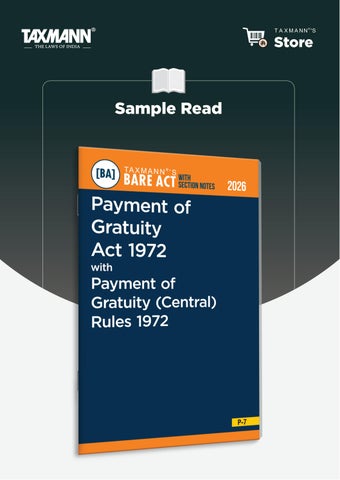
Sample Read
© Taxmann Price : ` 135 Law stated in this book is as updated till 1st December, 2025 Published by : Taxmann Publications (P.) Ltd. Sales & Marketing : 59/32, New Rohtak Road, New Delhi-110 005 India Phone : +91-11-45562222 Website : www.taxmann.com E-mail : sales@taxmann.com Regd. Office : 21/35, West Punjabi Bagh, New Delhi-110 026 India Printed at : Tan Prints (India) Pvt. Ltd. 44 Km. Mile Stone, National Highway, Rohtak Road Village Rohad, Distt. Jhajjar (Haryana) India E-mail : sales@tanprints.com Disclaimer Every effort has been made to avoid errors or omissions in this publication. In spite of this, errors may creep in. Any mistake, error or discrepancy noted may be brought to our notice which shall be taken care of in the next edition. It is notified that neither the publisher nor the author or seller will be responsible for any damage or loss of action to any one, of any kind, in any manner, therefrom. It is suggested that to avoid any doubt the reader should cross-check all the facts, law and contents of the publication with original Government publication or notifications. No part of this book may be reproduced or copied in any form or by any means [graphic, electronic or mechanical, including photocopying, recording, taping, or information retrieval systems] or reproduced on any disc, tape, perforated media or other information storage device, etc., without the written permission of the publishers. Breach of this condition is liable for legal action. For binding mistake, misprints or for missing pages, etc., the publisher’s liability is limited to replacement within seven days of purchase by similar edition. All expenses in this connection are to be borne by the purchaser. All disputes are subject to Delhi jurisdiction only.
Contents PAYMENT OF GRATUITY ACT, 1972 PAGE
1.
Short title, extent, application and commencement
1
2.
Definitions
2
2A.
Continuous service
9
3.
Controlling authority
10
4.
Payment of gratuity
10
4A.
Compulsory Insurance
15
5.
Power to exempt
16
6.
Nomination
16
7.
Determination of the amount of gratuity
17
7A.
Inspectors
19
7B.
Powers of Inspectors
20
8.
Recovery of gratuity
20
9.
Penalties
22
10.
Exemption of employer from liability in certain cases
23
11.
Cognizance of offences
23
12.
Protection of action taken in good faith
24
13.
Protection of gratuity
24
13A.
Validation of payment of gratuity
24
14.
Act to override other enactments, etc.
25
15.
Power to make rules
25
SUBJECT INDEX
27
I-5
CONTENTS
I-6 PAGE
PAYMENT OF GRATUITY (CENTRAL) RULES, 1972 1. Short title and commencement
29
2. Definitions
29
3. Notice of opening, change or closure of the establishment
29
4. Display of notice
29
5. Form of notice under proviso to section 2(h)(ii)
30
6. Nominations
30
7. Application of gratuity
31
8. Notice for payment of gratuity
31
9. Mode of payment of gratuity
32
10. Application to controlling authority for direction
32
11. Procedure for dealing with application for direction
33
12. Place and time of hearing
34
13. Administration of oath
34
14. Summoning and attendance of witnesses
34
15. Service of summons or notice
34
16. Maintenance of records of cases by the controlling authority
34
17. Direction for payment of gratuity
34
18. Appeal
35
19. Application for recovery of gratuity
35
20. Display of abstract of the Act and Rules
35
FORM A: Notice of opening
36
FORM B: Notice of change
36
FORM C: Notice of closure
37
FORM D: Notice for excluding husband from family
37
FORM E: Notice of withdrawal of notice for excluding husband from family
38
FORM F: Nomination
39
FORM G: Fresh Nomination
41
FORM H: Modification of nomination
42
FORM I: Application for gratuity by an employee
43
FORM J: Application for gratuity by a nominee
44
FORM K: Application for gratuity by a legal heir
45
FORM L: Notice for payment of gratuity
46
I-7
CONTENTS PAGE
FORM M: Notice rejecting claim of payment of gratuity
47
FORM N: Application for direction
47
FORM O: Notice for appearance before the controlling authority
49
FORM P: Summons
49
FORM Q: Particulars of application under section 7
50
FORM R: Notice for payment of gratuity
51
FORM S: Notice for payment of gratuity as determined by Appellate Authority
51
FORM T: Application for recovery of gratuity
52
FORM U: Abstract of the Act and Rules
52
SAMPLE CHAPTER
Payment of Gratuity Act, 1972 [39 OF 1972]* An Act to provide for a scheme for the payment of gratuity to employees engaged in factories, mines, oilfields, plantations, ports, railway companies, shops or other establishments and for matters connected therewith or incidental thereto. BE it enacted by Parliament in the Twenty-third Year of the Republic of India as follows:— Short title, extent, application and commencement. 1. (1) This Act may be called the Payment of Gratuity Act, 1972. (2) It extends to the whole of India : Provided that insofar as it relates to plantations or ports, it shall not extend to the State of Jammu and Kashmir. (3) It shall apply to— (a) every factory, mine, oilfield, plantation, port and railway company ; (b) every shop or establishment within the meaning of any law for the time being in force in relation to shops and establishments in a State, in which ten or more persons are employed, or were employed, on any day of the preceding twelve months; (c) such other establishments or class of establishments, in which ten or more employees are employed, or were employed, on any day of the preceding twelve months, as the Central Government may, by notification, specify in this behalf. [(3A) A shop or establishment to which this Act has become applicable shall continue to be governed by this Act notwithstanding that the number of persons employed therein at any time after it has become so applicable falls below ten.]
1
(4) It shall come into force on such date† as the Central Government may, by notification, appoint.
*Dated 21-8-1972. 1. Inserted by the Payment of Gratuity (Second Amendment) Act, 1984, w.e.f. 18-5-1984. † Enforced with effect from 16-9-1972, vide Notification No. S.O. 601(E), dated 16-9-1972.
1
S. 2
PAYMENT OF GRATUITY ACT, 1972
2
COMMENTS CASE LAWS Municipal Employees Covered - Overriding Effect on State Regulations - In this
case, employees of Municipal Corporations in Uttar Pradesh claimed gratuity under the Payment of Gratuity Act, 1972, but the municipal authorities argued that gratuity was payable only under the Retirement Benefits and General Provident Fund Regulations framed under the U.P. Municipal Corporation Act, 1959. The appellants contended that the Central Act was inapplicable due to the local body’s exclusion under the State law. However, the Supreme Court held that by virtue of a Central Government notification dated 08-01-1982 under section 1(3)(c), the Payment of Gratuity Act became applicable to local bodies employing ten or more persons. The Court emphasized that section 14 of the Act grants it overriding effect over any inconsistent provisions in other enactments, including State laws. Therefore, the restrictive gratuity benefits under the State regulations could not override the broader entitlements under the Central Act. Upholding the decisions of the Controlling Authorities and the High Court, the Court ruled that the employees of municipalities are entitled to gratuity under the Payment of Gratuity Act. - Nagar Ayukt, Nagar Nigam, Kanpur v. Mujib Ullah Khan AIR 2019 Supreme Court 1665. Applicability to Charitable Trusts - Gratuity for Religious Institution Employees – In
this case, the appellant, an employee of a religious and charitable trust, retired after 43 years of service and claimed both pension and gratuity. The High Court Division Bench rejected the claim, holding that the trust was not an “establishment” under the Payment of Gratuity Act, 1972. The Supreme Court reversed this view and held that since the appellant’s wages were below the statutory ceiling, he qualified as an employee under section 2(e). Furthermore, a government notification had already recognized the trust as an establishment under the Employees’ Provident Funds and Family Pension Fund Act, 1952, which reinforced its status under the Payment of Gratuity Act. The Court clarified that the existence of a scheme that was silent on gratuity did not exclude the statutory entitlement under the Act, especially given section 14’s overriding effect. Therefore, the trust was bound to pay gratuity as per the Act, and the employee was entitled to both pension under the trust scheme and gratuity under the statute. - Jotindra Nath Roy v. Surendra Bikram Singh Agarwal AIR 1996 Supreme Court 1736.
Definitions. 2. In this Act, unless the context otherwise requires,— (a) “appropriate Government” means,— (i) in relation to an establishment— (a) belonging to, or under the control of, the Central Government, (b) having branches in more than one State, (c) of a factory belonging to, or under the control of, the Central Government, (d) of a major port, mine, oilfield or railway company, the Central Government, (ii) in any other case, the State Government ; (b) “completed year of service” means continuous service for one year;
3
PAYMENT OF GRATUITY ACT, 1972 2
S. 2
[(c) “continuous service” means continuous service as defined in section 2A;] (d) “controlling authority” means an authority appointed by the appropriate Government under section 3; [(e) “employee” means any person (other than an apprentice) who is employed for wages, whether the terms of such employment are express or implied, in any kind of work, manual or otherwise, in or in connection with the work of a factory, mine, oilfield, plantation, port, railway company, shop or other establishment to which this Act applies, but does not include any such person who holds a post under the Central Government or a State Government and is governed by any other Act or by any rules providing for payment of gratuity;]
3
[***]
4
(f) “employer” means, in relation to any establishment, factory, mine, oilfield, plantation, port, railway company or shop— (i) belonging to, or under the control of, the Central Government or a State Government, a person or authority appointed by the appro-
2. Substituted for clause (c) and the Explanations thereto by the Payment of Gratuity (Second Amendment) Act, 1984, w.e.f. 18-5-1984. Prior to substitution, clause (c) and Explanations thereto read as under: ‘(c) “continuous service” means uninterrupted service and includes service which is interrupted by sickness, accident, leave, lay-off strike or a lock-out or cessation of work not due to any fault of the employee concerned, whether such uninterrupted or interrupted service was rendered before or after the commencement of this Act. Explanation I.— In the case of an employee who is not in uninterrupted service for one year, he shall be deemed to be in continuous service if he has been actually employed by an employer during the twelve months immediately preceding the year for not less than— (i) 190 days, if employed below the ground in a mine or (ii) 240 days, in any other case, except when he is employed in a seasonal establishment. Explanation II.— An employee of a seasonal establishment shall be deemed to be continuous service if he has actually worked for not less than seventy-five per cent of the number of days on which the establishment was in operation during the year:’ 3. Substituted by the Payment of Gratuity (Amendment) Act, 2009, w.r.e.f. 3-4-1997. Prior to substitution, clause (e), as amended by the Payment of Gratuity (Amendment) Act, 1984, w.e.f. 1-7-1984, Payment of Gratuity (Amendment) Act, 1987, w.e.f. 1-10-1987 and Payment of Gratuity (Amendment) Act, 1994, w.e.f. 24-5-1994, read as under: ‘(e) “employee” means any person (other than an apprentice) employed on wages, in any establishment, factory, mine, oilfield, plantation, port, railway company or shop, to do any skilled, semi-skilled, or unskilled, manual, supervisory, technical or clerical work, whether the terms of such employment are express or implied, and whether or not such person is employed in a managerial or administrative capacity, but does not include any such person who holds a post under the Central Government or a State Government and is governed by any other Act or by any rules providing for payment of gratuity.’ 4. Explanation omitted by the Payment of Gratuity (Amendment) Act, 1994, w.e.f. 24-5-1994. Prior to omission, Explanation read as under: “Explanation.— In the case of an employee, who having been employed for a period of not less than five years on wages not exceeding one thousand rupees per mensem, is employed at any time thereafter on wages exceeding one thousand rupees per mensem, gratuity in respect of the period during which such employee was employed on wages not exceeding one thousand per mensem, shall be determined on the basis of the wages received by him during that period;”
S. 2
PAYMENT OF GRATUITY ACT, 1972
4
priate Government for the supervision and control of employees, or where no person or authority has been so appointed, the head of the Ministry or the Department concerned, (ii) belonging to, or under the control of, any local authority, the person appointed by such authority for the supervision and control of employees or where no person has been so appointed, the chief executive officer of the local authority, (iii) in any other case, the person, who, or the authority which, has the ultimate control over the affairs of the establishment, factory, mine, oilfield, plantation, port, railway company or shop, and where the said affairs are entrusted to any other person, whether called a manager, managing director or by any other name, such person ; (g) “factory” has the meaning assigned to it in clause (m) of section 2 of the Factories Act, 1948 (63 of 1948); (h) “family”, in relation to an employee, shall be deemed to consist of — (i) in the case of a male employee, himself, his wife, his children, whether married or unmarried, his dependent parents 5[and the dependent parents of his wife and the widow] and children of his predeceased son, if any, (ii) in the case of a female employee, herself, her husband, her children, whether married or unmarried, her dependent parents and the dependent parents of her husband and the widow and children of her predeceased son, if any. [***]
6
Explanation : Where the personal law of an employee permits the adoption by him of a child, any child lawfully adopted by him shall be deemed to be included in his family, and where a child of an employee has been adopted by another person and such adoption is, under the personal law of the person making such adoption, lawful, such child shall be deemed to be excluded from the family of the employee ; (i) “major port” has the meaning assigned to it in clause (8) of section 3 of the Indian Ports Act, 1908 (15 of 1908); (j) “mine” has the meaning assigned to it in clause (j) of sub-section (1) of section 2 of the Mines Act, 1952 (35 of 1952);
5. Substituted for “and the widow” by the Payment of Gratuity (Amendment) Act, 1987, we.f. 1-10-1987. 6. Proviso omitted, ibid. Prior to omission, said proviso read as under: “Provided that if a female employee, by a notice in writing to the controlling authority, expresses her desire to exclude her husband from her family, the husband and his dependent parents shall no longer be deemed, for the purposes of this Act, to be included in the family of such female employee unless the said notice subsequently withdrawn by such female employee.”
PAYMENT OF GRATUITY ACT 1972 WITH PAYMENT OF GRATUITY (CENTRAL) RULES 1972 – BARE ACT WITH SECTION NOTES AUTHOR : PUBLISHER : DATE OF PUBLICATION : EDITION : ISBN NO : NO. OF PAGES : BINDING TYPE :
Taxmann's Editorial Board Taxmann December 2025 2026 Edition 9789371263986 68 Paperback
Rs. 135 DESCRIPTION Payment of Gratuity Act 1972, along with the Payment of Gratuity (Central) Rules 1972 [Bare Act with Section Notes] by Taxmann, provides the full, updated statutory text, accompanied by comprehensive section notes, case law summaries, and practical guidance. It is designed to facilitate effective understanding, compliance, and litigation support regarding gratuity law in India. This book is intended for the following audience: • Legal Professionals, Advocates, and Judges • HR Professionals, Employers, and Compliance Officers • Government Officers & Administrators • Academicians & Students • Employees and Trade Unions The Present Publication is the 2026 Edition, covering the amended and updated text of the Payment of Gratuity Act [Act No. 39 of 1972] and Rules, with the following noteworthy features: • [Complete, Amended Text] Covers the latest Payment of Gratuity Act 1972 and Central Rules • [Section-wise Notes] Concise explanations, insights, and commentary for each section • [Case Law Summaries] Leading Supreme Court and High Court judgments on key provisions • [Statutory Forms] All prescribed forms for compliance and claims • [Procedural Guidance] Stepwise procedures for applications, disputes, and appeals • [User-friendly Format] Logical structure, clear typography, and an extensive subject index • [Latest Amendments] Incorporates all relevant legislative updates and notifications • [Pre-amendment Provisions] Includes pre-amendment text for historical reference • [Ready Reference] Suitable for daily professional and academic use
Buy Now