Sample Read
Contents PATENTS ACT, 1970 PAGE
CHAPTER I PRELIMINARY 1.
Short title, extent and commencement
1
2.
Definitions and interpretation
1
CHAPTER II INVENTIONS NOT PATENTABLE 3.
What are not inventions
9
4.
Inventions relating to atomic energy not patentable
13
5.
[Omitted by the Patents (Amendment) Act, 2005, w.r.e.f. 1-1-2005]
13
CHAPTER III APPLICATIONS FOR PATENTS 6.
Persons entitled to apply for patents
13
7.
Form of application
14
8.
Information and undertaking regarding foreign applications
15
9.
Provisional and complete specifications
16
10.
Contents of specifications
17
11.
Priority dates of claims of a complete specification
19
I-5
CONTENTS
I-6 PAGE
CHAPTER IV PUBLICATION AND EXAMINATION OF APPLICATIONS 11A.
Publication of applications
20
11B.
Request for examination
21
12.
Examination of application
22
13.
Search for anticipation by previous publication and by prior claim
22
14.
Consideration of the report of examiner by Controller
23
15.
Power of Controller to refuse or require amended applications, etc., in certain cases
23
16.
Power of Controller to make orders respecting division of application
24
17.
Power of Controller to make orders respecting dating of application
24
18.
Powers of Controller in cases of anticipation
25
19.
Powers of Controller in case of potential infringement
26
20.
Powers of Controller to make orders regarding substitution of applicants, etc.
26
21.
Time for putting application in order for grant
27
22. [Omitted by the Patents (Amendment) Act, 2005, w.r.e.f. 1-1-2005] to 24.
28
CHAPTER IVA 24A. to 24F.
[Omitted by the Patents (Amendment) Act, 2005, w.r.e.f. 1-1-2005]
29
CHAPTER V OPPOSITION PROCEEDINGS TO GRANT OF PATENTS 25.
Opposition to the patent
31
26.
In cases of “obtaining” Controller may treat the patent as the patent of opponent
36
27.
[Omitted by the Patents (Amendment) Act, 2005, w.r.e.f. 1-1-2005]
37
28.
Mention of inventor as such in patent
37
I-7
CONTENTS PAGE
CHAPTER VI ANTICIPATION 29.
Anticipation by previous publication
38
30.
Anticipation by previous communication to Government
39
31.
Anticipation by public display, etc.
39
32.
Anticipation by public working
40
33.
Anticipation by use and publication after provisional specification
40
34.
No anticipation if circumstances are only as described in sections 29, 30, 31 and 32
40
CHAPTER VII PROVISIONS FOR SECRECY OF CERTAIN INVENTIONS 35.
Secrecy directions relating to inventions relevant for defence Purposes
41
36.
Secrecy directions to be periodically reviewed
41
37.
Consequences of secrecy directions
42
38.
Revocation of secrecy directions and extension of time
42
39.
Residents not to apply for patents outside India without prior permission
43
40.
Liability for contravention of section 35 or section 39
43
41.
Finality of orders of Controller and Central Government
44
42.
Savings respecting disclosure to Government
44
CHAPTER VIII GRANT OF PATENTS AND RIGHTS CONFERRED THEREBY 43.
Grant of patents
44
44.
Amendment of patent granted to deceased applicant
45
45.
Date of patent
45
46.
Form, extent and effect of patent
46
47.
Grant of patents to be subject to certain conditions
46
48.
Rights of Patentees
46
49.
Patent rights not infringed when used on foreign vessels, etc., temporarily or accidentally in India
47
50.
Rights of co-owners of patents
48
CONTENTS
I-8 PAGE
51.
Power of Controller to give directions to co-owners
48
52.
Grant of patent to true and first inventor where it has been obtained by another in fraud of him
49
53.
Term of patent
50 CHAPTER IX PATENTS OF ADDITION
54.
Patents of addition
50
55.
Term of patents of addition
51
56.
Validity of patents of addition
51
CHAPTER X AMENDMENT OF APPLICATIONS AND SPECIFICATIONS 57.
Amendment of application and specification or any document related thereto before Controller
52
58.
Amendment of specification before Appellate Board or High Court
53
59.
Supplementary provisions as to amendment of application or specification
54
CHAPTER XI RESTORATION OF LAPSED PATENTS 60.
Applications for restoration of lapsed patents
55
61.
Procedure for disposal of applications for restoration of lapsed patents
55
62.
Rights of patentees of lapsed patents which have been restored
56
CHAPTER XII SURRENDER AND REVOCATION OF PATENTS 63.
Surrender of patents
56
64.
Revocation of patents
56
65.
Revocation of patent or amendment of complete specification on directions from Government in cases relating to atomic energy
60
66.
Revocation of patent in public interest
60
CHAPTER XIII REGISTER OF PATENTS 67.
Register of patents and particulars to be entered therein
61
I-9
CONTENTS PAGE
68.
Assignments, etc., not to be valid unless in writing and duly executed
62
69.
Registration of assignments, transmissions, etc.
62
70.
Power of registered grantee or proprietor to deal with patent
63
71.
Rectification of register by High Court
63
72.
Register to be open for inspection
64
CHAPTER XIV PATENT OFFICE AND ITS ESTABLISHMENT 73.
Controller and other officers
64
74.
Patent office and its branches
64
75.
Restriction on employees of patent office as to right or interest in patents
65
76.
Officers and employees not to furnish information, etc.
65
CHAPTER XV POWERS OF CONTROLLER GENERALLY 77.
Controller to have certain powers of a civil court
65
78.
Power of Controller to correct clerical errors, etc.
66
79.
Evidence how to be given and powers of Controller in respect thereof
67
80.
Exercise of discretionary powers by Controller
67
81.
Disposal by Controller of applications for extension of time
67
CHAPTER XVI WORKING OF PATENTS, COMPULSORY LICENCES AND REVOCATION 82.
Definitions of “patented articles” and “Patentee”
67
83.
General principles applicable to working of patented inventions
73
84.
Compulsory licences
74
85.
Revocation of patents by the Controller for non-working
76
86.
Power of Controller to adjourn applications for compulsory licences, etc., in certain cases
76
87.
Procedure for dealing with applications under sections 84 and 85
77
88.
Powers of Controller in granting compulsory licences
77
89.
General purposes for granting compulsory licences
78
CONTENTS
I-10 PAGE
90.
Terms and conditions of compulsory licences
78
91.
Licensing of related patents
79
92.
Special provision for compulsory licences on notifications by Central Government
80
92A.
Compulsory licence for export of patented pharmaceutical products in certain exceptional circumstances
81
93.
Order for licence to operate as a deed between parties concerned
81
94.
Termination of compulsory licence
81
95. to [Omitted by the Patents (Amendment) Act, 2002, w.e.f. 20-5-2003] 98.
81
CHAPTER XVII USE OF INVENTIONS FOR PURPOSES OF GOVERNMENT AND ACQUISITION OF INVENTIONS BY CENTRAL GOVERNMENT 99.
Meaning of use of invention for purposes of Government
83
100.
Power of Central Government to use inventions for purposes of Government
83
101.
Rights of third parties in respect of use of invention for purposes of Government
85
102.
Acquisition of inventions and patents by the Central Government
86
103.
Reference to High Court of disputes as to use for purposes of Government
87
CHAPTER XVIII SUITS CONCERNING INFRINGEMENT OF PATENTS 104.
Jurisdiction
104A. Burden of proof in case of suits concerning infringement
88 88
105.
Power of court to make declaration as to non-infringement
89
106.
Power of court to grant relief in cases of groundless threats of infringement proceedings
89
107.
Defences, etc., in suits for infringement
90
107A. Certain acts not to be considered as infringement
90
108.
Reliefs in suits for infringement
90
109.
Right of exclusive licensee to take proceedings against infringement
91
110.
Right of licensee under section 84 to take proceedings against infringement
91
I-11
CONTENTS PAGE
111. 112. 113. 114. 115.
Restriction on power of court to grant damages or an account of profits for infringement [Omitted by the Patents (Amendment) Act, 2002, w.e.f. 20-5-2003] Certificate of validity of specification and costs of subsequent suits for infringement thereof Relief for infringement of partially valid specification Scientific advisers
91 92 92 93 93
CHAPTER XIX APPEALS 116.
[Omitted by the Tribunals Reforms Act, 2021, w.r.e.f. 4-4-2021]
93
117.
[Omitted by the Tribunals Reforms Act, 2021, w.r.e.f. 4-4-2021]
95
117A. Appeals to High Court
95
117B. [Omitted by the Tribunals Reforms Act, 2021, w.r.e.f. 4-4-2021]
95
117C. [Omitted by the Tribunals Reforms Act, 2021, w.r.e.f. 4-4-2021]
96
[Omitted by the Tribunals Reforms Act, 2021, w.r.e.f. 4-4-2021]
96
117D
117E. Appearance of Controller in legal proceedings
96
117F. [Omitted by the Tribunals Reforms Act, 2021, w.r.e.f. 4-4-2021]
96
[Omitted by the Tribunals Reforms Act, 2021, w.r.e.f. 4-4-2021]
97
117H [Omitted by the Tribunals Reforms Act, 2021, w.r.e.f. 4-4-2021]
97
117G
CHAPTER XX PENALTIES Contravention of secrecy provisions relating to certain inventions 119. Falsification of entries in register, etc. 120. Unauthorised claim of patent rights 121. [Omitted by the Jan Vishwas (Amendment of Provisions) Act, 2023, w.e.f. 1-8-2024] 122. Refusal or failure to supply information 123. Practice by non-registered patent agents 124. Offences by companies 124A. Adjudication of penalties 124B. Appeal 118.
97 97 97 98 98 99 99 99 100
CHAPTER XXI PATENT AGENTS 125.
Register of patent agents
100
126.
Qualifications for registration as patent agents
100
CONTENTS
I-12 PAGE
127.
Rights of patent agents
101
128.
Subscription and verification of certain documents by patent agents
101
129.
Restrictions on practice as patent agents
102
130.
Removal from register of patent agents and restoration
102
131.
Power of Controller to refuse to deal with certain agents
103
132.
Savings in respect of other persons authorised to act as agents
103
CHAPTER XXII INTERNATIONAL ARRANGEMENTS 133.
Convention countries
103
134.
Notification as to countries not providing for reciprocity
104
135.
Convention applications
104
136.
Special provisions relating to convention applications
105
137.
Multiple priorities
105
138.
Supplementary provisions as to convention applications
106
139.
Other provisions of Act to apply to convention applications
107
CHAPTER XXIII MISCELLANEOUS 140.
Avoidance of certain restrictive conditions
107
141.
Determination of certain contracts
108
142.
Fees
108
143.
Restrictions upon publication of specification
109
144.
Reports of examiners to be confidential
109
145.
Publication of official journal
109
146.
Power of Controller to call for information from patentees
109
147.
Evidence of entries, documents, etc.
110
148.
Declaration by infant, lunatic, etc.
110
149.
Service of notices, etc., by post
110
150.
Security for costs
110
151.
Transmission of orders of courts to Controller
111
152.
[Omitted by the Patents (Amendment) Act, 2005, w.r.e.f. 1-1-2005]
111
153.
Information relating to patents
111
154.
Loss or destruction of patents
111
I-13
CONTENTS PAGE
155.
Reports of Controller to be placed before Parliament
111
156.
Patent to bind Government
112
157.
Right of Government to sell or use forfeited articles
112
157A. Protection of security of India
112
158.
Power of High Courts to make rules
112
159.
Power of Central Government to make rules
113
160.
Rules to be placed before Parliament
115
161.
[Omitted by the Patents (Amendment) Act, 2002, w.e.f. 20-5-2003]
116
162.
Repeal of Act 2 of 1911 insofar as it relates to patents and savings
116
163.
[Omitted by the Patents (Amendment) Act, 2005, w.r.e.f. 1-1-2005]
117
SCHEDULE
117
SUBJECT INDEX
121
PATENTS RULES, 2003 CHAPTER I PRELIMINARY 1. 2. 3. 4. 5. 6. 7. 8. 9.
Short title and commencement Definitions Prescribed particulars Appropriate office Address for service Leaving and serving documents Fees Forms Filing of documents and copies, etc.
129 129 131 132 132 133 135 138 138
CHAPTER II APPLICATION FOR PATENTS 10. Period within which proof of the right under section 7(2) to make the application shall be furnished 11. Order of recording applications 12. Statement and undertaking regarding foreign applications 13. Specifications 14. Amendments to specifications 15. Drawings
139
16. Models
143
139 139 140 142 143
CONTENTS
I-14 PAGE
CHAPTER III INTERNATIONAL APPLICATIONS UNDER PATENT COOPERATION TREATY (PCT) 17. Definitions
143
18. Appropriate office in relation to international applications
144
19. International applications filed with appropriate office as receiving office
145
19A. Indian International Searching Authority
145
19B. International search report
145
19C. Time limit for establishing international search report
147
19D. Transmittal of the International Search Report and written opinion
147
19E. Confidential treatment
147
19F. Indian International Preliminary Examining Authority
147
19G. Period for making a demand
148
19H. Fees payable to Examining Authority
148
19-I. Manner of making a demand
148
19J. Processing of demands for international preliminary examination
148
19K. International Preliminary Examination Report
148
19L. Period for establishing international preliminary examination report and its transmission
149
19M. Transmittal of the International Preliminary Examination Report
150
19N. Conditions for and extent of refund
150
20. International applications designating or designating and electing India
150
21. Filing of priority document
152
22. Effect of non-compliance with certain requirements
152
23. The requirements under this Chapter to be supplemental of the regulations, etc., under the Treaty
152
CHAPTER IV PUBLICATION AND EXAMINATION OF APPLICATIONS 24. Publication of application 24A. Request for publication
153 153
I-15
CONTENTS PAGE
24B. 24C. 25. 26. 27. 28. 28A. 29. 29A. 30. 31. 32. 33. 34. 35. 36. 37. 38.
Examination of application Expedited examination of applications Identification of published applications Request for withdrawal Inspection and supply of published documents Procedure in case of anticipation by prior publication Procedure in relation to consideration of report of examiner under section 14 Procedure in case of anticipation by prior claiming Grace period Amendment of the complete specification in case of anticipation Form of reference to another specification Procedure in case of potential infringement Form of reference to another patent Manner in which a claim under section 20(1) shall be made Manner in which a request may be made under section 20(4) Manner of application under section 20(5) Numbering of applications on the grant of patent [Omitted by the Patents (Amendment) Rules, 2005, w.e.f. 1-12005]
153 156 158 158 158 158 159 159 160 160 160 160 160 161 161 161 161 161
CHAPTER V EXCLUSIVE MARKETING RIGHTS 39. to [Omitted by the Patents (Amendment) Rules, 2005, w.e.f. 1-154. 2005]
162
CHAPTER VI OPPOSITION PROCEEDINGS TO GRANT OF PATENT 55. Opposition to the patent 55A. Filing of notice of opposition
164 166
56. Constitution of Opposition Board and its proceeding
166
57. Filing of written statement of opposition and evidence
167
58. Filing of reply statement and evidence
167
59. Filing of reply evidence by opponent
167
60. Further evidence to be left with the leave of the Controller
167
61. Copies of documents to be supplied
167
62. Hearing
168
CONTENTS
I-16 PAGE
63. Determination of costs
168
63A. Request made under section 26(1)
168
64. [Omitted by the Patents (Amendment) Rules, 2005, w.e.f. 1-1-2005]
169
65. [Omitted by the Patents (Amendment) Rules, 2005, w.e.f. 1-1-2005]
169
66. Form of making a request under section 28(2)
169
67. Form of making a claim under section 28(3)
169
68. Form of application to be made under section 28(7)
169
69. Procedure for the hearing of claim or an application under section 28
169
70. Mention of inventor
170
70A. Certificate of inventorship
170
CHAPTER VII SECRECY DIRECTIONS 71. Permission for making patent application outside India under section 39
170
72. Communication of result of reconsideration under section 36(2)
170
CHAPTER VIII GRANT OF PATENTS 73. [Omitted by the Patents (Amendment) Rules, 2005, w.e.f. 1-1-2005]
171
74. Form of patent
171
74A. Inspection of documents related to grant of patent
171
75. Amendment of patent under section 44
171
76. Manner of applying for direction under section 51(1)
171
77. Manner of application under section 51(2)
172
78. Procedure for the hearing of proceedings under section 51
172
79. Request under section 52(2)
172
80. Renewal fees under section 53
172
CHAPTER IX AMENDMENT OF APPLICATION, SPECIFICATION OR ANY DOCUMENT RELATING THERETO 81. Amendment of application, specification or any document relating thereto
173
82. Preparation of amended specifications, etc.
173
83. Publication of the amendment allowed
174
I-17
CONTENTS PAGE
CHAPTER X RESTORATION OF PATENTS 84. Restoration of patents
174
85. Opposition to restoration under section 61
174
86. Payment of unpaid renewal fees
174
CHAPTER XI SURRENDER OF PATENTS 87. Surrender of Patents
175 CHAPTER XII
REGISTER OF PATENTS 88. Register of patents under section 67
175
89. [Omitted by the Patents (Amendment) Rules, 2005, w.e.f. 1-1-2005]
176
90. Registration of title and interest in patents
176
91. Presentation of assignment, etc. of patent to Controller
176
92. Registration of title or interest in a patent
176
93. Entry of renewal fee
177
94. Alteration of address
177
95. Inspection of register of patents under section 72 and fees payable therefor
177
CHAPTER XIII COMPULSORY LICENCE AND REVOCATION OF PATENT 96. Application for compulsory licence, etc.
177
97. When a prima facie case is not made out
178
98. Notice of opposition under section 87(2)
178
99. Manner of publication of the revocation order
178
100. Application under section 88(4)
178
101. Procedure to be followed in case of applications under section 88(4)
179
102. Application for termination of compulsory licence under section 94
179
CONTENTS
I-18 PAGE
CHAPTER XIV SCIENTIFIC ADVISERS 103. Roll of scientific advisers
180
103A. Disqualifications for inclusion in the roll of scientific advisers
181
104. Manner of application for inclusion in the roll of scientific advisers
181
105. Inclusion of the name of any other person in the roll of scientific advisers
181
106. Power to relax
181
107. Removal of names from the roll of scientific advisers
181
CHAPTER XIV-A ADJUDICATION OF PENALTIES AND APPEALS 107A. Definitions
182
107B. Complaint
182
107C. Holding of inquiry
182
107D. Appeal
185
107E. Service of communications
185
107F. Extension of time
185
107G. Order and penalties
185 CHAPTER XV PATENT AGENTS
108. Particulars to be contained in the register of patent agents
186
109. Application for registration of patent agents
186
110. Particulars of the qualifying examination for patent agents
186
111. Registration of patent agents
187
111A. Issue of duplicate certificate of patent agents
187
112. Details to be included in an application for the registration of a patent agent
187
113. Registration of patent agents under section 126(2)
187
114. Disqualifications for registration as a patent agent
187
115. Payment of fees
188
I-19
CONTENTS PAGE
116. Removal of a name from the register of patent agents
188
117. Restoration of name of persons removed from the register of patent agents
188
118. Alteration of names etc. in the register of patent agents
189
119. Refusal to recognise as patent agent
189
120. Publication of the names of patent agents, registered under the Act
189
CHAPTER XVI MISCELLANEOUS 121. Period within which copies of specification, etc. are to be filed
190
121A. Address of communications
190
122. Correction of clerical errors
190
123. Manner of advertisement of the proposed correction of any error
190
124. Manner and time of opposition to the making of corrections
190
125. Notification of corrections
191
126. Form, etc. of affidavits
191
127. Exhibits
191
128. Directions not otherwise prescribed
191
129. Exercise of discretionary power by the Controller
192
129A. Adjournment of hearing
192
130. Application for review of decisions or setting aside of orders of the Controller
192
131. Form and manner in which statements required under section 146(2) to be furnished
192
132. Form of application for the issue of a duplicate patent
193
133. Supply of certified copies and certificates under sections 72 and 147
193
134. Request for information under section 153
193
135. Agency
194
136. Scale of costs
195
137. Powers of Controller generally
195
138. Power to extend time specified or condone delay
195
139. Hearing before the Controller to be in public certain cases
196
FIRST SCHEDULE
197
SECOND SCHEDULE
212
CONTENTS
I-20 PAGE
THIRD SCHEDULE
254
FOURTH SCHEDULE
255
FIFTH SCHEDULE
256
INTELLECTUAL PROPERTY APPELLATE BOARD (PATENTS PROCEDURE) RULES, 2010 1. Short title and commencement
258
2. Definitions
258
3. Form of procedure of appeal or application
259
4. Appeal or application to be in writing
259
5. Documents to accompany appeal or application
260
6. Fees
260
7. Authorisation
260
8. Verification of the appeal or application
260
9. Presentation and scrutiny of appeal or application
261
10. Notices of appeal or application to the respondents
261
11. Filing of counter-statement to the appeal or application and other documents by the respondent
261
12. Affidavit and Exhibits
261
13. Filing of reply by the appellant or applicant
262
14. Filing of Additional documents in appeal
262
15. Translation of documents
262
16. Extension of time
262
17. Intervention by third parties
263
18. Date of hearing to be notified
263
19. Hearing of appeal or application
263
20. Adjournment of hearing
263
21. Award of costs by the Appellate Board
263
22. Language of the Appellate Board
263
23. Order to be signed and dated
263
24. Communication of orders
264
25. Publication of the orders
264
26. Review Petitions
264
27. Rectification of Orders
264
I-21
CONTENTS PAGE
28. Continuation of proceedings after the death of a party, merger, assignment, acquisition or transmission
264
29. Fee for inspection of records and obtaining copies thereof
264
30. Functions of the Deputy Registrar
265
31. Additional functions and duties of the Deputy Registrar
265
32. Dress code for the Chairman, Vice-Chairman, Technical Member of the Appellate Board and for the representatives of the parties
265
FIRST SCHEDULE
266
SECOND SCHEDULE
271
PATENTS (APPEALS AND APPLICATIONS TO THE INTELLECTUAL PROPERTY APPELLATE BOARD) RULES, 2011 1. Short title and commencement
273
2. Appeals and applications
273
3. Condonation of delay in filing appeal
274
4. Fees
274
FIRST SCHEDULE
274
SECOND SCHEDULE
278
Patents Act, 1970 [39 OF 1970]* An Act to amend and consolidate the law relating to patents. BE it enacted by Parliament in the Twenty-first Year of the Republic of India as follows:— CHAPTER I PRELIMINARY Short title, extent and commencement. 1. (1) This Act may be called the Patents Act, 1970. (2) It extends to the whole of India. (3) It shall come into force on such date† as the Central Government may, by notification in the Official Gazette, appoint: Provided that different dates may be appointed for different provisions of this Act, and any reference in any such provision to the commencement of this Act shall be construed as a reference to the coming into force of that provision. Definitions and interpretation. 2. (1) In this Act, unless the context otherwise requires,— 1
[(a) 2[***]
(ab) “assignee” includes an assignee of the assignee and the legal representative of a deceased assignee and references to the assignee of any
*Dated 19-9-1970. †With effect from 20-4-1972, vide S.O. 300(E), dated 20-4-1972 except provisions of sections 12(2), 13(2), 28, 68 and 125 to 132 which came into force w.e.f. 1-4-1978 vide S.O. 799, dated 10-3-1978. 1. Clauses (a), (ab) and (ac) substituted for clause (a) by the Patents (Amendment) Act, 2002, w.e.f. 20-5-2003. Prior to its substitution, clause (a) read as under: ‘(a) “assignee” includes the legal representative of a deceased assignee, and references to the assignee of any person include references to the assignee of the legal representative or assignee of that person;’ 2. Omitted by the Tribunals Reforms Act, 2021, w.r.e.f. 4-4-2021. Prior to its omission, clause (a) as substituted by the Patent (Amendment) Act, 2002, w.e.f. 20-5-2003 read as under: ‘(a) “Appellate Board” means the Appellate Board referred to in section 116;’
1
S. 2
PATENTS ACT, 1970
2
person include references to the assignee of the legal representative or assignee of that person; 3
[(aba) “Budapest Treaty” means the Budapest Treaty on the International Recognition of the Deposit of Micro-organisms for the purposes of Patent Procedure done at Budapest on 28th day of April, 1977, as amended and modified from time to time;] (ac) “capable of industrial application”, in relation to an invention, means that the invention is capable of being made or used in an industry;] (b) “Controller” means the Controller General of Patents, Designs and Trade Marks referred to in section 73; (c) “convention application” means an application for a patent made by virtue of section 135; 4
[(d) “convention country” means a country or a country which is member of a group of countries or a union of countries or an Inter-Governmental organization 5[referred to as a convention country in section 133];] (e) “district court” has the meaning assigned to that expression by the Code of Civil Procedure, 1908 (5 of 1908); (f) “exclusive licence” means a licence from a patentee which confers on the licensee, or on the licensee and persons authorised by him, to the exclusion of all other persons (including the patentee), any right in respect of the patented invention, and “exclusive licensee” shall be construed accordingly; (g) 6[***] (h) “Government undertaking” means any industrial undertaking carried on— (i) by a department of the Government, or (ii) by a corporation established by a Central, Provincial or State Act, which is owned or controlled by the Government, or (iii) by a Government company as defined in section 617 of the Companies Act, 1956 (1 of 1956) 7[, or] 7
[(iv) by an institution wholly or substantially financed by the Government;]
3. Inserted by the Patents (Amendment) Act, 2005, w.r.e.f. 1-1-2005. 4. Substituted by the Patents (Amendment) Act, 2002, w.e.f. 20-5-2003. Prior to its substitution, clause (d) read as under: ‘(d) “convention country” means a country notified as such under sub-section (1) of section 133;’ 5. Substituted for “notified as such under sub-section (1) of section 133” by the Patents (Amendment) Act, 2005, w.r.e.f. 1-1-2005. 6. Omitted, ibid. Prior to its omission, clause (g), as substituted by the Patents (Amendment) Act, 2002, w.e.f. 20-5-2003, read as under: ‘(g) “food” means any article of nourishment for human consumption and also includes any substance intended for the use of infants, invalids or convalescents as an article of food or drink;’ 7. Inserted, ibid.
3
PATENTS ACT, 1970 8 9
10
S. 2
[***]
[(i) “High Court”, in relation to a State or Union territory, means the High Court having territorial jurisdiction in that State or Union territory, as the case may be;]
[(ia) “international application” means an application for patent made in accordance with the Patent Co-operation Treaty;]
11
[(j) “invention” means a new product or process involving an inventive step and capable of industrial application;
12
[(ja) “inventive step” means a feature of an invention that involves technical advance as compared to the existing knowledge or having economic significance or both and that makes the invention not obvious to a person skilled in the art;]] (k) “legal representative” means a person who in law represents the estate of a deceased person;
8. Words “and includes the Council of Scientific and Industrial Research and any other institution which is financed wholly or for the major part by the said Council;” omitted by the Patents (Amendment) Act, 2005, w.r.e.f. 1-1-2005. 9. Substituted, ibid. Prior to its substitution, clause (i), as amended by the Patents (Amendment) Act, 2002, w.e.f. 20-5-2003, read as under: ‘(i) “High Court” means,— (i) in relation to the National Capital Territory of Delhi, the High Court of Delhi; (ii) in relation to the State of Arunachal Pradesh and the State of Mizoram, the Gauhati High Court (the High Court of Assam, Nagaland, Meghalaya, Manipur, Tripura, Mizoram and Arunachal Pradesh); (iii) in relation to the Union territory of the Andaman and Nicobar Islands, the High Court at Calcutta; (iv) in relation to the Union territory of the Lakshadweep, the High Court of Kerala; (v) in relation to the State of Goa, the Union territory of Daman and Diu and the Union territory of Dadra and Nagar Haveli, the High Court at Bombay; (vi) in relation to the Union territory of Pondicherry, the High Court at Madras; (vii) in relation to the Union territory of Chandigarh, the High Court of Punjab and Haryana; and (viii) in relation to any other State, the High Court for that State;’ 10. Inserted by the Patents (Amendment) Act, 2002, w.e.f. 20-5-2003. 11. Clauses (j) and (ja) substituted for clause (j), ibid. Prior to its substitution, clause (j) read as under: ‘(j) “invention” means any new and useful— (i) art, process, method or manner of manufacture; (ii) machine, apparatus or other article; (iii) substance produced by manufacture, and includes any new and useful improvement of any of them, and an alleged invention;’ 12. Substituted by the Patents (Amendment) Act, 2005, w.r.e.f. 1-1-2005. Prior to its substitution, clause (ja), as amended by the Patents (Amendment) Act, 2002, w.e.f. 20-5-2003, read as under: ‘(ja) “inventive step” means a feature that makes the invention not obvious to a person skilled in the art;’
S. 2
PATENTS ACT, 1970
4
13
[(l) “new invention” means any invention or technology which has not been anticipated by publication in any document or used in the country or elsewhere in the world before the date of filing of patent application with complete specification, i.e., the subject matter has not fallen in public domain or that it does not form part of the state of the art;
(la) “Opposition Board” means an Opposition Board constituted under sub-section (4) of section 25; (m) “patent” means a patent for any invention granted under this Act;] (n) “patent agent” means a person for the time being registered under this Act as a patent agent; (o) “patented article” and “patented process” mean respectively an article or process in respect of which a patent is in force; 14
[(oa) “Patent Co-operation Treaty” means the Patent Co-operation Treaty done at Washington on the 19th day of June, 1970 as amended and modified from time to time;] (p) “patentee” means the person for the time being entered on the register as the grantee or proprietor of the patent; (q) “patent of addition” means a patent granted in accordance with section 54; (r) “patent office” means the patent office referred to in section 74; (s) “person” includes the Government; (t) “person interested” includes a person engaged in, or in promoting, research in the same field as that to which the invention relates;
15
[(ta) “pharmaceutical substance” means any new entity involving one or more inventive steps;]
13. Substituted by the Patents (Amendment) Act, 2005, w.r.e.f. 1-1-2005. Prior to their substitution, clauses (l) and (m), read as under: ‘(l) “medicine or drug” includes— (i) all medicines for internal or external use of human beings or animals, (ii) all substances intended to be used for or in the diagnosis, treatment, mitigation or prevention of diseases in human beings or animals, (iii) all substances intended to be used for or in the maintenance of public health, or the prevention or control of any epidemic disease among human beings or animals, (iv) insecticides, germicides, fungicides, weedicides and all other substances intended to be used for the protection or preservation of plants, (v) all chemical substances which are ordinarily used as intermediates in the preparation or manufacture of any of the medicines or substances above referred to; (m) “patent” means a patent granted under this Act;’ 14. Inserted by the Patents (Amendment) Act, 2002, w.e.f. 20-5-2003. 15. Inserted by the Patents (Amendment) Act, 2005, w.r.e.f. 1-1-2005.
5
PATENTS ACT, 1970
S. 2
16
[(u) “prescribed” means,— (A) in relation to proceedings before a High Court, prescribed by rules made by the High Court; (B) 17[***] (C) in other cases, prescribed by rules made under this Act;] (v) “prescribed manner” includes the payment of the prescribed fee; (w) “priority date” has the meaning assigned to it by section 11; (x) “register” means the register of patents referred to in section 67; (y) “true and first inventor” does not include either the first importer of an invention into India, or a person to whom an invention is first communicated from outside India.
(2) In this Act, unless the context otherwise requires, any reference— (a) to the Controller shall be construed as including a reference to any officer discharging the functions of the Controller in pursuance of section 73; (b) to the patent office shall be construed as including a reference to any branch office of the patent office. COMMENTS SECTION NOTES
2.1 An introduction to the concepts of “patents”, “inventions”, “evergreening”, “patentability” and “patentable inventions”
The role of inventions and inventors in the progress of a society hardly needs to be over-emphasized. Inventions are the result of sweat, blood and tears of the inventor. Not to mention the expenditure of money, time and energy.
To encourage inventions, patent laws grant monopoly rights to the inventor to commercially exploit his invention for a fixed period. This right is commonly known as “patents”. However, granting a patent for an unlimited period would hurt societal interests. Under the scheme of patent law, a monopoly is given to a private individual in exchange for the invention being made public so that, at the end of the patent term, the invention may belong to the people at large who may benefit from it. Section 53 of this Act provides that the term of every patent granted shall be 20 years from the filing date of the patent application. However, patent-holders try to circumvent this fixed patent term of 20 years by a practice known as “evergreening”.
Making a trifling change to an existing product and claiming it as a new invention is called ‘evergreening’. Through such evergreening, patent holders try to perpetrate
16. Substituted by the Patents (Amendment) Act, 2002, w.e.f. 20-5-2003. Prior to its substitution, clause (u) read as under: ‘(u) “prescribed” means, in relation to proceedings before a High Court, prescribed by rules made by the High Court, and in other cases, prescribed by rules made under this Act;’ 17. Omitted by the Tribunals Reforms Act, 2021, w.r.e.f. 4-4-2021. Prior to its omission, subclause (B) read as under: ‘(B) in relation to proceedings before the Appellate Board, prescribed by rules made by the Appellate Board; and’
S. 2
6
PATENTS ACT, 1970
their monopoly and profits by extending patent-term ad infinitum against the interests of society. Their monopoly over the patented product is sought to be retained so that prices can be kept high even after the expiry of the old patent through the new one. A genuine patentable invention is an innovation of the inventor or the scientist. In evergreening cases, the legal team innovates in writing patent claims and documentation. ‘EVERGREENING’ TO EXTEND PATENT’S LEGAL LIFE INDEFINITELY Invention of Drug (Original)
Patent obtained for original drug for 20 years
Patent expires at the end at 20 years
New patent claim filed for ‘improved’ drug-tweaking the original formulation. New patent for 20 years
When new patent expires, again tweak and the new patent claim for ‘improved’ version
Note: Tweaking here does not lead to the enhanced therapeutic efficacy of the original drug and is therefore, not patentable.
Pharma companies are no exception to this practice of evergreening. In their case, it’s about tweaking the existing drug or formulation with no increase in the therapeutic efficacy of the drug. The tweaking may be by way of mere change in form of the drugs or by way of changes in dosage, etc. If patents are allowed for these so-called improvements to existing drugs where there is no increase in the therapeutic efficacy of the drug, the patent law is defeated. The old patent for the drug may have expired, and many producers may be producing the drug at a fraction of the price charged by the patentholder. By filing and getting a patent for an evergreened version of the original drug, the patent holder will be able to file patent infringement suits against other producers of the drug. The Supreme Court observed Novartis v. UOI [2013] 32 taxmann.com 1 (SC)/[2013] 119 SCL 217 (SC) as under: “We certainly do not wish the law of patent in this country to develop on lines where there may be a vast gap between the coverage and the disclosure under the patent; where the scope of the patent is determined not on the intrinsic worth of the invention but by the artful drafting of its claims by skilful lawyers, and where patents are traded as a commodity not for production and marketing of the patented products but to search for someone who may be sued for infringement of the patent.”
7
PATENTS ACT, 1970
S. 2
To curb extension of patent-life ad infinitum through evergreening, the Patents Act, 1970 as amended in 2002 and 2005 recognises the concept of “patentability” of inventions. Not all inventions are patentable. Only those inventions which are “inventions” as defined in the Act and are also ‘patentable’ can be granted patents. 2.2 Patent [Section 2(1)(m)] “Patent” means a patent for any invention [See Section 2(1)(j) and Section 3] granted under this Act. Not all inventions are patentable. Not all inventions can be granted patents under this Act. Only those inventions which are “inventions” as defined in the Act [See Section 2(1)(j)] and are also ‘patentable’ [See Section 3] can be granted patents. Every patent shall be in the prescribed form and shall have effect throughout India. A patent shall be granted for one invention only. However, no person can take any objection to a patent in any suit or proceeding on the ground that it has been granted for more than one invention. Patent is granted to the “patentee” i.e. the person for the time being entered on the Register of Patents as the grantee or proprietor of the patent. Patent granted under this Act shall confer upon the patentee certain exclusive rights in respect of the invention covered by the patent, as below— (a) where the subject matter of the patent is a product, the exclusive right to prevent third parties, who do not have his consent, from the act of making, using, offering for sale, selling or importing for those purposes that product in India; (b) where the subject matter of the patent is a process, the exclusive right to prevent third parties, who do not have his consent, from the act of using that process, and from the act of using, offering for sale, selling or importing for those purposes the product obtained directly by that process in India. Grant of patents to be subject to certain conditions [See Section 47] The term of every patent granted shall be twenty years from the filing date of the patent application. [Section 53(1)] The term of patent in case of International applications filed under the Patent Cooperation Treaty designating India, shall be twenty years from the international filing date accorded under the Patent Cooperation Treaty. A patent shall cease to have effect if the renewal fee is not paid within the prescribed period or within such extended period as may be prescribed. On cessation of the patent right due to non-payment of renewal fee or on the expiry of the term of patent, the subject matter covered by the said patent shall not be entitled to any protection. See section 60 for Applications for restoration of lapsed patents. For powers of Central Government as regards Revocation of patent in public interest, See section 66. “Patented article” and “patented process” mean, respectively, an article or process in respect of which a patent is in force; [Section 2(1)(o)] “Patentee” means the person for the time being entered on the register as the grantee or proprietor of the patent; [Section 2(1)(p)] 2.3 Invention [Section 2(1)(j)] “Invention” means a new product or process involving an inventive step [Section 2(1)(ja)] and capable of industrial application [Section 2(1)(ac)]. Invention is to be distinguished from “ discovery” as can be seen from clauses (c) and (d) of section 3 Invention is to be distinguished from the formulation of an abstract theory.
S. 2
PATENTS ACT, 1970
8
On a combined reading of clauses (j), (ac) and (ja) of section 2(1), to qualify as an
‘invention’, a product must satisfy the following tests: (A) It must be ‘new’; (B) It must be ‘capable of being made or used in an industry’; and (C) It must come into being as a result of an invention which has a feature that: (a) entails technical advance over existing knowledge; or (b) has an economic significance and (c) makes the invention not obvious to a person skilled in the art. [Novartis v. UOI [2013] 32 taxmann.com 1 (SC)/[2013] 119 SCL 217 (SC)] The following are not inventions in terms of clause (c) of section 3:— the mere discovery of a scientific principle (e.g., discovery of the principle of gravity by Sir Isaac Newton seeing an apple fall from the tree), or the formulation of an abstract theory, or the discovery of any living thing or non-living substance occurring in nature. The following are not inventions in terms of clause (d) of section 3 the mere discovery of a new form of a known substance which does not result in the enhancement of the known efficacy of that substance or the mere discovery of any new property or new use for a known substance or the mere discovery of the mere use of a known process, machine or apparatus unless such known process results in a new product or employs at least one new reactant. For the purpose of clause (d) of section 3, Salts, esters, ethers, polymorphs, metabolites, pure form, particle size, isomers, mixtures of isomers, complexes, combinations and other derivatives of known substance shall be considered to be the same substance, unless they differ significantly in properties with regard to efficacy. 2.4 Inventive Step [Section 2(1)(ja)] “Inventive step” means a feature of an invention: that involves technical advance as compared to the existing knowledge or having economic significance or both, and that makes the invention not obvious to a person skilled in the art. 2.5 Capable of industrial application [Section 2(1)(ac)] “Capable of industrial application” means that the invention is: capable of being made (where the invention is a product), or capable of being used in an industry (where invention is a process). 2.6 New Invention [Section 2(1)(l)] “New invention” means any invention or technology which has not been anticipated by publication in any document or used in the country or elsewhere in the world before the date of filing of patent application with complete specification, i.e., the subject matter has not fallen in public domain or that it does not form part of the state of the art. 2.7 True and first inventor [Section 2(1)(y)] “True and first inventor” does not include: either the first importer of an invention into India, or a person to whom an invention is first communicated from outside India. 2.8 Assignee [Section 2(1)(ab)] The term “Assignee” includes an assignee of the assignee and the legal representative of a deceased assignee.
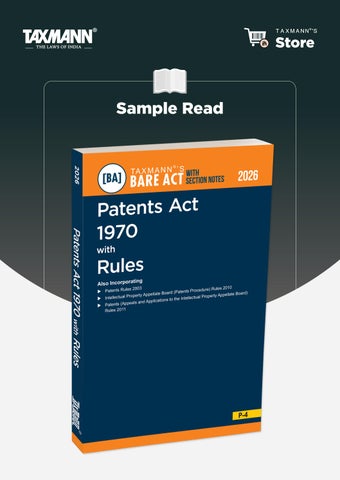
Patents Act 1970 with Rules – Bare Act with Section Notes AUTHOR : PUBLISHER : DATE OF PUBLICATION : EDITION : ISBN NO : No. of Pages : BINDING TYPE :
Taxmann’s Editorial Board Taxmann December 2025 2026 Edition 9789371266185 300 Paperback
Rs. 355 DESCRIPTION Patents Act 1970 with Rules [Bare Act with Section Notes] by Taxmann is a comprehensive and up-to-date presentation of India’s principal legislation governing patents and patent administration. This publication reproduces the complete text of the Act along with the applicable Patents Rules, as amended from time to time. It combines the precision of a Bare Act with the practical utility of concise section-wise notes, enabling readers to understand both the statutory framework and its practical application. The section notes highlight important judicial interpretations, legislative intent, procedural aspects, and key practical implications across the patent lifecycle, including patentability, examination, opposition, infringement, compulsory licensing, and enforcement. This book is intended for the following audience: • Legal Practitioners and Patent Agents • Corporate Counsel and R&D Professionals • Students and Academicians • Start-ups, Innovators, and Technology Enterprises The Present Publication is the 2026 Edition, covering the amended and updated text of the Patents Act [Act No. 39 of 1970] and Rules, with the following noteworthy features: • [Complete Statutory Text] Consolidated presentation of the Patents Act, 1970 and the corresponding Patents Rules • [Updated Content] Incorporates all relevant legislative amendments, notifications, and procedural changes • [Pre-amendment Provisions] Includes prior versions of amended provisions in amendment footnotes for historical and transitional reference • [Section Notes] Concise explanatory notes following each section, highlighting key amendments, judicial interpretations, and practical considerations • [User-friendly Layout] Clear structuring of sections, sub-sections, clauses, explanations, and provisos for ease of reference • [Reference Tools] Detailed subject index with references to important forms and schedules for efficient legal research
Buy Now