
Sample Read
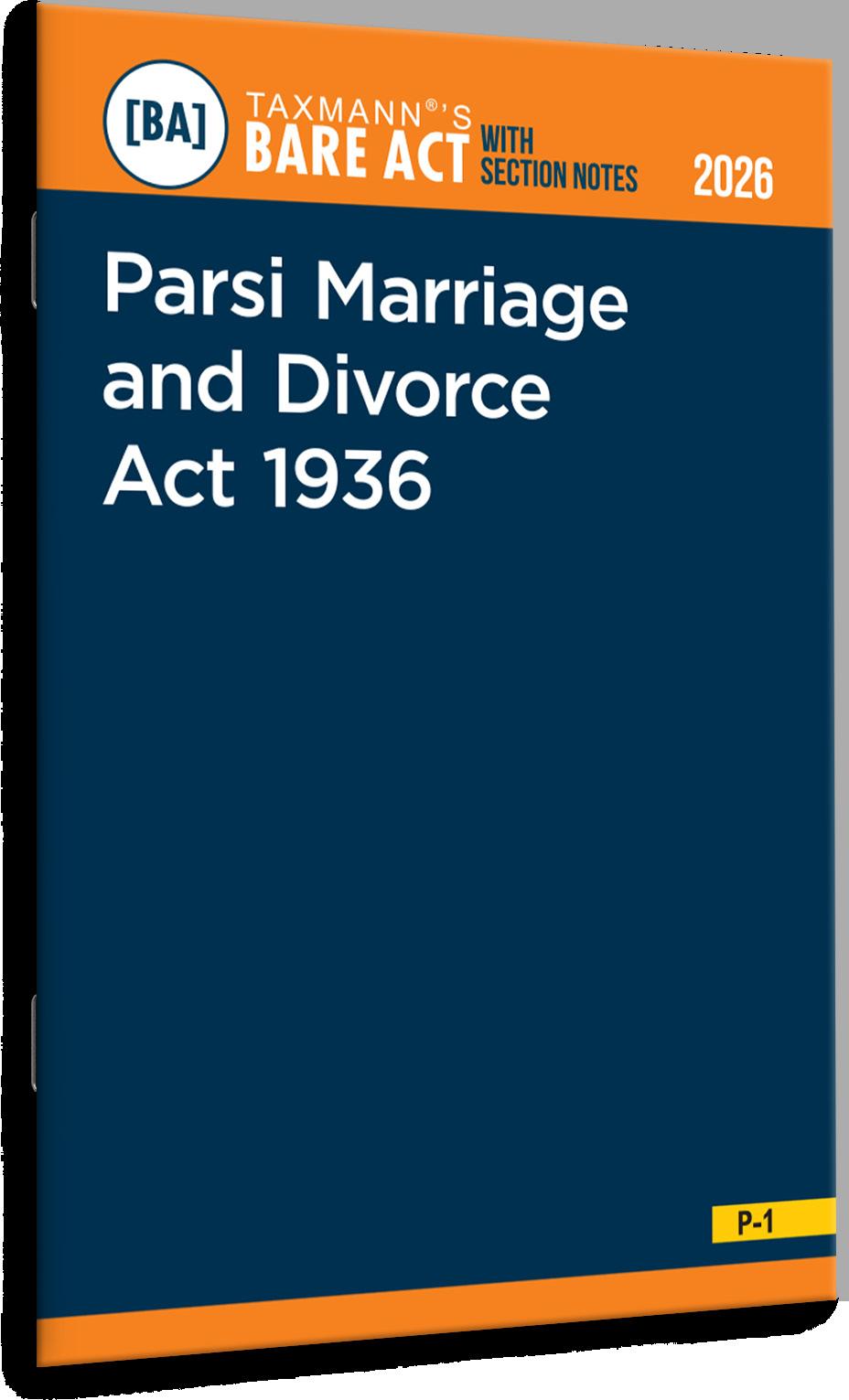

PARSI


MARRIAGE AND DIVORCE ACT, 1936
1. Short title, extent and commencement 1 2. Definitions 2
BETWEEN PARSIS
3. Requisites to validity of Parsi marriages 3
4. Remarriage when unlawful 4
5. Punishment of bigamy 5
6. Certificate and registry of marriage 6
7. Appointment of Registrar 7
8. Marriage register to be open for public inspection 7
9. Copy of certificate to sent to Registrar-General of Births, Deaths and Marriages 7
10. Registration of divorces 7
11. Penalty for solemnizing marriage contrary to section 4 7
12. Penalty for priest’s neglect of requirements of section 6 8
13. Penalty for omitting to subscribe and attest certificate 8
14. Penalty for making, etc., false certificate 8
39.
40.
43.
44.
45.
46.
47.
48.
CHAPTER V

Parsi Marriage and Divorce Act, 1936
[3 OF 1936]
An Act to amend the law relating to marriage and divorce among Parsis. WHEREAS it is expedient to amend the law relating to marriage and divorce among Parsis; It is hereby enacted as follows:
CHAPTER I PRELIMINARY
Short title, extent and commencement.
1. (1) This Act may be called the Parsi Marriage and Divorce Act, 19361 (2) 2[It extends to the whole of India except the State of Jammu and Kashmir*]:
Provided that the Central Government may, in respect of 3[territories which, immediately before the 1st November, 1956, were comprised in Part B States] by notification in the Official Gazette, direct that the provisions of this Act relating to the constitution and powers of Parsi Matrimonial Courts and to appeals from the decisions and orders of such Courts shall apply with such modifications as may be specified in the notification:
4[Provided further that nothing contained in this Act shall apply to the Renoncants of the Union territory of Pondicherry.]
1.Dated 23-4-1936.
This Act has been extended to— (i)Berar by the Berar Laws Act, 1941, w.e.f. 1-8-1941, and (ii)Dadra or Nagar Haveli by the Dadra and Nagar Haveli (Laws) Regulations, 1963, w.e.f. 1-7-1965.
2.Substituted for “It extends to the whole of India except Part B States and, in respect of Parsi citizens of India, to the whole of India” by the Part B States (Laws) Act, 1951, w.e.f. 1-4-1951.
3. Substituted for “Part B States” by the Adaptation of Laws (No. 3) Order, 1956, w.e.f. 1-11-1956.
4.Inserted by the Pondicherry (Extension of Laws) Act, 1968, w.e.f. 24-5-1968.
*Vide the Jammu and Kashmir Reorganisation (Removal of Difficulties) Order, 2019, w.e.f. 30-10-2019, this Act is made applicable to the Union territory of Jammu and Kashmir and the Union territory of Ladakh.
S. 2 PARSI MARRIAGE AND DIVORCE ACT, 1936 2
(3) It shall come into force on such date5 as the 6[Central Government] may, by notification in the 7[Official Gazette], appoint.
COMMENTS
SECTION NOTES
1.1 Title and identification
The legislation is identified as the “Parsi Marriage and Divorce Act, 1936.”
The title specifies its focus on matrimonial matters concerning Parsis.
1.2 Applicability and extent
The Act applies across India.
Provisions exist for modifications through notifications by the Central Government for specific regions, particularly for areas previously categorized as Part B States prior to 1956.
1.2-1 Central Government’s Authority to alter provision
The government may, through notifications in the Official Gazette, adapt or modify the Act’s provisions related to:
Parsi Matrimonial Courts: Their constitution and jurisdiction. Appellate Procedures: Processes for appeals from the decisions of these courts.
1.2-2 Exemptions for renoncants
Renoncants, as a unique category of inhabitants in Pondicherry with historical French legal influences, are excluded from the application of this Act.
1.3 Commencement
The Act’s effective date is contingent on the issuance of a notification by the Central Government in the Official Gazette.
The notification mechanism ensures flexibility for the government to decide the appropriate commencement timeline based on practical and administrative considerations. Definitions.
2. In this Act, unless there is anything repugnant in the subject or context,
(1) “Chief Justice” includes senior Judge;
(2) “Court” means a Court constituted under this Act;
(3) to “desert” together with its grammatical variations and cognate expressions, means to desert the other party to a marriage without reasonable cause and without the consent, or against the will, of such party;
(4) “grievous hurt” means—
(a) emasculation;
(b) permanent privation of the sight of either eye;
(c) permanent privation of the hearing of either ear;
(d) privation of any member or joint;
5. With effect from 22-6-1936.
6. Substituted for “Governor-General in Council” by the Government of India (Adaptation of Indian Laws) Order, 1937.
7. Substituted for “Gazette of India,” ibid.
3
PARSI
MARRIAGE
AND DIVORCE ACT, 1936 S. 3
(e) destruction or permanent impairing of the powers of any member or joint;
(f) permanent disfiguration of the head or face; or (g) any hurt which endangers life;
(5) “husband” means a Parsi husband;
(6) “marriage” means a marriage between Parsis whether contracted before or after the commencement of this Act;
(7) a “Parsi” means a Parsi Zoroastrian;
(8) “priest” means a Parsi priest and includes Dastur and Mobed; and
(9) “wife” means a Parsi wife.
COMMENTS
SECTION NOTES
2.1 Desert [Section 2(3)]
Defined comprehensively to include: Abandonment of the spouse without reasonable cause. Without consent or against the will of the other party. Incorporates all grammatical variations and cognate expressions, ensuring the term is interpreted inclusively.
2.2 Grievous hurt [Section 2(4)]
Elaborates on injuries considered grievous for legal purposes: Permanent impairments or loss of key bodily functions (e.g., sight, hearing, joint functionality).
Severe physical harm with long-term disfiguration (e.g., of the head or face) or life-threatening injuries.
2.3 Marriage [Section 2(6)]
Marriage under this Act refers to marriages between Parsis, irrespective of whether the marriage took place before or after the commencement of the Act.
2.4 Priest [Section 2(8)]
Refers to a Parsi priest, including titles such as: Dastur and Mobed.
CHAPTER II
MARRIAGES BETWEEN PARSIS
Requisites to validity of Parsi marriages.
3. 8[(1)] No marriage shall be valid if
(a) the contracting parties are related to each other in any of the degrees of consanguinity or affinity set forth in Schedule I; or
8. Section 3 renumbered as sub-section (1) thereof by the Parsi Marriage and Divorce (Amendment) Act, 1988, w.e.f. 15-4-1988.
S. 4
PARSI MARRIAGE AND DIVORCE ACT, 1936 4
(b) such marriage is not solemnized according to the Parsi form of ceremony called “Ashirvad” by a priest in the presence of two Parsi witnesses other than such priest; or
9[(c) in the case of any Parsi (whether such Parsi has changed his or her religion or domicile or not) who, if a male, has not completed twenty-one years of age, and if a female, has not completed eighteen years of age.]
10[(2) Notwithstanding that a marriage is invalid under any of the provisions of sub-section (1), any child of such marriage who would have been legitimate if the marriage had been valid, shall be legitimate.]
COMMENTS
SECTION NOTES
3.1 Prohibition of certain relationships
Marriages are invalid if the contracting parties are : related to each other within the prohibited degrees of consanguinity or affinity as outlined in Schedule I.
3.1 Mandatory religious ceremony
The marriage must be solemnized in accordance with the Parsi ceremony of Ashirvad, conducted by a Parsi priest.
The presence of two Parsi witnesses, in addition to the priest, is essential for validity.
3.3 Minimum age requirements
A marriage is invalid if:
The male is under 21 years of age.
The female is under 18 years of age.
3.4 Legitimacy of children from invalid marriages
Children born from marriages deemed invalid under sub-section (1). Remarriage when unlawful.
4. (1) No Parsi (whether such Parsi has changed his or her religion or domicile or not) shall contract any marriage under this Act or any other law in the lifetime of his or her wife or husband, whether a Parsi or not, except after his or her lawful divorce from such wife or husband or after his or her marriage with such wife or husband has lawfully been declared null and void or dissolved, and, if the marriage was contracted with such wife or husband under the Parsi Marriage and Divorce Act 186511 (15 of 1865), or under this Act, except after a divorce, declaration or dissolution as aforesaid under either of the said Acts.
(2) Every marriage contracted contrary to the provisions of sub-section (1) shall be void.
9. Substituted by the Parsi Marriage and Divorce (Amendment) Act, 1988, w.e.f. 15-4-1988.
10. Inserted, ibid.
11. Repealed by the Parsi Marriage and Divorce Act, 1936, w.e.f. 23-4-1936.
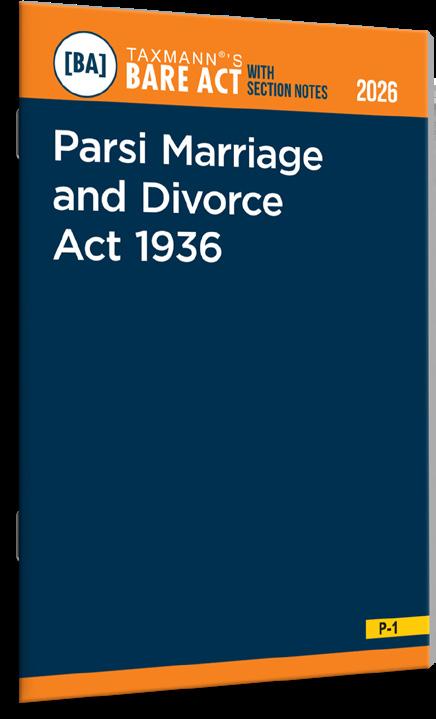
Parsi Marriage and Divorce Act 1936 – Bare Act with Section Notes
AUTHOR : Taxmann’s Editorial Board
PUBLISHER : Taxmann
DATE OF PUBLICATION : December 2025
EDITION : 2026 Edition
ISBN NO : 9789371264334
No. of Pages : 48
BINDING TYPE : Paperback
DESCRIPTION
Parsi Marriage and Divorce Act 1936 [Bare Act with Section Notes] by Taxmann is an authoritative statutory guide on matrimonial law applicable to Parsis in India. Updated for the 2026 Edition, this publication presents the complete and amended text of the Act, supplemented with clear section-wise notes, expert editorial explanations, and selective references to leading judicial decisions. It is designed to facilitate practical understanding and application of the legal framework governing Parsi marriages, divorce, judicial separation, maintenance, child custody, and related matrimonial reliefs. This book is intended for the following audience:
• Legal Practitioners, Judges & Law Firms
• Members of the Parsi Community
• Academics, Law Students & Researchers
• Courts, Quasi-Judicial Authorities & Mediators
• Corporate Legal Departments & Compliance Professionals
The Present Publication is the 2026 Edition, covering the amended and updated text of the Parsi Marriage and Divorce Act [Act No. 3 of 1936], with the following noteworthy features:
• [Full | Updated Text of the Act] Complete statutory text incorporating all amendments in force
• [Pre-amendment Provisions] Earlier versions of amended sections are reproduced through amendment footnotes for transitional understanding
• [Section-wise Expert Notes] Concise and practical notes explaining legislative intent, scope, and interpretation
• [Coverage of Allied Provisions] Includes prescribed forms, registers, and Schedules, including the Table of Prohibited Degrees and marriage certificate formats
• [Judicial Interpretation & Case Law References] Select Supreme Court and High Court rulings with focused explanatory summaries
• [Judicial Procedure Clarity] Detailed explanation of Parsi Matrimonial Courts, jurisdiction, delegates, trial process, and appellate remedies
• [Alimony, Maintenance & Custody] Covers pendente lite and permanent alimony, modification of orders, custody of children, and property settlement
• [Compliance, Offences & Penalties] Highlights statutory offences, penalties, and procedural safeguards
• [User-friendly Index & Structure] Chapter-wise layout with a detailed subject index for quick reference
• [Legal Authenticity & Practical Utility] A dependable statutory reference integrating amendments, judicial guidance, and practice-oriented notes