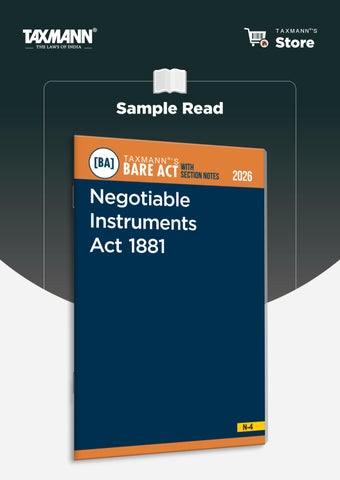
Sample Read
Contents NEGOTIABLE INSTRUMENTS ACT, 1881 PAGE
CHAPTER I PRELIMINARY
1. Short title
1
2. [Repealed by the Amending Act, 1891 (12 of 1891)]
2
3. Interpretation clause
2 CHAPTER II
OF NOTES, BILLS AND CHEQUES
4. “Promissory note”
2
5. “Bill of exchange”
4
6. “Cheque”
5
7. “Drawer”, “drawee”
7
8. “Holder”
8
9. “Holder in due course”
8
10. “Payment in due course”
9
11. “Inland instrument”
9
12. “Foreign instrument”
10
13. “Negotiable instrument”
10
14. Negotiation
11
15. Endorsement
11
16. Endorsement “in blank” and “in full”
12
I-5
CONTENTS
I-6 PAGE
17. Ambiguous instruments
12
18. Where amount is stated differently in figures and words
12
19. Instruments payable on demand
12
20. Inchoate stamped instruments
12
21. “At sight”, “On presentment”, “After sight”
13
22. “Maturity”
13
23. Calculating maturity of bill or note payable so many months after date or sight
13
24. Calculating maturity of bill or note payable so many days after date or sight
14
25. When day of maturity is a holiday
14
CHAPTER III PARTIES TO NOTES, BILLS AND CHEQUES
26. Capacity to make, etc., promissory notes, etc.
14
27. Agency
14
28. Liability of agent signing
14
29. Liability of legal representative signing
15
30. Liability of drawer
15
31. Liability of drawee of cheque
15
32. Liability of maker of note and acceptor of bill
15
33. Only drawee can be acceptor except in need or for honour
16
34. Acceptance by several drawees not partners
16
35. Liability of endorser
16
36. Liability of prior parties to holder in due course
17
37. Maker, drawer and acceptor principals
17
38. Prior party a principal in respect of each subsequent party
17
39. Suretyship
18
40. Discharge of indorser’s liability
18
41. Acceptor bound, although endorsement forged
18
42. Acceptance of bill drawn in fictitious name
18
43. Negotiable instrument made, etc. without consideration
18
44. Partial absence or failure of money-consideration
19
45. Partial failure of consideration not consisting of money
20
45A. Holder’s right to duplicate of lost bill
20
I-7
CONTENTS PAGE
CHAPTER IV OF NEGOTIATION
46. Delivery
21
47. Negotiation by delivery
21
48. Negotiation by endorsement
21
49. Conversion of endorsement in blank into endorsement in full
22
50. Effect of endorsement
22
51. Who may negotiate
22
52. Endorser who excludes his own liability or makes it conditional
22
53. Holder deriving title from holder in due course
23
54. Instrument endorsed in blank
23
55. Conversion of endorsement in blank into endorsement in full
23
56. Endorsement for part of sum due
23
57. Legal representative cannot by delivery only negotiate instrument endorsed by deceased
23
58. Instrument obtained by unlawful means or for unlawful consideration
23
59. Instrument acquired after dishonour or when overdue
24
60. Instrument negotiable till payment or satisfaction
24
CHAPTER V OF PRESENTMENT
61. Presentment for acceptance
24
62. Presentment of promissory note for sight
24
63. Drawee’s time for deliberation
25
64. Presentment for payment
25
65. Hours for presentment
25
66. Presentment for payment of instrument payable after date or sight
25
67. Presentment for payment of promissory note payable by instalments
25
68. Presentment for payment of instrument payable at specified place and not elsewhere
25
69. Instrument payable at specified place
26
70. Presentment where no exclusive place specified
26
CONTENTS
I-8 PAGE
71. Presentment when maker, etc., has no known place of business or residence
26
72. Presentment of cheque to charge drawer
26
73. Presentment of cheque to charge any other person
26
74. Presentment of instrument payable on demand
26
75. Presentment by or to agent, representative of deceased, or assignee of insolvent
26
75A. Excuse for delay in presentment for acceptance or payment
26
76. When presentment unnecessary
27
77. Liability of banker for negligently dealing with bill presented for payment
27
CHAPTER VI OF PAYMENT AND INTEREST
78. To whom payment should be made
27
79. Interest when rate specified
27
80. Interest when no rate specified
28
81. Delivery of instrument on payment, or indemnity in case of loss
28
CHAPTER VII OF DISCHARGE FROM LIABILITY ON NOTES, BILLS AND CHEQUES
82. Discharge from liability
28
83. Discharge by allowing drawee more than forty-eight hours to accept
29
84. When cheque not duly presented and drawer damaged thereby
29
85. Cheque payable to order
30
85A. Drafts drawn by one branch of a bank on another payable to order
30
86. Parties not consenting discharged by qualified or limited acceptance
31
87. Effect of material alteration
31
88. Acceptor or endorser bound notwithstanding previous alteration
31
89. Payment of instrument on which alteration is not apparent
31
90. Extinguishment of rights of action on bill in acceptor’s hands
32
I-9
CONTENTS PAGE
CHAPTER VIII OF NOTICE OF DISHONOUR
91. Dishonour by non-acceptance
32
92. Dishonour by non-payment
32
93. By and to whom notice should be given
32
94. Mode in which notice may be given
32
95. Party receiving must transmit notice of dishonour
33
96. Agent for presentment
33
97. When party to whom notice given is dead
33
98. When notice of dishonour is unnecessary
33
CHAPTER IX OF NOTING AND PROTEST
99. Noting
33
100. Protest
34
101. Contents of protest
34
102. Notice of protest
34
103. Protest for non-payment after dishonour by nonacceptance
35
104. Protest of foreign bills
35
104A. When noting equivalent to protest
35
CHAPTER X OF REASONABLE TIME
105. Reasonable time
35
106. Reasonable time of giving notice of dishonour
35
107. Reasonable time for transmitting such notice
35
CHAPTER XI OF ACCEPTANCE AND PAYMENT FOR HONOUR AND REFERENCE IN CASE OF NEED
108. Acceptance for honour
36
109. How acceptance for honour must be made
36
110. Acceptance not specifying for whose honour it is made
36
111. Liability of acceptor for honour
36
CONTENTS
I-10 PAGE
112. When acceptor for honour may be charged
36
113. Payment for honour
36
114. Right of payer for honour
37
115. Drawee in case of need
37
116. Acceptance and payment without protest
37
CHAPTER XII OF COMPENSATION
117. Rules as to compensation
37
CHAPTER XIII SPECIAL RULES OF EVIDENCE
118. Presumptions as to negotiable instruments
38
119. Presumption on proof of protest
39
120. Estoppel against denying original validity of instrument
39
121. Estoppel against denying capacity of payee to endorse
39
122. Estoppel against denying signature or capacity of prior party
39
CHAPTER XIV OF CROSSED CHEQUES
123. Cheque crossed generally
39
124. Cheque crossed specially
39
125. Crossing after issue
40
126. Payment of cheque crossed generally
40
127. Payment of cheque crossed specially more than once
40
128. Payment in due course of crossed cheque
40
129. Payment of crossed cheque out of due course
40
130. Cheque bearing “not negotiable”
40
131. Non-liability of banker receiving payment of cheque
40
131A. Application of chapter to drafts
41
CHAPTER XV OF BILLS IN SETS
132. Set of bills
41
133. Holder of first acquired part entitled to all
41
I-11
CONTENTS PAGE
CHAPTER XVI OF INTERNATIONAL LAW
134. Law governing liability of maker, acceptor or endorser of foreign instrument
41
135. Law of place of payment governs dishonour
42
136. Instrument made, etc., out of India, but in accordance with the law of India
42
137. Presumption as to foreign law
42
CHAPTER XVII OF PENALTIES IN CASE OF DISHONOUR OF CERTAIN CHEQUES FOR INSUFFICIENCY OF FUNDS IN THE ACCOUNTS
138. Dishonour of cheque for insufficiency, etc., of funds in the account
42
139. Presumption in favour of holder
48
140. Defence which may not be allowed in any prosecution under section 138
48
141. Offences by companies
48
142. Cognizance of offences
49
142A. Validation for transfer of pending cases
50
143. Power of Court to try cases summarily
50
143A. Power to direct interim compensation
51
144. Mode of service of summons
52
145. Evidence on affidavit
53
146. Bank’s slip prima facie evidence of certain facts
53
147. Offences to be compoundable
53
148. Power of Appellate Court to order payment pending appeal against conviction
53
SCHEDULE
54
SUBJECT INDEX
55
Negotiable Instruments Act, 1881 [26 OF 1881]* An Act to define and amend the law relating to Promissory Notes, Bills of Exchange and Cheques. Preamble. WHEREAS it is expedient to define and amend the law relating to promissory notes,
bills of exchange and cheques; It is hereby enacted as follows:— CHAPTER I PRELIMINARY Short title. 1. This Act may be called the Negotiable Instruments Act, 1881. Local extent, saving of usages relating to hundis, etc. It extends to 1[the whole of India 2[***]]; but nothing herein contained affects the Indian Paper Currency Act, 1871 (3 of 1871), section 21, or affects any local usage relating to any instrument in an oriental language: Provided that such usages may be excluded by any words in the body of the instrument, which indicate an intention that the legal relations of the parties thereto shall be governed by this Act; Commencement: and it shall come into force on the first day of March, 1882. COMMENTS SECTION NOTES
1.1 Negotiable instruments
This Act applies to all Negotiable instruments, whether payable to bearer to order.
*Dated 9-12-1881 1. Substituted for “all the Provinces of India” by the Adaptation of Laws Order, 1950, w.e.f. 26-1-1950. 2. Words “except the State of Jammu and Kashmir” omitted by the Jammu and Kashmir (Extension of Laws) Act, 1956, w.e.f. 1-11-1956.
1
S. 4
NEGOTIABLE INSTRUMENTS ACT, 1881
2
The scope of the term “negotiable instruments” covers Promissory Note, Bill of Exchange and Cheque.
See Sections 13, 4, 5 and 6 of this Act.
1.2 Applicability of this Act to hundis to which local usages apply
The provisions of this Act do not affect any local usage relating to any instrument in an oriental language.
Such usage shall apply unless such usage is excluded by any words in the body of the instrument which indicate an intention that the legal relations of the parties thereto shall be governed by this Act.
Repeal of enactments. 2. [Repealed by the Amending Act, 1891 (12 of 1891).] Interpretation clause. 3. In this Act— 3 [***] “Banker”: 4[“banker” includes any person acting as a banker and any post office savings bank]. 5
[***] COMMENTS
SECTION NOTES
The term ‘Negotiable Instrument’ is not defined in this section but in section 13(1)
-ANY TERMS USED IN THIS !CT ARE DEFINED IN SECTIONS TO
CHAPTER II OF NOTES, BILLS AND CHEQUES “Promissory note”. 4. A “promissory note” is an instrument in writing (not being a bank-note or a currency-note) containing an unconditional undertaking signed by the maker, to pay a certain sum of money only to, or to the order of, a certain person, or to the bearer of the instrument. Illustrations A signs instruments in the following terms: (a) “I promise to pay B or order Rs. 500”. (b) “I acknowledge myself to be indebted to B in Rs. 1, 000, to be paid on demand, for value received.” (c) “Mr B, I.O.U Rs. 1,000.” 3. Omitted by the Jammu and Kashmir (Extension of Laws) Act, 1956, w.e.f. 1-11-1956. 4. Substituted for “banker” by the Negotiable Instruments (Amendment) Act, 1955, w.e.f. 1-4-1956. 5. Omitted by the Notaries Act, 1952, w.e.f. 14-2-1956.
3
NEGOTIABLE INSTRUMENTS ACT, 1881
S. 4
(d) “I promise to pay B Rs. 500 and all other sums which shall be due to him.” (e) “I promise to pay B Rs. 500 first deducting thereout any money which he may owe me.” (f) “I promise to pay B Rs. 500 seven days after my marriage with C.” (g) “I promise to pay B Rs. 500 on D’s death, provided D leaves me enough to pay that sum.” (h) “I promise to pay B Rs. 500 and to deliver to him my black horse on 1st January next.” The instruments respectively marked (a) and (b) are promissory notes. The instruments respectively marked (c), (d), (e), (f), (g) and (h) are not promissory notes. COMMENTS SECTION NOTES
4.1 Ingredients of a “promissory note” The following are the essential ingredients of a “promissory note” as per section 4 : (a) It is an instrument in writing. (b) It is signed by the maker of the instrument. (c) It contains an undertaking (promise). (d) Such undertaking is unconditional. (e) Such undertaking is to pay a certain sum of money only. (f) Such undertaking is to pay to, or to the order of, a certain person, or to the bearer of the instrument [See Section 13 for definitions of ‘payable to bearer’ and ‘payable to order’] (g) Bank-notes and currency notes are not promissory notes. See also Section 17. 4.2 Unconditional undertaking/promise
A promise will be treated as unconditional if the time for payment is expressed to be on the lapse of a certain period after the occurrence of a specified event which is certain to occur but its time of occurrence is uncertain (An example of such an event which is certain but timing is uncertain is the death of a certain individual) [See 2nd Para of Section 5]
A mere acknowledgement of indebtedness is not a promise/undertaking to pay [See Illustration (c) of this section]
4.3 Certain sum of money
The sum payable may be “certain” although it includes future interest or is payable at an indicated rate of exchange, or is according to the course of exchange, and although the instrument provides that, on default of payment of an instalment, the balance unpaid shall become due. [See 3rd Para of Section 5]
See Illustrations (d) through (h) of this section [See Paras 4.6.2 to 4.6.6 below]
See also section 18
Negotiable Instruments Act 1881 – Bare Act with Section Notes AUTHOR : : PUBLISHER DATE OF PUBLICATION : : EDITION ISBN NO : : No. of Pages BINDING TYPE :
Taxmann’s Editorial Board Taxmann December 2025 2026 Edition 9789371263535 72 Paperback
Rs. 95 DESCRIPTION Negotiable Instruments Act 1881 [Bare Act with Section Notes] by Taxmann is an updated and authoritative statutory publication that presents the complete text of the Act, along with concise, section-wise explanatory notes. The book is designed as a reliable reference on the law governing negotiable instruments in India, including promissory notes, bills of exchange, and cheques. The publication reproduces the entire statutory text as in force, incorporating all amendments and legislative developments up to date. Each provision is immediately followed by section notes highlighting the scope of the section, key interpretations, underlying legal principles, and practical nuances. With statutory definitions, illustrations, explanations, and cross-references, this Bare Act serves both as a legislative text and a practical working guide for interpretation and application. This book is intended for the following audience: •
Legal Practitioners & Judges
•
Corporate & Finance Professionals
•
Academicians & Law Students
•
Business Owners & Entrepreneurs
The Present Publication is the 2026 Edition, covering the amended and updated text of the Negotiable Instruments Act [Act No. 26 of 1881], with the following noteworthy features: •
[Authoritative Text] Presents the verbatim statutory language of the Negotiable Instruments Act 1881, as amended up to date
•
[Section Notes] Provides succinct notes following each section to clarify legal concepts, definitions, procedural requirements, and interpretative aspects
•
[Updated Provisions] Incorporates all significant amendments up to date, including provisions on cheque dishonour, electronic and truncated cheques, digital signatures, interim compensation, summary trials, appellate deposits, and jurisdiction
•
[Pre-amendment Provisions] Includes pre-amendment texts in the respective amendment footnotes to enable understanding of the earlier legal position and its applicability
•
[Subject Index] Contains a comprehensive subject index for quick and efficient navigation
•
[User-friendly Layout] Features a clean, structured format with clear headings and logical sequencing for ease of reading and cross-referencing
Buy Now