Sample Read
Contents MUSLIM WOMEN (PROTECTION OF RIGHTS ON DIVORCE) ACT, 1986 PAGE
1. Short title and extent
1
2. Definitions
1
3. Mahr or other properties of Muslim woman to be given to her at the time of divorce
2
4. Order for payment of maintenance
8
5. Option to be governed by the provisions of sections 125 to 128 of Act 2 of 1974
10
6. Power to make rules
10
7. Transitional provisions
11
SUBJECT INDEX
13
DISSOLUTION OF MUSLIM MARRIAGES ACT, 1939 1. Short title and extent
15
2. Grounds for decree for dissolution of marriage
16
3. Notice to be served on heirs of the husband when the husband’s whereabouts are not known
21
4. Effect of conversion to another faith
21
5. Rights to dower not to be affected
22
6. [Repealed by the Repealing and Amending Act, 1942]
22
I-5
CONTENTS
I-6 PAGE
MUSLIM PERSONAL LAW (SHARIAT) APPLICATION ACT, 1937 1. Short title and extent
23
2. Application of Personal Law to Muslims
24
3. Power to make a declaration
27
4. Rule-making power
28
5. [Repealed by the Dissolution of Muslim Marriages Act, 1939, w.e.f. 17-3-1939]
29
6. Repeals
29
SUBJECT INDEX
31
CUTCHI MEMONS ACT, 1938 1. Short title and commencement
33
2. Cutchi Memons to be governed in certain matters by Muhammadan Law
33
3. Savings
34
4.
[Repealed by the Repealing and Amending Act, 1942]
SUBJECT INDEX
34 35
KAZIS ACT, 1880 1. Short title
37
2. Power to appoint Kazis for any local area
38
3. Naib Kazis
39
4. Nothing in Act to confer judicial or administrative powers; or to render the presence of Kazi necessary; or to prevent any one acting as Kazi
40
SUBJECT INDEX
43
MUSLIM WOMEN (PROTECTION OF RIGHTS ON MARRIAGE) ACT, 2019 CHAPTER I PRELIMINARY 1. Short title, extent and commencement 2. Definitions
45 46
I-7
CONTENTS PAGE
CHAPTER II DECLARATION OF TALAQ TO BE VOID AND ILLEGAL 3. Talaq to be void and illegal 4. Punishment for pronouncing talaq
46 47
CHAPTER III PROTECTION OF RIGHTS OF MARRIED MUSLIM WOMEN 5. Subsistence allowance
49
6. Custody of minor children
50
7. Offence to be cognizable, compoundable, etc.
50
8. Repeal and savings
52
SUBJECT INDEX
53
MUSLIM WOMEN (PROTECTION OF RIGHTS ON DIVORCE) RULES, 1986 1. Short title and commencement
55
2. Definitions
55
3. Service of summons
55
4. Evidence
56
5. Power to postpone or adjourn proceedings
56
6. Costs
57
7. Affidavit under section 5
57
8. Declaration under section 5
57
FORM A: Form of Affidavit
57
FORM B: Form of Declaration
57
Muslim Women (Protection of Rights on Divorce) Act, 1986 [25 OF 1986]1 An Act to protect the rights of Muslim women who have been divorced by, or have obtained divorce from, their husbands and to provide for matters connected therewith or incidental thereto. BE it enacted by Parliament in the Thirty-seventh Year of the Republic of India as follows:— Short title and extent 1. (1) This Act may be called the Muslim Women (Protection of Rights on Divorce) Act, 1986. (2) It extends to the whole of India 2[***]. COMMENTS SECTION NOTES
1.1 Short Title
The Act is formally titled “The Muslim Women (Protection of Rights on Divorce) Act, 1986.”
This title signifies its specific purpose, which is the protection of rights for Muslim women following a divorce.
1.2 Extent
The Act applies to the entire territory of India.
Definitions 2. In this Act, unless the context otherwise requires,— (a) “divorced woman” means a Muslim woman who was married according to Muslim law, and has been divorced by, or has obtained divorce from, her husband in accordance with Muslim law; (b) “iddat period” means, in the case of a divorced woman,— 1. Dated 19-5-1986. 2. Words “except the State of Jammu and Kashmir” omitted by the Jammu and Kashmir Reorganisation Act, 2019, w.e.f. 31-10-2019.
1
S. 3
MUSLIM WOMEN ACT, 1986
2
(i) three menstrual courses after the date of divorce, if she is subject to menstruation, (ii) three lunar months after her divorce, if she is not subject to menstruation; and (iii) if she is enceinte at the time of her divorce, the period between the divorce and the delivery of her child or the termination of her pregnancy, whichever is earlier; (c) “Magistrate” means a Magistrate of the First Class exercising jurisdiction under the Code of Criminal Procedure, 1973 (2 of 1974), in the area where the divorced woman resides; (d) “prescribed” means prescribed by rules made under this Act. COMMENTS SECTION NOTES
2.1 Divorced Woman [Section 2(a)] 2.1-1 Essential Elements:
Refers specifically to a Muslim woman.
2.1-2 Modes of Divorce:
Includes situations where the husband has divorced the woman.
2.2 Iddat Period [Section 2(b)] 2.2-1 Significance of Iddat:
A transitional period required under Muslim law before a divorced woman can remarry.
2.2-2 Defined Periods:
Three menstrual cycles are required to confirm the absence of pregnancy.
For women past menopause or not subject to menstruation, the iddat period is fixed at three lunar months.
Pregnant Women: Ends upon delivery or termination of pregnancy, whichever occurs first.
Mahr or other properties of Muslim woman to be given to her at the time of divorce 3. (1) Notwithstanding anything contained in any other law for the time being in force, a divorced woman shall be entitled to— (a) a reasonable and fair provision and maintenance to be made and paid to her within the iddat period by her former husband; (b) where she herself maintains the children born to her before or after her divorce, a reasonable and fair provision and maintenance to be made and paid by her former husband for a period of two years from the respective dates of birth of such children;
3
MUSLIM WOMEN ACT, 1986
S. 3
(c) an amount equal to the sum of mahr or dower agreed to be paid to her at the time of her marriage or at any time thereafter according to Muslim law; and (d) all the properties given to her before or at the time of marriage or after her marriage by her relatives or friends or the husband or any relatives of the husband or his friends. (2) Where a reasonable and fair provision and maintenance or the amount of mahr or dower due has not been made or paid or the properties referred to in clause (d) of sub-section (1) have not been delivered to a divorced woman on her divorce, she or any one duly authorised by her may, on her behalf, make an application to Magistrate for an order for payment of such provision and maintenance, mahr or dower or the delivery of properties, as the case may be. (3) Where an application has been made under sub-section (2) by a divorced woman, the Magistrate may, if he is satisfied that— (a) her husband having sufficient means, has failed or neglected to make or pay her within the iddat period a reasonable and fair provision and maintenance for her and the children; or (b) the amount equal to the sum of mahr or dower has not been paid or that the properties referred to in clause (d) of sub-section (1) have not been delivered to her, make an order, within one month of the date of the filing of the application, directing her former husband to pay such reasonable and fair provision and maintenance to the divorced woman as he may determine as fit and proper having regard to the needs of the divorced woman, the standard of life enjoyed by her during her marriage and the means of her former husband or, as the case may be, for the payment of such mahr or dower or the delivery of such properties referred to in clause (d) of sub-section (1) to the divorced woman: Provided that if the Magistrate finds it impracticable to dispose of the application within the said period, he may, for reasons to be recorded by him, dispose of the application after the said period. (4) If any person against whom an order has been made under sub-section (3) fails without sufficient cause to comply with the order, the Magistrate may issue a warrant for levying the amount of maintenance or mahr or dower due in the manner provided for levying fines under the Code of Criminal Procedure, 1973 (2 of 1974)3, and may sentence such person, for the whole or part of any amount remaining unpaid after the execution of the warrant, to imprisonment for a term which may extend to one year or until payment if sooner made, subject to such person being heard in defence and the said sentence being imposed according to the provisions of the said Code.
3. Now the Bharatiya Nagarik Suraksha Sanhita, 2023 (46 of 2023) [Vide Notification No. S.O. 2790(E), dated 16-7-2024]
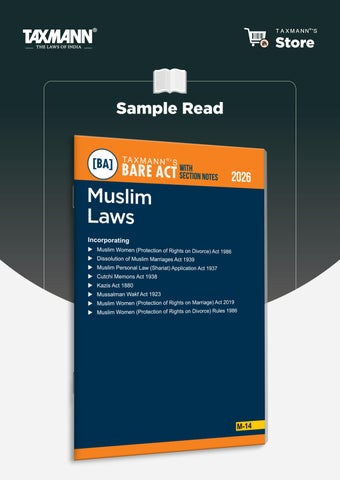
Muslim Laws – Bare Act with Section Notes AUTHOR : : PUBLISHER DATE OF PUBLICATION : : EDITION ISBN NO : : No. of Pages BINDING TYPE :
Taxmann’s Editorial Board Taxmann December 2025 2026 Edition 9789371266833 68 Paperback
Rs. 145 DESCRIPTION Muslim Laws [Bare Act with Section Notes] by Taxmann is a consolidated statutory compilation bringing together the principal enactments governing Muslim personal law in India. This authoritative volume reproduces the complete and updated text of key Central Acts and Rules, supplemented with concise section-wise notes to explain legislative intent, scope, and practical operation—while preserving the essential character of a Bare Act. The book provides a unified statutory framework covering marriage, divorce, maintenance, dower (mahr), succession, wakfs, and the role of Kazis, along with contemporary legislative protections introduced for Muslim women. The section notes are designed to aid clarity and application without assuming the character of a full-fledged commentary. This Edition incorporates the following Central enactments and allied rules: Muslim Women (Protection of Rights on Divorce) Act 1986 – Act No. 25 of 1986 • • Dissolution of Muslim Marriages Act 1939 – Act No. 8 of 1939 • Muslim Personal Law (Shariat) Application Act 1937 – Act No. 26 of 1937 • Cutchi Memons Act 1938 – Act No. 10 of 1938 • Kazis Act 1880 – Act No. 12 of 1880 • Mussalman Wakf Act 1923 – Act No. 42 of 1923 • Muslim Women (Protection of Rights on Marriage) Act 2019 – Act No. 20 of 2019 • Muslim Women (Protection of Rights on Divorce) Rules 1986 By consolidating these enactments in a single, systematically organised volume, the book presents a clear and comprehensive picture of Muslim personal law as currently in force in India. This publication is intended for a wide spectrum of readers, including: • Legal Practitioners & Advocates • Judges & Judicial Officers • Academics, Researchers & Students NGOs & Social Welfare Organisations • • Regulatory Authorities & Government Officials • Mediators & Counsellors The Present Publication is the 2026 Edition, covering the amended and updated text of the Muslim Laws, with the following noteworthy features: [Complete Bare Act Texts] Verbatim reproduction of all principal statutes and allied rules • • [Pre-amendment References] Retention of relevant pre-amendment positions to aid understanding of legislative transitions [Comprehensive Rule Coverage] Inclusion of the Muslim Women (Protection of Rights on Divorce) Rules 1986 • • [Section-wise Notes & Explanatory Annotations] Brief, practitioner-oriented notes highlighting legislative intent, scope, inter-statutory linkages, and key judicial principles [Schedules, Amendments & Cross-References] Reproduction of applicable schedules and amendments with • editorial clarification [Statutory Forms & Templates] Prescribed forms under the 1986 Rules for affidavits, declarations, and procedural • compliance • [User-friendly Navigation] Detailed table of contents and comprehensive subject index
Buy Now