Sample Read
© All rights reserved
Price : ` 995
Law stated in this book is as updated till January, 2026
Published by :
Taxmann Publications (P.) Ltd.
Sales & Marketing :
59/32, New Rohtak Road, New Delhi-110 005 India
Phone : +91-11-45562222
Website : www.taxmann.com
E-mail : sales@taxmann.com
Regd. Office :
21/35, West Punjabi Bagh, New Delhi-110 026 India
Printed at :
Tan Prints (India) Pvt. Ltd.
44 Km. Mile Stone, National Highway, Rohtak Road Village Rohad, Distt. Jhajjar (Haryana) India
E-mail : sales@tanprints.com
Disclaimer
Every effort has been made to avoid errors or omissions in this publication. In spite of this, errors may creep in. Any mistake, error or discrepancy noted may be brought to our notice which shall be taken care of in the next edition. It is notified that neither the publisher nor the author or seller will be responsible for any damage or loss of action to any one, of any kind, in any manner, therefrom. It is suggested that to avoid any doubt the reader should cross-check all the facts, law and contents of the publication with original Government publication or notifications.
No part of this book may be reproduced or copied in any form or by any means [graphic, electronic or mechanical, including photocopying, recording, taping, or information retrieval systems] or reproduced on any disc, tape, perforated media or other information storage device, etc., without the written permission of the publishers. Breach of this condition is liable for legal action.
For binding mistake, misprints or for missing pages, etc., the publisher’s liability is limited to replacement within seven days of purchase by similar edition. All expenses in this connection are to be borne by the purchaser. All disputes are subject to Delhi jurisdiction only.
Foreword by Justice Deepak Verma I-5
Foreword by Justice M.M. Kumar (Retd.) I-7
Foreword by Ateesh Kumar Singh (Additional Secretary) I-9
About the Author I-11
From the Desk of Author I-13
SUPREME COURT OF INDIA
NBCC (India) Ltd. v. State of West Bengal & Ors. 1
M/s. Vaishno Enterprises v. Hamilton Medical AG & Anr. 18
Silpi Industries & Ors. v. Kerala State Road Transport Corporation & Anr. 26
M/s. Pro Knits v. The Board of Directors of Canara Bank & Ors. 42
Lifecare Innovations Pvt. Ltd. & Anr. v. Union of India & Ors. 51
M/s Tirupati Steels v. M/s. Shubh Industrial Component & Anr. 89
Gujarat State Disaster Management Authority v. M/s. Aska Equipments Ltd. 96
Tamil Nadu Cements Corporation Limited v. Micro and Small Enterprises Facilitation Council & Anr. 104
Electrosteel Steel Limited (Now M/s. ESL Steel Limited) v. Ispat Carrier Private Limited 113
Gujarat State Civil Supplies Corporation Ltd. v. Mahakali Foods Pvt. Ltd. (Unit 2) & Anr. 120
M/s. Sonali Power Equipments Pvt. Ltd. v. Chairman, Maharashtra State Electricity Board 129
Kotak Mahindra Bank Ltd. v. Girnar Corrugators Pvt. Ltd. & Ors. 428
Shri Shri Swami Samarth Construction & Finance Solution & Anr. v. The Board of Directors of NKGSB Co-Op. Bank Ltd. & Ors. 436
HIGH COURT OF ORISSA
B.R. Sponge (P.) Ltd. v. MSEFC, Cuttack & Anr. 34
M/s. Adarsh Noble Corporation Limited v. Bridge & Roof Company (India) Ltd. & Ors. 278
HIGH COURT OF BOMBAY
Sterling and Wilson Pvt. Ltd. & Anr. v. Union of India & Ors. 60
Maharashtra State Electricity Distribution Company Ltd. & Ors. v.
M/s. Deltron Electronics 171
HIGH COURT OF CALCUTTA
New India Assurance Co. Ltd. v. Winsome International Ltd. 70
Mackintosh Burn Ltd. v. Micro and Small Enterprises Facilitation Council and Ors. 210
Marine Craft Engineers Private Limited v. Garden Reach Shipbuilders and Engineers Limited 320
Porel Dass Water & Effluent Control Private Limited v. The West Bengal Power Development Corporation Ltd. 334
HIGH COURT OF J&K AND LADAKH
Union Territory of J&K and Anr. v. Aibak Electric Industries 78
HIGH COURT OF DELHI
Bata India Ltd. v. AVS International Pvt. Ltd. 136
Bharat Heavy Electricals Limited v. Micro and Small Enterprises Facilitation Centre & Anr. 144
Indian Oil Corporation Ltd. v. FEPL Engineering (P.) Ltd. & Anr. 163
Advance Stimul v. GAIL (India) Ltd. 181
JKG Infratech Pvt. Ltd. v. Larsen & Toubro Ltd. 195
M/s. Quickdel Logistics Pvt. Ltd. v. Delhi Arbitration Centre & Ors. 225
Uniseven Engineering and Infrastructure Pvt. Ltd. v. Micro and Small Enterprises Facilitation Council (South) & Anr. 248
AVR Enterprises v. Union of India 257
M/s. HFCL Ltd. (Formerly Himachal Futuristic Communications Ltd.) v. MSEFC & Ors. 271
Principal Commissioner of Income Tax (Central) v. Micro & Small Enterprises Facilitation Council & Anr. 294
Indian Highways Management Company Ltd. v. Prakash Asphaltings and Toll Highways (India) Pvt. Ltd. 304
Mahanagar Telephone Nigam Ltd. v. Delhi International Arbitration Centre & Ors. 312
Sterlite Power Transmission Limited v. EPC Solutions LLP & Anr. 350
Grand Mumtaz Hotel & Resort v. Deputy Commissioner, North East Govt. of NCT of Delhi & Ors. 378
GE T&D India Limited v. Reliable Engineering Projects and Marketing 386
National Highways Authority of India v. PCL-STICCO (JV) 421
HIGH COURT OF ALLAHABAD
M/s. Cummins Technologies India Pvt. Ltd. v. Micro and Small Enterprises Facilitation Council & Ors. 154
M/s. Paper & Board Convertors v. U.P. State Micro & Small Enterprises & Ors. 218
Chhattisgarh Railway Corporation Limited (CRCL) v. Micro and Small Enterprises Facilitation Council (MSEFC) and Another 264
TBED (India) Transformer Private Limited v. U.P. Micro and Small Enterprises Facilitation Council & Anr. 360
Uttar Haryana Bijli Vitran Nigam Ltd. v. M/s. P.M. Electronics Ltd. 414
HIGH COURT OF KERALA
Managing Director, KSRTC v. Union of India & M/s. Silpi Industries 188
HIGH COURT OF TELANGANA
Lignite Power Pvt. Ltd. v. Totale Global Pvt. Ltd. 203
HIGH
COURT
OF PUNJAB & HARYANA
Scooter India Ltd. v. Micro and Small Enterprise Facilitation Council and Others 231
HIGH COURT OF CHHATTISGARH
Steel Authority of India Ltd. v. Jharkhand Micro and Small Enterprises Facilitation Council & Another 239
HIGH COURT OF ANDHRA PRADESH
Dalapathi Constructions v. State of Andhra Pradesh 285
HIGH COURT OF KARNATAKA
Northroof Ventures Private Limited v. Xync Structural Solutions Pvt. Ltd. 327
HIGH COURT OF MADRAS
Sivadarshini Papers Limited v. Sunwin Papers 343
Chennai Petroleum Corporation Limited v. Micro and Small Enterprises Facilitation Council, Chennai Region & M/s. M. Govindaraj
Contractor & Earth Movers 401
M/s. Ashok Leyland v. MSE Facilitation Council & Anr. 408
HIGH COURT OF JHARKHAND
M/s. Bharat Coking Coal Ltd. v. State of Jharkhand & Ors. 368
Union of India v. Ekta Telecommunications Systems 393
APPENDICES
Micro, Small and Medium Enterprises Development Act, 2006 447 Subject Index 477
Micro, Small and Medium Enterprises Development (Furnishing of Information) Rules, 2016 481
Micro, Small and Medium Enterprises Fund Rules, 2016 485
National Board for Micro, Small and Medium Enterprises Rules, 2006 488
Public Procurement Policy for Micro and Small Enterprises (MSEs) Order, 2012 491
SAMPLE CHAPTER
[2022] 145 taxmann.com 683 (SC)
SUPREME COURT OF INDIA
M/s. Vaishno Enterprises v.
Hamilton Medical AG & Anr.
This case revolves around the central issue of whether the Micro and Small Medium Enterprises Facilitation Council had jurisdiction under Section 18 of the MSMED Act, 2006 to entertain a dispute where the supplier was not registered as an MSME at the time of contract execution. The Court, interpreting Sections 2(n) and 8 of the Act, held that since the appellant was registered as an MSME only after entering into the agreement, the Act did not apply, and the Council lacked jurisdiction accordingly.
ABSTRACT/HEADNOTE
The Supreme Court in M/s. Vaishno Enterprises v. Hamilton Medical AG & Anr. clarified the applicability of the Micro, Small and Medium Enterprises Development Act, 2006 (MSMED Act) in contractual disputes involving foreign entities. The appellant, a consultancy service provider, entered into agreements with the Swiss-based respondent company for facilitating ventilator procurement in India. The central issue was whether the MSME Facilitation Council had jurisdiction under Section 18 of the MSMED Act when the appellant registered as an MSME only after the agreement was executed. The Court held that since the MSME registration was subsequent to the agreement, the provisions of the MSMED Act could not be retrospectively applied to cover disputes arising from the contract. Therefore, the Facilitation Council lacked jurisdiction. However, the Court left open larger questions such as whether a foreign buyer conducting business in India through Indian agents would fall under MSMED Act jurisdiction and whether post-contract MSME registration could later vest jurisdiction. This decision, while resolving the specific facts, left substantial interpretive space for future cases, especially involving cross-border commercial engagements and delayed MSME registrations.
Keywords:
MSMED Act, jurisdiction, foreign buyer, retrospective application, facilitation council, micro and small enterprise
M/S. VAISHNO ENTERPRISES v. HAMILTON MEDICAL AG & ANR. 19
CASE DETAILS
Particulars
Details
(i) Judgement Cause Title M/s. Vaishno Enterprises v. Hamilton Medical AG & Anr.
(ii) Case Number Civil Appeal No. 1892 of 2022
(iii) Judgement Date 24 March 2022
(iv) Court Supreme Court of India
(v) Quorum
(vi) Author
Justice M. R. Shah and Justice B. V. Nagarathna
Justice M. R. Shah
(vii) Citation [2022] 145 taxmann.com 683 (SC)
(viii) Legal Provisions Involved
(ix) Judgments overruled by the Case
(
x) Related Law Subjects
Sections 2(n), 8, and 18 of the MSMED Act, 2006
None
Commercial Law, MSME Law, Contract Law, Arbitration Law, Private International Law
INTRODUCTION AND BACKGROUND OF JUDGMENT
This appeal arose from a conflict concerning the applicability of the MSMED Act to contracts executed with a non-MSME at the time of execution but registered post-facto. The appellant, M/s Vaishno Enterprises, was engaged in consultancy for foreign medical equipment manufacturers and entered into agreements with Hamilton Medical AG, a Swiss company. The contracts included provision of services in India, particularly regarding the supply of ventilators via a government tender floated by HLL Infra-Tech Services Limited. Initially, the appellant was unregistered under the MSMED Act. However, a few days after the second consulting agreement was signed, the appellant obtained MSME registration. Subsequently, disputes emerged relating to payment of invoices and termination of the agreement, leading to the appellant invoking the jurisdiction of the MSME Facilitation Council. The Council issued notices to the foreign respondent, prompting the latter to challenge its jurisdiction through a writ petition before the High Court. Both the Single Judge and Division Bench concluded that the Council lacked jurisdiction as the registration occurred post-contract. The appellant contended before the Supreme Court that the services were rendered in India and that the buyer had substantial presence through agents and offices in India, thereby invoking domestic law. The Supreme Court examined the temporal application of the MSMED Act and upheld the High Court’s conclusion while keeping broader jurisdictional questions open for future adjudication.
FACTS OF THE CASE
The appellant, a partnership firm based in India, specialized in consultancy for foreign medical companies and approached Hamilton Medical AG a Swiss manufacturer of critical care ventilation systems for a consulting arrangement. On 10 February 2020, both parties signed a consulting agreement valid for six months, where Vaishno Enterprises was to assist with procurement and related services in India. The appellant raised multiple invoices under this agreement. Upon expiration, the parties renewed their engagement through another consulting agreement on 24 August 2020. Significantly, the appellant got registered under the MSMED Act on 28 August 2020, four days after the second agreement was signed.
Subsequent to this, disputes arose. The appellant issued legal notices claiming unpaid invoices and sought substantial compensation, alleging arbitrary termination. The respondent terminated the agreement on 22 October 2020. On the same day, the appellant filed a reference before the MSME Facilitation Council under Section 18 of the Act, seeking adjudication and conciliation. The Council issued notices to Hamilton Medical AG, which contested jurisdiction on grounds that it was a Swiss entity with no Indian establishment and that the consulting firm wasn’t an MSME at the time of contract execution.
Hamilton Medical AG moved the High Court of Telangana, where a Single Judge quashed the Council’s notices citing lack of jurisdiction due to the appellant’s post-facto MSME registration. The Division Bench upheld this ruling. Vaishno Enterprises then approached the Supreme Court challenging the decision, claiming that post-registration disputes fell within the Council’s jurisdiction and asserting the respondent’s operational presence in India via service centers and agents. The primary issue thus pivoted on whether post-contract MSME registration would empower retrospective application of the MSMED Act and whether a foreign buyer could be subject to its jurisdiction.
LEGAL ISSUES RAISED
1. Whether a supplier not registered as an MSME on the date of contract execution can invoke jurisdiction under Section 18 of the MSMED Act for disputes arising from that contract?
2 Whether a foreign buyer, who avails services in India and conducts business through Indian agents, falls within the jurisdictional scope of the MSME Facilitation Council?
3. Whether the timing of MSME registration impacts the applicability of statutory rights under the MSMED Act for existing commercial agreements?
M/S. VAISHNO
ENTERPRISES v. HAMILTON MEDICAL AG & ANR. 21
PETITIONER/APPELLANT’S ARGUMENTS
i. The counsels for the petitioner/appellant submitted that since the agreement was executed in India, and the services under the consulting agreement were also performed within Indian territory, the laws of India including the MSMED Act should be deemed applicable regardless of the buyer’s foreign status. They argued that Section 18 of the MSMED Act vested the Council with jurisdiction where disputes involved a “supplier” (like the appellant) and “buyer” (Hamilton Medical AG) in commercial relationships where services were rendered in India.
ii. The appellant emphasized that the registration as an MSME on 28 August 2020, though post-contract, was prior to the date of dispute initiation. Thus, they argued, the entity was entitled to statutory protection under the Act, as the cause of action for payment arose only thereafter. They claimed that MSME status at the time of dispute, not necessarily at contract formation, was the relevant criteria for jurisdiction.
iii. They contended that the MSMED Act being a bene cial legislation must be interpreted liberally. Reliance was placed on the decision in M/s Shilpi Industries v. Kerala State Road Transport Corporation [2021 SCC OnLine SC 439], which recognized the primacy of facilitating MSMEs through procedural simpli cation and dispute resolution.
iv. The appellant further argued that the High Court’s intervention at a pre-arbitration stage was premature, as Section 18 mandates conciliation before arbitration and the issue of jurisdiction could be determined later by the Arbitrator. They submitted that the respondent’s conduct by executing the contract in India and engaging Indian agents-amounted to submission to Indian jurisdiction.
RESPONDENT’S ARGUMENTS
i. The counsels for the respondent submitted that the MSMED Act was inapplicable as the appellant was not an MSME on the date of executing the contract. Since statutory rights cannot be conferred retrospectively unless explicitly stated, no jurisdiction could be vested in the Council based on later registration.
ii. They highlighted that both consulting agreements dated 10 February 2020 and 24 August 2020 expressly mentioned Hamilton Medical AG’s registered of ce as being in Switzerland. The respondent had no registered of ce in India, which made it ineligible to be classi ed as a “buyer” under Indian statutory jurisdiction, particularly under the MSMED framework.
MSME DIGEST
iii. They argued that the choice of law clause in the agreement stated Indian laws would apply “at the time of execution”, thereby restricting applicability to the legal regime as it existed on 24 August 2020, when the appellant was not registered under the MSMED Act.
iv. The respondent relied on Shanti Conductors Pvt. Ltd. v. Assam State Electricity Board (2019) 19 SCC 529, which emphasized the necessity of pre-existing registration for availing protections under statutes like the MSMED Act and its predecessors.
RELATED LEGAL PROVISIONS
Micro, Small and Medium Enterprises Development Act, 2006 (MSMED Act)
i. Section 2(n) de nes “supplier” to include micro or small enterprises registered with the prescribed authority.
ii. Section 8(1) mandates that any such enterprise must le a memorandum to be recognized as an MSME.
iii. Section 18 provides the framework for dispute resolution between buyers and MSMEs through Facilitation Councils.
iv. Section 16 allows for interest on delayed payments to registered MSMEs.
JUDGMENT
Ratio decidendi
The Supreme Court held that the jurisdiction of the Micro and Small Medium Enterprises Facilitation Council (MSMEFC) is determined by the legal status of the supplier at the time of execution of the agreement. The appellant, M/s Vaishno Enterprises, was not registered as a Micro or Small Enterprise under Section 8 of the MSMED Act on the date when the second consulting agreement was executed (24 August 2020). The registration took place only four days later on 28 August 2020. The Court emphasized that the applicability of the MSMED Act requires that the supplier must be a registered MSME at the time of entering into the contractual relationship, not merely at the time when the dispute arises or is referred.
The judgment also pointed out that the applicable law as per the contract was the law of India prevailing at the time of execution. Since the MSMED Act would only apply to registered MSMEs as per Sections 2(n) and 8, and the appellant was not registered on the date of execution, the Act could not be applied retrospectively. Therefore, the Facilitation Council had no jurisdiction under Section 18 of the Act to entertain the dispute.
In support, the Court referred to the precedents in M/s Shilpi Industries v. Kerala State Road Transport Corporation [2021 SCC OnLine SC 439] and
M/S. VAISHNO
v. HAMILTON MEDICAL AG & ANR. 23
Shanti Conductors Pvt. Ltd. v. Assam State Electricity Board (2019) 19 SCC 529. These decisions underline that statutory rights under the MSMED Act are contingent on prior registration and cannot be claimed retrospectively. Moreover, the Court acknowledged the foreign status of the respondent (Hamilton Medical AG), reiterating that both the agreements mentioned Switzerland as the buyer’s principal place of business. Despite the presence of Indian agents and service centers, such elements were not deemed sufficient to override the contractual and jurisdictional facts of the case. The Court thus upheld the decisions of the Telangana High Court’s Single Judge and Division Bench that quashed the Council’s proceedings for want of jurisdiction under Section 18 of the MSMED Act.
Obiter dicta
While ruling on the immediate matter, the Court left open two broader legal questions that may arise in future:
1. Whether a foreign buyer who avails services in India and conducts business with an Indian supplier can be subjected to MSME jurisdiction under Section 18 when the contract is executed in India.
2. Whether a supplier who is registered as an MSME after contract execution but before the dispute arises can still invoke the jurisdiction of the Facilitation Council.
By not conclusively deciding on these issues, the Court reserved them for future adjudication, acknowledging their complexity and potential implications in a globalized business environment where cross-border commercial agreements are increasingly common. These questions are likely to invite legislative clarification or detailed judicial pronouncements in the future, particularly with India’s aim to protect its MSME sector under liberalized foreign trade frameworks.
GUIDELINES
While the Court did not lay down binding operational guidelines, the ruling establishes certain judicial standards:
1. MSME Registration Date is Crucial: Only those entities registered as MSMEs at the time of contract execution are entitled to invoke the MSMED Act’s protective provisions.
2. No Retrospective Application of MSMED Act: Registration under the MSMED Act does not retrospectively confer jurisdiction to Facilitation Councils for contracts predating such registration.
3. Choice of Law Clauses Are Binding: Where parties agree to the applicability of Indian law at the time of execution, only such legal provisions as were enforceable at that point will apply.
4. Foreign Buyer Not Automatically Subject to MSMED Act: Even if services are rendered in India, the mere conduct of business in India by a foreign company through agents does not ipso facto attract MSMED Act jurisdiction unless explicitly provided or legislatively mandated.
5. Council Cannot Override Contractual Framework: Dispute resolution mechanisms under the MSMED Act must respect contractual stipulations and cannot usurp jurisdiction where the foundational requirements under Sections 2(n) and 8 are unmet.
CONCLUSION & COMMENTS
The Supreme Court’s ruling in Vaishno Enterprises v. Hamilton Medical AG delineates a clear boundary on the retrospective applicability of the MSMED Act and the jurisdictional reach of the Facilitation Council under Section 18. By holding that MSME registration must precede contract formation, the Court ensures that parties cannot retrospectively claim the statute’s benefits. This ruling fortifies legal certainty and predictability in commercial agreements involving MSMEs. However, the Court’s decision to keep open certain broader questions reflects judicial prudence. It acknowledges the evolving nature of transnational contracts and the increasing interplay between domestic regulatory protections and international commercial arrangements. Particularly, the treatment of foreign buyers operating within India-either directly or through agents may require legislative intervention or authoritative clarification in future jurisprudence. The case also underscores the importance for Indian enterprises to secure MSME registration prior to entering into any commercial agreement if they intend to avail the protections of the MSMED Act. Moreover, foreign entities engaging Indian service providers must remain cautious of legal exposure under Indian regulatory mechanisms, especially in sectors involving public tenders and consultancy services.
REFERENCES
Important Cases Referred
1. M/s Shilpi Industries v. Kerala State Road Transport Corporation, Civil Appeal No. 1570-78 of 2021, [2021 SCC OnLine SC 439].
2. Shanti Conductors Pvt. Ltd. v. Assam State Electricity Board, (2019) 19 SCC 529.
Important Statutes Referred
1. Micro, Small and Medium Enterprises Development Act, 2006, particularly:
Section 2(n) – De nition of “supplier”
M/S. VAISHNO ENTERPRISES v. HAMILTON MEDICAL AG & ANR. 25
Section 8 – Filing of memorandum for MSME recognition
Section 16 – Interest on delayed payments
Section 18 – Dispute resolution through Facilitation Council
MSME DIGEST
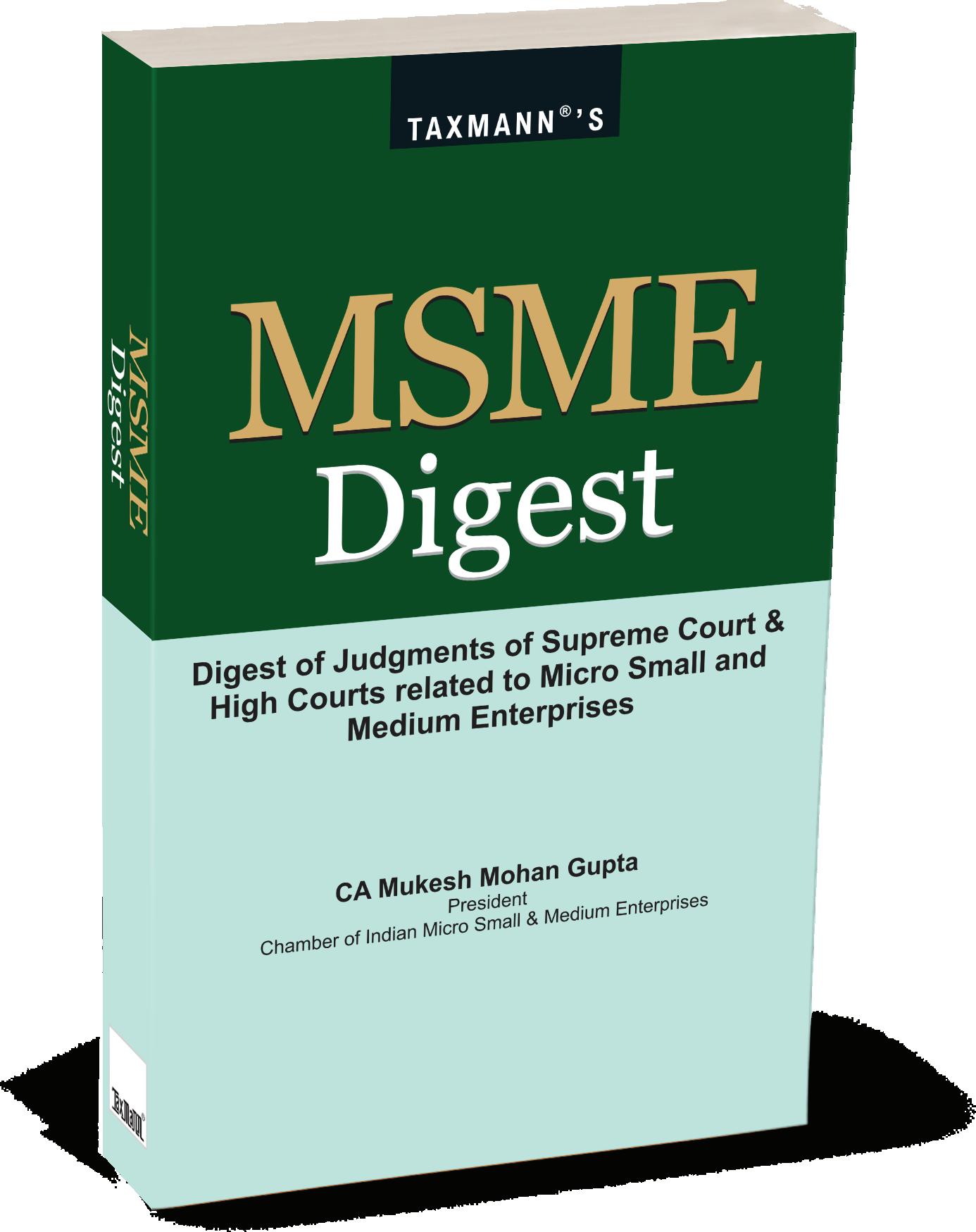
AUTHOR : Mukesh Mohan Gupta
PUBLISHER : Taxmann
DATE OF PUBLICATION : February 2026
EDITION : 2026 Edition
ISBN NO : 9789375616979
NO. OF PAGES : 536
BINDING TYPE : Paperback
Rs. 995
DESCRIPTION
MSME Digest is a structured, practice-oriented judicial compendium that consolidates the evolving jurisprudence governing India's Micro, Small, and Medium Enterprises (MSME) sector. It brings together landmark decisions of the Hon'ble Supreme Court and various High Courts to provide a coherent and research-driven understanding of MSME law under the MSMED Act 2006. In a sector critical to GDP, employment, and exports, judicial interpretation has been central to safeguarding statutory protections—particularly in matters of delayed payments, statutory interest, the jurisdiction of Facilitation Councils, and the enforceability of awards. This Digest bridges the gap created by scattered case law by presenting a systematic consolidation of judicial principles, harmonising the MSMED Act with the Arbitration and Conciliation Act, 1996 and addressing overlaps with insolvency proceedings to ensure effective enforcement of MSME rights.
This publication is intended to serve multiple stakeholders across the MSME and legal ecosystem:
• MSME Entrepreneurs and Business Owners
• Advocates and Arbitration Practitioners
• Chartered Accountants, Company Secretaries and Compliance Professionals
• Insolvency Professionals and Corporate Advisors
• Policy Makers, Administrators and Procurement Authorities
• Academicians and Researchers
The Present Publication is the Latest Edition, authored by CA. Mukesh Mohan Gupta, with the following noteworthy features:
• [Comprehensive Court Coverage] 50+ curated decisions, including 10+ Supreme Court rulings and 40+ High Court judgments, enabling readers to trace binding principles and jurisdictional developments
• [Uniform 14-Part Analytical Case Structure] Each judgment is presented through a research-friendly format—from case summary and legal issues to ratio decidendi, guidelines, and commentary—ensuring clarity and practical usability
• [Focused Thematic Coverage] Detailed analysis of Sections 15–23, 18 and 19 of the MSMED Act, supplier eligibility, Facilitation Council jurisdiction, arbitration conflicts, pre-deposit requirements, enforceability of awards, MSMED–IBC interaction, and procurement policies
• [Integrated Statutory & Policy Tools] Includes the full text of the MSMED Act 2006, relevant Rules (2016), MSME Fund Rules, National Board Rules, Public Procurement Policy Order, notifications, and a comprehensive Subject Index for efficient navigation