
Sample Read

© Taxmann
Price : ` 95
Law stated in this book is as updated till 15th November, 2025
Published by : Taxmann Publications (P.) Ltd.
Sales & Marketing :
59/32, New Rohtak Road, New Delhi-110 005 India
Phone : +91-11-45562222
Website : www.taxmann.com
E-mail : sales@taxmann.com
Regd. Office :
21/35, West Punjabi Bagh, New Delhi-110 026 India
Printed at :
Tan Prints (India) Pvt. Ltd.
44 Km. Mile Stone, National Highway, Rohtak Road Village Rohad, Distt. Jhajjar (Haryana) India
E-mail : sales@tanprints.com
Disclaimer
Every effort has been made to avoid errors or omissions in this publication. In spite of this, errors may creep in. Any mistake, error or discrepancy noted may be brought to our notice which shall be taken care of in the next edition. It is notified that neither the publisher nor the author or seller will be responsible for any damage or loss of action to any one, of any kind, in any manner, therefrom. It is suggested that to avoid any doubt the reader should cross-check all the facts, law and contents of the publication with original Government publication or notifications.
No part of this book may be reproduced or copied in any form or by any means [graphic, electronic or mechanical, including photocopying, recording, taping, or information retrieval systems] or reproduced on any disc, tape, perforated media or other information storage device, etc., without the written permission of the publishers. Breach of this condition is liable for legal action.
For binding mistake, misprints or for missing pages, etc., the publisher’s liability is limited to replacement within seven days of purchase by similar edition. All expenses in this connection are to be borne by the purchaser. All disputes are subject to Delhi jurisdiction only.



MOTOR TRANSPORT WORKERS

Motor Transport Workers Act, 1961*
[27 OF 1961]†
An Act to provide for the welfare of motor transport workers and to regulate the conditions of their work.
BE it enacted by Parliament in the Twelfth Year of the Republic of India as follows:—
CHAPTER I PRELIMINARY
Short title, extent, commencement and application.
1. (1) This Act may be called the Motor Transport Workers Act, 1961.
(2)It extends to the whole of India 1[***].
(3)It shall come into force on such date, not being later than 31st day of March, 1962, as the Central Government may, by notification in the Official Gazette, appoint and different dates may be appointed for different States:
2[Provided that it shall come into force in the State of Jammu and Kashmir on the commencement of the Central Labour Laws (Extension to Jammu and Kashmir) Act, 1970 (51 of 1970).]
(4)It applies to every motor transport undertaking employing five or more motor transport workers:
Provided that the State Government may, after giving not less than two months’ notice of its intention so to do, by notification in the Official Gazette, apply all or any of the provisions of this Act to any motor transport undertaking employing less than five motor transport workers.
*Shall be repealed by the Occupational Safety, Health and Working Conditions Code, 2020, with effect from a date yet to be notified.
† Dated 25-5-1961.
1. Words “except the State of Jammu and Kashmir” omitted by the Central Labour laws (Extension to Jammu and Kashmir) Act, 1970, w.e.f. 1-9-1971.
2. Inserted, ibid.
Section 1
For sub-section (4) substitute.—
STATE AMENDMENT
TAMIL NADU
“(4) It applies to every motor transport undertaking employing motor transport worker.”[Vide the Motor Transport Workers (Tamil Nadu Amendment) Act, 2008.]
Definitions.
2. In this Act, unless the context otherwise requires,—
(a) “adolescent” means a person who has completed his 3[fourteenth] year but has not completed his eighteenth year of age;
(b) “adult” means a person who has completed his eighteenth year of age;
(
c) “child” means a person who has not completed his 3[fourteenth] year;
(
d) “day” means a period of twenty-four hours beginning at midnight:
Provided that where a motor transport worker’s duty commences before midnight but extends beyond midnight, the following day for him shall be deemed to be the period of twenty-four hours beginning when such duty ends, and the hours he has worked after midnight shall be counted in the previous day;
(
e) “employer” means, in relation to any motor transport undertaking, the person who, or the authority which, has the ultimate control over the affairs of the motor transport undertaking, and where the said affairs are entrusted to any other person whether called a manager, managing director, managing agent or by any other name, such other person;
(
f) “hours of work” means the time during which a motor transport worker is at the disposal of the employer or of any other person entitled to claim his services and includes—
(i) the time spent in work done during the running time of the transport vehicle;
(ii) the time spent in subsidiary work; and
(iii) periods of mere attendance at terminals of less than fifteen minutes.
Explanation.—For the purposes of this clause—
(1) “running time” in relation to a working day means the time from the moment a transport vehicle starts functioning at the beginning of the working day until the moment when the transport vehicle ceases to function at the end of the working day, excluding any time during which the running of the transport vehicle is interrupted for a period exceeding such duration as may be prescribed during
3. Substituted for “fifteenth” by the Child Labour (Prohibition and Regulation) Act, 1986, w.e.f. 23-12-1986.
(
which period the person who drive, or perform any other work in connection with the transport vehicle are free to dispose of their time as they please or are engaged in subsidiary work;
(2) “subsidiary work” means work in connection with a transport vehicle, its passengers or its load which is done outside the running time of the transport vehicle, including in particular—
(i) work in connection with accounts, the paying in of cash, the signing of registers, the handing in of service sheets, the checking of tickets and other similar work;
(ii) the taking over and garaging of the transport vehicles;
(iii) travelling from the place where a person signs on to the place where he takes over the transport vehicle and from the place where he leaves the transport vehicle to the place where he signs off;
(iv) work in connection with the upkeep and repair of the transport vehicle; and
(v) the loading and unloading of the transport vehicle;
(3) “period of mere attendance” means the period during which a person remains at his post solely in order to reply to possible calls or to resume action at the time fixed in the duty schedule;
g) “motor transport undertaking” means a motor transport undertaking engaged in carrying passengers or goods or both by road for hire or reward, and includes a private carrier;
(
h) “motor transport worker” means a person who is employed in a motor transport undertaking directly or through an agency, whether for wages or not, to work in a professional capacity on a transport vehicle or to attend to duties in connection with the arrival, departure, loading or unloading of such transport vehicle and includes a driver, conductor, cleaner, station staff, line checking staff, booking clerk, cash clerk, depot clerk, time-keeper, watchman or attendant, but except in section 8 does not include.—
(i) any such person who is employed in a factory as defined in the Factories Act, 1948 (63 of 1948);
(ii) any such person to whom the provisions of any law for the time being in force regulating the conditions of service of persons employed in shops or commercial establishments apply;
(i) “prescribed” means prescribed by rules made under this Act;
(j) “qualified medical practitioner” means a person having a certificate granted by an authority specified in the Schedule to the Indian Medical Degrees Act, 1916 (7 of 1916), or notified under section 3 of that Act or specified in the Schedules to the Indian Medical Council Act, 1956 (102 of 1956), and includes any person having a certificate granted under any Provincial or State Medical Council Act;
(k) “spread-over” means the period between the commencement of duty on any day and the termination of duty on that day;
(l) “wages” has the meaning assigned to it in clause (vi) of section 2 of the Payment of Wages Act, 1936 (4 of 1936);
(m) “week” means the period between midnight on Saturday night and midnight on the succeeding Saturday night;
(n) all words and expressions used but not defined in this Act and defined in the Motor Vehicles Act, 1939 (4 of 1939), shall have the meanings respectively assigned to them in that Act.
COMMENTS
SECTION NOTES
2.1 Definition of “Day” [Section 2(d)]
The term “day” is defined as a period of twenty-four hours beginning at midnight. This is the standard definition used in employment and time-related provisions, likely for establishing work periods, wage entitlements, or rest intervals.
2.1-1 Exception for motor transport workers [Proviso]
Where the duty of a motor transport worker begins before midnight but continues past midnight:
The “day” for such a worker shall be the 24-hour period starting from the end of that duty.
Impact: The hours worked after midnight are counted towards the previous day.
2.2 Definition of “Employer” [Section 2(e)]
The term “employer” refers to:
The person or authority who has the ultimate control over the affairs of the motor transport undertaking.
This could be an individual owner, a public authority, or a private entity, depending on the organizational structure.
Delegated Authority:
Where the control of affairs is entrusted to another individual:
Such person, whether designated as manager, managing director, managing agent, or any equivalent designation, shall also be deemed the employer.
2.3 Definition of “Hours of Work” [(f)]
“Hours of work” means the time during which a motor transport worker is:
At the disposal of the employer or any other person entitled to claim his services. It includes the following time components:
(i) Time spent on work during running time of the transport vehicle.
(ii) Time spent on subsidiary work.
(iii) Periods of mere attendance at terminals, if less than fifteen minutes.
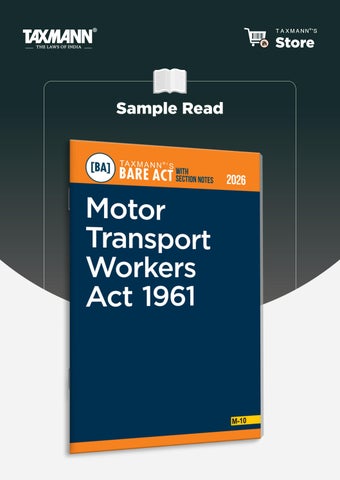
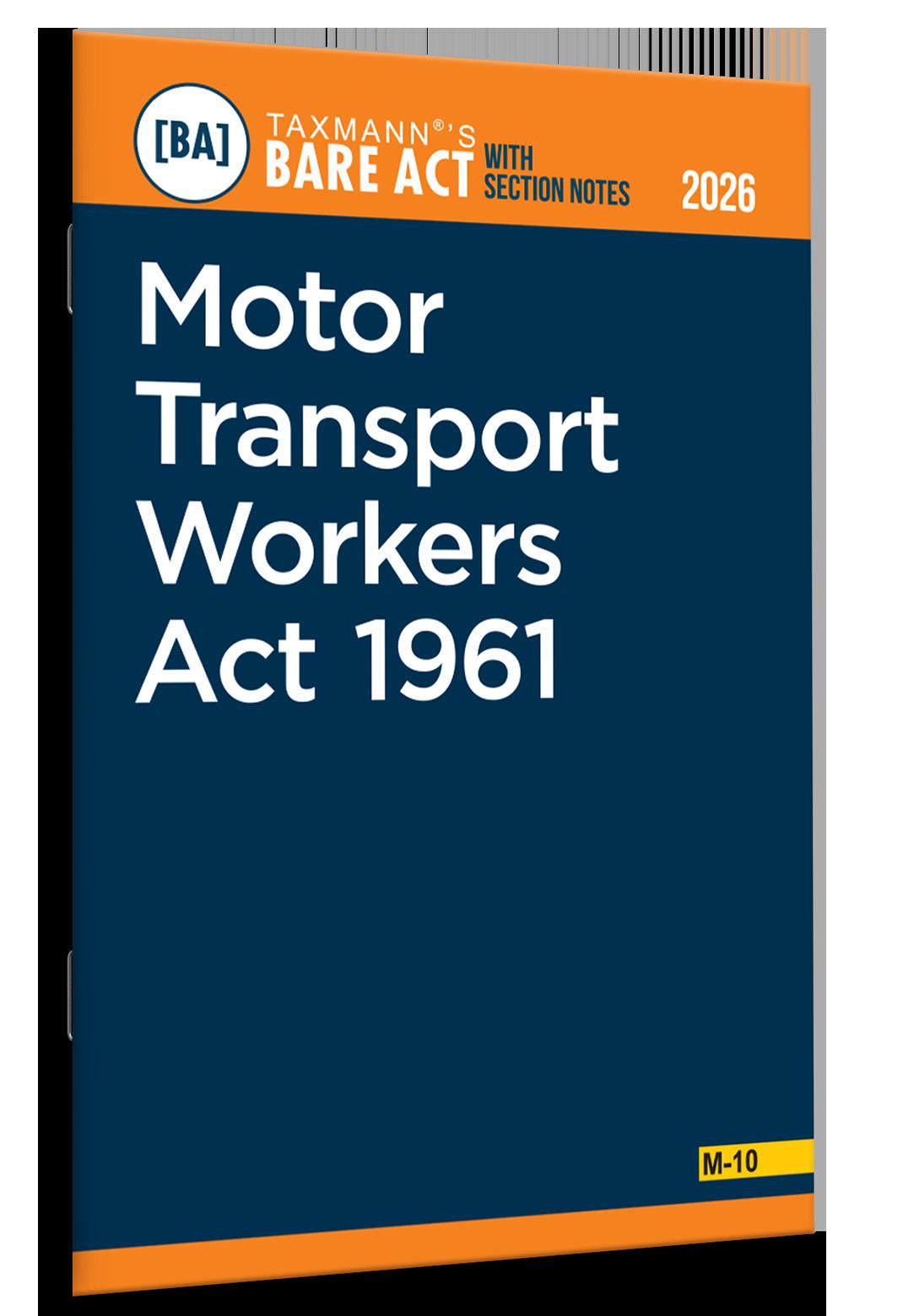
Motor Transport Workers Act 1961 – Bare Act with Section Notes
AUTHOR : Taxmann’s Editorial Board
PUBLISHER : Taxmann
DATE OF PUBLICATION : December 2025
EDITION : 2026 Edition
ISBN NO : 9789371264457
No. of Pages : 48
BINDING TYPE : Paperback
Rs. 95
DESCRIPTION
Motor Transport Workers Act 1961 [Bare Act with Section Notes] by Taxmann is an updated and authoritative statutory publication governing the welfare, health, and conditions of employment of motor transport workers in India. The book presents the complete and amended text of the Act, supported by clear, concise, and practitioneroriented section-wise notes. The Act is a specialised labour welfare legislation regulating working hours, rest intervals, overtime, wages, leave, health safeguards, and welfare amenities for workers engaged in passenger and goods transport undertakings. This 2026 Edition reflects the law as amended and applicable up to date, incorporating relevant State amendments and interpretative guidance to facilitate practical understanding and compliance.
This book is intended for the following audience:
• Legal Professionals & Judges
• HR Managers & Compliance Officers
• Regulatory Authorities & Inspecting Officials
• Academics & Students
• Employers & Motor Transport Operators
The Present Publication is the 2026 Edition, covering the amended and updated text of the Motor Transport Workers Act [Act No. 27 of 1961], with the following noteworthy features:
• [Complete Text of the Act] Presents the updated statutory text of the Motor Transport Workers Act 1961
• [Section-wise Expert Notes] Each provision is supported by explanatory notes clarifying scope, intent, and practical application
• [User-friendly Layout] Clear chapter-wise and section-wise arrangement with marginal headings
• [Latest Amendments Incorporated] Includes Central and relevant State amendments
• [Pre-amendment Provisions] Footnotes reproduce pre-amendment text to aid transitional and historical understanding
• [Judicial References & Interpretative Guidance] Select case law references for contextual clarity
• [Quick-reference Tools] Detailed Subject Index for easy navigation
• [Practical Utility & Compliance Orientation] Useful for compliance structuring, advisory, drafting, and litigation
• [Labour Code Transition Context] Notes highlight the proposed repeal and subsumption under the Occupational Safety, Health and Working Conditions Code 2020