Sample Read
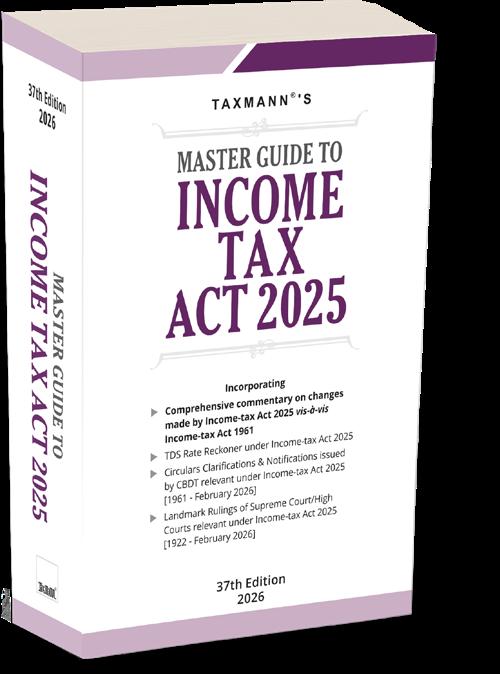

© Taxmann Price : ` 2995
Law stated in this book is as amended by the Finance Act, 2026
Published by : Taxmann Publications (P.) Ltd.
Sales & Marketing : 59/32, New Rohtak Road, New Delhi-110 005 India
Phone : +91-11-45562222
Website : www.taxmann.com
E-mail : sales@taxmann.com
Regd. Office : 21/35, West Punjabi Bagh, New Delhi-110 026 India
Printed at :
Tan Prints (India) Pvt. Ltd.
44 Km. Mile Stone, National Highway, Rohtak Road Village Rohad, Distt. Jhajjar (Haryana) India
E-mail : sales@tanprints.com
Disclaimer
Every effort has been made to avoid errors or omissions in this publication. In spite of this, errors may creep in. Any mistake, error or discrepancy noted may be brought to our notice which shall be taken care of in the next edition. It is notified that neither the publisher nor the author or seller will be responsible for any damage or loss of action to any one, of any kind, in any manner, therefrom. It is suggested that to avoid any doubt the reader should cross-check all the facts, law and contents of the publication with original Government publication or notifications.
No part of this book may be reproduced or copied in any form or by any means [graphic, electronic or mechanical, including photocopying, recording, taping, or information retrieval systems] or reproduced on any disc, tape, perforated media or other information storage device, etc., without the written permission of the publishers. Breach of this condition is liable for legal action.
For binding mistake, misprints or for missing pages, etc., the publisher’s liability is limited to replacement within seven days of purchase by similar edition. All expenses in this connection are to be borne by the purchaser. All disputes are subject to Delhi jurisdiction only.
CONTENTS
DIVISION ONE
Commentary on changes made by Income-tax Act, 2025 vis-a-vis Income-tax Act, 1961 1
DEFINITIONS
2.1 Overview of differences in the definitions contained in the ITA 1961 vis-à-vis the ITA 2025
2.2 A co-operative society registered under the Multi-State Co-operative Societies Act, 2002, is included within the definition of a co-operative society [Section 2(32) of the ITA 2025 (corresponding to Section 2(19) of the ITA 1961)]
2.3 Meaning of Assessment [Section 2(13) of the ITA 2025 (corresponding to Section 2(8) of ITA 1961)]
2.4 Meaning of ‘Assessment Year’ omitted [Section 2( 9) of the ITA 1961] 1.7
2.5 “Assistant Director” shall also mean ‘Deputy Director’ [Section 2(15) of the ITA 2025 (corresponding to Section 2(9B) of the ITA 1961)] 1.8
2.6 Books of account to cover records maintained on cloud-based storage [Section 2(19) of the ITA 2025 (corresponding to Section 2(12A) of the ITA 1961)] 1.8
2.7 Definition of ‘Charitable Purpose’ [Section 2(23) of the ITA 2025 (corresponding to Section 2(15) of the ITA 1961)] 1.9
2.8 Definition of ‘Income’ to include all import and export incentives [Section 2(49) of the ITA 2025 (corresponding to Section 2(24) of the ITA 1961)]
2.9 Meaning of ‘Previous Year’ omitted [Section 2(34) of the ITA 1961) 1.12
2.10 Relative of an individual to cover both Maternal and Paternal Lineal Ascendants [Section 2(94) and Section 92(5) of the ITA 2025 (corresponding to Section 2(41) and Section 56 of the ITA 1961)]
2.11 A concept of ‘Tax Year’ is introduced in place of ‘Previous Year’ and ‘Assessment Year’ [Section 3 of the ITA 2025 (corresponding to Section 3 of the ITA 1961)]
3
BASIS OF CHARGE
3.1 Overview of differences in the provisions relating to the basis of charge in the ITA 1961 vis-à-vis the ITA 2025
3.2 Tax payable on total income shall be paid by TDS, TCS or Advance Tax [Section 4 of the ITA 2025 (corresponding to Section 4 of the ITA 1961)]
3.3 ‘Conduct of business of an entity as a whole’ v. ‘Conduct of business of the company as a whole’ [Section 6 of the ITA 2025 (corresponding to Section 6 of the ITA 1961)]
3.4 Income deemed to accrue or arise in India [Section 9 of the ITA 2025 (corresponding to Section 9 of the ITA 1961)]
3.5 The cap on the investment by an eligible investment fund has been increased from 20% to 25% [Section 9 and Schedule I of the ITA 2025 (corresponding to Section 9A of the ITA 1961 Act)]
3.6 The provision giving guidelines issued by the CBDT, the binding impact has been removed [Section 8 of the ITA 2025 (corresponding to Section 9B of the ITA 1961)] 1.22
3.7 A term defined in Central Acts relating to taxes or other central laws can be considered for interpreting the term used in a treaty [Section 159(7) of the ITA 2025 (corresponding to Sections 90 and 90A of the ITA 1961)] 1.23
SALARY AND HOUSE PROPERTY
4.1 Overview of differences in the provisions relating to the income taxable under the heads salary and house property in the ITA 2025 vis-à-vis the ITA 1961
4.2 Amendment in the provisions relating to income from house property to align with ITA 1961 [Sections 21(5) and 22(2) of the ITA 2025 (corresponding to Sections 23(5) and 24(b) of the ITA 1961)]
4.3 Structural realignment of exemptions related to salary income into deductions [Section 19 of the ITA 2025 (corresponding to Sections 10 and 16 of the ITA 1961)]
4.4 Certain payments are excluded from the definition of “profits in lieu of salary” [Section 18(2) of the ITA 2025 (corresponding to Section 17(3)(ii) of the ITA 1961)]
4.5 Transfer of “any house property” for inadequate consideration v. Transfer of “any property” for inadequate consideration [Section 25(a) of the ITA 2025 (corresponding to Section 27(i) of the ITA 1961)]
5
BUSINESS INCOME
5.1 Overview of differences in the provisions relating to the Business Income in the ITA 2025 vis-à-vis the ITA 1961
5.2 Deduction for contributions to the employees’ welfare fund is allowable if paid by the due date for filing the return of income [Section 29(1)(e) of the ITA 2025 (corresponding to Section 36(1) (va) of the ITA 1961)] 1.37
5.3 Insertion of the definition of “commodity derivative” [Section 66(4) of the ITA 2025 (corresponding to Explanation 2 to Section 43(5) (e) of the ITA 1961)] 1.39
5.4 Expansion of the list of minerals eligible for deduction under section 51 [Section 51 and Schedule XII of the ITA 2025 (corresponding to Section 35E and Seventh Schedule of the ITA 1961)] 1.40
5.5 Expenditure disallowed on account of non-deduction or non-deposit of TDS can be claimed by non-life insurance companies when TDS is subsequently paid [Schedule XIV of the ITA 2025 (corresponding to the First Schedule of the ITA 1961)] 1.41
5.6 Changes in the charging provision for the profits and gains from business and profession [Section 26 of the ITA 2025 (corresponding to Section 28 of the ITA 1961)]
5.7 Changes in the provision for claiming deduction for depreciation [Section 33 of the ITA 2025 (corresponding to Section 32 of the ITA 1961)]
5.8 Procedural aspects relating to making an application by scientific research institutions shall be prescribed by rules [Section 45 of the ITA 2025 (corresponding to Section 35 of the ITA 1961)]
5.9 “Payment has actually been made” vs. “Actually paid” [Section 52(7)(a) of the ITA 2025 (corresponding to the Explanation (iii) to Section 35ABB(1) of the ITA 1961)]
5.10 Provisions for the deduction for employee welfare expenses have been consolidated at one place
5.11 Proportionate deduction in case of non-exclusive use of assets [Section 28(2) of the ITA 2025 (corresponding to Section 38 of the ITA 1961)]
5.12 Salary payment outside India or to a non-resident in India [Section 35(c) of the ITA 2025 (corresponding to Section 40(a)(iii) of the ITA 1961)]
5.13 Use of the term ‘Asset’ vs. ‘Capital asset’ while computing “actual cost” in certain cases [Section 43 of the 1961 Act/ Section 39 of the 2025 Act]
5.14 Deduction for surcharge shall be allowed on an actual payment basis, and no need to furnish the evidence of payment with the return [Section 37 of the ITA 2025 (corresponding to Section 43B of the ITA 1961)]
5.15 More provisions are added to the list, which shall not apply for the computation of income from the insurance business [Section 55 of the ITA 2025 (corresponding to Section 44 of the ITA 1961)]
5.16 Maintenance of books of account [Section 62 of the ITA 2025 (corresponding to Section 44AA of the ITA 1961)]
5.17 Audit of books of account [Section 63 of the ITA 2025 (corresponding to Section 44AB of the ITA 1961)] 1.55
5.18 More provisions are added to the list, which shall not apply to the computation of presumptive income of the business [Section 58 of the ITA 2025 (corresponding to Section 44AD of the ITA 1961)]
CONTENTS
5.19 More provisions are added to the list, which shall not apply to the computation of presumptive income of the specified professions [Section 58 of the ITA 2025 (corresponding to Section 44ADA of the ITA 1961)]
5.20 Changes in the presumptive tax scheme for business of plying, hiring and leasing of goods carriage [Section 58 of the ITA 2025 (corresponding to Section 44AE of the ITA 1961)]
5.21 More provisions are added to the list, which shall not apply to the computation of presumptive income of the shipping business [Section 61 of the ITA 2025 (corresponding to Section 44B of the ITA 1961)]
5.22 Changes in the presumptive tax scheme for exploration business [Section 61 of the ITA 2025 (corresponding to Section 44BB of the ITA 1961)]
5.23 More provisions are added to the list, which shall not apply to the computation of presumptive income of the airline business [Section 61 of the ITA 2025 (corresponding to Section 44BBA of the ITA 1961)]
5.24 Changes in the presumptive tax scheme for civil construction business [Section 61 of the ITA 2025 (corresponding to Section 44BBB of the ITA 1961)] 1.62
5.25 More provisions are excluded that shall not apply to the computation of presumptive income of the cruise shipping business [Section 61 of the ITA 2025 (corresponding to Section 44BBC of the ITA 1961)] 1.63
5.26 Changes in the presumptive tax scheme for the business of providing services or technology for setting up electronics manufacturing facilities in India [Section 61 of the ITA 2025 (corresponding to Section 44BBD of the ITA 1961)] 1.63
5.27 More provisions are added to the list, which shall not apply in respect of the deduction for head office expenditure in case of non-residents [Section 60 of the ITA 2025 (corresponding to Section 44C of the ITA 1961)] 1.64
CAPITAL GAINS
6.1 Overview of differences in the provisions relating to the Capital Gains in the ITA 2025 vis-à-vis the ITA 1961 1.66
6.2 Buyback of shares will be taxable as capital gains [Section 69 of ITA 2025 (corresponding to Section 46A of ITA 1961)]
6.3 Consequential amendment is made to provisions of deemed dividend to omit the taxability of buyback of shares from the provision [Section 2(40) of ITA 2025 (corresponding to Section 2(22) of ITA 1961)]
6.4 Consequential amendment is made to section 7 to omit the reference to sub-clause (f) of section 2(40) [Section 7 of ITA 2025 (corresponding to Section 8 of ITA 1961)]
6.5 Exemption for Sovereign Gold Bond to be allowed only to original holders if held till maturity [Section 70 of the ITA 2025 (corresponding to Section 47 of the ITA 1961)]
6.6 The drafting error in the charging provision for capital gains is corrected by including a reference to provisions providing exemption [Section 67(1) of the ITA 2025 (corresponding to Section 45(1) of the ITA 1961)]
7
OTHER SOURCES
7.1 Overview of differences in the provisions relating to the Other Sources in the ITA 2025 vis-à-vis the ITA 1961
7.2 No deemed dividend on loans and advances between group entities [Section 2(40) of ITA 2025 (corresponding to Section 2(22) of ITA 1961)] 1.88
7.3 No deduction of expenses to be allowed from the dividend income and income from units of mutual funds [Section 93 of ITA 2025 (corresponding to Section 57 of ITA 1961)]
7.4 Deduction to be allowed for land revenue, local rates, or municipal taxes from other source income [Section 93(1)(c) of the ITA 2025 (corresponding to Section 57(ii) of the ITA 1961)] 1.91
7.5 Deductions for employee welfare expenses to be allowed on timely payment while computing income from other sources [Section 94(2) of the ITA 2025 (corresponding to Section 58(1A) & (2) of the ITA 1961)] 1.92
DEDUCTIONS AND EXEMPTIONS
8.1 Overview of differences in the provisions relating to the deductions and exemptions in the ITA 2025 vis-à-vis the ITA 1961
8.2 Disability pension of armed forces will be exempt from tax [Schedule III: Table, Sl. No. 38A]
8.3 Interest on compensation awarded by the Motor Accident Claims Tribunal will be exempt from tax [Schedule III: Table, Sl. No. 38B]
8.4 Income arising from compulsory acquisition of land under the RFCTLARR Act will be exempt from tax [Schedule III: Table, Sl. No. 38C (corresponding to Section 10(37) of ITA 1961)]
8.4A Exemption for capital gain arising on the transfer of specified capital asset under the Andhra Pradesh Capital City Land Pooling Scheme [Schedule III: Table, Sl. No. 38D of the ITA 2025 (corresponding to Section 10(37A) of ITA 1961)]
8.5 Income arising to a foreign company on account of providing capital goods, equipment or tooling to a contract manufacturer in India will be exempt from tax [Schedule IV: Table, Sl. No. 13A]
8.6 Income arising to an individual after becoming a resident of India will be exempt from tax for 5 years [Schedule IV: Table, Sl. No. 13B]
8.7 Income arising to a foreign company from procuring data centre services will be exempt from tax till tax year 2046-47 [Schedule IV: Table, Sl. No. 13C]
8.8 Deduction allowed to federal co-operative in respect of dividend income from companies [Sections 149(2)(d) and 150 of the ITA 2025 (corresponding to Section 80P(2)(d) of the ITA 1961)]
8.9 Deduction to be allowed to a primary co-operative society from the income from the supply of cattle feed and cotton seed [Section 149(2)(b) of the ITA 2025 (corresponding to Section 80P(2)(b) of the ITA 1961)]
8.10 Certain deductions will be allowed to the co-operative society under the new tax regimes [Sections 203 and 204 of the ITA 2025 (corresponding to Sections 115BAD and 115BAE of the ITA 1961)] 1.148
8.11 Curative amendments have been made to various provisions to omit the reference to section 144 to remove redundancy 1.148
8.12 Deduction to IFSC or Offshore Banking Units [Section 147 of the ITA 2025 (corresponding to Section 80LA of ITA 1961)]
8.13 The condition to constitute a specified fund is rationalised [Note 1(g) of Schedule VI (corresponding to Explanation (C) to Section 10(4D) of ITA 1961)]
8.14 ‘New Development Bank’ will be exempt from tax [Schedule VII: Table Sl. No. 49 of the ITA, 2025]
8.15 The turnover limit to qualify as an eligible start-up has been increased [Section 140 of the ITA 2025 (corresponding to section 80-IAC of the ITA 1961)]
8.16 No double deduction should be allowed for housing projects to AOP/BOI and its members [Section 122 read with Section 142 of the ITA 2025 (corresponding to Section 80A read with Section 80-IBA of the ITA 1961)]
TAXATION FRAMEWORK FOR REGISTERED NPOs
9.1 Overview of the provisions in the Income-tax Act, 2025 relating to registered non-profit organisations and key differences vis-à-vis the Income-tax Act, 1961
9.2 Introduction
9.3 Definition of “Charitable Purpose” [Section 2(23) of the ITA 2025] 1.174
9.4 Application for Registration [Section 332 of the ITA 2025] 1.179
9.5 Switching over of regimes [Section 333 of the ITA 2025]
9.6 Tax on income of registered NPO [Section 334 of the ITA 2025] 1.192 9.7 Regular Income [Section 335 of the ITA 2025]
9.8 Specified Income [Section 337 of the ITA 2025]
9.9 Residual Income [Section 355(j) of the ITA 2025]
9.10 Corpus Donation [Section 339 of the ITA 2025] 1.207
9.11 Application of Income [Section 341 of the ITA 2025] 1.208
9.12 Accumulated Income [Sections 342 & 343 of the ITA 2025] 1.212
9.13 Commercial activities by registered NPOs [Sections 344, 345 and 346 of the ITA 2025] 1.214
9.14 Compliances to be done by registered NPOs [Sections 347, 348, 349 and 350 of the ITA 2025] 1.216
9.15 Specified Violations [Section 351 of the ITA 2025] 1.219
9.16 Tax on Accreted Income [Section 352 of the ITA 2025] 1.223
9.17 Merger of Registered NPOs will not trigger the accreted tax 1.226
CONTENTS
9.18 Other violations [Section 353 of the ITA 2025]
9.19 Approval for donations [Section 354 of the ITA 2025]
9.20 Exemption for Educational and Medical Institutions 1.233
SPECIAL TAX RATE
10.1 Overview of differences in the provisions relating to the Special Tax Rates in the ITA 2025 vis-à-vis the ITA 1961
10.2 The tax rate on unexplained income is reduced from 60% to 30% [Section 195 of ITA 2025 (corresponding to Section 115BBE of ITA 1961)]
10.3 Consolidation of provisions governing the optional tax regime for NRIs on foreign exchange assets [Section 217 of ITA 2025 (corresponding to Section 115H/115-I of ITA 1961)]
10.4 Insertion of provisions for taxing post-holiday income of IFSC units and OBUs [Section 218 of the ITA 2025]
10.5 Rationalisation of Minimum Alternate Tax (MAT) provisions [Section 206 of the ITA 2025 (corresponding to Section 115JAA/115JB of the ITA 1961)]
10.6 Mandatory to file an updated return with recomputed MAT credit [Section 263(6)(e) of the ITA 2025 (corresponding to the seventh proviso to section 139(8A) of the ITA 1961)]
10.7 Due to the rationalisation of the MAT provisions, consequential amendments have also been made to various provisions
10.8 Computation of depreciation in case of persons opting for concessional tax regimes [Section 199/200/201/203/204/205 of the ITA 2025 (corresponding to Section 115BA/115BAA/ 115BAB/115BAD/115BAE of the ITA 1961)]
10.9 Removal of difficulty guidelines under the concessional tax regimes for manufacturing domestic companies and resident co-operative societies will not be binding on the assessee [Section 201/204/205 of the ITA 2025 (corresponding to Sections 115BAB/115BAE of the ITA 1961)] 1.253
10.10 A co-operative society is allowed to form a business by rehabilitation in the prescribed circumstances for the concessional tax regime [Section 205(2)(a) of the ITA 2025 (corresponding to Section 115BAE(2)(a)(i) of the ITA 1961)] 1.254
10.11 Once the explanation by the assessee against ‘unexplained income’ is found unsatisfactory, the addition shall be made by the AO [Section 102 of the ITA 2025 (corresponding to Section 68 of the ITA 1961)]
10.12 Addition for unexplained assets owned by or belonging to the assessee [Section 104 of the ITA 2025 (corresponding to Sections 69A and 69B of the ITA 1961)]
10.13 Borrowing or repayment through bearer negotiable instruments is taxable as unexplained [Section 106 of the ITA 2025 (corresponding to Section 69D of the ITA 1961)]
11
TONNAGE TAX
11.1 Overview of differences in the provisions relating to the Tonnage Tax in the ITA 2025 vis-à-vis the ITA 1961
11.2 Background
11.3 Curative amendment is made to add ‘valid’ before the certificate [Section 227 of ITA 2025 (corresponding to Section 115VG/115VX of ITA 1961)]
11.4 On-board and onshore activities of inland vessels will be covered within the core activities of a tonnage company [Section 228(3) (b)(ii)(A) of the ITA 2025 (corresponding to Section 115V-I of the ITA 1961)]
11.5 Inland shipping companies to comply with the training requirements specified by relevant authorities [Section 232 of the ITA 2025 (corresponding to Section 115VU of the ITA 1961)]
11.6 Meaning of Inland Waterways Authority is inserted [Section 235 of the ITA 2025 (corresponding to Section 115V of the ITA 1961)]
12
TRANSFER PRICING
12.1 Overview of differences in the provisions relating to the Transfer Pricing in the ITA 2025 vis-à-vis the ITA 1961 1.263
12.2 Rationalisation of Safe Harbour Rules [Rules 86 to 93 of the Income-tax Rules, 2026] 1.263
12.3 Furnishing of a modified return by Associated Enterprise due to the Advance Pricing Agreement (APA) under section 169 [(corresponding to section 92CD of ITA 1961)]
CONTENTS
12.4 Change in the time limit to pass the order by the Transfer Pricing Officer [Section 166 of ITA 2025 (corresponding to section 92CA of ITA 1961)]
12.5 Removing ambiguity from the definition of “Associated Enterprise” under Section 162 of the ITA 2025 (Corresponding to section 92A of the ITA 1961)
12.6 Period to be excluded from the limitation period of assessment shall end on the date APA is entered into with the CBDT [Section 168(10) of the ITA 2025 (corresponding to Section 92CC(10) of the ITA 1961)]
TDS/TCS
13.1 Overview of differences in the provisions relating to TDS and TCS in the ITA 1961 vis-à-vis the ITA 2025
13.2 An amendment is made in the provision relating to TDS on the sale of immovable property to make a correct cross-reference [Section 393(1): Table: Sl. No. 3(i) (corresponding to section 194-IA of ITA 1961)]
13.3 A curative amendment is made in the provision relating to TDS on the interest other than on securities to extend the exemption where interest is paid to a co-operative bank [Section 393(4): Table: Sl. No. 7 (corresponding to section 194A(3) of ITA 1961)]
13.4 No tax is to be deducted from the interest on compensation awarded to an individual by the Motor Accidents Claims Tribunal [Section 393(4): Table: Sl. No. 7 (corresponding to section 194A(3) of ITA 1961)]
13.5 Investors are permitted to file a declaration for non-deduction of tax with the depositories [Section 393(6) (corresponding to section 197A of ITA 1961)]
13.6 Application for a lower or nil TDS certificate can also be filed with the prescribed tax authority [Section 395 of the ITA 2025 (corresponding to sections 195, 197, 203 and 206C of ITA 1961)] 1.288
13.7 No need to obtain a TAN by a resident individual/HUF deducting tax on purchase of immovable property from a non-resident [Section 397 of the ITA 2025 (corresponding to section 203A of ITA 1961)] 1.289
13.8 Supply of manpower included within the definition of ‘work’ for TDS under [Section 402(47) (corresponding to section 194C of ITA 1961)]
CONTENTS
13.9 A reference is given to take the meaning of “authorised person” from section 2 of the FEMA 1999 [Section 402(27) (corresponding to section 204 of ITA 1961)]
13.10 The guidelines for the removal of difficulties issued by the CBDT will be binding on the tax authorities and the deductor [Section 400 of the ITA 2025]
13.11 Consequential amendment made to the provision dealing with the processing of TDS/TCS statement due to a change in fee provisions [Section 399 of the ITA 2025 (corresponding to sections 200A & 206CB of ITA 1961)]
13.12 TCS rates rationalised to largely introduce a uniform rate of 2% [Section 394 of the ITA 2025 (corresponding to section 206C of the ITA 1961)]
13.13 Slight change in the threshold for TDS on payment in respect of a life insurance policy [Section 393 of the ITA 2025 (corresponding to Section 194DA of the ITA 1961)]
13.14 Advertising services fall within the scope of “professional services” for TDS on commission or brokerage [Section 393(1) read with Section 402 of the ITA 2025 (corresponding to Section 194H of the ITA 1961)]
13.15 Expanding the definition of ‘rent’ for the purpose of TDS on payments made by certain individuals or HUFs [Section 393(1) read with Section 402 of the ITA 2025 (corresponding to Section 194-IB of the ITA 1961)] 1.300
13.16 Tax to be deducted on credit or payment in case of compulsory acquisition of immovable property [Section 393(1) of the ITA 2025 (corresponding to Section 194LA of ITA 1961)] 1.301
13.17 Certificate for deduction of TDS at lower rates extended to all TDS provisions [Section 395 of the ITA 2025 (corresponding to Section 197(1) of the ITA 1961)] 1.302
13.18 No corresponding provision to enable notifying a scheme for processing of statements made by a person not being a deductor [Section 399 of the ITA 2025 (corresponding to Section 200A(3) of the ITA 1961)] 1.302
13.19 In case of motor vehicles and notified goods, the tax is to be collected at the time of collection or debited to the account of the buyer [Section 394(1) of the ITA 2025 (corresponding to Section 206C(1F) of the ITA 1961)] 1.303
CONTENTS
13.20 Reference to furnishing an invalid/wrong PAN has been omitted since it is covered under the main provisions [Section 397(2) of the ITA 2025 (corresponding to Section 206AA and Section 206CC of the ITA 1961)]
13.21 Time limit to furnish a correction statement of the TDS/ TCS statement is reduced [Section 397(3)(f) of the ITA 2025 (corresponding to Section 200(3) of the ITA 1961)]
13.22 TDS provisions on cash withdrawal applies on entire threshold limit [Section 393(3) of the ITA 2025 (corresponding to Section 194N of the ITA 1961)]
14
RETURN AND APPEALS
14.1 Overview of differences in the provisions relating to Return and Appeals in the ITA 2025 vis-à-vis the ITA 1961
14.2 Due date for filing of return has been extended from 31st July to 31st August for non-audit business taxpayers and partners of non-audit firms [Section 263(1)(c) of the ITA 2025 (corresponding to Explanation 2 to Section 139(1) of ITA 1961)]
14.3 A revised return can be filed after 9 months but before 12 months from the end of the relevant tax year after payment of a fee [Section 263(5) of the ITA 2025 (corresponding to Section 139(5) of ITA 1961)]
14.4 An updated return is allowed to be filed even when the loss was claimed in the original ITR or when a reassessment notice is issued [Sections 263(6) and 267 of the ITA 2025 (corresponding to Sections 139(8A) and 140B of the ITA 1961)] 1.312
14.5 CBDT is empowered to make rules to prescribe the documents relating to certain transactions in which quoting of PAN will be mandatory [Section 262 of the ITA 2025 (corresponding to Section 139A of the ITA 1961)]
14.5A Power to adjust refund extended to the tax liability due under ITA 1961 or ITA 2025 [Section 438 of the ITA 2025 (corresponding to Section 245 of the ITA 1961)] 1.325
14.5B The order of the ITAT must be sent electronically to the jurisdictional PCIT or CIT through the designated portal [Section 363 of the ITA 2025 (corresponding to Section 254 of the ITA 1961)] 1.326
14.6 No updated return only on violation of specified laws [Section 263(6)(c)(vi) of the ITA 2025 (corresponding to the 3rd proviso (c) to Section 139(8A) of the ITA 1961)]
14.7 Avoiding repetitive appeals by the assessee [Section 375 of the ITA 2025 (corresponding to Section 158A of the ITA 1961)]
14.8 Revision of orders prejudicial to revenue [Section 377 of the ITA 2025 (corresponding to Section 263 of the ITA 1961)]
14.9 Revision of other orders [Section 378 of the ITA 2025 (corresponding to Section 264 of the ITA 1961)]
14.10 Every order passed by the Commissioner (Appeals) or Joint Commissioner (Appeals) is appealable before ITAT [Section 362 of the ITA 2025 (corresponding to Section 253 of the ITA 1961)]
14.11 An Advance Ruling could be declared void for any misrepresentation [Section 386 of the ITA 2025 (corresponding to Section 245T of the ITA 1961)]
15
INTEREST AND FEE
15.1 Overview of differences in the provisions of interest and fee in the ITA 2025 vis-à-vis the ITA 1961
15.2 Substitution of certain penalty provisions with a fee for default in furnishing specified statements or reports [Sections 427 and 428 of the ITA 2025 (corresponding to sections 271B, 271BA and 271FA of the ITA 1961)] 1.333
15.3 Interest shall not be levied on penalties for under-reporting or misreporting income until the order is passed by the CIT(A) or ITAT [Section 411(3) of the ITA 2025 (corresponding to Section 220(2) of the ITA 1961)] 1.337
16
ASSESSMENT PROCEEDINGS
16.1 Overview of differences in the provisions relating to the Assessment Proceedings in the ITA 1961 vis-à-vis the ITA 2025 1.339
16.2 The general time limit for completion of assessment or reassessment will apply up to the stage of issuing of draft assessment order [Section 275/286 of ITA 2025 (corresponding to Section 144C/153 of ITA 1961)] 1.341
CONTENTS
16.3 Jurisdictional AO will have the jurisdiction to issue notice for reassessment [Section 279 of ITA 2025 (corresponding to section 147A of ITA 1961)]
16.3A Units in the faceless assessment are allowed to authenticate electronic records by way of electronic communication [Section 144B of the ITA 1961 (corresponding to Section 273 of the ITA 2025]
16.3B AO must allow the assessee a minimum period of 30 days in the reassessment notice to furnish the return of income [Section 148 of the ITA 1961 (corresponding to Section 280 of the ITA 2025]
16.3C Reassessment notice pursuant to the findings or directions of the courts or authorities must be issued within 3 months [Section 150 of the ITA 1961 (corresponding to Section 283 of the ITA 2025]
16.4 The powers of the Dispute Resolution Committee are enhanced to reduce or waive the penalty already imposed under the Act [Section 379 of ITA 2025 (corresponding to Section 245MA of ITA 1961)]
16.5 Assessment order will not be invalid merely on grounds of mistake or omission of DIN [Section 522 of ITA 2025 (corresponding to Section 292BA of ITA 1961)]
16.5A Approval given by the tax authorities in electronic mode for assessment proceedings shall not be deemed invalid on grounds of insufficient reasons or missing DSC [Section 292BC of the ITA 1961 (corresponding to Section 522(3) of the ITA 2025]
16.6 The time limit to furnish a special audit or inventory valuation report changed to six months from the end of the month of the direction [Section 268(10) of the ITA 2025 (corresponding to the Proviso to Section 142(2C) of the ITA 1961)] 1.362
16.7 Powers of the Valuation Officer are defined in the provision [Section 269 of the ITA 2025 (corresponding to Section 142A of the ITA 1961)] 1.363
16.8 Team-based decision-making removed from the faceless scheme for inquiry and valuation [Section 532(1) of the ITA 2025 (corresponding to Section 142B(1)(c) of the ITA 1961)] 1.363
16.9 Relief from tax on income from retirement benefit account to be allowed during summary assessment [Section 270(1)(c) of the ITA 2025 (corresponding to Section 143(1)(c) of the ITA 1961)] 1.364
16.10 Faceless assessment procedure to be laid down in rules [Section 273(1) of the ITA 2025 (corresponding to Section 144B(1) of the ITA 1961)] 1.365
16.11 DRP to focus on the structure and content of directions instead of listing out specific items to consider [Section 275(6) of the ITA 2025 (corresponding to Section 144C(6) of the ITA 1961)]
16.12 Direction by approving panel to invoke GAAR and finding or direction of the court is included in ‘information’ to initiate the reassessment [Section 280 of the ITA 2025 (corresponding to Section 148 of the ITA 1961)]
16.13 No need to follow the procedure before issuing a notice for reassessment where a direction is given to invoke GAAR or a finding or direction given by the court [Section 281 of the ITA 2025 (corresponding to Section 148A of the ITA 1961)]
16.14 Team-based decision-making removed from the faceless reassessment scheme [Section 532 of the ITA 2025 (corresponding to Section 151A of the ITA 1961)]
16.15 Time limit to complete the assessment [Section 286 of the ITA 2025 (corresponding to Section 153 of the ITA 1961)]
16.16 Team-based decision-making removed from the faceless rectification scheme [Section 532 of the ITA 2025 (corresponding to Section 157A of the ITA 1961)]
16.17 An SLP under Article 136 of the Constitution of India shall be considered in the provision for avoiding repetitive appeals by the assessee [Section 375 of the ITA 2025 (corresponding to Section 158A of the ITA 1961)] 1.372
16.18 Powers given to the Central Government to make faceless schemes for various provisions [Section 532 of the ITA 2025]
SEARCH & SEIZURE
17.1 Overview of differences in the provisions relating to the Search & Seizure in the ITA 2025 vis-à-vis the ITA 1961 1.378
17.2 A shorter block period will be computed in the case of other persons [Section 295 of ITA 2025 (corresponding to Section 158BD of ITA 1961)] 1.379
17.3 The limitation period for completion of the block assessment is increased from 12 months to 18 months [Section 296 of ITA 2025 (corresponding to Section 158BE of ITA 1961)]
CONTENTS
17.4 An authorised officer can now exercise the power to issue a summons during the course of a search action as well [Section 246(2)(c) of the ITA 2025 (corresponding to Section 131(1A) of the ITA 1961)]
17.5 Changes in the provisions relating to search and seizure [Section 247 of the ITA 2025 (corresponding to Section 132 of the ITA 1961)]
17.6 Monetary limit increased to call for Information in respect of any assessee who made certain payments [Section 252(1)(e) of the ITA 2025 (corresponding to Section 133(4) of the ITA 1961)]
17.7 The statement of a person can be recorded on oath during the survey [Section 253(5)(b) of the ITA 2025 (corresponding to Section 133A(3)(iii) of the ITA 1961)]
17.8 Joint Director is also an “income-tax authority” for the purposes of collecting certain information [Section 254(4) of the ITA 2025 (corresponding to the Explanation to Section 133B of the ITA 1961)]
18 PENALTIES
18.1 Overview of differences in the provisions relating to Penalty in the ITA 2025 vis-à-vis the ITA 1961
18.2 Overview of the amendment to the penalty and immunity provisions in case of unexplained income
18.3 Unexplained income detected by AO will be considered misreporting of income [Section 439 and Section 443 of the ITA 2025 (corresponding to Sections 270A and 271AAC of the ITA 1961)] 1.396
18.4 Extension of immunity from penalties for under-reporting caused by misreporting of income [Section 440 of the ITA 2025 (corresponding to Section 270AA of the ITA 1961)]
18.5 Insertion of penalty provisions for failure to submit information or furnishing inaccurate information regarding crypto-asset transactions [Section 446 of the ITA 2025]
18.6 A maximum cap is introduced on penalty for failure to furnish SFT or the reportable account within the prescribed time limit [Section 454 of the ITA 2025] 1.407
18.7 Increase in penalty for failing to provide information to tax authorities entering the place of business to collect certain information [Section 466 of the ITA 2025 (corresponding to Section 272AA of the ITA 1961)] 1.408
18.8 Integration of penalty proceedings with assessment orders [Section 471 of the ITA 2025 (corresponding to section 274 of the ITA 1961)]
18.9 Removal of the phrase “Without Prejudice” from various penalty provisions [Section 441/442/444/445/461/ 463/464 of the ITA 2025 (corresponding to Section 271A/271AA/271AAD/271AAE/271H/ 271J/271K of the ITA 1961)]
18.10 Expansion of reasonable cause provision [Section 470 of the ITA 2025 (corresponding to Section 273B of the ITA 1961)]
19
PROSECUTION FOR OFFENCES
19.1 Overview of differences in the provisions relating to the prosecution of offences in the ITA 2025 vis-à-vis the ITA 1961
19.2 “Rigorous imprisonment” is replaced with “simple imprisonment” for all prosecution provisions [Chapter XXII of the ITA 2025 (corresponding to Chapter XXII of the ITA 1961)]
19.3 Graded punishment structures are incorporated in various prosecution provisions [Chapter XXII of the ITA 2025 (corresponding to Chapter XXII of the ITA 1961)]
19.4 Certain offences are decriminalised [Sections 476 and 481 of the ITA 2025 (corresponding to Sections 276B and 276D of the ITA 1961)] 1.417
19.5 Prosecution for failure to furnish a return of income in search cases shall be non-cognizable [Section 480 of the ITA 2025 (corresponding to Section 276CCC of the ITA 1961)]
19.6 Due date to file a belated return is aligned with provisions granting relief from prosecution for failure to furnish the return of income [Section 479 of the ITA 2025 (corresponding to Section 276CC of the ITA 1961)] 1.419
20
MISCELLANEOUS
20.1 Overview of differences in the other provisions in the ITA 2025 vis-à-vis the ITA 1961
20.2 Rationalisation of Schedule XI governing recognised provident funds [Schedule XI of the ITA 2025 (corresponding to the Schedule IV of the ITA 1961)]
20.3 Repeal and Savings provision repeals the ITA 1961 and preserves the rights, liabilities and proceedings already existing [Section 536 of the ITA 2025]
20.4 Correction of cross-reference error in clubbing provisions [Section 99 of the ITA 2025 (corresponding to Section 64 of the ITA 1961)]
20.4A Power of the tax recovery officer to arrest and detain a taxpayer in prison for tax recovery has been removed [Section 413 of the ITA 2025 (corresponding to Section 222 read with the Second Schedule of the ITA 1961)]
20.5 Definitions of ‘Electronic Mail’ and ‘Electronic Mail Message’ are inserted [Section 501 of the ITA 2025 (corresponding to Section 282 of the ITA 1961)]
20.6 Meaning of ‘Registered Valuer’ is inserted [Sections 513 and 514 of the ITA 2025 (corresponding to Section 287A of the ITA 1961)]
20.7 Income of a minor child arising ‘directly or indirectly’ will be clubbed with the income of the parent [Section 99(1) of the ITA 2025 (corresponding to Section 64(1A) of the ITA 1961)]
20.8 Consequential changes in the provision requiring the person leaving India to obtain a Tax Clearance Certificate [Section 420 of the ITA 2025 (corresponding to Section 230 of the ITA 1961)]
20.9 Liability of representative assessee [Section 304 of the ITA 2025 (corresponding to Section 161 of the ITA 1961)]
20.10 Amount borrowed or repaid on hundi [Section 106 of the ITA 2025 (corresponding to Section 69D of the ITA 1961)]
20.11 Non-applicability of clubbing provision if spouse possesses technical or professional qualification [Section 99 of the ITA 2025 (corresponding to Section 64 of the ITA 1961)]
DIVISION TWO
TDS Rate Reckoner under the ITA 2025
DIVISION THREE
Circulars, Clarifications & Notifications Issued by CBDT relevant under Income-tax Act 2025 [1961 – February 2026]
Section Key to Circulars, Clarifications & Notifications issued by CBDT relevant under Income-tax Act 2025 [1961 - February 2026]
Alphabetical Key to Circulars, Clarifications & Notifications issued by CBDT relevant under Income-tax Act 2025 [1961 - February 2026]
Circulars, Clarifications and Notifications issued by CBDT Relevant under Income-tax Act 2025 [1961 – February 2026]
DIVISION FOUR
Landmark rulings of Supreme Court/High Courts relevant under Income-tax Act 2025 [1922 - February 2026]
Section Key to Landmark Rulings of Supreme Court/High Courts relevant under Income-tax Act 2025 [1922 - February 2026]
Alphabetical Key to Landmark Rulings of Supreme Court/High Courts relevant under Income-tax Act 2025 [1922 - February 2026]
Landmark Rulings of Supreme Court/High Courts relevant under Income-tax Act 2025

DEDUCTIONS AND EXEMPTIONS
8.1 Overview of differences in the provisions relating to the deductions and exemptions in the ITA 2025 vis-à-vis the ITA 1961
The following are the key differences in the provisions relating to the deductions and exemptions provided in the ITA 2025 and ITA 1961 (as amended by the Finance Act, 2026):
(
a) The new entry 38A has been inserted in the Table of Schedule III to provide an exemption for disability pension received by individual members of the armed forces, including paramilitary forces [see Para 8.2].
(
b) The new entry 38B has been inserted in the Table of Schedule III to provide an exemption for the interest on compensation awarded by the Motor Accident Claims Tribunal [see Para 8.3].
(
c) The new entry 38C has been inserted in the Table of Schedule III to provide an exemption for the income arising from compulsory acquisition of land under the RFCTLARR Act [see Para 8.4].
(d) A new entry 38D has been inserted in the Table of Schedule III (Corresponding to section 10(37A) of the ITA 1961) to provide an exemption from the capital gain arising on the transfer of specified capital asset under the Andhra Pradesh Capital City Land Pooling Scheme [see Para 8.4A].
(
e) The new entry 13A has been inserted in the Table of Schedule IV to provide an exemption for the income arising to a foreign company on account of providing capital goods, equipment or tooling to a contract manufacturer in India [see Para 8.5].
(f) The new entry 13B has been inserted in the Table of Schedule IV to provide an exemption for the income arising to an individual after becoming a resident of India [see Para 8.6].
(g) The new entry 13C has been inserted in the Table of Schedule IV to provide an exemption for the income arising to a foreign company from procuring data centre services [see Para 8.7].
1.94
(
(h) A new section 150 has been inserted to allow a deduction to a federal co-operative in respect of dividend income from companies [see Para 8.8].
(
i) Section 149 (corresponding to Section 80P of the ITA 1961) has been amended to allow a deduction to a primary co-operative society from the income from the supply of cattle feed and cotton seed [see Para 8.9].
(
j) Sections 203 and 204 of the ITA 2025 (corresponding to Sections 115BAD and 115BAE of the ITA 1961) have been amended to allow a deduction as referred to in sections 149 and 150 to the co-operative society under the new tax regimes [see Para 8.10].
(
k) Curative amendments have been made to various provisions to omit the reference to section 144 to remove redundancy (corresponding to section 10AA of the ITA 1961) [see Para 8.11].
(
l) Section 147 of the ITA 2025 (corresponding to Section 80LA of ITA, 1961) has been amended to extend the deduction period to IFSC or OBU [see Para 8.12].
m) Note 1(g) of Schedule VI (corresponding to Explanation (C) to Section 10(4D) of ITA 1961) has been amended to rationalise one of the conditions to constitute a specified fund [see Para 8.13].
(
n) A new Entry No. 49 has been inserted in Schedule VII of the ITA, 2025 to provide the exemption to the ‘New Development Bank’ on furnishing the prescribed information [see Para 8.14].
(
o) Section 140 of the ITA, 2025 (corresponding to section 80-IAC of the ITA, 1961) has been amended to increase the turnover limit to qualify as an eligible start-up from Rs. 100 crores to Rs. 300 crores [see Para 8.15].
The following is the other notable change in the ITA 2025 vis-à-vis ITA 1961:
(p) ITA 2025 prohibits double deduction under section 122 read with section 142 of the ITA 2025 (corresponding to Section 80A read with Section 80-IBA of the ITA 1961) for housing projects to AOP/BOI and its members [see Para 8.16].
8.2 Disability pension of armed forces will be exempt from tax [Schedule III: Table, Sl. No. 38A]
The Table in Schedule III of the ITA 2025 provides a list of 39 incomes that are not to be included in the total income of eligible persons. The nature of income is defined in Column B, the eligible persons are mentioned in Column C, and the conditions for exemptions are mentioned in Column D of the said Table. The expressions used in the table are defined in the Notes below the said Table. With effect from the tax year 2026-27, the Finance Act, 2026, inserted a Sl. No. 38A in the table, and Note 12 thereto which provides as follows:
Sl. No. Income not to be included in total income
Eligible persons
Conditions
A B C D
38A Disability pension received (including service element and disability element).
An individual who has been a member of the armed force (including paramilitary forces) of the Union.
(a) The individual has been invalided out of service in the armed forces on account of bodily disability attributable to, or aggravated by such service; and
Sl. No.
Income not to be included in total income
Note 12: For the purposes of Sl. No. 38A,—
Conditions
(b) The individual has not retired on superannuation or otherwise.
(a) the provisions as mentioned against the said serial number shall apply on or after such date as may be notified by the Central Government in this behalf; and
(b) pending such notification, the entire disability pension, that is, disability element and service element of a disabled officer of the Indian armed forces shall be exempt from income-tax.
It is important to note that although Sl. No. 38A has been inserted with effect from the tax year 2026–27, its applicability is deferred until the date notified by the Central Government. In the interim period, in view of Note 12, the exemption shall continue to apply for the disability pension covering the disability element and service element of a disabled officer [see Para 8.2-2a].
8.2-1 Position under the ITA 1961
Although the ITA 1961 does not expressly provide an exemption for disability pension received by armed forces personnel, the exemption operates through the transitional saving provision contained in section 297(2)(l) of the ITA 1961. Under this provision, notifications issued under section 60 of the repealed Indian Income-tax Act 1922 continue to remain effective to the extent no corresponding provision exists under the ITA 1961. Accordingly, Notification No. 878-F, dated 21-3-1922, which grants exemption from disability pension for armed forces personnel invalided out of service due to service-related disability, continues to apply even under the ITA 1961. In furtherance of the above, the CBDT1 explicitly states that the entire disability pension, including both disability and service elements, is exempt from income tax for disabled officers of the Indian Armed Forces. Circular No. 13/2019 further clarifies that this income-tax exemption is available to all armed forces personnel (irrespective of rank) who have been invalided from service on account of bodily disability attributable to or aggravated by such service. The High Court2 held that the exemption applies to the disability pension from the date of entitlement, irrespective of the date of actual sanction or receipt. The Supreme Court3 dismissed the Special Leave Petition filed by the revenue against this High Court order.
8.2-2 Position under the ITA 2025 (as amended by the Finance Act, 2026)
The new entry 38A in the Schedule III inserted by the Finance Act, 2026 provides as under:
(
a) The exemption is allowed for the disability pension [see Paras 8.2-2a].
(b) The exemption is allowed to the armed forces, including paramilitary forces [see Paras 8.2-2b].
(c) The exemption is allowed subject to conditions [see Paras 8.2-2c]
1. Vide Instruction No. 136, dated Jan 14, 1970, Instruction No. 2, dated July 2, 2001 and Circular No. 13/2019, dated June 24, 2019.
2. Col. Jaswinder Pal Singh v. Pr. CIT [2023] 152 taxmann.com 103 (Punjab & Haryana).
3. Jaswinder Pal Singh v. Principal CIT [2024] 164 taxmann.com 548 (SC).
8.2-2a Exemption for the disability pension - The exemption under Schedule III: Table, Sl. No. 38A will be available for the disability pension, including the service and disability element.
In the Indian Armed Forces, a disability pension is a financial benefit granted to personnel who suffer a disability because of military service. A disability pension is not a single sum but is made up of two distinct parts:
(
a) Service element: Based on the individual’s rank and length of service. It is essentially the “regular” pension that the armed forces personnel earned for their years of work.
(
b) Disability element: This is an additional amount based on the severity of the disability. The disability element would be 30% of the reckonable emoluments last drawn for 100% disability. For a lower percentage of disability, the amount of the disability element is reduced proportionally. No disability element shall be payable for disability assessed as less than 20%4.
8.2-2b Exemption is allowed to the defence personnel - The exemption for the disability pension will be allowed to an individual who has been a member of the:
(a) Armed forces of the Union.
(
b) Paramilitary forces of the Union.
Schedule III provides exemptions from the specified incomes for eligible persons upon fulfilment of the prescribed conditions. The eligible person can be a resident or a non-resident. Therefore, the exemption under the new entry Sl. No. 38A will be available to members of the armed and paramilitary forces, irrespective of their residential status.
It should be noted that the exemption under Sl. No. 38A applies to members of the armed and paramilitary forces, not to their legal heirs. Family pension received by the legal heirs of a member of the armed forces is exempt under Schedule III: Table, Sl. No. 16 (corresponding to section 10(19) of the ITA 1961).
u Who are the armed forces of the Union?
The armed forces of the Union are the regular military forces raised and maintained by the Union of India for the purpose of external defence and warfare. In the strict constitutional and legal sense, they comprise only the Indian Army, Indian Navy, and Indian Air Force. These forces fall under Entries 1 and 2 of the Union List in the Seventh Schedule to the Constitution and are governed by military laws, namely the Army Act, 1950, the Navy Act, 1957, and the Air Force Act, 1950. They are subject to military discipline and commanded by the President of India, who is the Supreme Commander of the Armed Forces.
u Who are the paramilitary forces of the Union?
The paramilitary forces of the Union, commonly referred to as the Central Armed Police Forces (CAPFs), are armed forces raised by the Union primarily for internal security, border guarding, and aid to civil authorities, rather than for external warfare. These forces operate under the Ministry of Home Affairs and derive constitutional recognition from Entry 2A of the Union List, which provides for the deployment of the armed forces in aid of civil power. The principal paramilitary forces include the following5:
(a) Assam Rifles,
(b) Border Security Force (BSF),
4. https://desw.gov.in/en/pensions.
5. https://en.wikipedia.org/wiki/Paramilitary_forces_of_India
(
c) Central Industrial Security Force (CISF),
(d) Central Reserve Police Force (CRPF),
(e) Indo-Tibetan Border Police (ITBP),
(f) National Security Guard (NSG),
(
g) Railway Protection Force (RPF),
(h) Sashastra Seema Bal (SSB)
(
i) Special Frontier Force (SFF)
(
j) Special Protection Group (SPG)
u Which forces are neither the armed nor the paramilitary forces of the Union?
Several forces, though armed or uniformed, are neither Armed Forces nor paramilitary forces of the Union in the constitutional or statutory sense. These include the following:
(
a) Intelligence Bureau (IB)
(
b) Research and Analysis Wing (R&AW)
(
c) National Investigation Agency (NIA)
(
d) State Police forces
(
e) State Armed Police
(
f) Home Guards6
(
g) Civil Defence organisations.
8.2-2c Conditions for exemption - The exemption for the disability pension to an eligible individual is allowed on fulfilment of the following conditions:
(
a) The individual has been invalided out of service in the armed forces on account of bodily disability attributable to, or aggravated by, such service; and
(b) The individual has not retired on superannuation or otherwise.
u Bodily disability attributable to service
To claim the exemption, it is mandatory that the army or paramilitary personnel be declared unfit due to bodily disability attributable to, or aggravated by, such service.
The 2023 Entitlement Rules7 for the Indian Armed Forces provide the framework for granting pensionary awards and disability compensation. It defines the criteria for determining whether a service member’s injury is officially linked to their military duties, including detailed definitions of on-duty status during travel or training. It provides as follows:
(a) For an injury or accident to be considered attributable to military service, there must be a direct causal connection between the injury and military service. The injury must have been sustained while the individual was performing a bona fide military duty. A person is considered on duty when performing official tasks, moving from one place of duty to another, or participating in organised recreation and sports. Injuries occurring while travelling to or from a leave station or duty station using a commonly available or adopted route are generally considered attributable to duty.
(b) For a disease to be accepted as attributable to military service, it must have arisen during the period of military service and must have been caused by
6. State of Manipur v. Ksh. Moirangninthou Singh, (2007) 10 SCC 544.
7. F. No. 16(3)/2023/D(Pen/Pol)/Vol-II, dated 21-9-2023.
(
(
the conditions of employment in military service. These service conditions may include active operations, high altitude, extreme cold or heat, extreme physical exertion, and exposure to infections, chemicals, or radiation. The mere fact that a disease manifested during military service does not, by itself, establish attributability; a causal link to service conditions is required.
c) Personnel travelling from their duty station to their leave station, or returning to duty from leave, are treated as being “on duty” and are considered attributable to military service, making the soldier eligible for disability pension.
d) If the accident occurred after the soldier had already reached their hometown and was spending time there, they are generally not considered on duty, and the accident is not attributable to military service.
Where the medical board declares that the disability of the army personnel is neither attributable to nor aggravated by the military service, but is declared unfit for active military service, he may still get the service pension, but not the disability pension. In this case, the exemption under the ITA 2025 will not apply to the service pension.
u No exemption in case a defence personnel “retires on superannuation or otherwise”
The expression “retired on superannuation or otherwise” is a general expression used to denote the cessation of service of an individual. Retirement on superannuation refers to retirement upon attaining the prescribed age under the service rules. In contrast, the expression “otherwise” is wide enough to cover other modes of leaving service, such as voluntary retirement, premature retirement, resignation, discharge, or other forms of separation from service.
It is to be noted that the exemption relating to disability pension is not linked merely to the fact that the individual has ceased to be in service. The central condition underlying the exemption is that the individual must have been invalidated out of service on account of a bodily disability attributable to or aggravated by armed force service.
This distinction is crucial because, in certain cases, armed force personnel may suffer from a disability but still be considered fit to continue in service, for instance, by being assigned administrative or back-office duties. In such situations, he does not receive a monthly disability pension concurrently while serving. Instead, the soldier has the following two specific options regarding compensation while continuing to serve:
(
a) Capitalised Impairment Relief (Lump Sum): If the soldier chooses to accept compensation immediately while remaining in service, he is eligible for a one-time lump sum payment known as ‘Capitalised Impairment Relief’. Once this lump sum is paid, it is treated as a full and final settlement. The individual will have no further claim for disability pension for that specific disability upon their eventual retirement or discharge.
(
b) Deferred compensation: The soldier may choose to forgo the Capitalised Impairment Relief offered at the time of retention. If he declines the lump sum, he remains eligible for disability pension at the time of his eventual retirement or discharge.
Thus, in the aforesaid situation, although the individual may receive disabilityrelated benefits, he cannot be regarded as having been invalidated out of service. Since the service continues, the essential condition for the exemption is not satisfied. Thus, the exemption will not be available in both scenarios.
8.3 Interest on compensation awarded by the Motor Accident Claims Tribunal will be exempt from tax [Schedule III: Table, Sl. No. 38B]
The Table in Schedule III of the ITA 2025 provides a list of incomes that are not to be included in the total income of eligible persons. With effect from the tax year 2026-27, the Finance Act, 2026, inserted a Sl. No. 38B in the table, which provides as follows:
Sl. No. Income not to be included in
38B Any interest on compensation amount awarded by Motor Accident Claims Tribunal.
An individual or his legal heir.
8.3-1 About the Motor Vehicles Act
Such interest is received under the Motor Vehicles Act, 1988 (59 of 1988).
Under Section 171 of the Motor Vehicles Act, 1988, the Motor Accident Claims Tribunal (MACT) has the discretionary power to allow simple interest on any compensation claim from a date not earlier than the date of filing the petition until the date of actual payment.
8.3-2 Position under the ITA 1961
The taxability of compensation awarded by an MACT can be broadly categorised into two components: the principal compensation amount and the interest awarded thereon.
8.3-2a Taxability of principal compensation - The principal amount of compensation awarded for personal injury, loss of life, or property damage is generally considered a capital receipt and is not taxable under the ITA 1961, as it does not fall within the inclusive definition of ‘income’ under section 2(24) and is not specifically made taxable by any other provision8
8.3-2b Taxability of interest on compensation - Section 56(2)(viii) of the ITA 1961 provides a general provision for the taxability of the income by way of interest received on compensation or on enhanced compensation referred to in section 145B(1) as income chargeable under the head ‘Income from other sources’. Section 145B(1) provides a special rule for the year of chargeability. It states that, notwithstanding the method of accounting, the income referred to in section 56(2)(viii) shall be deemed to be the income of the previous year in which it is received. Section 57(iv) allows a deduction of a sum equal to 50% of the income referred to in section 56(2)(viii). It is important to note that section 57(iv) explicitly states that no other deduction shall be allowed under any other clause of section 57 for this specific income.
In simple words, the 50% of the income by way of interest on compensation or enhanced compensation is taxable under the head of other sources in the previous year in which it is actually received, irrespective of the method of accounting followed by the assessee.
However, several judicial pronouncements have questioned whether such interest truly constitutes ‘income’ in the first place, or if it is merely an integral part of the
8. Indra Devi v. National Insurance Company Ltd. [2018] 100 taxmann.com 160 (Himachal Pradesh) and Court on its own motion v. H.P. State Cooperative Bank Ltd. [2014] 52 taxmann.com 151 (Himachal Pradesh).
compensation, which is generally a capital receipt and not taxable. The following are the noteworthy rulings on the taxability of interest on compensation awarded by MACT:
(
a) An assessee received compensation, along with interest, from the Supreme Court for a motor accident that occurred more than 21 years ago. The ITAT held that the compensation for loss of mobility and physical damages was a capital receipt and therefore not taxable. The ITAT extended this characterisation to the interest component, stating that interest on compensation is of the same character and seeks to compensate for the time value of money arising from a delay in payment. On the first principles, such an interest cannot have a standalone character of income, unless the interest itself is a kind of statutory interest at the prescribed rate of interest. The Tribunal further clarified that sections 145A and 56(2)(viii) are not charging provisions but merely deal with the timing of taxability, not the taxability itself. If a receipt is not income, these sections cannot make it taxable. This decision strongly supports the view that MACT interest is a capital receipt and not taxable [Urvi Chirag Sheth v. ITO [2016] 70 taxmann.com 33 (Ahmedabad - Trib.)].
(
b) Interest awarded in motor accident claim cases from the date of the claim petition till the passing of the award or judgment in appeal is not ‘income’ and therefore would not be exigible to tax. Such interest is compensatory in nature and will thus form part of the compensation itself. However, the interest which may be paid for delay in depositing the awarded amount would not form part of the compensation and, therefore, would fall in the bracket of interest income and would be exigible to tax under the normal provisions. (Para 61). This implies a bifurcation: pre-award/pre-judgment interest is compensation, while post-judgment delay interest is taxable income [Rupesh Rashmikant Shah v. UOI [2019] 108 taxmann.com 181 (Bombay)].
(
c) There is a crucial distinction between interest awarded under the Motor Vehicles Act and interest under the Land Acquisition Act, 1894. While compensation under the Land Acquisition Act is taxable as capital gains, compensation under the Motor Vehicles Act is exempt. Therefore, the nature of interest in MACT cases, being part of restitution to place the claimant in the same position as if the loss had not occurred, cannot be treated as income. The Court reiterated that Sections 145A(b) [now Section 145B(1)] and 56(2) (viii) only create a deeming fiction for the year of taxability and do not create taxability where none existed. Consequently, if the interest is not income, there is no question of deducting tax at source under Section 194A [Oriental Insurance Co. Ltd. v. CCIT [2022] 138 taxmann.com 88 (Gujarat)]9.
8.3-2c TDS obligations - The requirement to deduct tax on such interest payments arises under section 194A. However, unlike other interests, the tax shall be deducted under this provision only when the actual payment exceeds the threshold. Section 194A(3)(ix) provides the exemption from TDS under section 194A(1) to such income credited by way of interest on the compensation amount awarded by the MACT. This means that when the MACT merely credits the interest to the payee’s account, no tax is required to be deducted at that stage. As per section 194A(3)(ixa), the TDS obligation shall not arise to such income paid by way of interest on the compensation amount awarded by the MACT where the amount of such income or, as the case may be, the aggregate of the amounts of such income paid during the financial year does not exceed Rs. 50,000. In other words, the deduction of tax under section
9. The issue is currently sub judice as the Supreme Court has granted an SLP against this judgment in CCIT v. Oriental Insurance Co. Ltd. [2023] 154 taxmann.com 465 (SC).
194A(1) is required where the aggregate of the amounts of such income paid during the financial year exceeds Rs. 50,000.
However, the courts have held that interest awarded by MACT, particularly the portion from the date of the claim petition till the passing of the award or judgment, is compensatory in nature and forms part of the capital receipt (compensation itself), thus not being ‘income’ and consequently not exigible to tax. Following the non-taxability, the courts have also concluded that if the interest is not ‘income’, then the provisions of section 194A for TDS would not apply. However, interest paid for the delay in depositing the awarded amount (post-judgment) may be taxable income. It is crucial to note that the Supreme Court has granted an SLP against the Gujarat High Court’s ruling in Oriental Insurance Co. Ltd. (supra). This means the Supreme Court is currently reviewing the final legal position on the taxability of MACT interest. Until a definitive pronouncement from the Supreme Court, there remains an ambiguity, with High Court decisions favouring non-taxability for preaward/pre-judgment interest, while the explicit statutory provisions suggest taxability.
8.3-3 Position under the ITA 2025 (as amended by the Finance Act, 2026)
The new entry 38B in the Schedule III inserted by the Finance Act, 2026 provides as under:
(
a) The exemption applies to any interest on the compensation amount awarded by the Motor Accident Claims Tribunal. [see Paras 8.3-3a].
(
(
b) The exemption is allowed to an individual or his legal heir [see Paras 8.3-3b].
c) The exemption is allowed if such interest is received under the Motor Vehicles Act, 1988 [see Paras 8.3-3c]
8.3-3a Exemption for interest awarded by the MACT - The exemption under Schedule III applies to any interest on the compensation amount awarded by the Motor Accident Claims Tribunal. The interest on compensation can be categorised into the following:
(
(
a) Interest on the compensation amount for the period before the tribunal awarded the compensation (pre-award interest).
b) Interest on the compensation amount for the period after the tribunal awarded the compensation, which relates to the delay in disbursement (post-award interest).
(
c) Pre-award interest enhanced by the High Court/Supreme Court.
u Pre-award interest
The exemption under Schedule III will apply to the pre-award interest allowed by the Tribunal under section 171 of the Motor Vehicles Act, 1988. This provision provides that where any Claims Tribunal allows a claim for compensation made under this Act, such Tribunal may direct that, in addition to the amount of compensation, simple interest shall also be paid at such rate and from such date not earlier than the date of making the claim as it may specify in this behalf. The MACT awards interest on compensation to neutralise the loss caused by the delay in payment of money that became due to the victim on the occurrence of the accident.
u Post-award interest
The exemption under Schedule III should not apply to post-award interest, as it is not claimed under the MACT in the Motor Vehicles Act, 1988, but is claimed on the principle of equity and unjust enrichment.
u Enhanced pre-award interest
The Memorandum explaining the provisions of the Finance Bill, 2026, gave the following rationale for the proposal:
“In order to alleviate sufferings of victims of such accidents and their family which may cause extreme hardship to the aggrieved person and family, it is proposed to amend the said Schedule to provide exemption to an individual or his legal heir, on any income in the nature of interest under the Motor Vehicles Act, 1988.”
The rationale for the amendment recognises the principles laid down by the Courts that the interest awarded from the date of the claim petition until the final appellate judgment is compensatory in nature and it is an integral Part of “Just Compensation”. Based on this principle and the reason for the amendment, the exemption may be allowed when the Higher Court increases the pre-award interest.
8.3-3b Exemption to the individual and the legal heir - The exemption under this schedule will be allowed to an Individual and the legal heir, whether resident or non-resident. If the victim died intestate, the legal heir must be determined in accordance with succession laws. If the deceased left a valid Will, the legal heirs are the beneficiaries named in that Will.
8.3-3c Exemption under the MVA - The exemption for pre-award interest applies only if the interest is received under the Motor Vehicles Act, 1988. As discussed above, post-award interest is allowed on the principle of unjust enrichment under civil law, such as section 395 of the Bharatiya Nagarik Suraksha Sanhita (BNSS). Thus, an exemption may not be allowed for such interest, and it should be taxable under other sources.
8.4 Income arising from compulsory acquisition of land under the RFCTLARR Act will be exempt from tax [Schedule III: Table, Sl. No. 38C (corresponding to Section 10(37) of ITA 1961)]
The Table in Schedule III of the ITA 2025 provides a list of incomes that are not to be included in the total income of eligible persons. With effect from the tax year 2026-27, the Finance Act, 2026, inserted a Sl. No. 38C in the table, which provides as follows:
Sl. No. Income not to be included in total income
38C Any income in respect of any award or agreement made on account of compulsory acquisition of any land.
Eligible persons Conditions
An individual or a Hindu undivided family.
8.4-1 Overview of RFCTLARR Act
Such award or agreement is made under the provisions of the Right to Fair Compensation and Transparency in Land Acquisition, Rehabilitation and Resettlement Act, 2013 (30 of 2013), except under section 46 of the said Act.
The RFCTLARR Act governs how the government can acquire private land for public use. The Act was enacted to replace the colonial-era Land Acquisition Act of 1894, ensuring that those losing their land are not only paid but also resettled and rehabilitated.
8.4-1a Award under the Act - Under the RFCTLARR Act, the award is a comprehensive financial and social package issued by the Collector that consists of two distinct parts:
(a) Land Acquisition Award: It is calculated by multiplying the land’s “Market Value” by a factor to determine the base compensation and a mandatory 100% Solatium to account for the forced nature of the acquisition.
(b) Rehabilitation and Resettlement Award: It is a non-monetary, supplementary benefit for all affected families, including a one-time resettlement allowance, a subsistence grant, and, where applicable, a housing unit or an offer of employment.
8.4-1b Payment of interest - The RFCTLARR Act provides for two distinct types of interest to protect landowners from procedural delays: additional compensation interest and delayed payment interest.
8.4-1c Tax exemption - Section 96 of the RFCTLARR Act provides a comprehensive exemption from income tax, stamp duty, and registration fees on any award or agreement made under the Act. It stipulates that no income tax shall be levied on compensation received for land acquisition, except in cases of certain private negotiations under section 46.
8.4-1d Private negotiation under Section 46 of the Act - Section 46 of this Act regulates private land purchases, ensuring that large-scale private acquisitions do not circumvent the protections intended for displaced families. It mandates that when a private entity purchases land through private negotiations that exceed certain state-notified limits, it must still comply with the Act’s Rehabilitation and Resettlement provisions. Any purchase that fails to comply with these requirements is deemed void ab initio
8.4-2 Position under the ITA 1961
8.4-2a General provision - To determine the taxability of income from land acquisition, the first step is to ascertain whether the land in question qualifies as a ‘capital asset’ under the ITA 1961. Sub-clause (iii) of section 2(14) excludes ‘agricultural land in India’ from the definition of a capital asset, provided it is not situated in the urban or semi-urban areas. This means that if the land is classified as ‘rural agricultural land’, any gains arising from its transfer, including compulsory acquisition, will not be chargeable to tax under the head ‘Capital Gains’ because it is not a capital asset. The capital gains arising from the transfer of urban land will be taxable under the head of capital gains.
8.4-2b Exemption for the urban agriculture land - Where an agricultural land is classified as ‘urban agricultural land’ (and thus a capital asset), the income arising from the transfer of such land will be chargeable to tax as capital gains. However, section 10(37) provides a specific exemption from income tax for capital gains arising from its compulsory acquisition, subject to certain conditions. The exemption is allowed if the transfer is by way of compulsory acquisition under any law, or if the consideration is determined or approved by the Central Government or the Reserve Bank of India.
8.4-2c Exemption for the land acquired under the RFCTLARR Act - The CBDT vide Circular No. 36/2016, dated 25-10-2016, clarified the taxability of compensation received under the RFCTLARR Act, 2013. This circular states that compensation received in respect of an award or agreement for compulsory acquisition of land, whether agricultural or non-agricultural, under the RFCTLARR Act, 2013, is exempt from tax. The circular stated that this exemption is broader in scope than the specific exemptions available under the ITA 1961, as it covers both agricultural and non-agricultural land, including urban and rural land.
This means that if the land is compulsorily acquired under the RFCTLARR Act, 2013, the entire compensation received, including any enhanced compensation, is exempt from income tax, irrespective of whether the land is agricultural or non-agricultural, and even if it falls within urban limits.