
Sample Read

© All rights reserved
Price : ` 395
Sixth Edition : January 2026
Published by :
Taxmann Publications (P.) Ltd.
Sales & Marketing : 59/32, New Rohtak Road, New Delhi-110 005 India
Phone : +91-11-45562222
Website : www.taxmann.com
E-mail : sales@taxmann.com
Regd. Office : 21/35, West Punjabi Bagh, New Delhi-110 026 India
Printed at :
Tan Prints (India) Pvt. Ltd.
44 Km. Mile Stone, National Highway, Rohtak Road
Village Rohad, Distt. Jhajjar (Haryana) India
E-mail : sales@tanprints.com
Disclaimer
Every effort has been made to avoid errors or omissions in this publication. In spite of this, errors may creep in. Any mistake, error or discrepancy noted may be brought to our notice which shall be taken care of in the next edition. It is notified that neither the publisher nor the author or seller will be responsible for any damage or loss of action to any one, of any kind, in any manner, therefrom.
No part of this book may be reproduced or copied in any form or by any means [graphic, electronic or mechanical, including photocopying, recording, taping, or information retrieval systems] or reproduced on any disc, tape, perforated media or other information storage device, etc., without the written permission of the publishers. Breach of this condition is liable for legal action.
For binding mistake, misprints or for missing pages, etc., the publisher’s liability is limited to replacement within seven days of purchase by similar edition. All expenses in this connection are to be borne by the purchaser. All disputes are subject to Delhi jurisdiction only.


Chapter-wise Solved Paper: December 2024 (Suggested Answers) P.1
Chapter-wise Solved Paper: June 2025 (Suggested Answers) P.23
Chapter-wise Solved Paper: December 2025 (Suggested Answers) P.45

CHAPTER
A Quick Review
IMPORTANT DEFINITIONS
Standard cost: CIMA Official Terminology defines standard cost as planned unit cost of a product, component or service.
Standard Costing: CIMA Official Terminology standard costing is a control technique that reports variances by comparing actual costs to pre-set standards so facilitating action through management by exception.
Management by Exception: CIMA Official Terminology1 defines management by exception as ‘the practice of concentrating on activities that require attention and ignoring those which appear to be conforming to expectations. Typically, standard cost variances or variances from budget are used to identify those activities that require attention.’
Variance: CIMA Official Terminology defines Variance as the difference between a planned, budgeted, or standard cost and the actual cost incurred. The same comparisons may be made for revenues.
Variances are, as such, are either:
Favourable - A favourable variance is achieved when the actual performance is better than the expected results.
Adverse - An adverse variance is achieved when the actual performance is worse than the expected results.
Variance Analysis: CIMA Official Terminology defines Variance analysis as the evaluation of performance by means of variances, whose timely reporting should maximize the opportunity for managerial action.
OTHER IMPORTANT CONCEPTS
The advantages of standard costing
1.Carefully planned standards aids the budgeting process.
2.Standard costs provide a yardstick against which actual costs can be measured.
3.The setting of standards involves determining the best materials and methods which may lead to cost economies.
4.A target of efficiency is set for employees to reach and cost consciousness is stimulated.
5. Variances can be calculated which enable the principle of ‘management by exception’ to be operated.
6. Only the variances which exceed acceptable tolerance limits need to be investigated by management with a view to control action.
7. Standard costs simplify the process of bookkeeping in cost accounting, because they are easier to use than LIFO, FIFO and weighted average costs.
8. Standard times simplify the process of production scheduling.
9. Standard performance levels might provide an incentive for individuals to achieve targets for themselves at work.
TYPES OF STANDARDS
Ideal standard:
Some companies set their standards at the maximum degree of efficiency. Using such an ideal standard, they determine costs by considering estimated materials, labour, and overhead costs; the condition of the factory and machinery; and time for rest periods, holidays, and vacations—but make no allowances for inefficient conditions such as lost time, waste, or spoilage. This ideal standard can be achieved only under the most efficient operating conditions; therefore, it is practically unattainable, generally giving rise to unfavourable variances.
Attainable standards:
From the potential problems of the ideal standard as discussed in the previous paragraph most companies set attainable standards that include such factors as lost time and normal waste and spoilage. These companies realize that some inefficiencies cannot be completely eliminated, so they design standards that can be met or even bettered in efficient production situations.
Criticisms of standard costing
a. The use of standard costing relies on the existence of repetitive operations and relatively homogeneous output. Nowadays many organisations are forced continually to respond to customers’ changing requirements, with the result that output and operations are not so repetitive.
b. Standard costing systems were developed when the business environment was more stable and less prone to change. The current business environment is more dynamic and it is not possible to assume stable conditions.
c. Standard costing systems assume that performance to standard is acceptable. Today’s business environment is more focused on continuous improvement.
d. Standard costing was developed in an environment of predominantly mass production and repetitive assembly work. It is not particularly useful in today’s growing service sector of the economy.
Use of standard costing
1. Even when output is not standardized, it may be possible to identify a number of standard components and activities whose costs may be controlled effectively by the setting of standard costs and identification of variances.
2. The use of computer power enables standards to be updated rapidly and more frequently, so that they remain useful for the purposes of control by comparison.
3. The use of ideal standards and more demanding performance levels can combine the benefits of continuous improvement and standard costing control.
4. Standard costing can be applied in service industries, where a measurable cost unit can be established.
STANDARD COSTING AND BUDGETARY CONTROL
Budgetary control and standard costing have the common objective of cost control by establishing pre-determined targets. These two techniques are similar in certain respects but differ in respect of other points.
Budgetary control is a system of planning and controlling costs. It involves the establishment of budgets, measurement of actual performance, comparison of actual performance with budgeted performance to develop the deviations and the analysis of the causes of variations for taking appropriate remedial steps.
Points of similarity between standard costing and budgetary control:
1. The establishment of predetermined targets of performance.
2. The measurement of actual performance.
3. The comparison of actual performance with the predetermined targets to find out variations, if any.
4. Analysis of variations between actual and predetermined performance.
5. To take remedial action, where necessary.
Conceptual difference between standard costing and budgetary control:
1. Budgetary control deals with the operation of a department or business as a whole while standard costing mainly applies to manufacturing of a product or providing a service. As such budgetary control system is more extensive as it relates to the operations of the business as a whole and covers capital, sales and financial expenses in addition to production. But standard costing is more intensive and is concerned with controlling amount involved in various elements of cost.
2. Standard costing can be adopted in a business without any particular policy. Sole object of standard costing is to maximise efficiency in operation by determining standard costs before the start of operations. But in case of budgetary control, it is necessary to lay down the objective or the policy of the firm for the period for which budgets are being laid down.
3. Budgetary control is exercised by putting the budgets and actuals side by side. Variances are not revealed through the accounts. Under the Standard Costing system, actuals are recorded in accounts and the variances are revealed through different accounts.
4. Budgetary control system can be employed in parts such as budget for cash, selling and distribution expenses, research and development expenses, but partial application of standard costing system is not possible.
IMPORTANT FORMULAS
Material Variances:
(a) Total material cost variances = Standard cost – Actual cost
(b) Materials Price Variance = (Std. Price – Actual Price) × Actual Quantity
(c) Material Mix Variance = (Revised Standard Quantity – Actual Quantity) × Std. Price
(d) Material Yield Variance = (Standard Quantity- Revised Standard Quantity) × Std. Price
(e) Material Usage variance = (Standard Quantity- Actual Quantity) × Std. Price
(f) Revised Standard Quantity = Actual Total Quantity divided in standard proportion
Labour Variances:
(a) Labour Cost variance = Standard cost - Actual cost
(b) Labour rate Variance = (Std. rate – Actual rate) × Actual Hours paid
(c) Labour Efficiency Variance = (Standard Hours - Actual Hours worked) × Std. rate
(d) Labour Mix Variance = (Revised Standard Hours – Actual hours) × Std. rate
(e) Labour Sub-Efficiency Variance = (Standard Hours - Revised Standard Hours) × Std. rate
(f) Idle time Variance = (Actual hours paid – Actual hours worked) × Std. rate
(g) Revised standards hrs (RSH) = Actual total hours in standard proportion
Variable Overhead Variances:
(a) Total Variable Overhead variance = Standard cost – Actual cost
(b) Variable Overhead Expenditure Variance = (Std. rate per hour – Actual rate per hour) × Actual hours
Or
Variable Overhead Expenditure Variance = (Std. rate per unit – Actual rate per unit) × Actual Units
(c) Variable Overhead Efficiency Variance = (Standard hours- Actual hours) × Std. rate per hour
Or
Variable Overhead Efficiency Variance = (Standard units- Actual units) × Std. rate per unit
Fixed Overhead Variances:
(a) Fixed Overhead Cost Variance = Recovered Fixed Overheads – Actual Fixed Overheads
(b) Fixed Overhead Expenditure Variance = Budgeted fixed overhead – Actual fixed overhead
(c) Fixed Overhead Volume Variance = Recovered Fixed Overheads – Budgeted Fixed Overheads
(d) Fixed Overhead Efficiency Variance = Recovered Fixed Overheads - Standard Fixed Overheads
(e) Fixed Overhead Calendar Variance = Revised Budgeted Fixed Overheads – Budgeted Fixed Overheads
(f) Fixed Overhead Capacity Variance = Standard Overheads - Revised Budgeted Fixed Overheads
(g) Recovered Fixed Overheads = Standard fixed overhead rate per hours × Standard hours for actual production Or Recovered Fixed Overheads = Standard fixed overhead rate per unit × Standard units for actual production
(h) Standard Fixed Overheads = Standard fixed overhead rate per hour × Actual hour Or
Standard Fixed Overheads = Standard fixed overhead rate per unit × Actual units
(i) Revised Budgeted Fixed Overheads = Budgeted Fixed overheads × Budgeted Days/Actual Days
Ratios relating to Fixed Overhead Variances:
(a) Efficiency Ratio = (Standard hours for actual output ÷ Actual hours worked) × 100
(b) Activity Ratio = (Standard hours for actual output ÷ Budgeted hours) × 100
(c) Capacity Ratio = (Actual hours worked ÷ Budgeted hours) × 100
(d) Idle Capacity Ratio = (Budgeted hours – Actual hours worked) ÷ Budgeted hours × 100
Sales Variances:
(a) Sales Value variance = Actual Sales - Standard Sales
(b) Sales Price Variance = (Actual Price – Std. Price) × Actual Quantity
(c) Material Volume variance = (Actual Quantity- Std. Quantity) × Std. Price
(d) Sales Mix Variance = (Actual Quantity - Revised Standard Quantity) × Std. Price
(
e) Sales Sub-Volume Variance = (Revised Standard Quantity- Standard Quantity) × Std. Price
(f) Revised Standard Quantity = Actual Total Quantity divided in standard proportion
Sales Variances based on profit margin:
(a) Sales Margin Value variance = Actual Profit - Standard Profit
(b) Sales Margin Price Variance = (Actual Profit per unit – Std. profit per unit) × Actual Quantity
(
c) Sales Margin Volume variance = (Actual Quantity- Std. Quantity) × Std. Profit per unit
(
d) Sales Margin Mix Variance = (Actual Quantity - Revised Standard Quantity) × Std. Profit per unit
(
e) Sales Margin Sub-Volume Variance = (Revised Standard Quantity- Standard Quantity) × Std. Profit per unit
(f) Revised Standard Quantity = Actual Total Quantity divided in standard proportion
(g) Standard profit = Standard Selling Price – Standard Cost
(h) Actual Profit = Actual Selling Price – Standard Cost
Past Examination Questions
OBJECTIVE QUESTIONS
Q.1 Where there are two raw materials A and B, and the total material mix variance is favourable and if A has a favourable mix variance, then B will have a mix variance that is ____________ [June 2013, 1 Mark]
Ans. Adverse
Q.2 The standard and actual data for product ‘MNP’ are given as under: Standard 40 hours @ ` 20 per hour. Actual 45 hours @ ` 22 per hour, so labour efficiency variance is (A) ` 90 Adverse (B) ` 100 Favourable (C) ` 90 Favourable (D) ` 100 Adverse [Dec. 2013, 1 Mark]
Ans. (D) ` 100 Adverse
Working Note:
Labour Efficiency variance = (SH – AH) X SR = (40 – 45) Hrs. × ` 20 = (-) 5 Hrs. × ` 20 = ` 100 Adverse
Q.3 If the capacity usage ratio of a production department is 90% and activity ratio is 99%, then efficiency ratio is (A) 120% (B) 110% (C) 90% (D) 100%
Ans. (B) 110%
Working Note:
[Dec. 2013, 1 Mark]
Efficiency ratio = Activity ratio/Capacity Usage ratio = 99%/90% = 110%
Q.4 In a factory of ARITAN LTD. operating Standard Costing System, 2,000 kgs of a material @ ` 12 per kg were used for a product, resulting in price variance of ` 6,000 (FAV) and usage variance of ` 3,000 (ADV). What is the standard material cost of actual production of a product?
[Dec. 2013, 2 Marks]
Ans. Total material cost variance: Material price variance + Material usage variance = ` 6,000 (FAV) + ` 3,000 (Adv) = ` 3,000 (FAV).
Actual material cost = (2,000 ×12) = ` 24,000
Hence, the standard material cost of Actual Production: = 24,000 + 3,000 (FAV) = `27,000
Q.5 In a factory of ZEE LTD., where Standard Costing is followed, the budgeted fixed overheads for a budgeted production of 4800 units is ` 24,000. For a certain period actual (FOH) expenditure was ` 22,000 resulting in a fixed overhead volume variance of ` 3,000 (Adv.)
Calculate the actual production of ZEE LTD. for the period. [June 2014, 2 Marks]
Ans. Fixed Overhead volume variance = ` 3,000 (Adv)
Recovered Fixed Overheads - Budgeted Fixed overhead = -3000
Actual Production × Std. rate -24,000 = -3000
Actual Production × (24,000 ÷ 4,800)- 24,000 = -3000
Actual Production × 5 = 21,000
Actual Production for the period = 21,000 ÷ 5 = 4,200 units.
Q.6 Material usage variance is the sum of _____________ and _____________. [Dec. 2014, 1 Mark]
Ans. Material Mix Variance and Material Yield Variance
Q.7 Sum of material price variance and material usage variance is equal to _________ variance. [Dec. 2014, 1 Mark]
Ans.: Material cost
Q.8 The standard wage rate is ` 40 per hour, Actual wage rate is ` 45 per hour, standard time is 500 hours and actual hours worked is 480 hours. If wages paid for 505 hours then labour idle time variance will be (A) ` 200 (A) (B) ` 1,125 (A) (C) ` 1,000 (A) (D) ` 225 (F) [Dec. 2014, 1 Mark]
Ans. (C) ` 1000 (A)
Working Note:
Idle Time Variance = Idle Hours × standard Hourly wage Rate = (505 – 480) × ` 40 = ` 1000 (A)
Q.9 Idle time variance is always _________. [June 2015, 1 Mark]
Ans. Adverse
Q.10 In a factory of ASHLIN LTD., where Standard Costing System is followed, the production department consumed 1100 kgs, of a material @ ` 8 per kg. for Product- A resulting in material price variance of ` 2,200 (FAV) and material usage variance of ` 1,000 (Adv.). What is the standard material cost of Actual Production of a Product – A? [June 2015, 2 Marks]
Ans. Total material cost variance: Material price variance + Material usage variance = ` 2,200(FAV) + ` 1,000(Adv) = ` 1,200(FAV).
Actual material cost = (1,100 × 8) = ` 8,800
Hence, the standard material cost of Actual Production: = 8,800 + 1,200 (FAV) = ` 10,000
Q.11 Following details relating to product × during the month of April are available:
Standard cost per unit of X:
Materials: 50kg at ` 40/kg.
Actual production: 100 units.
Material Price Variance = ` 9,800 (Adverse)
Actual Materials cost: ` 42/kg.
Material Usage variance = ` 4,000 (Favourable)
Calculate the actual quantity of materials used during the month of April. [Dec. 2015, 2 Marks]
Ans. Material Price Variance = Actual Quantity × (Std. Price – Actual Price)
-9800 = AQ (40-42)
-9800 = AQ × -2
AQ = -9800/-2 = 4900 kg
Q.12 Calculate the efficiency ratio from the following figures:
Budgeted production160 units
Actual production120 units
Standard time per unit10 hours
Actual hours worked1000[Dec. 2015, 2 Marks]
Ans. Efficiency Ratio = standard hours for actual production/actual hours worked = (10 hours × 120 units/1000) × 100 = 120%
Q.13 Standard cost of material for output of 2,600 units is ` 71,500 and actual output is 2,550 units. If material mix variance is ` 1,095 adverse, find out material usage variance. [June 2016, 2 Marks]
Ans. Material Usage Variance = Material Yield variance + Material Mix variance. Material Yield variance = Std. Mat. Cost per unit × (Actual Output - Std. Output) = (71,500/2,600) × (2,550-2,600)
= 27.5 × 50 = 1,375 (adv)
Material Usage Variance = 1,375 (adv)+ 1,095 (Adv) = ` 2,470 (Adv)
Q.14 During the month of March, 560 kg. of material was purchased at a total cost of ` 15,904. The stock of material increased by 15 kg. It is the company’s policy to value the stocks at standard purchase price. If the material price variance was ` 224 (A), the standard price per kg. of material is:
(A) ` 28.40 (B) ` 28.80 (C) ` 28.00 (D) ` 29.20 [June 2017, 1 Mark]
Ans. (C) ` 28.00
Working Note:
Materials Price Variance = (Std. Price – Actual Price) × Actual Quantity
-224 = (Std. Price – [15,904/560]) × 560
-0.40 = Std. Price – 28.40
Std. price = 28.40 – 0.40 = ` 28.00
Q.15 A certain process needed standard labour of 24 skilled labour hours and 30 unskilled labour hours at ` 60 and 40 respectively as the standard labour rates. Actually, 20 and 25 labour hours were used at ` 50 and 50 respectively. Then, the labour mix variance will be:
(A) Adverse (B) Favourable (C) Zero (D) Favourable for skilled and unfavourable for unskilled [June 2017, 1 Mark]
Ans. (C) Zero
Q.16 In cost accounting, purpose of variance analysis is to:
(A) understand reasons for variances.
(B) take remedial measures.
(C) improve future performance.
(D) All of the above. [June 2017, 1 Mark]
Ans. (D) all of the above
Q.17 In standard costs, __________ norm is applied as a scale of reference for assessing actual cost to serve as a basis of cost control. [Dec. 2017, 1 Mark]
Ans. Pre-Determined
Q.18 When are overhead variances recorded in a standard costing system?
(A) When the goods are transferred out of work-in-progress.
(B) When the factory overhead is applied to work-in-progress.
(C) When the cost of goods sold is recorded.
(D) When the direct labour is recorded. [Dec. 2017, 1 Mark]
Ans. (B) When the factory overhead is applied to work-in-progress.
Q.19 Standard quantity of material for one unit output is 10 kg @ `8 per kg. Actual output during a given period is 600 units. The standard quantity of material for actual output is:
(A) 1200 kg (B) 6000 kg (C) 4800 kg (D) 48000 kg [Dec. 2018, 1 Mark]
Ans. (B) 6000 kg
Standard Quantity = 600 × 10 = 6,000 kg
Q.20 The management’s time is saved by reporting only the deviations from the predetermined standards is called:
(A) Management by objectives
(B) Budgetary Control
(C) Standard Costing
(D) Management by Exception [Dec. 2018, 1 Mark]
Ans. (D) Management by Exception
Q.21 During a period 13600 labour hours were worked at a standard rate of ` 8 per hour. The direct labour efficiency variance was ` 8,800 (Adv). How many standard hours were produced?
(A) 12000 hours (B) 12500 hours (C) 13000 hours (D) 13500 hours [June 2019, 1 Mark]
Ans. (B) 12,500 hours
Working Note:
Labour Efficiency variance = (Standard Hours – Actual Hours) × Std. rate
-8800 = [SH-13,600] × 8
-1100 = [SH-13,600]
SH = 13,600-1100 = 12,500 Hours
Q.22 When actual cost is less than the standard cost, it is known as __________ variance. [June 2019, 1 Mark]
Ans. Favourable
Q.23 The difference between hours paid and hours worked is known as:
(A) Labour rate variance (B) Labour efficiency variance (C) Idle time variance
(D) Net efficiency variance [June 2019, 1 Mark]
Ans. (C) Idle time variance
Management Accounting (MA) | CRACKER
AUTHOR : Tarun Agarwal
PUBLISHER : Taxmann
DATE OF PUBLICATION : January 2026
EDITION : 6th Edition
ISBN NO : 9789375615927
No. of Pages : 436
BINDING TYPE : Paperback
Rs. 395
DESCRIPTION
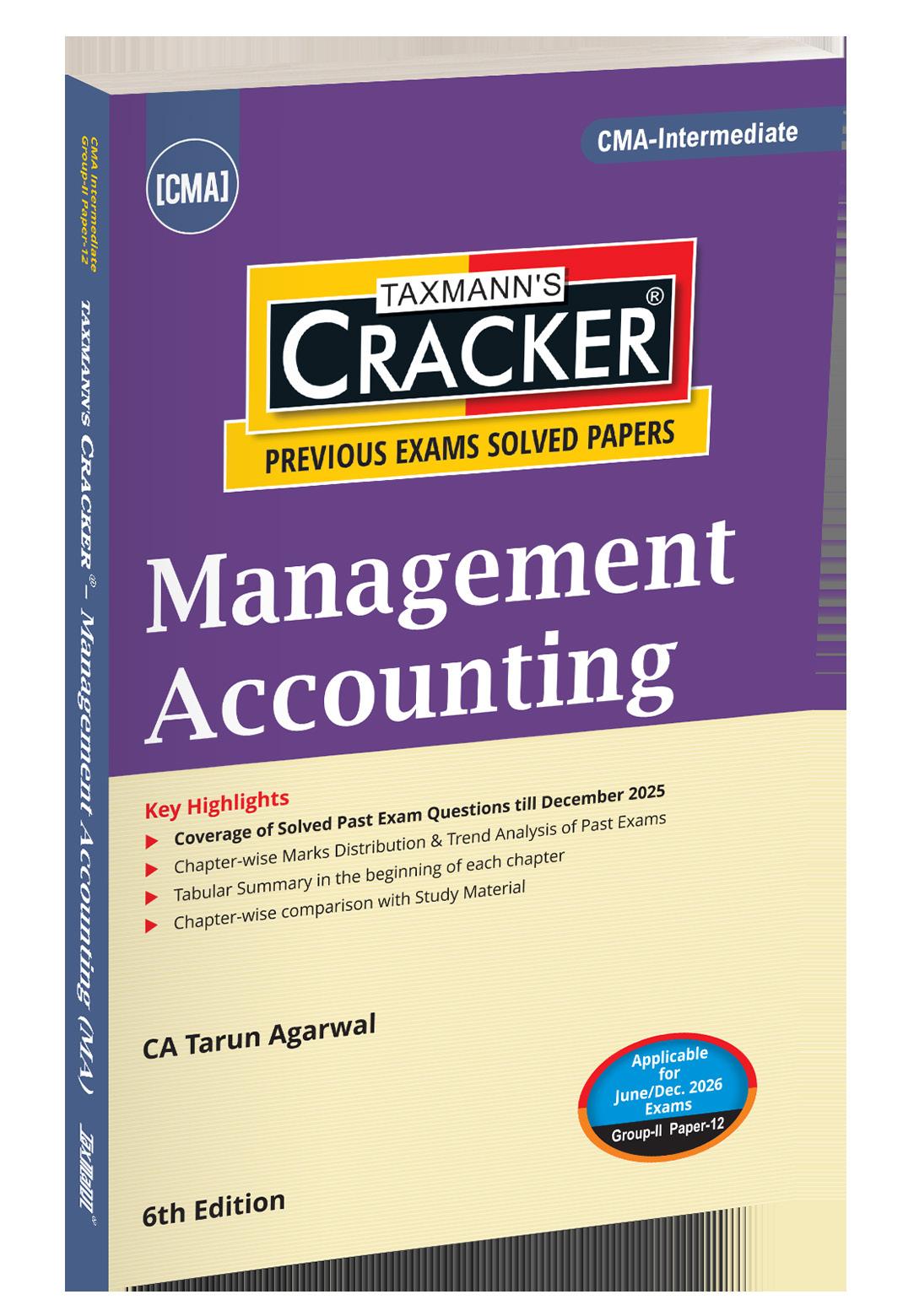
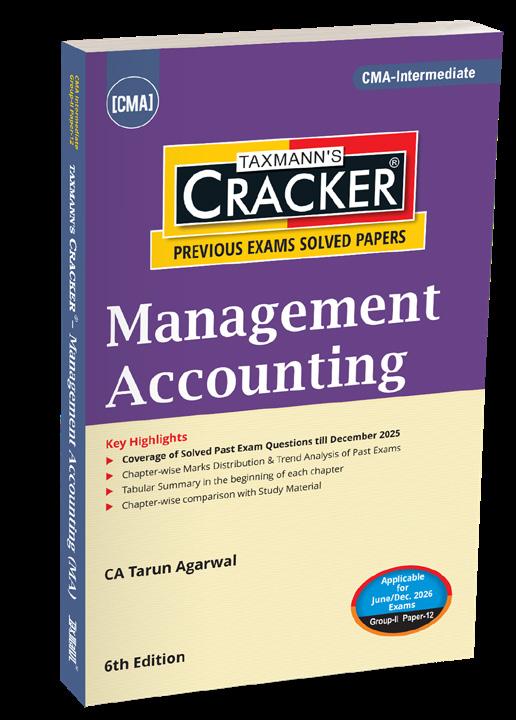
Management Accounting – CRACKER is a focused, exam-oriented preparation resource for CMA Intermediate – Group II | Paper 12, designed to maximise scoring outcomes through systematic practice of past examination questions and trend-based prioritisation. The book compiles fully solved past exam questions up to December 2025, presented in an examiner-oriented format and supported by analytical tools that highlight high-weightage and frequently tested areas. This Edition is fully updated for the June/December 2026 CMA examination cycle, ensuring alignment with the latest syllabus, question patterns, and ICMAI’s evaluation approach.
The Present Publication is the 6th Edition, authored by CA. Tarun Agarwal, with the following noteworthy features:
• [Complete Coverage of Past Exam Questions] Fully solved CMA Intermediate examination questions up to December 2025
• [Chapter-wise Marks Distribution & Trend Analysis] Analytical insights into marks allocation, recurring topics, and examiner focus areas
• [Tabular Summary at the Beginning of Each Chapter] Quick-reference tables outlining topic coverage, exam frequency, and marks trends
• [Chapter-wise Comparison with Study Material] Direct cross-referencing with ICMAI Study Material to ensure syllabus completeness