
Sample Read





Maintenance and Welfare of Parents and Senior Citizens Act, 2007
[56 OF 20071]
An Act to provide for more effective provisions for the maintenance and welfare of parents and senior citizens guaranteed and recognized under the Constitution and for matters connected therewith or incidental thereto.
BE it enacted by Parliament in the Fifty-eighth Year of the Republic of India as follows:—
CHAPTER I
PRELIMINARY
Short title, extent, application and commencement.
1. (1) This Act may be called the Maintenance and Welfare of Parents and Senior Citizens Act, 2007.
(2)It extends to the whole of India 2[***] and it applies also to citizens of India outside India.
(3)It shall come into force in a State on such date3 as the State Government may, by notification in the Official Gazette, appoint.
Definitions.
2. In this Act, unless the context otherwise requires,—
(a) “children” includes son, daughter, grandson and grand-daughter but does not include a minor;
(b) “maintenance” includes provision for food, clothing, residence and medical attendance and treatment;
(c)“minor” means a person who, under the provisions of the Majority Act, 1875 (9 of 1875), is deemed not to have attained the age of majority;
1.Dated 29-12-2007.
2. Words “except the State of Jammu and Kashmir” omitted by the Jammu and Kashmir Reorganisation Act, 2019, w.e.f. 31-10-2019.
3. Notification No. F.JD (A)/WO/Sr. Citizen Maint. Bill/DSW/2005-06,dated 8-9-2008—In exercise of powers conferred by sub-section (3) of Section I read with clause (1) of Section 2 of “The Maintenance and Welfare of Parents and Senior Citizens Act, 2007”, the Lt. Governor of the National Capital Territory of Delhi, hereby appoints the 1st September, 2008, the date on which the said Act shall come into force.
(d) “parent” means father or mother whether biological, adoptive or stepfather or step-mother, as the case may be, whether or not the father or the mother is a senior citizen;
(
e) “prescribed” means prescribed by rules made by the State Government under this Act;
(
f) “property” means property of any kind, whether movable or immovable, ancestral or self-acquired, tangible or intangible and includes rights or interests in such property;
(
g) “relative” means any legal heir of the childless senior citizen who is not a minor and is in possession of or would inherit his property after his death;
(
h) “senior citizen” means any person being a citizen of India, who has attained the age of sixty years or above;
(i) “State Government”, in relation to a Union territory, means the administrator thereof appointed under Article 239 of the Constitution;
(j) “Tribunal” means the Maintenance Tribunal constituted under section 7;
(
k) “welfare” means provision for food, health care, recreation centres and other amenities necessary for the senior citizens.
Act to have overriding effect.
3. The provisions of this Act shall have effect notwithstanding anything inconsistent therewith contained in any enactment other than this Act, or in any instrument having effect by virtue of any enactment other than this Act.
CHAPTER II
MAINTENANCE OF PARENTS AND SENIOR CITIZENS
Maintenance of parents and senior citizens.
4. (1) A senior citizen including parent who is unable to maintain himself from his own earning or out of the property owned by him, shall be entitled to make an application under section 5 in case of—
(i) parent or grand-parent, against one or more of his children not being a minor;
(ii) a childless senior citizen, against such of his relative referred to in clause (g) of section 2.
(2) The obligation of the children or relative, as the case may be, to maintain a senior citizen extends to the needs of such citizen so that senior citizen may lead a normal life.
(3) The obligation of the children to maintain his or her parent extends to the needs of such parent either father or mother or both, as the case may be, so that such parent may lead a normal life.
(4) Any person being a relative of a senior citizen and having sufficient means shall maintain such senior citizen provided he is in possession of the property of such senior citizen or he would inherit the property of such senior citizen:
Provided that where more than one relatives are entitled to inherit the property of a senior citizen, the maintenance shall be payable by such relative in the proportion in which they would inherit his property.
COMMENTS
CASE LAWS
Eviction without maintenance proof set aside - A mother-in-law filed a complaint before the Tribunal under the Act seeking eviction of her son and daughter-in-law from a jointly owned ancestral flat, citing ill-treatment. The daughter-in-law opposed the complaint, asserting her right to reside in the shared household along with her ailing husband and minor daughter. The Tribunal ordered eviction, relying on general observations about quarrels and the need for peaceful living for the senior citizen, without any finding of neglect or refusal to maintain by the children. The Bombay High Court held that such summary eviction without establishing neglect or denial of maintenance was not legally sustainable. The Court emphasized that under section 4, eviction can only follow proof of such grounds. Additionally, since the property was found to be jointly owned and possibly ancestral, and the daughter-in-law claimed a shared household right under the Domestic Violence Act, 2005, the Tribunal had to consider and balance both statutory rights. Accordingly, the eviction order was quashed and the matter remanded for fresh adjudication after due inquiry. — Ritika Prashant Jasani v. Anjana Niranjan Jasani AIRONLINE 2021 BOM. 2875.
Maintenance from beneficiary of property - An elderly widow challenged the Will executed by her deceased husband, who had bequeathed his entire agricultural property and house to a neighbour. Though the Courts upheld the Will’s validity, she pleaded that, being old and without independent means, it would be difficult to maintain herself. Initially, the neighbour offered to let her reside in the house or alternatively pay ` 3,000 per month from the property income. She later accepted the offer but requested enhancement. The Supreme Court, while confirming the lower court orders on the Will, directed that the neighbour, as the beneficiary of the property, must pay ` 7,500 per month to the appellant during her lifetime towards maintenance under section 4 of the Act. It held that a person who inherits property has a corresponding moral and legal obligation to maintain the dependent elderly, especially where the dependent is the testator’s widow. — Shewantabai v. Arun AIRONLINE 2019 SC 996.
Maintenance not barred by parental property - A senior citizen mother filed an application under the Act seeking maintenance from one of her three sons, asserting inability to sustain herself despite having a share in inherited property. The Sub-Divisional Magistrate awarded her ` 2,000 per month, which was upheld on appeal. The son challenged this, arguing that the mother was financially independent due to property income. The Punjab and Haryana High Court rejected this contention, clarifying that the Act does not impose an absolute bar on maintenance merely because a parent has property. If the senior citizen cannot meet basic needs from income or property, she is entitled to claim maintenance under section 4. The Court affirmed that the Act’s welfare objective must be interpreted liberally, and emphasized that appeal against such maintenance orders lies before the District Magistrate under section 16, not the District Judge. — Dhian Singh v. State of Punjab AIR 2017 (NOC) 545 (P. & H.).
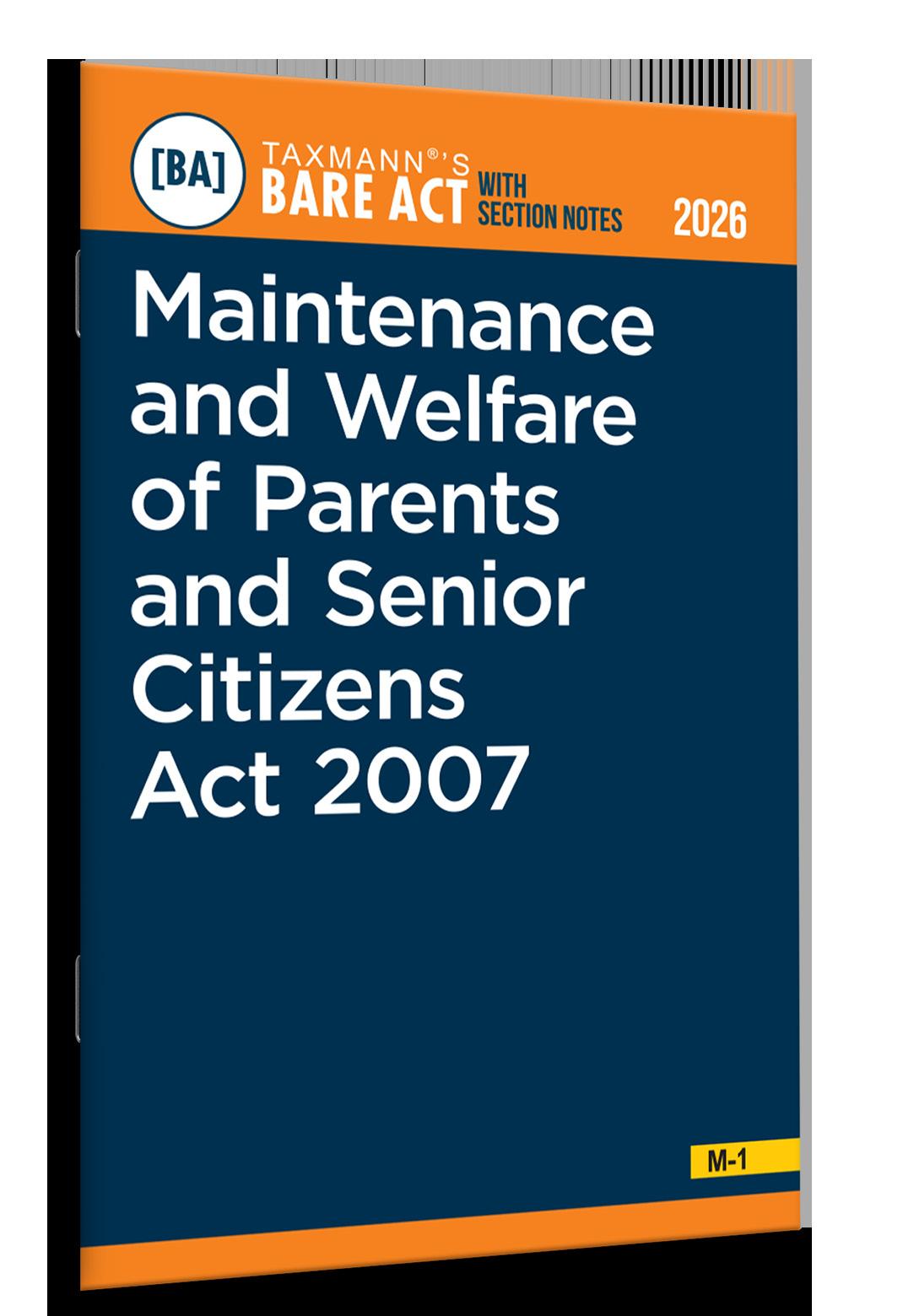
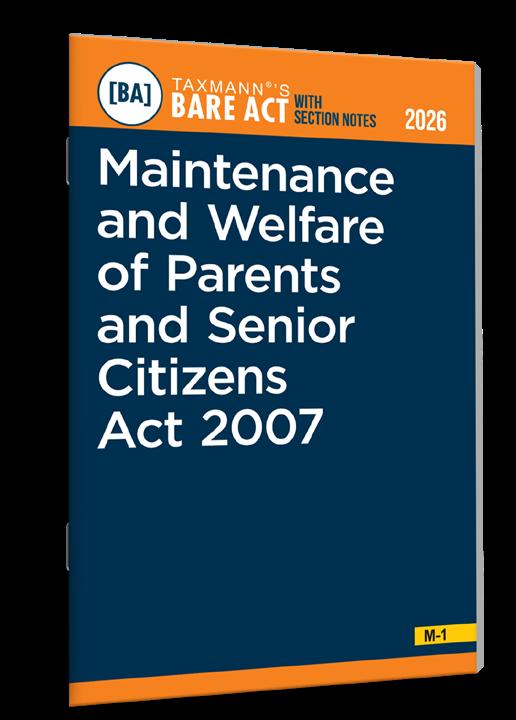
Maintenance and Welfare of Parents and Senior Citizens Act 2007 – Bare Act with Section Notes
AUTHOR : Taxmann’s Editorial Board
PUBLISHER : Taxmann
DATE OF PUBLICATION : December 2025
EDITION : 2026 Edition
ISBN NO : 9789371265515
No. of Pages : 28
BINDING TYPE : Paperback
Rs. 85
DESCRIPTION
Maintenance and Welfare of Parents and Senior Citizens Act, 2007 [Bare Act with Section Notes] by Taxmann is a practical, updated resource on the law that guarantees the maintenance, protection, and welfare of parents and senior citizens in India. The 2026 Edition brings together the amended text of the Act, relevant rules, and authoritative section notes—providing a reliable reference, compliance, and litigation guide. With clear section notes and key case law summaries, this Edition connects statutory provisions with practical judicial interpretation, making it indispensable for anyone engaged in elder law, welfare administration, or public policy.
This book is intended for the following audience:
• Legal Practitioners, Judges & Law Firms
• District Magistrates, Social Welfare Departments & Enforcement Agencies
• Senior Citizens, Parents & Families
• NGOs, Social Workers & Policy Makers
• Academicians, Law Students & Researchers
The Present Publication is the 2026 Edition, covering the amended and updated text of the Maintenance and Welfare of Parents and Senior Citizens Act [Act No. 56 of 2007] and Rules, with the following noteworthy features:
• [Comprehensive Statutory Coverage] Full, updated text of the Act and allied rules
• [Section-wise Notes & Expert Commentary] Clear explanations and legislative background for each provision
• [Exhaustive Case Law Digest] Summaries of key Supreme Court and High Court decisions on maintenance, property, tribunals, and protection of senior citizens
• [User-friendly Structure] Organised content, subject index, and clear notes for practical use
• [Latest Developments] Incorporates recent amendments and major judicial pronouncements up to date
• [Practical Compliance Guidance] Stepwise procedures for applications, property protection, and enforcement
• [Focused Analysis of Offences & Enforcement] Coverage of abandonment, penalties, offences, and enforcement
• [Practical Utility] Ideal for courts, tribunals, research, and policy formulation, as well as for citizens seeking to understand their rights