

Sample Read

© Taxmann
Price : ` 295
Law stated in this book is as updated till 1st May, 2026
Published by : Taxmann Publications (P.) Ltd.
Sales & Marketing :
59/32, New Rohtak Road, New Delhi-110 005 India
Phone : +91-11-45562222
Website : www.taxmann.com
E-mail : sales@taxmann.com
Regd. Office :
21/35, West Punjabi Bagh, New Delhi-110 026 India
Printed at :
Tan Prints (India) Pvt. Ltd.
44 Km. Mile Stone, National Highway, Rohtak Road Village Rohad, Distt. Jhajjar (Haryana) India
E-mail : sales@tanprints.com
Disclaimer
Every effort has been made to avoid errors or omissions in this publication. In spite of this, errors may creep in. Any mistake, error or discrepancy noted may be brought to our notice which shall be taken care of in the next edition. It is notified that neither the publisher nor the author or seller will be responsible for any damage or loss of action to any one, of any kind, in any manner, therefrom. It is suggested that to avoid any doubt the reader should cross-check all the facts, law and contents of the publication with original Government publication or notifications.
No part of this book may be reproduced or copied in any form or by any means [graphic, electronic or mechanical, including photocopying, recording, taping, or information retrieval systems] or reproduced on any disc, tape, perforated media or other information storage device, etc., without the written permission of the publishers. Breach of this condition is liable for legal action.
For binding mistake, misprints or for missing pages, etc., the publisher’s liability is limited to replacement within seven days of purchase by similar edition. All expenses in this connection are to be borne by the purchaser. All disputes are subject to Delhi jurisdiction only.
FAQs ON THE PROMOTION AND REGULATION OF ONLINE GAMING ACT, 2025
BAN ON ONLINE MONEY GAMES
1. Does the Promotion and Regulation of Online Gaming Act, 2025, ban all online games?
2. Is there any overlap between the definitions of e-Sports, Online Money Games and Online Social Games?
3. Is the ban on Online Money Games already effective from 22-08-2025 (the date of Presidential Assent)?
Can one play an online game and win performance-based prize money once the Act comes into force from notified date?
6. What happens to the deposits made by players/users/participants with Online Money Gaming platforms? Can they get refunds?
7. Is there any time limit within which users/players of online money games have to act in order to get their money/deposits back?
8. Can the Online Money Gaming platforms carry on refunds of deposits received by them from players/winnings or prize money credited to wallets?
9. If players of games withdraw their deposits or stakes from online money game wallets after the Act (ban on online money games) comes into force, will they be committing any illegality?
What is the definition of “Online Money Game” under the Act?
Whether game based on skill is excluded from the ambit of “online money game”?
Whether an online puzzle would come within the ambit of “online money game” and the ban on such games?
What if online game allows user to buy virtual coins/tokens to play the game, does not pay out any winnings to user and instead only allows him to buy more virtual coins/tokens to play more games?
Does the ban apply to all the above types of online money gaming/ online real money gaming enumerated in
Are the plea bargaining provisions in Chapter XXIII (Sections 289 to 300) of the Bharatiya Nagarik Suraksha Sanhita, 2023, applicable to offences under this Act?
If online money games continue to be offered after the Act comes into force, will those playing online money games be liable for punishment under the Act?
25. If online money games continue to be offered after the Act comes into force, will those playing online money games (users of online money gaming service) be liable for punishment under section 112 of the Bharatiya Nyaya Sanhita, 2023?
Whether the ban would apply only to Online Money Games offered on the internet? Or will it apply to such games played by authorised users on the intranet in gaming zones or parlours?
Whether the ban on online money games would apply to online money games played by authorised users on the intranet in gaming zones or parlours?
30. What was the categorisation of online games in the 2021
Whether there is any concept of ‘permissible online real money game’ under the Act?
33. What are the changes made by the Act in regulatory and legal framework for online games vis-a-vis the 2021 Rules?
What happens to the extant regulations in 2021 Rules regarding online real money games after the Act comes into force on 1-5-2026?
Whether public can file complaints if they come across any online money games operating once the Act comes into force?
DEFINITION OF “ONLINE GAME”
What are the changes made in the definition of “Online Game” by the Act vis-a-vis the definition in the 2021 Rules?
What are the implications of the changes made by the Act in definition of “online game”?
E-SPORTS
E-sports also involves player paying registration or participation fees and winning performance-based prize money. Will that be considered wagering and attract the ban applicable to Online Money Games?
45. What if an e-sports allows betting on the outcome of an e-sports competition?
46. Is it compulsory for as e-sports to register itself with the Authority (Online Gaming Authority of India)?
47. What happens if the character of an e-sports changes at any point of time to involve placing of bets, wagers or other stakes and winning out of such bets, wagers or any other stakes?
48. Can the registration of e-sports under this Act be suspended or cancelled?
ONLINE SOCIAL GAMES
Is an online social game allowed to pay any Prize Money to its players?
51. Can an Online Social Media Game pay a cashback of a part of a subscription fee or one-time access fee if the player/participant successfully completes games of a particular level?
52. When would subscription fee or one-time access fee collected by Online Social Gaming be considered to be in the nature of a stake or wager?
53. Can Online Social Games offer 100% cashback of subscription fee or one-time access fee if the player/participant successfully completes games of a particular level?
Is it compulsory for an online game service provider to register any online social game offered by him?
55. Can a person offering online money game make it a free-to-play online social game by discontinuing all contests to avoid ban and consequences once the Act comes into force?
56. Can the registration of online social money game under this Act be suspended or cancelled?
REGISTRATION OF ONLINE GAMES
57. If an online service provider offers 5 online social games, does the online game service provider have to get registered with the Online Gaming Authority of India?
58. Suppose an online service provider offers 5 unregistered online social games, and none of them requires registration, as none of them falls in any notified category. Does he need to maintain an internal grievance redressal mechanism to redress users’ grievances?
59. Suppose an online game service provider offers 5 online social games, of which 3 are registered as these 3 fall in the notified categories. Will the cancellation or suspension of registration of one of these 3 registered social online games result in automatic cancellation or suspension of registration of the other 2 registered online social games as well?
60. Is it mandatory for existing e-sports to apply to Online Gaming Authority of India for determination order as to nature of the game?
CHAPTER 1
INTRODUCTION
4.2
CHAPTER 5
ONLINE GAME
5.1.6 Comparison of definitions of “Online game” in section 2(1)(f) of the Act, Rule 2(1)(qa) of the 2021 Rules and Explanation (iii) of section 115BBJ of the Income-tax Act,
CHAPTER 6
CHAPTER 7
E-SPORTS
CHAPTER 8
CHAPTER 10
DETERMINATION
CHAPTER 11
REGISTRATION OF ONLINE GAMES
CHAPTER 12
CHAPTER 13
PUNISHMENT FOR VIOLATION OF PROHIBITIONS ON ONLINE MONEY GAMES
CHAPTER 14
INVESTIGATION & SEARCH AND SEIZURE
CONSEQUENCES
CHAPTER 15
GAMES
15.1
15.2 Prosecution/criminal liability if character of the online game offered/organised has changed from e-sports/online social game to online money game after the registration
CHAPTER 16
APPENDICES
APPENDIX V : GOVERNMENT USHERS IN NEW ERA OF RESPONSIBLE ONLINE GAMING THROUGH STRICT GUIDELINES FOR ENSURING SAFETY OF DIGITAL NAGRIKS AND ACCOUNTABILITY OF ONLINE GAMING INDUSTRY
APPENDIX VI : GOVERNMENT STRENGTHENS REGULATIONS FOR ONLINE GAMING TO ENSURE TRANSPARENCY AND USER SAFETY
APPENDIX VII : THE STATEMENT OF OBJECTS AND REASONS TO THE PROMOTION AND REGULATION OF ONLINE GAMING BILL, 2025
APPENDIX VIII : SECTION 112 OF BHARATIYA NYAYA SANHITA, 2023
APPENDIX IX : SECTION 115BBJ/SECTION 194BA OF INCOME-TAX ACT, 1961
APPENDIX X : SECTION 194/SECTION 393(3) OF INCOME-TAX ACT, 2025

ONLINE MONEY GAMES
Introduction
6.0
The Act completely bans harmful online money games and prescribes stringent punishment for violation of the prohibitions contained in Sections 5 to 7 of the Act [See Chapter 9] . Violation of the bans in Sections 5 and 7 and cognisable and non-bailable. Therefore, the definition of ‘online money game’ is crucial.
Definition of “Online Money Game”
6.1
Section 2(1)(g) of the Act defines “online money game” to mean an online game which fulfils the following conditions:
It is not an e-sports; [Para 6.1-1]
It does not matter whether the game is based on skill, chance, or both, [Para 6.1-2]
It is played by a user [Para 6.1-3] by paying fees, depositing money or other stakes in expectation of winning which entails monetary and other enrichment in return of money or other stakes; [Para 6.1-4]
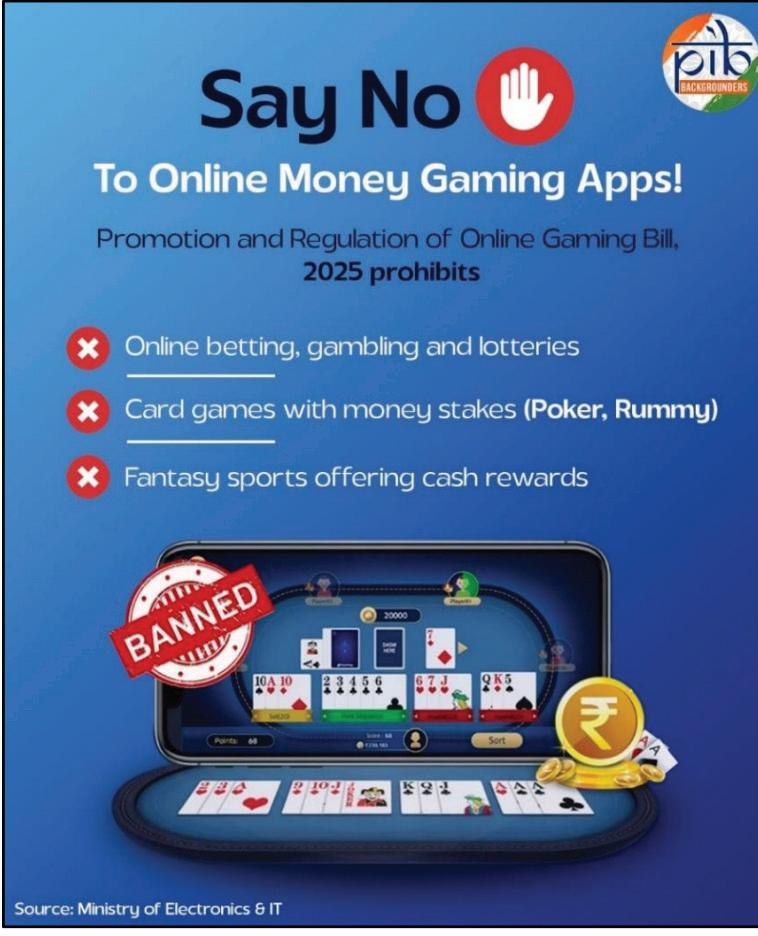
Online Money Game, as defined above, is what is currently known as Online Real Money Game. Rule 2(1)(qd) of the 2021 Rules defines “Online Real Money Game” to mean an online game where a user makes a deposit in cash or kind with the expectation of earning winnings on that deposit. The Explanation below Rule 2(1)(qd) clarifies that ‘winnings’ means any prize, in cash or kind, which is distributed or intended to be distributed to a user of an online game based on the performance of the user and in accordance with the rules of such online game. Some popular Online Real Money Games in India are as follows:
1. Fantasy Sports: Players create virtual teams comprising real-life athletes and earn points based on their performance in actual matches. Examples are Dream 11 and MPL.
2. Rummy: Players compete to form sequences or sets of cards, and the winner takes home cash prizes.
3. Poker: Examples of online Poker are Texas Hold’em and Omaha.
4. Teen Patti: It is a card game in which players bet on the strength of their cards. The game involves elements of skill and strategy.
5. Online Casinos: Many offshore platforms offer casino games like slots, blackjack, and roulette.
All these come within the scope of “Online Money Game” as defined in Section 2(1)(g) and are completely banned by the Act.
E-sports
is not characterised as OMG
6.1-1
The definition of Online Money Game in section 2(1)(g) expressly excludes e-sports from the scope of the term “Online Money Game”. To be characterised as e-Sports, the online game must be duly recognised under the National Sports Governance Act, 2025 and registered with the Authority or agency under section 3 of the Act. Rule 12(3) of the Promotion and Regulation of Online Gaming Rules, 2026 provides that an Online money game shall not be eligible for recognition or registration as an e-sport under National Sports Governance Act, 2025. An online e-sports game charging registration or participation fees and paying prize money to winner looks similar to an online money game collecting wagers or bets and paying out winnings
to the winner. However, e-sports is substantially financed by sponsorships, sale of television rights, endorsements on sports merchandise etc. The participation fees recovered from participants may recover administrative cost and may serve to ensure that there are not too many participants. However, the participation fees is unlikely to be sufficient to pay the prize money and other costs of the competition. Bulk of the funding of e-sports would be from sponsorships as sponsors would like to advertise their products and services among viewers of the e-sports as would happen in real physical sports. It would be better if the Central Government fixes norms on what percentage of total receipts of an E-Sport for a financial year or a tournament can be by way of participation fees (say 5%/10%/20%). This will ensure avoiding litigation on whether an e-sports has become an Online Money Game.
Game of skill not excluded from the scope of the term “Online Money Game” 6.1-2
Section 12 of the Public Gambling Act,1867 provides that sections 1 to 11 of the said Act shall not apply to a mere game of skill. In other words, playing a mere game of skill would not amount to playing for stakes(gambling). Based on this, the Courts evolved the ‘Game of Skill v. Game of Chance test’ to determine if a game is in the nature of gambling or betting, etc. If it is shown that the game is primarily a game of skill, the Courts have held that winning cannot be said to be from gambling. All games, naturally, consist of elements of both, i.e., elements of chance and skill. In State of Andhra Pradesh v. K Satyanarayana AIR 1968 SC 825, the Apex Court has held the expression “game of mere skill” means “mainly and preponderantly a game of skill”. In this case, the Court held that the game of rummy is a game of skill. In Gurdeep Singh Sachar v. UOI [2019] 106 taxmann.com 290/75 GST 258/30 GSTL 441 (Bombay), it was held that online fantasy sports is a game of skill. SLP against this decision was dismissed by Supreme Court vide Gurdeep Singh Sachar v. UoI [2020] 115 taxmann.com 201 (SC)
The Indian Courts have adopted the “Dominant Factor Test” or “Predominance Test” to determine the question of “game of skill”. [K Satyanarayana (supra) and Rex v. Fortier 13 Q.B. 308] A game of chance and a game of skill is distinguished by the characteristics of the dominating element that ultimately determines the result of the game.
The words “irrespective of whether such game is based on skill, chance, or both” have been added in section 2(1)(g) to overcome the above judicial rulings so that the prohibition(ban) on Online Money Games covers all Online Money games whether based on skill or chance or both. The Central Government’s Press Release, dated 21.08.2025, clarifies that “The Bill imposes a complete ban on online money games. This applies to games of chance, games of skill, and those that combine both. Advertising and promotion of such games is strictly prohibited. Financial transactions related to these platforms cannot be processed by banks or payment systems. Authorities will also be empowered to block access to unlawful platforms under the Information Technology Act, 2000.”
User 6.1-3
Section 2(1)(m) defines “user” to mean any person who accesses or avails online game.
Played by a user by paying stakes in expectation of winning 6.1-4
According to Section 2(1)(g), Online Money Game is an online game played by a user by paying fees, depositing money or other stakes in expectation of winning, which entails monetary and other enrichment in return for money or other stakes. It does not matter whether the game is based on chance or skill or both. So, essentially, an online money game platform operates by accepting fees, deposits of money or other stakes from a user and by paying the user his winnings. Thus, an existing online money game can avoid the illegality of violating the ban by simply stopping accepting fresh deposits/stakes from users and by letting users withdraw the amounts to their credit,
As the definition of “online money game” in Section 2(1)(g) excludes “e-sports”, it would be instructive to look at the definition of “e-sports” also. Sub-clause (v) of Clause (c) of sub-section (1) of Section 2(definition of ‘e-sports’) states that, for an online game to qualify as an e-sports, such game shall not involve not involve the placing of bets, wagers or any other stakes by any person, whether or not such person is a participant, including any winning out of such bets, wagers or any other stakes. In other words, Section 2(1)(c)(v) stipulates that e-sport should not have the essential ingredient of an online money game.
There is no contradiction between Section 2(1)(g) and Section 2(1)(c)(v) . Section 2(1)(g) states the essential feature of an online money game from the standpoint of the user/player/participant. Section 2(1)(c)(v) states it from the standpoint of the online money gaming platform in terms of the financial/operating model followed by it. According to Section 2(1)(c)(v), an online money game involves “the placing of bets, wagers or any other stakes by any person, whether or not such person is a participant, including any winning out of such bets, wagers or any other stakes”. What is mentioned in Section 2(1)(c)(v) is the “winning prize pool” format/model followed by Online money games. In this format/model, the gaming platform receives deposits from the players through authorised payment gateways. The platforms have no right to such deposits until the user uses the deposit to play a game. When a user pools the amount into game play, the platform deducts a portion of the stake as a rake fee for facilitating the game. The remaining stake (net of the rake fee) is considered the winning prize pool, and players compete against each other. The platform does not participate in the game but instead serves as a facilitator. The entire prize pool is distributed to the contest winner(s) as per the defined rules. Users are free to withdraw their winnings to their bank account or use them for further game play. The best example of such a format is online card-based games or fantasy sports. If an e-sports does what is spelt out in Section 2(1)(c)(v) (the winning pool prize format), the Authority or agency can invoke powers of suo motu inquiry to determine whether the e-sports has changed character to an online money game since its registration by Authority or Agency as an e-sport and accordingly de-register it and take further action.
No Category of Permissible Online Real Money Game in the Act
6.1.5
Rule 2(1)(qf) of the 2021 Rules defines ‘permissible online real money game’ means an online real money game verified by an online gaming self-regulatory body under rule 4A. Rule 4A(3) provides that the online gaming self-regulatory body, upon an application made to it by its member in respect of an online real money game, may declare such online real money game as permissible online real money game, if,
after making such inquiry as it deems fit, it is satisfied that—
(a) the online real money game does not involve wagering on any outcome; and
(b) the online gaming intermediary and such online game is in compliance with the provisions of rules 3 and 4, the provisions of any law relating to the age at which an individual is competent to enter into a contract, and the framework made by the online gaming self-regulatory body under sub-rule (8):
The Act does away with further categorisation of Online Real Money Games into permissible and non-permissible. The Act imposes a blanket ban on all Online Real Money Games.
Determination of whether an online game is an online money game by the Online Gaming Authority of India 6.2
Section 8(2)(a) of the Act provides that the Central Government may vest the Authority or agency, as the case may be, with the power to determine, on the receipt of an application from any person offering an online game or on suo motu basis, whether a particular online game is an online money game or otherwise, after making such inquiry as it deems necessary. Section 8(5) of the Act empowers the Authority or agency, as the case may be, to respond to the complaints relating to online games which are prejudicial to the interests of users, forwarded either in writing or in electronic mode.
Determination - When required
6.2-1
Rule 8 of the Promotion and Regulation of Online Gaming Rules, 2026 provides for the determination of an online game. Rules 8(1) provides that no online game of an online game service provider shall be required to be determined for the purpose of clause (a) of sub-section (2) of section 8 of the Act by the Authority, except where,—
(
a) the Authority, suo motu, directs an online game service provider to have one or more of its online games determined by it after issuing a notice to the online game service provider in accordance with clause (a) of subrule (1) of rule 10;
(b) the online game service provider intends such online game to be offered as an e-sport; or
(
c) the Central Government, by notification, requires a category of online social games to be determined, having due regard to the nature, volume or value of financial transactions or authorisation of funds permitted for participating in or accessing such online social game.
The online game service provider, for an online game required to be determined in accordance with clauses (b) and (c), shall apply to the Authority, in the digital Form published on the website or mobile based application of the Authority, as the case may be, containing such details as are specified in rule 23. [Rule 8(2)]
Rule 9 provides that for the purposes of determination under rule 8, the Authority shall have due regard to all or any of the following factors, namely:—
(a) whether the online game involves payment of fees, deposit of money or other stakes, by whatever name called, at any stage of participation in the online game;
(
b) whether users have an expectation of winning monetary or other enrichment in return for such money or other stakes deposited by them;
(
c) whether the payment of fees or deposits is used,—
(
i) in such manner that the online social game appears to be part of a competitive event between individuals or teams, conducted in multiplayer formats governed by predefined rules, or as payment of registration or participation fees solely for the purpose of entering the competition, or covering administrative costs for the event or as reward for performance based prize money;
(ii) in all other cases, as payment for accessing the online game as subscription fee or one-time access fee; or
(iii) as a bet, wager or any other stake in expectation of winning monetary or other stakes, including any winning out of such bets, wagers or any other stakes;
(
d) the structure and operation of the revenue model of the online game;
(e) the manner in which rewards, benefits or in-game assets may be transferred, redeemed, monetised or used outside the game environment.
Procedure for determination
Rules 10 provides for procedure for determination as follows:
(1) In making a determination under this Part, the Authority shall,—
(a) where such determination is undertaken suo motu,—
6.2-2
(i) issue a written notice to the online game service provider specifying the grounds of the proposed determination;
(ii) seek such information as may be deemed necessary for making a determination under this rule; and
(iii) provide a reasonable opportunity to submit representation and supporting material;
(b) where such determination is undertaken upon receipt of an application under sub-rule (2) of rule 8, examine the details provided by the applicant at the time of making an application, and—
(i) where the Authority considers that an application is incomplete or inadequate in any respect, it may, by notice, require the applicant to furnish such additional details and information within the time specified in the notice and the period taken for furnishing such details shall be excluded from the period specified in sub-rule (3);
(ii) the Authority may, for reasons to be recorded in writing, return an application where the details furnished are incomplete or insufficient for making a determination under this rule; and
(iii) upon being satisfied that the application is complete in all respects, the Authority shall make a determination under this rule;
(c) examine the technical architecture, game play mechanics, revenue model, user interface and such other details of the online game, as the case may be;
(d) where appropriate, seek expert or technical evaluation.
Determination order
Where the Authority,—
(
6.2-3
a) determines that an online game is an online money game, the Authority shall issue a determination order conveying its decision and may initiate any action under the provisions of the Act in relation to an online money game and issue such order in relation to such online money game as deemed necessary;
(
b) determines that an online game is not an online money game,—
(i) in respect of an application under sub-rule (2) of rule 8 in relation to an e-sport, the Authority shall inform the applicant that such online game is not an online money game and process the application for recognition and registration of such online game as an e-sport in accordance with sub-rule (3) of rule 13.
Explanation.—For the purpose of this sub-clause, information conveyed shall not amount to a determination order confirming the status of such online game as an e-sport;
(ii) in case of an online social game, the Authority shall issue a determination order conveying its decision that such online game is not an online money game; and
(iii) the Authority shall direct the online game service provider to inform the Authority of any changes in facilitation of payments in its online game prior to offering or making available such changes in the online game in such manner as may be published on the website or mobile based application or both, as the case may be, of the Authority.
Explanation.—For the purposes of sub-rule (2), a determination under the Act shall be specific to the particular online game and the particular online game service provider offering it and shall not amount to a determination of same or similar online games offered by any other online game service provider.
Time-bound determination
Rule 10(3) provides as follows:
6.2-4
(a) A determination under this rule shall, as far as practicable, be made within a period of ninety days from—
(i) the date of receipt of the complete application under sub-rule (2) of rule 8; or
(ii) the date of issuance of notice under clause (a) of sub-rule (1) of rule 8 in a suo motu proceeding;
(b) Where the determination is initiated suo motu, any time taken to obtain any information from the online game service provider upon issuance of notice under clause (a) of sub-rule (1) of rule 8 or any subsequent information shall be excluded from the period of ninety days.
Validity period of determination order
Rule 11 provides for the Validity of determination order as follows:
6.2-5
(1) A determination order shall be valid and subsisting for an online game till such time there are no changes to the online game offered by the online game service provider which affect the facilitation of payments or authorisation of funds for participating or accessing such online game.
(2) The Authority may undertake a periodic review of online games for which a determination order is issued under clause (b) of sub-rule (2) of rule 10, as it deems necessary.
(3) Where the Authority, suo motu or upon receipt of a complaint from any Ministry or Department or any agency of the Central Government or the State Government, has reasons to believe that the online game which has been determined in accordance with this rule has been modified in a manner that may require a fresh determination, the Authority may,—
(a) issue a notice to the online game service provider suspending the determination order issued to the online game service provider for such online game under sub-rule (2) of rule 10 and undertake an inquiry and provide the online game service provider an opportunity of being heard;
(b) upon conclusion of the inquiry under clause (a), where the Authority is of the opinion that the online game has been modified in a manner that,—
(
i) requires a fresh determination, issue an order withdrawing the determination order issued to the online game service provider for such online game under clause (b) of sub-rule (2) of rule 10 and direct the online game service provider to cease offering the online game till such fresh determination under this rule is completed; or (ii) makes such online game an online money game and shall proceed in accordance with clause (a) of sub-rule (2) of rule 10.
Compliance with direction of Central Government issued in relation to online money gaming service
6.3
Section 13 of the Act provides that every person shall comply with any direction issued by the Central Government in relation to online money gaming services. A question would arise here as to why Central Government shall issue any direction in relation to online gaming services since these are banned and illegal. It appears that Central Government would issue directions under section 13 to existing permissible online real money games regarding winding-up of their operations including refund of deposits from users and non-acceptance of fresh deposits. Strangely, there is no penalty or prosecution or imprisonment prescribed in the Act for violation of directions issued under section 13. Section 12(1) applies to directions issued under section 8(3) and not to directions issued under section 13.
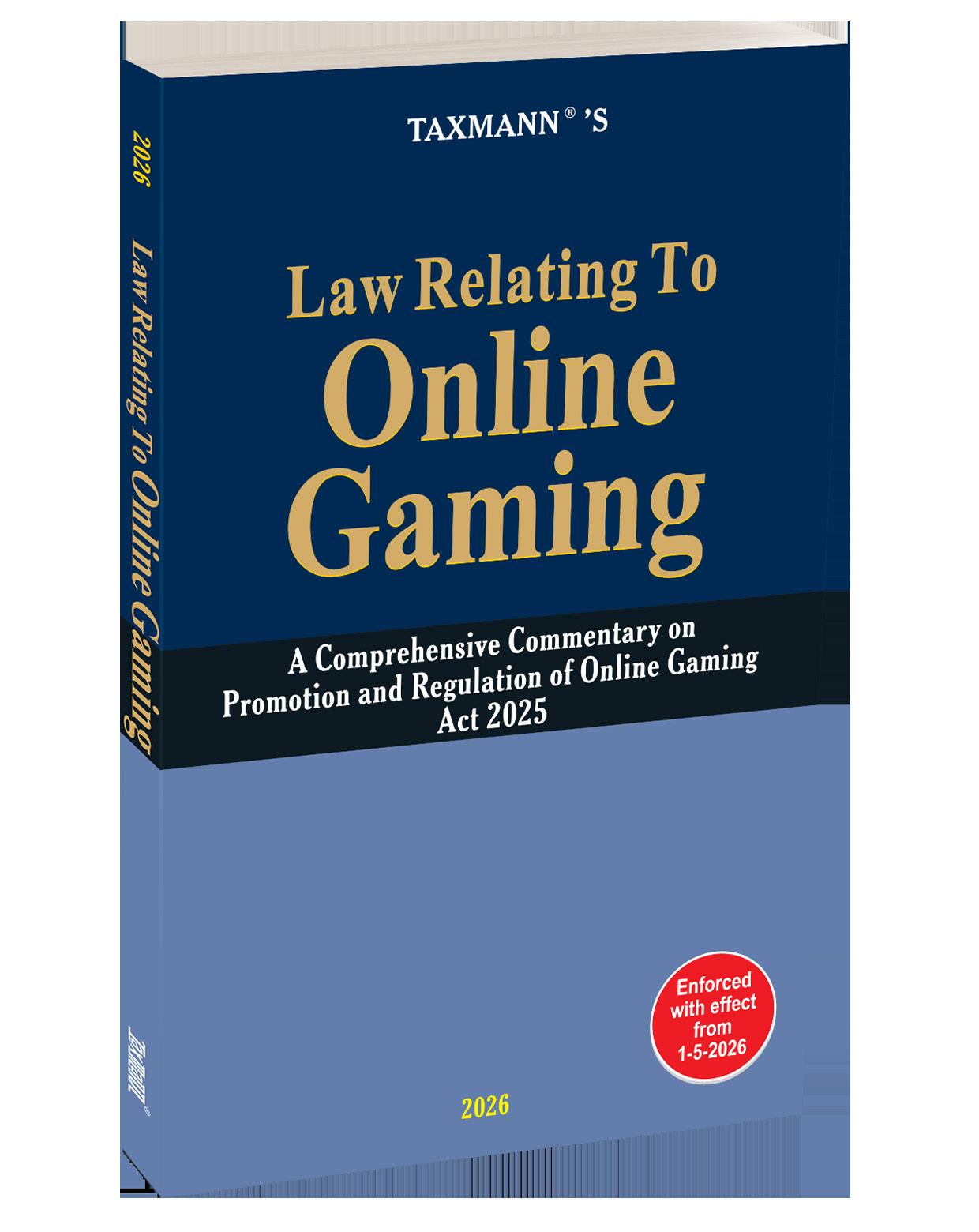
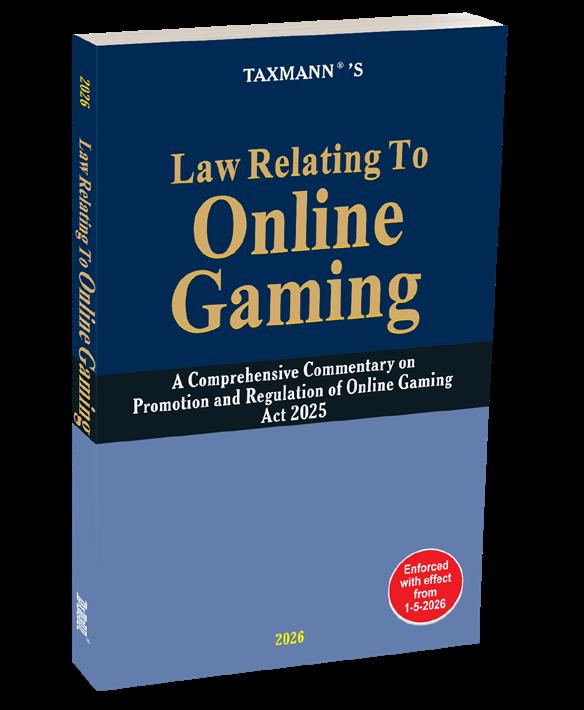
Law Relating to Online Gaming – A Comprehensive Commentary on Promotion and Regulation of Online Gaming Act 2025
AUTHOR : Taxmann’s Editorial Board
PUBLISHER : Taxmann
DATE OF PUBLICATION : May 2026
EDITION : 2026 Edition
ISBN NO : 9789371269261
No. of Pages : 192
BINDING TYPE : Paperback
DESCRIPTION
Law Relating to Online Gaming is a section-wise and rule-wise commentary on the Promotion and Regulation of Online Gaming Act 2025, brought into force with effect from 1-5-2026. The Act marks a structural break from the partial regime under the Information Technology (Intermediary Guidelines and Digital Media Ethics Code) Rules 2021 (as amended in 2023). It re-categorises online games into three mutually exclusive heads—e-Sports, Online Social Games, and Online Money Games—imposes a complete ban on Online Money Games (also known as Online Real Money Games) irrespective of skill, chance, or both, and provides a registration-based regulatory framework for e-Sports and Online Social Games administered by the newly constituted Online Gaming Authority of India.
The commentary explains every operative provision of the Act, read with the Promotion and Regulation of Online Gaming Rules 2026 (notified on 22-4-2026), and traces the transition from the 2021 Rules to the new statutory regime. It places the Act in its wider legal context, including its interaction with Section 112 of the Bharatiya Nyaya Sanhita 2023, the TDS and taxability provisions on winnings under Sections 115BBJ and 194BA of the Income-tax Act 1961 (and Sections 194 and 393(3) of the Income-tax Act 2025), and the recognition mechanism under the National Sports Governance Act 2025. It is positioned as a working reference for stakeholders who need to understand obligations, prohibitions, penalties, and transitional issues in a single, compact volume.
This book is intended for the following audience:
• Online Gaming Companies, Fantasy-Sports Platforms, Real-Money Gaming Operators
• Online Social Game Publishers and Intermediaries
• In-House Counsel and Compliance Teams
• Banks, Payment Aggregators, Payment Gateways
• Lawyers Practising in Technology, Criminal, and Constitutional Law
• Tax Practitioners
• Venture Capital, Private Equity, and Public-Market Investors
• Policy Professionals, Regulators, and Ministry Officials
• Law Schools, Academic Institutions, and Researchers
The Present Publication is the 2026 Edition, updated up to 1st May 2026. This book is authored by Taxmann’s Editorial Board, with the following noteworthy features:
• [60+ Thematically-Grouped FAQs at the Front] Covers the ban on Online Money Games, the redrawn definition of ‘online game’, e-Sports, Online Social Games, registration, the obligation of existing e-Sports and Online Social Games to apply for a Determination Order, and prosecution of providers, organisers, and facilitators—giving fast operational orientation before the chapter-wise treatment
• [Section-wise and Rule-wise Commentary] Covers all 20 sections of the Act and all 26 rules (organised into six Parts) of the 2026 PROG Rules, with each statutory provision broken down ingredient by ingredient
• [Comparative Tables Throughout] Side-by-side comparison of the new Section 2(1)(f) definition of ‘online game’ against Rule 2(1)(qa) of the 2021 IT Rules and Explanation (iii) of Section 115BBJ of the Income-tax Act 1961, with parallel comparators for Online Money Game, e-Sports, and Online Social Game
• [Defined-Term Analysis with Boundary Cases] ‘Online game’, ‘online money game’, ‘online money gaming service’, ‘online social game’, ‘e-sport’, ‘user’, ‘winning’, ‘other stakes’, and ‘advertisement’ each analysed, with boundary cases worked through—puzzles, virtual coins/tokens, intranet gaming, cashbacks, subscription fees, and freemium models
• [Displacement of the Predominance Test] Treatment of how the Act overrides the judicial ‘Game of Skill v. Game of Chance’ test through the express words ‘irrespective of whether such game is based on skill, chance, or both’ in Section 2(1)(g), engineered to displace State of Andhra Pradesh v. K Satyanarayana (AIR 1968 SC 825) and Gurdeep Singh Sachar v. UoI (Bombay HC; SLP dismissed by SC) on fantasy sports
• [Case-Law Support] Vivek Narayan Sharma v. UOI (SC) on the construction of ‘any’; Pleasantime Products v. CCE (SC) on the distinction between ‘game’ and ‘puzzle’; Madeva Upendra Sinai v. UOI (SC), Krishnadeo Misra v. State of Bihar (Patna HC), and Straw Products Ltd. v. ITO (SC) on the scope, jurisdictional fact, and limits of the Removal of Difficulties (Henry VIII) clause
• [Treatment of Transitional and Operational Issues] Includes the omission of Draft Rule 24 (180-day refund window) from the final 2026 Rules, and the practical position on user wallet balances, withdrawals versus fresh deposits, and orderly winding-up of operations under Section 13 directions
• [Identification of Drafting Issues] Absence of a penalty for breach of Section 13 directions (contrasted with the Section 12 penalty for Section 8(3) directions), and the awkward language of Rule 7(6) on the revisional power of the Appellate Authority
• [Policy Rationale Integrated into the Analysis] Reproduction of the Statement of Objects and Reasons, government press releases, and PIB notifications, with the policy drivers—financial fraud, money-laundering, tax evasion, financing of terrorism, gaming addiction, and WHO classification of gaming disorder—woven into the commentary