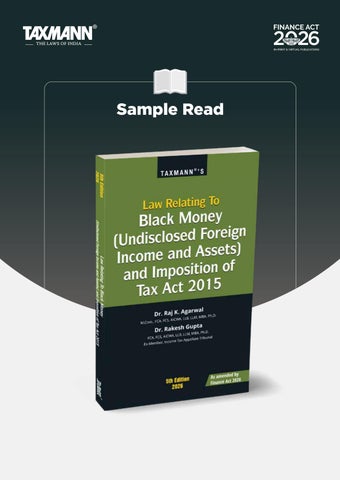
Sample Read
© All rights reserved
Price : ` 1125
Law stated in this book is as amended by the Finance Act, 2026
Published by : Taxmann Publications (P.) Ltd.
Sales & Marketing : 59/32, New Rohtak Road, New Delhi-110 005 India
Phone : +91-11-45562222
Website : www.taxmann.com
E-mail : sales@taxmann.com
Regd. Office : 21/35, West Punjabi Bagh, New Delhi-110 026 India
Printed at :
Tan Prints (India) Pvt. Ltd.
44 Km. Mile Stone, National Highway, Rohtak Road Village Rohad, Distt. Jhajjar (Haryana) India
E-mail : sales@tanprints.com
Disclaimer
Every effort has been made to avoid errors or omissions in this publication. In spite of this, errors may creep in. Any mistake, error or discrepancy noted may be brought to our notice which shall be taken care of in the next edition. It is notified that neither the publisher nor the author or seller will be responsible for any damage or loss of action to any one, of any kind, in any manner, therefrom. It is suggested that to avoid any doubt the reader should cross-check all the facts, law and contents of the publication with original Government publication or notifications.
No part of this book may be reproduced or copied in any form or by any means [graphic, electronic or mechanical, including photocopying, recording, taping, or information retrieval systems] or reproduced on any disc, tape, perforated media or other information storage device, etc., without the written permission of the publishers. Breach of this condition is liable for legal action.
For binding mistake, misprints or for missing pages, etc., the publisher’s liability is limited to replacement within seven days of purchase by similar edition. All expenses in this connection are to be borne by the purchaser. All disputes are subject to Delhi jurisdiction only.
Whether undisclosed foreign asset acquired or made prior to the commencement of this Act is required to exist as on 1-7-2015 before it can be assessed under this Act?
(v) Whether undisclosed foreign asset, not existing as on the date of coming to the notice of the Assessing Officer, can be brought to tax under this Act?
undisclosed foreign income relating to the previous year prior to commencement of this Act can be brought to
(vii) When can it be said that the source of investment in foreign asset is treated as ‘explained’? Whether undisclosed foreign asset can be explained from the untaxed income or capital receipts?
(viia) Settlor of foreign trust not liable to be taxed under BMA if source of investment is otherwise proved
(viii) When is a person who is beneficial owner or beneficiary of any asset located outside India but not having any taxable income in India, liable to file income-tax return and to disclose particulars of such assets in his income tax return?
(ix) In case of undisclosed foreign income or asset located outside India, residential status of the assessee is to be seen for which year i.e., the year in which such income is earned or asset is acquired or made, or the year in which asset comes to the notice of the Assessing Officer & notice under section 10 of this Act is issued? 64
(x) What may be the rationale for taking fair market value of undisclosed foreign asset, of the year in which it comes to the notice of the Assessing Officer for the purpose of assessment under this Act?
(xi) What would happen in case the previous year in which asset or income comes to the notice of AO and the previous year in which notice is issued are different years? 66
(xii) How the fair market value of undisclosed foreign asset is to be computed?
(xiii) Whether foreign income on which no income tax is payable in India can still be undisclosed foreign income under this Act?
(xiv) Whether credit for the taxes paid overseas qua undisclosed foreign income taxable under this Act can be claimed under this Act? Whether any relief as per treaty with foreign country would be available under this Act to the assessee?
(xv) Whether foreign income disclosed in the income tax return filed in response to notice under section 280 of the Income-tax Act, 2025 (corresponding to sections 148 and 153A of the Income-tax Act, 1961) can be said to be undisclosed foreign income to be assessed under this Act?
67
67
68
(xvi) Whether undisclosed foreign income or asset disclosed in the Updated Return filed under section 263(6) (a)to (e) and 263(9)(d) of the Income-tax Act, 2025 (corresponding to sub-section (8A) of section 139 of the Income-tax Act, 1961) may still be treated as undisclosed foreign income or asset under this Act?
(xvii) Whether foreign asset disclosed in Schedule FA of the income-tax return form or otherwise in the income tax return filed under sections 2(31), 263, 349 and Schedule VIII and its Table Sl. No. 1 [Column D(f)] of the Income-tax Act, 2025 (corresponding to section 139 of the Income-tax Act, 1961) can be said to be undisclosed foreign asset to be assessed under this Act?
(xviii) In case undisclosed foreign income is assessed under this Act, whether such assessed income can be again assessed under the Income-tax Act?
(xix) Where the quantum of foreign income declared in the income tax return filed under the Income-tax Act is not correct, the difference of such short declared foreign income can be brought to tax under this Act or under Income-tax Act? 72
(xx) What may be the implication of absence of the term ‘assessable’ in sub-clause (a) of clause (ii) of subsection (1) of section 5 in respect of foreign income relating to a period prior to commencement of this Act while in sub-clause (b), such word has been used for foreign income falling within the ambit of this Act? 73
(xxi) Whether variations made in the income during assessment under section other than the sections mentioned in section 4(2) would be undisclosed foreign income to be covered under this Act? What kind of such variations may be?
(xxii) What is the implication of the term ‘any income which is assessable under this Act’ as referred under section 5(1)(ii)(b) of this Act? In case source of undisclosed foreign asset is explained to be out of the untaxed income, whether the assessee is liable to be taxed on the total value of such undisclosed foreign asset?
(xxiii) What may be the implication of using only ‘immovable property’ in sub-section (2) of section 5?
73
75
5.3
(xxiv) What is the interplay between section 2(11) defining ‘undisclosed asset located outside India’ and section 5 providing the computation of total undisclosed foreign income and asset?
(xxv) In case any undisclosed foreign asset whose fair market value has been assessed under this Act, is disposed of later, whether such fair market value can be treated as cost of acquisition for computing capital gains/profits from the transfer of such asset?
(
)
4
TAX AUTHORITIES (SECTIONS 6 TO 9)
(i) Which tax authorities have been empowered to exercise jurisdiction under this Act & in what manner jurisdiction has been determined?
(ii) Which authorities are prescribed to exercise power under section 8 of this Act?
(iii) Whether Non-residents or Not-ordinarily residents can be summoned under section 8 of this Act?
(iv) Whether there is any time limit for issuing summons under section 8 of this Act & whether there is any time limit for seeking information relating to years prior to the commencement of this Act, under section 8 of this Act?
(v) Whether there is any power to search or conduct survey under this Act?
5
ASSESSMENT (SECTIONS 10 TO 14)
(i) Whether any separate tax return is required to be filed under this Act for making assessment or reassessment as per provisions of section 10 of this Act?
(ii) What may be the rationale for not providing any time-limit for initiating assessment or reassessment proceeding under this Act?
(iii) Whether recording of satisfaction is required by the Assessing Officer before issuing notice under section 10(1) of this Act?
(iv) Whether any approval of higher authority is required to be obtained before initiating proceeding of assessment or reassessment?
(v) Whether there is any provision for obtaining approval from higher authority before passing assessment or reassessment order?
(vi) Within how much time-limit notice under section 10 of this Act is to be issued by the Assessing Officer after the relevant information coming to his notice?
(vii) What is the nature of information or source of information on the basis of which proceeding under section 10 of this Act may be initiated?
(viia) Provisions of BMA can be pressed in service if undisclosed asset or income was in the knowledge of any governmental authorities, not necessarily the Assessing Officer, at the point when BMA came into force
(viii) Whether there is any threshold limit of the quantum of undisclosed foreign income or asset for the purpose or initiating proceeding under section 10 of this Act? (Limit of Rs. 5 lakhs in bank account is only for the purpose of penalty u/s 42)
(ix) Whether information disclosed in schedule FA of the income tax return can form the basis of initiating proceeding under this Act?
(x) Whether information collected from the public domain may form basis for the action under section 10 of this Act?
(xi) Whether information received or material collected as provided under section 10(3) of this Act is required to be confronted to the assessee before passing the assessment or reassessment order?
(xii) Whether assessment proceeding under this Act is to be conducted in faceless manner? 99
(xiii) Whether time limit for passing assessment or reassessment order under section 10 of this Act is to run from the issue of the notice or service of the notice under section 10 of this Act?
(xiv) Whether notice issued under sub-section (1) of section 10 of this Act can be challenged by way of writ before the High Court? 100
(xv) Whether fresh assessment or reassessment order can be passed as provided under section 11(2) of this Act when original order is cancelled or set aside without any further direction by the Tribunal? What kind of such situations there may be? Why under sub-section (2) of section 11 of this Act, only set aside or cancellation of assessment by the Tribunal alone has been contemplated?
(xvi) In what manner sub-section (2) of section 11 of this Act is different from sub-section (3) of section 11 of this Act? 101
(xvii) In case assessment of some undisclosed foreign income and asset has been made in wrong assessment year, whether such undisclosed income or asset can be assessed or reassessed in the year to which it belongs
(xviii) What would be consequence if mistake apparent from record is not rectified within six months from the end of the month in which application seeking rectification of such apparent error is received as provided under sub-section (5) of section 12 of this Act?
(xix) Whether assessment or reassessment under this Act can be made on a person other than the person who is beneficial owner?
102
103
104
6.4
APPEAL & REVISION (SECTIONS 15 TO 29)
(i) Jurisdiction to hear first or second appeal under this Act lies with whom?
(ii) Right to appeal is vested in whom - Whether the person assessed or the person aggrieved but not assessed?
(iii) Whether delay in filing appeal can be condoned by the first appellate authority or by the Appellate Tribunal and whether limiting such power up to one year is justified?
(iv) Whether Commissioner (Appeal) has power to reduce or enhance penalty under this Act? In case when quantum of addition is enhanced by Commissioner (Appeal), Whether there is power to impose penalty by Commissioner (Appeal) qua such enhancement?
(v) Whether additional evidence can be admitted by the appellate authority under this Act?
(vi) Whether any order other than the orders mentioned under section 15 of this Act may be appealable?
RECOVERY OF TAX & INTEREST (SECTIONS 30 TO 40)
(i) Whether tax demand raised under this Act can be recovered from domestic assets and income of the assessee?
(ii) At which stage Tax Recovery Officer (TRO) may draw certificate as provided under section 31 of this Act? Whether there are parallel power of recovery by the Assessing Officer and TRO?
(iii) Whether Assessing Officer can attach the property even before assessment under this Act?
(iv) How much salary of an employee on whom recovery is due under this Act, can be attached?
(v) What is the meaning of ‘debt becoming due’ as prescribed under section 32(5) for the purpose of recovery?
(vi) How can a debtor on whom garnishee recovery notice is served, raise objection against such notice?
(vii) When can a debtor be held as an assessee in default?
(viii) Whether recovery of the tax demand under this Act can be made from a person who is beneficial owner or beneficiary, but assessment is made in the case of some other person being the registered owner of the asset?
(ix) What is the procedure to recover the dues from the assets located outside India as prescribed under section 38?
(x) Whether tax demand has got precedence over the secured creditors under this Act?
(xi) Under what circumstances there may be personal liability of a Manager of a company as prescribed under section 35, for payment of tax demands under this Act & who can be the Manager for this purpose?
(xii) Whether interest under section 40 may be charged when assessment is made in respect of asset located outside India or only when assessment is made qua undisclosed foreign Income?
(xiii) Whether interest for late filing of return may be applicable under section 40 when income tax return under sections 2(31), 263, 349 and Schedule VIII and its Table Sl. No. 1 [Column D(f)] of the Income-tax Act, 2025 (corresponding to section 139 of the Income-tax Act, 1961) was filed but foreign income was not disclosed or short disclosed?
(xiv) Whether there are provisions under this Act for charging interest and imposing penalty corresponding to sections 411 and 412 of the Income-tax Act, 2025 (corresponding to sections 220, 221 of the Income-tax Act, 1961)?
(xv) How interest for non-payment of advance tax may be levied under this Act as provided under section 40(2) of this Act?
PENALTIES (SECTIONS 41 TO 47)
(i) Whether there is any time limit for initiation of penalty proceeding under section 41 of this Act?
(ii) Whether there is any time limit for initiation of penalty under sections 42, 43, 44 & 45 of this Act?
(iii) What are the time limits for passing the penalty order and whether pendency of first appeal can be ground for keeping the penalty proceeding under section 41 in abeyance?
(iv) Whether penalty under sections 42 and 43 can be levied under this Act even without assessment proceeding under this Act?
(v) Whether penalty under sections 42 & 43 can be levied under this Act even when source of foreign income and asset is not of unexplained nature?
(vi) Whether the provision of penalty of Rs. 10 lacs under sections 42 & 43 irrespective of the quantum of foreign income or asset, is justified?
(vii) Whether penalty provisions under sections 41, 42, 43, 44 & 45 are mandatory in nature?
(viii) What defences may be available to the assessee against the levy of penalty under section 41 of this Act and whether defence of reasonable cause can be pleaded?
(ix) Burden to prove reasonable cause for the purpose of Penalty under section 45 rests on whom? 155
(x) Whether the quantum of penalty under section 45 is for each default or for all the defaults put together?
(xi) Whether penalty under section 42 for failure to furnish return and under section 43 for furnishing inaccurate information in relation to foreign asset can be imposed independently for each year?
(xii) Whether there is any penalty provision under this Act for the offence of abetment on the lines of section 444 of the Income-tax Act, 2025 (Corresponding to section 271AAD of the Income-tax Act, 1961)?
(xiii) Whether penalty under sections 42 & 43 of this Act may be imposed in respect of foreign asset located outside India not disclosed in the Income-tax return filed prior to commencement of this Act but assessment under section 10 in respect of such foreign asset is made later under this Act as per provision of section 3 read with section 72( c) of this Act?
(xiv) Whether penalty under section 41 can be levied for undisclosed asset located outside India which was made or acquired prior to the commencement of this Act?
PROSECUTION (SECTIONS 48 TO 58)
(i) Whether there can be initiation of prosecution for evasion of tax, interest or penalty under this Act even without passing of the assessment order and/or penalty order under this Act? Whether prosecution for falsification of books can be initiated under this Act even before commencement of assessment proceeding under this Act, for the relevant assessment year?
(ii) Whether there can be parallel prosecution proceeding under this Act and under the Income-tax Act or any other Act for the same offence?
(iii) Whether prosecution under sections 49 & 50 for failure to furnish return in relation to foreign asset or for furnishing inaccurate information in relation to foreign asset may be initiated independently for each year?
(iv) Whether prosecution can be initiated under this Act for any evasion of tax irrespective of the quantum involved? What would be the consequence when threshold limit of Rs. 5 lacs in respect of one or more foreign bank account (Rs. 20 lacs in aggregate value of asset or assets other than immovable property as amended by the Finance Act, 2024 with effect from 1-10-2024) has not been given in the prosecution provisions under sections 49 & 50 (Prior to the amendment by Finance Act, 2026) whereas the above limit has been given for penalty provisions under sections 42 & 43 of this Act?
(v) Whether there is any time limit for initiation of prosecution proceeding under this Act?
(vi) Whether prosecution can be initiated for the offence prescribed under this Act but committed prior to the commencement of this Act?
(vii) Whether there can be prosecution of a person other than assessee for abetment?
DECLARATION SCHEME (SECTIONS 59 TO 72)
FOREIGN ASSETS OF SMALL TAXPAYERS DISCLOSURE
APPENDICES
u Notification No. 56/2015, dated 1-7-2015
u
No. 57/2015, dated 1-7-2015
u Notification No. 32/2022, dated 19-4-2022
u Notification No. 34/2022, dated 19-4-2022
u
u
No. 38/2022, dated 21-4-2022
No. 39/2022, dated 21-4-2022
No. 44/2022, dated 22-4-2022
u Sections 423, 424 & 425 of
u Section 42 of Black Money Act, 2015
u Sections 2(1)(b) & 6 of Chartered Accountants Act, 1949
Charge, Scope & Computation
of Total Undisclosed Foreign Income & Asset (Sections
3, 4 & 5)
3.1 TEXT OF SECTION 3
Charge of tax
3. (1) There shall be charged on every assessee for every assessment year commencing on or after the 1st day of April, 2016, subject to the provisions of this Act, a tax in respect of his total undisclosed foreign income and asset of the previous year at the rate of thirty per cent of such undisclosed income and asset: Provided that an undisclosed asset located outside India shall be charged to tax on its value in the previous year in which such asset comes to the notice of the Assessing Officer.
(2) For the purposes of this section, “value of an undisclosed asset” means the fair market value of an asset (including financial interest in any entity) determined in such manner as may be prescribed.
3.2 NOTES ON CLAUSES
Clause 3—provides for charge of tax. It provides that every assessee shall be liable to tax in respect of his total undisclosed foreign income and asset at the rate of thirty per cent of such undisclosed income and asset. It also defines the term “value of an undisclosed asset” to mean the fair market value of an asset (including financial interest in any entity) determined in the prescribed manner.
3.3 SALIENT FEATURES OF SECTION 3
(i) Applicable to whom?
As per section 3 of the Act regarding charge of tax, this Act is applicable to every ‘assessee’. ‘Assessee’ has been defined under section 2(2) of the Act to mean a person, –– (a) being a resident in India within the meaning of section 6 of the Income-tax Act, 2025 (corresponding to section 6 of the Income-tax Act, 1961) in the previous year; or (b) being a non-resident or not ordinarily resident in India within the meaning of clause (13) of section 6 of the Income-tax Act, 2025 (corre-
sponding to clause (6) of section 6 of the Income-tax Act, 1961) in the previous year, who was resident in India either in the previous year to which the income referred to in section 4 relates; or in the previous year in which the undisclosed asset located outside India was acquired. The definition of ‘assessee’ has been amended by the Finance Act, 2019 with retrospective effect from 1-7-2015. Prior to the amendment, the definition of ‘assessee’ was as under:
‘Assessee’ means a person being a resident other than non-ordinarily resident in India within the meaning of clause (6) of section 6 of the Income Tax Act by whom tax in respect of undisclosed foreign income and assets, or any other sum of money, is payable under this Act and includes every person who is deemed to be an assessee in default under this Act.
Originally, the ‘assessee’ was defined to mean, inter alia, a person who was a ordinarily resident in India. Finance Act, 2019 amended the definition of ‘assessee’ and that too with retrospective effect from 1-7-2015 and apart from the resident, one more category of person was included i.e. one who is a non-resident or not ordinarily resident in India in the previous year but, who was resident in India either in the previous year in which undisclosed foreign income was earned or in the previous year in which the undisclosed asset located outside India was acquired.
(ii) Purpose of amendment in the definition of ‘Assessee’
From the earlier definition of ‘assessee’, it was not clear as to in which previous year the assessee to be covered within the ambit of this Act has to be resident i.e. whether the year to which income belongs or the year during which notice is issued under section 10 of the Act. Absence of the clarity was creating a situation wherein a Non-resident or Not ordinarily Resident in the year in which notice under section 10 of the Act is issued would plead that he is not an ‘assessee’ under the Act for this previous year. To address this uncertainty, amendment was brought to prescribe the definition of ‘assessee’ laying down that even a Non-resident and Not-ordinarily resident in the year in which notice under section 10 of the Act is issued, is also assessee if he was resident in the year in which undisclosed foreign income was earned or undisclosed foreign asset was acquired.
The above amended definition is also creating confusion in as much as a person who is resident in the year in which the notice under section 10 of the Act is issued would also be an ‘assessee’ and would be subject to the provisions of this Act even if such person was non-resident or not ordinarily resident in the year in which foreign income was earned or foreign asset was acquired.
It would mean that if a person who was non-resident in earlier years and acquired foreign asset or earned foreign income while being nonresident becomes resident in India in later years, such person may also be served a notice under section 10 of the Act by the Assessing Officer in the year in which such income or asset comes to his notice and may be subject to the proceeding under this Act. However, it would be open for such assessee to show and establish during the course of proceeding under this Act that such income and such asset was not chargeable to tax as it was earned and acquired in the year in which he was either Non-resident or Not-Ordinarily Resident.
This view also finds support from the answer to question Nos. 24 & 32 of circular No. 13 of 2015 dated 6th July 2015.
Therefore, a person who was earlier non-resident or not-ordinarily resident but later on becomes resident should maintain and preserve all records and evidences in connection with his foreign income earned in the past and foreign asset acquired in the past so that at later stage when he is issued notice under section 10 of the Act, he may be in position to establish the source of the earning of the foreign income and acquisition of the foreign asset and about his residential status. This position of law under this Act seems to be anomalous for the reason that a person is not required to disclose his foreign income or foreign asset earned or acquired in a year in which he was non resident or not-ordinarily resident.
(iii) Applicable from which Assessment year?
Charge to tax has been created under this Act for every assessment year commencing on or after 1st April 2016 i.e. from A.Y. 2016-17 onwards. This Act has come into effect from 1-7-2015 which means that first previous year under this Act corresponding to A.Y. 2016-17 shall consist of 9 months commencing from 1-7-2015 till 31-3-2016.
Income is taxable for the year to which it relates & separate assessment for each year with respect to the undisclosed foreign income shall be made. However, in the case of undisclosed foreign asset, it has been provided that fair market value of such asset shall be brought to tax in the year in which it comes to the notice of the Assessing Officer.
(iv) “Total Undisclosed Foreign Income and Assets of the Previous Year”
Tax under this Act is levied on the total undisclosed foreign income and assets of the previous year.
‘Undisclosed foreign income and assets’ has been defined under section 2(12) of the Act which means the total amount of undisclosed income of an assessee from a source located outside India and the
(
(
value of an undisclosed asset located outside India. This definition has the following components:
(a) Foreign Income or asset is in the nature of undisclosed income or asset
(b) Income is from a source located outside India and
(c) asset is one which is located outside India
‘Undisclosed asset located outside India’ has been defined under section 2(11) of the Act whereas Undisclosed foreign income has not been defined. However, section 4(1)(a) & (b) of the Act provides the meaning of undisclosed foreign income.
Section 4 of the Act specifies the scope of total undisclosed foreign income and asset and further, section 5 of the Act prescribes the manner of computation of total undisclosed foreign income and asset.
v) Undisclosed foreign income- Meaning thereof
Undisclosed foreign income as such has not been defined under the definition clause even though ‘undisclosed asset located outside India’ has been defined under section 2(11). However, what is ‘undisclosed foreign income’ is clear from the bare reading of clauses (a) & (b) of sub-section (1) of section 4 of this Act.
‘Undisclosed foreign income’ would mean that any income from a source located outside India which is chargeable to tax in India as per the provisions of the Income Tax Act which has not been disclosed in the income tax return filed under sections 2(31), 263 and 349 of the Income-tax Act, 2025 (corresponding to section 139 of the Income-tax Act, 1961).
Chargeability of such income to tax in India is to be seen with reference to the domestic tax provisions read with the applicable tax treaty provisions.
vi) ‘Undisclosed asset located outside India’- Meaning thereof
Section 2(11) of this Act provides the definition of the ‘undisclosed asset located outside India’ to mean an asset located outside India held by the assessee in his name or in respect of which he is beneficial owner, and he has no explanation about the source of investment in such asset or the explanation given by him is in the opinion of the Assessing Officer is unsatisfactory.
From the above, the following features emerge regarding meaning & scope of ‘undisclosed asset located outside India’:
(a) Such asset should be located outside India. It would imply that if any asset is located in India, such asset would not come within the ambit of definition under consideration. Such asset should
(
be outside the boundaries of India before it can be covered under the definition as ‘asset located outside India’. An asset located in Nepal or Bhutan, or any other country would fall within its ambit. Asset may be in the nature of immovable asset, movable asset, bank deposits, shares of listed or unlisted companies or any other financial instruments etc. The asset shall be treated located outside India in case of immovable & movable asset when it is physically situated outside India. However, in case of shares or other financial instruments of a company, these would be treated to be located outside India if the company is registered outside India.
b) Meaning of ‘asset’ has not been given under the Act but in our opinion, it would include tangible asset as well as intangible asset. Issue regarding the location of intangible asset falling outside India may be a controversial and debatable. Intangible assets may be in the nature of patents, copyrights, licenses, trademarks and brands etc. Intangible assets can be said to be located in the jurisdiction in which such assets are registered with the relevant authority set up for this purpose. In case of non-registration of intangible asset, it can be said that these are located in the jurisdiction in which such assets have been created.
Location of asset outside India is important to be determined for the purpose of this Act. There is no definition or guidelines given under this Act in this regard. However, based on the general principles universally accepted, location of an asset can be determined. Moreover, Rule 8 of the Estate Duty Act which is no longer in force may however provide the guiding principles for this purpose. These are summarized in tabular form as under:
Description of Assets
(
a) Rights or interests (otherwise than by way of security) in or over immovable property
(b) (i) rights or interests (otherwise than by way of security) in or over tangible movable property other than such property for which specific provision is made in any other clause following
Are deemed to be situated at a place
Where such property is situated;
Where such property is situated at the time of death , or, if in transitu, at the place of destination;
(
ii) rights or interests in or over bank notes, currency-notes, any other legal tender, negotiable bills of exchange and negotiable promissory notes
(c) Debts, secured or unsecured and whether under seal or not, excluding the forms of indebtness for which specific provision has been made in this rule
(
d) Bank accounts
(
e ) ( i ) inscribed or registered securities issued by the government, municipality or local authority
(ii) other such securities in bearer forms
(
f ) Shares, stock, debentures, or debenture stock in a company (including any such property held by a nominee, whether the beneficial ownership is evidenced by scrip certificates or otherwise)
( g ) Monies payable under an insurance policy
(h) Share or interest in a partnership
Where such property, notes, currency or documents are situated at the time of death, if in transitu, at the place of destination;
Where the debtor was residing at the time of death, if, however, the interest on such debt was chargeable to income-tax in India the debt shall be deemed to be situated in India;
Where the branch (at which the account was kept) is situated;
At the place of inscription or registration;
Where they are situated at the time of death;
Where the company was incorporated;
Where the policy provides the money to be payable, and in all other cases where the head office of the insurer is situated;
Where the business of the partnership is primarily carried on;
(i) Ships, aircraft and shares thereof Of registration of the ship or aircraft;
(j) Goodwill in a trade; business or profession
(
k) Patents, trademarks and designs
(
l) Copyrights, franchises, and rights or licenses to use any copyrighted material etc.
(m) Rights or causes of action ex delicto surviving for the benefit of the estate of a deceased person
Where the trade, business or profession to which it pertains is carried on;
Where they are registered;
Where the rights arising therefrom are exercisable; and
Where such rights or causes of action
(
c) Such asset shall include financial interest in any entity which means financial interest as partner in the partnership firm or LLP or AOP or unincorporated body or beneficiary in Trust registered outside India.
(
d) The asset may be in the name of the assessee or in respect of which assessee is the beneficial owner. There may be situations when asset is held in the name of some other person or entity but if beneficial owner of such asset located outside India is the assessee, such asset would be covered.
(
e) Such asset should be explained in the sense that there should be explanation about the source of investment in such asset and if there is no such explanation or the explanation furnished is not to the satisfaction of the Assessing Officer, such asset would be treated undisclosed asset located outside India.
(vii) “Of
the Previous Year”
Sub-section (1) to section 3 of the Act provides that the tax is to be imposed in respect of total undisclosed foreign income and asset of the previous year. Concept of the previous year is the same as is there under the Income Tax Act. However, under this Act ‘previous year’ for undisclosed foreign income and for undisclosed foreign asset may have to be determined based on separate parameters. In the case of undisclosed foreign income, previous year shall be the year in which such income was earned. Such undisclosed foreign income is liable to be assessed with respect to the respective previous year(s) to which such income belongs.
However, in the case of undisclosed foreign asset, it has been provided under sub-section (1) of section 3 of the Act that an undisclosed asset located outside India shall be charged to tax on its value in the previous year in which such asset comes to the notice of the Assessing Officer. Therefore, in a case when the asset was acquired in earlier years, the undisclosed foreign asset shall not be brought to tax in the year of acquisition as is the case under the Income tax Act. Under this Act, a departure has been made and such undisclosed foreign asset is liable to be taxed in the year in which it comes to the notice of the Assessing Officer.
It is pertinent to note that there is no time barring limitation prescribed under this Act for assessing or reassessing the undisclosed foreign income and assets. It would mean that even after a lapse of considerable period, say 20 or 25 years, if any undisclosed foreign asset comes to the notice of the Assessing Officer, it shall be brought to tax in the year in which it comes to the notice of the Assessing Officer on the value of such asset in such previous year, to be determined as prescribed in the rules made in this regard.
It has been held in the case of Joint Commissioner of Income-tax v. Vikash Marda [2025] 174 taxmann.com 251 (Kolkata - Trib.) that jurisdiction under section 10 could be assumed only in the assessment year in which the information came to the notice of the Assessing Officer, i.e., AY 2019-20, and not for earlier years.
It was observed that, “The Assessing Officer could not have assessed the income of the assessee for assessment years 2014-15 and 2015-16… the assessee cannot be held liable for non-compliance of any provisions of the Black Money Act, 2015 in relation to assessment years prior to its coming into force.” (Para 8)
Penalty under section 43 was deleted on the ground that the lapse occurred in the first year of the BMA, the asset value was below ` 5 lakhs, and there was no intention to evade tax. Thus, Jurisdiction under section 10 arises only in the year in which information comes to the notice of the Assessing Officer, and penalties under sections 41 and 43 are not automatic where assets are sourced from disclosed, foreign-taxed income.
(viii) Value of undisclosed foreign asset
The value of the undisclosed foreign asset shall not be taken or would not be equal to the cost of investment made in acquiring the asset in earlier years when such investment was made. Since such undisclosed foreign asset is being taxed in the previous year in which such asset comes to the notice of the Assessing Officer, its value on which assessment is to be made and tax is to be charged shall be taken to be the value to be determined in such previous year.
Further, sub-section (2) to section 3 of the Act prescribes that value of undisclosed asset means the fair market value of an asset determined in such manner as may be prescribed. Separate rules have been prescribed for determining the fair market value of undisclosed asset for this purpose.
It has been held in the case of Rashesh Manhar Bhansali v. Addl. CIT [2021] 132 taxmann.com 20/[2022] 193 ITD 141 (Mum. - Trib.) which reads as under:
“Rule 3(1)(e) of BMA provides that for the purposes of chargeability of tax under section 3(2), the fair market value of an account with a bank shall be, (i) the sum of all the deposits made in the account with the bank since the date of opening of the account; or (ii) where a declaration of such account has been made under Chapter VI and the value of the account as computed under sub-clause (i) has been charged to tax and penalty under that Chapter, the sum of all the deposits made in the account with the bank since the date of such declaration subject to the proviso that ‘where any deposit is made from the proceeds of any withdrawal from the account, such deposit shall not be taken into consideration while computing the value
of the account’. Whether rule 3(1)(e) is on the statute or not, this is the right way, even from a common-sense perspective discussed earlier. It is not the case that it is because of rule 3(1)(e) that a bank account is being treated as an asset under section 2(11). Rule or no rule, the position would be the same. [Para 94]”
It has been held in the case of Section 18(7) – Rectification/Miscellaneous Application (pari materia with section 254(2) of the Income-tax Act) Rashesh Manhar Bhansali v. Additional Commissioner of Income-tax [2025] 173 taxmann.com 230/[2025] 212 ITD 210 (Mumbai - Trib.) that non-consideration of written submissions is a mistake apparent from record. The Tribunal noted that:
“The co-ordinate bench did not consider the written submissions furnished by the assessee, which contained detailed explanations along with the relevant statements with regard to the receipt of above said amounts…” (Para 6)
“Non-consideration of the detailed written submissions furnished by the assessees along with relevant evidences would result in a mistake apparent from the record in the orders passed by the Tribunal…” (Para 7)
Consequently, the earlier Tribunal order was recalled and matter restored for fresh consideration. (Paras 8 & 9)
(ix) Applicable Tax Rate
Tax on undisclosed foreign income and asset as assessed under this section of the Act shall be charged at the rate of 30% of the undisclosed foreign income and asset. Rate has been prescribed under Section 3 of the Act itself unlike separate tax rates which are usually given for income tax purpose in the Finance Act every year. There is no surcharge or cess on such tax rate.
Moreover, it may also be mentioned that in case of undisclosed foreign asset, as assessment is to be made at value in the previous year in which the asset comes to the notice of the Assessing Officer, no interest shall be leviable on such tax for the period commencing from the year of acquisition of asset. However, in case of undisclosed foreign income, it is to be assessed in the previous year in which such income was earned and therefore, interest under section 40 of the Act is leviable in the same manner as provided under sections 423, 424 and 425 of the Income-tax Act, 2025 (corresponding to sections 234A, 234B and 234C of the Income-tax Act, 1961) in respect of such tax on undisclosed foreign income.
In addition to tax and interest, penalty at the rate of 90% of the value of undisclosed foreign income and assets shall also be charged as provided under section 41 of the Act.
3.4 TEXT OF SECTION 4
Scope of total undisclosed foreign income and asset
4. (1) Subject to the provisions of this Act, the total undisclosed foreign income and asset of any previous year of an assessee shall be,—
(a) the income from a source located outside India, which has not been disclosed in the return of income furnished within the time specified in Explanation 2 to sub-section (1) or under sub-section (4) or sub-section (5) of section 139 of the Income-tax Act;
(b) the income, from a source located outside India, in respect of which a return is required to be furnished under section 139 of the Income-tax Act but no return of income has been furnished within the time specified in Explanation 2 to sub-section (1) or under sub-section (4) or sub-section (5) of section 139 of the said Act; and
(c) the value of an undisclosed asset located outside India.
(2) Notwithstanding anything contained in sub-section (1), any variation made in the income from a source outside India in the assessment or reassessment of the total income of any previous year, of the assessee under the Income-tax Act in accordance with the provisions of section 29 to section 43C or section 57 to section 59 or section 92C of the said Act, shall not be included in the total undisclosed foreign income.
(3) The income included in the total undisclosed foreign income and asset under this Act shall not form part of the total income under the Income-tax Act.
3.5 NOTES ON CLAUSES
Clause 4—deals with the scope of total undisclosed foreign income and asset. It provides that the total undisclosed foreign income and asset of any previous year of an assessee shall be,—
(a) the income from a source located outside India, which has not been disclosed in the return of income furnished under sub-section (1) or sub-section (4) or sub-section (5) of section 139 of the Income-tax Act;
(b) the income, from a source located outside India, in respect of which a return is required to be furnished under section 139 of the Income-tax Act but no return of income has been furnished under sub-section (1) or sub-section (4) or sub-section (5) of section 139 of the Income-tax Act;
(c) the value of any undisclosed asset located outside India.
It further provides that any variation made in the income from a source outside India in the assessment or reassessment of the total income of any previous year, of the assessee under the Income-tax Act in accordance with the provisions of section 29 to section 43C or section 57 to section 59 or
section 92C of the said Act shall not be included in the total undisclosed foreign income.
It also provides that the income included in the total undisclosed foreign income and asset under this Act shall not form part of the total income under the Income-tax Act.
3.6 SALIENT FEATURES OF SECTION 4
(
a) Section 4 prescribes the scope of total undisclosed foreign income and asset. It comprises of (a) undisclosed income from a source located outside India (b) Value of an undisclosed asset located outside India.
(
b) Undisclosed foreign income shall consist of the income of any previous year of an assessee from a source located outside India. It means that if there is any income, the source of which is located in India, such income cannot be said undisclosed foreign income.
(
c) A resident is required to disclose his global income in his income tax return to be filed under sections 2(31), 263, 349 and Schedule VIII and its Table Sl. No. 1 [Column D(f)] of the Income-tax Act, 2025 (corresponding to section 139 of the Income-tax Act, 1961). Therefore, such resident is required to disclose all his foreign income also in the income tax return to be filed by him under sections 2(31), 263, 349 and Schedule VIII and its Table Sl. No. 1 [Column D(f)] of the Income-tax Act, 2025 (corresponding to section 139 of the Income-tax Act, 1961) for the relevant year.
(
d) Undisclosed foreign income would arise under this Act when such foreign income has not been disclosed by the resident in the return of income furnished by the assessee under sections 2(31), 263 and 349 of the Income-tax Act, 2025 (corresponding to section 139 of the Income-tax Act, 1961) or where the return of income has not been furnished within the time prescribed under the section 263(1)(c) of the Income-tax Act, 2025 (corresponding to Explanation 2 to section 139(1) of the Income-tax Act, 1961) for the return under sub-section (1), or within the time prescribed under sub-sections (4) and (5) of section 263 of the Income-tax Act, 2025 (corresponding to sub-section (4) or (5) of section 139 of the Income-tax Act, 1961).
It has been held in the case of Srinidhi Karti Chidambaram v. Principal Chief Commissioner of Income Tax [2018] 99 taxmann.com 181/[2019] 411 ITR 1 (Mad.) that an offence under section 50 of the Black Money Act cannot be attracted, till the time period for filing a return, under section 139(5) of the Income-tax Act, is not over.
Similar view has been held in the case of K. Mohammed Haris v. Income-tax Department [2023] 147 taxmann.com 370 (Kar). Hon’ble High Court held that once assessee declares the foreign asset within
(
one year from the date of filing of original ITR, it cannot be considered, that he has wilfully not declared or failed to declare even in the revised ITR filed under section 139(5) of the Income-tax Act. To attract the offence under section 4 and penalty under section 50 of the Black Money Act would arise only even in the revised ITR under section 139(5) of the Income-tax Act, if the petitioner has not disclosed the foreign assets, then only it is an offence under sections 4 & 50 of the Black Money Act.
e) In case part of such foreign income has been included in the return of income filed aforesaid under the Income tax Act, the other part which has not been so disclosed would be treated to be undisclosed foreign income.
(
f) In case foreign income of any previous year has been disclosed by the assessee in his income tax return filed under sections 2(31), 263 and 349 of the Income-tax Act, 2025 (corresponding to section 139 of the Income-tax Act, 1961) and later during the course of income tax assessment, additions or disallowances are made in accordance with and under the provisions of sections 27 to 40 or sections 93 to 95 or section 165 of the Income-tax Act, such additional income would not be treated as undisclosed foreign income and such additional income would continue to be taxed under the Income-tax Act.
(
g) It has also been provided in sub-section (3) of section 4 of the Act that the income included in the total undisclosed foreign income and asset under this Act shall not form part of the total income under the Income Tax Act. This provision implies that provision of this Act shall have precedence over the provisions of the Income tax Act after the introduction of this Act.
3.7 TEXT OF SECTION 5
Computation of total undisclosed foreign income and asset
5. (1) In computing the total undisclosed foreign income and asset of any previous year of an assessee,—
(i) no deduction in respect of any expenditure or allowance or set off of any loss shall be allowed to the assessee, whether or not it is allowable in accordance with the provisions of the Income-tax Act;
(ii) any income,—
(a) which has been assessed to tax for any assessment year under the Income-tax Act prior to the assessment year to which this Act applies; or
(b) which is assessable or has been assessed to tax for any assessment year under this Act, shall be reduced from the value of the undisclosed asset located outside India, if, the assessee furnishes
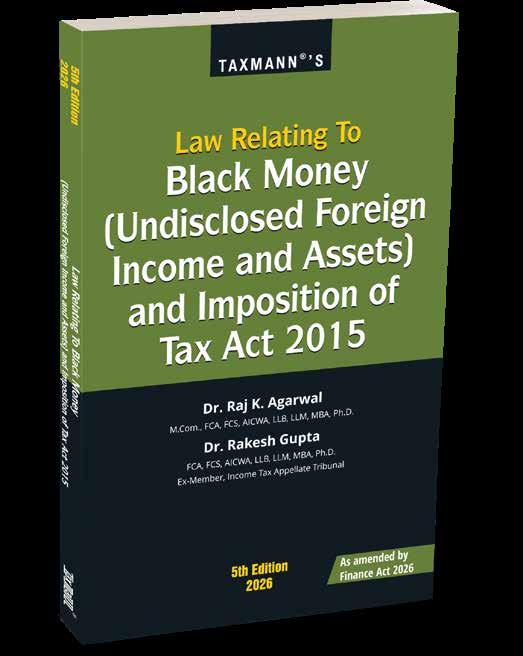
LAW RELATING TO BLACK MONEY (UNDISCLOSED FOREIGN INCOME AND ASSETS) AND IMPOSITION OF TAX ACT 2015
AUTHOR
:
Raj K Agrawal, Rakesh Gupta
PUBLISHER : Taxmann Publications
DATE OF PUBLICATION : April 2026
EDITION : 5th Edition | 2026
ISBN NO : 9789371268387
NO. OF PAGES : 352
BINDING TYPE : Paperback
1,125
DESCRIPTION
Law Relating to Black Money (Undisclosed Foreign Income and Assets) and Imposition of Tax Act 2015 is a comprehensive practitioner-level commentary updated to include all amendments made by the Finance Act 2026. It offers section-by-section analysis of every provision of the Act, supported by the authors' considered opinions on over 200 critical interpretive issues. It also features, for the first time, a dedicated chapter on the Foreign Assets of Small Taxpayers Disclosure Scheme 2026 (FAST-DS 2026) under Sections 130 to 144.
This book is intended for the following audience:
• Chartered Accountants, Tax Advocates, and Company Secretaries
• Judicial and Quasi-Judicial Officers
• Senior Litigation Counsel
• High Net Worth Individuals, NRIs Returning to India
• Academic Researchers and Law School Faculty
The Present Publication is the 5th Edition | 2026 and has been amended by the Finance Act 2026. This book is authored by Dr Raj K. Agarwal & Dr Rakesh Gupta, with the following noteworthy features:
• [No-Time-Limit Assessment Regime Fully Analysed] The Black Money Act prescribes no time-barring limit for initiating assessment or reassessment—proceedings can be initiated even 30 or 40 years after the fact. The book examines the constitutional validity, practical operation, and litigation risks arising from this provision in granular detail
• [Section-by-Section Commentary with Full Text] Every section of the Act is reproduced along with original Notes on Clauses from the legislative record, followed by a structured analysis of salient features and significant issues—making the commentary self-contained as a working reference
• [Over 200 Critical Issues Identified and Opined Upon] Each chapter lists the significant issues of litigation arising from its sections and provides the authors' considered opinion, covering interpretive gaps, constitutional challenges, procedural ambiguities, and questions not yet resolved by courts
• [Authors Openly Disagree with the CBDT Where Warranted] On whether pre-1st July 2015 assets are assessable under the Act, the authors directly challenge the CBDT's aggressive FAQ position—citing the Supreme Court's Ganpati Dealcom ratio—and state their considered opinion that such interpretation is legally untenable and constitutionally problematic
• [Tracks Legislative Evolution Across Five Finance Acts] Every amendment—the 2019 retrospective expansion of 'assessee', the 2024 prosecution threshold revision, the 2026 prosecution amendments, and the introduction of FAST-DS 2026—is placed in historical context with analysis of what changed, why, and what litigation consequences follow
• [Cross-Referenced to Both the Income-Tax Act 1961 and the Income-Tax Act 2025] All references to income-tax provisions appear in dual form—citing the corresponding section of the Income-tax Act 1961 and its equivalent in the Income-tax Act 2025—ensuring the book remains fully current as India's direct tax statute transitions
• [Schedule FA Treated as a Substantive Legal Obligation] The book documents what Schedule FA requires across all asset categories and draws a precise distinction between disclosures that immunise against BMA proceedings and those that merely furnish the Assessing Officer with a trigger to initiate them
• [Practical Roadmap for NRIs and Persons with Historical Foreign Positions] The book systematically maps obligations for persons who acquired foreign assets as non-residents and have since become resident—covering Schedule FA disclosure timing, the NOR status window, and the documentary evidence that must be preserved indefinitely against a future Section 10 notice
• [Structured Treatment of the BMA–PMLA Interplay] The book addresses the parallel enforcement architecture arising from the Act's scheduled offence status under PMLA—including the PMLA's independent arrest powers that the BMA itself does not confer—and the consequences for clients facing simultaneous exposure under both statutes
• [Covers FAST-DS 2026 in its Entirety] Chapter 10A provides a complete treatment of the Foreign Assets of Small Taxpayers Disclosure Scheme 2026, including statutory text (Sections 130–144), the Memorandum Explaining Objects, and a structured analysis of salient features—a significant addition exclusive to this Edition
• [Valuation Chapter with Rule-Level Analysis] Chapter 12 sets out the full valuation framework, including the fair market value methodology for different asset classes, valuation by foreign valuers, the significance of the valuation date, treatment of assets no longer in existence as on the valuation date, and re-rolling scenarios
• [Comprehensive Appendices] Four appendices reproduce all prescribed forms (Forms 1–8), key CBDT circulars from 2015 through 2024, all material CBDT notifications, and extracts from other laws cross-referenced in the Black Money Act—including the CPC, IPC/BNS, Companies Act, LLP Act, and Constitution of India