
Sample Read

© All rights reserved
Price :
Sixth Edition : January 2026
Published by :
Taxmann Publications (P.) Ltd.
Sales & Marketing : 59/32, New Rohtak Road, New Delhi-110 005 India
Phone : +91-11-45562222
Website : www.taxmann.com
E-mail : sales@taxmann.com
Regd. Office : 21/35, West Punjabi Bagh, New Delhi-110 026 India
Printed at :
Tan Prints (India) Pvt. Ltd.
44 Km. Mile Stone, National Highway, Rohtak Road Village Rohad, Distt. Jhajjar (Haryana) India
E-mail : sales@tanprints.com
Disclaimer
Every effort has been made to avoid errors or omissions in this publication. In spite of this, errors may creep in. Any mistake, error or discrepancy noted may be brought to our notice which shall be taken care of in the next edition. It is notified that neither the publisher nor the author or seller will be responsible for any damage or loss of action to any one, of any kind, in any manner, therefrom. It is suggested that to avoid any doubt the reader should cross-check all the facts, law and contents of the publication with original Government publication or notifications.
No part of this book may be reproduced or copied in any form or by any means [graphic, electronic or mechanical, including photocopying, recording, taping, or information retrieval systems] or reproduced on any disc, tape, perforated media or other information storage device, etc., without the written permission of the publishers. Breach of this condition is liable for legal action. For binding mistake, misprints or for missing pages, etc., the publisher’s liability is limited to replacement within seven days of purchase by similar edition. All expenses in this connection are to be borne by the purchaser. All disputes are subject to Delhi jurisdiction only.

CHAPTER
TORT – MEANING
1.“To constitute a tort, there must be a wrongful act and legal damages”. Explain. [June 2021 (4 Marks)]
Ans.: A tort consists of some act or omission done by the defendant whereby he has without just cause or excuse caused some harm to plaintiff. To constitute a tort, there must be:
(1)Wrongful act: The act complained of, should under the circumstances, be legally wrongful as regards the party complaining. Thus, every person whose legal rights, e.g. right of reputation, right of bodily safety and freedom, and right to property are violated without legal excuse, has a right of action against the person who violated them, whether loss results from such violation or not.
(2) Legal damages: It is not every damage that is a ‘damage’ in the eye of the law. It must be a damage which the law recognizes as such. In other words, there should be legal injury or invasion of the legal right. In the absence of an infringement of a legal right, an action does not lie. Also, where there is infringement of a legal right, an action lies even though no damage may have been caused.
2.Distinguish between: ‘Tort’ & ‘Crime’.
Ans.:
Meaning A tort consists of some act or omissions done by defendant whereby he has without a lawful excuse caused some harm to plaintiff.
Seriousness Less serious wrongs are considered as private wrongs and have been labelled as civil wrong.
Crime means any act or omission made punishable under any law.
More serious wrongs have been considered to be public wrongs and are known as crimes.
Points TortCrime
Suit Suit is filed by the injured person himself. Case is brought by the State.
Compromise Compromise is always possible. Except in certain cases, compromise is not possible.
Penalty Wrongdoer pays compensation to the injured party. Wrongdoer is punished.
DAMNUM SINE INJURIA & INJURIA SINE DAMNUM
3. Explain the Latin maxims ‘damnum sine injuria’ and ‘injuria sine damnum’. [Dec. 2021 (4 Marks)]
Or
Distinguish between ‘Damnum Sine Injuria’ and ‘Injuria Sine Damnum’ under the law relating to Torts.
[June 2014 (4 Marks)], [Dec. 2018 (4 Marks)]
Or
Explain with suitable examples that legal damage is neither identical with actual damage nor is it necessarily pecuniary. [Dec. 2022 (4 Marks)]
Ans.: It is not every damage that is a damage in the eye of the law. It must be a damage which the law recognizes as such. In other words, there should be legal injury or invasion of the legal right. In the absence of an infringement of a legal right, an action does not lie.
Also, where there is infringement of a legal right, an action lies even though no damage may have been caused. As was stated in Ashby v. White, legal damage is neither identical with actual damage nor is it necessarily pecuniary.
Two maxims, namely: (i) Damnum sine injuria and (ii) injuria sine damnum, explain this proposition.
Damnum sine injuria: Damnum means damage in the sense of loss of money, comfort, health, service or physical hurt or the like.
Injuria means breach of a legal right i.e. infringement of a right conferred by law on the plaintiff.
In some cases the act or omission of the defendant may have caused damage to the claimant but the claimant may have no action as the interest affected may not be one protected by law. Lawyers refer to this as damnum sine injuria or harm without legal wrong. Therefore, causing damage however substantial to another person is not actionable in law, unless there is also violation of legal right of the plaintiff.
Example: A opens a fish & chip shop in the same street as B’s fish & chip shop. A reduces his prices with the intention of putting B out of business. A
has committed no tort as losses caused by lawful business competition are not actionable in tort.
Injuria Sine Damnum: There are cases where conduct is actionable even though no damage has been caused. This is known as injuria sine damno. The maxim ‘injuria sine damno’ means breach of legal right without damage. In other words, there is an injury without damage or loss. It means infringement of legal rights not resulting in damages but giving the right to sue, to the plaintiff as the infringement is an injury in law. This is because there are certain absolute private rights or interests of an individual, so vital, that the infringement itself would be actionable in tort even if there is no proof of damages.
Example: If A walks across B’s land without B’s permission then A will commit the tort of trespass to land, even though he does not cause any damage to the land.
4. Alok was running a school at a certain place. Bimal started another school near the school of Alok. As a result of this, most of the students of Alok’s school left his school and joined Bimal’s school. Due to competition, Alok had to reduce the fees by ` 40 per student per quarter thereby suffering huge monetary loss. Alok instituted a suit against Bimal in the court for claiming compensation. Is the suit instituted by Alok maintainable? [June 2011 (6 Marks)]
Ans.: In some cases the act or omission of the defendant may have caused damage to the claimant but the claimant may have no action as the interest affected may not be one protected by law. This is explained by doctrine of “damnum sine injuria”, which means harm without legal wrong.
The maxim ‘damnum sine injuria’ is applicable for the given case.
Bimal has committed no tort as losses caused by lawful business competition are not actionable in tort. Therefore, suit instituted by Alok is not maintainable as per doctrine damnum sine injuria.
5. Vijay used to run a grocery store. Sanjay was one of his customers. One day, Vijay and Sanjay had an argument over something. With the intention of causing loss to Vijay, Sanjay opened a grocery store right in front of Vijay’s shop. As a result, Vijay lost some customers, and he suffered heavy losses. Can Vijay recover damages from Sanjay? Explain. [Dec. 2023 (4 Marks)]
Ans.: Damnum means damage in the sense of loss of money, comfort, health, service or physical hurt or the like.
Injuria means breach of a legal right i.e. infringement of a right conferred by law on the plaintiff.
In some cases the act or omission of the defendant may have caused damage to the claimant but the claimant may have no action as the interest affected may not be one protected by law. Lawyers refer to this as damnum sine injuria or harm without legal wrong. Therefore, causing damage however substantial
to another person is not actionable in law, unless there is also violation of legal right of the plaintiff.
In view of above, if Sanjay opens shop next to Vijay’s shop and if Vijay suffers loss then he cannot claim damages as Sanjay is exercising his legal right.
6. Water supply to A’s mill was disrupted due to B’s digging of his well. This resulted in the cutting of the water supply of the A’s mill, due to which it was shut down. A filed a suit for damages against B in a court of law. Decide and give reasons for your conclusions.
[June 2024 (5 Marks)]
Ans.: Damnum sine injuria: Damnum means damage in the sense of loss of money, comfort, health, service or physical hurt or the like
Injuria means breach of a legal right i.e. infringement of a right conferred by law on the plaintiff.
In some cases the act or omission of the defendant may have caused damage to the claimant but the claimant may have no action as the interest affected may not be one protected by law. Lawyers refer to this as damnum sine injuria or harm without legal wrong. Therefore, causing damage however substantial to another person is not actionable in law, unless there is also violation of legal right of the plaintiff.
In Chasemore v. Richards, water supply to Plaintiff’s mill was disrupted due to defendant’s digging of his well. This resulted in cutting of water supply to plaintiff’s mill due to which it was shut down. Court held defendant not liable because although monetary losses were incurred there was no violation of legal right.
In view of above, A (plaintiff) will not succeed in getting damage against B (defendant).
STRICT & VICARIOUS LIABILITY
7. Write a short note on: Rule of strict liability as laid down in Rylands v. Fletcher [Dec. 2010 (4 Marks)], [Dec. 2018 (4 Marks)] Or Explain strict or absolute liability under the law of torts. [Dec. 2011 (6 Marks)]
Ans.: Rules of strict liability refers that if a person bring anything from outside and accumulates on his land, which it escapes may cause damage to his neighbours, he does so at his own risk. He will be responsible for damage, however carefully he might have been and whatever precautions he might have taken to prevent damage. This principle was laid down in the case of Rylands v. Fletcher.
Fletcher (plaintiff) leased several underground coal mines from land adjacent to that owned by Rylands (defendant). Rylands owned a mill, and built a reservoir on his land for the purpose of supplying water to that mill. Rylands employed
engineers and contractors to build the reservoir. In the course of building the reservoir, these employees learned that it was being built on top of abandoned underground coal mines. This fact was unknown by Rylands. After the reservoir was completed, it broke and flooded Fletcher’s coal mines. This caused damage to Fletcher’s property, and Fletcher brought suit against Rylands.
Rylands was held strictly liable for damage caused to Fletcher’s property by water from the broken reservoir.
But, later, it was decided in the case of Read v. Lyons, that following two conditions were necessary for application of the rule decided in the case of Rylands v. Fletcher.
(1) Escape of something from the control of defendant, which is likely to do mischief.
(2) When defendant is making a non-natural use of the land. If either of these conditions is absent, the rule of strict liability will not apply.
8. A mill owner employed an independent contractor to construct a reservoir on his land to provide water for his mill. There were old disused mining shafts under the site of the reservoir, which the contractor failed to observe because they were filled with soil. Therefore, the contractor did not block them. When water was filled in the reservoir, it burst through the shaft and flooded the plaintiff’s coal mines on the adjoining land. Is the mill owner liable to compensate for loss or damage caused to the plaintiff? Give reasons. [June 2011 (6 Marks)]
Ans.: As per rules of strict liability, if a person brings anything from outside and accumulates on his land, which it escapes may cause damage to his neighbours; he does so at his own risk. He will be responsible for damage, however carefully he might have been and whatever precautions he might have taken to prevent damage. This principle was laid down in the case of Rylands v. Fletcher.
As per the facts given in case an independent contractor employed by mill owner was negligent as he failed to block the old disused mining shafts under the site of the reservoir and due this negligence water was filled in the reservoir and it burst through the shaft and flooded the plaintiff’s coal mines on the adjoining land. Thus, applying the ‘rules of strict liability’ the mill owner will be liable for damages to the coal mine owner.
9. Explain the exceptions to the rule of strict liability under Law of Torts. [June 2012 (5 Marks)], [June 2022 (4 Marks)]
Ans.: Rules of strict liability refers that if a person bring anything from outside and accumulates on his land, which it escapes may cause damage to his neighbours, he does so at his own risk. He will be responsible for damage, however carefully he might have been and whatever precautions he might have taken to prevent damage. This principle was laid down in the case of Rylands v. Fletcher.
Exceptions to the rule of strict liability:
(1) Damage due to natural use of the land: The rule of strict liability does not apply in the case where the things are present on a person’s land in the natural form or arise on the land, even though they are dangerous.
(2) Consent of the plaintiff: The rule of strict liability is not applicable in the cases where the things which escapes was brought or kept upon defendant’s premises by the defendant with the consent of the plaintiff.
(3) Act of third party: If the harm has been caused due to the act of a stranger, who is neither the defendant’s servant nor agent or has no control over him the defendant will not be liable.
(4) Statutory authority: Public bodies performing a statutory duty such as supply of water, electricity etc., are exempted from liability, so long as they have taken reasonable care and are not negligent.
(5) Act of God: The principle of strict liability does not apply for the damage caused due to acts which are irresistible & beyond human contemplation & caused due to operation of some superior force which is beyond human control.
(6) Escape due to plaintiffs own default: If the damage is caused due to the plaintiffs own action or default the defendant is exempted from liability, i.e. if plaintiff suffers damage by his own intrusion into defendant’s property, he cannot complain for damage so caused.
10. During the municipal council elections in Nagpur, Ramesh, a registered and eligible voter, reached the polling booth to cast his vote. However, the presiding officer refused to allow Ramesh to vote, despite him having valid identity documents. Later it was found that Ramesh’s preferred candidate won the election and Ramesh suffered no financial loss. Ramesh filed a suit against the presiding officer claiming damages for violation of his legal right. Discuss the remedy available to Ramesh. [Dec. 2025 (5 Marks)]
Ans.:
Issue involved
Whether Ramesh can claim damages even though he suffered no financial loss.
Relevant Law
The maxim Injuria Sine Damnum means violation of a legal right without actual damage.
Whenever a legal right is infringed, the injured person can claim damages even if he has suffered no monetary loss.
Case Law: Ashby v. White (1703) – Refusal to allow a qualified voter to vote entitled him to damages though no loss was proved.
Application
Ramesh was a registered and eligible voter. He was wrongfully prevented from voting by the presiding officer, which is a clear violation of his legal right. Even though his preferred candidate won and he suffered no financial loss, his legal right to vote was infringed.
Conclusion
Ramesh is entitled to claim damages under the principle of Injuria Sine Damnum and the suit against the presiding officer is maintainable.
11. The driver of a petrol lorry, while transferring petrol from the lorry to an underground tank at a garage, struck a matchstick in order to light a cigarette and then threw it, still alight on the floor. An explosion and a fire ensued. Who is liable for the damage so caused? Decide giving case law on this point. [June 2013 (5 Marks)]
Ans.: When a servant commits a tort in the ordinary course of his employment as servant, the master is liable for the same.
An act is deemed to be done in the course of employment if it is either:
(1) A wrongful act authorized by the employer, or
(2) A wrongful and unauthorized mode of doing some act authorized by the employer.
The facts of the given case are similar to Century Insurance Co. Ltd. v. Northern Ireland Road Transport Board. In this case, the driver of a petrol lorry, while transferring petrol from the lorry to an underground tank at a garage, struck a match in order to light a cigarette and then threw it, still alight on the floor. An explosion and a fire ensued. The House of Lords held his employers liable for the damage caused, for he did the act in the course of carrying out his task of delivering petrol; it was an unauthorized way of doing what he was employed to do.
12. Sunshine Solar Systems Private Limited operated a solar panel manufacturing plant on the outskirts of a city. As part of its operation, it stored large quantities of a dangerous chemical compound used in panel coating. It followed all the safety protocols and government regulations. One day a tank with this material ruptured causing the chemical to leak into a nearby field owned by Surya and destroyed its crops and contaminated the soil. Surya sued Sunshine solar systems private limited for damages. Discuss the applicability of the rule in Rylands v. Fletcher in this case and examine whether Surya can claim damages under the rule of strict liability? [Dec. 2025 (5 Marks)]
Ans.:
Issue involved
Whether Sunshine Solar Systems Pvt. Ltd. is liable to compensate Surya for the damage caused due to leakage of hazardous chemicals from its factory.
Rule in Rylands v. Fletcher (1868)
The rule of strict liability states that when a person brings and keeps any dangerous thing on his land for a non-natural use, and such thing escapes and causes damage, he is liable even without negligence.
Essential Conditions:
1. There must be a dangerous thing
2. It must be brought and kept by the defendant
3. It must be for non-natural use of land
4. There must be escape of such thing
5. There must be actual damage
Application to the Present Case
Sunshine Solar Systems stored a dangerous chemical compound in large tanks in its factory for industrial use, which is a non-natural use of land. Due to rupture of the tank, the chemical escaped into Surya’s field causing destruction of crops and contamination of soil, resulting in actual damage. Thus, all the essential conditions of strict liability are fully satisfied.
Defences
No valid defence such as Act of God, plaintiff’s fault, consent or third-party act is applicable here.
Conclusion
Sunshine Solar Systems Pvt. Ltd. is strictly liable under the rule of Rylands v. Fletcher and therefore Surya is entitled to claim damages for the loss suffered.
13. Vicarious liability of the State. Discuss. [Dec. 2013 (4 Marks)] Or
Discuss the vicarious or tortious liability of state for the act of his servant. Refer relevant Judgments. [June 2019 (4 Marks)]
Ans.: Unlike the Crown Proceeding Act, 1947 of England, we have no statutory provision with respect to the liability of the State in India. When a case of Government liability in tort comes before the Courts, the question is whether the particular Government activity, which gave rise to the tort, was the sovereign function or non-sovereign function. If it is a sovereign function it could claim immunity from the tortuous liability, otherwise not. Generally, the activities of commercial nature or those which can be carried out by the private individual are termed as non-sovereign functions.
In India Article 300 of the Constitution declares that the Government of India or of a State may be sued for the tortious acts of its servants in the same manner as the Dominion of India and the corresponding provinces could have sued or have been sued before the commencement of the Constitution. This rule is, however, subject to any such law made by the Parliament or the State Legislature. No law has so far been passed as contemplated by Article 300(1).
Jurisprudence Interpretation & General Laws (JIGL) | CRACKER
AUTHOR : N.S. Zad, Kalyani
PUBLISHER : Taxmann
DATE OF PUBLICATION : January 2026
EDITION : 6th Edition
ISBN NO : 9789375614715
No. of Pages : 380
BINDING TYPE : Paperback
Rs. 425
Shirode
DESCRIPTION
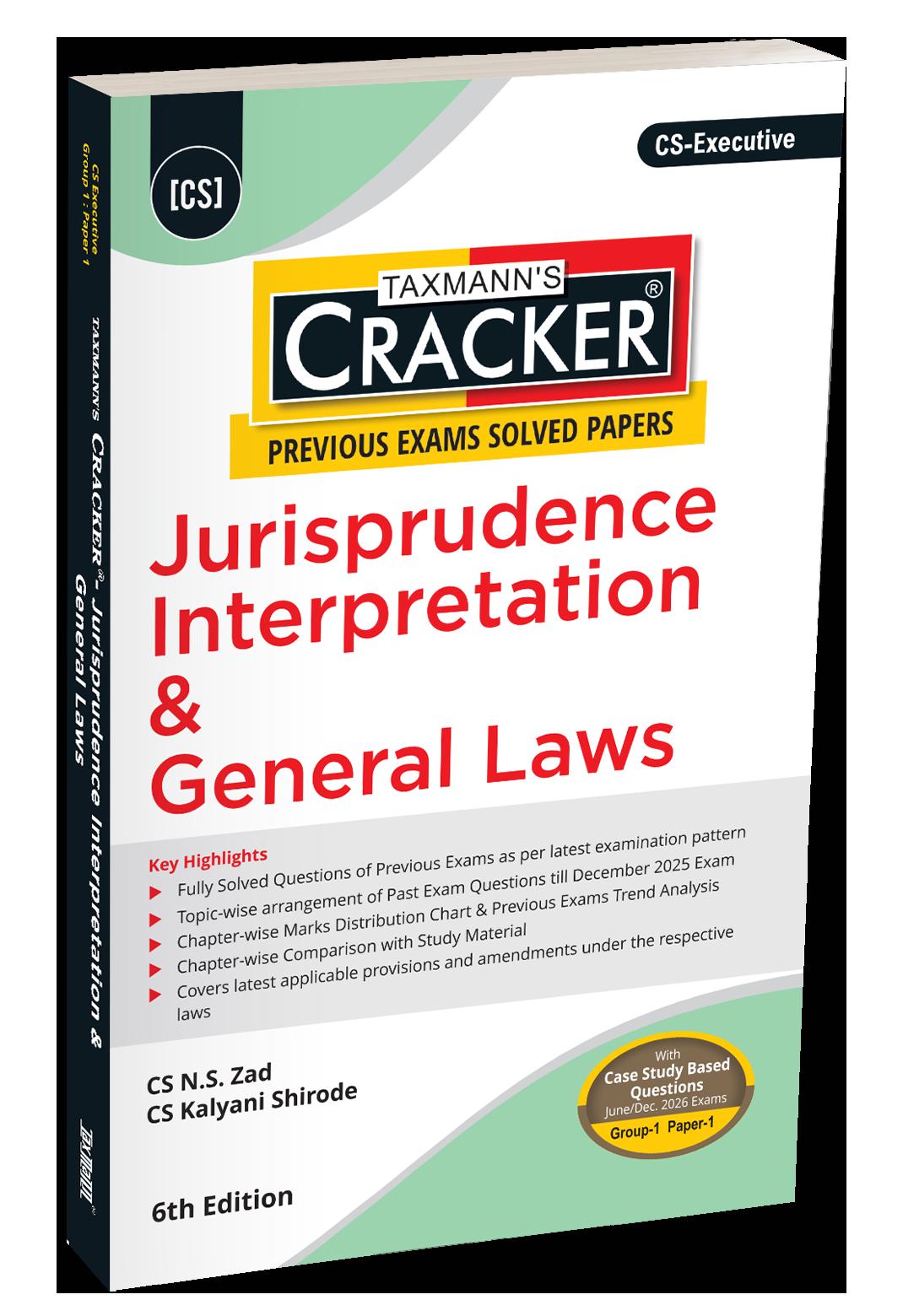
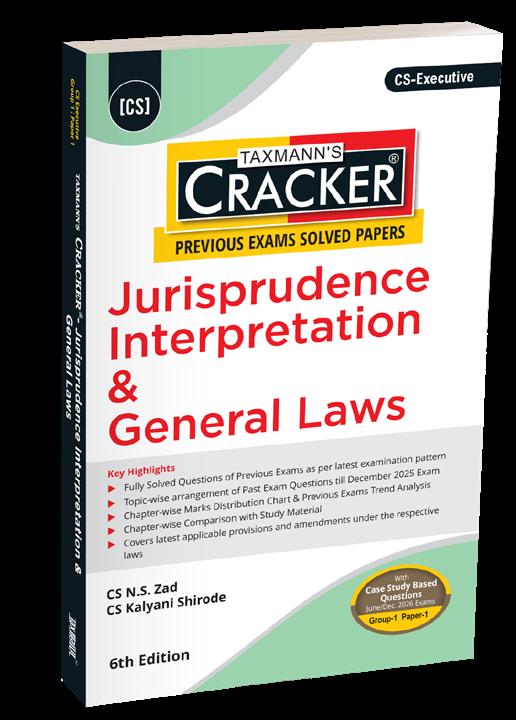
Jurisprudence, Interpretation & General Laws – CRACKER is an exam-intelligence-driven preparation manual for CS Executive – Group 1 | Paper 1, designed strictly around how the Institute of Company Secretaries of India (ICSI) sets, evaluates, and awards marks in this paper. The book treats the subject as an application-oriented discipline of legal reasoning, where success depends on issue identification, statutory interpretation, and the structured application of law, rather than on abstract legal theory. Reflecting the post-2023 examination framework, this Edition aligns with the dominance of case study–based, problem-oriented, and mixed descriptive-practical questions. Based on complete past examination coverage up to December 2025, the book converts historical exam patterns into predictive preparation tools, enabling focused, marks-optimised study.
The Present Publication is the 6th Edition, authored by CS N.S. Zad & CS Kalyani Shirode, with the following noteworthy features:
• [Fully Solved Previous Examination Questions] Covers all CS Executive Paper 1 questions up to December 2025, with answers drafted in the precise structure, depth, and language expected by ICSI examiners
• [Case Study Based Questions Module] Dedicated chapter aligned with the compulsory 20-mark case study pattern, enabling mastery of integrated legal application
• [Chapter-wise Marks Distribution Analysis] Multi-year (2021–2025) marks analytics in tabular form to support data-driven chapter prioritisation
• [Previous Exams Trend Analysis] Question-wise trend tables classifying questions as Practical or Descriptive, highlighting ICSI’s shift towards application-based testing
• [Topic-wise & Chapter-wise Question Arrangement] Past questions reorganised chapter-wise for consolidated topic-level preparation
• [ICSI Study Material Mapping] Chapter-wise mapping with ICSI Study Material to ensure syllabus alignment and exam relevance
• [Updated Legal Position] Answers reflect the latest applicable statutory provisions and judicial positions for the 2026 examination cycle