Sample Read
© Taxmann
Price : ` 1695
Law stated in this book is as amended upto 20th June, 2026
Published by : Taxmann Publications (P.) Ltd.
Sales & Marketing : 59/32, New Rohtak Road, New Delhi-110 005 India
Phone : +91-11-45562222
Website : www.taxmann.com
E-mail : sales@taxmann.com
Regd. Office : 21/35, West Punjabi Bagh, New Delhi-110 026 India
Printed at :
Tan Prints (India) Pvt. Ltd.
44 Km. Mile Stone, National Highway, Rohtak Road Village Rohad, Distt. Jhajjar (Haryana) India
E-mail : sales@tanprints.com
Disclaimer
Every effort has been made to avoid errors or omissions in this publication. In spite of this, errors may creep in. Any mistake, error or discrepancy noted may be brought to our notice which shall be taken care of in the next edition. It is notified that neither the publisher nor the author or seller will be responsible for any damage or loss of action to any one, of any kind, in any manner, therefrom. It is suggested that to avoid any doubt the reader should cross-check all the facts, law and contents of the publication with original Government publication or notifications.
No part of this book may be reproduced or copied in any form or by any means [graphic, electronic or mechanical, including photocopying, recording, taping, or information retrieval systems] or reproduced on any disc, tape, perforated media or other information storage device, etc., without the written permission of the publishers. Breach of this condition is liable for legal action. For binding mistake, misprints or for missing pages, etc., the publisher’s liability is limited to replacement within seven days of purchase by similar edition. All expenses in this connection are to be borne by the purchaser. All disputes are subject to Delhi jurisdiction only.
1.5
1.12
1.13
1.14
1.15
1.16
1.17
3.5
INSOLVENCY PROFESSIONAL
3.8
CONDUCTING CORPORATE INSOLVENCY
RESOLUTION PROCESS
4.1 Background
4.2 Moratorium and public announcement
4.3 Public announcement of corporate insolvency resolution process 127
4.4 Appointment and tenure of interim resolution professional 128
4.5 Submission of proof of claims to interim resolution professional 134
4.6 Committee of Creditors (CoC) 139
4.7 Appointment of resolution professional in first meeting of CoC 148
4.8 Powers and functions of Committee of Creditors (CoC) 151
4.9 Duties of resolution professional
4.10 Prior approval of committee of creditors for certain actions by resolution professional
4.11 Preparation of information memorandum
4.12 Protection to insolvency resolution professional in respect of earlier transactions 166
4.13 Special Provisions in respect of NBFC with assets of Rs. 500 crore or more 166
RESOLUTION
5.1 Background
PLAN BY RESOLUTION APPLICANT
5.2 Ineligible Resolution Applicant
5.3 Invitation for expression of interest
5.4 Submission of resolution plan by resolution applicant to insolvency professional
5.5 Insolvency resolution process costs
5.6 Approval of resolution plan by Committee of Creditors
5.7 Submission of plan to Adjudicating Authority
5.8 Assistance of district administration in implementing the resolution plan 208
5.9 Effect if resolution plan rejected by NCLT
5.10 Appeal against order of adjudicating authority 209
5.11 Immunity from prosecution of corporate debtor after approval of CIRP 209
5.12 No action against property of corporate debtor in respect of offence committed prior to CIRP if there was change in management or sale of assets 210
5.13 Corporate debtor and new management to provide assistance to investigating agency 213
5.14 Preservation of records of CIRP by RP 213
CREDITOR-INITIATED INSOLVENCY RESOLUTION PROCESS [CIIRP]
6.1 Insolvency resolution process initiated by creditors 214
6.2 Objections to commencement of CIIRP by Corporate Debtor 216
6.3 Period for completion of Creditor-Initiated Insolvency Resolution Process [CIIRP] 216
6.4 Duties and powers of resolution professional in CIIRP 217
6.5 Conversion of creditor-initiated insolvency resolution process [CIIRP] to corporate insolvency resolution process [CIRP] 219
6.6 Withdrawal of public announcement of CIIRP made under section 58B 220
6.7 Application for approval of resolution plan by RP to Adjudicating Authority on approval by CoC 220
6.8 Application of provisions of Chapters II, III, VI and VII to CIIRP 220
6.9 Conditions to be met for CIIRP 221
6A
PRE-PACKAGED INSOLVENCY RESOLUTION PROCESS (PPIRP)
6A.1 Background of the PPIRP (Pre-Packaged Insolvency Resolution Process) 222
6A.2 Basic design of Pre-Packaged Insolvency Resolution Process (PPIRP) 226
6A.3 Application of provisions of CIRP to PPIRP 230
6A.4 Priority to PPIRP over CIRP, except where CIRP proceedings have already commenced 233
6A.5 Eligibility and conditions to apply for PPIRP 235
6A.6 Initiation of PPIRP by Corporate Debtor 237
6A.7 Duties and authorities of Insolvency Professional proposed to be appointed as Resolution Professional 239
6A.8 Procedure prior to application to AA for approval to initiate PPIRP 241
6A.9 Filing of application by Corporate Applicant with Adjudicating Authority 243
6A.10 Admission or rejection of application by Adjudicating Authority (NCLT) 245
6A.11 Moratorium during PPIRP period 246
6B
PROCEDURE FOR PPIRP AFTER ADMISSION OF APPLICATION
6B.1 Formal process of PPIRP starts only after admission of application 247
6B.2 Conduct of PPIRP by Resolution Professional 248
6B.3 Powers of Resolution Professional during initial stages of PPIRP 250
6B.4 Filing of Application for avoidance of transactions 252
6B.5 Prior approval of Committee of Creditors (CoC) for certain actions by corporate debtor 254
6B.6 Information to be supplied by financial institutions to Resolution Professional 256
6B.7 Submission of List of claims and its updation in PPIRP 256
6B.8 Conduct of business of Corporate Debtor during PPIRP 259
6B.9 Constitution and functioning of Committee of Creditors in PPIRP 261
6B.10 Meeting of Committee of Creditors in PPIRP 263
6C
SUBMISSION AND APPROVAL OF RESOLUTION PLAN UNDER PPIRP
6C.1 What is a resolution plan
6C.2 Submission of Base Resolution Plan by RP to CoC 274
6C.3 Invitation to Resolution Applicants if CoC does not approve base resolution plan or operational creditors cannot be satisfied 277
6C.4 Furnishing of information to Resolution Applicants 279
6C.5 Submission of resolution plan by resolution applicant and its evaluation 281
6C.6 Submission of Resolution Plans by Resolution Professional to CoC 283
6C.7 Submission of Resolution Plan approved by CoC for approval by AA 286
6C.8 Termination of PPIRP which ultimately results in liquidation of corporate debtor 288
6C.9 CoC may terminate PPIRP if corporate debtor eligible for CIRP 290
6D
GROUP INSOLVENCY
6D.1 Concept of ‘group insolvency’ 292
6D.2 Power to make rules for initiating proceedings for coordination and cooperation of corporate debtors of group 293
LIQUIDATION OF CORPORATE PERSON
7.1 Initiation of Liquidation
7.2 Appointment of Liquidator and his fees
7.3 Powers and duties of Liquidator
7.4 Liquidation Estate
7.5 Realization of security interest by secured creditor
7.6 Distribution of unsold assets
7.7 Liabilities of contributory in liquidation
ADMISSION AND PROOF OF CLAIMS BY LIQUIDATOR
8.1 Liquidator has powers to access information
8.2 Ascertaining claims against corporate debtor
8.3 Avoidance of preferential transactions by liquidator
8.4 Avoidance of undervalued transactions
8.5 Order by Adjudicating Authority in case of undervalued transaction
8.6 Protection to corporate debtor against extortionate credit transactions
8.7 Position of secured creditor in liquidation proceedings
REALISATION AND DISTRIBUTION OF ASSETS BY LIQUIDATOR
9.1
9.2
9.3 All money to be paid into bank account except petty cash
9.4 Distribution of assets from sale of liquidation
9.5 Distribution of cash to
9.6 Completion of liquidation within six months
9.7 Final report by Liquidator prior to dissolution
9.8 Unclaimed proceeds of liquidation or undistributed assets to be transferred to Corporate Liquidation Account
9.9
PAYMENT OF DUES TO STAKEHOLDERS AFTER
10.1 Insolvency Code is complete code in respect of distribution of
10.4 Workmen’s portion of Workmen’s dues previous for two years have overriding priority
10.5 Provisions relating to secured creditors
10.6 Priority of tax dues in winding up over secured creditors
10.7 Preferential Payments under Companies Act
10.8 Distribution of surplus amount members
VOLUNTARY LIQUIDATION OF COMPANIES
11.1 Voluntary liquidation by corporates with no default
11.2 Procedure for Voluntary Liquidation
11.3 Information to Registrar after resolution
11.4 Application to NCLT after assets wound up
11.5 Procedure for
11.6 Claim by various creditors
ADJUDICATION AND APPEALS FOR CORPORATE PERSONS
12.1 Adjudicating Authority in relation to insolvency resolution and liquidation for corporate persons
12.2 Appeals and Appellate Authority
12.3 Appeal to Supreme Court on question of law
12.4 Civil Court not to have jurisdiction where NCLT or IBBI has jurisdiction
12.5 Expeditious disposal of applications
12.6 Penalty for fraudulent or malicious initiation of proceedings
12.7 Penalty of carrying on business fraudulently to defraud traders
CROSS BORDER INSOLVENCY AND BANKRUPTCY
13.1 Enabling provisions for cross border transactions 376
13.2 Agreements with foreign countries
13.3 Letter of request to a country outside India in respect of assets 377
OFFENCES AND PENALTIES IN RELATION TO CORPORATE INSOLVENCY
14.1 Punishments for offences 378
14.2 Punishment for concealment of property 378
14.3 Punishment for transactions defrauding creditors 379
14.4 Punishment for misconduct in course of corporate insolvency resolution process 380
14.5 Offences by insolvency professional 381
14.6 Punishment for falsification of books of corporate debtor 381
14.7 Punishment for wilful and material omissions from statements relating to affairs of corporate debtor 381
14.8 Punishment for false representations to creditors 381
14.9 Earlier provisions for punishment for contravention of moratorium or the resolution plan 381
14.10 Punishment for false information furnished in application 382
14.11 Earlier provisions in respect of Punishment for non-disclosure of (a) dispute or (b) payment of debt by operational creditor 382
14.12 Punishment for providing false information in application made by corporate debtor 382
14.13 Power of Adjudicating Authority to impose penalties 382
14.14 NCLT can ask Government to investigate and Government can file complaint before Special Court 383
14.15 Punishment for providing false information in Pre-Packaged Insolvency Resolution Process 383
14.16 Punishment in case of contravention of provisions of Chapter III-A (Pre-Packaged Insolvency Resolution Process) 384
14.17
15.1
15.3
15.4
15.5
16.1
16.3
17.1
17.4
17.5
17.6
17.7
17.9
BANKRUPTCY FOR INDIVIDUALS AND PARTNERSHIP FIRMS
17.10
18.1
18.2
18.3
BANKRUPTCY ORDER FOR INDIVIDUALS AND FIRMS
18.9
19.1
BANKRUPTCY TRUSTEE
19.8
20.1
20.2
20.3
20.4
20.5
20.6
SETTLEMENT OF CLAIMS AGAINST BANKRUPT
21.1
REGISTERED VALUERS
NCLT AND NCLAT
22.3
22.4
22.5
22.6
Resolution Plan by Resolution Applicant
The first and foremost duty of Resolution Professional is to get resolution plan/s by Resolution Applicants.
Resolution Professional can invite prospective resolution applicant/s, who fulfil such criteria as may be laid down by him with the approval of committee of creditors, having regard to the complexity and scale of operations of the business of the corporate debtor and such other conditions as may be specified by the Board, to submit a resolution plan or plans - section 25(2)(h) of Insolvency Code as amended w.e.f. 23-11-2017.
Resolution Applicant - “Resolution applicant” means a person, who individually or jointly with any other person, submits a resolution plan to the resolution professional pursuant to the invitation made under section 25(2)(h) or pursuant to section 54K of Insolvency Code, as the case may be - section 5(25) of Insolvency Code. Words in italics inserted vide IBC (Amendment) Act, 2021 w.r.e.f. 4-4-2021.
Can trust be resolution applicant - Trust is a ‘person’ and hence can be resolution applicant - Aswathi Agencies v. Bijoy Prabhakaran Pulipara [2023] 147 taxmann.com 590 (NCLAT).
However, in M.K. Rajagopalan v. Dr. Periasamy Palani Gounder [2023] 150 taxmann.com 70 (SC), it was held that in view of section 88 of Indian Trust Act, a trust cannot undertake business for profit.
Asset Reconstruction Company with net owned funds exceeding Rs 1,000 crore can be resolution applicant - RBI has revised regulatory framework for Asset Reconstruction Companies (ARC) vide Circular No. DOR.SIG.FIN.REC.75/26.03.001/2022-23 dated 11-10-2022. A per revised guidelines, ARC with net owned funds exceeding Rs 1,000 crores can be Resolution Application under Insolvency Code.
ARC can become resolution applicant under Insolvency Code without prior approval of RBI - As per section 10(2) of SARFAESI Act, Asset Reconstruction Company (ARC) cannot undertake any business other than (a) business of securitisation and asset reconstruction and (b) specified in section 10(1) of SARFAESI Act without prior approval of RBI. However, Insolvency Code prevails over SARFAESI Act as per section 238 of Insolvency Code, 2016. Hence, ARC can become resolution applicant under Insolvency Code without approval of RBI - Puissant Towers India (P.) Ltd. v. Neueon Towers Ltd. [2023] 151 taxmann.com 213 (NCLAT).
Insolvency Professional can fix criteria of persons who can submit resolution planSection 25(2)( h ) of Insolvency Code now specifically provides that the Insolvency Professional can fix criteria of persons who can submit a resolution plan. This criteria should be fixed in consultation with committee of creditors. Further, the person should not be ‘ineligible resolution applicant’ as defined in section 29A of Insolvency Code.
This is to ensure that (a) only persons with sufficient resources and technical and financial competency submit the resolution plan (b) unscrupulous or defaulting persons do not gain control of corporate debtor by making a back door entry.
Identification of preferential, undervalued or extortionate transactions by Resolution Professional - The resolution professional shall form opinion about preferential, undervalued or extortionate credit transactions within 75 days and determine within 105 days. He shall apply for appropriate relief within 130 says. Creditors shall provide information of audit etc. conducted by them Regulation 35A of IBBI (Insolvency Resolution Process for Corporate Persons) Regulations, 2016 amended on 16-9-2022.
Joint preparation of resolution plan - Section 5(25) of the Insolvency Code did not make provision for submission of resolution plan by more than one person. This section has been amended w.e.f. 23-11-2017 to make provision for submission of resolution plan by more than one person. Thus, a joint venture or AOP can be constituted to prepare and, if required, execute the resolution plan.
The resolution professional shall provide to the resolution applicant access to all relevant information in physical and electronic form. The resolution applicant should undertake -(a) to comply with provisions of law for the time being in force relating to confidentiality and insider trading (b) to protect any intellectual property of the corporate debtor it may have access to and (c) not to share relevant information with third parties unless clauses (a)and (b) of this sub-section are complied with - section 29(2) of Insolvency Code, 2016.
“Relevant information” means the information required by the resolution applicant to make the resolution plan for the corporate debtor, which shall include the financial position of the corporate debtor, all information related to disputes by or against the corporate debtor and any other matter pertaining to the corporate debtor as may be specified.Explanation to section 29(2) of Insolvency Code, 2016.
Section 29A of Insolvency Code specifies persons not eligible to act as resolution applicant.
This provision applies to PPIRP also [except where exemption has been given to MSME under section 240A of Insolvency Code] - Section 54P(1) of Insolvency Code inserted vide IBC (Amendment) Act, 2021 w.r.e.f. 4-4-2021.
In Swiss Ribbons v. UOI [2019] 4 SCC 17 = 152 SCL 365 = 101 taxmann.com 389 (SC), constitutional validity of section 29A has been upheld – same view in Chitra Sharma v. UOI [2018] 18 SCC 575 = 148 SCL 833 = 96 taxmann.com 216 (SC) * Jaiprakash Associates Ltd. v. IDBI Bank [2019] 156 SCL 782 = 111 taxmann.com 46 (SC).
The section 29A as amended on 28-12-2019 reads as follows –
A person shall not be eligible to submit a resolution plan, if such person, or any other person acting jointly or in concert with such person—
(a)is an undischarged insolvent.
(b)is a wilful defaulter in accordance with the guidelines of the Reserve Bank of India issued under the Banking Regulation Act, 1949.
(c)at the time of submission of the resolution plan has an account, or an account of a corporate debtor under the management or control of such person or of whom such person is a promoter, classified as non-performing asset in accordance with the guidelines of the Reserve Bank of India issued under the Banking Regulation Act, 1949 or the guidelines of a financial sector regulator issued under any other law for the time being in force, and at least a period of one year has lapsed from the date of such classification till the date of commencement of the corporate insolvency resolution process of the corporate debtor.
[This restriction in clause (c) is not applicable to resolution applicant in MSME sector – Section 240A(1) of Insolvency Code inserted w.e.f. 6-6-2018].
Provided that the person shall be eligible to submit a resolution plan if such person makes payment of all overdue amounts with interest thereon and charges relating to non-performing asset accounts before submission of resolution plan:
Provided further that nothing in this clause shall apply to a resolution applicant where such applicant is a financial entity and is not a related party to the corporate debtor.
Explanation I.—For the purposes of this proviso, the expression “related party” shall not include a financial entity, regulated by a financial sector regulator, if it is a financial creditor of the corporate debtor and is a related party of the corporate debtor solely on account of conversion or substitution of debt into equity shares or instruments convertible into equity shares or completion of such transactions as may be prescribed, prior to the insolvency commencement date [The words in italics inserted vide IBC (Amendment) Act, 2020, w.r.e.f. 28-12-2019.]
Explanation II.—For the purposes of this clause, where a resolution applicant has an account, or an account of a corporate debtor under the management or control of such person or of whom such person is a promoter, classified as non-performing asset and such account was acquired pursuant to a prior resolution plan approved under this Code, then, the provisions of this clause shall not apply to such resolution applicant for a period of three years from the date of approval of such resolution plan by the Adjudicating Authority under this Code.
(d)has been convicted for any offence punishable with imprisonment—(i) for two years or more under any Act specified under the Twelfth Schedule; or (ii) for seven years or more under any other law for the time being in force:
Provided that this clause shall not apply to a person after the expiry of a period of two years from the date of his release from imprisonment:
Provided further that this clause shall not apply in relation to a connected person referred to in clause (iii) of Explanation I ;
(
e)is disqualified to act as a director under the Companies Act, 2013:
Provided that this clause shall not apply in relation to a connected person referred to in clause (iii) of Explanation I .
(f)is prohibited by the Securities and Exchange Board of India from trading in securities or accessing the securities markets.
(g )has been a promoter or in the management or control of a corporate debtor in which a preferential transaction, undervalued transaction, extortionate credit transaction or fraudulent transaction has taken place and in respect of which an order has been made by the Adjudicating Authority under this Code:
Provided that this clause shall not apply if a preferential transaction, undervalued transaction, extortionate credit transaction or fraudulent transaction has taken place prior to the acquisition of the corporate debtor by the resolution applicant pursuant to a resolution plan approved under this Code or pursuant to a scheme or plan approved by a financial sector regulator or a court, and such resolution applicant has not otherwise contributed to the preferential transaction, undervalued transaction, extortionate credit transaction or fraudulent transaction.
(h)has executed a * guarantee in favour of a creditor in respect of a corporate debtor against which an application for insolvency resolution made by such creditor has been admitted under this Code and such guarantee has been invoked by the creditor and remains unpaid in full or part [* - The words were ‘an enforceable’. These words have been omitted w.e.f. 6-6-2018].
[This restriction in clause (h) is not applicable to resolution applicant in MSME sector – section 240A(1) of Insolvency Code inserted w.e.f. 6-6-2018].
(i)is subject to any disability, corresponding to clauses (a) to (h), under any law in a jurisdiction outside India; or
(j)has a connected person not eligible under clauses (a) to (i).
Explanation I.—For the purposes of this clause, the expression “connected person” means— (i) any person who is the promoter or in the management or control of the resolution applicant; or (ii) any person who shall be the promoter or in management or control of the business of the corporate debtor during the implementation of the resolution plan; or (iii) the holding company, subsidiary company, associate company or related party of a person referred to in clauses (i) and (ii):
Provided that nothing in clause (iii) of Explanation I shall apply to a resolution applicant where such applicant is a financial entity and is not a related party of the corporate debtor:
Provided further that the expression “related party” shall not include a financial entity, regulated by a financial sector regulator, if it is a financial creditor of the corporate debtor and is a related party of the corporate debtor solely on account of conversion or substitution of debt into equity shares or instruments convertible into equity shares or completion of such transactions as may be prescribed, prior to the insolvency commencement date [The words in italics inserted vide IBC (Amendment) Act, 2020, w.r.e.f. 28-122019.].
Explanation II.—For the purposes of this section, “financial entity” shall mean the following entities which meet such criteria or conditions as the Central Government may, in consultation with the financial sector regulator, notify in this behalf, namely:—
(a)a scheduled bank.
(
b)any entity regulated by a foreign central bank or a securities market regulator or other financial sector regulator of a jurisdiction outside India which jurisdiction is compliant with the Financial Action Task Force Standards and is a signatory to the International Organisation of Securities Commissions Multilateral Memorandum of Understanding.
(
c)any investment vehicle, registered foreign institutional investor, registered foreign portfolio investor or a foreign venture capital investor, where the terms shall have the meaning assigned to them in regulation 2 of the Foreign Exchange Management (Transfer or Issue of Security by a Person Resident Outside India) Regulations, 2017 made under the Foreign Exchange Management Act, 1999.
(
d)an asset reconstruction company registered with the Reserve Bank of India under section 3 of the Securitisation and Reconstruction of Financial Assets and Enforcement of Security Interest Act, 2002 (54 of 2002).
(e)an Alternate Investment Fund registered with the Securities and Exchange Board of India.
(
f)such categories of persons as may be notified by the Central Government.
The basic idea behind section 29A is that only those who contributed to defaults of the company or are otherwise undesirable are rendered ineligible.
Some of the criteria specified in section 29A in respect of ineligible resolution applicant like undischarged insolvent, convicted for offence punishable with imprisonment and disqualification as director can apply only to an individual. There will be very few individuals who will have sufficient resources to apply as resolution applicant.
The most important criteria are following - (i) clause (c) which provides that person having account with Bank which is NPA cannot be resolution applicant and (ii) clause (h)which provides that a surety (guarantor) of corporate debtor which has not paid the guarantee amount when guarantee has been invoked cannot be a resolution applicant. Financial Entities not ineligible – Financial Entities like Banks, investment vehicles, FIIS, Asset Reconstruction Company (ARC), Alternate Investment Funds will be eligible as resolution applicant unless they are related party.
Financial entity will not be ‘related party’ simply because it had converted debt into equity or had specified transactions with corporate debtor - A financial creditor will not be considered as related party of corporate debtor simply because it had converted debt into equity shares or completed some specified transactions – second proviso to section 29A(c) and second proviso to Explanation I of section 29A(j) as amended vide IBC (Amendment) Act, 2020, w.r.e.f. 28-12-2019.
Provision of section 29A apply to personal guarantor if guarantee invoked by creditorProvision of section 29A apply to personal guarantor if guarantee was invoked by even a single creditor and such person who had given personal guarantee is ineligible to submit resolution plan Bank of Baroda v. MBL Infrastructure Ltd. (2022) 5 SCC 661.
Person having NPA eligible if it was acquired under an earlier resolution plan – To encourage market of NPA, it is provided that if a person has NPA account which they had acquired pursuant to prior resolution plan, he will be eligible if such acquired NPA is less than three years old.
Person eligible if he makes full payment of overdue amount with interest before submission of resolution plan – In Numetal Ltd. v. Satish Kumar Gupta [2018] 92 taxmann.com 366 (NCLT), it has been held that Promoter or person in management of corporate debtor in default is ineligible to submit resolution plan. However, in appeal, in Numetal Ltd. v. Satish Kumar Gupta [2018] 150 SCL 55 = 97 taxmann.com 296 (NCLAT), it was held that a person is eligible to submit resolution plan, if he makes full payment of overdue amount with interest before submission of resolution plan. It was also held that date of submission of ‘Expression of Interest’ should be treated as date of submission of resolution plan. This view has been affirmed in Arcelormittal India P Ltd. v. Satish Kumar Gupta (2019) 2 SCC 1 = 150 SCL 354 = 98 taxmann.com 99 (SC).
Relaxation to resolution applicant in MSME sector - Notwithstanding anything to the contrary contained in Insolvency Code, the provisions of clauses (c) and (h) of section 29A of Insolvency Code shall not apply to the resolution applicant in respect of corporate insolvency resolution process of any micro, small and medium enterprises (MSME) –section 240A(1) of Insolvency Code inserted w.e.f. 6-6-2018. Thus, in case of corporate debtor in MSME sector, promoters of corporate debtor can make application as Resolution Applicant even if they have an account with Bank which is NPA. Similarly surety (guarantors) of corporate debtor in MSME sector can apply as Resolution Applicant, even if they have not paid the guarantee amount after invocation of the guarantee.
MSME can itself submit resolution plan for its own company - MSME can itself submit resolution plan for its own company, in view of section 29A(c) and 29A(h) of Insolvency Code – Brijendra Kumar Mishra, RP of Lakeland Chemicals (India) Ltd. In re [2021] 129 taxmann.com 182 (NCLT).
MSME may have to compete with other resolution applicants The object of Code is to maximise value of assets of Corporate debtor. Thus, in exceptional circumstances, if Corporate Debtor is MSME, he need not compete with other resolution applicants to regain control of the Corporate Debtor. Thus, in absence of exceptional circumstances, the MSME Corporate Debtor may be required to compete with other resolution applicants ratio of R Raghavendran v. C Raja John [2023] 180 SCL 320 = 154 taxmann.com 524 (SC).
Resolution applicant ineligible if Connected person is ineligible - “Connected person” means— (i) any person who is the promoter or in the management or control of the resolution applicant; or (ii) any person who shall be the promoter or in management or control of the business of the corporate debtor during the implementation of the resolution plan; or (iii) the holding company, subsidiary company, associate company or related party of a person referred to in clauses (i) and (ii).
Thus, if resolution applicant associated with any ‘connected person’ who is ineligible under section 29A of Insolvency Code, will be ineligible as ‘resolution applicant’ and hence cannot submit a resolution plan.
Ineligible persons cannot purchase property of corporate debtor - Ineligible will not be permitted to purchase property of the defaulting corporate debtor. This has been specifically provided by inserting proviso to section 35(1)(f) of Insolvency Code.
Secured creditor cannot sale assets to ineligible person - Secured creditor cannot sale assets under section 52(1)(b) of Insolvency Code, 2016 to persons who are ineligible under section 29A of Insolvency Code, 2016. In such case, liquidator can reject application of secured creditor to sale assets - State Bank of India v. Anuj Bajpai (Liquidator) (2020) 160 SCL 44 = 115 taxmann.com 15 (NCLAT).
Ineligible promoter cannot apply for arrangement scheme for taking immovable property of corporate debtor Ramesh Kumar Suneja v. Pawan Buildwell (2022) 138 taxmann.com 181 (NCLAT).
Piercing of corporate veil to determine if resolution applicant is ‘related person’ – In Arcelormittal India P Ltd. v. Satish Kumar Gupta (2019) 2 SCC 1 = 150 SCL 354 = 98 taxmann.com 99 (SC), it was held that corporate veil can be lifted to determine if resolution applicant is ‘related person’.
Person ineligible under section 29A of Insolvency Code cannot propose compromise or arrangement under section 230 of Companies Act - A person, who is ineligible under section 29A of Insolvency Code, would not be permitted to propose a compromise or arrangement under section 230 of Companies Act, 2013. Prohibition placed by Parliament in Section 29A and Section 35(1)(f) of Insolvency Code must also attach itself to a scheme of compromise or arrangement under section 230 of Companies Act, when company is undergoing liquidation under Insolvency Code - Arun Kumar Jagatramka v. Jindal Steel and Power Ltd. [2021] 125 taxmann.com 244 (SC) [Jindal Steel and Power Ltd. v. Arun Kumar Jagatramka [2020] 114 taxmann.com 133 (NCL-AT) affirmed ].
CoC has powers to consider eligibility of resolution applicant under section 29A - CoC has powers to consider eligibility of resolution applicant under section 29A (Ineligible resolution applicant) – Everest Organics Ltd. v. Leesa Lifesciences (2022) 138 taxmann.com 219 (NCLAT).
IBBI Circular No. IBBI/CIRP/88/2025, dated 18-11-2025 clarifies as followsSection 29A of the Code lays down the ineligibility criteria for resolution applicants i.e. persons who are not eligible to submit a resolution plan for a corporate debtor (CD) undergoing CIRP. Accordingly, various duties have been cast on the RPs and the PRAs under the Code and IBBI (Insolvency Resolution Process for Corporate Persons) Regulations as under:
(a )Regulation 36A(4): RP must mention in such form as notified by the Board through circular the ineligibility criteria under Section 29A - amended on 1-6-2026
(
b)Regulation 36A(7): PRA must submit an undertaking with the Expression of Interest confirming they are not ineligible.
(c)Section 30 & Regulation 39: PRA must submit an affidavit with the resolution plan confirming eligibility.
(d)Regulation 36A(8): RP must carry out due diligence to verify that PRAs comply with Section 29A.
(
e)Compliance Certificate - RP must confirm that the affidavit is in order and attach a Due Diligence Certificate in such form as notified by the Board through circular the ineligibility criteria under Section 29A - amended on 1-6-2026
Due diligence with respect to section 29A compliance is paramount as it safeguards the integrity of the process by ensuring that only credible resolution applicants participate in the process. It also reduces the risk of legal challenges post-approval of resolution plan. In view of the above, RPs are hereby directed to place a detailed note on section 29A compliance before the CoC when resolution plans are considered and ensure that deliberations and observations of the CoC are properly recorded in the minutes.
Resolution Professional to place detailed note on section 29A compliance before CoC - RPs are directed to place a detailed note on section 29A compliance before the CoC when resolution plans are considered and ensure that deliberations and observations of the CoC are properly recorded in the minutes - IBBI Circular No. IBBI/CIRP/88/2025 dated 18thNovember, 2025.
Intention of section 29A of Insolvency Code is that a corporate debtor cannot make back entry to the defaulting corporate debtor through its associate companies or defaulting connected persons.
It was observed that corporate debtors were trying to gain control of the defaulting body corporate through its associate companies or group companies. This was clear misuse of the Insolvency Code as they were getting loan waivers and regaining control of the defaulting corporate debtor.
Hence, section 29A of insolvency Code specified persons not eligible to be resolution applicant. The basic idea is that persons who are already defaulters or their associate companies or group companies cannot submit resolution plan. Thus, unscrupulous persons cannot be allowed to take possession of defaulting corporate debtors.
Intentions of this amendment - The intention of insertion of section 29A has been made clear in para 2 of Statement of Objects and Reasons appended to Amendment Bill, 2017 as follows –
The provisions for insolvency resolution and liquidation of a corporate person in the Code did not restrict or bar any person from submitting a resolution plan or participating in the acquisition process of the assets of a company at the time of liquidation. Concerns have been raised that persons who, with their misconduct contributed to defaults of
companies or are otherwise undesirable, may misuse this situation due to lack of prohibition or restrictions to participate in the resolution or liquidation process, and gain or regain control of the corporate debtor. This may undermine the processes laid down in the Code as the unscrupulous person would be seen to be rewarded at the expense of creditors. In addition, in order to check that the undesirable persons who may have submitted their resolution plans in the absence of such a provision, responsibility is also being entrusted on the Committee of Creditors (CoC) to give a reasonable period to repay overdue amounts and become eligible.
Following Acts have been included in Twelfth Schedule of Insolvency Code. Thus, if any person has been convicted of an offence under any of the following sections for period of two years or more, he cannot be a resolution applicant.
(1)The Foreign Trade (Development and Regulation) Act, 1922 (22 of 1922);
(2)The Reserve Bank of India Act, 1934 (2 of 1934);
(3)The Central Excise Act, 1944 (1 of 1944);
(4)The Prevention of Food Adulteration Act, 1954 (37 of 1954);
(5)The Essential Commodities Act, 1955 (10 of 1955);
(6)The Securities Contracts (Regulation) Act, 1956 (42 of 1956);
(7)The Income-tax Act, 1961 (43 of 1961);
(8)The Customs Act, 1962 (52 of 1962);
(9)The Water (Prevention and Control of Pollution) Act, 1974 (6 of 1974);
(10)The Conservation of Foreign Exchange and Prevention of Smuggling Activities Act, 1974 (52 of 1974);
(11)The Air (Prevention and Control of Pollution) Act, 1981 (14 of 1981);
(12)The Sick Industrial Companies (Special Provisions) Act, 1985 (1 of 1986);
(13)The Environment (Protection) Act, 1986 (29 of 1986);
(14)The Prohibition of Benami Property Transactions Act, 1988 (45 of 1988);
(15)The Prevention of Corruption Act, 1988 (49 of 1988);
(16)The Securities and Exchange Board of India Act, 1992 (15 of 1992);
(17)The Foreign Exchange Management Act, 1999 (42 of 1999);
(18)The Competition Act, 2002 (12 of 2003);
(19)The Prevention of Money-laundering Act, 2002 (15 of 2003);
(20)The Limited Liability Partnership Act, 2008 (6 of 2009);
(21)The Foreign Contribution (Regulation) Act, 2010 (42 of 2010);
(22)The Companies Act, 2013 (18 of 2013) or any previous company law;
(23)The Black Money (Undisclosed Foreign Income and Assets) and Imposition of Tax Act, 2015 (22 of 2015);
(24)The Insolvency and Bankruptcy Code, 2016 (31 of 2016);
(25)The Central Goods and Services Tax Act, 2017 (12 of 2017) and respective State Acts imposing State Goods and Services Tax;
(26)Such other Acts as may be notified by the Central Government.”.
Only an individual can be disqualified under section 29A(d) of Insolvency Code –Since only individual can be imprisoned, disqualification under section 29A(d) of Insolvency Code can apply only to an individual and not any company - State Bank of India v. Bhushan Steel Ltd. [2018] 93 taxmann.com 307 (NCLT).
The provision is no doubt with good intentions, but it is on the basis of basic assumption that the corporate debtor has defaulted because of the misappropriation and diversion of funds by management.
Government probably has in mind cases like Sahara and Kingfisher but there are many other reasons for failure of an enterprise.
This may be true in some cases, but surely not in all the cases. There can be various reasons for failure of an enterprise, misappropriation is only one of them.
In a market driven economy, failure can be for various reasons like change in market conditions, severe competition, change in technology, change in Government policies, stay by Supreme Court, bona fide management decisions (which later proved to be incorrect) and many others.
For example, introduction of mobile phone has wiped out alarm clock and camera industry and has affected many other sectors adversely, for no fault of theirs.
Failure of Nokia cannot be attributed to misappropriation at all.
Many industries had to be closed down because of orders of Supreme Court due to environment and other issues. Many 2G licenses and mining leases were cancelled by Supreme Court. This resulted in huge losses to many corporates.
All this cannot be attributed to misappropriation alone.
Many of Public Sector Undertakings (PSU) are incurring huge losses. Does it mean that the losses are due to misappropriation and diversion of funds?
Really, excluding the cases where there was misappropriation of funds or where management is clearly incompetent, in many cases, the corporate debtor himself is the best judge to decide the policy to revive or rehabilitate the enterprise, as they know ins and outs of the enterprise. They know where the shoe pinches.
An outsider cannot be normally expected to have deep and thorough knowledge of the problems faced by the enterprise and think of probable remedies.
Hence, really, blanket ban that the existing promoters cannot participate in resolution plan at all is not correct. Issues of each corporate debtor have to be considered on case to case basis and then to decide whether or not to allow the corporate debtor in the insolvency resolution process.
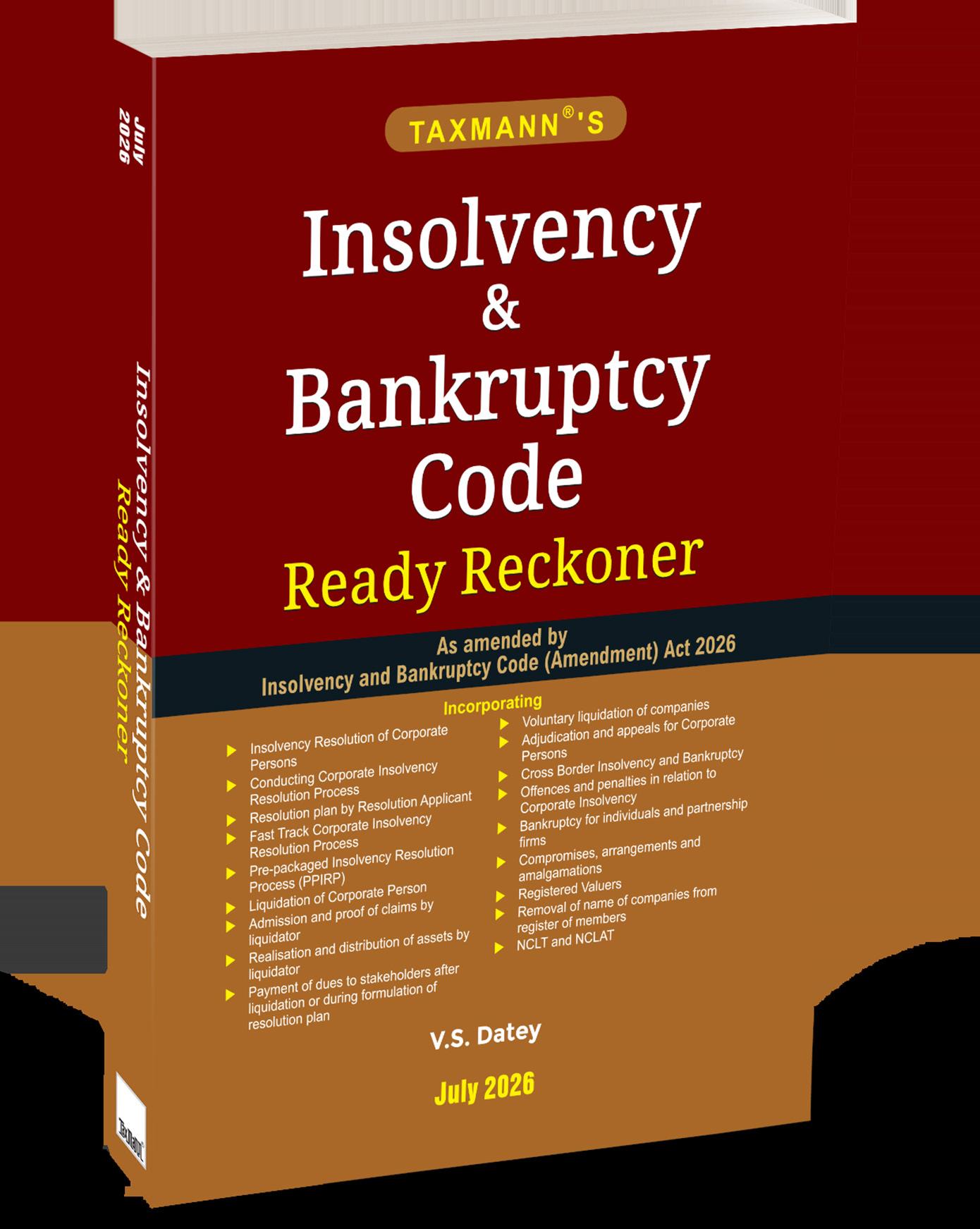
INSOLVENCY & BANKRUPTCY
CODE READY RECKONER
AUTHOR : V.S. Datey
PUBLISHER : Taxmann
DATE OF PUBLICATION : July 2026
EDITION : 2026 Edition
ISBN NO : 9789375617648
NO. OF PAGES : 504
BINDING TYPE : Paperback
Rs. 1,695
DESCRIPTION
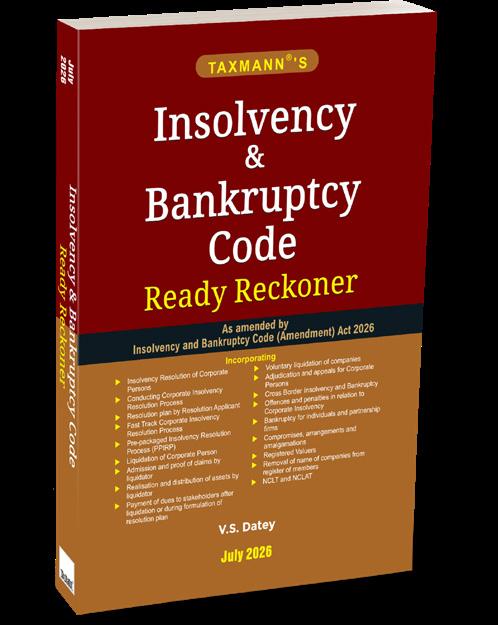
Insolvency & Bankruptcy Code Ready Reckoner is a comprehensive, practice-oriented reference that presents the Insolvency and Bankruptcy Code 2016 (IBC) as a complete insolvency resolution and economic revival framework, rather than a mere debt recovery statute. Designed as a true ready reckoner, this publication explains the law as it operates in practice, covering corporate insolvency resolution, pre-packaged insolvency, liquidation, individual and partnership bankruptcy, adjudication, appeals, and enforcement within a single, integrated volume. The 2026 Edition incorporates legislative amendments, regulatory developments, and evolving judicial interpretation. Structured around the actual lifecycle of insolvency proceedings, the book enables readers to move seamlessly from default and initiation through resolution or liquidation to distribution, dissolution, and appellate remedies. Its paragraph-numbered format makes it a dependable desk reference for practical insolvency work.
This book is intended for the following audience:
• Insolvency Professionals (IRPs, RPs, Liquidators, IPEs)
• Advocates and Insolvency Litigators
• Banks, Financial Institutions, ARCs, and Credit Teams
• Chartered Accountants, Company Secretaries, Cost Accountants, and Registered Valuers
• Corporate Management, In-house Legal, and Compliance Teams
• Academicians, Researchers, and Advanced Students
The Present Publication is the 2026 Edition, updated till 20th December 2025. It is authored by V.S. Datey with the following noteworthy features:
• [Process-oriented Ready Reckoner] Follows the complete lifecycle of insolvency proceedings, enabling quick, stage-wise reference during live matters
• [End-to-end Insolvency Coverage] Covers CIRP, PPIRP, Fast Track CIRP, liquidation, voluntary liquidation, and bankruptcy of individuals and partnership firms within one integrated framework
• [Resolution-first Orientation] Explains IBC as a revival and value-maximisation mechanism, reinforcing liquidation as a measure of last resort
• [Resolution Plan & CoC Mechanics] Analyses resolution applicant eligibility, plan formulation and approval, CoC decision-making, and post-approval consequences
• [Dedicated PPIRP Coverage] Provides structured treatment of PPIRP, including eligibility, initiation, claims handling, competitive improvement of plans, and approval, with special relevance for MSMEs
• [Liquidation & Distribution Framework] Examines liquidator powers, claims admission, avoidance transactions, asset realisation, distribution waterfall, stakeholder payments, and dissolution
• [Cross-statute & Regulatory Integration] Explores interaction with the Companies Act, limitation law, SARFAESI/DRT, and GST/Income-tax implications during insolvency
• [Adjudication & Appellate Architecture] Covers NCLT and NCLAT jurisdiction, procedure, and appeals to the Supreme Court
• [Offences, Penalties & Enforcement] Explains offences and penalties under IBC and related enforcement mechanisms
• [Individual & Partnership Insolvency] Covers Fresh Start Process, insolvency resolution, and bankruptcy proceedings for individuals and partnership firms
• [Institutional & Professional Framework] Explains the role of IBBI, Information Utilities, Registered Valuers, and other institutional participants
• [Jurisprudence-backed Interpretation] Integrates key judicial precedents to clarify interpretation and guide practical application
• [Navigation & Reference Tools] Includes acronyms, paragraph-wise numbering, section index, and subject index for rapid reference