Store
© Taxmann Price : ` 185 Law stated in this book is as updated till 25th November, 2025 Published by : Taxmann Publications (P.) Ltd. Sales & Marketing : 59/32, New Rohtak Road, New Delhi-110 005 India Phone : +91-11-45562222 Website : www.taxmann.com E-mail : sales@taxmann.com Regd. Office : 21/35, West Punjabi Bagh, New Delhi-110 026 India Printed at : Tan Prints (India) Pvt. Ltd. 44 Km. Mile Stone, National Highway, Rohtak Road Village Rohad, Distt. Jhajjar (Haryana) India E-mail : sales@tanprints.com Disclaimer Every effort has been made to avoid errors or omissions in this publication. In spite of this, errors may creep in. Any mistake, error or discrepancy noted may be brought to our notice which shall be taken care of in the next edition. It is notified that neither the publisher nor the author or seller will be responsible for any damage or loss of action to any one, of any kind, in any manner, therefrom. It is suggested that to avoid any doubt the reader should cross-check all the facts, law and contents of the publication with original Government publication or notifications. No part of this book may be reproduced or copied in any form or by any means [graphic, electronic or mechanical, including photocopying, recording, taping, or information retrieval systems] or reproduced on any disc, tape, perforated media or other information storage device, etc., without the written permission of the publishers. Breach of this condition is liable for legal action. For binding mistake, misprints or for missing pages, etc., the publisher’s liability is limited to replacement within seven days of purchase by similar edition. All expenses in this connection are to be borne by the purchaser. All disputes are subject to Delhi jurisdiction only.
Contents INDIAN STAMP ACT, 1899 PAGE
CHAPTER I PRELIMINARY
1. Short title, extent and commencement
1
2. Definitions
1 CHAPTER II STAMP-DUTIES
A.—Of the liability of instruments to duty 3. Instruments chargeable with duty
11
3A. [Omitted by the Refugee Relief Taxes (Abolition) Act, 1973, w.e.f. 1-4-1973]
13
4. Several instruments used in single transaction of sale, mortgage or settlement
13
5. Instruments relating to several distinct matters
14
6. Instruments coming within several descriptions in Schedule I
14
7. Policies of sea-insurance
15
8. Bonds, debentures or other securities issued on loans under Act 11 of 1879
15
8A. Securities dealt in depository not liable to stamp duty
16
8B. Corporatisation and demutualization schemes and related instruments not liable to duty
17
I-5
CONTENTS
I-6 PAGE
8C. Negotiable warehouse receipts not liable to stamp duty
18
8D. Agreement or document for assignment of receivables not liable to stamp duty
18
8E. Conversion of a branch of any bank into a wholly owned subsidiary of bank or transfer of shareholding of a bank to a holding company of bank not liable to duty
19
8F. Agreement or document for transfer or assignment of rights or interest in financial assets not liable to stamp duty
20
8G. Strategic sale, disinvestment, etc., of immovable property by Government company not liable to stamp duty
21
9. Power to reduce, remit or compound duties
21
AA.—Of the liability of instruments of transaction in stock exchanges and depositories to duty 9A. Instruments chargeable with duty for transactions in stock exchanges and depositories
22
9B. Instruments chargeable with duty for transactions otherwise than through stock exchanges and depositories
23
B.—Of stamps and the mode of using them 10. Duties how to be paid
23
11. Use of adhesive stamps
24
12. Cancellation of adhesive stamps
24
13. Instruments stamped with impressed stamps how to be written
25
14. Only one instrument to be on same stamp
25
15. Instrument written contrary to section 13 or 14 deemed unstamped
26
16. Denoting duty
26
C.—Of the time of stamping instruments 17. Instruments executed in India
27
18. Instruments other than bills and notes executed out of India
27
19. Bills and notes drawn out of India
28
D.—Of valuations for duty 20. Conversion of amount expressed in foreign currencies
28
21. Stock and marketable securities how to be valued
29
22. Effect of statement of rate of exchange or average price
29
23. Instruments reserving interest
30
23A. Certain instruments connected with mortgages of marketable securities to be chargeable as agreements
30
I-7
CONTENTS PAGE
24. How transfer in consideration of debt, or subject to future payment, etc., to be charged
31
25. Valuation in case of annuity, etc.
32
26. Stamp where value of subject-matter is indeterminate
33
27. Facts affecting duty to be set forth in instrument
34
28. Direction as to duty in case of certain conveyances
35
E.—Duty by whom payable 29. Duties by whom payable
37
30. Obligation to give receipt in certain cases
40
CHAPTER III ADJUDICATION AS TO STAMPS
31. Adjudication as to proper stamp
41
32. Certificate by Collector
43 CHAPTER IV
INSTRUMENTS NOT DULY STAMPED
33. Examination and impounding of instruments
45
34. Special provision as to unstamped receipts
46
35. Instruments not duly stamped inadmissible in evidence, etc.
47
36. Admission of instrument where not to be questioned
50
37. Admission of improperly stamped instruments
50
38. Instruments impounded, how dealt with
50
39. Collector’s power to refund penalty paid under section 38, sub-section (1)
51
40. Collector’s power to stamp instruments impounded
51
41. Instruments unduly stamped by accident
52
42. Endorsement of instruments on which duty has been paid under section 35, 40 or 41
53
43. Prosecution for offence against Stamp-law
54
44. Persons paying duty or penalty may recover same in certain cases
54
45. Power to Revenue authority to refund penalty or excess duty in certain cases
55
46. Non-liability for loss of instruments sent under section 38
55
47. Power of payer to stamp bills, and promissory notes received by him unstamped
55
48. Recovery of duties and penalties
55
CONTENTS
I-8 PAGE
CHAPTER V ALLOWANCES FOR STAMPS IN CERTAIN CASES
49. Allowance for spoiled stamps
56
50. Application for relief under section 49 when to be made
57
51. Allowance in case of printed forms no longer required by Corporations
58
52. Allowance for misused stamps
58
53. Allowance for spoiled or misused stamps how to be made
58
54. Allowance for stamps not required for use
59
54A. Allowances for stamps in denominations of annas
59
54B. Allowances for Refugee Relief stamps
59
55. Allowance on renewal of certain debentures
60
CHAPTER VI REFERENCE AND REVISION
56. Control of, and statement of case to, Chief Controlling Revenue-Authority
60
57. Statement of case by Chief Controlling Revenue-Authority to High Court
61
58. Power of High Court to call for further particulars as to case stated
62
59. Procedure in disposing of case stated
62
60. Statement of case by other Courts to High Court
62
61. Revision of certain decisions of Courts regarding the sufficiency of stamps
62
CHAPTER VII CRIMINAL OFFENCES AND PROCEDURE
62. Penalty for executing, etc., instrument not duly stamped
63
62A. Penalty for failure to comply with provisions of section 9A
64
63. Penalty for failure to cancel adhesive stamp
64
64. Penalty for omission to comply with provisions of section 27
64
65. Penalty for refusal to give receipt, and for devices to evade duty on receipts
64
66. Penalty for not making out policy or making one not duly stamped
65
I-9
CONTENTS PAGE
67. Penalty for not drawing full number of bills or marine policies purporting to be in sets
65
68. Penalty for post-dating bills, and for other devices to defraud the revenue
65
69. Penalty for breach of rule relating to sale of stamps and for unauthorized sale
65
70. Institution and conduct of prosecutions
66
71. Jurisdiction of Magistrates
66
72. Place of trial
66 CHAPTER VIII SUPPLEMENTAL PROVISIONS
73. Books, etc., to be open to inspection
67
73A. Power of Central Government to make rules
67
73B. Power to issue directions and to authorise certain authorities to issue instructions, etc.
68
74. Powers to make rules relating to sale of stamps
68
75. Power to make rules generally to carry out Act
68
76. Publication of rules
68
76A. Delegation of certain powers 77. Saving as to court-fees 77A. Saving as to certain stamps
69 69 69
78. Act to be translated, and sold cheaply
69
79. [Repealed by the Repealing and Amending Act, 1914]
69
SCHEDULE I : Stamp-duty on instruments
70
SCHEDULE II [Repealed by the Repealing and Amending Act, 1914]
97
SUBJECT INDEX
99
INDIAN STAMP (COLLECTION OF STAMP-DUTY THROUGH STOCK EXCHANGES, CLEARING CORPORATIONS AND DEPOSITORIES) RULES, 2019 1. Short title and commencement
105
2. Definitions
105
3. Collection of stamp-duty by stock exchange or clearing corporation
107
CONTENTS
I-10 PAGE
4. Determining transactions as on delivery basis or non-delivery basis, differential duty, etc.
107
5. Collection of stamp-duty by depositories from transferor
108
6. Collection of stamp-duty by depositories from issuer
108
7. Transfer of stamp-duty to States
109
8. Return of stamp-duty
109
9. Erroneous entries
110
FORM: Return of Stamp-Duty Collected (Monthly/Yearly)
110
Indian Stamp Act, 1899 [2 OF 1899]*
An Act to consolidate and amend the law relating to Stamps. Wheareas it is expedient to consolidate and amend the law relating to Stamps; It is hereby enacted as follows:— CHAPTER I PRELIMINARY Short title, extent and commencement. 1. (1) This Act may be called the Indian Stamp Act, 1899. [(2) It extends to the whole of India 2[***]:
1
Provided that it shall not apply to 3[the territories which, immediately before the 1st November, 1956, were comprised in Part B States] (excluding the State of Jammu and Kashmir) except to the extent to which the provisions of this Act relate to rates of stamp-duty in respect of the documents specified in entry 91 of List I in the Seventh Schedule to the Constitution.] (3) It shall come into force on the first day of July, 1899. Definitions. 2. In this Act, unless there is something repugnant in the subject or context,— [(1) “allotment list” means a list containing details of allotment of the securities intimated by the issuer to the depository under sub-section (2) of section 8 of the Depositories Act, 1996 (22 of 1996);
4
*Dated 27-1-1899. This Act has been partially extended to the Berar by the Berar Laws Act, 1941, w.e.f. 1-8-1941. It has also been extended to Dadra and Nagar Haveli by the Dadra and Nagar Haveli (Laws) Regulation, 1963, w.e.f. 1-7-1965 to Goa, Daman and Diu by the Goa, Daman and Diu (Laws) No. 2 Regulation, 1963, w.e.f. 19-12-1963 and to Laccadive, Minicoy and Amindivi Islands by the Laccadive, Minicoy and Amindivi Islands (Laws) Regulation, 1965, w.e.f. 1-10-1967. 1. Substituted by the Indian Stamp (Amendment) Act, 1955, w.e.f. 1-4-1956. 2. Words “except the State of Jammu and Kashmir” omitted by the Jammu and Kashmir Reorganisation Act, 2019, w.e.f. 31-10-2019. 3. Substituted for “Part B States” by the Adaptation of Laws (No. 2) Order, 1956, w.e.f. 1-111956. 4. Clauses (1) and (1A) substituted for clause (1) by the Finance Act, 2019, w.e.f. 1-7-2020 [Vide S.O. 4419(E), dated 10-12-2019, as amended by S.O. 115(E), dated 8-1-2020 and S.O. 1226(E), dated 30-3-2020]. Prior to its substitution, clause (1) read as under: ‘(1) “Banker” includes a bank and any person acting as a banker;’
1
S. 2
INDIAN STAMP ACT, 1899
2
(1A) “banker” includes a bank and any person acting as a banker;] (2) “bill of exchange” means a bill of exchange as defined by the Negotiable Instruments Act, 1881 (26 of 1881), and includes also a hundi, and any other document entitling or purporting to entitle any person, whether named therein or not, to payment by any other person of, or to draw upon any other person for, any sum of money; (3) “bill of exchange payable on demand” includes— (a) an order for the payment of any sum of money by a bill of exchange or promissory note, or for the delivery of any bill of exchange or promissory note in satisfaction of any sum of money, or for the payment of any sum of money out of any particular fund which may or may not be available, or upon any condition or contingency which may or may not be performed or happen; (b) an order for the payment of any sum of money weekly, monthly, or at any other stated period; and (c) a letter of credit, that is to say, any instrument by which one person authorizes another to give credit to the person in whose favour it is drawn; (4) “bill of lading” includes a “through bill of lading”, but does not include a mate’s receipt; (5) “bond” includes— (a) any instrument whereby a person obliges himself to pay money to another, on condition that the obligation shall be void if a specified act is performed, or is not performed, as the case may be; (b) any instrument attested by a witness and not payable to order or bearer, whereby a person obliges himself to pay money to another; and (c) any instrument so attested, whereby a person obliges himself to deliver grain or other agricultural produce to another, 5 [but does not include a debenture;]
(6) “chargeable” means, as applied to an instrument executed or first executed after the commencement of this Act, chargeable under this Act, and, as applied to any other instrument, chargeable under the law in force in 6 [India] when such instrument was executed or, where several persons executed the instrument at different times, first executed; (7) “cheque” means a bill of exchange drawn on a specified banker and not expressed to be payable otherwise than on demand;
5. Inserted by the Finance Act, 2019, w.e.f. 1-7-2020 [Vide S.O. 4419(E), dated 10-12-2019, as amended by S.O. 115(E), dated 8-1-2020 and S.O. 1226(E), dated 30-3-2020]. 6. Substituted for “the States” by the Indian Stamp (Amendment) Act, 1955, w.e.f. 1-4-1956.
3
INDIAN STAMP ACT, 1899
S. 2
[(7A) “clearance list” means a list of transactions of sale and purchase relating to contracts traded on the stock exchanges submitted to a clearing corporation in accordance with the law for the time being in force in this behalf;
7
(7B) “clearing corporation” means an entity established to undertake the activity of clearing and settlement of transactions in securities or other instruments and includes a clearing house of a recognised stock exchange;] (8) 7a[***] (9) “Collector”— (a) means, within the limits of the towns of Calcutta, Madras and Bombay, the Collector of Calcutta, Madras and Bombay, respectively, and, without those limits, the Collector of a district, and (b) includes a Deputy Commissioner and any officer whom 8[the 9[State Government]] may, by notification in the Official Gazette, appoint in this behalf; (10) “conveyance” includes a conveyance on sale and every instrument by which property, whether movable or immovable, is transferred inter vivos and which is not otherwise specifically provided for by Schedule I; [(10A) “debenture” includes––
7
(i) debenture stock, bonds or any other instrument of a company evidencing a debt, whether constituting a charge on the assets of the company or not; (ii) bonds in the nature of debenture issued by any incorporated company or body corporate; (iii) certificate of deposit, commercial usance bill, commercial paper and such other debt instrument of original or initial maturity upto one year as the Reserve Bank of India may specify from time to time; (iv) securitised debt instruments; and (v) any other debt instruments specified by the Securities and Exchange Board of India from time to time; (10B) “depository” includes–– (a) a depository as defined in clause (e) of sub-section (1) of section 2 of the Depositories Act, 1996 (22 of 1996); and
7. Inserted by the Finance Act, 2019, w.e.f. 1-7-2020 [Vide S.O. 4419(E), dated 10-12-2019, as amended by S.O. 115(E), dated 8-1-2020 and S.O. 1226(E), dated 30-3-2020]. 7a. Clause (8) omitted by the Government of India (Adaptation of Indian Laws) Order, 1937, w.e.f. 1-4-1937. 8. Substituted for “the Local Government”, ibid. 9. Substituted for “collecting Government” by the Adaptation of Laws Order, 1950, w.e.f. 26-1-1950.
S. 2
INDIAN STAMP ACT, 1899
4
(b) any other entity declared by the Central Government, by notification in the Official Gazette, to be a depository for the purposes of this Act;] (11) “Duly stamped”, as applied to an instrument, means that the instrument bears an adhesive or impressed stamp of not less than the proper amount and that such stamp has been affixed or used in accordance with the law for time being in force in 10[India]; (12) “Executed” and “execution”, used with reference to instruments, mean “signed” and “signature” 10a[and includes attribution of electronic record within the meaning of section 11 of the Information Technology Act, 2000 (21 of 2000)]; (12A) 11[***] (13) “impressed stamp” includes— (a) labels affixed and impressed by the proper officer, and (b) stamps embossed or engraved on stamped paper; [(13A) “India” means the territory of India excluding the State of Jammu and Kashmir;]
12
[(14) “instrument” includes—
13
(a) every document, by which any right or liability is, or purports to be, created, transferred, limited, extended, extinguished or recorded; (b) a document, electronic or otherwise, created for a transaction in a stock exchange or depository by which any right or liability is, or purports to be, created, transferred, limited, extended, extinguished or recorded; and (c) any other document mentioned in Schedule I, but does not include such instruments as may be specified by the Government, by notification in the Official Gazette;] (15) “instrument of partition” means any instrument whereby co-owners of any property divide or agree to divide such property in severalty, and includes also a final order for effecting a partition passed by any revenue-authority or any Civil Court and an award by an arbitrator directing a partition; 10. Substituted for “the States” by the Indian Stamp (Amendment) Act, 1955, w.e.f. 1-4-1956. 10a. Inserted by the Finance Act, 2019, w.e.f. 1-7-2020 [Vide S.O. 4419(E), dated 10-12-2019, as amended by S.O. 115(E), dated 8-1-2020 and S.O. 1226(E), dated 30-3-2020]. 11. Omitted by the Adaptation of Laws Order, 1950, w.e.f. 26-1-1950. Earlier, clause (12A) was inserted by the Government of India (Adaptation of Indian Laws) Order, 1937, w.e.f. 1-4-1937. 12. Inserted by the Indian Stamp (Amendment) Act, 1955, w.e.f. 1-4-1956. 13. Substituted by the Finance Act, 2019, w.e.f. 1-7-2020 [Vide S.O. 4419(E), dated 10-12-2019, as amended by S.O. 115(E), dated 8-1-2020 and S.O. 1226(E), dated 30-3-2020]. Prior to its substitution, clause (14) read as under: ‘(14) “instrument” includes every document by which any right or liability is, or purports to be, created, transferred, limited, extended, extinguished or record;’
5
INDIAN STAMP ACT, 1899
S. 2
[(15A) “issuer” means any person making an issue of securities;]
14
(16) “lease” means a lease of immovable property, and includes also— (a) a patta; (b) a Kabuliyat or other undertaking in writing, not being a counterpart of a lease, to cultivate, occupy, or pay or deliver rent for, immovable property; (c) any instrument by which tolls of any description are let; (d) any writing on an application for a lease intended to signify that the application is granted; [(16A) “marketable security” means a security capable of being traded in any stock exchange in India;
15
(16B) “market value”, in relation to an instrument through which— (a) any security is traded in a stock exchange, means the price at which it is so traded; (b) any security which is transferred through a depository but not traded in the stock exchange, means the price or the consideration mentioned in such instrument; (c) any security is dealt otherwise than in the stock exchange or depository, means the price or consideration mentioned in such instrument;] (17) “mortgage-deed” includes every instrument whereby, for the purpose of securing money advanced, or to be advanced, by way of loan, or an existing or future debt, or the performance of an engagement, one person transfers, or creates, to, or in favour of, another, a right over or in respect of specified property; (18) “paper” includes vellum, parchment or any other material on which an instrument may be written; (19) “policy of insurance” includes— (a) any instrument by which one person, in consideration of a premium, engages to indemnify another against loss, damage or liability arising from an unknown or contingent event; (b) life-policy, and any policy insuring any person against accident or sickness, and any other personal insurance; 15a[***]
14. Inserted by the Finance Act, 2019, w.e.f. 1-7-2020 [Vide S.O. 4419(E), dated 10-12-2019, as amended by S.O. 115(E), dated 8-1-2020 and S.O. 1226(E), dated 30-3-2020]. 15. Clauses (16A) and (16B) substituted for clause (16A), ibid. Prior to its substitution, clause (16A), as amended by the Indian Stamp (Amendment) Act, 1955, w.e.f. 1-4-1956, read as under: ‘(16A) “Marketable security” means a security of such a description as to be capable of being sold in any stock market in India or in the United Kingdom;’ 15a. Word “and” omitted by the Indian Stamp (Amendment) Act, 1906.
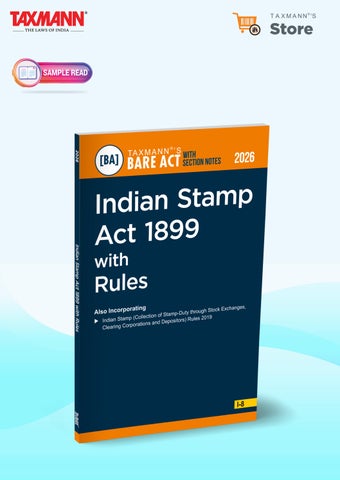
INDIAN STAMP ACT 1899 WITH RULES – BARE ACT WITH SECTION NOTES AUTHOR PUBLISHER DATE OF PUBLICATION EDITION ISBN NO NO. OF PAGES BINDING TYPE
: : : : : : :
TAXMANN'S EDITORIAL BOARD TAXMANN DECEMBER 2025 2026 EDITION 9789371262736 124 PAPERBACK
Rs. 185
DESCRIPTION Indian Stamp Act 1899 with Rules [Bare Act with Section Notes] by Taxmann is a consolidated reference for the Indian Stamp Act and its allied rules, including the Indian Stamp (Collection of Stamp-Duty through Stock Exchanges, Clearing Corporations and Depositories) Rules 2019. Each section of the statute is supplemented by explanatory notes that focus on historical evolution, recent amendments, and everyday applications. This publication aims to clarify the legal framework governing stamp duties in India, ensuring readers understand both core statutory provisions and current guidelines. This book is intended for the following audience: � Legal Practitioners & Law Firms � Corporate Entities & Financial Institutions � Judicial & Quasi-Judicial Authorities � Public Offices & Administrators � Academicians & Students The Present Publication is the 2026 Edition, covering the amended and updated text of the Indian Stamp Act [Act No. 2 of 1899] and Rules, with the following noteworthy features: • [Section Notes & Commentary] Each section is followed by notes clarifying practical implications • [Coverage of Amendments] Includes recent legislative changes, notably the 2019 Rules on stamp-duty collection • [Pre-amendment Provisions] Displays earlier text in footnotes for historical context • [Practical Insight on Duties] Provides guidelines on chargeability, remission, and adjudication • [Relevant Rules & Forms] Contains the Indian Stamp (Collection of Stamp-Duty) Rules 2019, along with essential forms • [User-friendly Format] Bare Act layout with inline notes for quick reference • [Up-to-date & Authoritative] Published by Taxmann, known for reliability in legal and tax commentaries
BUY NOW