
Sample Read

© Taxmann
Price : ` 85
Published by :
Taxmann Publications (P.) Ltd.
Sales & Marketing :
59/32, New Rohtak Road, New Delhi-110 005 India
Phone : +91-11-45562222
Website : www.taxmann.com
E-mail : sales@taxmann.com
Regd. Office :
21/35, West Punjabi Bagh, New Delhi-110 026 India
Printed at :
Tan Prints (India) Pvt. Ltd.
44 Km. Mile Stone, National Highway, Rohtak Road Village Rohad, Distt. Jhajjar (Haryana) India
E-mail : sales@tanprints.com
Disclaimer
Every effort has been made to avoid errors or omissions in this publication. In spite of this, errors may creep in. Any mistake, error or discrepancy noted may be brought to our notice which shall be taken care of in the next edition. It is notified that neither the publisher nor the author or seller will be responsible for any damage or loss of action to any one, of any kind, in any manner, therefrom. It is suggested that to avoid any doubt the reader should cross-check all the facts, law and contents of the publication with original Government publication or notifications.
No part of this book may be reproduced or copied in any form or by any means [graphic, electronic or mechanical, including photocopying, recording, taping, or information retrieval systems] or reproduced on any disc, tape, perforated media or other information storage device, etc., without the written permission of the publishers. Breach of this condition is liable for legal action.
For binding mistake, misprints or for missing pages, etc., the publisher’s liability is limited to replacement within seven days of purchase by similar edition. All expenses in this connection are to be borne by the purchaser. All disputes are subject to Delhi jurisdiction only.



APPROPRIATION
CHAPTER VI
CHAPTER VIII
CHAPTER IX OF BAILMENT
BAILMENTS OF PLEDGES
CHAPTER X
SUB-AGENTS
RATIFICATION
REVOCATION OF AUTHORITY
AGENT’S DUTY TO PRINCIPAL
PRINCIPAL’S DUTY TO
CHAPTER XI OF PARTNERSHIP

Indian Contract Act, 1872
[9 OF 1872*]
Preamble
Whereas it is expedient to define and amend certain parts of the law relating to contracts; It is hereby enacted as follows:—
PRELIMINARY
Short title.
1. This Act may be called the Indian Contract Act, 1872.
Extent, Commencement.—It extends to the whole of India 1[***]; and it shall come into force on the first day of September, 1872.
Saving.— 2[***] Nothing herein contained shall affect the provisions of any Statute, Act or Regulation not hereby expressly repealed, nor any usage or custom of trade, nor any incident of any contract, not inconsistent with the provisions of this Act.
Interpretation clause.
2. In this Act the following words and expressions are used in the following senses, unless a contrary intention appears from the context:—
(a)When one person signifies to another his willingness to do or to abstain from doing anything, with a view to obtaining the assent of that other to such act or abstinence, he is said to make a proposal;
(b)When the person to whom the proposal is made, signifies his assent thereto, the proposal is said to be accepted. A proposal, when accepted, becomes a promise;
*Dated 25-4-1872.
This Act has been extended to Berar by the Berar Laws Act, 1941, w.e.f. 1-8-1941, to Dadra and Nagar Haveli by the Dadra and Nagar Haveli (Laws) Regulation, 1963, w.e.f. 1-7-1965 to Goa, Daman and Diu by the Goa, Daman and Diu (Laws) No. 2 Regulation, 1963, w.e.f. 19-12-1963 to Laccadive, Minicoy and Amindivi Islands by the Laccadive, Minicoy and Amindivi Islands (Laws) Regulation, 1965, w.e.f. 1-10-1965, to Pondicherry by the Pondicherry (Extension of Laws) Act, 1968, w.e.f. 24-5-1968 and State of Sikkim vide S.O. 641(E), dated 24-8-1984, w.e.f. 1-9-1984.
1. Words “except the State of Jammu and Kashmir” omitted by the Jammu and Kashmir Reorganisation Act, 2019, w.e.f. 31-10-2019. Earlier, said quoted words were substituted for “except Part B States” by the Part B States (Laws) Act, 1951, w.e.f. 1-4-1951.
2. Words "The enactments mentioned in the Schedule hereto are repealed to the extent specified in the third column thereof, but" omitted by the Repealing and Amending Act, 1914.
(c) The person making the proposal is called the “promisor”, and the person accepting the proposal is called “promisee”;
(d) When, at the desire of the promisor, the promisee or any other person has done or abstained from doing, or does or abstains from doing, or promises to do or to abstain from doing, something, such act or abstinence or promise is called a consideration for the promise;
(
e) Every promise and every set of promises, forming the consideration for each other, is an agreement;
(
f) Promises which form the consideration or part of the consideration for each other are called reciprocal promises;
(
g) An agreement not enforceable by law is said to be void;
(
h) An agreement enforceable by law is a contract;
(i) An agreement which is enforceable by law at the option of one or more of the parties thereto, but not at the option of the other or others, is a voidable contract;
(j) A contract which ceases to be enforceable by law becomes void when it ceases to be enforceable.
CHAPTER I
OF THE COMMUNICATION, ACCEPTANCE AND REVOCATION OF PROPOSALS
Communication, acceptance and revocation of proposals.
3. The communication of proposals, the acceptance of proposals, and the revocation of proposals and acceptances, respectively, are deemed to be made by any act or omission of the party proposing, accepting or revoking by which he intends to communicate such proposal, acceptance or revocation, or which has the effect of communicating it.
See also section 5
Communication when complete.
4. The communication of a proposal is complete when it comes to the knowledge of the person to whom it is made.
The communication of an acceptance is complete,— as against the proposer, when it is put in a course of transmission to him, so as to be out of the power of the acceptor; as against the acceptor, when it comes to the knowledge of the proposer.
The communication of a revocation is complete,— as against the person who makes it, when it is put into a course of transmission to the person to whom it is made, so as to be out of the power of the person who makes it; as against the person to whom it is made, when it comes to his knowledge.
Illustrations
(
a) A proposes, by letter, to sell a house to B at a certain price. The communication of the proposal is complete when B receives the letter.
(b) B accepts A’s proposal by a letter sent by post. The communication of the acceptance is complete, as against A, when the letter is posted; as against B, when the letter is received by A.
(c) A revokes his proposal by telegram.
The revocation is complete as against A when the telegram is despatched. It is complete as against B when B receives it.
B revokes his acceptance by telegram. B’s revocation is complete as against B when the telegram is despatched, and as against A when it reaches him.
Revocation of proposals and acceptances.
5. A proposal may be revoked at any time before the communication of its acceptance is complete as against the proposer, but not afterwards.
An acceptance may be revoked at any time before the communication of the acceptance is complete as against the acceptor, but not afterwards.
Illustrations
A proposes, by a letter sent by port, to sell his house to B. B accepts the proposal by a letter sent by post.
A may revoke his proposal at any time before or at the moment when B posts his letter of acceptance, but not afterwards.
B may revoke his acceptance to any time before or at the moment when the letter communicating it reaches A, but not afterwards.
Revocation how made.
6. A proposal is revoked—
(1) by the communication of notice of revocation by the proposer to the other party;
(2) by the lapse of the time prescribed in such proposal for its acceptance, or, if no time is so prescribed, by the lapse of a reasonable time, without communication of the acceptance;
(3) by the failure of the acceptor to fulfil a condition precedent to acceptance; or
(4) by the death or insanity of the proposer, if the fact of the death or insanity comes to the knowledge of the acceptor before acceptance.
Acceptance must be absolute.
7. In order to convert a proposal into a promise, the acceptance must—
(1) be absolute and unqualified;
(2) be expressed in some usual and reasonable manner, unless the proposal prescribes the manner in which it is to be accepted. If the proposal prescribes a manner in which it is to be accepted, and the acceptance is
not made in such manner, the proposer may, within a reasonable time after the acceptance is communicated to him, insist that his proposal shall be accepted in the prescribed manner, and not otherwise; but, if he fails to do so, he accepts the acceptance.
Acceptance by performing conditions, or receiving consideration.
8. Performance of the conditions of a proposal, or the acceptance of any consideration for a reciprocal promise which may be offered with a proposal, is an acceptance of the proposal.
Promises, express or implied.
9. Insofar as the proposal or acceptance of any promise is made in words, the promise is said to be express. Insofar as such proposal or acceptance is made otherwise than in words, the promise is said to be implied.
CHAPTER II
OF CONTRACTS, VOIDABLE CONTRACTS AND VOID AGREEMENTS
What agreements are contracts.
10. All agreements are contracts if they are made by the free consent of parties competent to contract, for a lawful consideration and with a lawful object, and are not hereby expressly declared to be void.
Nothing herein contained shall affect any law in force in 3[India], and not hereby expressly repealed, by which any contract is required to be made in writing or in the presence of witnesses, or any law relating to the registration of documents.
Who are competent to contract.
11. Every person is competent to contract who is of the age of majority according to the law to which he is subject, and who is of sound mind and is not disqualified from contracting by any law to which he is subject.
What is a sound mind for the purposes of contracting.
12. A person is said to be of sound mind for the purpose of making a contract, if, at the time when he makes it, he is capable of understanding it and of forming a rational judgment as to its effect upon his interests.
A person who is usually of unsound mind, but occasionally of sound mind, may make a contract when he is of sound mind.
A person who is usually of sound mind, but occasionally of unsound mind, may not make a contract when he is of unsound mind.
3. Substituted for “Part A States and Part C States” by the Part B States (Laws) Act, 1951, w.e.f. 1-4-1951. Earlier, the quoted words were substituted for “the Provinces” by the Adaptation of Laws Order, 1950, w.e.f. 26-1-1950.
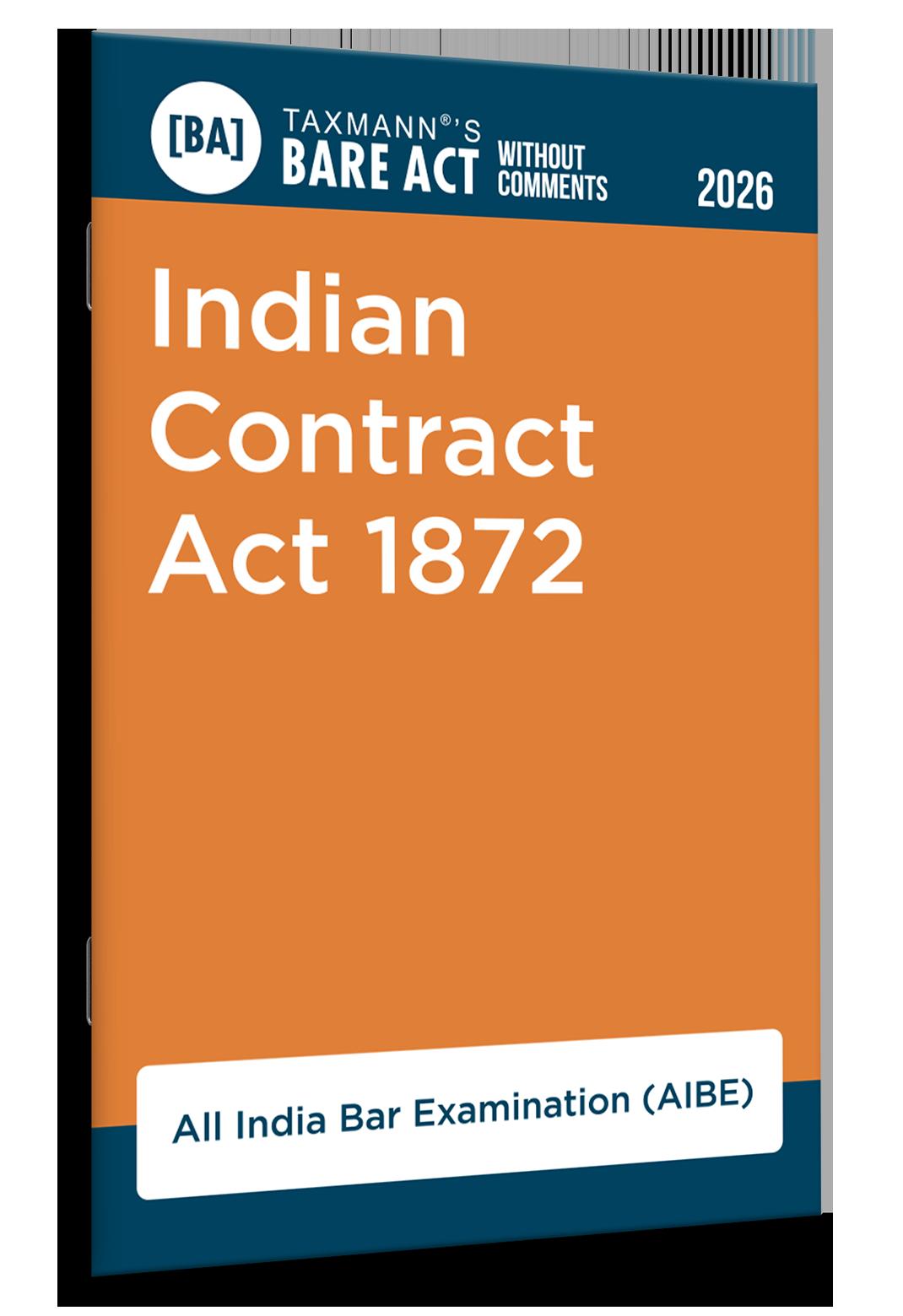
Indian Contract Act 1872 – Bare Act without Comments | AIBE
AUTHOR : Taxmann’s Editorial Board
PUBLISHER : Taxmann
DATE OF PUBLICATION : February 2026
EDITION : 2026 Edition
ISBN NO : 9789364551397
No. of Pages : 68
BINDING TYPE : Paperback
Rs. 85
DESCRIPTION
Indian Contract Act 1872 [Bare Act without Comments] by Taxmann for All India
Bar Examination (AIBE) is a precise and authoritative compilation of India’s primary legislation on contracts and related obligations. The 2026 Edition provides the complete, unaltered text of the Act, incorporating all amendments in force, in an exam-compliant format without commentary or annotations. It covers key principles of contract law, including formation, performance, breach, remedies, special contracts, and agency, making it an essential reference for legal study and practice.
The Present Publication is the 2026 Edition, covering the amended and updated text of the Indian Contract Act [Act No. 9 of 1872], with the following noteworthy features:
• [Complete & Authentic Text] Full statutory provisions of the Indian Contract Act 1872, as amended up to date
• [Exam-compliant Format] No commentary, annotations, or case law; fully permissible for AIBE use
• [Logical Arrangement] Chapter-wise and section-wise layout for easy navigation
• [Updated Coverage] Includes all recent legislative changes
• [Portable & Handy] Ideal for quick reference in study or practice