
Sample Read

CONTENTS
CONTENTS
RETURN FORMS
[SEE VOLUME 2 OF INCOME-TAX RULES]
OTHER RULES AND SCHEMES
Income-tax (Certificate Proceedings) Rules, 1962See Vol. 2
Bank Term Deposit Scheme, 2006See Vol. 2
Senior Citizens’ Savings Scheme, 2019See Vol. 2
National Savings Certificates (VIII Issue) Scheme, 2019See Vol. 2
Income-tax (Appellate Tribunal) Rules, 1963See Vol. 2

INCOME-TAX RULES, 1962*
[SO 969, DATED 26-3-1962]
In exercise of the powers conferred by section 295 of the Income-tax Act, 1961 (43 of 1961) and rule 15 of Part A, rule 11 of Part B and rule 9 of Part C of the Fourth Schedule to that Act, the Central Board of Revenue hereby makes the following rules, namely :—
PART I
PRELIMINARY
Short title and commencement.
1. (1) These rules may be called the Income-tax Rules, 1962. (2)They shall come into force on the 1st day of April, 1962. Definitions.
2. (1) In these rules, unless the context otherwise requires,—
(a) “Act” means the Income-tax Act, 1961 (43 of 1961);
1[(aa)“authorised bank” means any bank as may be appointed by the Reserve Bank of India as its agent under the provisions of sub-section (1) of section 45 of the Reserve Bank of India Act, 1934 (2 of 1934);]
(b)“Chapter”, “section” and “Schedule” means respectively Chapter and section of, and Schedule to, the Act.
*Rules, which have been either substituted or inserted or amended by the Amending Rules notified since 1962, are annotated and indicated in the footnotes. To highlight the amendments notified during 2024 to 2026, the affected rules are printed in italics. The compendium has been enriched by incorporating therein at appropriate places latest relevant case laws and clarifications issued by the CBDT.
Section 4 of the Finance (No. 2) Act, 2014 provides as under :
“In the Income-tax Act, save as otherwise expressly provided, and unless the context otherwise requires, the reference to any income-tax authority specified in column (1) of the Table below shall be substituted and shall be deemed to have been substituted with effect from the 1st day of June, 2013 by reference to the authority or authorities specified in the corresponding entry in column (2) of the said Table and such consequential changes as the rules of grammar may require shall be made:
TABLE
Sl. No. (1) (2)
1.Commissioner Principal Commissioner or Commissioner
2.Director Principal Director or Director
3.Chief CommissionerPrincipal Chief Commissioner or Chief Commissioner
4.Director GeneralPrincipal Director General or Director General ”
CBDT has not yet issued any Income-tax (Amendment) Rules to effectuate the consequential changes to be made in the Income-tax Rules.
1.Inserted by the IT (Sixth Amdt.) Rules, 1981, w.e.f. 19-6-1981.
(2) All references to “Forms” in these rules shall be construed as references to the forms set out in Appendix II hereto.
PART II
DETERMINATION OF INCOME
A.—Salaries
2[Limits for the purposes of section 10(13A)3 .
2A. The amount which is not to be included in the total income of an assessee in respect of the special allowance referred to in clause (13A) of section 10 shall be—
2.Inserted by the IT (Amdt.) Rules, 1965, w.e.f. 4-1-1965.
3.Rule 2A does not in any way run counter to the provisions of the Act - CIT v. H.V. Yazdi [1978] 114 ITR 14 (Cal.).
Exemption under section 10(13A) is not available where the assessee is taxable in view of provisions of section 115BAC(1A).
Receipts on account of House rent allowance (HRA) would be taxable as ‘perquisites’ u/s 17(2) under the head ‘Salaries’—Karamchari Union v. UOI [2000] 109 Taxman 1 (SC). Where house was owned by wife of assessee and assessee had paid rent to her through bank transfer entry, assessee would be entitled to exemption under section 10(13A)—Bajrang Prasad Ramdharani v. Asstt. CIT [2013] 37 taxmann.com 186/60 SOT 66 (URO) (Ahd.-Trib.). Where sources for purchase of house in hands of assessee’s wife were proved, assessee could not have been denied HRA exemption for rent paid to wife—Abhay Kumar Mittal v. DCIT [2022] 136 taxmann.com 78/194 ITD 224 (Delhi-Trib.).
Only the expenditure actually incurred on payment of rent in respect of residential accommodation occupied by the assessee subject to the limits laid down in rule 2A, qualifies for exemption from income-tax. Thus, house rent allowance granted to an employee who is residing in a house/flat owned by him is not exempt from income-tax—Para 5.3.10 of Circular No. 24/2022, dated 7-12-2022. Where assessee had occupied the residential accommodation belonging to HUF and had not incurred any expenditure towards the rent, assessee was not entitled to claim the exemption—CIT v. D. Lakshminarayanaswamy [1999] 238 ITR 976 (Mad.).
A retired Judge, who has been appointed by State Government or Central Government to any post, cannot claim exemption from income-tax in respect of HRA—Justice Challa Kondaiah v. CIT [2001] 119 Taxman 511 (AP). Where HRA rules of a company states that an employee who refused or surrendered accommodation offered to him by the employer company, he should not be eligible for HRA—Arup Ratan Gooptu v. Coal India Ltd. [2022] 139 taxmann.com 137/288 Taxman 189 (Cal.). Once housing perquisite value was worked out as nil, there was no rental payment made by assessee for purpose of working out exemption of HRA and, therefore, assessee was not entitled to said benefit—DCIT v. Kuldeep D. Kaura [2012] 23 taxmann.com 225 (Ahd.-Trib.). Where assessee had failed to establish genuineness of payment of rent and the whole arrangement of payment of rent was a sham transaction to take benefit of exemption under section 10(13A), exemption was to be denied—Mrs. Meena Vaswani v. Asstt. CIT [2017] 80 taxmann.com 2/164 ITD 120 (Mum.-Trib.).
In view of section 192(2D), read with rule 26C, the person responsible for paying [i.e., Drawing and Disbursing Officer (DDO)] shall obtain from the assessee evidence or proof or particular of claim of HRA, where aggregate annual rent exceeds Rs. 1 lakh during the previous year. Consequently, an employee has to furnish the name, address and PAN of the landlord(s) to such DDO in Form No. 12BB for the purpose of estimating his income or computing the TDS—Paras 4.7.4 and 8 of Circular No. 24/2022, dated 7-12-2022. For the purposes of TDS, the Disbursing Officer should ensure that the employee concerned has, in fact, incurred the expenditure on rent. The payment of rent should be verified through rent receipts in the cases of all employees—Letter F. No. 12/19/64-IT(A-I), dated 2-1-1967. For details, see Taxmann’s Master Guide to Income-tax Rules.
1.3
DETERMINATION OF INCOME - SALARIES
(a)the actual amount of such allowance received by the assessee in respect of the relevant period; or
(b)the amount by which the expenditure actually incurred by the assessee in payment of rent in respect of residential accommodation occupied by him exceeds one-tenth of the amount of salary due to the assessee in respect of the relevant period; or
4[(c)an amount equal to—
(i)where such accommodation is situate at Bombay, Calcutta, Delhi or Madras, one-half of the amount of salary due to the assessee in respect of the relevant period; and
(ii)where such accommodation is situate at any other place, two-fifth of the amount of salary due to the assessee in respect of the relevant period,]
(d) 5[***] whichever is the least.
Explanation.—In this rule—
(i) 6“salary” shall have the meaning assigned to it in clause (h) of rule 2 of Part A of the Fourth Schedule;
(ii)“relevant period” means the period during which the said accommodation was occupied by the assessee during the previous year.]
4.Substituted by the IT (Fourth Amdt.) Rules, 1986, w.e.f. 1-4-1987. Original clause (c) was first substituted by the IT (Third Amdt.) Rules, 1981, w.e.f. 1-4-1981, read as under : “(c) an amount equal to—
(i)where such accommodation is situate in any one of the following places, namely :— Agra, Ahmedabad, Allahabad, Amritsar, Bangalore, Bhopal, Calcutta, Coimbatore, Delhi, Faridabad, Gwalior (Lashkar), Hyderabad, Indore, Jabalpur, Jaipur, Kanpur, Lucknow, Ludhiana City, Madurai, Nagpur, Patna, Poona, Srinagar, Surat, Vadodara (Baroda) or Varanasi (Benaras) or the urban agglomeration of each of such places; (ii)where such accommodation is situate at Bombay, Calicut, Cochin, Ghaziabad, HubliDharwad, Madras, Sholapur, Trivandrum or Visakhapatnam; one-fifth of the amount of salary due to the assessee in respect of the relevant period; and (iii)where such residential accommodation is situate at any other place, one-tenth of the amount of salary due to the assessee in respect of the relevant period; or”
Prior to 1-4-1981, clause (c)(i) was amended by the IT (Second Amdt.) Rules, 1966, w.r.e.f. 1-4-1966 and later substituted by the IT (Third Amdt.) Rules, 1975, w.r.e.f. 1-4-1975, respectively.
5.Omitted by the IT (Fourth Amdt.) Rules, 1986, w.e.f. 1-4-1987.
6.In case of Central Government and State Government employees, since dearness pay is considered as ‘pay’ for the purposes of pension and gratuity and compensatory allowance, it is to be included in the definition of ‘salary’—Circular No. 90, dated 26-6-1972. Commission expressed as a fixed percentage of turnover is to be included in the definition of ‘salary’— Gestetner Duplicators (P.) Ltd. v. CIT [1979] 1 Taxman 1 (SC). In CIT v. India Radiators Ltd. [1976] 105 ITR 680 (Mad.), it has been held that after the enactment of the Payment of Bonus Act, bonus paid is part of the ‘salary’ or ‘wages’; however, in CIT v. B. Ghosal [1980] 4 Taxman 55 (Ker.), it has been held that since bonus is not ordinarily paid under the terms of contract of employment as part of employees’ remuneration for the services rendered, it cannot be regarded as ‘salary’. For details, see Taxmann’s Master Guide to Income-tax Rules.
(iii) 7[***]
8[Conditions for the purpose of section 10(5)9 . 2B. (1) The amount exempted under clause (5) of section 10 in respect of the value of travel concession or assistance received by or due to the individual10 from his employer or former employer for himself and his family11, in connection with his proceeding,—
(a)on leave to any place in India12;
(b)to any place in India12 after retirement from service or after the termination of his service, shall be the amount actually incurred on the performance of such travel subject to the following conditions13, namely :—
14[(i)where the journey is performed on or after the 1st day of October, 1997, by air, an amount not exceeding the air economy fare of the national carrier by the shortest route to the place of destination;
7.Omitted by the IT (Fourth Amdt.) Rules, 1986, w.e.f. 1-4-1987. Earlier, clause (iii) was inserted by the IT (Third Amdt.) Rules, 1981, w.e.f. 20-2-1981.
8.Substituted by the IT (First Amdt.) Rules, 1989, w.e.f. 1-4-1989. Earlier, it was inserted by the IT (Third Amdt.) Rules, 1975, w.r.e.f. 1-4-1975.
9.Exemption under section 10(5) is not available where the assessee is taxable in view of provisions of section 115BAC(1A).
10.LTC provided to a Judge (Supreme Court as well as High Court) and his/her family members shall not be included in his/her computation of income chargeable under the head “Salaries”. For details, see Taxmann’s Master Guide to Income-tax Rules.
11.For the definition of “family” under the Central Civil Services (Leave Travel Concession) Rules, 1988, see Taxmann’s Master Guide to Income-tax Rules.
12.A foreign travel frustrates the basic purpose of LTC. Thus, since the employees of SBI had done their travel not just within India but their journey involved a foreign leg as well, it was in violation of the statutory provisions—State Bank of India v. Asstt. CIT [2022] 144 taxmann. com 131/[2023] 290 Taxman 129 (SC). In other words, a journey performed by circuitous routes is in violation of statutory provisions. For details, see Taxmann’s Master Guide to Income-tax Rules.
13.Fixed sums of LTA paid by the assessee were not exempt under section 10(5) and as such, the assessee was not justified in excluding the same from computation of tax to be deducted at source from the salaries paid by it to the employees—Dr. Reddy’s Laboratories Ltd. v. ITO [1996] 58 ITD 104 (Hyd. - Trib.). Hotel charges at the place where the assessee decides to spend his leave do not fall under section 10(5) and are not exempt—Uday C. Nanavati v. ITO [1983] 4 ITD 591 (Bom.-Trib.).
In view of section 192(2D) read with rule 26C, the person responsible for paying [i.e., Drawing and Disbursing Officer (DDO)] shall obtain from the assessee evidence or proof or particular of claim of LTA/LTC. Consequently, an employee has to furnish the evidence of expenditure incurred in Form No. 12BB for the purpose of estimating his income or computing the TDS— Paras 4.7.4, 5.3.1 and 8 of Circular No. 24/2022, dated 7-12-2022. For details, see Taxmann’s Master Guide to Income-tax Rules.
14.Substituted by the IT (First Amdt.) Rules, 1998, w.r.e.f. 1-10-1997, as amended by Notification No. SO 201(E), dated 12-3-1998. Prior to their substitution, clauses (i), (ii) and (iii), as amended by the IT (Fifth Amdt.) Rules, 1990, w.r.e.f. 1-4-1989, read as under :
“(i)where the journey is performed on or after the 1st day of April, 1989 by rail, an amount not exceeding the air-conditioned second class fare by the shortest route to the place of destination;
(Contd. on p. 1.5)
1.5
DETERMINATION OF INCOME - SALARIES R. 2B
(ii)where places of origin of journey and destination are connected by rail and the journey is performed on or after the 1st day of October, 1997, by any mode of transport other than by air, an amount not exceeding the air-conditioned first class rail fare by the shortest route to the place of destination; and
(iii)where the places of origin of journey and destination or part thereof are not connected by rail and the journey is performed on or after the 1st day of October, 1997, between such places, the amount eligible for exemption shall be :—
(A)where a recognised public transport system exists, an amount not exceeding the 1st class or deluxe class fare, as the case may be, on such transport by the shortest route to the place of destination; and
(B)where no recognised public transport system exists, an amount equivalent to the air-conditioned first class rail fare, for the distance of the journey by the shortest route, as if the journey had been performed by rail.]
15[(1A) For the assessment year beginning on the 1st day of April, 2021, where the individual referred to in sub-rule (1) avails any cash allowance from his employer in lieu of any travel concession or assistance, the amount exempted under the second proviso to clause (5) of section 10 shall be the amount, not exceeding thirtysix thousand rupees per person, for the individual and the member of his family, or one-third of the specified expenditure, whichever is less, subject to fulfilment of the following conditions, namely:—
(i)the individual has exercised an option to avail exemption under the second proviso of clause (5) of section 10, in lieu of the exemption under clause (5) of section 10 in respect of one unutilised journey during the block of four calendar years commencing from the calendar year 2018;
(Contd. from p. 1.4)
(ii)where places of origin of journey and destination are connected by rail and the journey is performed on or after the 1st day of April, 1989 by any other mode of transport, an amount not exceeding the air-conditioned second class rail fare by the shortest route to the place of destination; and
(iii)where the places of origin of journey and destination or part thereof are not connected by rail and the journey is performed on or after the 1st day of April, 1989 between such places, the amount eligible for exemption shall be,—
(A)where a recognised public transport system exists, an amount not exceeding the 1st class or deluxe class fare, as the case may be, on such transport by the shortest route to the place of destination; and
(B)where no recognised public transport system exists, an amount equivalent to the air-conditioned second class rail fare, for the distance of the journey by the shortest route, as if the journey had been performed by rail.”
Provisions of rule 2B(1) making difference between air travel charges and railway first class AC charges exigible to tax are not ultra vires provision of section 10(5)—K. P. Harihara Kumar v. UOI [2005] 142 Taxman 64 (Ker.).
15.Sub-rules (1A) and (1B) inserted by the IT (Fifteenth Amdt.) Rules, 2021, w.r.e.f. 1-4-2021.
(ii)the payment in respect of the specified expenditure is made by the individual or any member of his family to a registered person during the specified period;
(iii)the payment in respect of the specified expenditure is made by an account payee cheque drawn on a bank or account payee bank draft, or use of electronic clearing system through a bank account or through such other electronic mode as prescribed under rule 6ABBA; and
(iv)the individual obtains a tax invoice in respect of specified expenditure from the registered person referred to in clause (ii).
Explanation 1.—For the purpose of this sub-rule,—
(i)‘tax invoice’ means an invoice issued by the registered person under section 31 of the Central Goods and Services Tax Act, 2017 (12 of 2017)16;
(ii)‘registered person’ shall have the meaning assigned to it in clause (94)17 of section 2 of the Central Goods and Services Tax Act, 2017 (12 of 2017);
(iii)‘specified expenditure’ means expenditure incurred by an individual or a member of his family during specified period on goods or services, which are liable to tax at an aggregate rate of twelve per cent or above under various Goods and Services Tax (GST) laws and goods are purchased or services procured from GST registered vendors or service providers;
(
iv)‘specified period’ means the period commencing from the 12th day of October, 2020 and ending on the 31st day of March, 2021.
Explanation 2.—For the removal of doubt, it is hereby clarified that if the amount received by or due to an individual, as per the terms of his employment, from his employer in relation to himself and member of his family, in connection with the specified expenditure is in excess of the thirty six thousand rupees per person, for the individual and the member of his family, the exemption under this sub-rule would be restricted to thirty-six thousand rupees per person, for the individual and the member of his family, or one-third of the specified expenditure, whichever is less.
Explanation 3.—It is hereby clarified that the clarification issued by the Department of Expenditure, Ministry of Finance, vide OM F. No. 12(2)/2020-EII (A) dated 12th October, 2020 and any subsequent clarifications18, if any, issued in this regard shall apply mutatis mutandis to the exemption under this sub-rule.
16.For text of section 31, see Appendix 17.For definition of “registered person”, see Appendix 18.Subsequent clarifications are Office Memorandum, F. No. 12(2)/2020-E.II(A), dated 20-102020; Office Memorandum, F. No. 12(2)/2020-E.II(A), dated 4-11-2020; Office Memorandum, F. No. 12(2)/2020-E.II(A), dated 10-11-2020; Office Memorandum, F. No. 12(2)/2020-E.II(A), dated 25-11-2020; Office Memorandum, F. No. 12(2)/2020-E.II(A), dated 10-3-2021; Office Memorandum, F. No. 12(2)/2020-E.II(A), dated 31-3-2021; and Office Memorandum, F. No. 12(2)/2020-E.II(A), dated 7-5-2021. For text of clarifications, see Taxmann’s Master Guide to Income-tax Rules or www.taxmann.com.
1.7
DETERMINATION OF INCOME - SALARIES R. 2BA
(1B) Where an exemption under the second proviso to clause (5) of section 10 is claimed and allowed, sub-rule (2) shall have effect as if for the words “two journeys”, the words “one journey” has been substituted.]
(2) The exemption referred to in sub-rule (1) shall be available to an individual in respect of two journeys19 performed in a block of four calendar years commencing from the calendar year 1986 :
20[Provided that nothing contained in this sub-rule shall apply to the benefit already availed of by the assessee in respect of any number of journeys performed before the 1st day of April, 1989 except to the extent that the journey or journeys so performed shall be taken into account for computing the limit of two journeys specified in this sub-rule.]
(3) Where such travel concession or assistance is not availed of by the individual during any such block of four calendar years, an amount in respect of the value of the travel concession or assistance, if any, first availed of by the individual during first calendar year of the immediately succeeding block of four calendar years shall be eligible for exemption.
Explanation.— The amount in respect of the value of the travel concession or assistance referred to in this sub-rule shall not be taken into account in determining the eligibility of the amount in respect of the value of the travel concession or assistance in relation to the number of journeys under sub-rule (2).]
21[(4) The exemption referred to in sub-rule (1) shall not be available to more than two surviving children of an individual after 1st October, 1998 :
Provided that this sub-rule shall not apply in respect of children born before 1st October, 1998, and also in case of multiple births after one child.]
22[Guidelines for the purposes of section 10(10C)23 . 2BA. The amount received24 by an employee25 of— (i)a public sector company; or
19.There is no stipulation that the LTC received in the subsequent block of 4 years should not exceed what was received in the first block of 4 years—Fifth ITO v. S. K. Deenadayalu [1986] 17 ITD 61 (Bang. - Trib.).
20.Inserted by the IT (Fifth Amdt.) Rules, 1990, w.r.e.f. 1-4-1989.
21.Inserted by the IT (First Amdt.) Rules, 1998, w.r.e.f. 1-10-1997.
22.Substituted by the IT (Twentieth Amdt.) Rules, 1993, w.r.e.f. 18-8-1992. Prior to its substitution, rule 2BA, as inserted by the IT (Sixteenth Amdt.) Rules, 1992, w.e.f. 18-8-1992 and amended by the IT (Third Amdt.) Rules, 1993, w.e.f. 26-2-1993, read as under : ‘2BA. Guidelines for the purposes of section 10(10C).—The amount received by an employee of a public sector company or of any other company at the time of his voluntary retirement shall be exempt under clause (10C) of section 10 only if the scheme of voluntary retirement framed by the aforesaid company is in accordance with the following requirements, namely:—
( i)it applies to an employee of the company who has completed 10 years of service or completed 40 years of age;
(ii)it applies to all employees (by whatever name called) including workers and executives of the company excepting Directors of the company;
(Contd. on p. 1.8)
(ii)any other company; or
(iii)an authority established under a Central, State or Provincial Act; or
(iv)a local 26[authority; or]
27[(v)a co-operative society; or
(vi)a University established or incorporated by or under a Central, State or Provincial Act and an institution declared to be a University under section 3 of the University Grants Commission Act, 1956 (3 of 1956); or
(vii)an Indian Institute of Technology within the meaning of clause (g)28 of section 3 of the Institutes of Technology Act, 1961 (59 of 1961); or
29[(viia)an institution, having importance throughout India or in any State or States, as the Central Government may, by notification in the Official Gazette30, specify in this behalf; or]
(Contd. from p. 1.7)
(iii)the scheme of voluntary retirement has been drawn up to result in overall reduction in the existing strength of the employees of the company;
(iv)the vacancy caused by voluntary retirement is not to be filled up, nor the retiring employee is to be employed in another company or concern belonging to the same management;
(v)the amount receivable on account of voluntary retirement of the employee, does not exceed the amount equivalent to one and one-half months’ salary for each completed year of service or salary at the time of retirement multiplied by the balance months of service left before the date of his retirement on superannuation. In any case, the amount should not exceed rupees five lakhs in case of each employee;
(vi)the employee has not availed in the past, the benefit of any other voluntary retirement scheme.
Explanation.— In this rule, the expression “salary” shall have the same meaning as is assigned to it in clause (h) of rule 2 of Part A of the Fourth Schedule.’
23.VRS expenditure claimed under section 35DDA by assessee-employer cannot be disallowed on ground that assessee’s VRS scheme was not framed in accordance with conditions in rule 2BA—CIT v. Sony India (P.) Ltd. [2012] 26 taxmann.com 237/210 Taxman 149 (Mag.) (Delhi); CIT v. State Bank of Mysore [2013] 36 taxmann.com 552/217 Taxman 357 (Kar.).
24.The word “received” should read as “received or receivable” to bring it in line with amendment made to section 10(10C) by the Finance Act, 2003, w.e.f. assessment year 2004-05. Terminal benefits such as provident fund, gratuity, leave encashment, pension are to be excluded from the scope of ‘amount received’—SAIL DSP VR Employees Association 1998 v. UOI [2003] 128 Taxman 704 (Cal.).
25.There is no invidious distinction between public sector employees and private sector employees in the matter of taxation nor is it arbitrary and unintelligible amounting to hostile discrimination—Shashikant Laxman Kale v. UOI [1990] 52 Taxman 352 (SC).
26.Substituted for “authority,” by the IT (Fifth Amdt.) Rules, 1994, w.r.e.f. 1-4-1994.
27.Inserted, ibid.
28.For definition of “Institute” under section 3(g) of the Institutes of Technology Act, 1961, see Appendix
29.Inserted by the IT (Tenth Amdt.) Rules, 2002, w.r.e.f. 1-4-2002. [Amendment in section 10(10C) was with effect from 1-4-2002.]
30.(i) International Crop Research Institute for Semi Arid Tropics - Notification No. SO 645(E), dated 19-6-2002, (ii) Action for Food Production (AFPRO), New Delhi - Notification No. SO 996, dated 26-3-2004, and (iii) Govt. Tool Room & Training Centre, Rajajinagar Industrial Area, Bangalore - Notification No. 159/2004 [F. No. 200/7/2003-IT(A-I)], dated 22-6-2004.
1.9
DETERMINATION OF INCOME - SALARIES R. 2BA
(viii)such institute of management as the Central Government may, by notification in the Official Gazette31, specify in this behalf,]
32at the time of his voluntary retirement 33[or voluntary separation] shall be exempt34 under clause (10C) of section 10 only if the scheme35 of voluntary retirement framed by the aforesaid company or authority36 37[or co-operative society or University or institute], as the case may be 38[or if the scheme of voluntary separation framed by a public sector company,] is in accordance with the following requirements39, namely:—
(i)it applies to an employee 40[***] who has completed 10 years of service or completed 40 years of age41;
31.(i) Indian Institutes of Management at Ahmedabad, Bangalore, Calcutta & LucknowNotification No. SO 475(E), dated 28-6-1994, and (ii) Indian Institute of Foreign Trade, New Delhi - Notification No. SO 114(E), dated 16-2-1999. For details, see Taxmann’s Master Guide to Income-tax Rules.
32.The expression ‘at the time of’ should read as ‘on’ to bring it in line with amendment made to section 10(10C) by the Finance Act, 2003, w.e.f. assessment year 2004-05.
33.Inserted by the IT (Twenty-third Amdt.) Rules, 2000, w.e.f. 24-11-2000.
34.If the payment is stretched over a period of years, then the same would not become chargeable to tax in any subsequent assessment year—SAIL DSP VR Employees Association 1998 v. UOI [2003] 128 Taxman 704 (Cal.); ITO v. Dhan Sai Srivas [2009] 183 Taxman 302 (Chhattisgarh). Exemption is allowable even if not claimed in return of income—Gopalbhai Babubhai Parikh v. PCIT [2021] 127 taxmann.com 245/279 Taxman 464 (Guj.). Exemption is allowable even if revised return had been filed belatedly due to circumstances beyond the control of the assessee—S. Sevugan Chettiar v. PCCIT [2016] 76 taxmann.com 156/[2017] 244 Taxman 267 (Mad.). Where the amount receivable exceeds Rs. 5,00,000, only the amount representing in excess of Rs. 5,00,000 is subjected to income-tax—Circular No. 640, dated 2611-1992. Once the scheme is approved, the occasion to effect TDS would arise only if the benefit of a particular employee exceeds Rs. 5,00,000—V. Venkat Reddy v. CCIT [2014] 49 taxmann.com 331/226 Taxman 116 (AP). For details, see Taxmann’s Master Guide to Incometax Rules.
35.Companies can frame different schemes of voluntary retirement for different classes of their employees. However, these schemes have to conform to the guidelines prescribed in rule 2BA—Circular No. 640, dated 26-11-1992
36.Amount received under the optional early retirement scheme of RBI was eligible for exemption as the scheme impliedly satisfied all the conditions of rule 2BA—CIT v. Koodathil Kallyatan Ambujakshan [2008] 175 Taxman 113 (Bom.), approved in Chandra Ranganathan v. CIT [2010] 8 taxmann.com 126/195 Taxman 418 (SC). Retiring employees of ICICI under VR were also eligible for exemption—R. Banumathy v. CIT [2018] 96 taxmann.com 310/257 Taxman 578 (Mad.). For details, see Taxmann’s Master Guide to Income-tax Rules.
37.Inserted by the IT (Fifth Amdt.) Rules, 1994, w.r.e.f. 1-4-1994.
38.Inserted by the IT (Twenty-third Amdt.) Rules, 2000, w.e.f. 24-11-2000.
39.Provision has to be interpreted in a manner beneficial to the optee for voluntary retirement, if there is any ambiguity—ITO v. Dhan Sai Srivas [2009] 183 Taxman 302 (Chhattisgarh). Income-tax exemption on the amount of voluntary retirement is available even when the amount payable is in addition to normal retirement benefits like provident fund, gratuity, pension, etc., payable under the terms governing the employment—Circular No. 640, dated 26-11-1992. For details, see Taxmann’s Master Guide to Income-tax Rules.
40.Words “of the company or the authority, as the case may be,” omitted by the IT (Fifth Amdt.) Rules, 1994, w.r.e.f. 1-4-1994.
41.Amount receivable on account of voluntary retirement of an employee (presuming his age is less than 40 years) of a company which has been set up less than 10 years ago is not entitled to exemption—Circular No. 640, dated 26-11-1992.
42[(ii)it applies to all employees (by whatever name called) including workers and executives of a company or of an authority or of a co-operative society, as the case may be, excepting directors of a company or of a co-operative society;]
(iii)the scheme of voluntary retirement 43[or voluntary separation] has been drawn to result in overall reduction in the existing strength of the employees 44[***]45;
(iv)the vacancy caused by the voluntary retirement 46[or voluntary separation] is not to be filled up;
(v)the retiring employee of a company shall not be employed in another company or concern belonging to the same management47;
(vi)the amount receivable on account of voluntary retirement 46[or voluntary separation] of the employee48 does not exceed the amount equivalent to 49[three months’] salary50 for each completed year of service or salary at the time of retirement multiplied by the balance months of service left before the date of his retirement on superannuation :
51[Provided that requirement of (i ) above would not be applicable in case of amount received by an employee of a public sector company under the scheme of voluntary separation framed by such public sector company.]
42.Substituted by the IT (Fifth Amdt.) Rules, 1994, w.r.e.f. 1-4-1994. Prior to its substitution, it read as under:
“(ii)it applies to all employees (by whatever name called) including workers and executives of the company or the authority, as the case may be, excepting Directors of the company;”
43.Inserted by the IT (Twenty-third Amdt.) Rules, 2000, w.e.f. 24-11-2000.
44.Words “of the company or the authority, as the case may be” omitted by the IT (Fifth Amdt.) Rules, 1994, w.r.e.f. 1-4-1994
45.If this condition is met, the scheme framed can be made applicable to the employees of an undertaking of a company rather than the entire company itself; and the scheme can also be drawn by the profit-making companies too—Circular No. 640, dated 26-11-1992
46.Inserted by the IT (Twenty-third Amdt.) Rules, 2000, w.e.f. 24-11-2000.
47.Where assessee opted for VRS on same day when he relinquished his duties as MD of company and took over charge as advisor, since company accepted application of VRS with effect from date when assessee voluntarily retired as MD, Tribunal without appreciating the factual position with respect to actual date of retirement on voluntary basis could not deny exemption under section 10(10C) merely because assessee did not draw any salary even for half day in his position as advisor—Premila Bhatia v. CIT [2022] 142 taxmann.com 514/289 Taxman 527 (Cal.).
48.The words ‘does not exceed the amount equivalent to’ do not suggest at all that the lower of the two limits specified therein is allowable. The amount receivable by an employee on account of his voluntary retirement can be either of the aforesaid two amounts—Arunkumar T. Makwana v. ITO [2006] 156 Taxman 429 (Guj.). For details, see Taxmann’s Master Guide to Income-tax Rules.
49.Substituted for “one and one-half months” by the IT (Tenth Amdt.) Rules, 1994, w.e.f. 1-11-1994.
50.When payment is to be computed on the basis of 3 months’ salary for each completed year of service, it is the last salary drawn that should form the basis, and not the different levels of salaries for each completed year of service—Circular No. 640, dated 26-11-1992.
51.Inserted by the IT (Twenty-third Amdt.) Rules, 2000, w.e.f. 24-11-2000.
1.11
DETERMINATION OF INCOME - SALARIES R. 2BB
Explanation.—In this rule, the expression “salary”52 shall have the same meaning as is assigned to it in clause (h) of rule 2 of Part A of the Fourth Schedule.]
53[Prescribed allowances for the purposes of clause (14) of section 10. 2BB. 54(1) For the purposes of sub-clause (i) of clause (14) of section 10, prescribed allowances, by whatever name called, shall be the following, namely :—
(a)any allowance granted to meet the cost of travel on tour or on transfer;
(b)any allowance, whether granted on tour or for the period of journey in connection with transfer, to meet the ordinary daily charges incurred by an employee on account of absence from his normal place of duty;
(c)any allowance granted to meet the expenditure incurred on conveyance55 in performance of duties of an office or employment of profit : Provided that free conveyance is not provided by the employer;
(d)any allowance granted to meet the expenditure incurred on a helper where such helper is engaged for the performance of the duties of an office or employment of profit;
(e)any allowance granted for encouraging the academic, research and training pursuits in educational and research institutions;
(f)any allowance granted to meet the expenditure incurred on the purchase or maintenance of uniform56 for wear during the performance of the duties of an office or employment of profit.
Explanation.—For the purpose of clause (a), “allowance granted to meet the cost of travel on transfer” includes any sum paid in connection with transfer, packing and transportation of personal effects on such transfer.
57(2) For the purposes of sub-clause (ii) of clause (14) of section 10, the prescribed allowances, by whatever name called, and the extent thereof shall be the following, namely :—
52.Commission expressed as a fixed percentage of turnover is to be included in the definition of ‘salary’—Gestetner Duplicators Pvt. Ltd. v. CIT [1979] 1 Taxman 1 (SC). Payment of bonus should be treated as forming part of the ‘salary’—CIT v. India Radiators Ltd. [1976] 105 ITR 680 (Mad.); however, in CIT v. B. Ghosal [1980] 4 Taxman 55 (Ker.), it has been held that since bonus is not ordinarily paid under the terms of contract of employment as part of employees’ remuneration for the services rendered, it cannot be regarded as ‘salary’. For details, see Taxmann’s Master Guide to Income-tax Rules.
53.Inserted by the IT (Eighth Amdt.) Rules, 1995, w.r.e.f. 1-7-1995.
54.Exemption under clauses (a), (b) and (c) of rule 2BB(1) is only available where the assessee is taxable in view of provisions of section 115BAC(1A).
55.LIC would be liable to deduct tax at source while paying conveyance/additional allowance to its development officers where same were not notified under section 10(14)(i)—Life Insurance Corpn. of India v. ITO [2021] 132 taxmann.com 159/283 Taxman 573 (Ori.).
56.Dress code worn by employees is not uniform for purpose of exemption as uniform allowance under section 10(14)(i). Term ‘uniform’, in context of dressing, carries a vast different connotation and would necessarily include precise instructions as to dress, design, and also colours which will achieve a uniformity in dressing at a work place or at place of study or some such collection of group of persons belonging to by and large a common class and is entirely different from a far more broader concept of a general dress code. Where no uniform for employees was prescribed by company, payment made to employees in the name of uniform allowance could not be said to be exempt—Oil & Natural Gas Corpn. Ltd. v. Asstt. CIT [2016] 73 taxmann.com 273/243 Taxman 105 (Guj.).
57.Exemption under Sl. No. 11 of rule 2BB(2) is only available where the assessee is taxable in view of provisions of section 115BAC(1A).
R. 2BB INCOME-TAX RULES, 1962 1.12
TABLE
Sl.Name ofPlace at which allowanceExtent to which No.allowanceis exemptallowance is exempt
(1)(2)(3)(4)
1. Any Special Compensatory Allowance in the nature of 58 [Special Compensatory (Hilly Areas) Allowance] or High Altitude Allowance or Uncongenial Climate Allowance or Snow Bound Area Allowance or Avalanche Allowance
I. (a)Manipur Mollan/RH-2365. 59[Rs. 800] per (b)Arunachal Pradesh month
(i)Kameng;
(ii)North Eastern Arunachal Pradesh where heights are 9,000 ft. and above;
(iii)Areas east or west of Siang and Subansiri sectors
(c)Sikkim
(i)Area North-NE-East of line Chhaten LR 0105, Launchung LR 1902, pt. 4326 LW 1790, pt. 4549 LW 1479, pt. 3601 LW 1471 to mile 13 LW 1367 to Berluk LW 2253.
(ii)All other areas at 9,000 ft. and above.
(d)Uttar Pradesh
Areas of Harsil, Mana and Malari Sub-divisions and other areas of heights at 9,000 ft. and above.
(e)Himachal Pradesh
(i)All areas at 9,000 ft. and above ahead of line joining Puhkaja-kunzomla towards the bower.
(ii)Area ahead of line joining Karchham and Shigrila towards the bower.
(iii)All areas in Kalpa, Spiti, Lahaul and Tisa.
(f)Jammu and Kashmir
(i)All areas from NR 396950 to NR 350850, NR 370790, NR 311776 North of
58.Substituted for “Composite Hill Compensatory Allowance” by the IT (Third Amdt.) Rules, 2000, w.r.e.f. 1-8-1997.
59.Substituted for “Rs. 600”, ibid.
1.13
DETERMINATION OF INCOME - SALARIES R. 2BB
Sl.Name ofPlace at which allowanceExtent to which No.allowanceis exemptallowance is exempt (1)(2)(3)(4)
Shaikhra Village, North of Pindi Village to NR 240800.
(ii)Areas of Doda, Sank and other posts located in areas at a height of 9,000 ft. and above.
(iii)North of line Kud-Dudu and Bastt-garh, Bilwar, Batote and Patnitop.
(iv)All areas ahead of Zojila served by Road SrinagarZojila-Leh in Leh District.
(v)Gulmarg - All areas forward of line joining Anita Linyan 3309 - Kaunrali2407.
(vi)Uri South - All areas forward of Kaunrali - Kandi 1810 Kustam 1505 - Sebasantra 1006 Changez 0507 - Jak 19904 Keekar 9704 Jamun 9607 Neeta 9508.
(vii)BAAZ Kaiyan Bowl - All areas forward of Dulurja 9712-BAAZ 0317Shamsher 0416 including New Shamsher 0615Zorawar 1017 - Malaugan Base 1027 - Radha 0836 to Nastachun Pass 9847.
(viii)Tangdhar - All areas west of Nastachun Pass Tangdhar Bowl and on Shamshabari Range and forward of it.
(ix)Karan and Machhal subsectors - All areas along the line Pharkiangali 0869 to Z Gali 4376 and forward of Shamshabari Range.
(x)Panzgam, Trehgam and Drugmul.
Income Tax Rules 1962
AUTHOR : Taxmann’s Editorial Board
PUBLISHER :
Taxmann
DATE OF PUBLICATION : March 2026
EDITION : 64th Edition | 2026
ISBN NO : 9789375616146
No. of Pages : 1944
BINDING TYPE : Paperback
2,795
DESCRIPTION
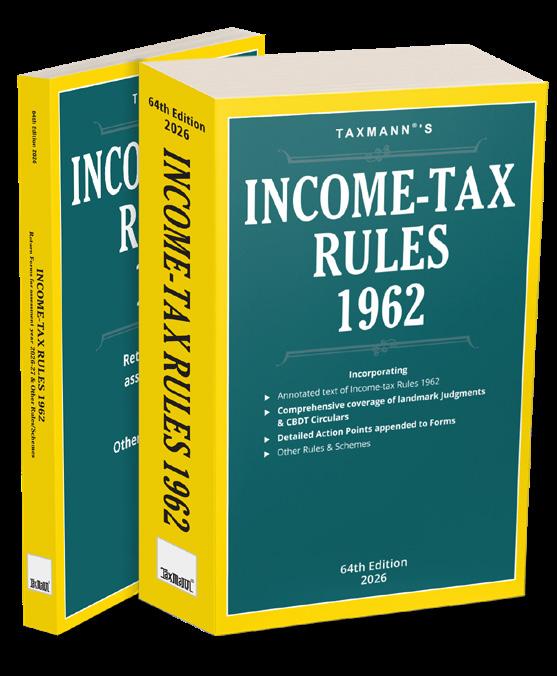
Income Tax Rules 1962 is the definitive, annotated compilation that governs the procedural, computational, and compliance framework under the Income-tax Act 1961. Now in its 64th Edition, this book presents the most current text of the Income-tax Rules, incorporating all amendments notified up to the IT (Amendment) Rules 2026. Every rule is annotated with judicial pronouncements from the Supreme Court, High Courts, and the ITAT, along with CBDT Circulars, Notifications, and Instructions — positioned at the relevant sub-rule, clause, or proviso. Rules amended during 2024 to 2026 are printed in italics for easy recognition. The book also includes detailed action points appended to prescribed forms and compiles the text of related legal provisions referenced within the Rules. This book is designed as an indispensable working reference for the following categories of professionals and stakeholders:
• Tax Practitioners and Consultants
• Advocates Practising Before Income-Tax Authorities and Appellate Forums
• Corporate Tax and Finance Teams
• Income-tax Officers and Departmental Officers
• Academic Researchers and Students
• Non-Resident Assessees and their Advisors
The Present Publication is the 64th Edition | 2026, incorporating all amendments upto IT (Amendment) Rules 2026. This book is edited by Taxmann’s Editorial Board, with the following noteworthy features:
• [Annotated Rule Text with Integrated Case Law] Every rule is annotated with judicial pronouncements from the Supreme Court, High Courts and the ITAT—placed in the footnotes at the precise sub-rule, clause or proviso where they are relevant
• [CBDT Circulars, Notifications & Instructions] Integrated at each relevant rule, giving the practitioner statute, judicial interpretation and administrative clarification in one place
• [Visual Identification of Amendments] Amended rules printed in italics; footnotes identify the specific Amending Rules notification with exact effective date
• [Action Points Appended to Prescribed Forms] Each form—including income tax return forms, tax audit report forms, TDS/TCS certificates, Form 16, Form 26AS—is accompanied by action points on filing obligations, timelines, mode of filing, enabling rule/section references and e-Form identification
• [Depreciation Rate Tables as per Income Tax Act] Appendix I & IA covering:
o New Appendix I (AY 2006-07 onwards)
o Old Appendix I (AY 2003-04 to 2005-06)
o Old Appendix I (AY 1988-89 to 2002-03)
o Old Appendix I Part I (AY 1984-85 to 1987-88)
o Appendix IA — Supplementary table
• [Allied Law Provisions] Full text of cross-referenced provisions from the Companies Act, RBI Act, CGST Act, SEBI Act and other allied enactments
• [Complete Amendment History] Every amendment since 1962 is documented in footnotes with the specific notification and effective date
• [Subject Index] Keyword-based navigation across all rules, forms, appendices and allied provisions
• [Companion to Taxmann’s Income-tax Act] Section references keyed to the Act’s numbering for seamless crossreferencing
• [Editorial Accuracy] Text derived from official Gazette notifications, cross-verified by Taxmann’s Editorial Board