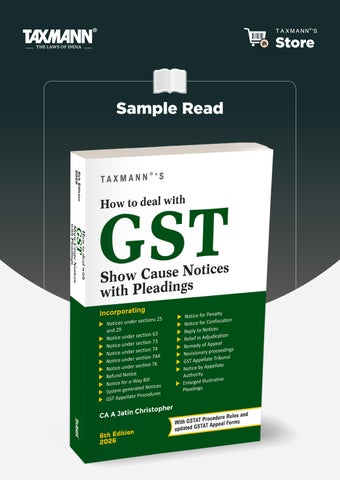
Sample Read
Contents PAGE
About the Author
I-5
Preface to sixth edition
I-7
Preface to first edition
I-11
Acknowledgements and Dedication
I-13
Chapter-heads
I-15
DIVISION ONE
NOTICES UNDER GST
1 BACKGROUND 1.1
Introduction
3
1.2
Procedures established by law
4
1.3
Due process
4
1.4
Abuse of process
7
1.5
Spot recovery
8
1.6
Demand in GST
9
1.7
Principles of natural justice
10
1.8
Cause of action
11
1.9
Allegation and evidence
13
1.10
No Presumption flows from GSTN data
14
1.11
Effect of non-denial
14
1.12
Vagueness of denial
15
1.13
Rights, remedies and safeguards
16
I-19
CONTENTS
I-20 PAGE
2 NOTICES UNDER SECTIONS 25 AND 29 2.1
Overview
18
2.2
Anatomy of a notice
19
2.3
Limitations of scope
19
2.4
Rejection of application
20
2.5
Repeated applications without reply to notice
21
2.6
Option for composition
21
2.7
Reply to CMP5
22
2.8
Option for provisional assessment
23
2.9
Suspension of registration
24
2.10
Suo Motu cancellation
26
2.11
Revocation of cancellation
27
2.12
Voluntary cancellation
29
2.13
Appealable orders
30
2.14
Circulars and instructions
30
3 NOTICE UNDER SECTION 63 3.1
Overview
31
3.2
Section 63 not competing with section 62
32
3.3
Section 63 not competing with section 67
33
3.4
Taxable person not holding registration on date of notice
34
3.5
Authority to investigate absent
36
3.6
Registration ousts jurisdiction of proper officer
37
3.7
Best judgment is not wild guesswork
38
3.8
Basis of Best Judgment
39
3.9
Interest and Penalty not imposable
39
3.10
Reply more onerous
40
3.11
Pre-emptive powers imperil taxpayers
40
I-21
CONTENTS
PAGE
4 NOTICE UNDER SECTION 73 4.1
Overview
41
4.2
Anatomy of a notice
41
4.3
Pre-notice consultations
44
4.4
Limitation
46
4.5
Statement of demand
47
4.6
Accompanying summary
49
4.7
Service of notice
50
4.8
Validity of service
51
4.9
Concessional penalty
53
4.10
Burden of proof
53
4.11
Deficiencies in notice
56
4.12
Discrepancies in notice
57
4.13
Omission to object
58
4.14
Non-denial implies admission
59
4.15
Post-adjudication penalty
61
4.16
Demand for interest or penalty only
62
5 NOTICE UNDER SECTION 74 5.1
Overview
64
5.2
Special circumstances
65
5.3
Anatomy of a notice
68
5.4
Exception to pre-notice consultations
70
5.5
Pre-notice penalty
70
5.6
Post-notice penalty
71
5.7
Post-adjudication penalty
72
5.8
Additional aspect about evasion
73
5.9
Disputed tax period
74
5.10
Implication of ‘cum tax’ demand
76
5.11
Circulars and instructions
77
CONTENTS
I-22 PAGE
6 NOTICE UNDER NEW SECTION 74A 6.1
Date of commencement
79
6.2
Terminal date for old notice of demand
80
6.3
Ingredients to jurisdiction
80
6.4
New limitation to issue notice and conclude adjudication
81
6.5
No new ingredients
83
6.6
Discharge of demand
84
6.7
Same situations, same limitation and same penalty
85
6.8
Order of adjudication
85
6.9
Definition of suppression
86
6.10
Power to impose penalty
87
6.11
Special features of new provision
89
6.12
No alteration of extant jurisprudence
90
6.13
Mother notice v. child notice
91
6.14
Eventual resolution of dispute
92
7 NOTICE UNDER SECTION 76 7.1
Overview
94
7.2
Pre-requisites to notice
95
7.3
Composite demand notice
97
7.4
Absence of limitation
98
7.5
Recovery of credit loss
98
8 SYSTEM GENERATED NOTICES 8.1
Validity
101
8.2
Rule 88C and Rule 142B
101
8.3
Options for response 1
103
8.4
Rule 88D
104
I-23
CONTENTS
PAGE
8.5
Options for response 2
104
8.6
Validity of adverse inference
105
8.7
Presumption of arrears from turnover admitted
106
8.8
Service and belated response
107
8.9
Effective date and period of coverage
107
8.10
Auto-generated appropriation
108
9 REFUND NOTICE 9.1
Overview
109
9.2
Pre-requisites to notice
109
9.3
Purpose of notice
110
9.4
Unjust Enrichment
112
9.5
Mischief of credit notes
113
9.6
Second round of refund proceedings
114
9.7
Composite refund notice
116
9.8
Protective action
117
9.9
Protective Notice
119
9.10
Erroneous refund along with interest
120
9.11
Refund to unregistered Persons
122
9.12
Circulars and instructions
122
10 NOTICE FOR E-WAY BILL 10.1
Overview
123
10.2
Binary verification
124
10.3
Alteration of scope by circular
125
10.4
Extra legislative enquiry
125
10.5
Cryptic notice
126
10.6
Misplaced responses
126
10.7
Pleading for lenience
127
10.8
Secure release immediately
128
CONTENTS
I-24 PAGE
10.9
Essential fact to be documented
129
10.10 Remediation in appeal
130
10.11 Risks of revisionary proceedings
130
10.12 Circulars and instructions issued
131
11 NOTICE FOR PENALTY 11.1
Overview
132
11.2
Pre-requisites to notice
133
11.3
Exception to pre-notice consultations
134
11.4
Accompanying summary
135
11.5
Notice under alternative sections
135
11.6
Statutory definition of infraction
136
11.7
Concept of animus
139
11.8
General discipline on penalty
140
11.9
Personal penalty to Director
140
11.10 Penalty under section 52
141
11.11 Waiver of penalty notice
141
11.12 Circulars and instructions issued
142
12 NOTICE FOR CONFISCATION 12.1
Overview
143
12.2
Seizure must for confiscation
143
12.3
Exigencies absent
144
12.4
Waiver of demand notice
145
12.5
Redemption fine
146
12.6
Omission to avail option
146
12.7
Release from detention not in confiscation
147
12.8
Limitation unlimited for confiscation
148
12.9
Provisional release Irregular
149
12.10 Appellate remedy
150
I-25
CONTENTS
PAGE
13 PREPARATION TO REPLY 13.1
Overview
151
13.2
Test the notice
153
13.3
Scrutinize allegation and supporting evidence
154
13.4
Construct of allegation
156
13.5
Allegations by presumption
157
13.6
Contradictory allegations
158
13.7
Rejection of taxpayer’s records
159
13.8
Merits of rejecting taxpayer’s books
160
13.9
Taxing ingredients
161
13.10 Acting under compulsion
163
13.11 Acting under dictation
164
13.12 Internal validation
165
13.13 External validation
166
13.14 Influence of allied laws
167
13.15 Post-notice continuation of enquiry
169
13.16 Fatal errors in pre-notice stage
170
13.17 Taxpayer’s statements recorded
171
13.18 Taxpayer’s assertions rejected
172
13.19 Cross-examination
173
13.20 Elaborate reply
175
13.21 Short reply
176
13.22 Benefits of ex parte orders
178
13.23 Reply other than on merits
179
13.24 Case laws overload
179
13.25 Case laws from earlier tax regime
180
13.26 Reliance on AARs
181
13.27 Case laws from overseas
181
13.28 Assumptions about GST
183
13.29 Fallacy about existence of basic features
183
13.30 Vague is not arbitrary
187
CONTENTS
I-26 PAGE
14 JURISPRUDENCE OF ADJUDICATION 14.1
Overview of section 75
188
14.2
Limitation on disposal
188
14.3
Impatience in adjudication
190
14.4
Belated adjudication
190
14.5
Wisdom in adjournment
191
14.6
Reasons for adjournment
192
14.7
Personal hearing
193
14.8
Authorized representative
194
14.9
Grounds in notice and order
195
14.10 Facts-in-issue
197
14.11 Irrefutable facts
198
14.12 Irrelevant facts
199
14.13 Grounds modified or withdrawn
200
14.14 Bar on improvement
201
14.15 Relief in absence of special circumstances
201
14.16 Remand sans power of remand
202
14.17 Orders to be ‘speaking’
203
14.18 Consequential demand order
206
14.19 Interest automatic, not penalty
206
14.20 Special modes of computing interest
207
14.21 Plurality of penalty barred
213
14.22 Limitation not to commence
214
14.23 Circulars and instructions issued
215
15 REPLY TO NOTICES 15.1
Overview
216
15.2
From strength to strength
217
15.3
Statutory provision dictates approach
219
15.4
Jurisdiction and Proper Officer
220
I-27
CONTENTS
PAGE
15.5
Illegal evidence
222
15.6
Bona fide demand in mala fide proceedings
223
15.7
Question-the-question
224
15.8
Revenue’s evidence
227
15.9
Impeaching Revenue’s evidence
228
15.10 Admissibility of evidence
230
15.11 Statements on oath
233
15.12 Probative value of evidence
234
15.13 Evidence impeached by denial
236
15.14 Rebuttal and evidence
236
15.15 Discussion on facts
240
15.16 Reply to restore facts
242
15.17 Reply to expose conjecture
242
15.18 Reply to summarize facts-in-issue
243
15.19 Discussion on law
244
15.20 Evidence via Affidavit
244
15.21 Binding nature of circulars
246
15.22 Binding nature of decisions
247
15.23 Prayer on findings to be reached in adjudication
248
15.24 Personal hearing
249
15.25 Readiness for later proceedings
249
15.26 Description of business does not dictate HSN
250
15.27 Introducing new material
252
15.28 Relevance of circulars
253
15.29 Case law authorities - More
255
15.30 Case law authorities - Less
255
15.31 Essentials in a reply 1
257
15.32 Essentials in a reply 2
258
15.33 ‘Without prejudice’ replies
262
15.34 ‘With prejudice’ replies
262
15.35 ‘Alternate pleas’ replies
263
15.36 Circulars and instructions issued
264
CONTENTS
I-28 PAGE
16 RELIEF IN ADJUDICATION 16.1
Relevance in replying to notices
266
16.2
Pleadings
267
16.3
No relief beyond pleadings
267
16.4
Moulding relief
268
16.5
Injustice inherent in ‘due process’
268
16.6
Creature-of-statute effect
269
16.7
Decisions distinguished
269
16.8
Non-binding circulars
270
16.9
Adjudication in offence cases
272
16.10 Perspective bias
273
16.11 Shortest route to favourable decision
275
16.12 Adverse orders
277
16.13 Defective orders
278
16.14 Non-speaking orders
280
16.15 Consequential relief
280
17 OUTCOME IN ADJUDICATION 17.1
Relevance in replying to notices
282
17.2
Revised notice or fresh notice
283
17.3
Person aggrieved
283
17.4
Remedies to aggrieved persons
284
17.5
Rectification of apparent errors
285
17.6
Time lost in rectification
289
17.7
Appeal against rejection of rectification
290
17.8
Taxpayer’s appeal
290
17.9
Restrictions under section 121
290
17.10 Maintainability of appeal
291
17.11 Payment under Protest
291
I-29
CONTENTS
PAGE
17.12 Payment of demand indicates admission of liability
293
17.13 Direct writ petition
295
17.14 Perils of pre-deposit in court
300
17.15 Special procedure for pre-deposit via DRC-3
301
18 REMEDY OF APPEAL 18.1
Relevance in replying to notices
303
18.2
Standard Operating Procedure
304
18.3
Purpose of appeal to Appellate Authority
305
18.4
Departmental appeal
306
18.5
Taxpayers exposure in counter
307
18.6
Condonation of delay 1
307
18.7
Defective appeal 1
308
18.8
Order ‘at large’ in appeal
309
18.9
Proceedings not ‘at large’ in appeal
310
18.10 Issue ‘at large’ in appeal
312
18.11 Burden of Appellate Authority to verify evidence
313
18.12 Curative powers of Appellate Authority
314
18.13 Framing of facts-in-issue
315
18.14 Exclude irrelevant facts
316
18.15 Good reason to be confident
316
18.16 Withdrawal of appeal 1
316
19 ‘SEQUEL NOTICE’ BY APPELLATE AUTHORITY 19.1
Introduction
319
19.2
Fact-Finding via Further Inquiry
320
19.3
Update Original Demand
321
19.4
DRC-1A bypassed
322
19.5
Acquiescence not curative
323
CONTENTS
I-30 PAGE
19.6
First Proviso
324
19.7
Second Proviso
325
19.8
Calling of Books Barred
326
19.9
Update notice v. Upgrade notice
327
19.10 Altogether new notice barred
328
19.11 Sequel not free from defects
330
19.12 Safety of Limitation
330
19.13 Safety of Original Grounds
331
19.14 Readiness for Tribunal
332
20 RELIEF IN APPEAL 20.1
Standard Operating Procedure
333
20.2
Scope of permissible relief
333
20.3
Limitations in powers of Appellate Authority
334
20.4
Relief limited by pleadings and prayer
336
20.5
Inherent powers
337
20.6
Scope for review and appeal
338
20.7
Directions of Appellate Tribunal or Court
339
20.8
Consequential effects of relief in appeal
339
20.9
Dismissal, if appeal does not merit interference
340
20.10 Strict v. Beneficial interpretation
342
20.11 Interpretation of tariff v. Exemption notification
343
20.12 Time limits - Limitation or prescription
345
20.13 Suo motu Writ Petition by SC
346
20.14 Circulars - Distinguishable or binding
347
20.15 Case law authority - Distinguishable or binding
348
20.16 Questions about jurisdiction
349
20.17 Proceedings in appeal
349
20.18 Speaking Orders
350
I-31
CONTENTS
PAGE
21 REVISIONARY PROCEEDINGS 21.1
Relevance in replying to notices
351
21.2
Decision or order
351
21.3
Officer subordinate
352
21.4
Suo motu
353
21.5
Information received
354
21.6
Request from Commissioner of State Tax
355
21.7
Resolution of conflict with section 107(2)
355
21.8
Call for and examine
356
21.9
Prejudicial to interests of revenue
357
21.10 Illegal (decision or order)
359
21.11 Improper (decision or order)
360
21.12 Not taken into account pre-existing factors
361
21.13 Not taken into account post-arising factors
362
21.14 Adverse observation by CAG
363
21.15 Prerequisites to invoke powers
363
21.16 Doctrine of election
365
21.17 Stay operation (of such decision or order)
365
21.18 After making such further inquiry
366
21.19 Immediately ‘stay’ operation of Orders
367
21.20 Pass such new ‘substitutionary’ Orders
367
21.21 Enhance (said decision or order)
368
21.22 Modify (said decision or order)
368
21.23 Annul (said decision or order)
369
21.24 Bar on revisionary proceedings
369
21.25 Mischievous appeals
370
21.26 Limitation (time bar) for Revision
372
21.27 Appeal against Revision
372
21.28 Limitation ‘extension’ for Revision
372
21.29 Enhanced remedy for Revenue
373
21.30 Checklist
373
CONTENTS
I-32 PAGE
22 APPELLATE TRIBUNAL 22.1
Relevance in replying to notices
376
22.2
Creatures of the statute
376
22.3
Structure of GSTAT
377
22.4
Full bench or division bench
378
22.5
Single member bench
378
22.6
Reference to third member
379
22.7
Appealable orders
379
22.8
Appeal filed before erroneous bench
379
22.9
Types of appeals
380
22.10 Limitation
381
22.11 Pre-deposit
382
22.12 Pre-deposit when ‘penalty only’ is in dispute
383
22.13 Pre-deposit when ‘fine’ is in dispute
384
22.14 Statement of facts 1
384
22.15 Grounds of appeal 1
385
22.16 Defective appeals 2
386
22.17 Paper-book
388
22.18 Departmental representative
389
22.19 Limitations in powers of Appellate Tribunal
389
22.20 Power of inquiry by Appellate Tribunal
390
22.21 Fruits of earlier preparations
391
22.22 Law of precedent
392
22.23 Conclusion
393
23 TRIBUNAL PROCEDURE 23.1
Standard operating procedure
394
23.2
Appeal online only but offline by order
395
23.3
Number of appeals
395
23.4
Appeal memorandum
396
I-33
CONTENTS
PAGE
23.5
Annexures to APL5
397
23.6
Appeal memo not to include
397
23.7
Without pre-deposit, appeal not filed
399
23.8
Date of order v. Date of communication of order
400
23.9
Memorandum of cross-objections
402
23.10 Reply to departmental Appeal
405
23.11 Cross appeals
405
23.12 Classification of supply in dispute
406
23.13 Computational tables
407
23.14 Statement of facts 2
408
23.15 Grounds of appeal 2
412
23.16 Appeal non est if not free of fatal defects
414
23.17 Paper-book 2
415
23.18 Synopsis
416
23.19 Compilation
417
23.20 Condonation of delay 2
423
23.21 Withdrawal of appeal
425
24 GSTAT PROCEDURE RULES 24.1 24.2 24.3 24.4 24.5 24.6 24.7 24.8 24.9 24.10 24.11 24.12 24.13
Introduction Powers of appellate tribunal Instituting Appeal Registry Hearing Appeals Case Management Forms and Registers Records and Inspection Authorized Representative Code of Civil Procedure Decisions and Orders E-Filing Miscellaneous
426 429 431 435 435 437 437 439 439 440 441 442 442
CONTENTS
I-34 PAGE
25 APPLICABLE JURISPRUDENCE 25.1
Justice v. Fairness
444
25.2
Power of moulding relief
444
25.3
Notice ends inquiry
445
25.4
Death brings quietus to demand and recovery
446
25.5
Purposive construction
447
25.6
Doctrine of merger
449
25.7
Tax avoidance
449
25.8
Mandatory or Directory
451
25.9
Litigation in anticipation of amnesty
454
25.10 Limited relief from permanent credit loss
455
25.11 Legality of accord and forfeiture
457
25.12 Ineffectiveness of relief from court
459
25.13 Obiter dicta by courts
460
25.14 Relevancy of facts
461
25.15 Relevancy of tax period for cause-of-action
462
25.16 Binding nature of judicial authority
463
25.17 Rule of law
465
25.18 Appropriateness of forum selection
466
25.19 Understanding taxpayer’s business
467
25.20 Authorities that illuminate understanding
468
25.21 Illustrative formats
469
25.22 Index of decisions
469
DIVISION TWO
PLEADINGS IN GST
26 PLEADINGS FOR REPLY TO NOTICES 26.1
Replying to notices
499
26.2
Relief prayed
500
26.3
Burden of proof
500
I-35
CONTENTS
PAGE
26.4
Accept and discharge
501
26.5
Dispute and litigate
502
26.6
Reject allegations
503
26.7
Burden on taxpayer
504
26.8
Options to reply
504
26.9
Departmental observations
505
26.10 Payments made via DRC-3 1
506
26.11 Payments made via DRC-3 2
507
26.12 Mismatch of GSTR-2A with GSTR-3B 1
509
26.13 Mismatch of GSTR-2A with GSTR-3B 2
513
26.14 Interest on belated filing of GSTR-3B
515
26.15 URP-RCM unpaid in 2017-18
516
26.16 RCM unpaid 1
518
26.17 RCM unpaid 2
520
26.18 RCM unpaid 3
523
26.19 Invoice of earlier tax periods included in current GSTR-3B
525
26.20 Tax paid in excess and adjusted
526
26.21 Credit notes (with GST) received
528
26.22 Credit notes (without GST) received 1
531
26.23 Credit notes (without GST) received 2
533
26.24 Debit notes issued
535
26.25 Output tax on debit notes discharged belatedly with credit
536
26.26 Credit notes issued for domestic sales
538
26.27 Credit notes issued for zero-rated supplies
540
26.28 Non-disclosure of exempt turnover
541
26.29 Mismatch of EWB and GSTR-1/3B
543
26.30 Mismatch of GSTR-1 with GSTR-3B
545
26.31 Mismatch of GSTR-7 with GSTR-1/3B
550
26.32 Mismatch of GSTR-8 with GSTR-1/3B
552
26.33 Non-reversal of common credits
554
26.34 Blocked credits availed
556
26.35 Matched credits from absconding Suppliers
558
CONTENTS
I-36 PAGE
26.36 Mismatch of TRAN-1 credit
560
26.37 Claim of TRAN-1 credit in GSTR-3B
561
26.38 Interest on TRAN-1 credit reversed
564
26.39 Composition taxpayer collecting tax
564
26.40 Composition taxpayer with service turnover
566
26.41 Composition taxpayer exceeding threshold
567
26.42 Composition taxpayer with credit balance
568
26.43 Disposal of capital goods
569
26.44 Write-off of inputs and capital goods
570
26.45 Refund of unmatched credits to exporter
571
26.46 Credit claimed after due date
572
26.47 Credit claimed when payment not made to Suppliers
575
26.48 Output tax payable on ‘other income’
577
26.49 Credit blocked under rule 86A
579
26.50 Output tax in cash under rule 86B
581
26.51 Demand for ‘interest only’
584
26.52 Demand for ‘penalty only’
585
26.53 Classification not correct 1
586
26.54 Classification not correct 2
588
26.55 Exemption not admissible 1
590
26.56 Exemption not admissible 2
591
26.57 Pure agency collections
593
26.58 Continuous utilization of credit
595
27 27.1
PLEADINGS IN DEPARTMENTAL ENGAGEMENT Form for Reply
598
27.2
Accepting Liability
599
27.3
Rejecting Liability
599
27.4
Payment ‘under Protest’ 2
600
27.5
Books to be produced for Verification
600
27.6
Reply to proposed recovery in view of adverse orders passed 1
602
I-37
CONTENTS
PAGE
27.7
Reply to proposed recovery in view of adverse orders passed 2
603
27.8
Reply by third-party to DRC-13 issued against first-party
604
27.9
Objections by first-party to DRC-13 issued to third-party
604
27.10 Reply by first-party to provisional attachment in DRC-22
605
27.11 Request to keep appeal in ‘call book’
607
27.12 Intimation of stay of Recovery after Filing Appeal
607
27.13 Intimation that notice is time-barred
608
27.14 Intimation that notice is time-barred
609
27.15 Intimation of anomalies in notice
610
27.16 Reply to CMP5 in CMP6
611
27.17 Recovery be kept in abeyance pending appeal
615
27.18 Death of proprietor
615
27.19 Death of appellant in harness
617
28 PLEADINGS IN APPEAL MEMO 28.1
Form for communication before appellate fora
619
28.2
Belated service of impugned order passed within limitation
620
Rectification of appeal dismissed due to lapse of limitation
621
Recovery after statutory appeal due to non-issuance of APL-2
623
28.5
Impugned order passed beyond limitation
624
28.6
Grounds that could ‘save the day’
625
28.7
Relief under section 75(2)
626
28.8
Objections to provisional attachment even after initiation of due process
627
Dismissal of appeal due to payment of pre-deposit via DRC-3
630
28.3 28.4
28.9
28.10 Audit-led demand for output tax on forward charge basis
631
28.11 Audit-led demand for output tax on reverse charge basis
634
28.12 Audit-led demand for input tax credit on various grounds
636
CONTENTS
I-38 PAGE
28.13 Audit-led demand of transition credit
640
28.14 Audit-led demand common issues 1
641
28.15 Audit-led demand common issues 2
644
28.16 Audit-led demand for output tax on deemed supply
645
28.17 Audit-led demand for reversal of credit on unpaid suppliers
648
28.18 Audit-led demand for tax on supplies from unregistered suppliers
650
28.19 Audit-led demand for reversal of credit due to invoices not available for verification
652
28.20 Audit-led demand for data mismatch with GSTR-9
653
28.21 Audit-led demand for late fee
654
28.22 Audit-led demand for ‘interest only’
655
28.23 Inquiry-led demand for differential tax on admitted turnover
656
28.24 Inquiry-led demand for output tax on ‘subsidy’
658
28.25 Inquiry-led demand of output tax on ‘escaped turnover’ 1
660
28.26 Inquiry-led demand of output tax on ‘escaped turnover’ 2
662
28.27 Inquiry-led demand for output tax on ‘escaped turnover’ 3
664
28.28 Inquiry-led demand for reversal of credit on ‘exempt turnover’
666
28.29 Inquiry-led demand for reversal of inadmissible credit
667
28.30 Inquiry-led demand for reversal of credit from supplierin-default 1
668
28.31 Inquiry-led demand for reversal of credit from supplierin-default 2
669
28.32 Inquiry-led demand for penalty for furnishing false documents
671
28.33 Interception-led demands (consignment)
674
28.34 Interception-led demands (conveyance)
676
28.35 Inquiry-led demand for tax allowing relief ‘selectively’
678
28.36 Inquiry-led demand for reversal of credit due to nongenuine suppliers
679
28.37 RNV-1 issued against order of appellate authority
681
28.38 RVN-1 issued against ADT-2
686
I-39
CONTENTS
PAGE
28.39 Recovery of finalized demand after expiration of limitation to appeal
689
28.40 Affidavit accompanying application for condonation of delay
695
29 APPELLATE TRIBUNAL 29.1
Notes on APL5
699
29.2
Notes on APL6
709
29.3
Application and affidavit for condonation
712
29.4
Preliminary Grounds 1 (Section 61)
715
29.5
Preliminary Grounds 2 (Section 65)
716
29.6
Preliminary Grounds 3 (Section 67)
717
29.7
Preliminary Grounds 4
719
29.8
Special Grounds 1
721
29.9
Special Grounds 2
722
29.10 Special Grounds 3
723
29.11 Special Grounds 4
726
29.12 Common Grounds 1
729
29.13 Common Grounds 2
731
29.14 Mismatch of 2A with 3B
733
29.15 Mismatch of R1 with 3B
734
29.16 Mismatch of R7 with 3B
735
29.17 Output tax on reverse charge basis
736
29.18 EWB Penalty 1
737
29.19 EWB Penalty 2
738
29.20 EWB Penalty 3
738
29.21 Reversal of blocked credit 1
740
29.22 Reversal of blocked credit 2
741
29.23 Reversal of credit from non-genuine suppliers
742
29.24 Penalty for abetment
743
29.25 General penalty
744
13 CHAPTER
PREPARATION TO REPLY 13.1 OVERVIEW Taxpayers often launch into their reply (to notice) without first attending to the preparation needed to determine the approach necessary to optimize the outcome in adjudication. Taxpayers also operate under a misconception that adjudication is to readily accept tax position adopted by taxpayer and to even find ways around any inadvertent slips and allow relief sought. This is a significant burden of expectation - from process of adjudication - that taxpayers need to overcome right away. Taxpayers are overcome by alarm and dismay that their tax position is being challenged. And blinded by their innocence, taxpayers rush to parade their innocence or bemoan the injustice on learning of the ‘view’ canvassed by Revenue. All these aspects lead to an impoverished approach that is devoid of any strategy in their reply. Taxpayers often look to find someone to blame for this turn of events - whether their own internal team or some experts who were engaged to advise - when time to take that tax position had come up. Long-standing relationships with advisors and experts can turn sour when notices are issued. It is most important for taxpayers to accept that Revenue has a duty not to leave any tax position unchallenged, especially, where another ‘view’ is possible. Everyone would agree that GST is not free from plurality of tax positions. Nearly no provision of this law is free from an ‘alternate view’. Not because this other view is more accurate or the one adopted by taxpayer is flawed, but because there is doubt about finality of interpretation, nearly no tax position can go unchallenged Mischievous tax positions and evasion of tax are not the sole reasons for notices to be issued. Notices is the ‘due process’ in law to clear any doubts about the validity of given tax position. GST is a self-assessment tax regime. As such, there is no ‘Assessing Officer’. Assessment of tax liability is by taxpayer and Revenue must follow ‘due process’ to put forward their challenge and get satisfied that self-assessed liability is valid and proper. And for this reason, tax Officers are called “Proper Officers” and for each provision of 151
Para 13.1
PREPARATION TO REPLY
152
law there are different Officers designated as Proper Officers. Proceedings initiated in accordance with law by an Officer who is not the one designated will not be ‘proper’. Proper proceeding must be initiated by a Proper Officer to be valid and proper. Divergent AARs too have exposed the ‘other view’ that is possible. Circulars issued have attempted to clarity common misunderstanding. Nearly everyone is confident about the correctness of their ‘view’. And only when alternate views are exposed, will it illuminate the mind about the alternative that is possible. Unlike earlier tax regime, limitation in GST puts Revenue ‘on a clock’ to issue notices and conclude adjudication. And there is no time to be unsure about the correct tax position. If notice is not issued, demand cannot be raised. When notice is issued, adjudication must be completed within limitation. Finality of tax position is not doing to emerge privately or swiftly. And pursuit of finality demands notices be issued. Example Taxpayer ‘A’ has adopted a tax position that GST is not payable on lease of land but all other taxpayers ‘B’ to ‘Z’ have admitted and discharged tax. It would be unconscionable for Revenue to remain a silent spectator when ‘A’ derives windfall gains being able to sell cheaper or for earn better margins compared to ‘B’ to ‘Z’.
Entire society of diligent taxpayers look to Revenue to exercise every power available in the law to ensure that not even a single taxpayer gets away with an unjust advantage, or at least not without a challenge. Jus in rem demands that tax positions adopted not be left unchallenged, certainly not when there is a real possibility that an ‘alternate view’ can be canvassed. Jus in personam is not absolute that taxpayers are assured of uncontested acceptance of their tax positions. And self-assessment is not immune from challenge. Persevering taxpayers who find their tax positions being accepted in adjudication or appeal realize their initial angst was misplaced. But this will evade those who are impatient or expect unqualified acceptance of their tax positions and relationships with those who provided advice early on which were allowed to turn sour, was completely unjustified. Proper Officer is not taxpayer’s enemy. Proper Officer has a statutory duty. Proper Officer is not taxpayer’s friend either. Taxpayers must eschew unholy friendships and awkward proximity with Proper Officers. Keep it polite and respectful, without causing prejudice to taxpayer’s interests or forfeiting rights, remedies and safeguards in this law. Taxpayer’s must face this challenge and remain confident about tax positions adopted. Proper Officers must not hesitate to put up a lawful challenge, confident that the alternate view canvassed is more accurate interpretation of the law.
153
Para 13.2
TEST THE NOTICE
13.2 TEST THE NOTICE At the outset, it is unacceptable that taxpayers would proceed with their reply to notice without first understanding the ‘how’ to every ‘what’, contained in a notice. In order words, it is necessary to grasp the origin of proceedings that culminated in a notice. Notice for demand cannot be issued by any Officer, but a Proper Officer. And to know if the ‘Officer is Proper’ it is necessary to complete the following preliminary checklist: Checklist of Notice (Part A) Noticee
Notice
Unregistered
by Central or State (or UT) administration
Underlying proceedings
63
64
Notice for demand under
63
73
74
76
Notice for penalty under
122
125
127
OTHER
Accompanying summary
DRC1
DRC1
DRC1
OTHER
Pre-notice consultations
-
DRC1A
NONE
-
Noticee Registered
67
OTHER
Notice by Central or State (or UT) administration
Underlying proceedings
61-62-64
65
67
OTHER
Notice for demand under
-
73
74
76
Notice for penalty under
122
125
127
OTHER
Accompanying summary
DRC7
DRC1-2
DRC1
OTHER
Pre-notice consultations
-
DRC1A
NONE
-
With this preliminary understanding of the notice, it will be possible to assess the validity of challenge to self-assessment carried out by taxpayer. Even though section 59 mandates ‘registered persons’ to carry out self-assessment of liability under the Act, determination that registration is not required is also self-assessment as well as claim for exclusion from registration under section 23. While ‘every registered person’ is referred in section 59, determination of (in) applicability of section 22 is no less self-assessed than determination of liability to tax. Proper Officers of Central or State (or UT) administration having territorial jurisdiction over the location of unregistered persons, can initiate action but only under sections 63 and 73 or 74. But once registered, Proper Officers from Central or State (or UT) administration without even territorial limitations are enjoined with authority to exercise jurisdiction under
Para 13.3
PREPARATION TO REPLY
154
section 67 but based on prior authorization granted based on material taken on record regarding three (3) areas involving evasion of tax. This review beings to clear the air around ‘how’ and ‘what’ relating to notice and adds perspective about ‘who’ and ‘when’ can initiate these proceedings. When legitimate demands are barred for failing to adhere to ‘due process’ of law, entering discussion as to the existence and merits of a demand cannot commence without first establishing if powers invoked were legitimate and ‘due process’ proper. It is not uncommon that demands are made via a letter or notice without accompanying summary. Failure to adhere to ‘due process’ to issue notice of demand is fatal to demand (discussed earlier).
13.3 SCRUTINIZE ALLEGATION AND SUPPORTING EVIDENCE After notice for demand or penalty is tested to be lawful and complete, and found to be satisfactory, the next step is to scrutinize the allegations in the notice and evidence used to support the demand (or penalty) made. Allegation is not suspicion. Allegation is not actionable cause. Allegation is the interpretation of acts (or omissions) by taxpayers that affect the correctness of self-assessment made, that is, wrongdoing by taxpayers in exercise of the authority vested in section 59. Allegation is accusation about facts backed up by evidence, if proved reliable, will establish said wrongdoing. Allegation is not a fact. Allegation is an opinion or interpretation of facts as observed. Fact is that which is undeniable by both sides. If it is deniable then it is not a fact. Examples Taxpayer is a company - that is a fact. Taxpayer is registered - that is a fact. Taxpayer has discharged tax of ` 100 lakhs in Apr 2022 as per 3B filed on 19 May 2022 - that is a fact since no further investigation is required beyond taxpayer’s own admission in returns filed under section 39. Taxpayer has not discharged output tax correctly - this is not a fact but an opinion. Taxpayer has claim inadmissible input tax credit - this is not a fact but an opinion. Taxpayer has discharged IGST instead of CGST-SGST - this is an interpretation of underlying facts hence, not a fact in itself.
Taxpayers must enlist ‘facts’ and ‘opinion’ contained in ‘allegations’ in a notice. Omission to separate these will imperil the course of defence because mat-
155
SCRUTINIZE ALLEGATION AND SUPPORTING EVIDENCE
Para 13.3
ters of opinion left undisputed become facts that do not require any further proof. And taxpayer’s omission (to object to matters of opinion) become the basis of further course of adjudication (and appellate) proceedings which cannot be withdrawn later, not without prejudice to the case. Very often, opinion may be presented somewhat similar to facts and unless taxpayers lend their expertise to ‘separate the wheat from the chaff’, all subsequent proceedings will be acted upon ‘as if’ alleged facts were true and for leaving them undisputed. Example SCN demanding repayment of credit availed (being a blocked credit) in respect of motor vehicles purchased determined based on its HSN classification under chapter 87 does not establish whether it is for transportation of goods or for transportation of passengers. And whether it is designed for transportation of passengers and having seating capacity more than 13 or not. Unless these inalienable facts are established allegation in SCN is mere assumptions or (unsubstantiated) opinion.
Approach to list all allegations and sort them as ‘facts’ and ‘opinion’ requires the checklist to be expanded further. Checklist of Notice (Part B) Noticee Demand raised:
Notice (Allegations) Fact
Opinion
Evidence
Issue A
YES / NO
NO / YES
YES / NO
Issue B
YES / NO
NO / YES
YES / NO
Interest
YES / NO
NO / YES
YES / NO
Penalty 1
YES / NO
NO / YES
YES / NO
Penalty 2
YES / NO
NO / YES
YES / NO
This differentiation - of facts and opinion - extend to demand for penalties too. And there are more than one provisions under which penalties may be demanded. Where opinion form basis for demand, it must be referenced with ‘evidence’ adduced in support of such opinion. In order to counter any ‘opinion’, evidence adduced must first be impeached so as to the render the opinion ‘baseless’. Baseless opinion is proof to the contrary. Merely offering disagreement with the allegation is not sufficient. For such disagreement to be substantial, it must be denied unequivocally. Rushing to deny allegations become disorganized and unstructured if it is not point-wise. The denial of allegation may be on account of different factors, that is, it may be due to defective evidence or erroneous understanding of facts or misapplication of law to those facts.
Para 13.4
156
PREPARATION TO REPLY
Checklist of Notice (Part C) Noticee Demand raised:
Notice (Allegations) Accepted
Rejected On facts
On law
Issue A
YES / NO
YES / NO
NO / YES
Issue B
YES / NO
YES / NO
NO / YES
Interest
YES / NO
YES / NO
NO / YES
Penalty 1
YES / NO
YES / NO
NO / YES
Penalty 2
YES / NO
YES / NO
NO / YES
Over a period of time and with practice, efficiency will set in with respect to scrutiny of allegations in notice and supporting evidence adduces with notice. This checklist will not keep growing but with this extent of scrutiny, fatalities in the notice (discussed earlier as discrepancies and deficiencies) will be exposed and set taxpayer in the right direction to put together the defence.
13.4 CONSTRUCT OF ALLEGATION It is very common to find Revenue making allegations and taxpayers running around to disprove the allegations. Taxpayers must investigate ‘how’ has the demand been constructed in the allegation made and canvassed in the notice, subject to the contours of the provision of law under which it is issued. Example SCN issued demanding RCM in respect of payments made to inward supplies from Government Agencies. Taxpayer’s reply proceeds with either (i) dispute as to exigibility to tax due to absence of ‘supply’ or (ii) claims exemption from tax as ‘sovereign functions’. In either approach (in reply), taxpayer has unequivocally admitted that RCM has not been deposited. With that, half of Revenue’s case stands proved.
Taxpayers reply must ‘put to trial’ the construct of the allegations by examining ‘how’ has the demand been established. Haste in providing an answer, even one that challenges taxability or claims non-taxability, contains an unequivocal admission that the demand is not discharged albeit because it is not taxable or exempt. Careful analysis of the ‘construct’ of the demand will reveal inherent shortcomings in the notice. Taxpayers must ensure they are truthful in their replies but being truthful is not to leave the notice unquestioned. Very often, taxpayers tend to veer off the track and enter into matters not forming the pith of the notice and conceding to demand on grounds unknown to the notice. At the risk of repetition, taxpayers must be cautioned to grasp the
157
ALLEGATIONS BY PRESUMPTION
Para 13.5
importance of waiting to thoroughly understand the question and how it has come to be established in the notice before launching to furnish their answer.
13.5 ALLEGATIONS BY PRESUMPTION All too often, allegations appear to be so obvious that precious little is contained in the notice to establish those allegations on firm footing and supported by quality evidence to bring home those allegations. Just like taxpayer, Revenue too can be blinded by incontrovertibility of the demand. In the study of Administrative Law, expert jurists hold divided opinion about the need for a notice when there is nothing new that can be offered by way of defence. This is referred as ‘useless formality’ theory. But the remarkable nature of GST is that Legislature has provided very specific instances where the need for notice is bypassed and permitted demand being determined by a Speaking Order. These exceptions are contained in: (a) section 62 where best judgment order is mandated without the need to put taxpayer at notice and supported by taxpayer’s own delinquencies in filing returns; (b) section 64 where summary assessment order is permitted based on evidence of liability and oversight by Joint Commissioner; and (c) section 121 where certain pre-emptive actions culminating orders based on application of mind to certain transactional facts, are declared NOT to be appealable (discussed later). Barring these, it is explicit that no recourse to ‘useless formality’ theory is admissible in GST and every demand (for tax, credit or refund and penalty) must be initiated by serving (i) a valid notice (ii) by a Proper Officer and (iii) in accordance with prescribed ‘due process’. As such, there is no occasion for any demand to be based on presumption or conjecture. Examples Taxpayer (Recipient) received SCN for inadmissible credit due to mismatch (2A v. 3B) is a demand based on presumption that mismatch of data from Common Portal, necessarily means Supplier has defaulted in payment of tax on supplies to Recipient (taxpayer-noticee). In fact, there is no presumption about accuracy of data on Common Portal. And it is seen that this data has been revised repeatedly in the past and different reports have been reported by Model 1 and Model 2 States. Taxpayer (Recipient) received SCN for payment of RCM on account of data reported by Suppliers in their returns under section 37 (GSTR1) as ‘outward supplies liable to RCM’. This is a demand based on presumption that Supplier’s interpretation of RCM Notification is more accurate determination of liability than that self-assessed by Recipient, is inaccurate.
Para 13.6
PREPARATION TO REPLY
158
Third-party data may not have any motivation to lower tax liability as would be in case of data of Recipient but third-party data may not, for the same reasons, be accurate as it does not concern them directly and even deflects their own liability (to pay tax on forward charge basis). Taxpayer’s enthusiasm to reply on merits focussing on their bona fides often makes refutable evidence (used to support demands and allegations based on presumptions) evade their attention. In the course of preparation (to reply to notice), locating such presumptuous allegations is an important step. Example SCN demands CGST-SGST on ‘other income’ appearing in financials and proceeds on a presumption that underlying supply is intra-State supply without showing basis for determining ‘place of supply’ and establishing it to be within the State.
No presumption can be raised without showing taxing ingredients to support allegations and demand for tax. It is irrefutable that demand can be made without establishing taxing ingredients (discussed earlier) in respect of alleged supply transaction. Not even when demand is made for payment of right tax again under section 77 read with under section 19 of Integrated GST Act, citing that tax already paid was wrong, it is still necessary to show taxing ingredients and demonstrate tax discharged was, in fact, ‘wrong’, the burden on Revenue cannot be a discharged by any presumption.
13.6 CONTRADICTORY ALLEGATIONS Notices issued with contradictions are self-defeating allegations. Notice is not merely to canvass every possible interpretation to a given set of facts. It is important to consider ‘doctrine of election’ which basically states that to pursue one path, one must elect to abandon all others that may be available. And, by implication, having abandoned other available paths, the chosen path cannot be retraced if outcome anticipate from it (chosen path) does not avail. Singularity of purpose is the essence of this doctrine. This doctrine is captured in the maxim “quod approbo non reprobo” (discussed later). When it comes to taxation, Revenue is free to canvass any reasonable interpretation that it believes to be the most accurate treatment on applying the law to given facts (chosen path) keeping in mind the attendant outcome (anticipated outcome or tax consequence). If the desired outcome evades, Revenue cannot go back and try again, as it creates uncertainty in trade. And this is ensured by placing an inalienable limitation. Likewise, taxpayer too is subject to the consequences of ‘doctrine of election’ in exercising the right to self-assessment. Doctrine of election bars alternative paths to be pursued.
159
REJECTION OF TAXPAYER’S RECORDS
Para 13.7
With this understanding of election, every notice alleging a certain tax position, is implicit that all others alternative tax positions are abandoned by Revenue. Here lies the defence for taxpayer to assail the interpretation canvassed (in the notice) not by showing how Revenue’s interpretation is correct but by showing how, at least one other interpretation is more correct, relative to the one canvassed by Revenue. That is, notice bearing self-defeating contradiction. Example SCN issued demanding tax on savouries (namkeens) supplied in a sweet meat shop by electing classification of this transaction to be ‘supply of goods’ under HSN 210690 at 12%. Such election, implicitly abandons classification as ‘supply of services’ under HSN 9963 (read with para 6(b), schedule II) and the attending consequences of restriction on credit applicable.
13.7 REJECTION OF TAXPAYER’S RECORDS Not only can such contradiction occur in questions of law but also on questions of fact. Example SCN issued demanding output tax on works contract services under HSN 9954 by rejecting invoice and contracts which are alleged that an indivisible contract is artificially split into independent supplies of goods (Purchase Order) and services (Work Order) for some tax advantage. But final demand for tax computed in SCN based on the sum total of amounts in the PO and WO. Either the documents must be rejected, and turnover arrived at without reference to documents treated as artificial and unreliable, or data available in documents disclosed must be admitted entirely.
It would be remarkable to reject documents presented by taxpayer and then rely on the very same documents (for the values or place of supply or HSN code) to compute a different (or higher) demand. Adverting to the instructive words in the maxim “quod approbo non reprobo”, it means “that which I approve, I cannot disapprove”. And in this case, either the entire document (presented by taxpayer) must be rejected, and demand arrived at based on some other more reliable (to be shown how) source of information or said documents admitted in their entirety. Examples RFD8 issued proposing to reject claim for inverted tax structure (IDS) refund on the ground that notification 15/2017-CT bars IDS refund to works contracts but, proposes to appropriate output tax discharged under HSN 9967 in respect of highway construction project.
Para 13.8
PREPARATION TO REPLY
160
SCN issued denying input tax credit on purchase of motor vehicle (passenger transport) to Builder of commercial complex after accepting that said motor vehicle (given as prize) involves lawful transfer of property to Customer (who makes first booking with full payment in newly launched project) is in the course of business of Builder.
Very often, tax already discharged (and consequent tax position) is left undisturbed in the pursuit of demand for additional tax. The very admission implicit in leaving tax position adopted by taxpayer unchallenged, defeats the tax position canvassed by Revenue in a correlative matter within a connected transaction.
13.8 MERITS OF REJECTING TAXPAYER’S BOOKS Books of account and contemporaneous transaction documents (‘records’) presented by taxpayer cannot be rejected by Revenue, not because they are perfect and unassailable but because they bear taxpayer’s assertions. Before that, these records cannot be easily accessed by Revenue except in audit under section 65 and upon seizure when they are secreted and detected in search proceedings under section 67(2). With such limited access to taxpayer’s records, it is impermissible to ‘reject’ them routinely. It is one thing to determine tax liability based on best judgment under section 62 or 63, or on summary assessment based on evidence in possession and authorization by Joint Commissioner under section 64. But it a totally different thing to ‘reject’ taxpayer’s records. There is no provision in this law where records presented by taxpayer can be rejected and substituted by information ‘invented’ by Revenue because Proper Officer is NOT the Assessing Officer. Instructive words in CIT v. Motor and General Stores (P.) Ltd. AIR 1968 SC 200 where Apex Court stated that: “In the present case, however, there is no suggestion on behalf of the appellant of bad faith on the part of the assessee-company nor is it alleged that the particular form of the transaction was adopted as a cloak to conceal a different transaction. It is not disputed that the document in question was intended to be acted upon and there is no suggestion of mala fides or that the document was never intended to have any legal effect. In the absence of any suggestion of bad faith or fraud the true principle is that the taxing statute has to be applied in accordance with the legal rights of the parties to the transaction. When the transaction is embodied in a document the liability to tax depends upon the meaning and content of the language used in accordance with the ordinary rules of construction. In Bank of Chettinad Ltd. v. CIT [1940] 8 ITR 522 (PC), it was pointed out by the Judicial Committee that the doctrine that in revenue cases the ‘substance of the matter’ may be regarded as distinguished from the strict legal
161
TAXING INGREDIENTS
Para 13.9
position, is erroneous. If a person sought to be taxed comes within the letter of the law he must be taxed, however great the hardship may appear to the judicial mind to be. On the other hand, if the Crown seeking to recover the tax cannot bring the subject within the letter of the law, the subject is free, however apparently within the spirit of the law the case might otherwise appear to be.” It was common, especially in State tax administration under earlier tax regime, to reject taxpayer’s records and furnish values based on ‘logical reasoning’. In GST, rejecting taxpayer’s records imposes a very great burden at the threshold of this adventure to demonstrate, not just imperfections in records presented but fictitious entries recorded which are by themselves the result of falsification of records. And even then, recourse to rules is circumscribed by a mandate and yet in such circumstances, it is not permissible for Proper Officer to ‘invent’ values and impose tax. In fact, taxable value is but one of the several taxing ingredients (discussed later) that are needed to support a demand based on a certain interpretation of this law. Where there is any doubt about the reliability of taxable value in determining liability on self-assessment basis by taxpayer, Revenue cannot have recourse to the rules without first impeaching the taxable value under section 15(1) and then reach the rules via mandate in section 15(4). Section 15(4) can be entered only after showing that section 15(1) has failed on account of the three (3) criteria listed therein. And in case any notification under section 15(5) is issued, no further debate as to sufficiency of taxable value can be entertained due to the compulsion to use the values declared in such notification. As this is not a deliberation on valuation, suffice to state that ‘rejecting’ taxpayer’s records is not permissible in proceedings under section 73, 74 or 76 and ‘inventing’ taxing ingredients needed to arrive at the demand (proposed in the notice) is alien to GST.
13.9 TAXING INGREDIENTS Demand for output tax requires that any enquiry or inquiry to yield information by way of ‘taxing ingredients’ needed to support demand for output tax: (a) Investigative description of ‘nature’ of alleged transaction; (b) Coverage of transaction within definition of ‘supply’; (c) Object of supply - whether goods or services - and basis; (d) Outside any exclusions from supply; (e) HSN code under applicable tariff notification; (f) Outside any exemption under applicable exemption notification; (g) Time of supply, based on facts of transaction;
How to Deal with GST Show Cause Notices with Pleadings AUTHOR : PUBLISHER : DATE OF PUBLICATION : EDITION : ISBN NO : No. of Pages : BINDING TYPE :
A Jatin Christopher Taxmann December 2025 6th Edition | 2026 9789371268219 788 Paperback
Rs. 1595 DESCRIPTION How to Deal with GST Show Cause Notices with Pleadings is a litigation-first, procedure-sensitive GST practice manual that treats a show cause notice (SCN) not as a routine compliance communication but as the formal initiation of adversarial adjudicatory proceedings. The book is anchored in the central proposition that a taxpayer’s earliest written response—often issued even before a formal notice—is capable of irreversible evidentiary and strategic consequences, including implied admissions and restricted appellate remedies. This approach is reinforced through focused discussion on: • How GST notices set the law in motion • Why a reply must represent a clear legal position against allegations, and not a narrative justification • How does due process under the Act–Rules–Forms framework govern every stage of demand, adjudication, and recovery This Edition assumes particular significance as it integrates the post–Finance Act, 2025 tribunal framework, covering GSTAT procedural architecture, filing discipline, registry scrutiny, e-filing mechanics, and updated appeal forms and annexures—effectively bridging the gap between adjudication-stage drafting and tribunal-stage litigation readiness. This book is designed for readers who must draft, defend, and litigate GST positions under time pressure and procedural constraints, including: • GST Litigation Professionals • In-house Tax & Compliance Leaders • Practitioners Handling GSTAT Filings • Learners of GST Procedural Jurisprudence The Present Publication is the 6th Edition | 2026, incorporating GSTAT Procedure Rules & Updated GSTAT Appeal Forms. It is authored by CA. A Jatin Christopher with the following noteworthy features: • [End-to-End Notice-to-Tribunal Manual] Progresses from foundational concepts (due process, natural justice, cause of action, allegation vs. evidence, service, limitation) to notice-specific analysis and ultimately to appellate and tribunal mechanics, demonstrating how early drafting choices affect later remedies • [Practical Jurisprudence of Notices and Replies] Explains why replies must be structured as legal positions (accept and discharge vs. dispute and litigate), how non-denial and vagueness operate adversely, and how to avoid unintentionally widening the scope of enquiry • [High-utility, Enlarged Illustrative Pleadings] Provides scenario-based pleadings covering recurring GST disputes (2A/2B mismatches, RCM issues, debit/credit notes, exempt turnover, e-way bill mismatches, rules 86A/86B, interest- or penalty-only demands, etc.), drafted with litigation consequences in mind • [System-generated Notices and Accelerated Recovery Risk] Treats system-generated notices as a distinct procedural category, explaining Rule 88C, compressed response timelines, and the real risk of recovery proceedings if such notices are mishandled • [GSTAT-ready—Procedure Rules, Filing Discipline, and Appeal Memo Design] Covers GSTAT Procedure Rules (powers, institution of appeals, registry functions, hearings, case management, forms and registers, records and inspection, authorised representatives, CPC interface, orders, e-filing, and miscellaneous provisions), while emphasising disciplined appeal memo drafting and avoidance of excessive or irrelevant annexures
Buy Now