Sample Read
Contents HINDU MARRIAGE ACT, 1955 PAGE
PRELIMINARY 1. Short title and extent
1
2. Application of Act
1
3. Definitions
3
4. Overriding effect of Act
5
HINDU MARRIAGES 5. Conditions for a Hindu marriage
6
6. [Omitted by the Child Marriage Restraint (Amendment) Act, 1978, w.e.f. 1-10-1978]
8
7. Ceremonies for a Hindu marriage
8
8. Registration of Hindu marriages
10
RESTITUTION OF CONJUGAL RIGHTS AND JUDICIAL SEPARATION 9. Restitution of conjugal rights
11
10. Judicial separation
12
NULLITY OF MARRIAGE AND DIVORCE 11. Void marriages
13
12. Voidable marriages
13
13. Divorce
16
13A. Alternate relief in divorce proceedings
20
13B. Divorce by mutual consent
20 I-5
CONTENTS
I-6 PAGE
14. No petition for divorce to be presented within one year of marriage
22
15. Divorced persons when may marry again
23
16. Legitimacy of children of void and voidable marriages
23
17. Punishment of bigamy
24
18. Punishment for contravention of certain other conditions for a Hindu marriage
25
JURISDICTION AND PROCEDURE 19. Court to which petition shall be presented
25
20. Contents and verification of petitions
26
21. Application of Act 5 of 1908
27
21A. Power to transfer petitions in certain cases
27
21B. Special provision relating to trial and disposal of petitions under the Act
28
21C. Documentary evidence
28
22. Proceedings to be in camera and may not be printed or published
28
23. Decree in proceedings
29
23A. Relief for respondent in divorce and other proceedings
30
24. Maintenance pendente lite and expenses of proceedings
30
25. Permanent alimony and maintenance
32
26. Custody of children
33
27. Disposal of property
34
28. Appeals from decrees and orders
34
28A. Enforcement of decrees and orders
35
SAVINGS AND REPEALS 29. Savings
35
30. [Repealed by the Repealing and Amending Act, 1960, w.e.f. 26-121960]
36 37
SUBJECT INDEX
HINDU SUCCESSION ACT, 1956 CHAPTER I PRELIMINARY 1. Short title and extent
39
2. Application of Act
39
I-7
CONTENTS PAGE
3. Definitions and interpretations
41
4. Overriding effect of Act
44 CHAPTER II
INTESTATE SUCCESSION General 5. Act not to apply to certain properties
45
6. Devolution of interest in coparcenary property
46
7. Devolution of interest in the property of a tarwad, tavazhi, kutumba, kavaru or illom
50
8. General rules of succession in the case of males
52
9. Order of succession among heirs in the Schedule
54
10. Distribution of property among heirs in class I of the Schedule
54
11. Distribution of property among heirs in class II of the Schedule
55
12. Order of succession among agnates and cognates
55
13. Computation of degrees
56
14. Property of a female Hindu to be her absolute property
56
15. General rules of succession in the case of female Hindus
59
16. Order of succession and manner of distribution among heirs of a female Hindu
60
17. Special provisions respecting persons governed by marumakkattayam and aliyasantana laws
61
General Provisions Relating to Succession 18. Full blood preferred to half blood
62
19. Mode of succession of two or more heirs
62
20. Right of child in womb
63
21. Presumption in cases of simultaneous deaths
63
22. Preferential right to acquire property in certain cases
63
23. [Omitted by the Hindu Succession (Amendment) Act, 2005, w.e.f. 9-9-2005]
64
24. [Omitted by the Hindu Succession (Amendment) Act, 2005, w.e.f. 9-9-2005]
64
25. Murderer disqualified
64
26. Convert’s descendants disqualified
64
27. Succession when heir disqualified
65
28. Disease, defect, etc., not to disqualify
65
I-8
CONTENTS
PAGE
Escheat 29. Failure of heirs
66 CHAPTER III TESTAMENTARY SUCCESSION
30. Testamentary Succession
71 CHAPTER IV REPEALS
31. [Repealed by the Repealing and Amending Act, 1960, w.e.f. 26-12-1960]
71
SCHEDULE : Heirs in Class I and Class II
72
SUBJECT INDEX
73
HINDU MINORITY AND GUARDIANSHIP ACT, 1956 1. Short title and extent
75
2. Act to be supplemental to Act 8 of 1890
75
3. Application of Act
75
4. Definitions
77
5. Overriding effect of Act
78
6. Natural guardians of a Hindu minor
78
7. Natural guardianship of adopted son
81
8. Powers of natural guardian
81
9. Testamentary guardians and their powers
84
10. Incapacity of minor to act as guardian of property
85
11. De facto guardian not to deal with minor’s property
85
12. Guardian not to be appointed for minor’s undivided interest in joint family property
86
13. Welfare of minor to be paramount consideration
86 87
SUBJECT INDEX
HINDU ADOPTIONS AND MAINTENANCE ACT, 1956 CHAPTER I PRELIMINARY 1. Short title and extent
89
I-9
CONTENTS PAGE
2. Application of Act
89
3. Definitions
91
4. Overriding effect of Act
92 CHAPTER II ADOPTION
5. 6. 7. 8. 9. 10. 11. 12. 13. 14. 15. 16. 17.
Adoptions to be regulated by this Chapter Requisites of a valid adoption Capacity of a male Hindu to take in adoption Capacity of a female Hindu to take in adoption Persons capable of giving in adoption Persons who may be adopted Other conditions for a valid adoption Effects of adoption Right of adoptive parents to dispose of their properties Determination of adoptive mother in certain cases Valid adoption not to be cancelled Presumption as to registered documents relating to adoption Prohibition of certain payments
92 93 94 95 96 98 98 100 101 102 102 102 103
CHAPTER III MAINTENANCE Maintenance of wife Maintenance of widowed daughter-in-law Maintenance of children and aged parents Dependants defined Maintenance of dependants Amount of maintenance Claimant to maintenance should be a Hindu Amount of maintenance may be altered on change of circumstances 26. Debts to have priority 27. Maintenance when to be a charge 28. Effect of transfer of property on right to maintenance
18. 19. 20. 21. 22. 23. 24. 25.
104 106 107 108 109 110 111 111 112 112 112
CONTENTS
I-10 PAGE
CHAPTER IV REPEALS AND SAVINGS 29. [Repealed by the Repealing and Amending Act, 1960, w.e.f. 26-12-1960]
112
30. Savings
112
SUBJECT INDEX
113
HINDU DISPOSITION OF PROPERTY ACT, 1916
1. Short title and extent
115
2. Dispositions for the benefit of persons not in existence
115
3. Limitations and conditions
116
4. [Repealed by the Transfer of Property (Amendment) (Supplementary) Act, 1929]
117
5. Application of this Act to the Khoja community
117
SUBJECT INDEX
119
Hindu Marriage Act, 1955 [25 OF 1955]* An Act to amend and codify the law relating to marriage among Hindus. BE it enacted by Parliament in the Sixth Year of the Republic of India as follows:— PRELIMINARY Short title and extent. 1. (1) This Act may be called the Hindu Marriage Act, 1955†. (2) It extends to the whole of India 1[***], and applies also to Hindus domiciled in the territories to which this Act extends who are outside the said territories. COMMENTS CASE LAWS Applicability of Hindu Marriage Act - Domicile in India – The Supreme Court held
that the Hindu Marriage Act, 1955, applies to Hindus domiciled in India even if they reside abroad. In this case, the husband claimed Australian domicile to contest the applicability of the Act for a judicial separation petition filed by his wife. The Court ruled that mere long-term residence or tenancy in a foreign country does not constitute a change in domicile. The husband’s failure to prove abandonment of his Indian domicile affirmed that both parties remained domiciled in India, making the Act applicable. – Sondur Gopal v. Sondur Rajini AIR 2013 SC 2678.
Application of Act. 2. (1) This Act applies— (a) to any person who is a Hindu by religion in any of its forms or developments, including a Virashaiva, a Lingayat or a follower of the Brahmo, Prarthana or Arya Samaj; (b) to any person who is a Buddhist, Jaina or Sikh by religion; and *Dated 18-5-1955. †The Act has been extended to Union Territory of Dadra and Nagar Haveli by the Dadra and Nagar Haveli (Laws) Regulation, 1963, w.e.f. 1-7-1965, and Pondicherry by the Pondicherry (Laws) Regulation, 1963, w.e.f. 1-10-1963. 1. Words “except the State of Jammu and Kashmir” omitted by the Jammu and Kashmir Reorganisation Act, 2019, w.e.f. 31-10-2019.
1
S. 2
HINDU MARRIAGE ACT, 1955
2
(c) to any other person domiciled in the territories to which this Act extends who is not a Muslim, Christian, Parsi or Jew by religion, unless it is proved that any such person would not have been governed by the Hindu law or by any custom or usage as part of that law in respect of any of the matters dealt with herein if this Act had not been passed. Explanation.—The following persons are Hindus, Buddhists, Jainas or Sikhs by religion, as the case may be:— (a) any child, legitimate or illegitimate, both of whose parents are Hindus, Buddhists, Jainas or Sikhs by religion; (b) any child, legitimate or illegitimate, one of whose parents is a Hindu, Buddhist Jaina or Sikh by religion and who is brought up as a member of tribe, community, group or family to which such parents belongs or belonged; and (c) any person who is a convert or re-convert to the Hindu, Buddhist, Jaina or Sikh religion. (2) Notwithstanding anything contained in sub-section (1), nothing contained in this Act shall apply to the members of any Scheduled Tribe within the meaning of clause (25) of article 366 of the Constitution unless the Central Government, by notification in the Official Gazette, otherwise directs. (3) The expression “Hindu” in any portion of this Act shall be construed as if it included a person who, though not a Hindu by religion, is, nevertheless, a person to whom this Act applies by virtue of the provisions contained in this section. COMMENTS SECTION NOTES
2.1 Persons to whom the Act applies Section 2(1) explicitly provides that the Act applies to any person who is: Hindu by religion: Includes Hindus in all forms or developments of the religion,
including Virashaivas, Lingayats, and followers of Brahmo, Prarthana, or Arya Samaj. Buddhists, Jains, and Sikhs by religion Nota Muslim, Christian, Parsi or Jew by religion z However, this Act will not apply, if it is proved that any such person would
not have been covered by Hindu law, by any custom or usage as part of that law in respect of matters dealt in this Act, if this Act has not been passed. Meaning of Hindus, Buddhists, Jainas or Sikhs by religion
The explanation attached to Section 2 elaborates on the definition of individuals who are legally considered Hindus, Buddhists, Jains, or Sikhs for the purposes of the Act and includes the following: Children of Hindu, Buddhist, Jain, or Sikh Parent: z Legitimate
or illegitimate children whose parents are both Hindus, Buddhists, Jainas, or Sikhs by religion.
3
HINDU MARRIAGE ACT, 1955
S. 3
z Legitimate or illegitimate children whose one parent belongs to Hindu,
Buddhist, Jaina, or Sikh religion and the child is raised as part of that parent’s religious community. Converts or re-converts: z Any individual who is a convert or re-convert to Hindu, Buddhist, Jaina,
or Sikh religion. 2.2 Exceptions for Scheduled Tribes Members of Scheduled Tribes (as per Article 366(25) of the Constitution) are excluded
under sub-section (2) unless specifically brought under this Act by a notification from the Central Government. 2.3 Inclusive Definition of term “Hindu” According to sub-section (3), the term “Hindu” is to be interpreted inclusively to cover
all persons to whom the Act applies under this section, even if they are not Hindus by religion in the strict sense. CASE LAWS Applicability to Scheduled Tribes - Customary Law Prevails – The Supreme Court
held that under section 2(2) of the Hindu Marriage Act, 1955, the Act does not apply to members of Scheduled Tribes unless specifically notified by the government. The Court emphasized that marriages within Scheduled Tribes are governed by their customary laws and usages. In this case, a tribal woman alleged bigamy by her husband under section 494 IPC but failed to prove a custom prohibiting second marriages within the tribe. The Court dismissed the complaint, ruling that in the absence of such proof, no offence of bigamy under the Hindu Marriage Act could be made out. – Dr. Surajmani Stella Kujur v. Durga Charan Hansdah AIR 2001 SC 938.
Definitions. 3. In this Act, unless the context otherwise requires,— (a) the expressions “custom” and “usage” signify any rule which, having been continuously and uniformly observed for a long time, has obtained the force of law among Hindus in any local area, tribe, community, group or family: Provided that the rule is certain and not unreasonable or opposed to public policy: and Provided further that in the case of a rule applicable only to a family it has not been discontinued by the family; (b) “District Court” means, in any area for which there is a city civil court, that court, and in any other area the principal civil court of original jurisdiction, and includes any other civil court which may be specified by the State Government, by notification in the Official Gazette, as having jurisdiction in respect of the matters dealt with in this Act; (c) “full blood”and “half blood”—two persons are said to be related to each other by full blood when they are descended from a common ancestor by the same wife and by half blood when they are descended from a common ancestor but by different wives;
S. 3
HINDU MARRIAGE ACT, 1955
4
(d) “uterine blood”—two persons are said to be related to each other by uterine blood when they are descended from a common ancestress but by different husbands. Explanation.—In clauses (c) and (d), “ancestor” includes the father and “ancestress” the mother; (e) “prescribed” means prescribed by rules made under this Act; (f) (i) “sapinda relationship” with reference to any person extends as far as the third generation (inclusive) in the line of ascent through the mother, and the fifth (inclusive) in the line of ascent through the father, the line being traced upwards in each case from the person concerned, who is to be counted as the first generation; (ii) two persons are said to be “sapindas” of each other if one is a lineal ascendant of the other within the limits of sapinda relationship, or if they have a common lineal ascendant who is within the limits of sapinda relationship with reference to each of them; (g) “degrees of prohibited relationship”—two persons are said to be within the “degrees of prohibited relationship”— (i) if one is a lineal ascendant of the other; or (ii) if one was the wife or husband of a lineal ascendant or descendant of the other; or (iii) if one was the wife of the brother or of the father’s or mother’s brother or of the grandfather’s or grandmother’s brother of the other; or (iv) if the two are brother and sister, uncle and niece, aunt and nephew, or children of brother and sister or of two brothers or of two sisters. Explanation.—For the purposes of clauses (f) and (g), relationship includes— (i) relationship by half or uterine blood as well as by full blood; (ii) illegitimate blood relationship as well as legitimate; (iii) relationship by adoption as well as by blood, and all terms of relationship in those clauses shall be construed accordingly. COMMENTS SECTION NOTES
3.1 Definitions of key terms Custom and usage: Clause (a) defines expression “customs” and “usage” as a rule followed consistently
and uniformly over a long period, gaining the force of law among Hindus in specific areas or groups. Conditions for Validity: z The rule must be certain.
5
HINDU MARRIAGE ACT, 1955
S. 4
z It must not be unreasonable or against public policy. z If specific to a family, it should not have been discontinued. Blood Relationships: Clauses (c) and (d) defines relationship by full blood, half blood or uterine blood
between two persons. Full Blood: When two persons are descendants from the common ancestor and
the same wife. Half Blood: When two persons are descendants from the common ancestor but
by different wives. Uterine Blood: When two persons are descendants from the same ancestress
but by different husbands. Explanation: The terms “ancestor” and “ancestress” are inclusive of the father
and mother, respectively. Sapinda Relationship: Clause (f) explains that sapinda relationship with reference to any person extends
to: z third generation (inclusive) in line of ascent through mother. z fifth generation (inclusive) in line of ascent through father. The line of ascent is traced upward from the individual concerned, counted as
the first generation. Rules for determining sapinda relationship: One person will be sapinda to another: z If one is a lineal ascendant of the other within the prescribed limits. In other
words, if an individual is in direct degrees of ascent within five degrees to the other through the father or three degrees of ascent to the other through the mother. z If they share a common lineal ascendant within the specified generational
limits. In other words, if both are sapinda to common lineal ascendant. Explanation of Relationships: Sapinda relationship includes relationship by: z Half-blood, or uterine blood as well as by full blood z Illegitimate blood relationships as well as legitimate z Adoption as well as by blood.
Overriding effect of Act. 4. Save as otherwise expressly provided in this Act,— (a) any text rule or interpretation of Hindu law or any custom or usage as part of that law in force immediately before the commencement of this Act shall cease to have effect with respect to any matter for which provision is made in this Act; (b) any other law in force immediately before the commencement of this Act shall cease to have effect insofar as it is inconsistent with any of the provisions contained in this Act.
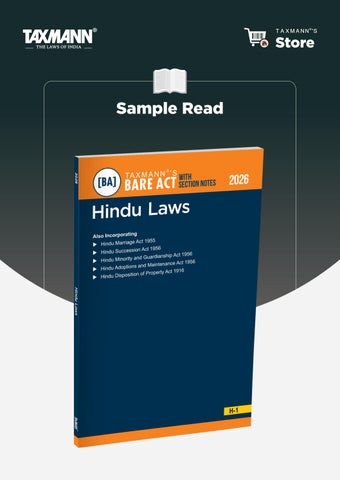
Hindu Laws – Bare Act with Section Notes AUTHOR : PUBLISHER : DATE OF PUBLICATION : EDITION : ISBN NO : No. of Pages : BINDING TYPE :
Taxmann’s Editorial Board Taxmann December 2025 2026 Edition 9789371260206 132 Paperback
Rs. 185 DESCRIPTION Hindu Laws [Bare Act with Section Notes] by Taxmann is a definitive, all-in-one legal compilation and annotated commentary that covers the principal statutes and provisions governing Hindu personal law in India. It provides the complete text of five key Acts, along with concise, section-wise notes that explain legislative intent, scope, and related judicial rulings. This book is intended for the following audience: • Legal Practitioners & Advocates • Judges & Judicial Officers • Academics, Researchers, & Students • NGOs & Social Welfare Organisations • Regulatory Authorities & Government Officials • Mediators & Counsellors The Present Publication is the 2026 Edition, covering the amended and updated text of the Hindu Laws, with the following noteworthy features: • [Complete Bare Act Texts] Incorporates all amendments up to date • [Section-wise Notes & Commentary] Legislative intent, cross-references, and judicial interpretations • [Pre/Post-Amendment Provisions] Enables comparison of the law before and after recent changes • [Detailed Schedules & Amendments] Class I & Class II heirs, coparcenary rights, and other important updates • [Practical Forms & Procedural Illustrations] Examples for marriage registration, guardianship petitions, etc. • [User-friendly Navigation] Subject index and table of contents for quick cross-referencing • [Judicial Interpretations & Case References] Significant case laws influencing Hindu law principles
Buy Now